Quote

Menu

Worldwide Shipping Wishlist Login / Register

Marine Spare Parts Blog & News

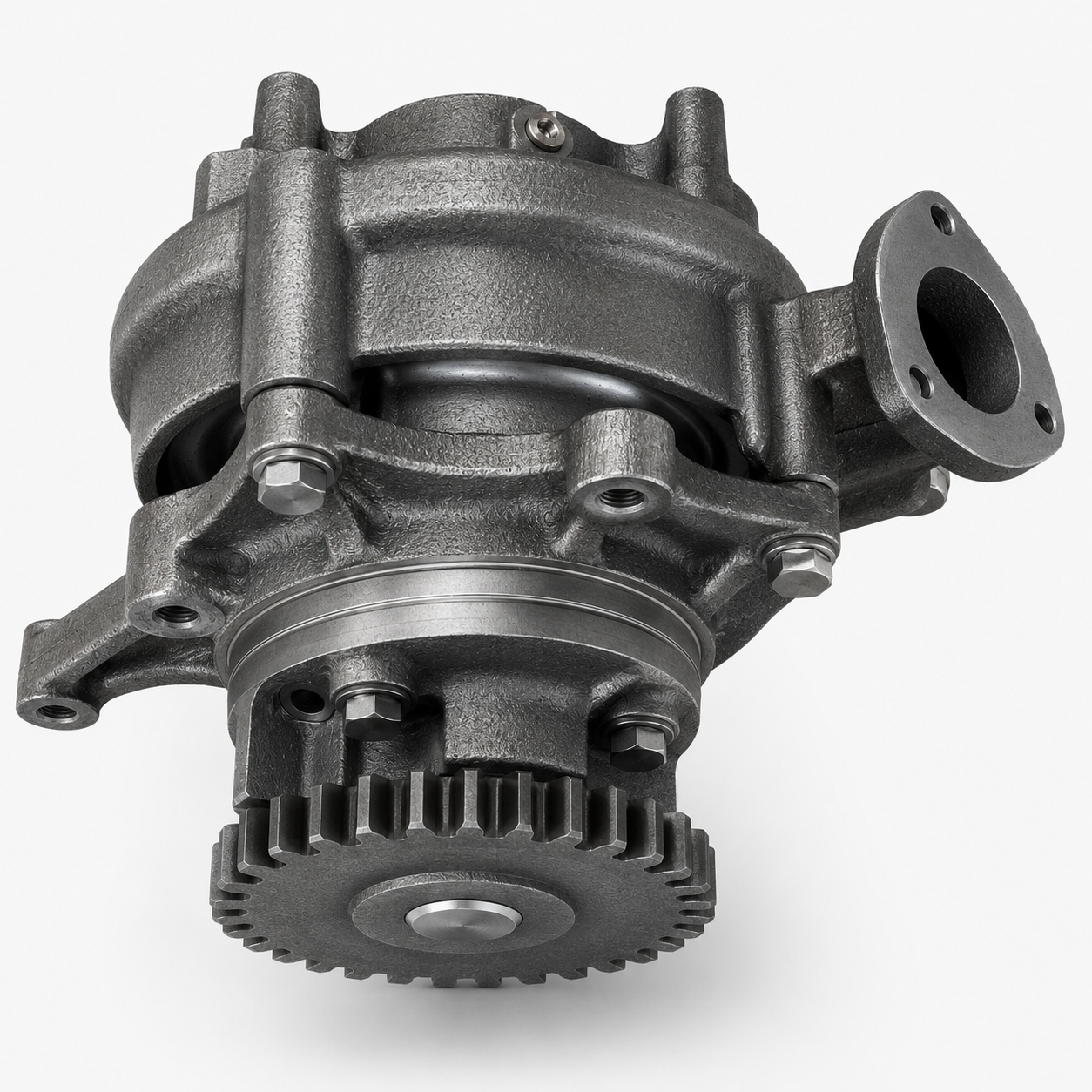
  • MTU 4000 Water Pumps: Part Numbers, Types & Marine Applications
  • 1. Water Pumps Used on MTU Series 4000 Engines
  • 2. MTU 4000 Water Pump X52620200081
  • 3. MTU 4000 Water Pump X52420300001
  • 4. MTU 16V4000 Seawater Pump X59420700008
  • 5. Common MTU Series 4000 Water Pump Components
  • 6. Signs an MTU 4000 Water Pump Needs Attention
  • 7. Why the MTU Engine Serial Number Matters
  • 8. MTU 4000 Water Pumps for Marine Maintenance
  • Request an MTU 4000 Water Pump Quote
  • Frequently Asked Questions
  • Are all MTU 4000 water pumps identical?
  • What is MTU part number X52620200081?
  • What is MTU part number X52420300001?
  • What application uses MTU part number X59420700008?
  • What information is required to order an MTU water pump?
Read more
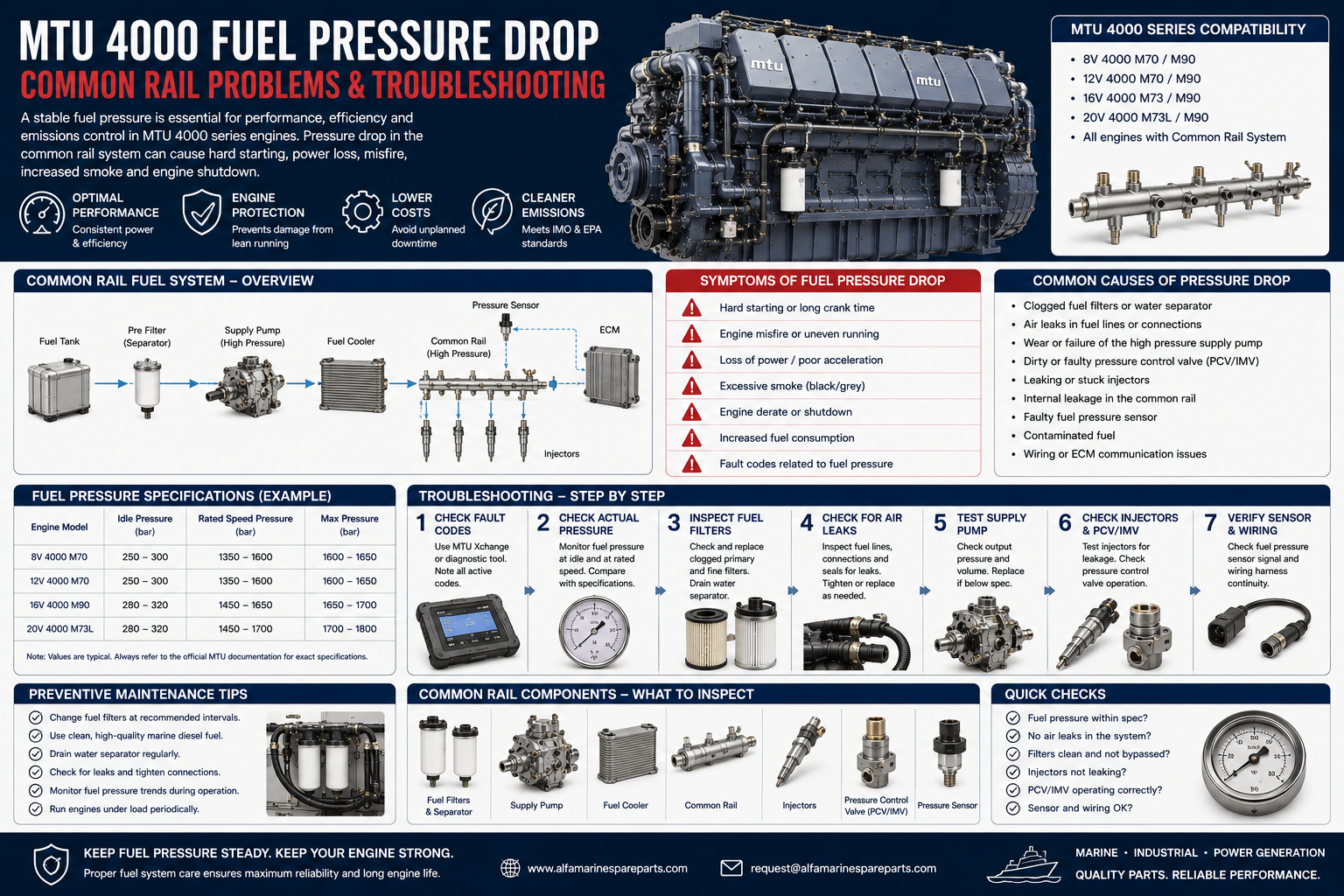
  • When tracking down an MTU 4000 fuel pressure drop, your engineering crew should always conduct an injector return-flow test before condemning the high-pressure fuel pump. By measuring the return volume of each cylinder's injector circuit, you can easily isolate whether a single failed injector is causing a cylinder imbalance, or if a whole bank of worn injectors is draining your rail pressure. Keep your fuel clean, change your final filters at the recommended intervals, and always use marine-grade sealing components to protect your common-rail network.
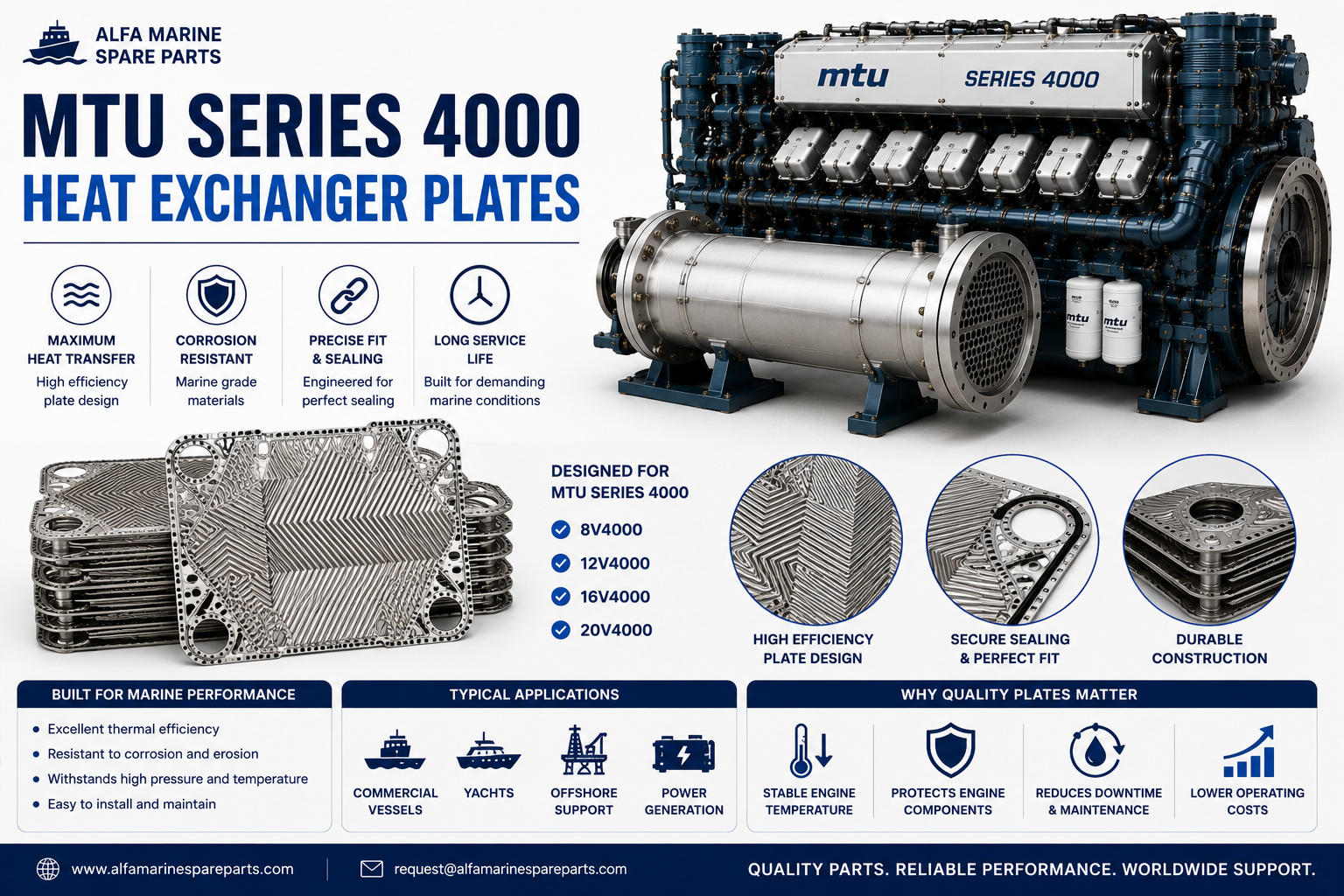
  • MTU Series 4000 Heat Exchanger Plates: Cooling Performance, Fouling, Leaks & Replacement Guide
  • 1. MTU Series 4000 Marine Engine Types
  • MTU 8V 4000
  • MTU 12V 4000
  • MTU 16V 4000
  • MTU 20V 4000
  • 2. What Is a Plate Heat Exchanger?
  • 3. Why Are the Plates So Thin?
  • 4. Why Heat Exchanger Plates Become Dirty
  • 5. The Engine May Not Overheat Immediately
  • 6. Fouled Plates Can Reduce Cooling Performance
  • 7. Flow Restriction Can Develop Too
  • 8. Situation: One MTU 4000 Runs Hotter Than the Other
  • 9. Seawater Fouling
  • 10. Oil on the Plates Is a Warning
  • 11. Rust and Corrosion Products
  • 12. Inspect the Plates When the Exchanger Is Open
  • 13. Pitting Deserves Attention
  • 14. What Happens if a Plate Develops a Hole?
  • 15. External Leak vs. Internal Plate Leak
  • External Leak
  • Internal Leak
  • 16. Pressure Testing Can Be Important
  • 17. Heat Exchanger Plates and Gaskets Work Together
  • 18. Inspect Plate Gaskets During Cleaning
  • 19. Plate Gasket Alignment Matters
  • 20. Do Not Mix Up the Plate Sequence
  • 21. Mark the Plate Pack Before Disassembly
  • 22. Do Not Damage Plates During Cleaning
  • 23. Be Careful With Mechanical Tools
  • 24. Chemical Cleaning Must Match the Deposit
  • 25. Plate Material Matters
  • 26. Why Replacement Plates Need Correct Identification
  • 27. Don't Order Plates From “MTU 4000” Alone
  • 28. Vessel Installation Matters
  • 29. MTU 8V 4000 Heat Exchanger Plates
  • 30. MTU 12V 4000 Heat Exchanger Plates
  • 31. MTU 16V 4000 Heat Exchanger Plates
  • 32. MTU 20V 4000 Heat Exchanger Plates
  • 33. When Should Heat Exchanger Plates Be Cleaned?
  • 34. Temperature Trends Are Useful
  • 35. Pressure Drop Can Tell You Something Too
  • 36. More Plates Do Not Automatically Mean Better
  • 37. Never Remove Plates Randomly Either
  • 38. Plate-Pack Compression Matters
  • 39. Inspect Tie Bolts and Frame Components
  • 40. What If Only One Plate Is Damaged?
  • 41. Why Plates Sometimes Fail After Cleaning
  • 42. Pressure Test After Major Service
  • 43. First Startup After Heat Exchanger Service
  • 44. Check Again After the Sea Trial
  • 45. Heat Exchanger Plate Inspection Checklist
  • 46. Heat Exchanger Plates vs. Heat Exchanger Gaskets
  • Heat Exchanger Plate
  • Plate Gasket
  • 47. Complete Plate Pack or Individual Plates?
  • Individual Replacement Plate
  • Plate & Gasket Set
  • Complete Plate Pack
  • Complete Heat Exchanger
  • 48. Don't Guess Heat Exchanger Plate Part Numbers
  • 49. What Information Should You Send When Ordering?
  • 50. Frequently Asked Questions
  • What Do MTU 4000 Heat Exchanger Plates Do?
  • Can Dirty Heat Exchanger Plates Cause an MTU 4000 to Run Hot?
  • Why Is My MTU 4000 Normal at Idle but Hot at Full Load?
  • Can Heat Exchanger Plates Corrode?
  • Can a Damaged Plate Mix Seawater and Coolant?
  • Should Plate Gaskets Be Inspected During Cleaning?
  • Can I Clean Heat Exchanger Plates With a Wire Brush?
  • Can I Remove a Damaged Plate and Continue Operating?
  • Does Every MTU Series 4000 Use the Same Heat Exchanger Plates?
  • What Information Is Best for Finding Replacement Plates?
  • MTU Series 4000 Heat Exchanger & Cooling Parts
  • Browse Our Complete Catalog
  • Contact Alfa Marine Spare Parts
  • Final Word
Read more
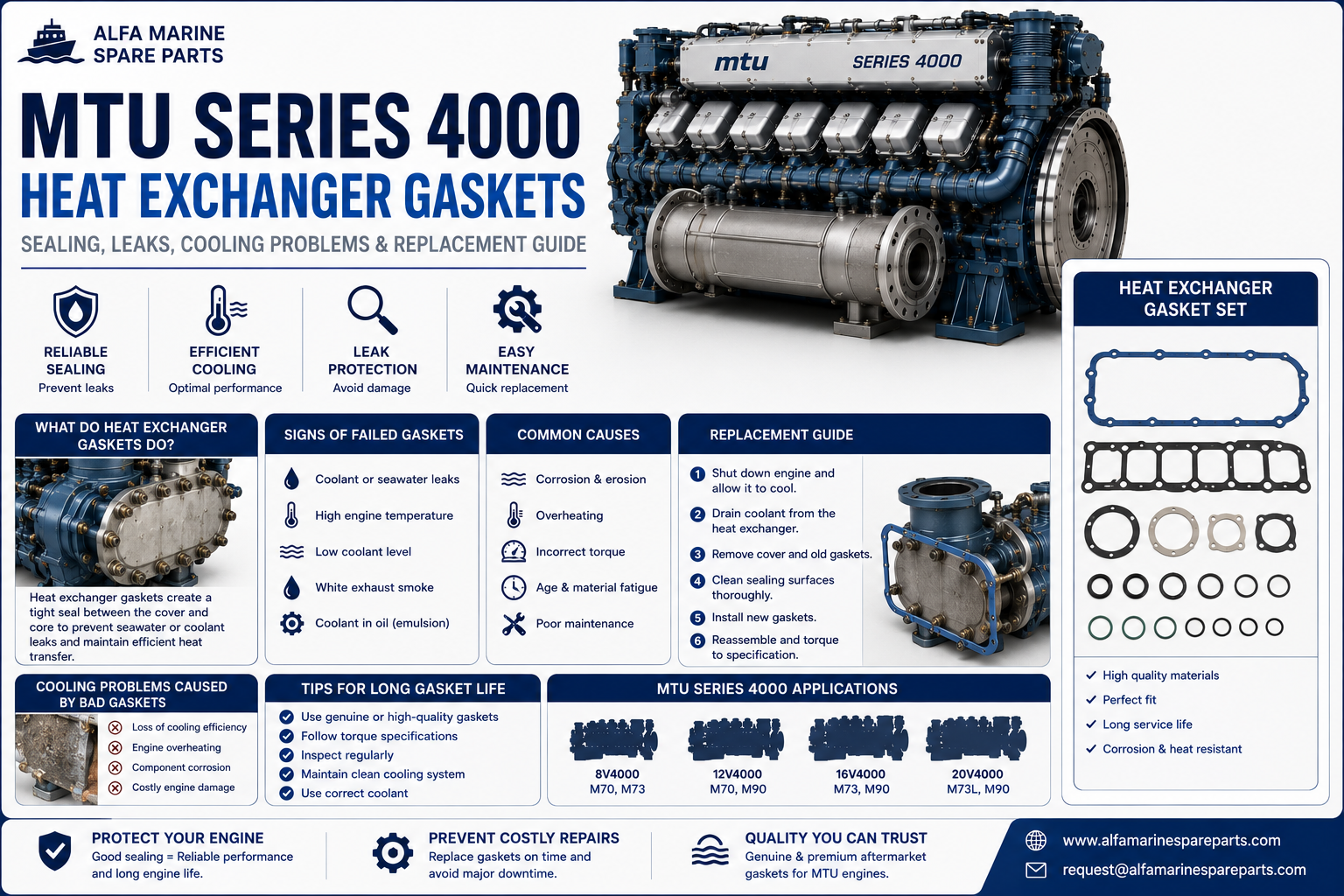
  • MTU Series 4000 Heat Exchanger Gaskets: Cooling Leaks, Seals & Replacement Guide
  • 1. MTU Series 4000 Marine Engine Types
  • MTU 8V 4000
  • MTU 12V 4000
  • MTU 16V 4000
  • MTU 20V 4000
  • 2. What Does the Heat Exchanger Actually Do?
  • 3. Why Are Heat Exchanger Gaskets Important?
  • 4. Where Are Gaskets and Seals Used?
  • 5. The First Sign May Be Very Small
  • 6. Coolant Around the Heat Exchanger
  • 7. White Salt Deposits Tell a Story
  • 8. Why Small Seawater Leaks Matter
  • 9. A Gasket Leak After Heat Exchanger Cleaning
  • 10. Should You Reuse an Old Heat Exchanger Gasket?
  • 11. Don't Forget the O-Rings
  • 12. Corrosion Under the Gasket
  • 13. The Sealing Surface Matters as Much as the Gasket
  • 14. Be Careful Removing Old Gasket Material
  • 15. More Sealant Is Not Always Better
  • 16. Over-Tightening Can Cause Another Leak
  • 17. Under-Tightening Can Cause Problems Too
  • 18. The Old Gasket Can Help Diagnose the Failure
  • 19. Coolant Level Keeps Dropping but You Cannot Find the Leak
  • 20. Heat Exchanger Gasket Failure vs. Heat Exchanger Fouling
  • Gasket or Seal Failure
  • Heat Exchanger Fouling
  • 21. Situation: Engine Runs Hotter After Heat Exchanger Service
  • 22. One Twin Engine Runs Hotter
  • 23. MTU 4000 Cooling Systems Are More Than One Cooler
  • 24. Heat Exchanger Gaskets on MTU 8V 4000 Engines
  • 25. Heat Exchanger Gaskets on MTU 12V 4000 Engines
  • 26. Heat Exchanger Gaskets on MTU 16V 4000 Engines
  • 27. Heat Exchanger Gaskets on MTU 20V 4000 Engines
  • 28. Should You Replace All Seals When the Exchanger Is Open?
  • 29. Pressure Testing After Repair
  • 30. When Is the Heat Exchanger Itself the Problem?
  • 31. Rebuild or Replace the Heat Exchanger?
  • 32. Common MTU 4000 Heat Exchanger Sealing Parts
  • 33. Why Part Numbers Matter
  • 34. Do Not Guess MTU Heat Exchanger Gasket Part Numbers
  • 35. What Information Should Be Used to Identify the Gasket?
  • 36. Photograph the Heat Exchanger Identification
  • 37. Common Signs of MTU 4000 Heat Exchanger Gasket Problems
  • 38. Heat Exchanger Gasket Replacement Checklist
  • 39. First Startup After Heat Exchanger Work
  • 40. Check Again After the Sea Trial
  • 41. Keep a Cooling-System Maintenance History
  • 42. Frequently Asked Questions
  • What Does an MTU 4000 Heat Exchanger Gasket Do?
  • Can a Bad Heat Exchanger Gasket Cause Overheating?
  • Why Is There White Salt Around My Heat Exchanger?
  • Why Does My Heat Exchanger Leak After Cleaning?
  • Can I Just Tighten the Cover Bolts?
  • Should Old Heat Exchanger Gaskets Be Reused?
  • Can a New Gasket Fix a Corroded Flange?
  • Does Every MTU 4000 Use the Same Heat Exchanger Gasket?
  • What Information Should I Provide When Ordering?
  • MTU Series 4000 Heat Exchanger & Cooling Parts
  • Browse Our Complete Catalog
  • Contact Alfa Marine Spare Parts
  • Final Word
Read more
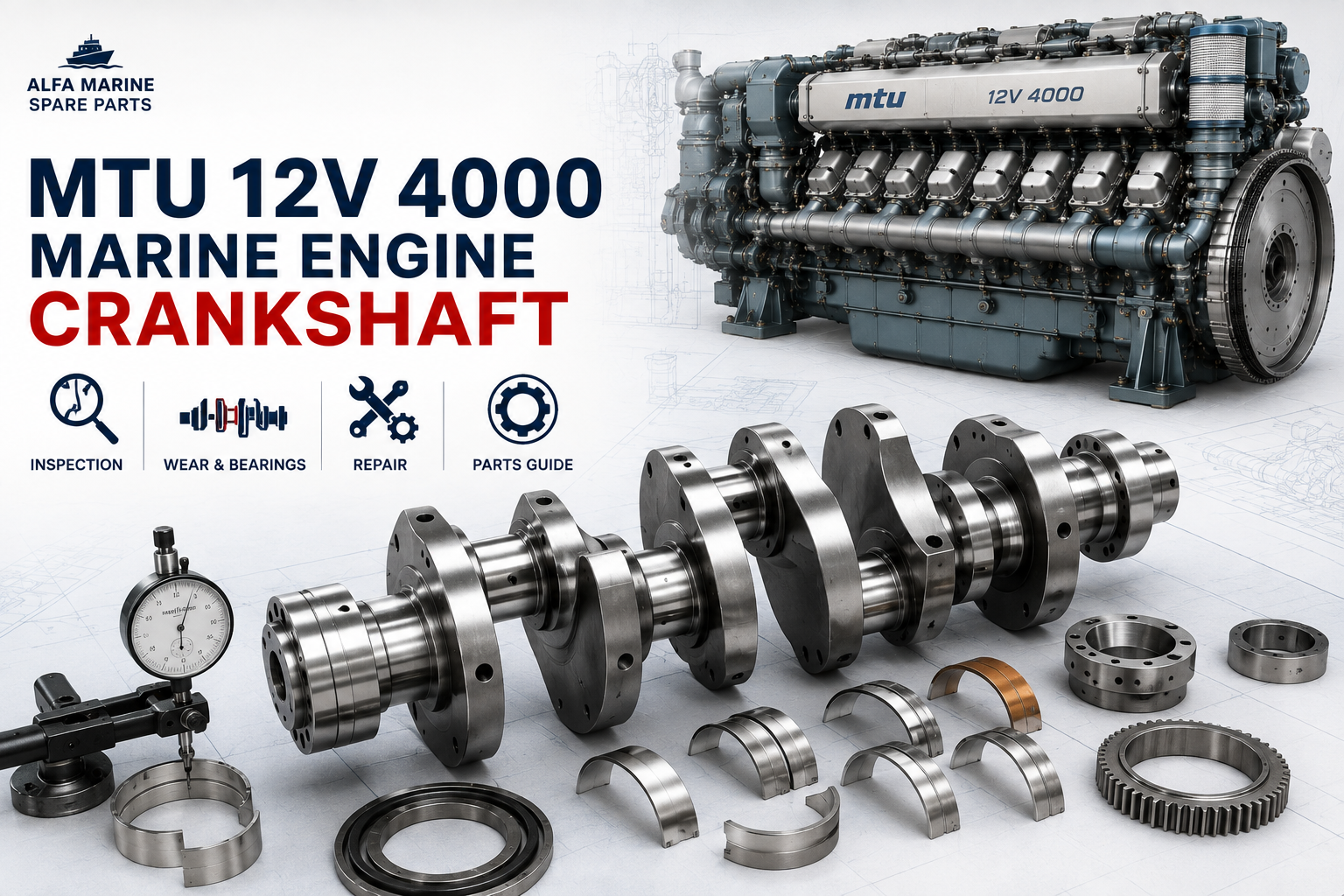
  • MTU 12V 4000 Marine Engine Crankshaft: Inspection, Wear, Bearings, Repair & Parts Guide
  • 1. MTU 12V 4000 Marine Engine Types
  • 2. What Does the MTU 12V 4000 Crankshaft Do?
  • 3. Main Journals and Connecting-Rod Journals
  • Main Journals
  • Connecting-Rod Journals
  • 4. Why Crankshaft Lubrication Is So Important
  • 5. Situation: MTU 12V 4000 Oil Pressure Begins Falling
  • 6. Watch the Oil Pressure Trend
  • 7. Metallic Material in the Oil Filter
  • 8. Do Not Throw Away Damaged Bearings Before Looking at Them
  • 9. What Causes Crankshaft Journal Scoring?
  • 10. Oil Starvation Can Damage the Crankshaft Quickly
  • 11. High Oil Temperature Matters
  • 12. Fuel Dilution Can Damage Bearing Protection
  • 13. Coolant Contamination Is Also Serious
  • 14. Crankshaft Inspection During Overhaul
  • 15. Do Not Judge the Crankshaft Only by Appearance
  • 16. Measuring the Main Journals
  • 17. Measuring Connecting-Rod Journals
  • 18. Why Taper Matters
  • 19. Why Ovality Matters
  • 20. Crankshaft Fillet Areas
  • 21. Internal Crankshaft Oil Passages
  • 22. Clean the Complete Lubrication System After Bearing Failure
  • 23. Main Bearing Wear Patterns
  • 24. Connecting-Rod Bearings
  • 25. Connecting-Rod Condition
  • 26. One Bad Journal vs. General Crankshaft Wear
  • General Wear Across Many Journals
  • One Severely Damaged Journal
  • 27. Cylinder Problems Can Affect Crankshaft Loading
  • 28. Injector Inspection During Crankshaft Repair
  • 29. Can an MTU 12V 4000 Crankshaft Be Polished?
  • 30. Can an MTU 12V 4000 Crankshaft Be Ground?
  • 31. Polishing and Grinding Are Not the Same
  • Polishing
  • Grinding
  • 32. When Is Crankshaft Replacement More Appropriate?
  • 33. Heat Discoloration
  • 34. Crack Inspection
  • 35. Crankshaft Straightness
  • 36. Correct Crankshaft Handling
  • 37. Crankshaft Storage
  • 38. Main Bearing Selection
  • 39. Connecting-Rod Bearing Selection
  • 40. Crankshaft Thrust Components
  • 41. Oil Pump Inspection
  • 42. Oil Cooler Inspection
  • 43. Torsional Vibration
  • 44. Flywheel and Coupling Inspection
  • 45. Marine Gear and Shaft Alignment
  • 46. Propeller Overload
  • 47. First Startup After Crankshaft Work
  • 48. Do Not Immediately Apply Full Load
  • 49. Sea Trial
  • 50. Keep the Crankshaft Measurements
  • 51. New, Used and Reconditioned MTU 4000 Crankshafts
  • New Crankshaft
  • Used Crankshaft
  • Reconditioned Crankshaft
  • 52. MTU 12V 4000 Crankshaft Part Number
  • Important Parts Identification Note
  • 53. Why I Would Not Publish an Unverified Crankshaft Number
  • 54. Common MTU 12V 4000 Crankshaft-Related Parts
  • 55. Crankshaft Seals
  • 56. Information to Send When Ordering an MTU 12V 4000 Crankshaft
  • 57. Frequently Asked Questions
  • How Many Cylinders Does the MTU 12V 4000 Have?
  • What Is the Approximate Displacement?
  • What Causes MTU 4000 Crankshaft Damage?
  • Does Low Oil Pressure Mean the Crankshaft Is Bad?
  • Can an MTU 12V 4000 Crankshaft Be Reconditioned?
  • Can I Reuse the Crankshaft With New Bearings?
  • Should I Order Bearings Before Measuring the Crankshaft?
  • Should the Oil Cooler Be Checked After Bearing Failure?
  • Is There One MTU 12V 4000 Crankshaft Part Number?
  • What Information Is Needed to Order the Correct Crankshaft?
  • MTU 12V 4000 Marine Engine Types
  • MTU 12V 4000 Crankshaft & Overhaul Spare Parts
  • Browse Our Complete Catalog
  • Contact Alfa Marine Spare Parts
  • Final Word
  • Meta Title
  • Meta Description
Read more
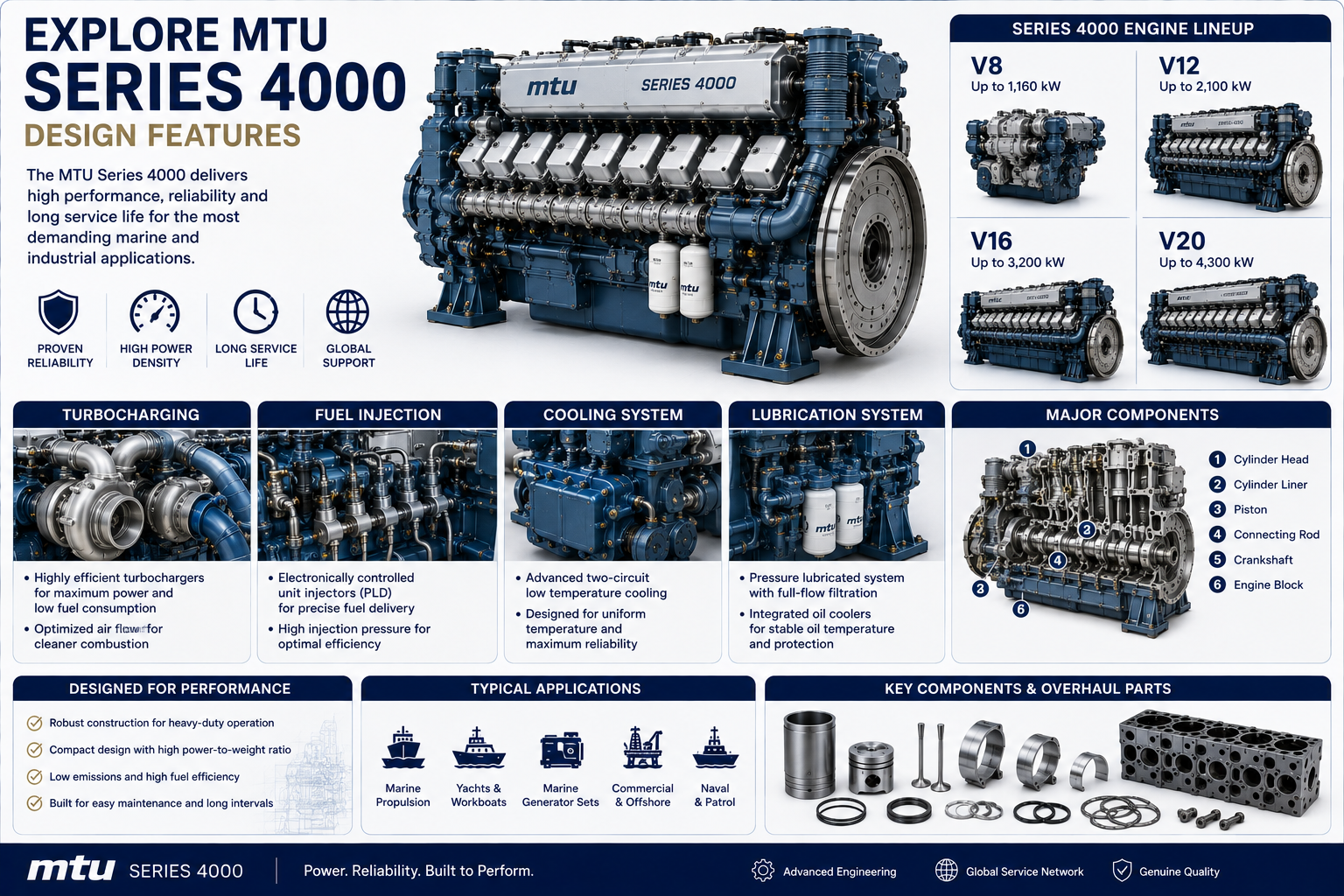
  • Key Design Features of the MTU Series 4000 Marine Engine Family
  • 1. V-Engine Architecture
  • 2. Four-Stroke Diesel Design
  • 3. Large-Displacement Engine Platform
  • 4. Strong Crankcase Construction
  • 5. Heavy-Duty Crankshaft
  • 6. Individual Cylinder Construction
  • 7. Replaceable Cylinder Liners
  • 8. High-Strength Pistons
  • 9. Piston Cooling
  • 10. Connecting-Rod Design
  • 11. Individual Cylinder Heads
  • 12. Four-Valve Cylinder Head Concept
  • 13. Turbocharging
  • 14. Why Turbocharger Condition Matters
  • 15. Charge-Air Cooling
  • 16. Why Charge-Air Cooler Condition Is Important
  • 17. Electronic Fuel Injection
  • 18. Common-Rail Technology in Later Series 4000 Generations
  • 19. High-Pressure Fuel System
  • 20. Electronically Controlled Injectors
  • 21. Electronic Engine Management
  • 22. Sensor-Based Monitoring
  • 23. Cooling-System Architecture
  • 24. Freshwater and Seawater Circuits
  • Freshwater / Engine-Coolant Side
  • Seawater Side
  • 25. Heat Exchangers
  • 26. Seawater Pumps
  • 27. Lubrication System
  • 28. Oil Cooling
  • 29. Full-Flow Oil Filtration
  • 30. Modular Engine-Family Concept
  • 31. Different Marine Ratings
  • 32. High Power Density
  • 33. Compact Installation
  • 34. Power-to-Weight Considerations
  • 35. V8 4000 Configuration
  • 36. 12V 4000 Configuration
  • 37. 16V 4000 Configuration
  • 38. 20V 4000 Configuration
  • 39. M53-Type Applications
  • 40. M73-Type Applications
  • 41. M93-Type Applications
  • 42. Starting System
  • 43. Alternator and Charging System
  • 44. Exhaust-System Design
  • 45. Engine Monitoring Helps Prevent Expensive Damage
  • 46. Condition Trending
  • 47. Serviceability
  • 48. Why the Serial Number Matters
  • 49. Important MTU Series 4000 Spare Parts
  • Internal Engine Parts
  • Fuel-System Parts
  • Air & Exhaust Parts
  • Cooling Parts
  • Lubrication Parts
  • Electrical Parts
  • 50. Frequently Asked Questions
  • What Cylinder Configurations Are Available in the MTU Series 4000 Family?
  • Are All MTU 4000 Engines the Same?
  • Are MTU Series 4000 Engines Turbocharged?
  • Why Is Charge-Air Cooling Important?
  • Do Series 4000 Engines Use Electronic Fuel Injection?
  • Are Parts Interchangeable Between 12V, 16V and 20V 4000 Engines?
  • What Information Should Be Used When Ordering Parts?
  • Browse Our Complete Catalog
  • Contact Alfa Marine Spare Parts
  • Final Word
Read more