Mitsubishi Marine Engine Aftermarket Parts: S4S, S6S, 6D16, S6R, S12R & S16R Replacement Parts Guide
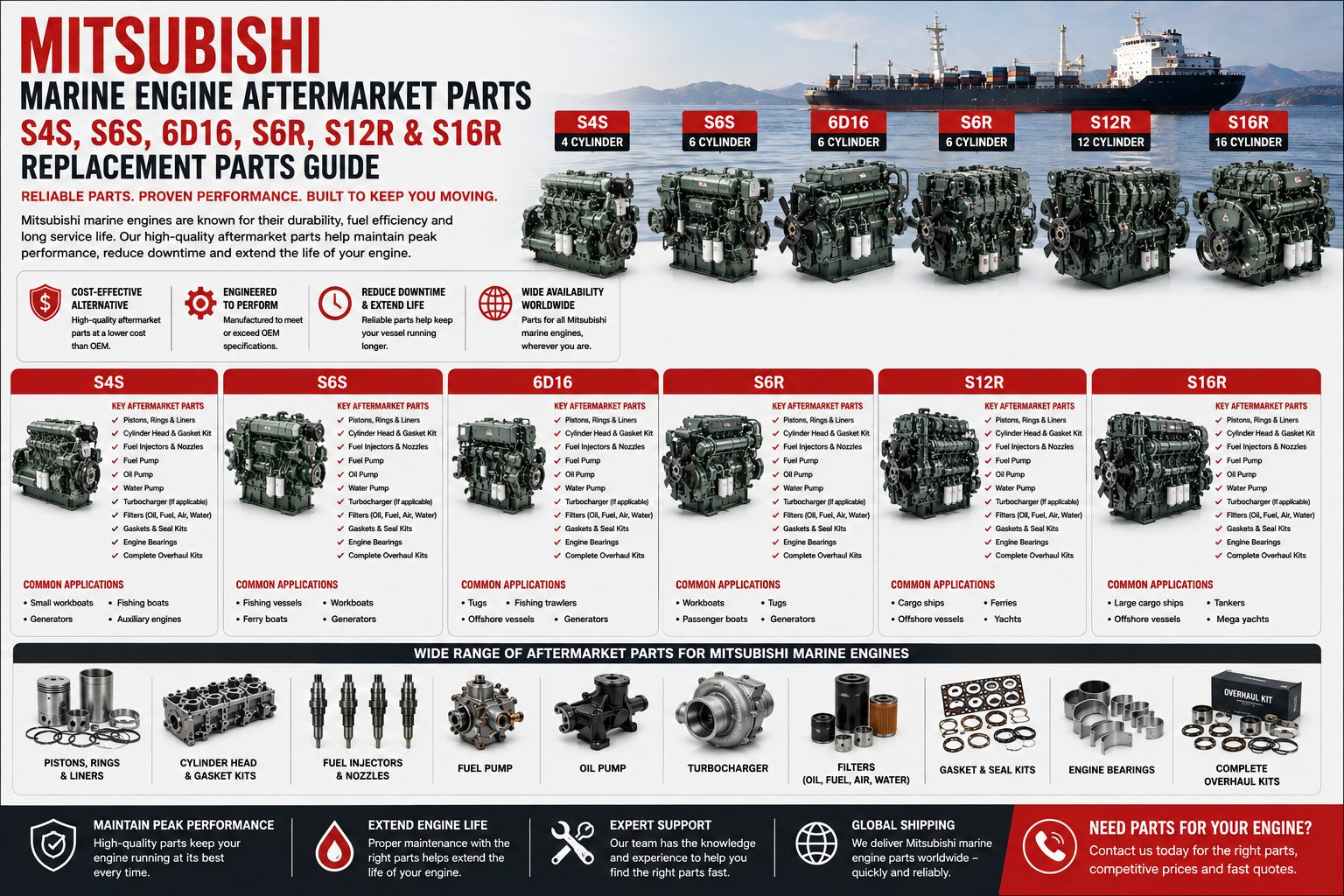
The Mitsubishi marine engine range covers everything from compact auxiliary and generator engines to large commercial propulsion engines used in fishing vessels, workboats, ferries, tugs, and other heavy marine applications.
Common Mitsubishi marine engine families include:
- Mitsubishi S4S
- Mitsubishi S6S
- Mitsubishi 6D16
- Mitsubishi 6D24
- Mitsubishi S6R
- Mitsubishi S6R2
- Mitsubishi S12R
- Mitsubishi S16R
As these engines accumulate operating hours, owners and engineers eventually face the same question:
Should we use genuine parts, OEM-quality parts, aftermarket replacements, remanufactured parts, or reconditioned components?
There is no single answer for every component.
For routine maintenance items such as filters, belts, certain gaskets, and external pumps, a good-quality aftermarket part can often be a sensible choice.
For critical internal parts such as:
injectors, injection pumps, pistons, liners, bearings, cylinder heads, connecting rods, and crankshaft components
quality and exact specification matter much more.
The goal should not be:
“Find the cheapest Mitsubishi marine engine parts.”
A better approach is:
“Find the correct replacement part for the exact Mitsubishi engine model, serial number, and duty.”
1. Which Mitsubishi Marine Engines Does This Guide Cover?
This guide focuses on commonly encountered Mitsubishi marine and marine-related diesel families including:
Mitsubishi S4S
Compact four-cylinder diesel used in auxiliary, generator, and light commercial applications.
Mitsubishi S6S
Six-cylinder development of the same general small-engine family.
Mitsubishi 6D16
Medium-size inline six used in marine, industrial, and commercial applications.
Mitsubishi 6D24
Larger six-cylinder engine used in heavier commercial service.
Mitsubishi S6R
Large inline-six engine widely used in commercial marine and generator applications.
Mitsubishi S6R2
Larger-displacement development of the S6R family.
Mitsubishi S12R
Large V12 diesel used for propulsion and high-output generating duty.
Mitsubishi S16R
Large V16 platform for demanding marine and power applications.
These engines can appear in:
- Fishing vessels
- Workboats
- Tugboats
- Passenger vessels
- Ferries
- Cargo vessels
- Marine generators
- Auxiliary installations
- Government and patrol craft
2. Mitsubishi S4S Aftermarket Parts
The Mitsubishi S4S is one of the smaller engines in the range.
It is commonly encountered in generator sets and compact commercial applications.
Typical aftermarket requirements may include:
- Oil filters
- Fuel filters
- Air filters
- Water pumps
- Thermostats
- Injectors
- Injection-pump components
- Gaskets
- Seals
- Pistons
- Piston rings
- Main bearings
- Connecting-rod bearings
- Cylinder-head components
Because the S4S is relatively simple compared with larger electronic engines, the aftermarket can be practical for many routine components.
But internal engine parts should still be matched carefully.
3. Mitsubishi S6S Aftermarket Parts
The Mitsubishi S6S is the six-cylinder member of the same general compact engine family.
It can be found in:
- Marine generator sets
- Auxiliary machinery
- Small commercial vessels
- Industrial installations
Common parts include:
- Fuel injectors
- Fuel injection pumps
- Water pumps
- Oil pumps
- Filters
- Pistons
- Rings
- Bearings
- Gasket sets
- Valves
- Cylinder-head components
Do not assume S4S and S6S parts are universally interchangeable simply because the engines share family architecture.
The cylinder count alone changes many major assemblies.
4. Mitsubishi 6D16 Aftermarket Parts
The Mitsubishi 6D16 is a well-known inline-six engine family used across marine, industrial, and commercial applications.
Typical service parts can include:
- Injectors
- Injection pumps
- Turbochargers
- Water pumps
- Oil pumps
- Pistons
- Piston rings
- Cylinder liners
- Bearings
- Cylinder heads
- Gaskets
- Thermostats
The 6D16 exists in different ratings and versions.
That means a request such as:
“Need Mitsubishi 6D16 injector.”
may still be too broad.
A better inquiry includes:
Engine Model: 6D16-________
Serial Number: __________
Current Part Number: __________
Rated Power: __________
Quantity: __________
5. Mitsubishi 6D24 Aftermarket Parts
The Mitsubishi 6D24 belongs to a heavier commercial class.
Depending on configuration, aftermarket parts requirements can include:
- Cylinder heads
- Fuel injection equipment
- Turbochargers
- Pistons
- Liners
- Rings
- Connecting rods
- Main bearings
- Rod bearings
- Water pumps
- Oil pumps
- Gasket sets
Because these engines may work long hours in commercial applications, part quality becomes especially important.
A lower-priced bearing or piston is not good value if it shortens overhaul life.
6. Mitsubishi S6R Marine Engine Aftermarket Parts
The Mitsubishi S6R is one of the most important large commercial engine families.
It is commonly associated with:
- Fishing vessels
- Workboats
- Marine generator sets
- Passenger craft
- Commercial propulsion
Typical replacement parts may include:
- Cylinder heads
- Fuel injectors
- Injection pumps
- Turbochargers
- Freshwater pumps
- Seawater-related cooling components depending on installation
- Oil pumps
- Pistons
- Rings
- Liners
- Connecting rods
- Bearings
- Gaskets
- Valves
The S6R is large enough that an overhaul should be planned as a complete job rather than a series of emergency parts purchases.
7. Mitsubishi S6R2 Aftermarket Parts
The S6R2 is a larger-displacement development of the S6R architecture.
It is often used where more output is needed from an inline-six configuration.
Common aftermarket components include:
- Pistons
- Piston rings
- Cylinder liners
- Cylinder heads
- Bearings
- Connecting rods
- Injectors
- Injection pumps
- Turbochargers
- Oil pumps
- Water pumps
- Gasket sets
Do not assume an S6R component fits an S6R2.
The engines are related, but displacement and component specifications differ.
8. Mitsubishi S12R Aftermarket Parts
The Mitsubishi S12R moves into V12 territory.
This means major overhaul quantities increase quickly.
A full engine rebuild can involve:
- 12 pistons
- 12 liner positions
- 12 injector positions
- Multiple cylinder-head components
- Main bearings
- Connecting-rod bearings
- Many gaskets and seals
- Turbocharger components
- Fuel-system components
- Cooling-system components
This is where good parts planning becomes essential.
For a large V12, missing a relatively inexpensive O-ring or seal can delay an engine rebuild just as effectively as missing a piston.
9. Mitsubishi S16R Aftermarket Parts
The Mitsubishi S16R is one of the largest commonly encountered Mitsubishi high-speed diesel families.
It uses a V16 configuration and can appear in:
- Large marine generator sets
- Commercial vessels
- Heavy-duty propulsion
- Power-generation installations
A major overhaul may require:
- Pistons
- Rings
- Liners
- Cylinder-head components
- Injectors
- Injection pumps
- Main bearings
- Rod bearings
- Connecting rods
- Oil pumps
- Water pumps
- Gasket sets
- Turbocharger components
At this scale, part quality and correct identification become even more important.
10. Mitsubishi Aftermarket Cylinder Heads
Cylinder heads are among the most important major components in any diesel overhaul.
Replacement may be required because of:
- Cracks
- Valve-seat damage
- Corrosion
- Warping
- Overheating
- Injector-bore damage
- Excessive previous machining
Aftermarket cylinder heads may be available for various Mitsubishi families.
Before buying, consider:
- Casting quality
- Machining accuracy
- Valve-seat quality
- Injector bore dimensions
- Cooling passages
- Sealing surface finish
A cylinder head that looks correct in a photograph is not necessarily dimensionally correct.
11. Rebuild or Replace a Mitsubishi Cylinder Head?
A used cylinder head may still be serviceable.
A qualified workshop can inspect:
- Cracks
- Pressure integrity
- Surface flatness
- Valve guides
- Valve seats
- Valve condition
- Injector bore condition
Replacement becomes more attractive when there is:
- Severe cracking
- Heavy corrosion
- Structural damage
- Excessive previous machining
- Major seat damage
The decision should be based on actual condition.
12. Mitsubishi Marine Overhaul Kits
A complete overhaul kit may include:
- Pistons
- Piston rings
- Cylinder liners
- Main bearings
- Connecting-rod bearings
- Thrust bearings
- Gasket set
- Oil seals
- O-rings
- Valve components
Depending on scope, you may also need:
- Injectors
- Injection-pump components
- Turbocharger parts
- Oil pump
- Water pump
The value of a good overhaul kit is not simply having many parts in one box.
It is having the correct combination of parts for the exact engine.
13. Mitsubishi Part Numbers: Always Verify Before Ordering
Mitsubishi marine engines can exist in multiple:
- Power ratings
- Production generations
- Fuel-system configurations
- Cooling arrangements
- Applications
That means a part number found in an old list should not automatically be treated as universal.
Before ordering:
Engine Family: S6R / S12R / etc.
Complete Model: __________
Serial Number: __________
Current Part Number: __________
Application: Propulsion / Generator / Auxiliary
Rated Power: __________
Rated RPM: __________
This is especially important for major parts.
14. Example Mitsubishi Part Number Practice
For Mitsubishi engines, part numbers can vary significantly between engine families and revisions.
Instead of building an order around a generic online number, use the number physically removed from the engine whenever possible.
If the existing component shows a clear stamped or cast number:
- Photograph it
- Record it
- Compare it with the engine identification
- Verify supersession where applicable
This is safer than buying a component because a listing says:
“Fits Mitsubishi S6R.”
15. Aftermarket Mitsubishi Fuel Injectors
Mechanical Mitsubishi engines commonly use traditional diesel injection equipment.
Injector wear can contribute to:
- Difficult starting
- Excessive smoke
- Uneven running
- Poor fuel consumption
- Reduced power
- Abnormal exhaust temperature
But smoke does not prove an injector has failed.
Other causes can include:
- Poor compression
- Incorrect injection timing
- Air restriction
- Turbocharger problems
- Engine overload
Test injectors where possible before replacing them.
16. New vs. Reconditioned Mitsubishi Injectors
You may encounter:
- New genuine
- OEM-quality
- New aftermarket
- Professionally reconditioned
A properly reconditioned injector should be more than a cleaned component.
Ask whether it has been:
- Disassembled
- Inspected
- Rebuilt
- Calibrated
- Tested
A fresh coat of paint is not a test report.
17. Mitsubishi Injection Pumps
Many Mitsubishi marine engines use mechanical injection pumps.
These pumps depend on precise:
- Timing
- Fuel delivery
- Governor operation
- Internal clearances
A worn or incorrectly adjusted injection pump can affect:
- Engine speed
- Power
- Smoke
- Starting
- Fuel consumption
Before replacing the pump, also check:
- Fuel supply
- Filters
- Feed pump
- Air leaks
- Tank condition
A restricted fuel supply can make a good injection pump look bad.
18. Fuel Feed Pumps
The feed pump has a simpler but essential role.
It has to move fuel from the supply side toward the injection equipment.
Possible symptoms of poor feed-pump performance include:
- Loss of prime
- Hard starting
- Power loss under load
- Engine shutdown
- Fuel starvation
But similar symptoms can also come from a blocked filter or air leak.
Diagnosis matters.
19. Fuel Filters
Filters protect the injection equipment.
A good aftermarket fuel filter should match:
- Flow capacity
- Micron rating
- Seal dimensions
- Pressure characteristics
- Connection type
A filter that physically fits may still be wrong internally.
Inspect removed filters for:
- Water
- Rust
- Sludge
- Black contamination
- Other debris
The filter can tell you a lot about tank condition.
20. Aftermarket Mitsubishi Turbochargers
Turbochargers are common on higher-output Mitsubishi engines such as S6R, S6R2, S12R, and S16R variants.
A worn turbocharger can contribute to:
- Reduced boost
- Black smoke
- Higher exhaust temperature
- Poor acceleration
- Reduced engine output
When sourcing an aftermarket turbo, verify:
- Engine model
- Rated power
- Turbocharger number
- Compressor specification
- Turbine housing
- Oil connections
- Exhaust arrangement
Do not match turbochargers by appearance alone.
21. Rebuilding a Mitsubishi Turbocharger
A professional turbo rebuild should include inspection of:
- Shaft
- Bearings
- Compressor wheel
- Turbine wheel
- Seals
- Housing
- Clearances
- Rotational balance
A turbocharger operates at very high rotational speed.
Poor rebuilding can create major damage.
22. Freshwater Pumps
The freshwater circulation pump moves coolant through the closed engine circuit.
Possible problems include:
- Seal leakage
- Bearing wear
- Shaft wear
- Impeller damage
- Corrosion
If engine temperature rises, also inspect:
- Thermostat
- Heat exchanger
- Coolant quality
- Cooling passages
- Raw-water side where applicable
Cooling-system diagnosis should not stop at the pump.
23. Seawater Pumps on Mitsubishi Marine Engines
Marine versions can use dedicated raw-water pumps depending on the marinization package.
These pumps can suffer from:
- Corrosion
- Seal leakage
- Bearing wear
- Impeller damage
- Shaft wear
Reduced seawater flow can affect:
- Heat exchanger
- Oil cooler
- Charge-air cooler
- Exhaust cooling
A small raw-water problem can therefore become a large engine problem.
24. Heat Exchangers
A heat exchanger can gradually lose efficiency because of:
- Scale
- Marine deposits
- Corrosion
- Restricted tubes
- Internal leakage
A useful maintenance question is:
“Is the engine running hotter than it used to under the same load?”
Trend changes can appear before an actual overheating alarm.
25. Aftermarket Oil Pumps
Oil pumps protect:
- Main bearings
- Rod bearings
- Camshaft components
- Turbocharger
- Other lubricated surfaces
If oil pressure is low, do not immediately blame the pump.
Also consider:
- Oil level
- Oil viscosity
- Oil temperature
- Bearing clearances
- Pressure-control components
- Gauge/sensor accuracy
Replacing the pump without identifying the cause may not solve the problem.
26. Mitsubishi Pistons
Piston design is engine-specific.
Before ordering, verify:
- Diameter
- Bowl shape
- Compression height
- Pin size
- Ring grooves
- Engine rating
The piston crown forms part of the combustion chamber.
A physically similar piston can still be wrong.
27. Mitsubishi Piston Rings
Piston rings control:
- Compression
- Blow-by
- Oil consumption
Before fitting new rings, inspect the liner.
New rings installed into a badly worn liner may not restore proper sealing.
Treat:
piston + rings + liner
as one system.
28. Mitsubishi Cylinder Liners
During overhaul, inspect liners for:
- Scoring
- Polishing
- Wear
- Corrosion
- Cavitation
- Abnormal running pattern
On applicable wet-liner designs, liner sealing areas deserve particular attention.
A cheap liner is not a bargain if:
- Bore geometry is wrong
- Material is poor
- Surface finish is incorrect
29. Main Bearings and Connecting-Rod Bearings
Good-quality aftermarket bearings can be suitable when specification is correct.
Before assembly, measure:
- Crankshaft journal diameter
- Journal condition
- Bearing clearance
- Required bearing size
Inspect removed bearings for:
- Scoring
- Heat damage
- Embedded contamination
- Uneven wear
- Copper exposure
Old bearings can help explain why the engine needed overhaul.
30. Mitsubishi Connecting Rods
Connecting rods should be inspected for:
- Cracks
- Distortion
- Big-end condition
- Small-end wear
- Fastener condition
- Bearing-seat damage
If buying aftermarket, verify:
- Material quality
- Dimensions
- Weight consistency
- Machining
A connecting rod failure can destroy an engine.
This is not a component where price should come first.
31. Mitsubishi Crankshafts
A crankshaft is one of the highest-risk aftermarket components.
Before replacement, determine whether the existing crankshaft can be:
- Measured
- Inspected
- Polished
- Reconditioned within allowable limits
If using an aftermarket crankshaft, evaluate:
- Material
- Journal dimensions
- Heat treatment
- Surface finish
- Balance
- Manufacturing quality
A poor crankshaft can cause catastrophic failure.
32. Full Mitsubishi Gasket Sets
A complete gasket set may contain:
- Cylinder-head gaskets
- Rocker-cover gaskets
- Intake gaskets
- Exhaust gaskets
- Oil-pan gaskets
- Front seals
- Rear seals
- Pump gaskets
- O-rings
- Other sealing components
For large engines such as S12R and S16R, there can be many sealing positions.
One missing O-ring can stop reassembly.
Plan the full job before opening the engine.
33. Mitsubishi Thermostats
Thermostats help regulate engine operating temperature.
A thermostat stuck closed can contribute to overheating.
A thermostat stuck open can keep the engine too cool.
Always use the correct:
- Opening temperature
- Physical size
- Flow characteristic
A thermostat that fits in the housing is not automatically correct.
34. Mitsubishi Starters
When ordering an aftermarket starter, confirm:
- Voltage
- Power rating
- Tooth count
- Rotation
- Mounting
- Solenoid position
- Electrical connections
Marine and generator applications may differ.
35. Mitsubishi Alternators
Alternator selection should consider:
- Voltage
- Amperage
- Pulley
- Mounting
- Belt arrangement
- Connector layout
Marine installations can have high electrical demands, particularly on passenger and commercial vessels.
Do not increase alternator output without checking the drive system.
36. Which Mitsubishi Aftermarket Parts Are Lower Risk?
Routine service parts can often be sourced successfully from the aftermarket, including:
- Filters
- Belts
- Hoses
- Simple gaskets
- O-rings
- Thermostats
- Some external pumps
Critical parts deserve more scrutiny:
- Injectors
- Injection pumps
- Turbochargers
- Cylinder heads
- Pistons
- Liners
- Bearings
- Connecting rods
- Crankshafts
The greater the potential engine damage, the more important quality becomes.
37. When Should You Prefer Genuine or OEM-Quality Parts?
Genuine or OEM-quality parts may be preferable when:
- The engine works many annual hours
- Failure could stop a commercial vessel
- Component tolerances are critical
- Parts quality cannot be verified
- The price difference is small relative to downtime
- Long overhaul life is the priority
Aftermarket should be treated as a quality option, not simply a cheap option.
38. Best Mitsubishi Marine Spares to Keep Onboard
Depending on vessel and engine, useful onboard spares can include:
- Oil filters
- Fuel filters
- Air filters
- Belts
- Thermostats
- Gaskets
- O-rings
- Hose clamps
- Water-pump service parts
- Spare injector where justified
- Starter-related service items
- Selected sensors on electronic variants
A fishing vessel working far offshore should carry a different spare inventory from a generator operating next to a major port.
39. How to Avoid Buying the Wrong Mitsubishi Marine Part
Before ordering, provide:
Brand: Mitsubishi
Engine Family: S6R / S12R / S16R / etc.
Complete Engine Model: __________
Serial Number: __________
Rated Power: __________
Rated RPM: __________
Application: Propulsion / Generator / Auxiliary
Current Part Number: __________
Quantity: __________
Photographs: Attached
This is much more useful than:
“Need Mitsubishi S12R parts.”
40. Recommended Mitsubishi Aftermarket Parts Categories
Routine Maintenance
- Oil filters
- Fuel filters
- Air filters
- Belts
- Thermostats
- Gaskets
- Seals
Cooling System
- Freshwater pumps
- Seawater pumps
- Heat-exchanger components
- Oil-cooler components
- Hoses
- Thermostats
Fuel System
- Fuel feed pumps
- Injection pumps
- Injectors
- Injector nozzles
- Fuel filters
- High-pressure pipes
- Gaskets and seals
Air System
- Turbochargers
- Turbo repair components
- Intake gaskets
- Charge-air cooler parts
Internal Engine
- Cylinder heads
- Pistons
- Piston rings
- Cylinder liners
- Connecting rods
- Main bearings
- Rod bearings
- Crankshaft components
- Camshaft components
Electrical
- Starter motors
- Alternators
- Sensors where applicable
- Relays
- Solenoids
41. Frequently Asked Questions
Are Aftermarket Parts Available for Mitsubishi Marine Engines?
Yes. Aftermarket components are available for many Mitsubishi engine families including S4S, S6S, 6D16, 6D24, S6R, S6R2, S12R, and S16R.
Can I Use Aftermarket Mitsubishi Injectors?
Yes, provided injector specification and calibration match the exact engine.
Can Mechanical Mitsubishi Injection Pumps Be Rebuilt?
Many mechanical injection pumps can be professionally rebuilt when correct parts and specialist equipment are available.
Can I Use an Aftermarket Mitsubishi Cylinder Head?
Yes, but casting quality, machining accuracy, valve-seat installation, and coolant passages should be checked carefully.
Can I Use Aftermarket Pistons and Liners?
Yes, but exact dimensions, materials, piston design, and engine application must match.
Are S6R and S6R2 Parts the Same?
Some design principles may be related, but major components should never be assumed interchangeable.
Are S12R and S16R Parts Interchangeable?
Some component concepts may be shared across engine families, but the V12 and V16 engines have different quantities and potentially different specifications. Always verify part numbers.
Can I Use Aftermarket Bearings?
Yes, provided dimensions and material specifications are correct and the crankshaft has been properly measured.
Should I Buy a Complete Mitsubishi Overhaul Kit?
A complete kit can simplify planning, but it should match the exact engine model, serial number, and overhaul scope.
Mitsubishi Marine Engine Aftermarket Spare Parts
Alfa Marine Spare Parts can assist with aftermarket and replacement parts inquiries for:
- Mitsubishi S4S
- Mitsubishi S6S
- Mitsubishi 6D16
- Mitsubishi 6D24
- Mitsubishi S6R
- Mitsubishi S6R2
- Mitsubishi S12R
- Mitsubishi S16R
- Mitsubishi marine propulsion engines
- Mitsubishi marine generators
- Mitsubishi auxiliary engines
Parts inquiries may include:
- Cylinder heads
- Injectors
- Injection pumps
- Fuel feed pumps
- Turbochargers
- Freshwater pumps
- Seawater pumps
- Oil pumps
- Pistons
- Piston rings
- Cylinder liners
- Main bearings
- Rod bearings
- Connecting rods
- Gaskets
- Filters
- Starters
- Alternators
- Overhaul parts
Depending on availability, components may be offered as OEM-quality, aftermarket, remanufactured, or reconditioned alternatives.
Browse Our Complete Catalog
Marine engine brands:
https://alfamarinespareparts.com/our-brand
Marine spare parts:
https://alfamarinespareparts.com/spareparts
Contact Alfa Marine Spare Parts
For Mitsubishi marine engine aftermarket spare parts:
Email: request@alfamarinespareparts.com
For faster identification, provide:
Mitsubishi engine model + serial number + existing part number + rated power + quantity + photographs + delivery location.
Final Word
Mitsubishi marine engines are strong candidates for aftermarket support because many of the engine families have long commercial histories and are built around conventional, repairable diesel architecture.
For routine components such as:
filters, belts, gaskets, seals, thermostats, and certain external pumps,
good-quality aftermarket parts can offer excellent value.
For critical engine components such as:
injectors, injection pumps, turbochargers, cylinder heads, pistons, liners, bearings, connecting rods, and crankshafts,
quality control becomes much more important.
A cheap piston is not inexpensive if it damages a cylinder.
A cheap bearing is not inexpensive if it damages a crankshaft.
And a cheap injection pump is not inexpensive if the engine has to be removed from service again.
So whether you are working on a compact S4S, a commercial S6R, a large S12R, or a V16 S16R, the same rule applies:
Identify the exact engine first, verify the component carefully, and then choose the best-quality replacement option for the vessel's operating duty.