
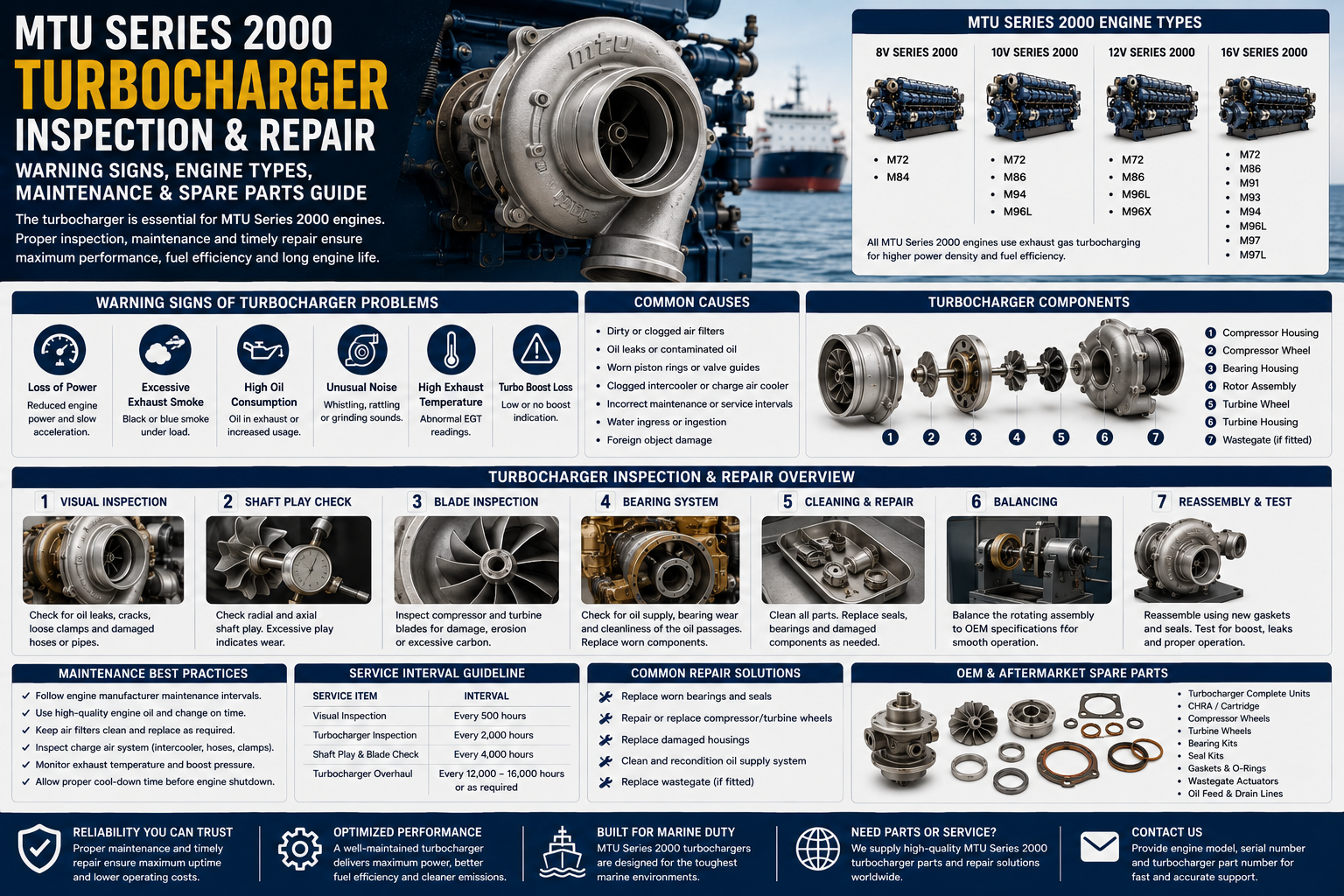

MTU Series 2000 Turbocharger Inspection & Repair: Warning Signs, Engine Types, Maintenance & Spare Parts Guide
The turbocharger on an MTU Series 2000 marine engine has a demanding job.
Every time the vessel accelerates, the turbocharger uses exhaust-gas energy to supply the engine with the large volume of compressed air required for combustion.
When everything is working correctly, the crew may barely think about it.
Then something changes.
The engine begins producing more black smoke than usual.
Acceleration feels slower.
Exhaust temperatures begin climbing.
Boost pressure is not where the engineer expects it to be.
Or a new whistle, scraping sound, or oil trace appears around the turbocharger.
That is when a small turbocharger problem can become a much more expensive engine problem if it is ignored.
This guide looks at turbocharger inspection and repair for MTU Series 2000 marine engines, including the different MTU 2000 engine types, warning signs, inspection areas, causes of turbocharger damage, repair decisions, and the information you should collect before ordering replacement parts.
1. Which MTU Series 2000 Marine Engines Does This Guide Cover?
The MTU Series 2000 is not one engine.
It is a family of high-speed V-diesels available across different cylinder configurations, generations, power ratings, and marine applications.
Marine engineers may encounter engines including the following.
MTU 8V 2000
Examples include:
- MTU 8V 2000 M72
- MTU 8V 2000 M84
MTU 10V 2000
Examples include:
- MTU 10V 2000 M72
- MTU 10V 2000 M84
- MTU 10V 2000 M86
- MTU 10V 2000 M94
- MTU 10V 2000 M96L
MTU 12V 2000
Examples include:
- MTU 12V 2000 M72
- MTU 12V 2000 M84
- MTU 12V 2000 M86
- MTU 12V 2000 M94
- MTU 12V 2000 M96L
- MTU 12V 2000 M96X
- MTU 12V 2000 M96Z
MTU 16V 2000
Examples include:
- MTU 16V 2000 M72
- MTU 16V 2000 M84
- MTU 16V 2000 M86
- MTU 16V 2000 M91
- MTU 16V 2000 M93
- MTU 16V 2000 M94
- MTU 16V 2000 M96L
- MTU 16V 2000 M97
- MTU 16V 2000 M97L
Different versions can have different turbocharging arrangements and component specifications.
That means:
“MTU 2000 turbocharger”
is not enough information when ordering a replacement.
The complete engine designation and serial number should be identified first.
2. What Does the Turbocharger Actually Do?
A diesel engine needs fuel and air.
If more fuel is injected without enough air, combustion quality deteriorates.
The turbocharger helps solve that problem by using exhaust-gas energy to compress incoming air.
A simplified process looks like:
Engine exhaust
↓
Turbine wheel spins
↓
Turbocharger shaft rotates
↓
Compressor wheel spins
↓
More air is supplied to the engine
↓
More efficient combustion and greater engine output
This allows the MTU Series 2000 to produce substantial power from a relatively compact engine package.
3. Why Turbocharger Condition Matters So Much on an MTU 2000
The turbocharger affects much more than maximum horsepower.
Its condition influences:
- Airflow
- Boost pressure
- Acceleration
- Combustion
- Exhaust temperature
- Smoke
- Fuel consumption
- Engine loading
A deteriorating turbocharger can therefore make an otherwise healthy engine behave poorly.
But there is another important lesson:
Not every boost problem is a turbocharger problem.
The complete air and exhaust system needs to be considered.
4. Situation: The MTU 2000 Suddenly Produces Black Smoke
Black smoke is often one of the first signs that something has changed.
The immediate reaction may be:
“The turbo is bad.”
Maybe.
But not necessarily.
Black smoke generally indicates that the engine is receiving more fuel than can be burned cleanly with the available air.
Possible causes include:
- Reduced turbocharger boost
- Air-filter restriction
- Charge-air cooler restriction
- Intake leakage
- Exhaust restriction
- Injector problem
- Fuel-system problem
- Excessive propeller load
- Hull fouling
The turbocharger is one possibility, not the only possibility.
5. Situation: The Engine Feels Slow to Accelerate
An MTU Series 2000 is often installed in vessels where acceleration matters.
If an engine that previously responded quickly begins feeling noticeably slower, investigate.
Possible causes include:
- Reduced turbocharger efficiency
- Compressor fouling
- Turbine fouling
- Charge-air leakage
- Exhaust leakage
- Fuel-delivery problems
- Excessive vessel loading
- Propeller fouling
The useful word is:
change.
If the engine behaved one way for years and suddenly behaves differently under the same operating conditions, find out why.
6. Situation: Boost Pressure Is Lower Than Normal
Reduced boost pressure deserves investigation.
Possible causes include:
- Compressor-wheel damage
- Turbocharger bearing wear
- Turbine damage
- Fouling
- Air-filter restriction
- Intake leak
- Charge-air leak
- Exhaust leak before the turbine
- Restricted exhaust flow
- Engine-load changes
Do not replace the turbocharger until the surrounding system has been checked.
A cracked charge-air hose can make a healthy turbocharger appear weak.
7. Situation: Exhaust Temperature Is Increasing
Exhaust temperature is a useful indicator.
Suppose the engine normally operates with relatively consistent temperatures at a known cruise condition.
Then the temperatures begin increasing.
Possible reasons include:
- Reduced airflow
- Turbocharger deterioration
- Dirty charge-air cooler
- Injector problem
- Excessive engine loading
- Exhaust restriction
- Cooling-system deterioration
The engine does not have to reach an alarm condition before the trend becomes useful.
Ask:
“Is it running hotter than it normally does?”
That can be much more valuable than waiting for:
HIGH EXHAUST TEMPERATURE.
8. Situation: One Bank Behaves Differently
On a V-engine, comparison is extremely useful.
If one bank appears to have:
- Higher exhaust temperatures
- Different boost behavior
- More smoke
- Different turbocharger noise
than the other, investigate why.
The difference may help narrow the fault.
Do not automatically assume that both sides require the same repair simply because the engine has accumulated the same operating hours.
9. Listen to the Turbocharger
A healthy turbocharger has a recognizable operating sound.
New noises deserve attention.
Listen for:
- Abnormally loud whistling
- Scraping
- Rubbing
- Grinding
- Metallic contact
- Unusual high-pitched noise
A change in sound can indicate:
- Bearing wear
- Compressor contact
- Turbine contact
- Air leakage
- Exhaust leakage
If actual wheel-to-housing contact is suspected, continued operation may make the damage much worse.
10. Inspect for Oil Around the Turbocharger
Oil around a turbocharger should not simply be cleaned away and forgotten.
First determine where it originated.
Possible sources include:
- Oil supply connection
- Oil return connection
- External engine leak
- Turbocharger seal area
- Breather-related condition
Oil found in the intake or exhaust path can require further investigation.
But oil presence alone should not automatically lead to the conclusion that the turbocharger must be replaced.
Look at the complete lubrication and crankcase ventilation conditions.
11. Why Turbocharger Lubrication Is Critical
The turbocharger shaft operates at extremely high rotational speed.
Its bearings depend on clean, correctly supplied lubricating oil.
Problems can develop from:
- Low oil pressure
- Contaminated oil
- Restricted oil supply
- Blocked oil return
- Incorrect lubricant
- Excessive oil temperature
A turbocharger can be mechanically perfect when installed and still fail quickly if its oil supply is poor.
That is why a turbocharger failure should sometimes trigger investigation of the engine lubrication system, not only the turbo itself.
12. Never Install a Replacement Turbo Without Checking the Oil Lines
Suppose the original turbocharger failed because its oil supply was restricted.
The workshop installs a new turbo.
The restricted oil line remains.
What happens?
The new turbocharger can fail for exactly the same reason.
Before installing a replacement, inspect:
- Oil supply line
- Oil return
- Connections
- Restrictions
- Contamination
- Leakage
A new component cannot solve an old lubrication problem.
13. Compressor-Side Inspection
The compressor side handles incoming air.
Depending on the inspection scope and applicable service procedure, areas to evaluate can include:
- Compressor wheel
- Blade condition
- Deposits
- Foreign-object damage
- Housing condition
- Evidence of rubbing
- Oil contamination
Blade damage deserves particular attention.
Even relatively small damage can affect turbocharger balance.
At turbocharger operating speeds, balance matters enormously.
14. What Can Damage the Compressor Wheel?
Possible causes include:
- Foreign objects entering the intake
- Deteriorated intake components
- Debris
- Previous incorrect service
- Severe compressor contact
This highlights why the air-intake system matters.
The turbocharger can only process what the intake system allows to reach it.
Protect it.
15. Turbine-Side Inspection
The turbine side lives in an even harsher environment.
It is constantly exposed to hot exhaust gas.
Inspect for signs such as:
- Heavy deposits
- Blade damage
- Cracking
- Foreign-object damage
- Housing contact
- Abnormal discoloration
Turbine-side problems can originate from the engine itself.
For example, abnormal combustion upstream can expose the turbocharger to excessive thermal loading.
16. Carbon Deposits and Fouling
Deposits can gradually affect turbocharger performance.
The result may not be a sudden failure.
Instead, the crew notices:
- Slower response
- More smoke
- Higher exhaust temperature
- Reduced boost
This gradual deterioration is exactly why maintenance records are useful.
Without a baseline, slow performance changes can become the new “normal.”
17. Shaft Play: What Should You Look For?
Turbocharger shaft condition is an important inspection area.
Excessive movement can indicate bearing wear.
Technicians may evaluate:
- Radial movement
- Axial movement
- Evidence of wheel contact
- Shaft rotation
But turbochargers are precision components.
Do not determine serviceability only by grabbing the wheel and guessing whether the movement “feels about right.”
Measurement should follow the appropriate specifications for the exact turbocharger.
18. Never Spin or Handle the Turbocharger Carelessly
Turbocharger compressor and turbine components are precision-balanced assemblies.
Avoid:
- Striking blades
- Using blades as handles
- Allowing debris into openings
- Placing components on dirty surfaces
A component that looks heavy and robust can still be extremely sensitive to small damage.
19. Charge-Air Cooler Problems Can Look Like Turbo Problems
This is one of the most important troubleshooting points.
The turbocharger creates compressed air.
But that air still needs to travel through the charge-air system before reaching the cylinders.
If the charge-air cooler becomes:
- Fouled
- Restricted
- Contaminated
- Internally damaged
engine performance can deteriorate.
Possible symptoms include:
- Higher intake temperature
- Increased smoke
- Higher exhaust temperature
- Reduced power
Do not replace a good turbocharger because the charge-air cooler is dirty.
20. Charge-Air Leaks
Compressed air escaping before reaching the engine represents lost boost.
Possible leak locations can include:
- Hoses
- Clamps
- Connections
- Cooler connections
- Gaskets
- Sealing surfaces
Listen for unusual air leakage and inspect connections carefully.
Oil mist around a charge-air connection can sometimes help identify where pressurized air is escaping.
21. Exhaust Leaks Before the Turbocharger
The turbine relies on exhaust energy.
If exhaust gas escapes before reaching the turbine, the turbocharger receives less energy.
Possible results include:
- Reduced boost
- Slow acceleration
- Smoke
- Hot engine-room areas
- Exhaust smell
Inspect:
- Exhaust manifolds
- Connections
- Gaskets
- Fasteners
- Expansion components
A turbocharger cannot produce normal performance if the exhaust energy driving it is leaking away upstream.
22. Air Filters Matter Too
A restricted air filter can reduce the air reaching the compressor.
This can contribute to:
- Reduced performance
- Increased smoke
- Higher exhaust temperature
Before condemning an expensive turbocharger, check the simple components.
Sometimes the expensive-looking problem has an inexpensive cause.
23. Propeller Overload Can Make the Turbocharger Look Bad
Suppose the engine no longer reaches normal rated RPM under load.
The crew notices smoke and assumes the turbochargers are weak.
But the real problem could be:
- Propeller fouling
- Damaged propeller
- Excessive pitch
- Hull fouling
- Increased vessel weight
If the engine is being overloaded mechanically, the turbocharger may simply be reacting to the excessive load.
Check the complete propulsion system.
24. Twin MTU 2000 Engines Give You a Useful Comparison
Many yachts and fast commercial vessels use twin MTU Series 2000 engines.
That gives the engineer a valuable diagnostic tool.
Compare port and starboard:
- Boost pressure
- Exhaust temperature
- Smoke
- Acceleration
- Engine load
- Maximum RPM
- Fuel consumption
- Turbocharger sound
If one engine behaves differently under similar conditions, the difference deserves investigation.
25. Inspect the Turbocharger During Routine Engine-Room Checks
You do not need to dismantle the turbocharger every time you inspect the engine room.
Routine visual inspection can look for:
- Oil leakage
- Exhaust leakage
- Loose fasteners
- Damaged air connections
- Loose clamps
- Abnormal deposits
- New noises
- Heat damage
The goal is to recognize a developing problem before it becomes a failed turbocharger.
26. Keep the Turbocharger Area Clean
A clean engine makes leakage easier to see.
If the turbocharger area is covered in old oil, soot and dirt, a fresh leak may go unnoticed.
A clean installation makes it easier to spot:
- New oil traces
- Exhaust deposits
- Loose hardware
- Damaged hoses
- Cracks
Cleaning is therefore part of inspection.
27. When Should an MTU 2000 Turbocharger Be Repaired?
There should not be one universal operating-hour number applied blindly to every Series 2000 turbocharger.
Repair decisions depend on factors including:
- Exact MTU engine model
- Turbocharger specification
- Operating hours
- Duty profile
- Vessel application
- Service history
- Oil condition
- Exhaust condition
- Measured wear
- Symptoms
Always use the applicable maintenance requirements for the exact engine and turbocharger configuration.
28. What Happens During a Professional Turbocharger Inspection?
Depending on turbo type and repair scope, specialist inspection can involve:
- External cleaning
- Disassembly
- Compressor-wheel inspection
- Turbine-wheel inspection
- Shaft inspection
- Bearing inspection
- Seal inspection
- Housing inspection
- Dimensional measurements
- Rotating-assembly evaluation
- Balancing
- Replacement of service components
A professional rebuild should be more than:
clean it, paint it and put it back together.
29. Rebuild or Replace the Turbocharger?
This depends on condition.
Rebuilding May Make Sense When:
- Major housings remain usable
- Shaft and wheel assemblies are repairable within specifications
- Correct repair components are available
- Specialist balancing and testing are available
Replacement May Make More Sense When:
- Major wheel damage exists
- Housing damage is severe
- Shaft damage is excessive
- Repair cost approaches replacement cost
- Fast vessel turnaround is required
The cheapest option is not automatically the lowest-cost decision.
Downtime matters too.
30. Be Careful With Cheap Replacement Turbochargers
A turbocharger does not simply need to bolt onto the engine.
It must provide the correct:
- Airflow
- Pressure characteristics
- Turbine behavior
- Compressor behavior
- Oil supply arrangement
- Exhaust connection
An incorrectly specified turbocharger can affect:
- Boost
- Smoke
- Fuel consumption
- Exhaust temperature
- Engine loading
Looks the same is not a technical specification.
31. Always Identify the Existing Turbocharger Number
Before ordering, inspect the turbocharger identification.
Record:
- Turbocharger manufacturer
- Turbocharger model
- Part number
- Serial number where applicable
Combine this with the engine information.
For example:
Engine: MTU 16V 2000 M96L
Engine Serial Number: __________
Turbocharger Number: __________
Quantity: __________
Photos: Attached
This is far more useful than:
“Need turbo for MTU 2000.”
32. Don't Forget the Engine Serial Number
The Series 2000 contains many different versions.
Therefore:
MTU 16V 2000
may not be enough.
A better identification is:
MTU 16V 2000 M94
And better still:
MTU 16V 2000 M94 + serial number + turbocharger number.
This becomes particularly important when engines have undergone previous repairs or component updates.
33. Why Previous Overhauls Matter
An older Series 2000 engine may no longer contain every component that was originally installed when it left the factory.
During previous service, it may have received:
- Updated turbochargers
- Replacement housings
- Revised components
- Different replacement part numbers
That is why the current turbocharger identification can be just as useful as the engine serial number.
34. Turbocharger Failure Can Be the Result of Another Engine Problem
This deserves emphasis.
The failed turbocharger may be the victim, not the cause.
Possible upstream causes include:
- Lubrication failure
- Excessive exhaust temperature
- Foreign-object damage
- Poor air filtration
- Abnormal combustion
- Exhaust-system problems
Simply installing another turbocharger without investigating why the old one failed may lead to another failure.
35. What to Check After a Turbocharger Failure
Before installing a replacement, consider inspecting:
- Intake system
- Air filters
- Charge-air cooler
- Charge-air piping
- Exhaust manifold
- Exhaust piping
- Oil supply
- Oil return
- Engine oil
- Filters
- Cylinder condition where relevant
If fragments entered the intake or exhaust system, determine where they went.
Do not assume they disappeared.
36. Foreign-Object Damage Requires Investigation
If compressor or turbine blades are damaged by debris, find the source.
Ask:
Where did the object come from?
Was it:
- Intake debris?
- Broken upstream component?
- Loose hardware?
- Engine-related material entering the turbine side?
Replacing the turbocharger without finding the source leaves the new unit exposed to the same danger.
37. Warning Signs That Deserve Quick Attention
Watch for combinations such as:
- New black smoke
- Reduced boost
- High exhaust temperature
- Slow acceleration
- Oil leakage
- New turbo noise
- Failure to achieve normal loaded RPM
- Significant difference between port and starboard engines
One symptom alone may have several explanations.
Several appearing together make the need for investigation stronger.
38. Common MTU 2000 Turbocharger-Related Spare Parts
Depending on turbocharger design and repair scope, requirements can involve:
- Complete turbocharger assemblies
- Cartridge assemblies
- Bearing components
- Seal components
- Compressor-side components
- Turbine-side components
- Housings
- Gaskets
- O-rings
- Oil-line seals
- Exhaust gaskets
- Intake gaskets
- Fasteners
- Associated charge-air components
Exact components must be matched to the specific engine and turbocharger.
39. Other MTU Series 2000 Parts Often Checked During Turbo Repair
A turbocharger problem can lead technicians to inspect related systems and components, including:
- Air filters
- Charge-air coolers
- Intake hoses
- Exhaust manifolds
- Exhaust gaskets
- Fuel injectors
- Oil filters
- Engine oil
- Oil lines
- Sensors
- Temperature sensors
- Pressure sensors
Turbocharger diagnosis should be treated as part of the complete engine system.
40. Information to Send When Ordering MTU 2000 Turbocharger Parts
A good inquiry should contain:
Manufacturer: MTU
Engine Series: 2000
Complete Engine Model: __________
Engine Serial Number: __________
Rated Power: __________
Rated RPM: __________
Turbocharger Manufacturer: __________
Turbocharger Model: __________
Existing Turbo Part Number: __________
Required Component: __________
Quantity: __________
Photographs: Attached
Delivery Location: __________
This can significantly speed up correct parts identification.
41. Frequently Asked Questions
What Are the Main MTU Series 2000 Marine Engine Configurations?
The Series 2000 has been produced in several V-engine configurations, including 8V, 10V, 12V and 16V versions depending on generation and application.
Does Every MTU 2000 Use the Same Turbocharger?
No. Turbocharger configuration can differ according to engine model, rating and generation.
Can an MTU 2000 Turbocharger Be Rebuilt?
Depending on condition and turbocharger type, professional repair or rebuilding may be possible. Critical components should be measured, inspected and balanced by a properly equipped specialist.
Does Black Smoke Mean the Turbocharger Is Bad?
Not necessarily. Black smoke can also be caused by air restriction, charge-air leakage, injector problems, excessive vessel loading or propeller problems.
Can a Dirty Charge-Air Cooler Reduce Turbo Performance?
Yes. Reduced charge-air cooling or restriction can affect engine airflow and performance even when the turbocharger itself remains serviceable.
Can Low Oil Pressure Damage the Turbocharger?
Adequate lubrication is critical to turbocharger bearing life. Lubrication-system problems can contribute to severe turbocharger damage.
Should I Replace Both Turbochargers If Only One Has a Problem?
Not automatically. Each turbocharger should be evaluated according to condition, operating data and maintenance requirements.
Should I Replace the Turbocharger if Boost Is Low?
Not before checking the intake, charge-air, exhaust, fuel and engine-load conditions.
What Information Do I Need to Order an MTU 2000 Turbocharger?
Provide the complete MTU engine model, engine serial number, turbocharger identification number, rated power, quantity and photographs.
MTU Series 2000 Marine Engine Types
Alfa Marine Spare Parts can assist with inquiries involving Series 2000 marine engines including:
8V Series
- MTU 8V 2000 M72
- MTU 8V 2000 M84
10V Series
- MTU 10V 2000 M72
- MTU 10V 2000 M84
- MTU 10V 2000 M86
- MTU 10V 2000 M94
- MTU 10V 2000 M96L
12V Series
- MTU 12V 2000 M72
- MTU 12V 2000 M84
- MTU 12V 2000 M86
- MTU 12V 2000 M94
- MTU 12V 2000 M96L
- MTU 12V 2000 M96X
- MTU 12V 2000 M96Z
16V Series
- MTU 16V 2000 M72
- MTU 16V 2000 M84
- MTU 16V 2000 M86
- MTU 16V 2000 M91
- MTU 16V 2000 M93
- MTU 16V 2000 M94
- MTU 16V 2000 M96L
- MTU 16V 2000 M97
- MTU 16V 2000 M97L
Exact configuration should always be verified using the engine identification and serial number.
MTU Series 2000 Turbocharger & Engine Spare Parts
Alfa Marine Spare Parts can assist with inquiries for maintenance, repair and overhaul components including:
- Turbochargers
- Turbocharger repair components
- Cartridge assemblies
- Turbocharger gaskets
- Air-system components
- Charge-air cooler components
- Exhaust-system components
- Cylinder heads
- Fuel injectors
- Fuel-system components
- Freshwater pumps
- Seawater pumps
- Oil pumps
- Pistons
- Piston rings
- Cylinder liners
- Bearings
- Gaskets
- O-rings
- Seals
- Filters
- Sensors
- Electronic components
- Overhaul parts
Depending on availability and the required component, inquiries may involve genuine, OEM-quality, aftermarket, remanufactured or reconditioned parts.
Browse Our Complete Catalog
Marine engine brands:
https://alfamarinespareparts.com/our-brand
Marine spare parts:
https://alfamarinespareparts.com/spareparts
Contact Alfa Marine Spare Parts
For MTU Series 2000 turbochargers and marine engine spare parts:
Email: request@alfamarinespareparts.com
For faster identification, provide:
MTU engine model + full M-designation + engine serial number + existing turbocharger part number + quantity + photographs + delivery location.
Final Word
The turbocharger on an MTU Series 2000 marine engine should not be viewed as an isolated component.
It sits in the middle of several systems.
Before it:
air intake.
Driving it:
exhaust gas.
After it:
charge-air cooling and intake piping.
Supporting it:
engine lubrication.
And controlling the amount of fuel that must be matched with its airflow:
the engine fuel system.
That means a low-boost problem is not automatically a bad turbocharger.
Black smoke is not automatically a bad turbocharger.
High exhaust temperature is not automatically a bad turbocharger.
The useful question is:
“What changed?”
Check the air filters.
Check the intake.
Inspect the turbocharger.
Check charge-air connections.
Inspect the coolers.
Check the exhaust system.
Look at engine loading.
Compare port and starboard engines when possible.
And if the turbocharger itself has failed, ask:
“Why did it fail?”
before installing another one.
Because a new MTU 2000 turbocharger connected to the same blocked oil line, contaminated intake, leaking exhaust manifold or abnormal combustion condition may eventually suffer the same fate.
Good turbocharger maintenance is therefore not simply about repairing the turbo.
It is about protecting the entire air, exhaust and lubrication system that allows the turbocharger to do its job.