Hard Starting or Low Oil Pressure? Troubleshooting Perkins, DEUTZ & Doosan Engines
A diesel engine that becomes increasingly difficult to start or suddenly begins showing lower oil pressure can quickly lead to expensive assumptions. Injectors are blamed, the injection pump becomes suspicious, or an oil pump is ordered before anyone has established whether the component itself is actually responsible.
That approach can easily lead to replacing good parts.
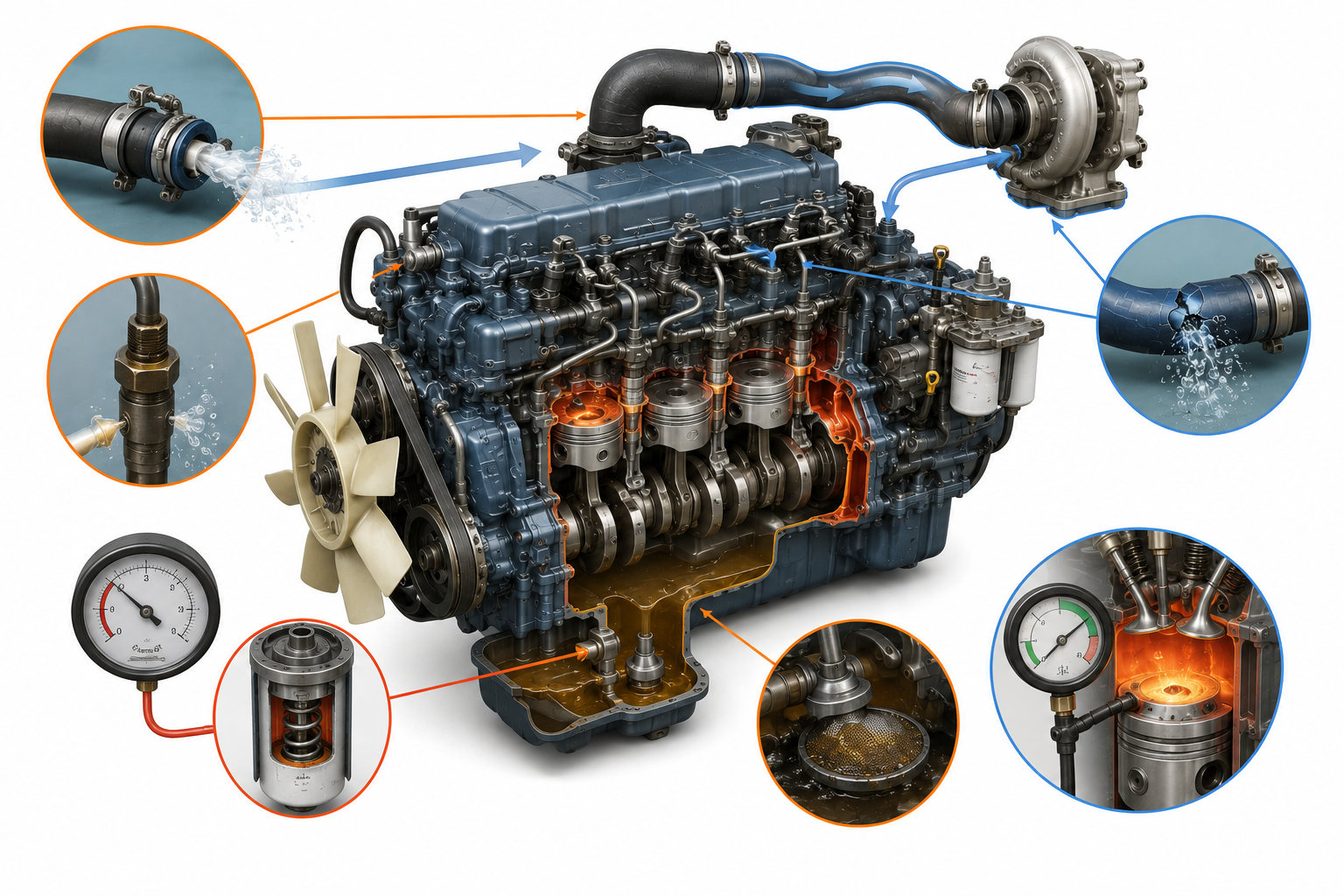
Hard starting and low oil pressure are symptoms, not diagnoses. The real value comes from understanding when the problem occurs and what changes with it. Does the engine struggle only when cold? Does it crank more slowly than before? Is there smoke during starting? Does oil pressure fall only after the engine reaches operating temperature, or did the reading change suddenly?
These questions are particularly relevant when working with long-serving engines such as the Perkins 4.108, Perkins 4.236 and Perkins 6.354, as well as DEUTZ marine and industrial engines and Doosan marine and industrial engines.
The useful question is therefore not simply “Which part has failed?” It is “What has changed in the way this engine starts, lubricates or operates?”
1. Hard Starting: Look at Cranking, Fuel and Compression Together
A diesel engine requires adequate cranking speed, correct fuel delivery and sufficient compression temperature to start reliably. Weakness in any one of these areas can produce the same complaint from the operator: the engine is difficult to start.
Start by determining whether the problem occurs when the engine is cold, hot or under both conditions.
If cranking speed has become noticeably slower, investigate the electrical starting system before condemning the fuel system. Batteries, starter motors, battery cables, grounds, relays and corroded connections can reduce cranking performance enough to affect diesel combustion.
This is particularly relevant in marine installations, where moisture, salt and vibration can gradually affect electrical connections.
Fuel supply should then be considered from the tank toward the injection equipment. Restricted filters, air entering the suction side, weak fuel-transfer supply, contaminated fuel or loss of prime can all extend cranking time.
On an older Perkins 4.108 marine engine, for example, fuel supply, injection equipment, cranking performance and general engine condition should be considered together rather than immediately assuming that the injectors have failed.
What Does the Exhaust Tell You During Cranking?
Watch the exhaust while the engine is being started.
Smoke during cranking can help establish whether fuel is reaching the cylinders and whether combustion is beginning correctly. It should never be used as a diagnosis by itself, but combined with cranking speed, engine temperature and fuel-system condition it can narrow the investigation.
An engine receiving fuel but struggling to ignite it presents a different diagnostic path from an engine receiving insufficient fuel.
Compression becomes increasingly important on older engines as well.
A Perkins, DEUTZ or Doosan engine that has become progressively harder to start cold but restarts much more easily when warm may deserve investigation of compression, valve condition and cylinder condition alongside the fuel system.
The fact that temperature changes the symptom is itself an important diagnostic clue.
2. Low Oil Pressure Does Not Automatically Mean a Failed Oil Pump
When an oil-pressure gauge suddenly reads low, the oil pump often becomes the first suspect.
But the first question should be:
Is the engine actually experiencing low oil pressure?
A sender, pressure switch, gauge, wiring connection or instrumentation problem can produce a misleading indication. Where appropriate, actual lubrication pressure should be verified before expensive mechanical work begins.
The way pressure changes with temperature is also important.
Cold oil is more viscous, so pressure will normally behave differently during initial startup than after the engine reaches operating temperature. An engine with apparently acceptable cold pressure but unusually poor hot-idle pressure presents a different diagnostic problem from an engine that suddenly loses pressure immediately after startup.
If genuine low pressure is confirmed, consider the lubrication system as a whole.
Oil level and condition matter, but so do lubricant specification, filter condition, pressure-regulating components, oil pickup, pump condition and internal engine clearances.
Why Engine Wear Can Reduce Oil Pressure
The oil pump provides flow, while pressure develops through the relationship between that flow and resistance inside the lubrication system.
As bearing and other internal clearances increase through wear, oil can pass through those clearances more readily. An engine can therefore have a functioning oil pump and still develop poor hot-idle oil pressure.
This becomes particularly important on older engines such as the Perkins 6.354.
Previous overhaul history also matters. A crankshaft that has already been machined, for example, may require different bearing dimensions from an untouched engine. That is one reason parts should not be selected from the model designation alone.
3. Perkins, DEUTZ and Doosan Can Show the Same Symptoms for Different Reasons
The operator may report exactly the same problem—“hard starting” or “low oil pressure”—but the engines behind those symptoms can be very different.
Perkins: Age and Previous Repairs Matter
Many Perkins 4.108, Perkins 4.236 and Perkins 6.354 engines have accumulated decades of service in yachts, fishing boats, workboats and commercial craft.
That history changes the diagnostic picture.
Consider an older Perkins showing:
hard cold starting + increased blow-by + higher oil consumption + declining hot oil pressure.
Those symptoms together deserve a broader assessment of internal engine condition rather than simply replacing the injectors and oil pump.
Now compare that with the same engine starting perfectly before a fuel-filter change and requiring prolonged cranking immediately afterwards.
The engine model is identical, but the diagnostic direction is completely different. In the second case, air in the fuel system, priming and recently disturbed connections deserve attention first.
DEUTZ: Know Which Engine Generation You Have
The DEUTZ engine range includes substantially different diesel-engine families. Alfa Marine's DEUTZ range covers engines including the 912, 913, 914, 1011, 1012, 1013M, 1015M, 2011, 2012, 2013, 2015M and various TCD and TBD families.
That distinction matters during troubleshooting.
Older air-cooled DEUTZ engines such as the 912, 913 and 914 require different thinking from later liquid-cooled designs. Cooling condition can influence engine temperature, which in turn affects lubricant temperature and viscosity.
Hard starting should still be approached systematically: cranking speed, fuel delivery, injection condition, compression and temperature-related behavior all matter.
Likewise, if oil pressure is acceptable when cold but falls progressively as the engine warms, ask what is changing with temperature before automatically ordering another oil pump.
Doosan: Exact Engine Identification Comes First
The Doosan engine range includes multiple marine and industrial engine families, including L066TI, L086TI, L126TI, L136, V158TI and V222TI applications.
That makes a request such as “Doosan oil pump” or “Doosan injector” far too broad for accurate parts identification.
The diagnostic process should begin with the complete engine designation and serial information.
On a mechanically controlled engine, fuel priming, injection equipment, compression and cranking condition may dominate a hard-start investigation. On later electronically controlled installations, electrical supply, sensors, fault information and fuel-system pressure can become increasingly important.
The symptom may still be hard starting, but the technology producing that symptom can be very different.
4. Combine the Symptoms Instead of Diagnosing Them Separately
The greatest diagnostic value often comes from considering several symptoms together.
| Operating patternAreas worth investigating | |
| Hard starting cold, easier when warm | Cranking speed, compression, fuel delivery, cold-start system |
| Long cranking after standing | Fuel drain-back, air entry, priming and supply |
| Starts but initially runs unevenly | Fuel delivery, injection condition, compression |
| Suddenly low indicated oil pressure | Sender, gauge, wiring and actual pressure |
| Good cold pressure, poor hot pressure | Oil condition, temperature, internal clearances and regulation |
| Low oil pressure + increased oil consumption | Broader internal engine condition |
| Hard starting + blow-by + oil consumption | Compression and cylinder condition |
| Hard starting after fuel-system work | Air, priming, filters and disturbed connections |
The table is not a substitute for model-specific troubleshooting information. Its purpose is to prevent the diagnosis from jumping immediately from a symptom to an expensive replacement component.
Hard starting does not automatically mean failed injectors.
Low oil pressure does not automatically mean a failed oil pump.
If a Perkins 4.236 historically started quickly but now requires prolonged cranking every morning, something has changed. The same reasoning applies to a DEUTZ that gradually loses hot-idle oil pressure or a Doosan engine that suddenly becomes difficult to start after fuel-system work.
Finding what changed and when it changed is often more valuable than guessing which component is worn.
5. Establish a Baseline Before Ordering Parts
Before replacing injectors, injection pumps, starter motors, oil pumps or internal engine components, record how the fault actually behaves.
For hard starting, note whether the engine is cold or warm, how quickly it cranks, whether smoke appears during cranking, whether the fuel system has recently been opened and how the engine behaves immediately after firing.
For low oil pressure, compare the oil level and condition, cold-start pressure, hot-idle pressure, pressure under load and engine temperature.
Trends matter.
An engine that has always maintained one hot-idle pressure but gradually loses pressure over hundreds of operating hours presents a different problem from an engine whose gauge suddenly falls after electrical work.
Likewise, an engine that gradually becomes harder to start over several seasons is different from one that develops the problem immediately after a fuel-filter replacement.
Good troubleshooting follows the history of the symptom.
Before Ordering Perkins, DEUTZ or Doosan Engine Parts
Once the faulty system or component has been identified, accurate engine information becomes essential.
Do not request only:
“Perkins injector”
“DEUTZ oil pump”
or
“Doosan starter motor.”
Provide:
Engine manufacturer + complete engine model + engine serial number + existing part number + application + quantity + photographs + delivery location
For engine-specific requirements, browse:
Perkins 4.108 Marine Engine Parts
Perkins 4.236 Marine Engine Parts
Perkins 6.354 Marine Engine Parts
DEUTZ Marine & Industrial Engine Parts
Doosan Marine & Industrial Engine Parts
Frequently Asked Questions
Why is my diesel engine difficult to start when cold but easier when warm?
Cold starting places greater demands on cranking speed, fuel delivery and compression-generated temperature. Weak cranking performance, fuel-system problems, cold-start assistance or reduced compression can therefore become more noticeable when the engine is cold.
Does hard starting mean the injectors need replacing?
Not necessarily. Fuel restriction, air entering the fuel system, weak batteries, slow starter speed, injection timing, compression and other conditions can produce similar symptoms.
Why is my oil pressure good when cold but low when hot?
Oil becomes less viscous as temperature rises. If hot pressure has declined from the engine's established normal readings, oil condition, operating temperature, internal clearances, pressure regulation and pump condition may need investigation.
Does low oil pressure mean I need a new oil pump?
No. Low oil level, unsuitable or contaminated lubricant, excessive temperature, increased internal clearances, pressure-regulating problems and inaccurate instrumentation can all contribute to a low reading.
Why is the engine serial number important?
Engines within the same family can use different components depending on build specification, application and previous repairs. Older engines may also have undergone significant rebuilding or modification during their service life.
What should I provide for a Perkins, DEUTZ or Doosan parts inquiry?
Send the complete engine model, engine serial number, existing part number, quantity, application and delivery destination. Photographs of the engine data plate and existing component can also help with identification.
Need Perkins, DEUTZ or Doosan Engine Parts?
If your diagnosis identifies a faulty injector, injection pump, lift pump, oil pump, starter motor, bearing, piston, cylinder liner, gasket, sensor, filter or another engine component, Alfa Marine Spare Parts can assist with parts identification and availability.
For the fastest quotation, send:
Engine manufacturer + engine model + engine serial number + part number + quantity + photographs + delivery destination
Email: request@alfamarinespareparts.com
Or submit your parts requirement directly through the Alfa Marine Spare Parts quotation form:
Request a Quote | Alfa Marine Spare Parts
The quotation page allows customers to provide the delivery country, brand, product type and parts requirement, and to upload supporting parts lists or documents.
A diesel engine that becomes difficult to start or begins showing lower oil pressure is telling you that something has changed. Understanding when the symptom appears, what happens as the engine warms and which other operating parameters change at the same time provides a much stronger diagnostic starting point than replacing the first component associated with the fault.