Marine Diesel Engine Fuel Pumps Explained: Wärtsilä, MAN & Mitsubishi
A marine diesel engine depends on fuel being delivered cleanly, consistently, at the correct pressure, and at precisely the right moment.
When that process starts to fail, the symptoms can appear quickly:
- Difficult starting
- Loss of power
- Unstable engine speed
- Increased smoke
- Higher fuel consumption
- Abnormal exhaust temperatures
- Cylinder imbalance
- Poor acceleration
- Engine alarms
- In severe cases, engine shutdown
But when an engineer says:
“I think the fuel pump is bad,”
there is an important question to ask first:
Which fuel pump—and on which engine?
A Wärtsilä medium-speed engine, a high-speed MAN marine engine, and a Mitsubishi marine diesel can use very different fuel-system arrangements.
Understanding those differences helps engineers diagnose problems more accurately and, just as importantly, helps purchasing departments order the correct fuel-system components.
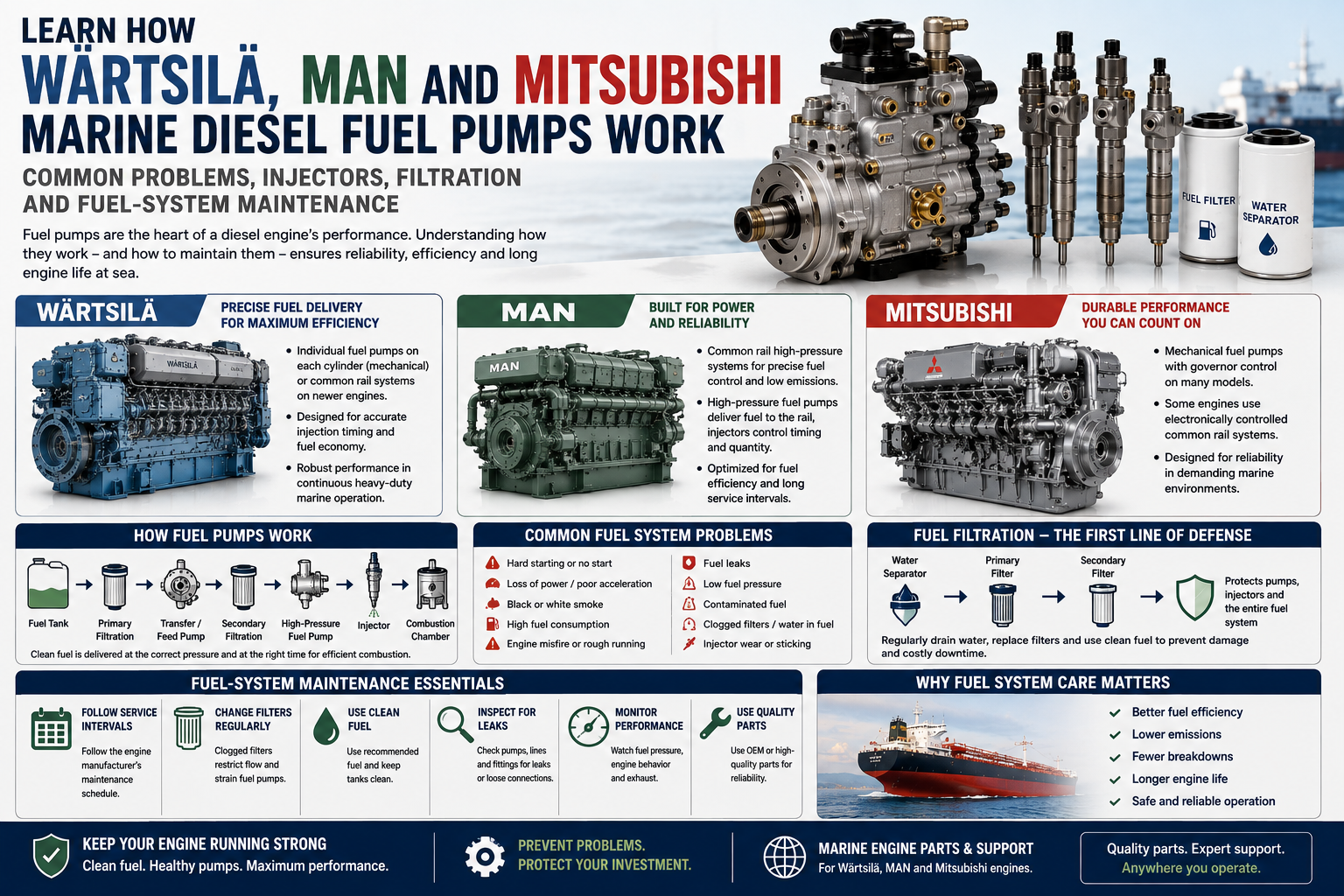
1. What Does a Marine Diesel Fuel Pump Actually Do?
The fuel system has one basic objective:
Get the correct amount of fuel into each cylinder at the correct time and under the correct conditions.
Getting there involves several stages.
A simplified system might look like:
Fuel Tank → Primary Filtration → Supply/Feed Pump → Secondary Filtration → Injection Equipment → Injector → Cylinder
The exact arrangement depends heavily on engine design.
That is why the term fuel pump can describe several different components.
It may refer to a:
- Fuel feed pump
- Transfer pump
- Supply pump
- Booster pump
- Injection pump
- High-pressure pump
- Common-rail high-pressure pump
- Cylinder-specific injection pump
Before ordering anything, identify which part of the system is actually causing the problem.
2. Low-Pressure Fuel Supply vs. High-Pressure Injection
This distinction is fundamental.
Low-Pressure Side
The low-pressure system moves fuel from storage toward the engine's injection equipment.
Depending on the installation, this side can contain:
- Fuel tank
- Transfer pump
- Water separator
- Primary filters
- Supply lines
- Feed pump
- Secondary filters
Its job is to make sure the injection equipment receives a stable supply of clean fuel.
High-Pressure Side
The high-pressure side prepares the fuel for injection into the combustion chamber.
Depending on the engine, this may involve:
- Individual injection pumps
- High-pressure common-rail pumps
- Fuel rails
- Pressure-control components
- Injectors
The difference matters.
Low fuel supply pressure and low injection pressure are not necessarily the same problem.
3. Why Fuel Pressure Is So Important
Diesel combustion depends heavily on fuel atomization.
Fuel cannot simply be poured into a cylinder.
It must be injected in a controlled way that allows it to mix correctly with compressed air.
Injection quality influences:
- Combustion efficiency
- Engine power
- Smoke
- Exhaust temperature
- Fuel consumption
- Starting
- Cylinder balance
- Emissions
Modern electronic systems can control injection with enormous precision.
Older mechanical engines achieve the same basic objective using pumps, governors, injectors, and mechanical timing.
Both systems work.
But they should not be diagnosed in the same way.
4. Wärtsilä Marine Fuel Systems: Large Engines Need Precise Fuel Control
Wärtsilä marine engines cover a wide range of medium-speed propulsion and generating applications.
Engine families encountered in marine service can include:
- Wärtsilä 20
- Wärtsilä 26
- Wärtsilä 31
- Wärtsilä 32
- Wärtsilä 34
- Wärtsilä 38
- Wärtsilä 46
- Wärtsilä 46F
- Wärtsilä 46TS
- Wärtsilä dual-fuel engine families
These engines can be installed in:
- Ferries
- Cruise ships
- Offshore vessels
- Tugs
- Cargo vessels
- Fishing vessels
- Naval vessels
- Generator installations
- Specialized commercial ships
The important point is:
There is no single Wärtsilä fuel pump that applies to every Wärtsilä engine.
Engine family, generation, fuel type, and configuration matter.
5. Traditional Wärtsilä Injection Systems
On traditional mechanically injected medium-speed diesel engines, injection equipment may use dedicated high-pressure pumping arrangements associated with individual cylinders.
The basic principle is straightforward.
Fuel must be:
metered
then:
pressurized
then:
injected into the cylinder at the correct time.
Mechanical components perform functions that newer electronically controlled systems can manage differently.
During troubleshooting, technicians may therefore need to consider components such as:
- Fuel feed equipment
- Injection pumps
- Pump elements
- Delivery components
- High-pressure fuel pipes
- Injectors
- Nozzles
- Control mechanisms
Wear in one area can affect combustion in one cylinder without necessarily affecting every cylinder equally.
6. Common-Rail Technology on Modern Wärtsilä Engines
Modern Wärtsilä engine technology can use electronically controlled common-rail fuel injection.
This changes the basic architecture.
Instead of each injection event relying entirely on a mechanically timed individual pump, high-pressure fuel can be maintained within a rail or accumulator system.
The engine-management system then controls injection events electronically.
This can provide much greater control over:
- Injection timing
- Injection quantity
- Combustion
- Engine response
- Emissions
For engineers, however, it also means that diagnosis becomes more system-oriented.
A problem may involve:
- Supply pressure
- High-pressure generation
- Rail pressure
- Pressure control
- Injector operation
- Sensor input
- Electronic control
Replacing the injector does not automatically solve a rail-pressure problem.
7. Wärtsilä Dual-Fuel Engines Make Fuel Systems Even More Interesting
Wärtsilä also produces engines designed for dual-fuel operation.
That means the combustion and fuel-control strategy can become significantly more complicated than on a traditional diesel-only engine.
Depending on engine family and operating mode, different fuel systems and injection components may be involved.
For spare-parts identification, this makes the complete engine designation especially important.
An inquiry saying:
“Wärtsilä 34 fuel pump”
doesn't provide enough information.
The exact engine variant and fuel-system configuration need to be established.
8. What Can Cause Fuel-Pump Problems on a Wärtsilä Engine?
Possible causes include:
- Contaminated fuel
- Water in fuel
- Wear
- Poor lubrication
- Restricted filters
- Damaged pumping components
- Pressure-control problems
- Internal leakage
- Injector problems
- Incorrect adjustment
- Electronic-control faults on applicable engines
The symptoms can overlap.
That is why diagnosis should focus on measurements rather than assumptions.
If one cylinder has an abnormal exhaust temperature, compare it with the other cylinders.
If system pressure is low, determine where pressure is being lost.
9. MAN Marine Fuel Pumps: Know Which MAN Engine You Have
MAN marine engines cover several very different applications.
Large MAN engines can be found in:
- Yachts
- Patrol vessels
- Workboats
- Commercial vessels
- Passenger vessels
- Generator applications
Marine engineers may encounter different MAN engine families and generations, including high-speed V engines and larger commercial propulsion engines.
Again, the words:
“MAN fuel pump”
are not enough to identify a replacement component.
10. Mechanical vs. Electronic Fuel Systems on MAN Engines
Older MAN engines may rely more heavily on mechanically controlled injection equipment.
Newer engines can use electronically managed high-pressure injection technology.
The difference is significant.
A traditional mechanical system may rely on:
- Mechanical fuel pumps
- Injection pumps
- Governors
- High-pressure lines
- Mechanical injectors
A modern electronic system can involve:
- Supply pumps
- High-pressure pumps
- Fuel rails
- Pressure sensors
- Pressure-control valves
- Electronic injectors
- Engine-control electronics
Both ultimately accomplish the same thing:
getting fuel into the cylinder.
How they accomplish it is very different.
11. MAN Common-Rail Fuel Injection
Common-rail injection allows fuel pressure generation to be separated from the individual injection event.
Think of the rail as a high-pressure fuel reservoir.
The pump creates pressure.
The rail stores high-pressure fuel.
The electronic system determines when the injector opens.
This allows sophisticated control of injection timing and quantity.
But it also creates a major maintenance requirement:
cleanliness.
Precision high-pressure equipment does not tolerate contamination well.
12. Why MAN Fuel Filtration Matters
Fuel-system components can be extremely expensive compared with routine filtration components.
That makes clean fuel one of the best forms of protection.
The fuel system should be protected against:
- Water
- Rust
- Dirt
- Tank sediment
- Microbial contamination
- Other particles
If injectors or high-pressure components repeatedly fail, don't only replace them.
Investigate the fuel supply.
Otherwise, the replacement components may eventually suffer the same damage.
13. Mitsubishi Marine Fuel Pumps: Mechanical Simplicity Still Matters
Mitsubishi has a long history of producing diesel engines for commercial marine applications.
Mitsubishi marine engines can be encountered in:
- Fishing vessels
- Workboats
- Tugs
- Cargo vessels
- Passenger vessels
- Auxiliary applications
- Generator installations
Many operators value older Mitsubishi marine diesels for their robust mechanical construction.
And this is where understanding the fuel system becomes particularly useful.
14. Traditional Mitsubishi Marine Injection Pumps
Many traditional Mitsubishi marine diesel engines use mechanical fuel-injection equipment.
Depending on engine family and configuration, the system may involve:
- Fuel feed pump
- Injection pump
- High-pressure fuel lines
- Mechanical injectors
- Governor
- Fuel filters
The injection pump performs a critical function.
It must deliver the correct quantity of fuel at the correct moment.
Mechanical wear or incorrect adjustment can affect:
- Starting
- Power
- Engine speed
- Smoke
- Fuel consumption
- Cylinder balance
But before blaming the injection pump, check the fuel supply reaching it.
15. Mitsubishi Fuel Feed Pumps
The feed side of the system has a much simpler but equally necessary job.
It has to keep the injection equipment supplied with fuel.
If the feed pump cannot maintain sufficient delivery, the engine may experience:
- Difficult starting
- Fuel starvation
- Loss of power
- Unstable operation
- Engine shutdown
These symptoms can easily be mistaken for an injection-pump problem.
That is why technicians should determine whether the problem is occurring:
before the injection pump
or:
inside/after the injection equipment.
16. A Simple Comparison: Wärtsilä vs. MAN vs. Mitsubishi
| Engine BrandFuel-System Character | |
| Wärtsilä | Medium-speed engines using different mechanical/electronic injection architectures depending on family and generation |
| MAN | Mechanical and electronically controlled high-pressure systems depending on engine generation |
| Mitsubishi | Many traditional commercial marine engines use robust mechanical fuel-injection arrangements |
| Modern Systems | Increasing use of electronic control and high-pressure injection technology |
The key lesson is:
Never identify a fuel pump by engine brand alone.
You need the engine model.
Preferably, you also need the serial number and existing component part number.
17. Common Symptoms of Marine Diesel Fuel-Pump Problems
Regardless of brand, fuel-delivery problems can produce similar symptoms.
These may include:
- Difficult starting
- Cranking without starting
- Loss of power
- Engine hesitation
- Uneven running
- Failure to achieve normal rpm
- Fuel starvation
- Abnormal smoke
- High exhaust temperatures
- Poor acceleration
- Engine shutdown
But none of these symptoms automatically prove the pump is defective.
That is worth repeating:
Symptoms indicate where to investigate. They don't automatically identify the failed part.
18. Engine Runs at Idle but Loses Power Under Load
This is a classic fuel-system complaint.
At idle, the engine requires relatively little fuel.
Under heavy propulsion load, fuel demand increases substantially.
A partially restricted system may therefore provide enough fuel at idle but fail to keep up at higher load.
Possible causes include:
- Restricted primary filter
- Restricted secondary filter
- Blocked tank pickup
- Damaged fuel hose
- Restricted fuel line
- Air leak
- Weak feed pump
- Tank ventilation problem
- Injection-system problem
Don't automatically replace the most expensive component first.
19. Start Troubleshooting at the Fuel Tank
Sometimes the best diagnostic approach is also the simplest.
Follow the fuel.
Fuel Tank
↓
Pickup
↓
Fuel Lines
↓
Water Separator
↓
Primary Filtration
↓
Feed / Transfer Pump
↓
Secondary Filtration
↓
Injection Equipment
↓
Injector
↓
Cylinder
The exact arrangement differs between Wärtsilä, MAN, and Mitsubishi engines.
But the diagnostic principle remains useful:
Find the point where correct fuel delivery disappears.
20. A Clogged Filter Can Look Like a Bad Fuel Pump
Suppose the engine loses power.
Fuel pressure is low.
Someone says:
“Order a pump.”
But the primary filter is almost completely blocked.
The pump may be perfectly healthy.
It simply cannot pull sufficient fuel through the restriction.
Before condemning the pump, inspect:
- Primary filter
- Secondary filter
- Water separator
- Fuel lines
- Tank pickup
Basic checks can prevent unnecessary component replacement.
21. Don't Throw the Old Fuel Filter Away Immediately
An old filter can tell you a lot about the vessel.
Inspect it.
Look for:
- Rust
- Sludge
- Water
- Black contamination
- Metallic particles
- Unusual debris
If a new filter becomes heavily contaminated after only a short operating period, the filter may not be the real problem.
The tank may need attention.
22. Water in Marine Diesel Fuel
Water contamination deserves immediate attention.
Possible sources can include:
- Condensation
- Contaminated bunkered fuel
- Tank leakage
- Poor fuel handling
- Water entering through damaged deck fittings or other tank-related problems
Water can contribute to:
- Corrosion
- Injector damage
- Pump damage
- Poor combustion
- Filter problems
- Microbial growth
High-precision fuel equipment is particularly sensitive.
23. Air Leaks Can Be Difficult to Find
A fuel line on the suction side may draw air without producing an obvious external diesel leak.
This can result in:
- Hard starting
- Loss of prime
- Unstable operation
- Power loss
- Engine shutdown
Check:
- Hose connections
- Filter seals
- Fittings
- Gaskets
- Water separator seals
- Fuel lines
Sometimes a very small sealing problem creates a very large engine problem.
24. Fuel Temperature Can Also Matter
Fuel condition is not only about cleanliness.
Temperature can influence fuel properties and system behavior.
Large marine installations often include sophisticated fuel-treatment and circulation systems.
For heavier fuels in particular, viscosity and temperature management historically played an important role in achieving correct injection characteristics.
Even when operating on distillate fuels, the complete fuel-conditioning system deserves attention.
The pump is only one part of the system.
25. Injection Timing on Mechanical Engines
Mechanical injection systems depend on correct timing.
If injection occurs at the wrong point in the combustion cycle, engine behavior can change significantly.
Possible consequences can include:
- Difficult starting
- Smoke
- Reduced power
- Higher exhaust temperature
- Rough operation
- Abnormal combustion
When injection equipment has been removed or rebuilt, correct installation and timing procedures are essential.
A perfectly rebuilt pump installed incorrectly can still produce a poorly running engine.
26. Injector Problems Can Look Like Pump Problems
Suppose fuel supply pressure is correct.
The pump appears healthy.
But one cylinder is running abnormally.
Now the injector deserves attention.
Possible injector problems can affect:
- Spray pattern
- Injection quantity
- Opening behavior
- Combustion quality
One useful diagnostic technique on multi-cylinder marine engines is comparison.
Ask:
Does every cylinder behave similarly?
If most cylinders have similar exhaust temperatures but one cylinder is dramatically different, focus attention on what is unique to that cylinder.
27. High Exhaust Temperature Does Not Automatically Mean a Bad Injector
An injector is one possibility.
But other causes can include:
- Valve problems
- Compression problems
- Airflow issues
- Excessive fuel
- Incorrect injection timing
- Cylinder condition
Diagnosis should consider the complete combustion process.
Replacing injectors simply because exhaust temperature changed can become expensive very quickly on a large multi-cylinder engine.
28. Why Fuel-Pump Cleanliness Matters During Repair
Fuel pumps and injectors are precision components.
That means the workshop environment matters.
Avoid:
- Dirty benches
- Open fuel connections
- Contaminated containers
- Dirty tools
- Unprotected fuel lines
Before opening a fuel connection, clean the surrounding area.
Cap open lines where appropriate.
A fuel-system repair should not introduce the contamination that causes the next failure.
29. Rebuild or Replace the Fuel Pump?
This depends on the type of pump.
A traditional mechanical injection pump may sometimes be professionally rebuilt.
The workshop may inspect:
- Pump elements
- Delivery components
- Seals
- Bearings
- Governor components
- Housing condition
Modern high-pressure electronic systems require specialized equipment and extremely clean working conditions.
The decision should consider:
- Pump condition
- Availability of components
- Manufacturer specifications
- Repair capability
- Turnaround time
- Replacement availability
- Cost
Do not rebuild a precision pump simply because someone has a toolbox and an empty workbench.
30. What Information Should You Send When Ordering a Fuel Pump?
Avoid sending:
“Need Mitsubishi fuel pump.”
Instead send:
Manufacturer: Mitsubishi
Engine Model: __________
Engine Serial Number: __________
Fuel Pump Type: __________
Existing Part Number: __________
Rated Power: __________
Rated RPM: __________
Application: Main Propulsion / Generator / Auxiliary
Quantity: __________
Photographs: Attached
The same applies to Wärtsilä and MAN engines.
Correct identification saves time.
31. Common Wärtsilä Fuel-System Spare Parts
Depending on engine family and configuration, fuel-system requirements may include:
- Fuel feed pumps
- Fuel injection pumps
- High-pressure pumps
- Pump elements
- Injectors
- Injector nozzles
- High-pressure fuel pipes
- Fuel filters
- Pressure-control components
- Seals
- O-rings
- Sensors
- Electronic control components
Exact compatibility must be checked against the engine model and serial number.
32. Common MAN Marine Fuel-System Spare Parts
MAN marine fuel-system inquiries may involve:
- Fuel supply pumps
- High-pressure pumps
- Injection pumps
- Common-rail components
- Fuel rails
- Injectors
- Fuel filters
- Pressure-control valves
- Fuel-pressure sensors
- High-pressure lines
- Seals
- O-rings
The required components depend heavily on the particular MAN engine generation.
33. Common Mitsubishi Marine Fuel-System Spare Parts
For Mitsubishi marine diesel engines, requirements can include:
- Fuel feed pumps
- Injection pumps
- Pump assemblies
- Pump elements
- Injectors
- Injector nozzles
- Governors and related components
- Fuel filters
- High-pressure pipes
- Gaskets
- Seals
- O-rings
Older engines may also have undergone previous modifications or repairs, making existing part numbers particularly useful.
34. Why the Engine Serial Number Matters
Two engines may have the same general model designation but not necessarily use every identical component.
Changes can occur because of:
- Production updates
- Different power ratings
- Application differences
- Fuel-system revisions
- Previous modifications
This is why professional parts identification should go beyond:
“It looks the same.”
Appearance is not a part number.
35. Frequently Asked Questions
What Does a Marine Diesel Fuel Pump Do?
Depending on the system, a fuel pump may move fuel from the tank toward the engine, supply injection equipment, or generate the high pressure required for fuel injection.
Are Wärtsilä, MAN and Mitsubishi Fuel Pumps the Same?
No. These manufacturers use different fuel-system architectures across different engine families and generations.
Does Every Marine Diesel Use Common Rail?
No. Many older marine diesels use mechanical injection pumps and mechanical injectors. Modern engines increasingly use electronically controlled high-pressure systems.
Can a Blocked Fuel Filter Cause Low Power?
Yes. A restricted filter can reduce fuel delivery, particularly when the engine is operating under heavy load.
Can a Bad Injector Look Like a Fuel-Pump Problem?
Yes. Pump, injector, filtration, air-leak, and fuel-supply problems can sometimes create overlapping symptoms.
Can Water Damage a Marine Fuel Pump?
Yes. Water can promote corrosion and damage precision fuel-system components.
Should I Replace the Fuel Pump When Fuel Pressure Is Low?
Not automatically. Determine whether the pressure problem is caused by the pump, filter restriction, air leakage, fuel-line restriction, tank supply, pressure-control system, or another component.
Can Mechanical Injection Pumps Be Rebuilt?
Many traditional mechanical pumps can be professionally inspected and rebuilt when the necessary parts, specifications, and specialist equipment are available.
What Information Is Needed to Order the Correct Pump?
Provide the manufacturer, complete engine model, engine serial number, existing pump part number, application, quantity, and photographs where available.
Marine Diesel Fuel Pump Parts
Alfa Marine Spare Parts supports fuel-system parts inquiries for:
Wärtsilä Marine Engines
MAN Marine Engines
Mitsubishi Marine Engines
Depending on the engine and availability, requirements can include:
- Fuel feed pumps
- Transfer pumps
- Injection pumps
- High-pressure pumps
- Injectors
- Injector nozzles
- Fuel filters
- Fuel lines
- Pressure-control components
- Gaskets
- Seals
- O-rings
- Sensors
- Related fuel-system components
Parts should always be identified against the specific engine model and serial number.
Browse Our Complete Catalog
Alfa Marine Spare Parts supplies marine diesel engine spare parts for major engine brands, including Wärtsilä, MAN, Mitsubishi, MTU, Caterpillar, Cummins, Detroit Diesel, Volvo Penta, Yanmar, Perkins, Scania, Deutz, Komatsu, and John Deere.
Marine engine brands:
Alfa Marine Spare Parts – Our Brands
Marine spare parts:
Alfa Marine Spare Parts – Spare Parts Catalog
Contact Alfa Marine Spare Parts
For Wärtsilä, MAN, and Mitsubishi marine diesel fuel pumps, injectors, filters, and associated fuel-system components:
Email: request@alfamarinespareparts.com
For faster identification, include:
engine manufacturer + complete engine model + serial number + existing part number + quantity + photographs + delivery location.
Final Word
A marine diesel fuel pump sounds like a single component.
In reality, it can mean something very different depending on the engine.
A traditional Mitsubishi marine diesel may use a mechanical injection arrangement.
A Wärtsilä medium-speed engine may have individual injection equipment or a more modern electronically controlled system depending on its generation.
A modern MAN marine engine can use sophisticated high-pressure fuel injection and electronic control.
The technologies are different, but the fundamentals remain remarkably similar.
The engine needs:
clean fuel.
It needs:
adequate supply.
It needs:
correct pressure.
And it needs:
precise injection.
So when an engine starts losing power, smoking, running unevenly, or developing a fuel-pressure problem, don't immediately ask:
“Which fuel pump should we replace?”
Ask:
“At what point in the fuel system does correct fuel delivery disappear?”
Start at the tank.
Check the fuel.
Check the filters.
Check for air.
Check supply pressure.
Then move toward the injection equipment.
That approach can prevent an expensive pump from being replaced when the real problem was a blocked filter, contaminated tank, damaged fuel line, leaking seal, or faulty injector.
And on a large marine engine, finding the actual cause before ordering parts can save both money and valuable vessel downtime.