
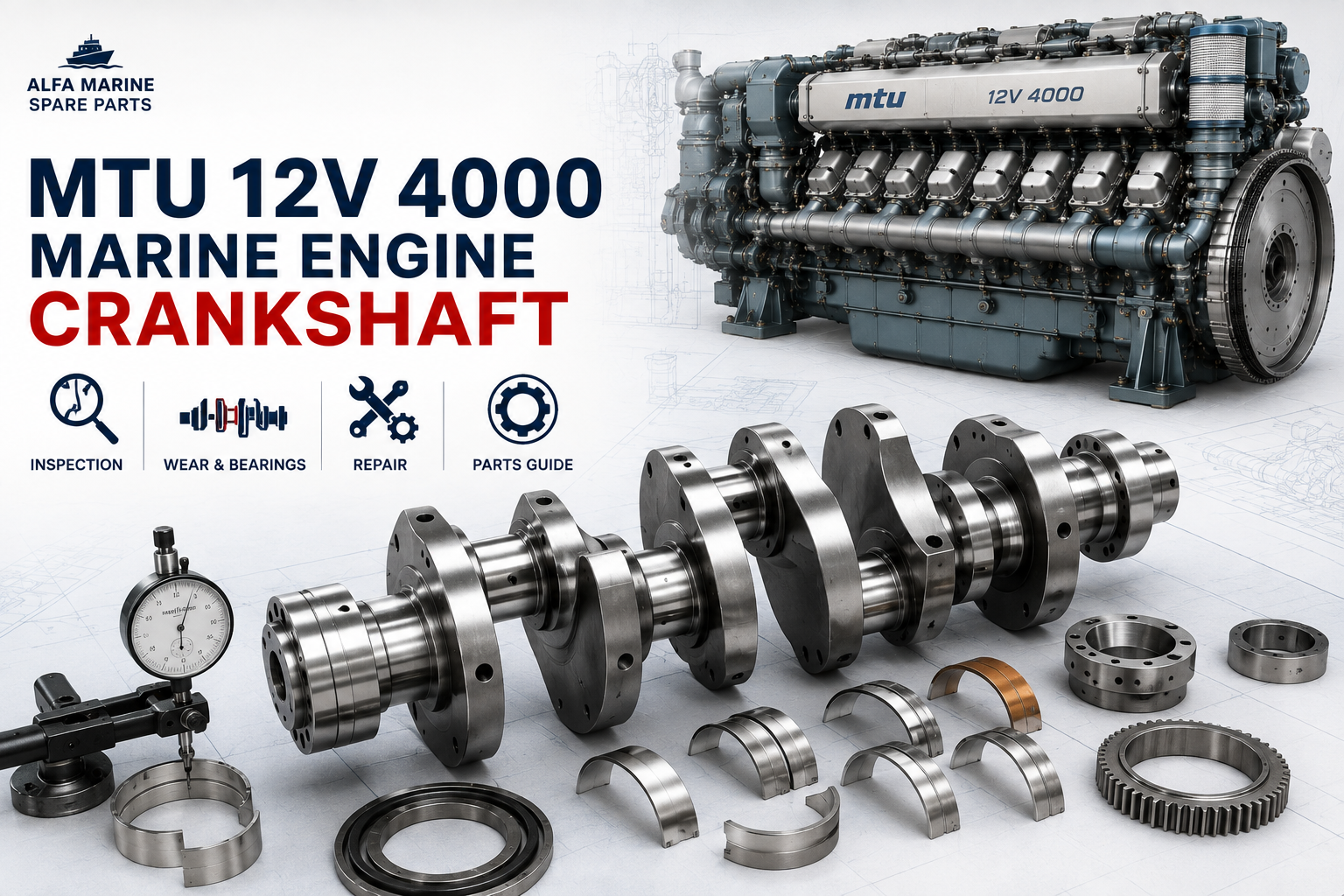

MTU 12V 4000 Marine Engine Crankshaft: Inspection, Wear, Bearings, Repair & Parts Guide
The crankshaft in an MTU 12V 4000 marine engine is one of the most important and expensive internal components in the complete engine.
Every combustion event creates force at the piston.
That force travels through:
piston → connecting rod → crankshaft
and becomes usable rotational power.
When the crankshaft is in good condition, the engine can operate smoothly for many hours.
When problems begin, the first warning signs may be much less dramatic than a complete engine failure.
You may notice:
- Lower oil pressure
- Metallic debris in the engine oil
- Bearing material in the oil filter
- Increased vibration
- Abnormal knocking
- Uneven bearing wear
- Changes during overhaul inspection
The important question is not simply:
“Is the crankshaft damaged?”
It is:
“Why did the crankshaft become damaged?”
If the original cause was oil starvation, contaminated oil, incorrect bearing clearance, a failed connecting-rod bearing or another lubrication problem, installing another crankshaft without correcting that cause can lead to the same failure again.
1. MTU 12V 4000 Marine Engine Types
The MTU Series 4000 includes several 12-cylinder marine versions across different generations, ratings and applications.
Common 12V 4000 types include:
- MTU 12V 4000 M53
- MTU 12V 4000 M53R
- MTU 12V 4000 M54
- MTU 12V 4000 M63
- MTU 12V 4000 M64
- MTU 12V 4000 M65
- MTU 12V 4000 M65L
- MTU 12V 4000 M65R
- MTU 12V 4000 M73
- MTU 12V 4000 M73L
- MTU 12V 4000 M93
- MTU 12V 4000 M93L
These engines should not automatically be assumed to use the same crankshaft or bearing specification.
Always identify:
full engine model + engine serial number + existing crankshaft identification
before ordering.
2. What Does the MTU 12V 4000 Crankshaft Do?
The crankshaft converts the linear movement of the pistons into rotary motion.
The basic power path is:
Combustion
↓
Piston moves downward
↓
Connecting rod transfers force
↓
Crankshaft rotates
↓
Power moves toward the flywheel and marine transmission
The crankshaft is therefore continuously subjected to:
- Bending loads
- Torsional loads
- Combustion forces
- Bearing loads
- Repeated acceleration and deceleration forces
On a high-output V12 marine diesel, these loads are substantial.
3. Main Journals and Connecting-Rod Journals
The crankshaft contains two important types of bearing surfaces.
Main Journals
These support the crankshaft inside the crankcase.
They operate with the engine's main bearings.
Connecting-Rod Journals
These support the big ends of the connecting rods.
They operate with the connecting-rod bearing shells.
Both depend on:
- Correct journal dimensions
- Correct bearing clearance
- Clean oil
- Correct oil pressure
- Proper alignment
A problem in one area can quickly damage the others.
4. Why Crankshaft Lubrication Is So Important
The crankshaft journals should normally rotate on a film of lubricating oil rather than directly against the bearing material.
That oil film helps prevent:
metal-to-metal contact.
If the oil film is lost, even briefly under heavy load, bearing temperature and wear can increase rapidly.
Possible causes include:
- Low oil level
- Oil-pump problems
- Restricted oil passages
- Oil contamination
- Incorrect lubricant
- Excessive oil temperature
- Excessive bearing clearance
- Incorrect assembly
A crankshaft failure is therefore often closely connected to a lubrication-system problem.
5. Situation: MTU 12V 4000 Oil Pressure Begins Falling
Low oil pressure can be an important warning.
Possible causes include:
- Low engine oil level
- Incorrect oil viscosity
- High oil temperature
- Oil-filter problems
- Oil-pump wear
- Internal leakage
- Worn main bearings
- Worn connecting-rod bearings
- Crankshaft journal wear
- Pressure-sensor problems
Do not immediately conclude:
“The oil pump is bad.”
Increasing bearing clearance can also reduce system pressure.
6. Watch the Oil Pressure Trend
One isolated reading is useful.
A history is better.
For example:
Last season: normal
Six months ago: slightly lower
Three months ago: lower again
Now: noticeably lower under the same load
If:
- RPM
- Oil temperature
- Engine load
are comparable, that trend deserves investigation.
The engine may be showing the beginning of internal wear.
7. Metallic Material in the Oil Filter
The used oil filter can provide valuable information.
If unusual metallic debris is found during inspection, do not simply install a new filter and continue running.
Possible sources include:
- Main bearings
- Connecting-rod bearings
- Other lubricated internal components
The crankshaft itself may not yet be severely damaged.
Finding bearing material early may give you the opportunity to protect the journals before major damage develops.
8. Do Not Throw Away Damaged Bearings Before Looking at Them
Old bearings can tell you a great deal.
Inspect for:
- Scoring
- Wiping
- Heat discoloration
- Embedded contamination
- Uneven wear
- Fatigue
- Exposure of underlying bearing layers
The wear pattern can provide clues about the failure mechanism.
A bearing is evidence.
Inspect it before discarding it.
9. What Causes Crankshaft Journal Scoring?
Journal scoring can be caused by:
- Contaminated oil
- Metallic debris
- Bearing failure
- Oil starvation
- Incorrect clearance
- Foreign particles
- Poor assembly cleanliness
Scoring can range from light polishing marks to deep grooves.
The repair decision depends on:
- Depth of damage
- Journal diameter
- Taper
- Ovality
- Surface condition
- Applicable repair limits
10. Oil Starvation Can Damage the Crankshaft Quickly
A crankshaft journal carrying heavy combustion loads cannot operate correctly without adequate lubrication.
Loss of oil supply can damage:
bearing → journal → connecting rod → crankshaft
in a relatively short period.
Possible causes include:
- Pump failure
- Low oil level
- Blocked oilway
- Oil pickup problem
- Incorrect assembly
- Severe contamination
When bearing damage is discovered, always investigate the oil supply to that position.
11. High Oil Temperature Matters
Hot oil becomes less viscous.
Under heavy load, excessive oil temperature can reduce the margin of protection at bearings.
If the engine develops:
higher oil temperature + lower oil pressure,
investigate:
- Oil cooler
- Cooling system
- Engine load
- Oil condition
- Lubrication system
Do not look at the crankshaft without looking at the oil conditions that supported it.
12. Fuel Dilution Can Damage Bearing Protection
Fuel entering the engine oil can reduce viscosity.
Possible warning signs include:
- Rising oil level
- Diesel smell
- Abnormally thin oil
- Lower oil pressure
If fuel dilution continues, bearing protection can deteriorate.
A fuel-system problem can therefore eventually become:
a bearing problem
and later:
a crankshaft problem.
13. Coolant Contamination Is Also Serious
Coolant entering the lubrication system can rapidly compromise bearing protection.
Possible signs include:
- Milky oil
- Sludge
- Rising oil level
- Coolant loss
If coolant contamination has occurred, inspect more than the oil.
Consider:
- Bearings
- Crankshaft journals
- Oil passages
- Oil cooler
- Lubrication system
Changing the oil alone may not be enough after a serious contamination event.
14. Crankshaft Inspection During Overhaul
During a major overhaul, inspection should be systematic.
Areas can include:
- Main journals
- Connecting-rod journals
- Journal surfaces
- Oil holes
- Fillet areas
- Signs of overheating
- Dimensional wear
- Evidence of cracking
- Straightness where required
The exact inspection procedure should follow the technical requirements for the specific MTU 12V 4000 version.
15. Do Not Judge the Crankshaft Only by Appearance
A journal may look smooth and shiny while being dimensionally worn.
Possible conditions include:
- Undersize diameter
- Taper
- Ovality
- Uneven wear
Visual inspection answers:
“Does it look damaged?”
Measurement answers:
“Can it still operate correctly?”
Both are necessary.
16. Measuring the Main Journals
Main journals should be measured accurately at multiple positions.
Technicians may check for:
- Diameter
- Taper
- Ovality
- Localized wear
Measurements should then be compared with the applicable specification.
Do not make bearing-selection decisions from visual condition alone.
17. Measuring Connecting-Rod Journals
The same principle applies to connecting-rod journals.
One journal may show more wear than another.
If one rod journal is significantly different, ask why.
Possible causes include:
- Local oil-supply problem
- Connecting-rod condition
- Bearing failure
- Cylinder-specific loading
Localized damage deserves localized investigation.
18. Why Taper Matters
A journal may wear more at one side than another.
This creates taper.
Excessive taper can affect:
- Bearing loading
- Oil-film formation
- Bearing life
Even if one measurement looks acceptable, the complete journal geometry still matters.
19. Why Ovality Matters
A worn journal can become slightly oval rather than perfectly round.
That changes bearing clearance as the crankshaft rotates.
Possible consequences include:
- Uneven oil film
- Increased bearing stress
- Oil-pressure effects
- Accelerated wear
A smooth-looking journal can therefore still be unsuitable.
20. Crankshaft Fillet Areas
The fillet area between the journal and crank web carries significant stress.
Inspect for:
- Cracks
- Surface damage
- Poor previous machining
- Grinding marks
Incorrect crankshaft repair around fillet areas can negatively affect crankshaft strength.
This is one reason crankshaft machining should be handled by specialists experienced with large high-output diesel crankshafts.
21. Internal Crankshaft Oil Passages
Crankshaft oil passages distribute lubrication toward important bearing positions.
During overhaul, these passages must be clean.
This becomes especially important after:
- Bearing failure
- Metal contamination
- Severe oil degradation
A rebuilt engine with new bearings can still fail quickly if metallic debris remains inside an internal crankshaft oil passage.
22. Clean the Complete Lubrication System After Bearing Failure
Do not focus only on the crankshaft.
Metal can circulate into:
- Oil cooler
- Oil pump
- Filter housing
- Oil lines
- Oil pan
- Engine galleries
- Crankshaft oilways
If the contamination is not removed, it can return to the new bearings.
A successful crankshaft repair therefore includes lubrication-system cleanliness.
23. Main Bearing Wear Patterns
Main bearings may show:
- Even wear
- Edge loading
- Scoring
- Embedded debris
- Heat damage
- Localized wear
Different patterns point toward different possible causes.
For example, repeated unusual wear across several main bearings may require investigation beyond simply replacing bearing shells.
24. Connecting-Rod Bearings
Rod bearings carry heavy combustion loading.
Inspect them carefully during overhaul.
Possible signs include:
- Scoring
- Wiping
- Pitting
- Heat discoloration
- Uneven wear
- Bearing material transfer
If one rod bearing is dramatically worse than the others, determine why before rebuilding.
25. Connecting-Rod Condition
The connecting rod itself should also be considered.
Inspect as required for:
- Big-end condition
- Alignment
- Bushings
- Fasteners
- Surface damage
Installing a good crankshaft and new bearing with a questionable connecting rod is poor overhaul practice.
26. One Bad Journal vs. General Crankshaft Wear
This distinction can help identify the failure cause.
General Wear Across Many Journals
May indicate:
- High overall engine hours
- General lubrication deterioration
- Widespread contamination
One Severely Damaged Journal
May indicate:
- Local oil-supply problem
- One failed bearing
- One connecting-rod problem
- One abnormal cylinder
Do not assume every crankshaft failure is simply caused by old age.
27. Cylinder Problems Can Affect Crankshaft Loading
Abnormal combustion can increase loading on a particular crankpin and connecting rod.
Possible cylinder-related causes can include:
- Injector problems
- Incorrect fuel delivery
- Piston damage
- Severe combustion imbalance
If one rod bearing or crankpin is badly damaged, inspect the cylinder connected to it.
28. Injector Inspection During Crankshaft Repair
Suppose one bearing position has failed badly.
Do not rebuild the bottom end and reinstall the same questionable injector without testing or evaluation.
Inspect the corresponding:
- Injector
- Piston
- Liner
- Connecting rod
The bottom-end failure may have had an upstream cause.
29. Can an MTU 12V 4000 Crankshaft Be Polished?
Possibly, when damage is minor and dimensions remain within permitted limits.
Polishing may address:
- Light marks
- Minor surface imperfections
But after polishing, the crankshaft still needs to meet the required dimensional and surface condition.
Shiny does not mean correct.
30. Can an MTU 12V 4000 Crankshaft Be Ground?
This depends entirely on:
- Crankshaft design
- Existing dimensions
- Damage
- Previous repair history
- Permitted repair sizes
- Applicable technical limits
Do not assume that every Series 4000 crankshaft can simply be ground to the next undersize.
Confirm the allowed repair procedure for the exact crankshaft.
31. Polishing and Grinding Are Not the Same
Polishing
Removes a very small amount of material to improve surface condition.
Grinding
Removes substantially more material to restore journal shape or surface.
Grinding changes the journal dimension.
That affects the bearings required.
This difference is critical during parts ordering.
32. When Is Crankshaft Replacement More Appropriate?
Replacement may be required when there is:
- Severe scoring
- Cracking
- Major heat damage
- Excessive journal wear
- Distortion
- Damage beyond approved repair limits
Trying to save a badly damaged crankshaft can put the entire rebuilt engine at risk.
33. Heat Discoloration
A bearing failure can create very high local temperature.
Look for:
- Blue discoloration
- Dark heat marks
- Surface distress
Severe heat can affect more than appearance.
Further inspection may be necessary before deciding that the journal can be reused.
34. Crack Inspection
Depending on condition and overhaul requirements, specialist crack detection may be required.
Areas deserving particular attention can include:
- Fillets
- Journal transitions
- Areas affected by severe bearing failure
A cracked crankshaft should never be treated casually.
35. Crankshaft Straightness
Major internal failure or improper handling can potentially affect crankshaft straightness.
Where required, straightness should be evaluated using the appropriate procedure.
Do not install an expensive crankshaft simply because the journals measure correctly if there are concerns about distortion.
36. Correct Crankshaft Handling
An MTU Series 4000 crankshaft is a large precision component.
During handling:
- Use suitable lifting equipment
- Support it correctly
- Protect journal surfaces
- Prevent impacts
- Keep it clean
- Avoid uncontrolled loading
A good crankshaft can be damaged in the workshop through poor handling.
37. Crankshaft Storage
Precision surfaces should be protected against:
- Moisture
- Salt air
- Dirt
- Corrosion
- Impact
This is especially important in marine workshops where humidity can be high.
Store the crankshaft correctly until installation.
38. Main Bearing Selection
Do not order main bearings until the crankshaft condition is known.
You need to establish:
- Journal dimensions
- Standard or approved repair size
- Bearing requirements
An engine that has been rebuilt previously may not necessarily still have untouched original journal dimensions.
39. Connecting-Rod Bearing Selection
The same principle applies to rod bearings.
Before ordering, confirm:
- Crankpin dimensions
- Repair history
- Bearing specification
- Exact engine version
Do not choose bearings from engine-family name alone.
40. Crankshaft Thrust Components
Crankshaft axial movement must also be controlled.
During overhaul, inspect relevant thrust-bearing components and surfaces.
Excessive axial movement can indicate:
- Thrust-bearing wear
- Thrust-surface damage
- Incorrect assembly
Bottom-end inspection should therefore include both radial and axial crankshaft control.
41. Oil Pump Inspection
If the engine suffered bearing or crankshaft damage, inspect the oil pump.
Look for:
- Wear
- Scoring
- Drive condition
- Contamination
- Pressure-control issues
A rebuilt crankshaft assembly needs reliable oil pressure from the first seconds of startup.
42. Oil Cooler Inspection
Metal contamination can enter the oil cooler.
If it remains trapped there and the cooler is returned to service, debris can contaminate the rebuilt engine.
This is why serious bearing failures may require inspection, cleaning or replacement of contaminated lubrication-system components.
43. Torsional Vibration
The crankshaft also experiences twisting forces.
The complete drivetrain can include:
crankshaft → flywheel → coupling → marine gear → shaft → propeller.
Components affecting torsional behavior and alignment should be considered when unusual vibration has been present.
44. Flywheel and Coupling Inspection
During major crankshaft work, inspect connected components where appropriate for:
- Wear
- Loose fasteners
- Damage
- Abnormal contact
The crankshaft works as part of a propulsion system.
Do not view it in isolation.
45. Marine Gear and Shaft Alignment
If the engine has been removed or significantly disturbed during overhaul, alignment should be checked according to the vessel's procedures.
Poor alignment can contribute to:
- Vibration
- Coupling stress
- Drivetrain problems
A successful engine rebuild still requires correct installation in the vessel.
46. Propeller Overload
A heavily loaded engine can experience increased mechanical stress.
Possible causes include:
- Over-pitched propeller
- Propeller fouling
- Damaged propeller
- Excessive vessel resistance
If the engine historically struggled to reach rated loaded RPM, investigate the propulsion load during overhaul.
47. First Startup After Crankshaft Work
After major bottom-end repair, monitor the engine carefully.
Important areas include:
- Oil pressure
- Oil leakage
- Engine noise
- Vibration
- Coolant temperature
If oil pressure is abnormal, stop and investigate.
Do not assume that a lubrication problem will correct itself after the engine runs longer.
48. Do Not Immediately Apply Full Load
After major internal repair, the engine should be commissioned using the correct procedure for the specific engine and overhaul.
Monitor progressively:
- Oil pressure
- Temperature
- Vibration
- Exhaust conditions
- Engine load
The objective is to verify the rebuild before demanding maximum propulsion power.
49. Sea Trial
A propulsion engine should ultimately be evaluated under actual operating load.
During the sea trial, monitor:
- Oil pressure
- Coolant temperature
- Oil temperature
- Loaded RPM
- Engine load
- Vibration
- Exhaust behavior
Compare with historical vessel data where available.
50. Keep the Crankshaft Measurements
A good overhaul report should record:
- Main journal sizes
- Rod journal sizes
- Taper measurements
- Ovality measurements
- Repair work performed
- Bearings fitted
- Clearances
- Crankshaft identification
- Engine hours
These records can be extremely valuable during the next overhaul.
51. New, Used and Reconditioned MTU 4000 Crankshafts
There is an important difference.
New Crankshaft
A newly manufactured crankshaft.
Used Crankshaft
A component removed from another engine.
Its history and dimensions need to be understood.
Reconditioned Crankshaft
A used crankshaft that has undergone inspection and permitted repair work.
When buying a used or reconditioned crankshaft, request information about:
- Journal measurements
- Repair history
- Crack inspection
- Surface condition
- Previous machining
Appearance alone is not enough.
52. MTU 12V 4000 Crankshaft Part Number
The MTU 12V 4000 crankshaft part number must be verified against the exact engine build.
There is not one crankshaft number that should be published as universally correct for every:
- 12V 4000 M53
- 12V 4000 M63
- 12V 4000 M65
- 12V 4000 M73
- 12V 4000 M93
configuration.
The correct identification should be based on:
Engine model: MTU 12V 4000 M____
Engine serial number: __________
Existing crankshaft part number: __________
Crankshaft casting/identification markings: __________
Important Parts Identification Note
When requesting an MTU 12V 4000 crankshaft, do not rely on a generic Series 4000 part number.
The crankshaft part number should be confirmed by engine serial number before ordering.
This is especially important because different Series 4000 generations and M-designations can have component revisions.
53. Why I Would Not Publish an Unverified Crankshaft Number
Crankshafts are high-value internal components.
Publishing a number simply because it appears associated with a Series 4000 engine elsewhere can create a serious identification problem.
The safest and most technically accurate approach is:
MTU 12V 4000 model + serial number + existing crankshaft identification = correct crankshaft part number.
This also protects buyers when dealing with engines that have been rebuilt or updated previously.
54. Common MTU 12V 4000 Crankshaft-Related Parts
A crankshaft repair may involve:
- Complete crankshaft
- Main bearings
- Connecting-rod bearings
- Thrust bearings
- Connecting rods
- Connecting-rod bushings
- Pistons
- Piston rings
- Cylinder liners
- Crankshaft seals
- Oil pump
- Oil-cooler components
- Gaskets
- O-rings
- Fasteners
The final parts requirement should be determined after inspection and measurement.
55. Crankshaft Seals
Front and rear crankshaft sealing components should also be evaluated during major bottom-end work.
Replacing a relatively inexpensive seal while the engine is already dismantled may prevent a significant amount of labor later.
Inspect:
- Seal surfaces
- Oil leakage history
- Mating components
56. Information to Send When Ordering an MTU 12V 4000 Crankshaft
Instead of:
“Need MTU 4000 crankshaft.”
send:
Manufacturer: MTU
Engine Model: 12V 4000 M73 / M93 / M53 / Other
Engine Serial Number: __________
Rated Power: __________
Rated RPM: __________
Current Crankshaft Part Number: __________
Crankshaft Identification Marking: __________
Condition Required: New / Used / Reconditioned
Main Bearings Required: Yes / No
Rod Bearings Required: Yes / No
Quantity: __________
Photographs: Attached
Delivery Location: __________
This provides a much stronger basis for correct parts identification.
57. Frequently Asked Questions
How Many Cylinders Does the MTU 12V 4000 Have?
It is a 12-cylinder V-engine.
What Is the Approximate Displacement?
Established 12V Series 4000 architecture is approximately 57.3 liters, depending on the generation and version.
What Causes MTU 4000 Crankshaft Damage?
Possible causes include oil starvation, contaminated lubricant, failed bearings, excessive clearances, overheating and abnormal mechanical loading.
Does Low Oil Pressure Mean the Crankshaft Is Bad?
Not automatically. Oil level, oil temperature, pump condition, bearing clearance, internal leakage and sensors should also be investigated.
Can an MTU 12V 4000 Crankshaft Be Reconditioned?
Depending on condition and permitted repair limits, some crankshafts may be suitable for specialist reconditioning.
Can I Reuse the Crankshaft With New Bearings?
Only after the journals have been inspected and measured and found suitable for continued service.
Should I Order Bearings Before Measuring the Crankshaft?
No. Determine crankshaft dimensions and repair condition first.
Should the Oil Cooler Be Checked After Bearing Failure?
Yes. Metal contamination can circulate through the lubrication system.
Is There One MTU 12V 4000 Crankshaft Part Number?
No single number should be assumed correct for every 12V 4000 version. Confirm the part number against the exact M-designation and engine serial number.
What Information Is Needed to Order the Correct Crankshaft?
Provide the complete engine model, engine serial number, existing crankshaft identification, rated power, rated RPM and photographs.
MTU 12V 4000 Marine Engine Types
Crankshaft and bottom-end requirements may apply to engines including:
- MTU 12V 4000 M53
- MTU 12V 4000 M53R
- MTU 12V 4000 M54
- MTU 12V 4000 M63
- MTU 12V 4000 M64
- MTU 12V 4000 M65
- MTU 12V 4000 M65L
- MTU 12V 4000 M65R
- MTU 12V 4000 M73
- MTU 12V 4000 M73L
- MTU 12V 4000 M93
- MTU 12V 4000 M93L
Always confirm the complete engine identification before ordering internal engine parts.
MTU 12V 4000 Crankshaft & Overhaul Spare Parts
Alfa Marine Spare Parts can assist with inquiries for:
- Crankshafts
- Main bearings
- Connecting-rod bearings
- Thrust bearings
- Connecting rods
- Pistons
- Piston rings
- Cylinder liners
- Cylinder heads
- Fuel injectors
- Turbochargers
- Oil pumps
- Coolant pumps
- Seawater pumps
- Oil coolers
- Gaskets
- O-rings
- Crankshaft seals
- Filters
- Sensors
- Overhaul components
Depending on component and availability, requirements may include new, OEM-quality, aftermarket, remanufactured or reconditioned parts.
Browse Our Complete Catalog
Marine engine brands:
https://alfamarinespareparts.com/our-brand
Marine spare parts:
https://alfamarinespareparts.com/spareparts
Contact Alfa Marine Spare Parts
For MTU 12V 4000 crankshafts, bearings and overhaul spare parts:
Email: request@alfamarinespareparts.com
For faster identification, provide:
complete MTU 12V 4000 M-designation + engine serial number + existing crankshaft identification + bearing requirements + quantity + photographs + delivery location.
Final Word
A crankshaft problem on an MTU 12V 4000 marine engine should never be treated as only a crankshaft problem.
The crankshaft depends on:
clean oil.
correct oil pressure.
correct bearing clearances.
healthy connecting rods.
proper alignment.
correct engine loading.
If one crank journal is damaged, determine why.
If the bearing failed because its oil passage was blocked, clean and inspect the lubrication system.
If the lubricant was contaminated, identify the source.
If one rod bearing is badly damaged while the others remain healthy, investigate that connecting rod and cylinder.
And if the crankshaft has already been repaired in the past, measure it before ordering bearings.
Most importantly, do not rely on a generic MTU Series 4000 crankshaft part number when ordering such an expensive component.
Use:
engine model + M-designation + serial number + crankshaft identification.
That combination gives you a much stronger basis for selecting the correct crankshaft.
The best MTU 12V 4000 crankshaft repair begins with measurement and root-cause diagnosis, not simply replacing the most visibly damaged part.
Meta Title
MTU 12V 4000 Crankshaft | Inspection, Bearings & Repair Guide