
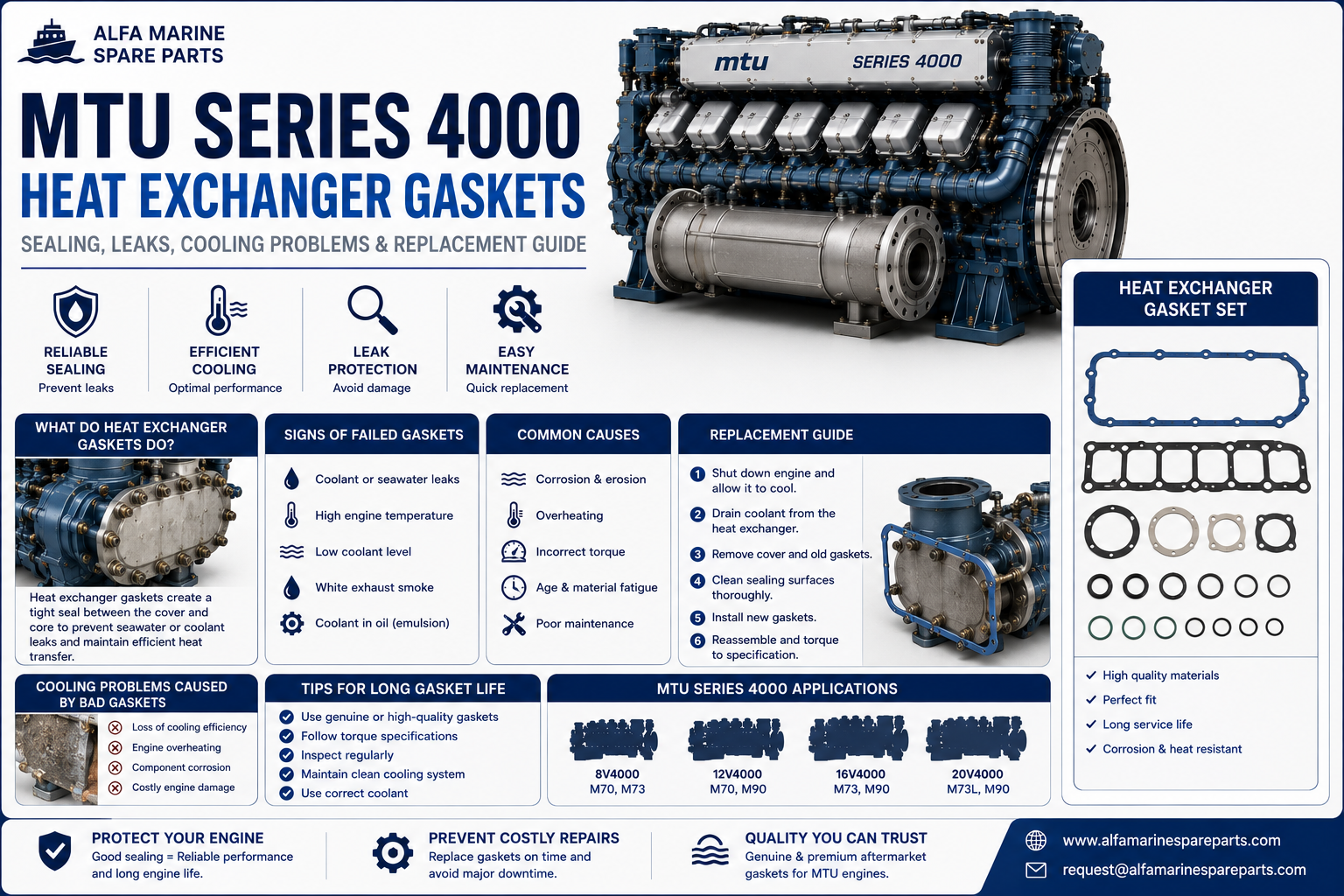
MTU Series 4000 Heat Exchanger Gaskets: Cooling Leaks, Seals & Replacement Guide
The heat exchanger gaskets on an MTU Series 4000 marine engine are small components with a very important job.
They help keep the cooling system sealed while the engine is operating under demanding temperatures and pressures.
When everything is working correctly, most people never think about them.
But imagine walking through the engine room and noticing a small dried coolant mark around the heat exchanger.
Or perhaps there is a little white salt buildup around an end cover.
The engine is still running normally. There is no alarm. Nothing appears urgent.
A few weeks later, however, the coolant needs topping up again.
That small mark suddenly becomes much more interesting.
A leaking heat exchanger gasket should therefore not be treated simply as:
“Replace the gasket and continue running.”
The better question is:
Why did the gasket start leaking?
Was it simply old?
Is the sealing surface corroded?
Was the heat exchanger recently dismantled?
Is the cover distorted?
Or is pressure developing somewhere in the cooling system?
Understanding the cause can prevent the new gasket from failing again.
1. MTU Series 4000 Marine Engine Types
The MTU Series 4000 family includes a wide range of marine engines used in yachts, commercial vessels, workboats and other high-power marine applications.
Common engine types include:
MTU 8V 4000
- MTU 8V 4000 M53
- MTU 8V 4000 M53R
- MTU 8V 4000 M54
- MTU 8V 4000 M63
MTU 12V 4000
- MTU 12V 4000 M53
- MTU 12V 4000 M63
- MTU 12V 4000 M64
- MTU 12V 4000 M65
- MTU 12V 4000 M65L
- MTU 12V 4000 M73
- MTU 12V 4000 M73L
- MTU 12V 4000 M93
- MTU 12V 4000 M93L
MTU 16V 4000
- MTU 16V 4000 M53
- MTU 16V 4000 M63
- MTU 16V 4000 M63L
- MTU 16V 4000 M64
- MTU 16V 4000 M65
- MTU 16V 4000 M65L
- MTU 16V 4000 M73
- MTU 16V 4000 M73L
- MTU 16V 4000 M93
- MTU 16V 4000 M93L
MTU 20V 4000
- MTU 20V 4000 M65L
- MTU 20V 4000 M73
- MTU 20V 4000 M73L
- MTU 20V 4000 M93
- MTU 20V 4000 M93L
The important point for spare-parts identification is that not every Series 4000 engine uses the same heat exchanger, gasket or sealing arrangement.
Engine model, serial number and cooler configuration matter.
2. What Does the Heat Exchanger Actually Do?
A marine diesel engine produces a tremendous amount of heat.
The cooling system has to remove that heat continuously while keeping the engine within its correct operating temperature range.
The heat exchanger allows heat to pass between separate cooling circuits without allowing the fluids themselves to mix.
A simplified example is:
Hot engine coolant
↓
Heat exchanger
↓
Heat transferred through exchanger surfaces
↓
Cooling medium carries heat away
The gaskets and seals keep those circuits contained.
That makes them much more important than their size suggests.
3. Why Are Heat Exchanger Gaskets Important?
Think about what the gasket experiences every time the engine operates.
The engine starts cold.
It warms up.
Metal components expand.
Pressure increases.
The vessel operates for several hours.
Then everything cools again.
This cycle can happen hundreds or thousands of times.
Over time, a gasket may:
- Harden
- Flatten
- Lose elasticity
- Crack
- Become chemically degraded
- Lose sealing pressure
Eventually, fluid can begin finding its way past the sealing surface.
4. Where Are Gaskets and Seals Used?
Depending on the particular heat exchanger and cooler arrangement, sealing components may be found around:
- Heat exchanger end covers
- Cooler housings
- Header plates
- Coolant connections
- Seawater connections
- Heat exchanger inserts
- Pipe flanges
- Cooler mounting surfaces
The system may use different sealing methods, including:
- Flat gaskets
- O-rings
- Profile seals
- Sealing rings
This is why ordering simply an “MTU 4000 heat exchanger gasket” can easily lead to the wrong component.
5. The First Sign May Be Very Small
A heat exchanger gasket rarely needs to produce a large leak before it becomes worth investigating.
The first warning might be:
A small coolant stain
or:
A white salt deposit
or:
A slightly damp flange
Perhaps the engine needs a small amount of coolant every few weeks.
These are exactly the kinds of changes engine-room inspections should catch.
A cooling-system leak is much easier to deal with while it is still small.
6. Coolant Around the Heat Exchanger
Suppose you discover coolant around one end of the exchanger.
Do not immediately reach for a wrench and tighten the bolts.
First determine exactly where the fluid is coming from.
Inspect:
- Gasket joint
- O-rings
- Hose connections
- Pipe fittings
- End cover
- Heat exchanger housing
- Nearby coolant lines
Coolant can travel along surfaces and make the leak appear somewhere other than its actual source.
Clean the area and inspect again.
7. White Salt Deposits Tell a Story
Seawater often leaves very clear evidence after it evaporates.
You may find:
- White crystalline deposits
- Green corrosion
- Rust staining
The area might be completely dry when you inspect it.
But the salt remains.
That can indicate that seawater has been escaping from:
- A gasket
- An O-ring
- A hose connection
- An end cover
- The heat exchanger itself
Do not clean away the evidence before determining where it came from.
8. Why Small Seawater Leaks Matter
A few drops of seawater may not appear serious.
But saltwater and engine-room components are not a good combination.
Continued leakage can attack:
- Fasteners
- Cooler housings
- Electrical connections
- Engine brackets
- Pipes
- Nearby metal components
What begins as a gasket replacement can eventually become a corrosion repair.
9. A Gasket Leak After Heat Exchanger Cleaning
This is an important situation.
The heat exchanger was not leaking.
It was opened for cleaning.
It is reassembled.
Now it leaks.
When a problem appears immediately after maintenance, look closely at what was disturbed.
Possible causes include:
- Old gasket reused
- Incorrect gasket fitted
- O-ring pinched
- O-ring twisted
- Sealing surface not cleaned properly
- Corrosion under the old gasket
- Uneven tightening
- Damaged cover
The new leak may have very little to do with the heat exchanger itself.
It may simply be an assembly problem.
10. Should You Reuse an Old Heat Exchanger Gasket?
Generally, a gasket that has already been compressed and heat-cycled deserves careful consideration before reuse.
An old gasket may appear fine when removed.
But it may already have:
- Lost elasticity
- Hardened
- Taken a permanent compression set
- Developed small cracks
Once the exchanger is dismantled, replacing applicable sealing components can help avoid reopening the same assembly because an old seal failed shortly afterward.
11. Don't Forget the O-Rings
People often talk about “heat exchanger gaskets” when the actual leak comes from an O-ring.
Inspect O-rings for:
- Flattening
- Cuts
- Cracks
- Hardening
- Swelling
- Twisting
A brand-new O-ring can also leak if it is damaged during installation.
Correct positioning is just as important as using a new seal.
12. Corrosion Under the Gasket
This is where simply installing a new gasket may not solve the problem.
Remove the old gasket and inspect underneath it.
You may discover:
- Pitting
- Corrosion
- Uneven surfaces
- Old gasket material
- Scratches
The gasket needs a suitable surface against which to seal.
A deeply corroded flange can continue leaking even with a new gasket.
13. The Sealing Surface Matters as Much as the Gasket
Imagine fitting a perfect new gasket onto a badly damaged flange.
The gasket is new.
The part number is correct.
The bolts are tightened.
But the leak returns.
Why?
Because the gasket can only compensate for a limited amount of surface damage.
Always inspect both mating surfaces.
14. Be Careful Removing Old Gasket Material
Old gasket material can sometimes stick firmly to the flange.
It needs to be removed without damaging the underlying sealing surface.
Deep scratches created during cleaning can become leak paths for the new gasket.
The objective is:
clean surface—not damaged surface.
15. More Sealant Is Not Always Better
Another common reaction is:
“Put extra sealant on it so it definitely won't leak.”
That is not always a good idea.
Excess sealant can squeeze into fluid passages.
It may:
- Restrict flow
- Break loose later
- Contaminate the cooling system
Use the correct sealing method for the component.
If the design relies on an O-ring or specific gasket, additional sealant should not automatically be assumed necessary.
16. Over-Tightening Can Cause Another Leak
A leaking cover sometimes encourages people to tighten the bolts harder.
But excessive tightening can:
- Crush the gasket
- Extrude the gasket
- Damage an O-ring
- Distort the cover
- Damage threads
- Create uneven clamping
The goal is not maximum bolt force.
The goal is correct and even sealing pressure.
17. Under-Tightening Can Cause Problems Too
Of course, insufficient clamping can also create leakage.
This is why correct assembly procedure matters.
Heat exchanger covers should be tightened according to the requirements for the specific assembly rather than by guesswork.
18. The Old Gasket Can Help Diagnose the Failure
Before throwing the old gasket away, inspect it.
Look for:
- Uneven compression
- Torn sections
- Hardened areas
- Localized corrosion
- Fluid tracking
- Chemical deterioration
The failure pattern can sometimes tell you what happened.
For example, one badly compressed area may suggest uneven clamping.
Corrosion concentrated around one section may point toward a damaged sealing surface.
19. Coolant Level Keeps Dropping but You Cannot Find the Leak
This deserves investigation.
If coolant continually needs topping up, it is going somewhere.
Possible areas include:
- Heat exchanger
- Cooler seals
- Coolant hoses
- Water pump
- Pipe connections
- Other cooling-system components
Clean the engine and cooling system thoroughly.
Then monitor it.
A clean engine room makes small leaks much easier to locate.
20. Heat Exchanger Gasket Failure vs. Heat Exchanger Fouling
These two problems can produce very different symptoms.
Gasket or Seal Failure
May cause:
- Coolant leakage
- Seawater leakage
- Salt deposits
- Pressure loss
- Repeated coolant top-ups
Heat Exchanger Fouling
May cause:
- Higher engine temperature
- Reduced cooling efficiency
- Temperature rise under load
And an older cooling system can have both problems at the same time.
Replacing the gasket does not clean the exchanger.
Cleaning the exchanger does not repair a damaged gasket.
21. Situation: Engine Runs Hotter After Heat Exchanger Service
Suppose an MTU 16V 4000 M73 ran normally before cooler maintenance.
The heat exchanger is removed and cleaned.
After reassembly, the engine operates hotter.
That timing matters.
Check:
- Coolant level
- Air trapped in the cooling circuit
- Seawater flow
- Cooler installation
- Gasket alignment
- O-ring installation
- Hose routing
- Valves that may have been closed during service
Do not immediately assume the engine suddenly developed an unrelated problem.
22. One Twin Engine Runs Hotter
Twin-engine installations provide an excellent reference.
Imagine twin MTU 16V 4000 M73 engines operating at similar RPM and load.
Port engine:
Temperature normal
Starboard engine:
Temperature gradually higher
Compare:
- Coolant levels
- Heat exchanger condition
- Seawater flow
- Cooler cleanliness
- Pump operation
- Charge-air temperature
- Oil temperature
The healthy engine can help show what “normal” looks like.
23. MTU 4000 Cooling Systems Are More Than One Cooler
On Series 4000 marine installations, cooling duties can involve several components and circuits.
Depending on engine version and installation, these can include cooling for:
- Engine coolant
- Charge air
- Lubricating oil
- Turbocharger-related components
- Marine transmission
This is why identifying which exchanger or cooler is leaking matters before ordering gaskets.
24. Heat Exchanger Gaskets on MTU 8V 4000 Engines
For engines such as:
- MTU 8V 4000 M53
- MTU 8V 4000 M53R
- MTU 8V 4000 M63
cooler configuration should be confirmed before parts are ordered.
Do not assume that because two engines belong to the Series 4000 family they use identical exchanger seals.
25. Heat Exchanger Gaskets on MTU 12V 4000 Engines
Common marine configurations include:
- MTU 12V 4000 M53
- MTU 12V 4000 M63
- MTU 12V 4000 M65
- MTU 12V 4000 M65L
- MTU 12V 4000 M73
- MTU 12V 4000 M73L
- MTU 12V 4000 M93
- MTU 12V 4000 M93L
During heat exchanger servicing, inspect:
- Main gaskets
- O-rings
- End-cover seals
- Pipe seals
- Flange condition
- Fasteners
A cooling-system overhaul should consider the complete sealing arrangement.
26. Heat Exchanger Gaskets on MTU 16V 4000 Engines
Common configurations include:
- MTU 16V 4000 M53
- MTU 16V 4000 M63
- MTU 16V 4000 M65
- MTU 16V 4000 M65L
- MTU 16V 4000 M73
- MTU 16V 4000 M73L
- MTU 16V 4000 M93
- MTU 16V 4000 M93L
These high-output engines produce substantial heat under load.
Cooling-system condition becomes particularly important during sustained high-power operation.
A small leak that seems insignificant at idle deserves more attention before the engine is operated hard for hours.
27. Heat Exchanger Gaskets on MTU 20V 4000 Engines
Examples include:
- MTU 20V 4000 M65L
- MTU 20V 4000 M73
- MTU 20V 4000 M73L
- MTU 20V 4000 M93
- MTU 20V 4000 M93L
These large engines have substantial cooling requirements.
Cooler cleanliness, pump performance and correct sealing all work together.
A gasket may be inexpensive.
The consequences of losing cooling performance on a large V20 engine are not.
28. Should You Replace All Seals When the Exchanger Is Open?
This depends on the specific cooler and service procedure, but once an exchanger is dismantled, all disturbed sealing components should be carefully evaluated.
That can include:
- Flat gaskets
- O-rings
- Sealing rings
- Pipe seals
- Cover seals
Opening the exchanger again because one old O-ring was reused can create unnecessary labor.
29. Pressure Testing After Repair
When internal leakage or exchanger damage is suspected, pressure testing can help separate a gasket problem from a cooler-core problem.
This distinction matters.
If the core itself is damaged, repeatedly replacing external gaskets will not solve the actual fault.
30. When Is the Heat Exchanger Itself the Problem?
Not every cooling leak is caused by a gasket.
Inspect for:
- Cracked housing
- Damaged cooler core
- Corroded end cover
- Pitted flange
- Tube damage
- Distorted mating surface
Sometimes the gasket is simply where the leak becomes visible.
The actual problem can be the component surrounding it.
31. Rebuild or Replace the Heat Exchanger?
Repair may make sense when:
- Housing remains serviceable
- Core is repairable
- Flanges remain sound
- Corrosion is limited
- Replacement gaskets and seals are available
Replacement may become necessary when:
- Housing is badly corroded
- Flange pitting is severe
- Core damage is extensive
- Structural integrity is questionable
The decision should be based on the condition of the exchanger, not simply its age.
32. Common MTU 4000 Heat Exchanger Sealing Parts
Depending on the engine and cooler arrangement, parts requirements may include:
- Heat exchanger gaskets
- End-cover gaskets
- Cooler gaskets
- O-rings
- Profile seals
- Sealing rings
- Flange gaskets
- Pipe O-rings
- Cooler insert seals
- Housing seals
This is why photographs can be extremely useful when identifying an unfamiliar seal.
33. Why Part Numbers Matter
A gasket can look extremely simple.
That does not mean any gasket with approximately the same dimensions will work.
Differences can involve:
- Thickness
- Material
- Internal openings
- Bolt-hole position
- Temperature resistance
- Coolant compatibility
- Seawater resistance
For reliable identification, use the actual part number whenever possible.
34. Do Not Guess MTU Heat Exchanger Gasket Part Numbers
With Series 4000 engines, part numbers should be matched against the exact engine and heat exchanger configuration.
Unlike a generic service component, the wrong gasket can appear almost correct while still having different:
- Passage openings
- Dimensions
- Sealing profiles
For this reason, it is better to verify a gasket number than publish one as though it fits the entire Series 4000 family.
35. What Information Should Be Used to Identify the Gasket?
For an MTU 4000 heat exchanger gasket inquiry, collect:
Engine manufacturer: MTU
Complete engine type: __________
Example: MTU 16V 4000 M73
Engine serial number: __________
Heat exchanger / cooler part number: __________
Existing gasket number: __________
Quantity required: __________
Photographs: Attached
If the old gasket has a visible number, photograph it before cleaning or discarding it.
36. Photograph the Heat Exchanger Identification
If possible, photograph:
- Complete heat exchanger
- Identification plate
- Part number
- Old gasket
- Gasket location
- Connections
- Engine serial-number plate
One good photograph can sometimes answer questions that several emails cannot.
37. Common Signs of MTU 4000 Heat Exchanger Gasket Problems
Watch for:
☐ Coolant stains
☐ Seawater leakage
☐ White salt deposits
☐ Green corrosion
☐ Repeated coolant top-ups
☐ Damp exchanger covers
☐ Cooling-system pressure changes
☐ Higher operating temperature
☐ Leak appearing after cooler maintenance
These symptoms do not automatically prove gasket failure, but they justify further inspection.
38. Heat Exchanger Gasket Replacement Checklist
Before reassembly:
☐ Confirm correct gasket
☐ Confirm engine serial number
☐ Confirm cooler identification
☐ Remove old gasket completely
☐ Inspect sealing surfaces
☐ Check for corrosion
☐ Inspect O-rings
☐ Clean mating surfaces
☐ Check cover condition
☐ Follow correct tightening procedure
☐ Refill cooling system correctly
☐ Check for leakage
☐ Monitor operating temperature
Taking a few extra minutes during assembly can save hours of dismantling later.
39. First Startup After Heat Exchanger Work
After servicing the exchanger, stay with the engine during the initial startup.
Watch:
- Coolant level
- Coolant leakage
- Seawater leakage
- Operating temperature
- Hose connections
- Exchanger joints
Allow the engine to reach operating temperature.
Then inspect again.
A seal may remain dry when cold but begin leaking after thermal expansion.
40. Check Again After the Sea Trial
The cooling system experiences different conditions under load.
After a sea trial, inspect the heat exchanger again.
Look for:
- Fresh salt deposits
- Coolant traces
- Moisture
- New corrosion marks
Also compare operating temperatures with the readings recorded before maintenance.
41. Keep a Cooling-System Maintenance History
Record:
- Heat exchanger cleaning
- Gasket replacement
- O-ring replacement
- Cooler repairs
- Coolant replacement
- Seawater-pump service
- Temperature changes
This becomes especially useful on older engines.
If the same exchanger begins leaking every year, repeated gasket replacement may not be addressing the actual cause.
42. Frequently Asked Questions
What Does an MTU 4000 Heat Exchanger Gasket Do?
It seals joints within the heat exchanger or cooling assembly so coolant and seawater remain correctly contained and separated.
Can a Bad Heat Exchanger Gasket Cause Overheating?
It can contribute indirectly if leakage causes coolant loss, pressure problems or reduced cooling-system performance.
Why Is There White Salt Around My Heat Exchanger?
It can indicate that seawater has leaked and evaporated. Inspect gaskets, O-rings, hose connections and the heat exchanger itself.
Why Does My Heat Exchanger Leak After Cleaning?
Possible causes include an old gasket being reused, incorrect seal installation, damaged O-ring, corrosion, dirty sealing surfaces or incorrect tightening.
Can I Just Tighten the Cover Bolts?
Not necessarily. Excessive tightening can damage the gasket, cover or threads. First determine why the joint is leaking.
Should Old Heat Exchanger Gaskets Be Reused?
Disturbed gaskets and seals should be carefully evaluated. A compressed, hardened or damaged gasket may not reseal reliably.
Can a New Gasket Fix a Corroded Flange?
Not always. Severe pitting or surface damage may prevent proper sealing even with a new gasket.
Does Every MTU 4000 Use the Same Heat Exchanger Gasket?
No. Gasket requirements vary according to engine model, serial number, heat exchanger and cooling-system configuration.
What Information Should I Provide When Ordering?
Provide the complete MTU engine model, engine serial number, heat exchanger number, existing gasket number and photographs.
MTU Series 4000 Heat Exchanger & Cooling Parts
Common requirements for Series 4000 cooling-system service can include:
- Heat exchanger gaskets
- End-cover gaskets
- O-rings
- Sealing rings
- Cooler inserts
- Heat exchanger cores
- Heat exchanger housings
- Coolant pumps
- Seawater pumps
- Oil cooler components
- Charge-air cooler components
- Thermostats
- Coolant pipes
- Cooling hoses
- Temperature sensors
- Cooling-system seals
Correct parts identification should always be based on the exact engine and cooler configuration.
Browse Our Complete Catalog
Marine engine brands:
https://alfamarinespareparts.com/our-brand
Marine spare parts:
https://alfamarinespareparts.com/spareparts
Contact Alfa Marine Spare Parts
For MTU Series 4000 heat exchanger gaskets, O-rings, cooler seals and cooling-system spare parts:
Email: request@alfamarinespareparts.com
For accurate identification, send:
MTU 4000 engine type + engine serial number + heat exchanger part number + existing gasket number + photographs + quantity + delivery location.
Final Word
A heat exchanger gasket on an MTU Series 4000 marine engine can look like one of the least important parts in the engine room.
Until it starts leaking.
Then the right approach is not simply:
“Change the gasket.”
Ask:
Why did it leak?
If the exchanger was just serviced, inspect the assembly.
If the gasket is badly damaged in one area, inspect the flange.
If there are salt deposits, find the seawater leak.
If the coolant level keeps dropping, find where it is going.
And if a new gasket begins leaking again shortly after replacement, stop replacing gaskets and investigate the surrounding component.
The gasket is only as good as the surfaces holding it.
For an MTU 8V, 12V, 16V or 20V 4000, accurate identification is equally important. Do not order from the words “MTU 4000 heat exchanger gasket” alone.
Use:
engine type + serial number + heat exchanger number + existing gasket number + photographs.
That small amount of information can make the difference between receiving a gasket that looks almost right and receiving the gasket that actually belongs on the engine.