Perkins Marine Engine Exhaust Systems: Manifolds, Turbochargers, Risers, Elbows, Leaks & Troubleshooting
The exhaust system on a Perkins marine engine does much more than carry exhaust gas away from the engine.
It affects:
- Turbocharger performance
- Exhaust backpressure
- Engine-room temperature
- Engine power
- Exhaust temperature
- Smoke
- Fuel consumption
- Noise
- Safe handling of cooling water on wet-exhaust installations
A small exhaust leak may begin as nothing more than a black soot mark around a manifold joint.
A corroded exhaust elbow may gradually restrict flow.
A damaged wet-exhaust component can create a much more serious problem if seawater is allowed to travel toward the engine.
This is why the exhaust system should be inspected as part of the complete Perkins marine engine system.
The useful question is not simply:
“Is exhaust coming out of the boat?”
It is:
“Is exhaust leaving the engine freely, at the correct temperature and without allowing seawater to return toward the engine?”
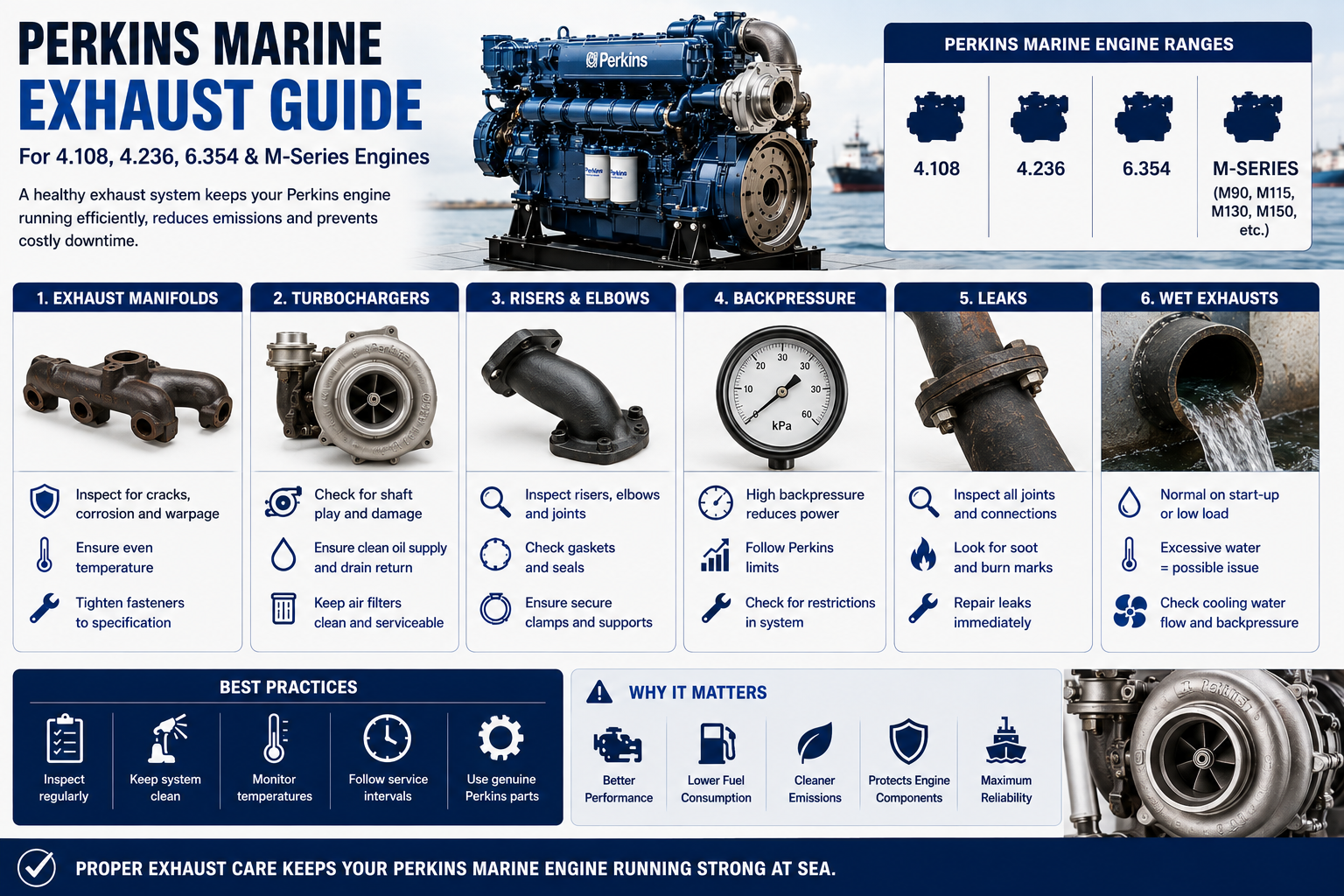
1. Perkins Marine Engine Types Covered in This Guide
Perkins has supplied marine diesel engines for many years, and numerous older models remain in service.
Common Perkins marine engine types include:
Smaller Perkins Marine Engines
- Perkins 1GM10-related legacy installations
- Perkins 4.108
- Perkins 4.154
- Perkins 4.236
- Perkins 4.248
- Perkins 4.4GM
- Perkins 4.4TGM
- Perkins 415GM
Perkins 6-Cylinder & Legacy Marine Engines
- Perkins 6.354
- Perkins 6.354M
- Perkins 6.3544
- Perkins 6TWGM
- Perkins 6TG2AM
Perkins Sabre / M-Series Marine Engines
- Perkins M65
- Perkins M85T
- Perkins M92
- Perkins M92B
- Perkins M115T
- Perkins M130C
- Perkins M135
- Perkins M150Ti
- Perkins M185C
- Perkins M190C
- Perkins M200C
- Perkins M215C
- Perkins M216C
- Perkins M225Ti
- Perkins M245C
- Perkins M250C
- Perkins M265Ti
- Perkins M300C
- Perkins M300Ti
Newer Perkins Auxiliary Marine Engines
- Perkins E44
- Perkins E70-TAG
- Other Perkins marine auxiliary configurations
Different engines can use very different exhaust arrangements.
An M92B and an M300Ti should not automatically be treated as having the same exhaust components simply because both carry the Perkins name.
2. What Does a Perkins Marine Exhaust System Do?
The exhaust system starts at the cylinders.
After combustion, the exhaust gas must leave the engine with as little unnecessary restriction as possible.
On a turbocharged engine, the flow is approximately:
Cylinder
↓
Exhaust manifold
↓
Turbocharger turbine
↓
Exhaust outlet
↓
Riser / elbow / exhaust piping
↓
Wet or dry exhaust system
↓
Overboard discharge
Every part of that path influences the next.
A restriction at the end of the system can affect the engine much farther upstream.
3. Why Exhaust Backpressure Matters
The engine has to push exhaust gas out after combustion.
If the exhaust system becomes restricted, the engine has to work harder to empty the cylinders.
Excessive restriction can contribute to:
- Reduced power
- Higher exhaust temperature
- Increased smoke
- Higher fuel consumption
- Reduced turbocharger performance
- Difficulty reaching expected RPM
A partially restricted exhaust can therefore make a healthy Perkins engine appear worn or underpowered.
4. Situation: The Perkins Engine No Longer Reaches Normal RPM
Suppose your M225Ti used to reach its normal loaded RPM.
Now it cannot.
The first suspects may be:
- Fuel filters
- Injectors
- Turbocharger
Those are reasonable checks.
But do not forget the exhaust.
Possible exhaust-related causes include:
- Restricted exhaust elbow
- Internal exhaust-hose deterioration
- Silencer restriction
- Carbon deposits
- Corrosion
- Excessive exhaust backpressure
The engine needs to breathe both in and out.
5. Perkins Exhaust Manifolds
The exhaust manifold collects exhaust gas from the cylinders and directs it toward the turbocharger or exhaust outlet.
Depending on the Perkins engine, marine manifolds may also incorporate water cooling.
For example, marine engines from the Perkins range have used freshwater-cooled or water-jacketed exhaust manifolds as part of their marine configuration.
This helps control external surface temperature and makes the engine more suitable for confined marine installations.
But cooling introduces additional components and sealing points that also need inspection.
6. Common Exhaust Manifold Problems
Possible problems include:
- Cracking
- Gasket failure
- Corrosion
- Coolant leakage
- Loose fasteners
- Distortion
- Carbon deposits
A manifold problem does not always begin with dramatic failure.
Sometimes the first sign is simply:
a small black soot mark.
7. Black Soot Around the Exhaust Manifold
Soot around a joint can indicate exhaust gas escaping.
Inspect:
- Manifold gasket
- Turbocharger connection
- Exhaust flange
- Fasteners
- Cracks
Do not simply wipe it away.
Clean the area, then inspect whether fresh soot returns.
That tells you the leak is active.
8. Why a Leak Before the Turbocharger Matters
On turbocharged Perkins engines, exhaust energy drives the turbine wheel.
If gas escapes before reaching the turbocharger, the turbine receives less energy.
Possible results include:
- Lower boost
- Slower acceleration
- Increased smoke
- Higher exhaust temperature
- Reduced engine output
A leaking manifold can therefore look like:
a weak turbocharger.
9. Exhaust Leaks Increase Engine-Room Heat
Escaping exhaust gas can substantially increase local temperature.
Nearby components may include:
- Fuel lines
- Electrical wiring
- Hoses
- Sensors
- Insulation
- Air-intake components
A small leak can eventually affect other systems.
It also introduces exhaust fumes into the engine room.
10. Perkins 4.108 Exhaust System
The Perkins 4.108 remains one of the best-known older Perkins marine engines.
Many have accumulated decades of service.
That means exhaust-system condition may depend as much on previous repairs as the original design.
Inspect:
- Exhaust manifold
- Elbow
- Riser
- Exhaust hose
- Clamps
- Water-injection arrangement
- Corrosion
Do not assume the current exhaust arrangement is still exactly as it left the original boatbuilder.
11. Perkins 4.236 Exhaust System
The Perkins 4.236 is another well-established mechanical diesel widely encountered in older marine installations.
On these engines, inspect for:
- Manifold leaks
- Exhaust elbow corrosion
- Wet-exhaust hose deterioration
- Water-injection condition
- Excessive soot
An older engine may still run very well while its exhaust components are approaching the end of their service life.
12. Perkins 6.354 Marine Exhaust System
The Perkins 6.354 family has been used in many commercial and recreational vessels.
These engines can have long service histories.
Pay attention to:
- Exhaust manifold condition
- Turbocharger on turbocharged versions
- Riser condition
- Water injection
- Wet-exhaust hoses
- Backpressure
If an older 6.354 suddenly develops more smoke or loses loaded RPM, inspect both the engine and the exhaust system.
13. Perkins M65 Exhaust System
The M65 is a smaller marine engine where the exhaust installation may be compact.
Small engine room dimensions make proper exhaust routing particularly important.
Inspect:
- Elbow
- Hose
- Clamps
- Water injection
- Exhaust outlet
A hose failure in a small engine compartment can quickly create a major problem.
14. Perkins M85T Exhaust System
The M85T is turbocharged.
That means the exhaust system directly influences turbocharger operation.
Watch for:
- Manifold leakage
- Turbo connection leakage
- Exhaust elbow restriction
- Soot
- Reduced boost
- Higher exhaust temperature
If the engine begins smoking more under load, inspect both the air and exhaust sides of the turbocharger.
15. Perkins M92 & M92B Exhaust Systems
The M92 and M92B are well-known Perkins marine engines.
The M92B marine configuration uses a freshwater-cooled exhaust manifold as part of its marine package.
Inspect:
- Manifold condition
- Cooling connections
- Exhaust outlet
- Elbow or riser
- Hose
- Clamps
Any evidence of coolant leakage around the manifold deserves attention.
16. Perkins M115T Exhaust System
The M115T is turbocharged, so exhaust-gas energy directly affects boost.
Possible symptoms of exhaust problems include:
- Poor acceleration
- Increased smoke
- Lower power
- High exhaust temperature
Check the manifold and turbocharger connections before assuming the turbocharger itself has failed.
17. Perkins M130C & M135 Exhaust Systems
These engines may be installed in yachts and commercial boats where compact engine-room design makes water-cooled exhaust components particularly useful.
Inspect the full system from:
manifold → exhaust outlet → riser/elbow → hose → discharge.
Do not only inspect what is visible at the rear of the engine.
18. Perkins M150Ti Exhaust System
The M150Ti is turbocharged and intercooled.
Its performance depends on good:
- Air supply
- Turbocharger condition
- Exhaust flow
A restricted exhaust can produce symptoms similar to:
- Turbocharger failure
- Dirty intercooler
- Fuel-system problems
Use several observations together before replacing components.
19. Perkins M185C Exhaust System
The M185C belongs to a higher-output marine engine class.
At increased output, exhaust flow and temperature become more significant.
Watch for:
- Manifold leaks
- Turbocharger connection leaks
- Elbow restrictions
- Insulation damage
- Exhaust hose deterioration
Changes under load are particularly useful.
20. Perkins M215C & M225Ti Exhaust Systems
These engines can be found in commercial and recreational propulsion.
The M225Ti adds turbocharged/intercooled performance considerations.
If the engine develops:
black smoke + lower boost + reduced RPM,
inspect:
- Air intake
- Turbocharger
- Exhaust manifold
- Exhaust backpressure
Do not assume it is only a fuel problem.
21. Perkins M250C & M300C Exhaust Systems
Larger Perkins marine engines produce substantially more exhaust flow.
On these engines, inspect:
- Manifold
- Turbocharger where applicable
- Exhaust piping
- Flexible connections
- Risers
- Cooling arrangements
- Insulation
The larger the engine, the greater the potential heat released by even a relatively small exhaust leak.
22. Perkins M265Ti & M300Ti Exhaust Systems
These turbocharged marine engines depend strongly on good exhaust flow.
A restriction downstream of the turbine can increase backpressure.
Possible symptoms include:
- High exhaust temperature
- Poor acceleration
- Reduced maximum RPM
- Increased fuel use
- Smoke
If performance deteriorates gradually, measure and inspect rather than simply replacing the turbocharger.
23. Perkins E44 & E70 Marine Exhaust Systems
Newer Perkins auxiliary marine engines can use purpose-designed water-jacketed or water-cooled exhaust components.
For example, Perkins lists water-jacketed exhaust manifolds and water-cooled turbocharger arrangements on selected newer marine auxiliary engines.
This helps manage heat in confined vessel installations.
But it also means the cooling and exhaust systems interact closely.
24. What Is a Wet Exhaust System?
Many Perkins marine installations use a wet exhaust system.
Cooling water is introduced into the exhaust downstream of the engine's hot components.
This reduces exhaust temperature before the mixture passes through marine exhaust hose and related components.
A simplified wet exhaust looks like:
Engine exhaust
↓
Riser/elbow
↓
Cooling water introduced
↓
Wet exhaust hose
↓
Silencer / waterlock where fitted
↓
Overboard
This system is practical, but it must be designed correctly.
25. The Biggest Wet-Exhaust Risk: Water Returning Toward the Engine
Cooling water should move toward the exhaust outlet.
It should not move backward toward the engine.
If seawater reaches the exhaust valves or cylinders, severe engine damage can occur.
This is why:
- Exhaust height
- Riser design
- Water-injection location
- Anti-siphon arrangements
- Waterlock sizing
- Vessel trim
all matter.
26. Exhaust Riser Problems
A marine riser operates in a difficult environment involving:
- Heat
- Exhaust gas
- Moisture
- Saltwater
Possible problems include:
- Internal corrosion
- Cracking
- Carbon deposits
- Cooling-water leakage
- Restriction
Do not judge a riser only from the outside.
Internal deterioration may be much worse.
27. Exhaust Elbows
The exhaust elbow is one of the most important service components on many smaller marine diesels.
Possible problems include:
- Carbon buildup
- Internal corrosion
- Reduced exhaust passage
- Reduced cooling-water passage
- Leakage
A restricted elbow can gradually reduce performance.
28. What Does a Restricted Exhaust Elbow Feel Like?
Symptoms can include:
- Engine will not reach normal RPM
- More black smoke
- Slower acceleration
- Higher exhaust temperature
- Increased fuel consumption
This can easily be misdiagnosed as a fuel or turbocharger fault.
29. Water Injection Can Become Restricted Too
Do not only inspect the exhaust-gas side.
Cooling-water passages in a marine elbow can also become restricted by:
- Scale
- Corrosion
- Salt deposits
- Debris
Reduced water injection can result in excessive downstream exhaust temperature.
That can damage exhaust hoses and silencers.
30. Wet Exhaust Hose Problems
Marine wet-exhaust hoses live under demanding conditions.
Inspect for:
- Cracks
- Soft spots
- Bulging
- Hardening
- Delamination
- Heat damage
- Chafing
A hose does not need to burst before becoming unsafe.
31. Internal Hose Delamination
A hose can deteriorate internally while appearing acceptable on the outside.
The inner layer may partially collapse and restrict exhaust flow.
That creates increasing backpressure.
This is why an old exhaust hose should not automatically be considered healthy just because there is no visible leak.
32. Exhaust Hose Clamps
Inspect exhaust clamps for:
- Corrosion
- Broken bands
- Loose fasteners
- Incorrect positioning
A wet-exhaust connection coming apart can release both:
exhaust gas
and:
seawater
into the vessel.
33. Waterlock / Muffler Problems
Many wet-exhaust installations use a waterlock or silencer.
Problems can include:
- Internal damage
- Cracking
- Incorrect drainage
- Excessive water retention
- Restriction
An incorrectly sized or damaged waterlock can influence both exhaust flow and water-backflow risk.
34. Dry Exhaust Systems
Some larger Perkins commercial or auxiliary installations may use dry exhaust arrangements.
These can include:
- Manifold
- Turbocharger
- Flexible expansion section
- Insulated pipe
- Silencer
- Stack
Dry exhaust systems require careful attention to:
heat and thermal expansion.
35. Expansion Joints
Hot exhaust piping expands.
Flexible or expansion components help prevent excessive loads being transferred into:
- Turbocharger
- Manifold
- Supports
Inspect for:
- Cracking
- Soot leakage
- Distortion
- Heat damage
A seized or damaged expansion joint can transfer stress to expensive engine components.
36. Exhaust Insulation
Insulation helps control engine-room heat.
Inspect for:
- Missing insulation
- Torn covering
- Wet insulation
- Hot spots
- Soot underneath the covering
Do not treat damaged insulation only as a cosmetic issue.
37. Situation: Engine Room Is Hotter Than Normal
If the engine room suddenly becomes hotter while ventilation has not changed, inspect the exhaust system.
Possible causes include:
- Manifold leak
- Turbocharger connection leak
- Damaged insulation
- Exhaust pipe leak
Higher engine-room temperature may also increase intake-air temperature, further reducing engine performance.
38. Situation: You Smell Exhaust in the Engine Room
Do not accept this as normal.
Inspect for leakage around:
- Manifold
- Turbocharger
- Riser
- Dry exhaust piping
- Flexible joints
Exhaust gas inside the vessel should be investigated promptly.
39. Situation: Black Smoke Under Load
Possible causes include:
- Air restriction
- Turbocharger problem
- Fuel-injection problem
- Excessive engine load
- Exhaust restriction
The exhaust system is one part of the diagnostic picture.
Do not automatically replace injectors.
40. Situation: Blue Smoke
Blue or blue-grey exhaust may indicate oil entering the combustion process.
Possible areas include:
- Piston rings
- Cylinder wear
- Valve-related oil control
- Turbocharger leakage
This is more likely an engine/turbocharger issue than a downstream exhaust restriction.
41. Situation: White Smoke
White smoke can be associated with incomplete combustion or other engine conditions.
Possible areas include:
- Cold operation
- Injector problems
- Compression
- Fuel quality
On a wet exhaust, visible vapor can also vary with water and ambient conditions.
Use smoke as a clue, not a complete diagnosis.
42. Exhaust Backpressure Testing
If restriction is suspected, measuring exhaust backpressure can provide much stronger evidence than guessing.
The correct maximum backpressure depends on:
- Engine model
- Rating
- Installation
Do not use one generic value for every Perkins engine.
Always use the specification for the exact engine.
43. Why Backpressure Can Increase Over Time
Possible causes include:
- Carbon deposits
- Corrosion
- Restricted elbow
- Collapsed hose
- Silencer damage
- Poor exhaust modifications
- Waterlock problems
Gradual restriction is one reason engine performance can decline slowly instead of failing suddenly.
44. Exhaust Problems After Repowering
Suppose an older Perkins 4.108 is replaced by a higher-output engine.
If the old exhaust system is retained without proper evaluation, it may be too restrictive.
Repowering should consider:
- Pipe diameter
- Hose diameter
- Exhaust flow
- Silencer capacity
- Water injection
- Riser height
- Backpressure
A new engine should not be forced to breathe through an exhaust system designed for a much smaller one.
45. Water Backflow After Engine Shutdown
One of the most dangerous wet-exhaust situations can occur after shutdown.
Water remaining inside the exhaust system must not travel back toward the engine.
Possible contributing factors include:
- Incorrect riser height
- Poor waterlock arrangement
- Incorrect hose routing
- Vessel trim
- Siphoning
If an engine repeatedly shows water-related starting problems, inspect exhaust geometry.
46. What Happens if Water Enters a Cylinder?
Water is effectively incompressible compared with air.
If enough water enters a cylinder, attempting to crank the engine can create serious mechanical damage.
Possible consequences include:
- Bent connecting rod
- Piston damage
- Valve damage
- Internal corrosion
If significant water ingress is suspected, do not simply keep cranking the engine.
47. Corrosion After Water Ingress
Even if the engine does not suffer immediate mechanical damage, saltwater inside a cylinder can quickly cause corrosion.
Affected areas may include:
- Cylinder liner
- Piston rings
- Valves
- Valve seats
Marine water ingress deserves urgent attention.
48. Turbocharger & Exhaust System Relationship
The turbine side of the turbocharger sits directly in the exhaust stream.
Problems upstream or downstream can affect turbo performance.
Examples include:
- Manifold leak
- Excessive backpressure
- Turbine fouling
- Foreign-object damage
- High exhaust temperature
A turbocharger should never be diagnosed without considering the exhaust system around it.
49. Turbocharger Damage From Foreign Material
If the turbine wheel has impact damage, investigate the source.
Material may have originated from:
- Cylinder/valve-related components
- Exhaust system debris
- Previous repair work
Do not install a new turbocharger without understanding where the debris came from.
50. Fuel Injectors Influence Exhaust Temperature
An injector problem can cause:
- High exhaust temperature
- Smoke
- Uneven combustion
- Carbon deposits
So an abnormal exhaust reading does not automatically mean the exhaust system itself is restricted.
The fault may begin inside the cylinder.
51. Exhaust Valve Problems
A leaking or damaged exhaust valve can change:
- Compression
- Exhaust temperature
- Combustion
- Cylinder contribution
On an older Perkins marine engine, valve condition should be considered when one cylinder behaves very differently from the others.
52. Propeller Overload Can Look Like Exhaust Trouble
An overloaded engine may develop:
- Black smoke
- High exhaust temperature
- Reduced RPM
Possible causes can include:
- Fouled propeller
- Excessive pitch
- Damaged propeller
- Heavy vessel load
The exhaust system may be perfectly healthy.
53. Hull Fouling
A heavily fouled hull increases resistance.
That means the engine has to work harder for the same speed.
Possible results include:
- Increased fuel consumption
- Higher exhaust temperature
- Smoke
- Reduced vessel speed
Always consider vessel condition when diagnosing performance loss.
54. Daily Exhaust-System Checks
A routine engine-room inspection can include:
☐ Look for black soot
☐ Check for exhaust smell
☐ Inspect water-cooled manifold areas
☐ Look for coolant or seawater leakage
☐ Inspect turbocharger connections
☐ Inspect exhaust hose
☐ Check hose clamps
☐ Look for damaged insulation
☐ Listen for new exhaust noise
☐ Observe exhaust smoke
You do not need to dismantle the exhaust every day.
You do need to notice when it changes.
55. Keep Exhaust Components Clean Enough to Inspect
A completely dirty manifold makes a new soot leak difficult to identify.
A heavily corroded elbow can hide fresh water leakage.
Clean surfaces make developing problems easier to see.
56. Maintenance Depends on the Exact Perkins Engine
Do not apply the same exhaust-service assumptions to:
4.108, M92B and M300Ti.
These engines differ greatly in:
- Output
- Turbocharging
- Cooling
- Exhaust flow
- Installation
Use the appropriate maintenance and installation information for the specific engine and vessel.
57. Common Perkins Marine Exhaust Spare Parts
Depending on engine model and installation, requirements can include:
- Exhaust manifolds
- Water-cooled manifolds
- Exhaust manifold gaskets
- Turbochargers
- Turbocharger gaskets
- Exhaust elbows
- Exhaust risers
- Water-injection elbows
- Exhaust hoses
- Hose clamps
- Expansion joints
- Exhaust piping
- Silencers
- Waterlocks
- Heat shields
- Insulation
- O-rings
- Seals
- Fasteners
Exact parts should be matched to the engine and vessel arrangement.
58. Other Perkins Parts Often Checked During Exhaust Troubleshooting
An exhaust complaint may also lead to inspection of:
- Air filters
- Turbochargers
- Intercoolers
- Fuel injectors
- Fuel pumps
- Cylinder heads
- Exhaust valves
- Seawater pumps
- Heat exchangers
- Temperature sensors
Engine systems interact.
That is why one symptom can have several possible causes.
59. What Information Should You Send When Ordering Perkins Exhaust Parts?
Instead of:
“Need Perkins exhaust elbow.”
send:
Manufacturer: Perkins
Engine Model: __________
Complete Engine Type: __________
Engine Serial Number: __________
Rated Power: __________
Rated RPM: __________
Existing Part Number: __________
Part Required: Manifold / Elbow / Riser / Turbo / Other
Wet or Dry Exhaust: __________
Quantity: __________
Photographs: Attached
Delivery Location: __________
Photographs are particularly useful for marine exhaust systems because the vessel installation can differ from one boat to another.
60. Frequently Asked Questions
Can a Restricted Perkins Exhaust Cause Loss of Power?
Yes. Excessive exhaust restriction can increase backpressure and reduce engine performance.
Why Is There Black Soot Around My Perkins Exhaust Manifold?
It may indicate leakage from a gasket, flange, crack or turbocharger connection.
Can a Bad Exhaust Elbow Cause Black Smoke?
A severely restricted exhaust can contribute to poor engine performance and smoke, although fuel, air and engine-loading problems should also be considered.
Can a Perkins Exhaust Elbow Corrode Internally?
Yes. Marine exhaust components exposed to seawater and exhaust gas can deteriorate internally.
Can Seawater Enter a Perkins Engine Through the Exhaust?
An incorrectly designed, damaged or poorly arranged wet-exhaust system can create water-backflow risk.
What Should I Do if I Suspect Water Has Entered the Engine?
Avoid repeatedly cranking the engine until the situation has been assessed. Significant water in a cylinder can cause serious damage.
Can an Exhaust Leak Reduce Turbo Boost?
A leak before the turbine can reduce the exhaust energy available to drive the turbocharger.
Can Exhaust Hose Deteriorate Internally?
Yes. Internal deterioration can restrict flow even when the outside still looks acceptable.
Does High Exhaust Temperature Always Mean a Blocked Exhaust?
No. Injector problems, airflow problems, turbocharger condition and engine overload can also raise exhaust temperature.
What Information Is Needed for Perkins Exhaust Parts?
Provide the complete engine model, serial number, existing part number, photographs and exhaust configuration.
Perkins Marine Engine Types
Common Perkins marine engine families encountered in service include:
- Perkins 4.108
- Perkins 4.236
- Perkins 6.354
- Perkins M65
- Perkins M85T
- Perkins M92
- Perkins M92B
- Perkins M115T
- Perkins M130C
- Perkins M135
- Perkins M150Ti
- Perkins M185C
- Perkins M190C
- Perkins M200C
- Perkins M215C
- Perkins M216C
- Perkins M225Ti
- Perkins M245C
- Perkins M250C
- Perkins M265Ti
- Perkins M300C
- Perkins M300Ti
- Perkins 4.4GM
- Perkins 4.4TGM
- Perkins E44
- Perkins E70-TAG
Perkins' marine technical documentation still lists many of these M-series and auxiliary engine types, including M92B, M115T, M130C, M150Ti, M185C, M215C, M225Ti, M250C and M300C configurations.
Perkins Marine Exhaust & Engine Spare Parts
Alfa Marine Spare Parts can assist with inquiries for:
- Exhaust manifolds
- Exhaust manifold gaskets
- Turbochargers
- Turbocharger gaskets
- Exhaust elbows
- Risers
- Water-injection components
- Exhaust hoses
- Expansion joints
- Cylinder heads
- Injectors
- Fuel pumps
- Freshwater pumps
- Seawater pumps
- Heat exchangers
- Intercoolers
- Oil pumps
- Pistons
- Piston rings
- Cylinder liners
- Bearings
- Gaskets
- Seals
- Filters
- Overhaul components
Depending on the component and availability, requirements may include OEM-quality, aftermarket, remanufactured, reconditioned or other suitable replacement parts.
Browse Our Complete Catalog
Marine engine brands:
https://alfamarinespareparts.com/our-brand
Marine spare parts:
https://alfamarinespareparts.com/spareparts
Contact Alfa Marine Spare Parts
For Perkins marine engine exhaust manifolds, turbochargers, elbows, risers and related spare parts:
Email: request@alfamarinespareparts.com
For faster identification, provide:
Perkins engine model + serial number + existing part number + exhaust configuration + quantity + photographs + delivery location.
Final Word
The exhaust system on a Perkins marine engine should never be treated simply as a pipe behind the engine.
It begins at the cylinder head.
It affects turbocharger performance.
It controls how easily the engine can expel combustion gases.
And on a wet-exhaust boat, it also has to manage seawater safely.
That means small clues matter.
Black soot around an M92B manifold matters.
An M150Ti that suddenly loses loaded RPM matters.
An M225Ti developing lower boost matters.
A 4.108 exhaust elbow showing heavy corrosion matters.
And a wet-exhaust hose that has become soft or internally damaged deserves attention before it fails.
When a Perkins marine engine develops an exhaust problem, follow the system logically:
cylinder → manifold → turbocharger where fitted → riser/elbow → exhaust hose or piping → silencer/waterlock → overboard outlet.
Then ask:
Where is exhaust escaping?
Where is flow being restricted?
Where is excessive heat developing?
And most importantly on a wet system:
Is the cooling water always moving away from the engine?
Finding the answer early can protect the turbocharger, cylinder head, valves, pistons and the engine itself.