
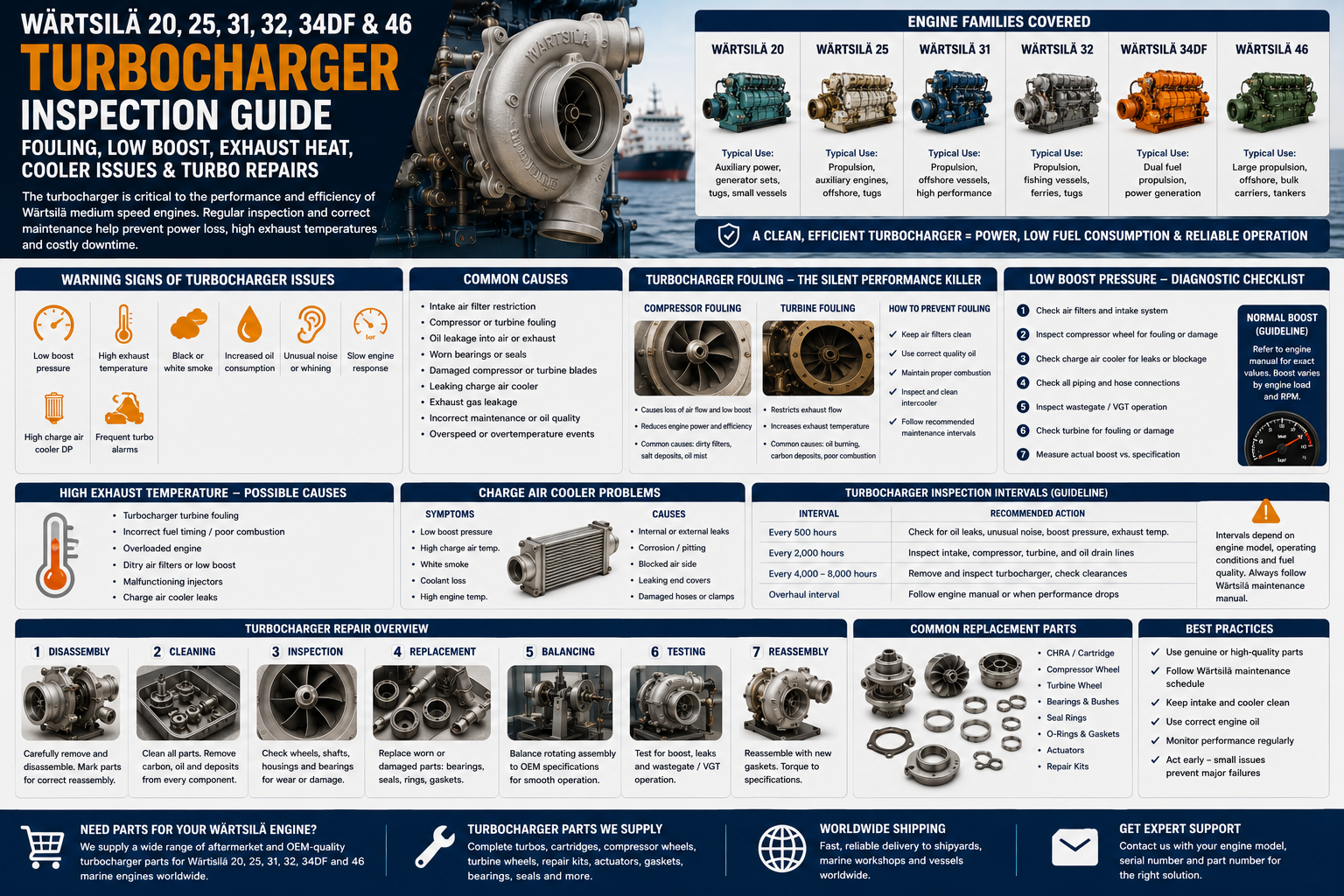

Wärtsilä Marine Engine Turbocharger Inspection & Repair: Wärtsilä 20, 25, 31, 32, 34DF, 46F & 46TS-DF
The turbocharger on a Wärtsilä marine engine is one of the most important components in the complete air and combustion system.
On a medium-speed engine, the turbocharger is responsible for supplying the large volume of compressed air required for efficient combustion under heavy marine load.
When the system is healthy, the engine can maintain stable power, controlled exhaust temperatures, good combustion and efficient fuel use.
When something changes, the first signs may be relatively small.
Maybe the engine starts producing more smoke than normal.
Maybe one bank develops higher exhaust temperatures.
Perhaps the engine becomes slower to accept load.
The charge-air pressure may begin falling.
Or the crew notices oil, unusual turbocharger noise or increasing differential pressure through the air system.
Those symptoms deserve investigation.
But one point is especially important:
A Wärtsilä engine showing low charge-air pressure does not automatically have a failed turbocharger.
The complete system needs to be considered:
air intake → turbocharger → charge-air cooler → engine → exhaust system → turbocharger.
This guide covers practical turbocharger inspection and repair considerations across several Wärtsilä marine engine families.
1. Which Wärtsilä Marine Engines Does This Guide Cover?
The Wärtsilä marine range contains different medium-speed diesel, dual-fuel and fuel-flexible engine families.
Current and widely encountered families include:
Wärtsilä 20
A compact medium-speed engine used for:
- Auxiliary power
- Marine generator applications
- Smaller-vessel propulsion
- Tugs
- Offshore vessels
- Commercial marine installations
Wärtsilä 20DF
A dual-fuel development of the Wärtsilä 20 platform.
Wärtsilä 25
A newer compact medium-speed engine family used for propulsion and auxiliary power.
Wärtsilä 25DF
A dual-fuel version within the Wärtsilä 25 family.
Wärtsilä 26
An established medium-speed engine family still encountered in operating vessels.
Wärtsilä 31
A modern medium-speed marine engine used for demanding propulsion and power-generation applications.
Wärtsilä 31DF
A dual-fuel version of the Wärtsilä 31 platform.
Wärtsilä 32
One of the best-known Wärtsilä medium-speed engine families.
It can be found in:
- Fishing vessels
- Tugs
- Ferries
- Offshore vessels
- Dredgers
- Generator installations
- Commercial propulsion
Wärtsilä 32M
A newer development within the Wärtsilä 32 family.
Wärtsilä 32 Methanol
A fuel-flexible version designed for methanol-capable operation.
Wärtsilä 34DF
A dual-fuel medium-speed engine family used for propulsion and electrical generation.
Wärtsilä 38
An older engine family still encountered in marine service.
Wärtsilä 46
An established large medium-speed engine family.
Wärtsilä 46F
A large medium-speed engine family available in inline and V configurations for demanding marine propulsion and power-generation applications.
Wärtsilä 46DF
A dual-fuel development within the large 46-series range.
Wärtsilä 46TS-DF
A high-output dual-fuel engine using two-stage turbocharging.
This final engine is especially interesting because turbocharger inspection becomes more complex when two turbocharging stages are involved.
2. Why the Exact Wärtsilä Engine Model Matters
A request saying:
“Need Wärtsilä turbocharger parts.”
is not nearly enough.
Even:
“Wärtsilä 32 turbocharger”
may require additional information.
Different configurations may vary according to:
- Cylinder count
- Engine generation
- Fuel version
- Rated power
- Rated speed
- Turbocharger arrangement
- Application
- Production revision
For accurate identification, provide:
Engine Family: Wärtsilä 32
Complete Engine Model: __________
Engine Serial Number: __________
Cylinder Configuration: __________
Rated Power: __________
Rated RPM: __________
Turbocharger Number: __________
For expensive turbocharger components, guessing should never be part of the purchasing process.
3. What Does the Turbocharger Do on a Wärtsilä Marine Engine?
A turbocharger recovers energy from the exhaust gas.
Instead of allowing all of that exhaust energy to disappear through the funnel, part of it is used to drive the turbocharger turbine.
The process looks approximately like this:
Combustion
↓
Exhaust gas leaves the cylinders
↓
Exhaust drives turbine wheel
↓
Turbocharger shaft rotates
↓
Compressor wheel compresses incoming air
↓
Compressed air passes through charge-air cooling
↓
Air reaches the cylinders
↓
More efficient combustion becomes possible
On a large multi-cylinder marine engine, enormous volumes of air are involved.
That makes turbocharger condition critical.
4. Why Turbocharger Efficiency Matters
Turbocharger condition can influence:
- Charge-air pressure
- Engine power
- Load acceptance
- Exhaust temperature
- Smoke
- Fuel consumption
- Combustion quality
- Cylinder balance
A turbocharger may continue spinning even while its efficiency deteriorates.
That is why:
“The turbo is turning”
does not prove:
“The turbo is healthy.”
Performance trends matter.
5. Situation: The Wärtsilä Engine Is Producing More Black Smoke
Black smoke normally suggests that fuel quantity and available combustion air are no longer properly balanced.
Possible causes include:
- Reduced turbocharger performance
- Compressor fouling
- Turbine fouling
- Charge-air cooler restriction
- Air-intake restriction
- Charge-air leakage
- Fuel-injection problem
- Engine overload
- Exhaust-system problem
Do not begin by replacing the turbocharger.
Determine whether the engine is actually receiving the correct amount of air.
6. Situation: Charge-Air Pressure Is Falling
Reduced charge-air pressure is an important warning sign.
Possible causes include:
- Compressor contamination
- Turbine deposits
- Turbocharger bearing wear
- Damaged compressor blades
- Damaged turbine blades
- Charge-air leakage
- Dirty charge-air cooler
- Air-filter restriction
- Exhaust leakage before the turbocharger
- Engine-load changes
The useful question is:
“Where is the air or energy being lost?”
That is more useful than:
“Which turbo should we replace?”
7. Situation: Exhaust Temperatures Begin Rising
Exhaust-temperature trending is particularly useful on multi-cylinder Wärtsilä engines.
If the engine historically operates at a particular load with relatively stable exhaust temperatures and those temperatures gradually begin increasing, investigate.
Possible causes include:
- Reduced turbocharger efficiency
- Dirty compressor
- Turbine fouling
- Charge-air cooler contamination
- Fuel-injection problems
- Engine overload
- Exhaust restriction
Do not wait until temperatures become extreme.
A gradual increase from the vessel's normal baseline can be an early warning.
8. One Cylinder Is Hotter Than the Others
If only one cylinder has elevated exhaust temperature, do not immediately condemn the turbocharger.
The turbocharger generally influences multiple cylinders.
One abnormal cylinder may direct attention toward:
- Fuel injector
- Fuel pump or injection control
- Exhaust valve condition
- Compression
- Cylinder condition
This is why cylinder-to-cylinder comparison is valuable.
9. All Cylinders Are Becoming Hotter
Now the situation is different.
If exhaust temperatures rise across many cylinders while charge-air pressure falls, the air system deserves much more attention.
Possible areas include:
- Turbocharger
- Charge-air cooler
- Intake restriction
- Exhaust restriction
- Engine loading
Look at the pattern.
Patterns often tell you more than one isolated measurement.
10. Turbocharger Fouling on Medium-Speed Marine Engines
Fouling is a major concern in marine service.
Deposits can form on:
- Compressor components
- Turbine components
- Nozzle areas where applicable
- Gas-path surfaces
Over time, contamination can affect:
- Airflow
- Exhaust-gas flow
- Turbocharger efficiency
- Rotor balance
- Engine performance
The deterioration may be gradual.
The engine may continue operating, but fuel consumption or exhaust temperatures slowly increase.
11. Why Turbine Fouling Matters
The turbine extracts energy from the exhaust stream.
If deposits change the gas path, turbocharger efficiency can deteriorate.
Possible symptoms include:
- Reduced charge-air pressure
- Increased exhaust temperature
- Higher fuel consumption
- Poor load response
- Smoke
Heavy fouling can also contribute to imbalance.
Regular condition monitoring is therefore important.
12. Compressor Fouling
The compressor side can accumulate contamination from:
- Airborne dirt
- Oil mist
- Ventilation contaminants
- Engine-room environment
Compressor fouling can reduce:
- Compressor efficiency
- Air delivery
- Pressure ratio
The engine may compensate by operating at less favorable combustion conditions.
Over time, this can show up as increased fuel consumption and exhaust temperature.
13. Turbocharger Washing
Depending on the turbocharger and engine configuration, cleaning procedures may be used to control contamination.
But cleaning must follow the correct procedure.
Do not improvise with:
- Incorrect chemicals
- Excessive water
- Uncontrolled cleaning media
- Incorrect engine conditions
A turbocharger is a high-speed precision assembly.
Cleaning it incorrectly can create new problems.
14. Turbocharger Washing Is Not a Repair for Mechanical Damage
Cleaning can help with deposits.
It cannot repair:
- Worn bearings
- Bent blades
- Cracked turbine components
- Damaged compressor wheels
- Excessive shaft movement
- Housing contact
Do not confuse:
dirty turbocharger
with:
mechanically damaged turbocharger.
The repair approach is completely different.
15. Listen for Changes in Turbocharger Noise
Experienced engine-room crews know the normal sound of machinery.
Pay attention if the turbocharger develops:
- Unusual whistling
- Grinding
- Scraping
- Metallic rubbing
- Pulsating noise
- Sudden changes in pitch
A change in sound can point toward:
- Bearing problems
- Rotor contact
- Air leakage
- Exhaust leakage
- Foreign-object damage
Do not ignore new mechanical noise on a high-speed rotating component.
16. Turbocharger Vibration
Vibration should also be monitored where applicable.
Increasing vibration can result from:
- Fouling
- Rotor imbalance
- Bearing wear
- Blade damage
- Deposits
- Foreign-object damage
A turbocharger can rotate extremely fast.
Even a relatively small imbalance can become significant at operating speed.
17. Why Rotor Balance Matters
The turbine wheel, shaft and compressor assembly form a precision rotating system.
Damage or uneven deposits can disturb its balance.
Possible results include:
- Increased vibration
- Bearing loading
- Seal deterioration
- Wheel contact
- Accelerated wear
This is why professional turbocharger repair includes proper rotor inspection and balancing.
18. Shaft and Bearing Inspection
During an appropriate shutdown inspection, technicians may evaluate:
- Rotor movement
- Bearing condition
- Axial clearance
- Radial clearance
- Smoothness of rotation
- Evidence of contact
But these measurements should be compared with the correct specifications.
Do not rely only on:
“The shaft feels loose.”
Large turbochargers are precision machinery.
Measure rather than guess.
19. Oil Supply to the Turbocharger
Turbocharger bearings depend on correct lubrication.
Possible causes of lubrication-related turbo damage include:
- Low oil pressure
- Restricted oil supply
- Dirty lubricating oil
- Contaminated oil
- Blocked oil return
- Excessive oil temperature
- Incorrect oil condition
If a turbocharger suffers bearing damage, inspect the engine lubrication system.
The failed turbocharger may simply be the victim.
20. Do Not Install a Rebuilt Turbo Without Checking Lubrication
Imagine the original turbocharger failed because its oil supply was restricted.
The turbocharger is rebuilt.
It is installed again.
But the oil restriction remains.
What happens?
The repaired turbocharger can fail again.
Before returning the unit to service, inspect:
- Oil feed
- Oil return
- Pipework
- Connections
- Filters
- Oil condition
- Engine oil pressure
Solve the cause, not only the consequence.
21. Oil Leakage From a Wärtsilä Turbocharger
Oil around the turbocharger needs investigation.
Possible sources include:
- Oil supply connection
- Oil return
- Bearing housing
- Seal-related condition
- External oil leakage from nearby equipment
Determine whether the oil is:
external
or:
entering the compressor/exhaust gas path.
The difference is important.
22. Charge-Air Cooler Condition
A clean turbocharger cannot compensate for a badly restricted charge-air cooler.
The cooler sits downstream of the compressor and reduces the temperature of compressed air before it reaches the cylinders.
If it becomes contaminated, the engine may experience:
- Increased air temperature
- Greater pressure drop
- Reduced airflow
- Higher exhaust temperatures
- Increased fuel consumption
Charge-air cooler condition should therefore be considered whenever turbocharger performance appears abnormal.
23. Differential Pressure Across the Charge-Air Cooler
A rising pressure difference across the cooler can indicate increasing restriction.
This is extremely useful for condition monitoring.
Instead of waiting for:
“The cooler is completely blocked.”
the engineer can observe:
“The pressure drop has gradually increased.”
That gives time to clean the cooler before the engine's overall performance deteriorates significantly.
24. Charge-Air Leakage
Compressed air can escape from:
- Piping
- Expansion joints
- Connections
- Gaskets
- Cooler connections
- Sealing surfaces
Air leakage can result in:
- Reduced charge-air pressure
- Poor combustion
- Smoke
- Higher exhaust temperature
Inspect the complete compressed-air path.
25. Exhaust Leakage Before the Turbocharger
The turbocharger needs exhaust energy.
If exhaust gas leaks before reaching the turbine, less energy is available to drive it.
Possible leak locations include:
- Exhaust manifold connections
- Cylinder exhaust connections
- Expansion joints
- Turbocharger connections
- Gaskets
Possible evidence includes:
- Soot deposits
- Hot spots
- Exhaust smell
- Reduced charge-air pressure
A healthy turbo cannot recover exhaust energy that never reaches it.
26. Exhaust Restriction After the Turbocharger
The exhaust side downstream of the turbocharger also matters.
Excessive exhaust backpressure can affect:
- Turbocharger operation
- Cylinder scavenging
- Engine performance
- Exhaust temperature
Inspect the complete exhaust system if engine performance changes significantly.
27. Fuel Injection Can Affect Turbocharger Behavior
Turbocharging and fuel injection are closely connected.
If a cylinder receives excessive fuel, exhaust conditions change.
If multiple cylinders are poorly balanced, turbine input can change.
Fuel-system problems can therefore produce symptoms that appear turbo-related.
This is especially relevant when troubleshooting:
- High exhaust temperatures
- Smoke
- Uneven loading
Do not diagnose the turbocharger in isolation from combustion.
28. Engine Load Matters
A medium-speed marine engine can operate under extremely demanding loads.
If vessel resistance increases because of:
- Hull fouling
- Propeller damage
- Propeller fouling
- Excessive cargo
- Changed operating conditions
the engine may be required to produce more torque.
Possible results include:
- Higher exhaust temperature
- More smoke
- Increased fuel consumption
The turbocharger may not be the original cause.
29. Wärtsilä 20 Turbocharger Inspection
For Wärtsilä 20 and related configurations, turbocharger-related inspection can include:
- Compressor cleanliness
- Turbine cleanliness
- Charge-air cooler
- Exhaust connections
- Oil supply
- Bearing condition
- Charge-air pressure
The engine is smaller than a Wärtsilä 46F, but the same basic turbocharging principles apply.
30. Wärtsilä 25 Turbocharger Inspection
The newer Wärtsilä 25 family should be treated according to its specific turbocharger and engine configuration.
Key areas include:
- Air intake
- Turbocharger condition
- Charge-air cooling
- Exhaust-gas path
- Lubrication
- Engine operating data
Do not transfer maintenance assumptions directly from an older engine family.
31. Wärtsilä 26 Turbocharger Inspection
Older Wärtsilä 26 engines can have significant accumulated service history.
When inspecting these engines, consider:
- Previous turbocharger rebuilds
- Current turbocharger identification
- Rotor condition
- Bearings
- Oil supply
- Cooler cleanliness
- Exhaust deposits
An older engine may no longer have every original component installed.
32. Wärtsilä 31 Turbocharger Inspection
The Wärtsilä 31 is a modern medium-speed platform.
Turbocharger performance should be evaluated together with:
- Charge-air pressure
- Exhaust temperature
- Engine load
- Fuel-system condition
- Charge-air cooler condition
Trend data can be particularly valuable.
One abnormal measurement may not tell the complete story.
A trend developing over weeks or months can.
33. Wärtsilä 32 Turbocharger Inspection
The Wärtsilä 32 has a large installed population in marine service.
These engines may work in:
- Fishing vessels
- Offshore vessels
- Tugs
- Ferries
- Dredgers
- Generating sets
Turbocharger inspections should include attention to:
- Fouling
- Bearing condition
- Rotor clearances
- Charge-air cooler condition
- Exhaust-system condition
- Lubrication
- Operating trends
For a high-hour Wärtsilä 32, historical data is particularly valuable.
34. Wärtsilä 32M Turbocharger Inspection
The 32M belongs to a newer generation within the 32 family.
Do not assume:
Wärtsilä 32 = Wärtsilä 32M
for every turbocharger or air-system component.
Always verify the:
- Complete engine designation
- Serial number
- Turbocharger type
- Installed component number
35. Wärtsilä 34DF Turbocharger Inspection
Dual-fuel operation introduces additional combustion considerations.
Turbocharger performance affects airflow regardless of the selected fuel mode.
When troubleshooting, compare operating data carefully under similar:
- Fuel mode
- Engine load
- Ambient conditions
Do not compare gas-mode performance directly with another operating condition without accounting for the difference.
36. Wärtsilä 46 Turbocharger Inspection
The Wärtsilä 46 belongs to a much larger medium-speed engine class.
Individual turbocharger components are correspondingly large and expensive.
Inspection may involve:
- Compressor components
- Turbine
- Nozzle components where applicable
- Rotor
- Bearings
- Lubrication
- Charge-air cooler
- Exhaust path
The economics of repair versus replacement become particularly important at this size.
37. Wärtsilä 46F Turbocharger Inspection
The Wärtsilä 46F is a large high-output medium-speed engine family.
A turbocharger-related performance problem can affect substantial engine output.
Trend:
- Charge-air pressure
- Turbocharger speed where monitored
- Exhaust temperatures
- Cooler pressure drop
- Engine load
- Fuel consumption
One of the most valuable tools on an engine this large is simply knowing what normal operation looks like.
38. Wärtsilä 46TS-DF: Two-Stage Turbocharging Changes the Picture
The Wärtsilä 46TS-DF uses two-stage turbocharging.
This means the air-compression process involves more than one turbocharging stage.
The system therefore requires a broader diagnostic approach.
Possible areas include:
- Low-pressure turbocharger stage
- High-pressure turbocharger stage
- Inter-stage air path
- Charge-air cooling
- Piping and connections
- Exhaust-gas routing
- Control components
A pressure problem can occur at one stage while the other remains healthy.
Do not treat two-stage turbocharging like a conventional single-turbo arrangement.
39. Why Two-Stage Turbocharging Is Useful
Two-stage turbocharging can provide more controlled compression across the operating range.
But it also introduces more components that must work together.
A fault may involve:
- One compressor stage
- One turbine stage
- Inter-stage leakage
- Fouling
- Cooler restriction
This makes pressure measurements at different points in the system particularly valuable.
40. Turbocharger Inspection During Routine Engine-Room Rounds
Routine inspection does not always require dismantling.
Look and listen for:
- New oil leakage
- Soot deposits
- Air leakage
- Unusual noise
- Excessive vibration
- Hot spots
- Loose connections
- Changes in operating data
A five-minute inspection can sometimes identify a problem weeks before an actual failure.
41. Keep the Turbocharger Area Clean
Clean machinery is easier to inspect.
On a dirty engine:
- New soot disappears into old soot.
- New oil disappears into old oil.
On a clean engine, even a small fresh leak becomes visible.
Cleaning therefore supports condition monitoring.
42. When Should a Wärtsilä Turbocharger Be Overhauled?
Do not apply one universal operating-hour figure to every Wärtsilä engine.
The correct interval depends on:
- Engine family
- Turbocharger type
- Fuel
- Operating load
- Engine hours
- Vessel duty
- Fouling rate
- Oil condition
- Condition measurements
- Previous service
The correct maintenance program should be based on the exact installation.
43. Condition-Based Inspection Can Be Extremely Valuable
Instead of focusing only on running hours, monitor:
- Charge-air pressure
- Exhaust temperature
- Turbocharger speed where available
- Vibration
- Bearing condition
- Cooler pressure drop
- Fuel consumption
Hours tell you how long the equipment has operated.
Condition data helps tell you how it has operated.
Both matter.
44. What Happens During a Professional Turbocharger Overhaul?
Depending on turbocharger type and condition, overhaul work can involve:
- Cleaning
- Disassembly
- Compressor-wheel inspection
- Turbine-wheel inspection
- Shaft measurement
- Bearing inspection
- Seal inspection
- Nozzle-ring inspection where applicable
- Housing inspection
- Clearance measurement
- Rotor balancing
- Reassembly
- Testing
This is precision work.
A large marine turbocharger should not be treated like a simple exhaust accessory.
45. Rebuild or Replace?
Rebuilding can make sense when:
- Major housings remain serviceable
- Rotor components remain within repair limits
- Proper spare parts are available
- Specialist balancing is available
Replacement can make more sense when:
- Major wheel damage exists
- Housing damage is severe
- Shaft damage is extensive
- Repair time would create unacceptable vessel downtime
The decision should consider both:
technical condition
and:
commercial downtime.
46. New, Remanufactured or Reconditioned Turbochargers
There is an important difference.
New
Newly manufactured complete unit.
Remanufactured
Used core professionally restored through controlled inspection, component replacement, measurement, balancing and testing.
Reconditioned
A repaired used unit. The scope can vary.
When buying a repaired turbocharger, ask what work was actually performed.
Do not judge quality by the paint.
47. After a Turbocharger Failure, Find the Cause
Do not stop at:
“The turbo failed.”
Ask:
“Why?”
Possible underlying causes include:
- Oil starvation
- Dirty oil
- Foreign-object damage
- Heavy deposits
- Excessive exhaust temperature
- Abnormal combustion
- Poor air filtration
The new turbocharger deserves a healthy engine system.
48. Foreign-Object Damage
If a compressor or turbine wheel shows impact damage, locate the source.
On the compressor side, inspect:
- Intake
- Filters
- Ducting
- Loose components
On the turbine side, investigate:
- Exhaust valves
- Cylinder-related components
- Exhaust-system debris
Do not install another turbocharger until the source has been understood.
49. What to Check Before Installing a Repaired Turbocharger
Inspect:
- Air intake
- Filters
- Charge-air cooler
- Charge-air piping
- Exhaust connections
- Oil supply
- Oil return
- Lubricating oil
- Engine combustion condition
This helps protect the repaired unit.
50. Operating Data You Should Record
A useful baseline can include:
| ParameterRecord Normal Value | |
| Engine load | Vessel baseline |
| Charge-air pressure | Vessel baseline |
| Turbocharger speed | Where monitored |
| Exhaust temperature | Cylinder-by-cylinder |
| Charge-air temperature | Vessel baseline |
| Cooler pressure drop | Vessel baseline |
| Fuel consumption | Vessel baseline |
| Turbo vibration | Where monitored |
The specific permitted values depend on engine type.
The purpose of the table is not to create universal numbers.
It is to help the crew recognize changes.
51. Compare Like With Like
Do not compare data collected at:
30% engine load
with data from:
90% engine load.
For meaningful comparison, use similar:
- Load
- RPM
- Fuel mode
- Ambient conditions
- Vessel condition
This is particularly important on dual-fuel engines.
52. Warning Signs That Deserve Investigation
Pay attention to:
- Falling charge-air pressure
- Rising exhaust temperature
- Increasing turbocharger vibration
- New turbocharger noise
- Oil leakage
- Increased smoke
- Higher fuel consumption
- Poor load acceptance
- Rising cooler differential pressure
One symptom may have many causes.
Several changing together can reveal a developing system problem.
53. Common Wärtsilä Turbocharger Spare Parts
Depending on turbocharger model, parts requirements can include:
- Complete turbocharger assemblies
- Rotor assemblies
- Compressor wheels
- Turbine components
- Shafts
- Bearings
- Seals
- Nozzle-ring components
- Diffuser components
- Housings
- Gaskets
- O-rings
- Oil-line seals
- Fasteners
- Air-system sealing components
Exact compatibility must always be checked against the installed turbocharger.
54. Related Wärtsilä Air-System Parts
A turbocharger repair may also involve:
- Charge-air coolers
- Air filters
- Intake piping
- Expansion joints
- Charge-air connections
- Exhaust manifolds
- Exhaust connections
- Gaskets
- Temperature sensors
- Pressure sensors
The turbocharger is only one part of the air system.
55. Common Wärtsilä Marine Engine Families for Turbocharger Parts
Alfa Marine Spare Parts can assist with inquiries involving engine families such as:
- Wärtsilä 20
- Wärtsilä 20DF
- Wärtsilä 25
- Wärtsilä 25DF
- Wärtsilä 26
- Wärtsilä 31
- Wärtsilä 31DF
- Wärtsilä 32
- Wärtsilä 32M
- Wärtsilä 32 Methanol
- Wärtsilä 34DF
- Wärtsilä 38
- Wärtsilä 46
- Wärtsilä 46F
- Wärtsilä 46DF
- Wärtsilä 46TS-DF
Current Wärtsilä marine portfolios include families such as the 20/20DF, 25/25DF, 31/31DF, 32/32M, 34DF, 46F and 46TS-DF, while several older families remain widely encountered in service.
56. Wärtsilä Turbocharger & Marine Engine Spare Parts
Parts inquiries may include:
- Turbochargers
- Turbocharger overhaul components
- Rotor assemblies
- Bearings
- Seals
- Charge-air cooler components
- Air-system components
- Exhaust-system components
- Cylinder heads
- Fuel injectors
- Fuel pumps
- Oil pumps
- Water pumps
- Pistons
- Piston rings
- Cylinder liners
- Connecting rods
- Main bearings
- Connecting-rod bearings
- Gaskets
- O-rings
- Sensors
- Filters
- Overhaul components
Depending on availability and engine configuration, requirements may involve OEM-quality, aftermarket, remanufactured, reconditioned or other suitable replacement components.
57. Frequently Asked Questions
Which Wärtsilä Marine Engines Use Turbochargers?
Turbocharging is fundamental across many modern and legacy Wärtsilä medium-speed marine engine families, including Wärtsilä 20, 25, 31, 32, 34DF and 46-series engines. Current Wärtsilä marine engine portfolios include these families for propulsion and onboard power.
Does Every Wärtsilä Engine Use the Same Turbocharger?
No. Turbocharger configuration depends on engine family, cylinder configuration, power rating, generation and application.
What Is Special About the Wärtsilä 46TS-DF?
It uses a two-stage turbocharging system, so turbocharger diagnosis must consider both stages and the air path between them.
Can a Dirty Charge-Air Cooler Reduce Turbocharger Performance?
Yes. Cooler contamination can increase pressure drop and reduce the effectiveness of the charge-air system. Wärtsilä specifically offers charge-air cooler cleaning solutions aimed at controlling contamination and differential pressure.
Does Black Smoke Always Mean a Bad Turbocharger?
No. Fuel injection, charge-air leakage, intake restrictions, engine load and cooler condition can produce similar symptoms.
Can Low Oil Pressure Damage the Turbocharger?
Turbocharger bearings depend on adequate lubrication, so lubrication problems can contribute to serious damage.
Can Wärtsilä Turbochargers Be Rebuilt?
Many marine turbochargers can be professionally inspected and overhauled depending on condition and turbocharger type.
Should I Replace the Turbocharger Because Charge-Air Pressure Is Low?
Not before checking the air intake, cooler, piping, exhaust system, fuel system and engine operating load.
What Information Should I Send When Ordering Wärtsilä Turbocharger Parts?
Provide:
engine family + complete engine model + serial number + cylinder configuration + turbocharger manufacturer/model + turbocharger part number + quantity + photographs.
Browse Our Complete Catalog
Marine engine brands:
https://alfamarinespareparts.com/our-brand
Marine spare parts:
https://alfamarinespareparts.com/spareparts
Contact Alfa Marine Spare Parts
For Wärtsilä marine engine turbochargers and spare parts:
Email: request@alfamarinespareparts.com
For faster identification, provide:
Wärtsilä engine model + serial number + cylinder configuration + existing turbocharger number + required component + quantity + photographs + delivery location.
Final Word
A turbocharger problem on a Wärtsilä marine engine should rarely be viewed as an isolated turbocharger problem.
The turbocharger sits at the center of several systems.
Before it:
the air intake.
Driving it:
the engine exhaust.
After it:
the charge-air cooler and intake system.
Supporting it:
the lubrication system.
And creating the exhaust energy that drives it:
the combustion and fuel-injection system.
That is why:
low charge-air pressure does not automatically mean a bad turbocharger.
Black smoke does not automatically mean a bad turbocharger.
High exhaust temperature does not automatically mean a bad turbocharger.
A dirty charge-air cooler can produce similar symptoms.
Wärtsilä specifically recognizes charge-air cooler contamination and pressure drop as important performance factors, with cleaning solutions designed to maintain cooler efficiency.
An exhaust leak can reduce the energy available to drive the turbine.
A fuel-injection problem can change exhaust temperatures.
A heavily fouled hull or propeller can overload the engine.
And on a Wärtsilä 46TS-DF, the situation becomes even more interesting because the engine uses two-stage turbocharging rather than a single conventional turbo stage.
So when performance begins changing, ask:
“What changed in the complete engine system?”
Check the operating data.
Inspect the intake.
Inspect the turbocharger.
Check the charge-air cooler.
Look for air leaks.
Check the exhaust side.
Verify lubrication.
Compare cylinder exhaust temperatures.
And if the turbocharger really is damaged, do not stop with:
“Replace the turbo.”
Find out why it failed.
Because the best turbocharger overhaul is not simply the one that makes the turbocharger look new again.
It is the one that removes the condition that caused the damage in the first place.
Meta Title
Wärtsilä Turbocharger Inspection & Repair Guide | Alfa Marine Spare Parts
Meta Description
Technical engine-family and turbocharging details were verified against current Wärtsilä information. No third-party website links