Doosan L126TI Marine Engine Gauges: What Every Reading Can Tell You
A Doosan L126TI marine engine can tell you a great deal about its condition before anyone removes a cylinder head, injector, turbocharger or water pump.
You only need to pay attention to what the gauges are showing.
Oil pressure begins falling.
Coolant temperature slowly rises.
Engine RPM becomes unstable.
Boost pressure is lower than normal.
Battery voltage changes.
The engine no longer reaches the same loaded RPM.
Or one engine in a twin installation suddenly begins operating differently from the other.
None of these readings automatically tells you which component has failed.
But together, they can provide valuable early warnings that something in the Doosan L126TI engine or its supporting marine systems is beginning to change.
The important question is therefore not simply:
“Is the gauge still inside the normal zone?”
It is:
“Is this reading normal for this particular L126TI under these operating conditions?”
1. Which Engine Does This Guide Cover?
This article focuses on the:
Doosan L126TI Marine Engine
The L126TI is an inline six-cylinder turbocharged and intercooled commercial diesel engine family used in marine propulsion and related heavy-duty applications.
It may be found in:
- Fishing vessels
- Workboats
- Passenger craft
- Commercial boats
- Utility vessels
- Patrol craft
- Marine propulsion installations
Different ratings and installations can use different instrumentation.
So not every L126TI vessel will display exactly the same gauges.
2. What Gauges Can You Find on a Doosan L126TI Marine Engine?
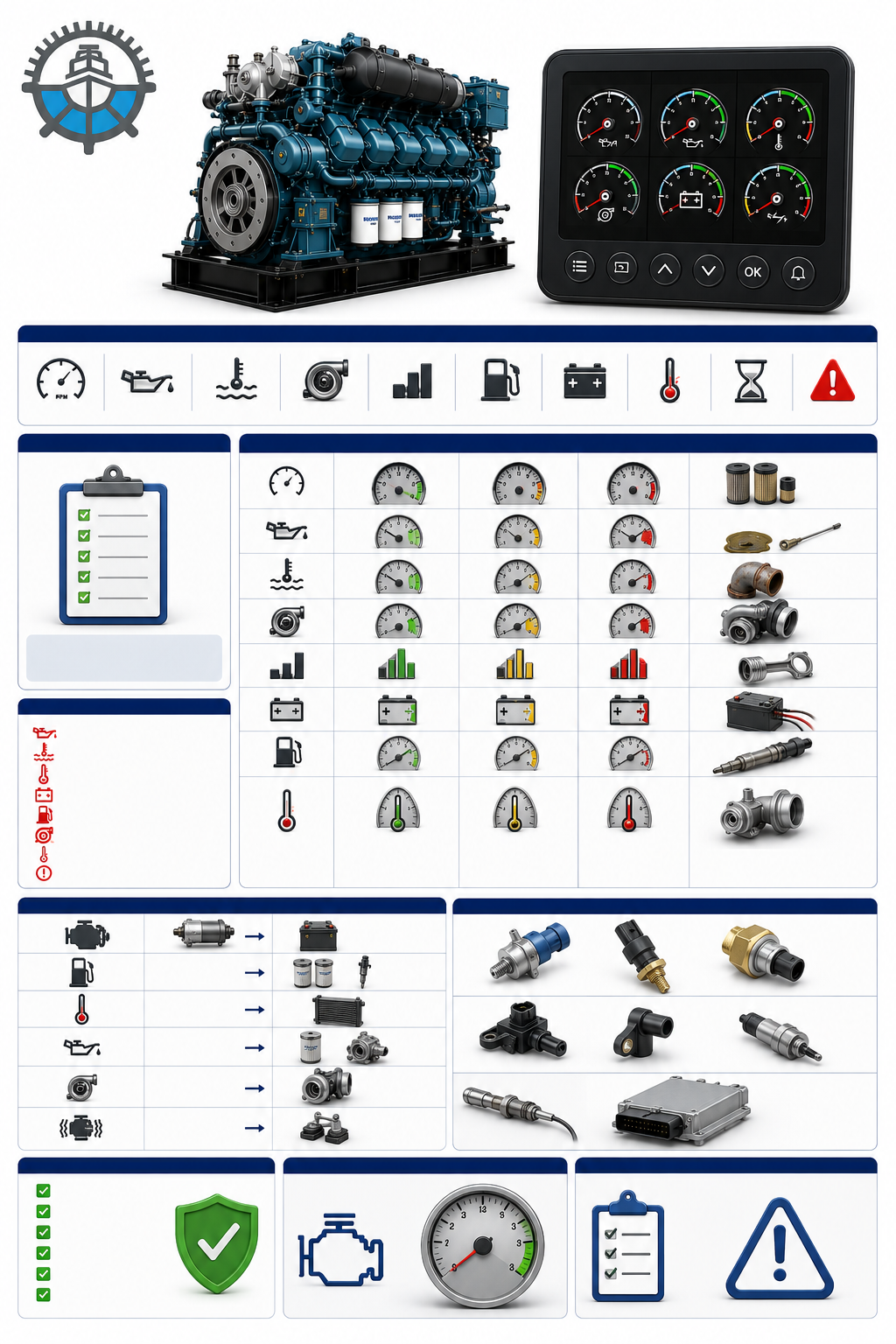
Depending on the vessel installation, instrumentation can include:
- Engine RPM
- Engine oil pressure
- Coolant temperature
- Battery/system voltage
- Engine hours
- Boost pressure
- Fuel-related pressure or warning information
- Exhaust temperature where additional monitoring is installed
- Gearbox oil pressure
- Gearbox oil temperature
- Raw-water pressure or flow where fitted
- Alarm indicators
More sophisticated vessel monitoring systems may display additional information.
The exact instrumentation depends on the vessel rather than only the engine.
3. Know What Normal Looks Like
This is the most important rule.
Suppose the L126TI has operated for years with stable oil pressure at cruising speed.
Then under the same:
- RPM
- Engine load
- Oil temperature
- Vessel conditions
the oil pressure begins trending lower.
It may still look acceptable.
But something has changed.
That change matters.
A gauge becomes much more useful when you have historical data to compare against.
4. Engine RPM Gauge
The tachometer displays engine speed in:
revolutions per minute — RPM.
Watch the engine at:
- Idle
- Acceleration
- Normal cruising
- Heavy load
- Gear engagement
The engine should behave consistently under similar operating conditions.
If the engine suddenly cannot reach the RPM it used to achieve, investigate why.
5. L126TI Cannot Reach Normal Loaded RPM
Possible causes include:
- Fuel restriction
- Dirty fuel filter
- Blocked air intake
- Turbocharger problem
- Charge-air restriction
- Fuel-injection problem
- Excessive propeller load
- Hull fouling
- Damaged propeller
- Excess vessel weight
Do not automatically conclude:
“The engine is worn out.”
The propulsion load may be the problem.
6. RPM Drops Under Load
If the engine reaches normal speed without load but drops excessively after the propeller is engaged, possible causes include:
- Fuel starvation
- Air restriction
- Turbocharger problem
- Propeller overload
- Marine gear problem
- Excessive vessel resistance
The important clue is:
the problem appears when load increases.
That helps narrow the search.
7. Unstable RPM
If engine speed rises and falls unexpectedly, investigate areas such as:
- Fuel supply
- Air entering the fuel system
- Fuel filters
- Governor or control system
- Injection equipment
- Engine load
Record whether the hunting happens:
- At idle
- During acceleration
- At cruising speed
- Only under heavy load
This information can make troubleshooting much easier.
8. Oil Pressure Gauge
Engine oil pressure is one of the most important readings on the L126TI.
Oil lubricates components including:
- Crankshaft bearings
- Connecting-rod bearings
- Camshaft components
- Valve train
- Turbocharger bearings
- Other moving surfaces
Loss of proper lubrication can create serious engine damage very quickly.
9. Low Oil Pressure
Possible causes can include:
- Low engine oil level
- Incorrect lubricant
- Excessively hot oil
- Oil filter problem
- Oil-pump wear
- Worn main bearings
- Worn connecting-rod bearings
- Internal leakage
- Faulty sender or gauge
Do not immediately replace the oil pump.
The pump is only one possible cause.
10. Oil Pressure Is Lower When the Engine Is Hot
Oil becomes thinner as temperature increases.
Therefore oil pressure should always be interpreted together with:
- Oil temperature
- Engine RPM
- Engine load
- Engine operating condition
Comparing cold idle pressure with fully warmed cruise pressure does not tell you very much by itself.
Compare the engine under similar conditions.
11. Sudden Oil Pressure Drop
A sudden change is more concerning than a slow variation.
If oil pressure suddenly falls:
- Check engine oil level
- Look for leakage
- Check oil temperature
- Verify the reading
- Review alarms
- Listen for abnormal mechanical noise
If lubrication pressure has genuinely been lost, continued operation can quickly damage bearings and the turbocharger.
12. Coolant Temperature Gauge
The cooling system must remove the heat produced by the engine.
Temperature depends on several components working together.
These can include:
- Freshwater circulation pump
- Thermostats
- Heat exchanger
- Seawater pump
- Raw-water intake
- Sea strainer
- Coolant level
- Cooling hoses
The gauge tells you that the engine is getting hot.
It does not automatically tell you why.
13. L126TI Runs Hot Only at High RPM
This is a very useful symptom.
At low engine load, the cooling system may still have enough capacity.
Under heavy load, heat production increases.
If temperature rises only at high RPM, possible causes include:
- Restricted sea strainer
- Weak seawater pump
- Dirty heat exchanger
- Restricted seawater intake
- Worn impeller
- Collapsing hose
- Thermostat not fully opening
- Excessive engine load
This often indicates a system that is:
working—but not well enough.
14. Engine Overheats Soon After Leaving the Dock
If temperature rises quickly after the vessel gets underway, inspect the raw-water side.
Possible causes include:
- Closed seacock
- Blocked sea strainer
- Damaged seawater-pump impeller
- Pump failure
- Intake obstruction
- Severe raw-water restriction
A major reduction in seawater flow can create rapid overheating.
15. Temperature Slowly Creeps Higher Over Months
This is exactly the kind of trend an engineer should notice.
For example:
Last season the engine stayed stable at cruise.
Now it runs several degrees hotter under similar conditions.
Possible causes include:
- Progressive heat-exchanger fouling
- Reduced pump efficiency
- Thermostat deterioration
- Cooling-system deposits
- Increasing engine load
The alarm may still be silent.
The engine is already giving you a warning.
16. Twin L126TI Engines Are Excellent for Comparison
If a vessel has:
Port Doosan L126TI
and:
Starboard Doosan L126TI,
you have a useful built-in reference.
Compare:
- RPM
- Oil pressure
- Coolant temperature
- Boost pressure
- Fuel consumption
- Exhaust appearance
- Loaded engine speed
If one engine behaves differently under similar conditions, investigate.
17. One Engine Runs Hotter Than the Other
Possible causes include differences in:
- Seawater flow
- Heat-exchanger cleanliness
- Freshwater pump condition
- Thermostat condition
- Coolant level
- Engine load
- Sensor accuracy
Do not automatically assume both engines need the same repair.
The difference itself is useful diagnostic information.
18. Boost Pressure Gauge
Boost pressure tells you something about the turbocharging and air system.
If boost pressure becomes lower than normal at similar load, possible causes include:
- Turbocharger wear
- Compressor fouling
- Charge-air leak
- Air-filter restriction
- Intake restriction
- Intercooler restriction
- Exhaust leakage
- Engine load changes
Do not automatically order a turbocharger.
Check the complete air path first.
19. Low Boost + Black Smoke
This combination is especially useful.
If you see:
lower boost
together with:
more black smoke,
the engine may not be receiving enough combustion air.
Possible causes include:
- Dirty air filter
- Charge-air leak
- Turbocharger problem
- Intercooler restriction
- Exhaust-side problem
The problem may be in the air system rather than the fuel system.
20. Low Boost but No Smoke
That may tell you something different.
Possible causes can still involve:
- Turbocharger
- Gauge/sender
- Air system
- Engine load
But if smoke does not increase, fuel delivery may also have changed.
One reading should rarely be considered alone.
21. Turbocharger Problems Can Change Several Gauge Readings
A deteriorating turbocharger may contribute to:
- Reduced boost
- Increased exhaust temperature
- More smoke
- Reduced engine output
- Failure to reach normal RPM
Several readings moving in the same direction can provide a stronger clue than one reading alone.
22. Intake and Charge-Air Temperature
Where this information is available, higher intake-air temperature can suggest reduced cooling efficiency.
Possible causes include:
- Dirty charge-air cooler
- Reduced cooling-water flow
- High engine-room temperature
- High seawater temperature
- Heavy engine load
Cooler intake air supports better combustion.
23. Fuel Pressure and Fuel-Supply Indicators
Depending on the installation, fuel pressure or restriction warning information may be available.
Fuel-supply problems can involve:
- Dirty filters
- Water contamination
- Restricted fuel lines
- Tank pickup
- Feed pump
- Air leaks
Fuel starvation often becomes most obvious when engine load increases.
24. Engine Runs Fine at Idle but Loses Power Underway
This is a classic fuel-restriction situation.
At idle, the engine needs relatively little fuel.
Under heavy propulsion load, demand rises sharply.
A partially blocked filter may be adequate at idle but insufficient at full load.
Check:
- Primary filter
- Secondary filter
- Tank pickup
- Fuel lines
- Feed pump
- Air leaks
25. Fuel Consumption
If your vessel monitoring system displays fuel consumption, use it as a trend.
Compare:
- Fuel rate
- Engine RPM
- Vessel speed
- Engine load
Suppose fuel use rises while vessel speed falls.
The engine may be working harder because of:
- Hull fouling
- Propeller fouling
- Propeller damage
- Excess vessel load
Not every increase in fuel consumption means the injectors are defective.
26. Voltage Gauge
Battery/system voltage is important because reliable electrical power supports:
- Starting
- Instrumentation
- Engine-control components where applicable
- Alarms
- Monitoring equipment
Watch for:
- Low voltage
- Unstable voltage
- Excessively high charging voltage
Possible causes include:
- Battery problems
- Alternator problems
- Loose connections
- Corrosion
- Wiring faults
27. Low Voltage During Starting
If voltage falls excessively during cranking, the engine may turn too slowly.
This can create:
- Hard starting
- Excessive smoke during startup
- Apparent fuel problems
Before blaming the fuel system, confirm that the starting system is healthy.
28. Engine Hour Meter
The hour meter is central to maintenance planning.
Use it to schedule:
- Oil changes
- Filter replacement
- Valve inspection
- Cooling-system maintenance
- Turbocharger inspection
- Injector servicing
- Larger engine inspections
Record hours accurately.
Without operating hours, maintenance becomes guesswork.
29. Exhaust Temperature Monitoring
Some vessels add exhaust temperature monitoring beyond the basic engine gauges.
This can be particularly useful on an inline six-cylinder engine such as the L126TI.
If cylinder-specific monitoring is available, compare all six cylinders.
30. One Cylinder Is Hotter Than the Others
Possible causes include:
- Injector problem
- Fuel-delivery imbalance
- Valve problem
- Compression issue
- Combustion problem
Do not automatically replace the injector.
Use the temperature reading to identify which cylinder needs further testing.
31. One Cylinder Is Cooler
A cooler cylinder can indicate:
- Weak fuel injection
- Poor combustion
- Low compression
- Cylinder not contributing fully
A cool cylinder is not automatically a healthy one.
32. All Exhaust Temperatures Rise
If all cylinders are becoming hotter, consider a system-wide problem.
Possible causes include:
- Reduced turbocharger performance
- Air restriction
- Charge-air cooling problem
- Excess engine load
- Exhaust restriction
This is different from one cylinder behaving abnormally.
Look for patterns.
33. Marine Gear Oil Pressure
The engine can be healthy while the marine gearbox has a problem.
Gear pressure should be monitored where instrumentation is available.
Low pressure can involve:
- Low gearbox oil
- Pump problems
- Filter restriction
- Internal leakage
- Excessive oil temperature
Do not confuse gearbox problems with engine problems.
34. Marine Gear Temperature
Rising gearbox temperature can involve:
- Low oil
- Cooling-system restriction
- Cooler problem
- Excessive load
- Internal wear
If both:
engine coolant temperature
and:
gearbox temperature
begin rising together, investigate anything they may share.
A common seawater circuit is one possibility depending on installation.
35. Raw-Water Pressure or Flow
Some installations monitor seawater pressure or flow.
This can provide an early warning of:
- Sea-strainer restriction
- Pump deterioration
- Damaged impeller
- Raw-water intake blockage
- Hose restriction
Reduced flow can sometimes be detected before engine coolant temperature reaches an alarm point.
36. Alarm Lights and Warning Indicators
The L126TI instrumentation may include warning indicators for conditions such as:
- Low oil pressure
- High coolant temperature
- Charging-system problems
- Other engine or vessel-system conditions
An alarm should start an investigation.
It should not start an assumption.
37. Do Not Assume Every Alarm Means a Bad Sensor
Sensors do fail.
So do engines.
If the high-temperature alarm appears:
verify actual temperature.
If low oil pressure appears:
verify actual oil pressure.
Do not simply disconnect or ignore an alarm because the engine still sounds normal.
38. Gauge Problems Can Be Electrical Problems
An incorrect reading can sometimes originate from:
- Sender failure
- Wiring damage
- Loose connector
- Corrosion
- Grounding problem
- Instrument problem
Marine engine rooms are harsh environments for electrical components.
Heat, vibration, moisture and salt can all contribute.
39. Check Connections Before Replacing Expensive Components
If a gauge suddenly becomes erratic, inspect:
- Sensor connection
- Wiring
- Grounds
- Instrument connections
But never assume the reading is false until the actual engine condition has been confirmed.
40. Use Several Gauges Together
This is where engine instrumentation becomes much more powerful.
Situation A
High coolant temperature + normal load
Look closely at cooling-system performance.
Situation B
High coolant temperature + unusually high engine load
The vessel may be overloaded or heavily fouled.
Situation C
Black smoke + low boost
Inspect the air/turbocharger system.
Situation D
Low oil pressure + high oil temperature
Investigate why lubrication temperature has increased.
Situation E
High load + low vessel speed
Inspect propeller, hull and drivetrain.
One gauge gives a clue.
Several gauges help build the story.
41. Hull Fouling Can Change Engine Readings
Marine growth creates resistance.
That forces the engine to work harder.
Possible results include:
- Higher engine load
- More fuel consumption
- Higher coolant temperature
- Higher exhaust temperature
- Reduced vessel speed
A perfectly healthy L126TI can therefore appear underpowered because of the vessel.
42. Propeller Fouling Can Have the Same Effect
A fouled or damaged propeller can cause:
- Failure to reach expected RPM
- High engine load
- Increased fuel consumption
- Smoke
- Higher temperatures
Do not rebuild the engine before checking the propeller.
43. Over-Pitched Propeller
If propeller pitch is too aggressive, the engine may be unable to reach the correct loaded RPM.
The symptoms can look like:
- Weak engine
- Turbocharger problem
- Fuel problem
But the true issue is mechanical overload.
The engine and propeller must be considered as one system.
44. Engine-Room Ventilation Can Affect Readings
A poorly ventilated engine room can increase intake-air temperature.
Possible consequences include:
- Reduced air density
- Higher engine-room temperatures
- Additional thermal stress
- Lower performance
If performance deteriorates only when the engine room becomes extremely hot, ventilation deserves attention.
45. Gauge Changes After Maintenance Work
If abnormal readings begin immediately after maintenance, inspect what was disturbed.
For example:
After Cooling-System Service
Check:
- Coolant filling
- Air trapped in the system
- Hose connections
- Pump installation
- Seawater valves
After Fuel-Filter Service
Check:
- Air in fuel
- Filter installation
- Leaks
- Restricted supply
After Electrical Work
Check:
- Connectors
- Grounds
- Sensors
- Wiring
Timing can be a powerful diagnostic clue.
46. Keep a Daily L126TI Gauge Log
A simple operating log can look like this:
| ParameterPort EngineStarboard EngineNotes | |||
| Engine RPM | ___ | ___ | |
| Oil Pressure | ___ | ___ | |
| Coolant Temperature | ___ | ___ | |
| Boost Pressure | ___ | ___ | |
| Voltage | ___ | ___ | |
| Engine Hours | ___ | ___ | |
| Fuel Rate | ___ | ___ | |
| Exhaust Temperature | ___ | ___ | Where fitted |
| Gear Pressure | ___ | ___ | |
| Gear Temperature | ___ | ___ | |
| Alarms | ___ | ___ |
The specific values should be based on the vessel's normal operating data and the correct engine specifications.
47. Record Data Under Similar Conditions
For useful comparison, record readings at approximately the same:
- RPM
- Engine load
- Vessel speed
- Sea condition
Do not compare:
cold idle
with:
fully warmed heavy-load operation.
Consistency makes trends much easier to recognize.
48. What Is More Important: The Number or the Trend?
Both matter.
The absolute reading tells you whether the engine may be approaching a limit.
The trend tells you whether the engine is deteriorating.
For example:
Normal → Normal → Normal → Slightly higher → Higher again
is often more useful than one isolated reading.
49. Common Gauge-Related Spare Parts
Gauge and monitoring problems may involve parts such as:
- Oil-pressure senders
- Coolant-temperature senders
- RPM sensors
- Temperature sensors
- Pressure sensors
- Wiring
- Connectors
- Alarm switches
- Instrument panels
- Charging-system components
But always verify whether the problem is truly electrical before replacing a sender.
50. Related L126TI Engine Parts
An abnormal gauge reading may lead to investigation or replacement of mechanical parts such as:
- Oil pump
- Freshwater pump
- Seawater pump
- Thermostat
- Heat exchanger
- Turbocharger
- Fuel filters
- Fuel pump
- Injectors
- Oil cooler
- Hoses
- Gaskets
- Seals
The gauge identifies a symptom.
The actual repair may involve another system.
51. What Information Should You Send When Ordering Doosan L126TI Gauge or Sensor Parts?
Instead of:
“Need Doosan temperature sender.”
provide:
Manufacturer: Doosan
Engine Model: L126TI
Engine Serial Number: __________
Rated Power: __________
Rated RPM: __________
Existing Part Number: __________
Part Required: __________
Gauge Symptom: __________
Quantity: __________
Photographs: Attached
Delivery Location: __________
This greatly improves parts identification.
52. Frequently Asked Questions
What Are the Most Important Gauges on a Doosan L126TI?
Important readings commonly include RPM, engine oil pressure, coolant temperature, charging voltage and engine hours. Depending on vessel instrumentation, boost, exhaust and marine-gear data may also be available.
Why Is My L126TI Oil Pressure Lower When Hot?
Oil becomes less viscous as temperature rises. A significant change from the engine's established normal pressure should still be investigated.
Why Does My L126TI Run Hot Only Under Load?
Possible causes include restricted seawater flow, dirty heat exchanger, pump wear, thermostat problems, hose restriction or excessive engine loading.
Why Is My L126TI Not Reaching Normal RPM?
Check fuel supply, air intake, turbocharger performance, propeller condition, hull fouling and vessel load.
Does Black Smoke Mean the Injectors Are Bad?
Not automatically. Air restriction, turbocharger problems, charge-air leaks and engine overload can produce similar symptoms.
Can Low Boost Cause Black Smoke?
Yes. Insufficient combustion air can contribute to black smoke and reduced performance.
Can a Dirty Heat Exchanger Affect the Temperature Gauge?
Yes. Reduced heat-transfer efficiency can gradually cause higher operating temperature.
Can Hull Fouling Affect Engine Gauges?
Yes. Increased hull resistance increases engine load, fuel consumption and heat production.
Can a Bad Sensor Create a False Alarm?
Yes, but always verify the actual engine condition before assuming the sensor is defective.
Should Twin L126TI Engines Have Exactly the Same Readings?
Not necessarily, but significant differences under comparable conditions deserve investigation.
Doosan L126TI Marine Engine Gauge & Spare Parts
Alfa Marine Spare Parts can assist with inquiries involving Doosan L126TI marine engine monitoring, maintenance and repair components, including:
- Oil-pressure sensors
- Temperature sensors
- RPM-related sensors
- Alarm switches
- Wiring components
- Electrical connectors
- Instrumentation components
- Oil pumps
- Freshwater pumps
- Seawater pumps
- Thermostats
- Heat exchangers
- Oil coolers
- Turbochargers
- Fuel pumps
- Injectors
- Fuel filters
- Oil filters
- Cylinder heads
- Pistons
- Piston rings
- Cylinder liners
- Bearings
- Gaskets
- Seals
- Overhaul parts
Correct parts identification should always be based on the complete L126TI engine identification, serial number and existing component number.
Browse Our Complete Catalog
Marine engine brands:
https://alfamarinespareparts.com/our-brand
Marine spare parts:
https://alfamarinespareparts.com/spareparts
Contact Alfa Marine Spare Parts
For Doosan L126TI marine engine gauges, sensors, pumps, turbochargers and engine spare parts:
Email: request@alfamarinespareparts.com
For faster identification, provide:
Doosan L126TI serial number + existing part number + required component + quantity + photographs + delivery location.
Final Word
The gauges on a Doosan L126TI marine engine should not be treated only as alarms waiting for something to go wrong.
They are early diagnostic tools.
The RPM gauge can tell you that the engine is no longer handling the same load.
The oil-pressure gauge can reveal changes in the lubrication system.
The coolant-temperature gauge can show that cooling capacity is deteriorating.
Boost information can point toward turbocharger or charge-air problems.
Voltage can reveal a charging-system issue.
And additional exhaust-temperature monitoring can help identify cylinder differences.
The best approach is therefore:
know normal.
record normal.
compare with normal.
Then investigate when something changes.
A small rise in temperature may be the beginning of heat-exchanger fouling.
A small drop in boost may be a charge-air leak.
A slow reduction in loaded RPM may actually be a fouled propeller.
And a falling oil-pressure trend may be the first indication that the lubrication system deserves closer inspection.
The most useful question is not:
“Is the gauge still in the green?”
It is:
“Why is this L126TI showing a different reading than it used to?”
Finding that answer early can turn a developing failure into routine maintenance.