Quote

Menu

Worldwide Shipping Wishlist Login / Register
Doosan L126TI Marine Engine Spare Parts

Doosan L126TI Marine Engine Spare Parts

Doosan L126TI Marine Engine Spare Parts

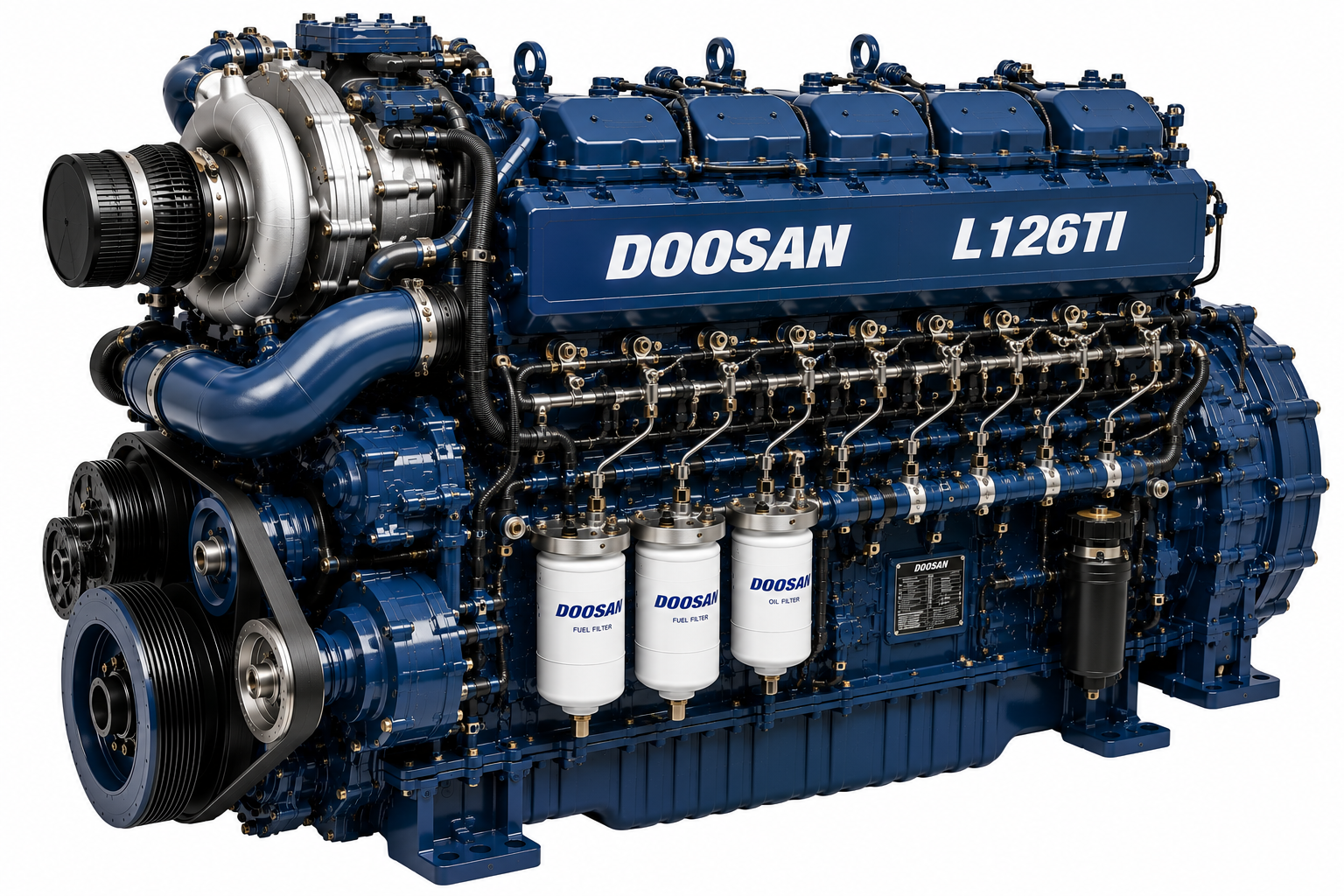
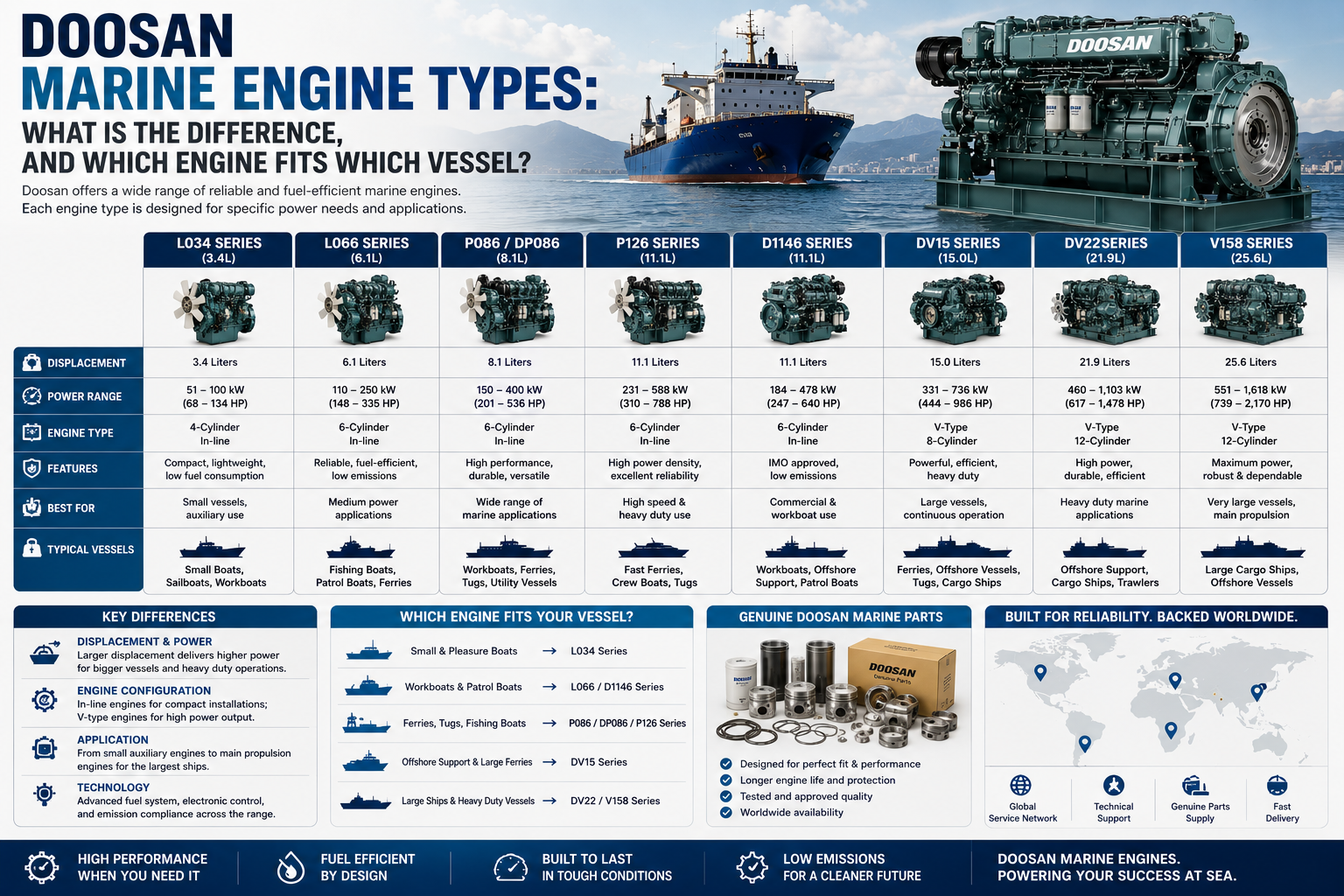
The Doosan L126TI marine engine is a mechanically controlled, turbocharged and intercooled inline six-cylinder diesel engine developed for commercial marine propulsion applications.

Built around an approximately 11.1-liter displacement, the L126TI combines a traditional mechanical fuel-injection system with turbocharging and charge-air cooling. This makes it a practical heavy-duty marine engine for vessels where reliability, repairability and long operating hours are important.

For shipyards, marine engineers and vessel operators, one important consideration is the age and service history of the engine.

An L126TI that has been operating for years may already have had its:

  • Fuel Injectors Replaced
  • Injection Pump Repaired
  • Turbocharger Reconditioned
  • Intercooler Repaired
  • Raw-Water Pump Replaced
  • Freshwater Pump Rebuilt
  • Heat Exchanger Serviced
  • Cylinder Head Reconditioned
  • Crankshaft Repaired
  • Starter Motor Replaced
  • Alternator Replaced

For that reason, spare-parts identification should not rely only on the engine model.

The safest approach is:

Doosan L126TI + Engine Serial Number + Existing Part Number + Clear Photographs

Alfa Marine Spare Parts supports Doosan L126TI Marine Engine Spare Parts requirements for routine maintenance, repair and complete engine overhaul.

Depending on component and availability, supply options can include genuine components, OEM-quality parts, selected aftermarket alternatives and professionally rebuilt or remanufactured components.

1. What Is the Doosan L126TI Marine Engine?

The Doosan L126TI is a six-cylinder inline marine diesel engine using mechanical fuel control, turbocharging and intercooling.

Its general design includes:

  • Inline Six-Cylinder Configuration
  • Four-Stroke Diesel Operation
  • Direct Fuel Injection
  • Mechanical Engine Control
  • Turbocharger
  • Intercooler / Charge-Air Cooler
  • Water Cooling
  • Commercial Marine Propulsion Configuration

The combination of turbocharging and intercooling helps the engine produce useful power from its displacement while remaining based around a mechanically controlled diesel platform.

2. Doosan L126TI Technical Information

Typical technical characteristics include:

Technical InformationDoosan L126TIEngine ModelL126TIEngine ConfigurationInline 6-CylinderOperating CycleFour-Stroke DieselDisplacementApprox. 11.1 LitersBoreApprox. 123 mmStrokeApprox. 155 mmAspirationTurbocharged & IntercooledFuel SystemDirect Diesel InjectionEngine ControlMechanicalCoolingWater CooledApprox. Power Range265–294 kWApprox. Metric Output360–400 PSTypical Speed RangeApprox. 2,000–2,100 rpmApplicationCommercial Marine Propulsion

The exact engine rating and installed equipment can vary according to engine specification and vessel installation.

For replacement parts, always prioritize:

Engine Serial Number + Existing Component Identification

over a general specification table.

3. What Does “TI” Mean on the Doosan L126TI?

The TI designation identifies the engine as:

Turbocharged + Intercooled

The simplified airflow is:

Air Filter → Turbocharger → Intercooler → Intake Manifold → Cylinders

The turbocharger compresses the air supplied to the engine.

Compressing air raises its temperature.

The intercooler then removes part of this heat before the air enters the cylinders.

This arrangement introduces additional components compared with a simpler turbocharged engine.

These can include:

  • Intercooler
  • Charge-Air Cooler Core
  • Intercooler Housing
  • Charge-Air Pipes
  • Charge-Air Hoses
  • Cooling-Water Connections
  • Intercooler Gaskets
  • O-Rings
  • Charge-Air Seals
  • Mounting Components

4. Why Is the Intercooler Important on the L126TI?

The intercooler directly affects the condition of the air entering the engine.

The process can be understood simply:

Turbocharger Compresses Air → Air Gets Hotter → Intercooler Removes Heat → Cooler Air Reaches Cylinders

If intercooler efficiency begins deteriorating, the engine can experience:

  • Reduced Power
  • Black Smoke
  • Poor Load Response
  • Higher Exhaust Temperature
  • Higher Charge-Air Temperature
  • Increased Fuel Consumption

This is why the turbocharger and intercooler should often be considered together during troubleshooting.

5. Where Is the Doosan L126TI Used?

The L126TI is suited to commercial marine propulsion applications.

Depending on installation, these can include:

  • Commercial Fishing Vessels
  • Fishing Boats
  • Passenger Vessels
  • Workboats
  • Utility Vessels
  • Service Craft
  • Ferry Applications
  • Fishing Excursion Boats
  • Commercial Marine Craft
  • Repower Applications

Many of these vessels operate for long periods at substantial engine load.

That places particular importance on:

  • Fuel-System Condition
  • Turbocharger Performance
  • Intercooler Efficiency
  • Raw-Water Cooling
  • Freshwater Cooling
  • Heat Exchanger Condition
  • Lubrication
  • Exhaust-System Condition

6. What Doosan L126TI Spare Parts Can Be Required?

Spare-parts requirements can range from routine maintenance components to complete overhaul parts.

Fuel-System Parts

Potential requirements include:

  • Fuel Injectors
  • Injector Nozzles
  • Injector Seals
  • Injector Hardware
  • Injection Pump Components
  • Fuel Filters
  • Fuel Supply Components
  • Fuel Pipes
  • Fuel Connections
  • Pump Seals
  • Gaskets
  • O-Rings

Turbocharger Parts

Potential requirements include:

  • Complete Turbochargers
  • Turbocharger Cartridges
  • Compressor Components
  • Turbine Components
  • Bearings
  • Seals
  • Oil Feed Components
  • Oil Drain Components
  • Intake Connections
  • Exhaust Connections
  • Turbocharger Gaskets
  • Mounting Hardware

Intercooler & Charge-Air Parts

Potential requirements include:

  • Complete Intercoolers
  • Charge-Air Cooler Cores
  • Intercooler Housings
  • End Covers
  • Charge-Air Pipes
  • Charge-Air Hoses
  • Air Connections
  • Cooling-Water Connections
  • Intercooler Gaskets
  • O-Rings
  • Charge-Air Seals
  • Mounting Components

Cooling-System Parts

Potential requirements include:

  • Freshwater Pumps
  • Raw-Water Pumps
  • Raw-Water Pump Impellers
  • Thermostats
  • Thermostat Housings
  • Heat Exchangers
  • Cooling Pipes
  • Cooling Hoses
  • Mechanical Seals
  • Gaskets
  • O-Rings

Lubrication-System Parts

Potential requirements include:

  • Engine Oil Pumps
  • Oil Pump Components
  • Engine Oil Filters
  • Oil Pressure Components
  • Turbocharger Oil Lines
  • Front Crankshaft Seals
  • Rear Crankshaft Seals
  • Oil Seals
  • Gaskets
  • O-Rings

Cylinder Head & Valve Parts

Potential requirements include:

  • Complete Cylinder Heads
  • Cylinder Head Gaskets
  • Intake Valves
  • Exhaust Valves
  • Valve Guides
  • Valve Seats
  • Valve Springs
  • Rocker Components
  • Valve Cover Gaskets

Internal Engine Components

Potential requirements include:

  • Pistons
  • Piston Rings
  • Piston Pins
  • Cylinder Components
  • Connecting Rods
  • Main Bearings
  • Connecting Rod Bearings
  • Thrust Components
  • Crankshaft
  • Camshaft Components

Electrical Components

Potential requirements include:

  • Starter Motors
  • Starter Solenoids
  • Alternators
  • Charging Components
  • Electrical Connections
  • Related Wiring Components

7. Why Is Correct Doosan L126TI Parts Identification Important?

Consider this request:

“Need raw-water pump for Doosan L126TI.”

That identifies the engine model, but additional information may still be required.

An older vessel may already have had its pump:

  • Rebuilt
  • Replaced
  • Modified
  • Changed During Previous Repair
  • Replaced With an Alternative Configuration

The same situation can occur with:

  • Turbochargers
  • Intercoolers
  • Fuel Injectors
  • Injection Pumps
  • Freshwater Pumps
  • Heat Exchangers
  • Starter Motors
  • Alternators

Therefore, identification from the currently installed component can be extremely valuable.

8. What Information Should I Send for Doosan L126TI Parts?

Provide:

  • Engine Model: Doosan L126TI
  • Engine Serial Number
  • Photograph of Engine Identification Plate
  • Existing Part Number
  • Component Manufacturer Number
  • Casting Number Where Available
  • Quantity Required
  • Clear Photographs
  • Vessel Application
  • Delivery Country or Port

For major components, provide identification directly from the installed unit whenever possible.

9. What Information Should I Send for an L126TI Turbocharger?

Provide:

  • Engine Serial Number
  • Turbocharger Manufacturer
  • Turbocharger Model
  • Turbocharger Part Number
  • Identification Plate Photograph
  • Compressor-Side Photograph
  • Turbine-Side Photograph
  • Oil Feed Connection
  • Oil Drain Connection
  • Exhaust Connection
  • Intake Connection

Do not rely only on:

“Turbo for L126TI.”

The number from the existing turbocharger can make identification significantly more reliable.

10. What Information Should I Send for an L126TI Intercooler?

Provide:

  • Engine Serial Number
  • Existing Intercooler Number
  • Casting Numbers
  • Complete Intercooler Photograph
  • Air Inlet
  • Air Outlet
  • Cooling-Water Connections
  • Mounting Arrangement
  • Overall Dimensions Where Required

If the original cooler has previously been replaced, the installed component becomes particularly important for identification.

11. What Information Should I Send for an L126TI Raw-Water Pump?

Provide:

  • Engine Serial Number
  • Existing Pump Manufacturer
  • Existing Pump Number
  • Clear Photograph of Complete Pump
  • Drive Arrangement
  • Mounting Arrangement
  • Inlet Connection
  • Outlet Connection
  • Shaft or Drive Details Where Relevant

Do not assume every L126TI installation uses exactly the same external marine cooling arrangement.

12. What If the L126TI Part Number Cannot Be Read?

Do not immediately throw the old component away.

Marine components can lose identification because of:

  • Salt Corrosion
  • Paint
  • Oil
  • Dirt
  • Scratching
  • Heat
  • Age

Take photographs showing:

  • Complete Component
  • Front
  • Rear
  • Both Sides
  • Identification Plate
  • Casting Numbers
  • Mounting Arrangement
  • Fuel Connections
  • Oil Connections
  • Cooling Connections
  • Intake Connections
  • Charge-Air Connections
  • Exhaust Connections
  • Electrical Connections Where Applicable

Several physical details together may help identify the correct replacement.

13. Doosan L126TI Fuel Injector Parts

Potential requirements can include:

  • Complete Fuel Injectors
  • Injector Nozzles
  • Injector Seals
  • Injector Hardware
  • Related Fuel Components

Injector condition influences:

  • Starting
  • Combustion
  • Cylinder Balance
  • Engine Power
  • Exhaust Smoke
  • Fuel Consumption

14. What Are Possible Signs of an L126TI Injector Problem?

Possible symptoms include:

  • Difficult Starting
  • Rough Idle
  • Uneven Running
  • Increased Exhaust Smoke
  • Reduced Engine Power
  • Increased Fuel Consumption
  • Abnormal Combustion Noise
  • Cylinder-to-Cylinder Temperature Differences

But these symptoms do not automatically prove an injector is faulty.

Other causes can include:

  • Fuel Supply
  • Injection Pump
  • Compression
  • Valve Condition
  • Piston Ring Wear
  • Cylinder Wear
  • Turbocharger
  • Intercooler

15. One L126TI Cylinder Is Weak — Does It Need an Injector?

Possibly.

But investigate the cylinder before replacing components.

Check:

  • Injector Condition
  • Fuel Delivery
  • Injection Pump Operation
  • Compression
  • Intake Valve
  • Exhaust Valve
  • Piston Rings
  • Cylinder Condition

The useful principle is:

Weak Cylinder ≠ Automatically Bad Injector

16. Doosan L126TI Injection Pump Parts

Potential requirements can include:

  • Injection Pump Components
  • Pump Seals
  • Fuel Supply Components
  • Fuel Pipes
  • Fuel Connections
  • Gaskets
  • O-Rings

Because the L126TI uses mechanical fuel control, injection-pump condition directly influences engine operation.

Provide identification from the installed fuel equipment whenever possible.

17. Why Is My Doosan L126TI Difficult to Start?

Possible causes include:

  • Weak Batteries
  • Slow Cranking Speed
  • Poor Battery Connections
  • Restricted Fuel Filter
  • Air Entering the Fuel System
  • Poor Fuel Supply
  • Injector Problems
  • Injection Pump Problems
  • Low Compression
  • Valve-Sealing Problems

A practical sequence is:

Cranking → Fuel Supply → Injection → Compression

18. Why Does the L126TI Lose Power Under Load?

This is one of the most useful troubleshooting situations.

An engine may start normally.

It may idle perfectly.

Then it struggles once the vessel is operating under load.

Possible causes include:

  • Restricted Fuel Filter
  • Poor Fuel Supply
  • Air Entering the Fuel System
  • Injector Problems
  • Injection Pump Problems
  • Restricted Air Filter
  • Intake Restriction
  • Turbocharger Problems
  • Charge-Air Leakage
  • Intercooler Fouling
  • Exhaust Leakage
  • Exhaust Restriction
  • Low Compression
  • Hull Fouling
  • Propeller Fouling
  • Excessive Propeller Load

At idle, engine demand is low.

Under load, demand for:

Fuel + Air + Boost + Cooling + Exhaust Flow

increases significantly.

19. Why Should the Fuel Filter Be Checked Before Expensive Repairs?

A partly restricted fuel filter may still provide enough fuel for:

  • Starting
  • Idling
  • Light Running

Once the vessel is working harder, fuel demand increases.

The engine may then:

  • Lose RPM
  • Respond Slowly
  • Smoke More
  • Struggle Under Load
  • Fail to Produce Expected Power

Check simple causes before moving to expensive injection-system components.

20. Doosan L126TI Air-Intake Parts

Potential requirements can include:

  • Air Filter Elements
  • Air Cleaner Components
  • Intake Hoses
  • Turbocharger Inlet Components
  • Intake Pipes
  • Charge-Air Pipes
  • Charge-Air Hoses
  • Clamps
  • Intake Gaskets
  • Charge-Air Gaskets
  • Seals

21. Why Can Restricted Airflow Cause Black Smoke?

Diesel combustion needs sufficient air.

If the engine receives too little air for the amount of fuel being injected, possible symptoms include:

  • Black Smoke
  • Reduced Power
  • Poor Load Response
  • Higher Exhaust Temperature
  • Increased Fuel Consumption

Airflow should therefore be checked before fuel-system adjustments are made.

22. Doosan L126TI Turbocharger Parts

Potential requirements can include:

  • Complete Turbochargers
  • Turbocharger Cartridges
  • Compressor Components
  • Turbine Components
  • Bearings
  • Seals
  • Oil Feed Components
  • Oil Drain Components
  • Intake Connections
  • Exhaust Connections
  • Turbocharger Gaskets
  • Mounting Hardware

23. What Are Possible Signs of L126TI Turbocharger Problems?

Possible symptoms include:

  • Reduced Boost
  • Reduced Engine Power
  • Poor Load Response
  • Black Smoke
  • Higher Exhaust Temperature
  • Abnormal Turbocharger Noise
  • Oil Leakage
  • Increased Oil Consumption

The turbocharger should be considered together with:

  • Air Intake
  • Fuel System
  • Intercooler
  • Charge-Air System
  • Exhaust System

24. Does Black Smoke Mean the L126TI Turbocharger Has Failed?

No.

Black smoke can also result from:

  • Restricted Air Filter
  • Intake Restriction
  • Charge-Air Leakage
  • Intercooler Fouling
  • Fuel Injector Problems
  • Injection Pump Problems
  • Exhaust Leakage
  • Low Compression
  • Excessive Engine Load

A turbocharger should not be replaced simply because the engine produces black smoke.

25. Can an L126TI Turbocharger Lose Performance Gradually?

Yes.

Possible causes include:

  • Compressor Fouling
  • Turbine Fouling
  • Bearing Wear
  • Oil Contamination
  • Intake Restriction
  • Exhaust Leakage
  • Exhaust Restriction

The engine can continue operating while turbocharger efficiency slowly deteriorates.

26. Why Is Turbocharger Oil Supply Important?

The turbocharger operates at very high rotational speed.

Its bearing system depends on reliable lubrication.

Poor lubrication can contribute to:

  • Bearing Wear
  • Shaft Damage
  • Excessive Heat
  • Oil Leakage
  • Turbocharger Failure

When turbocharger damage occurs, always investigate the lubrication system.

27. Why Is the Turbocharger Oil Drain Important?

The turbocharger needs both:

Oil In

and:

Oil Out

A restricted drain can contribute to:

  • Oil Leakage
  • Carbon Deposits
  • Seal Problems
  • Bearing Problems

The correct lubrication path is:

Clean Oil Supply → Turbocharger Bearings → Free Oil Drain

28. What Should Be Checked Before Installing a Replacement L126TI Turbocharger?

Inspect:

  • Engine Oil Condition
  • Turbocharger Oil Feed
  • Turbocharger Oil Drain
  • Air Filter
  • Intake System
  • Foreign-Object Damage
  • Charge-Air Pipes
  • Intercooler
  • Exhaust Leakage
  • Exhaust Restriction

A replacement turbocharger should not be installed without considering why the previous unit failed.

29. Doosan L126TI Intercooler Parts

Potential requirements can include:

  • Complete Intercoolers
  • Charge-Air Cooler Cores
  • Intercooler Housings
  • End Covers
  • Charge-Air Pipes
  • Charge-Air Hoses
  • Air Connections
  • Cooling-Water Connections
  • Gaskets
  • O-Rings
  • Seals
  • Mounting Components

30. What Can Cause L126TI Intercooler Problems?

Possible causes include:

  • Air-Side Fouling
  • Oil Deposits
  • Salt Deposits
  • Scale
  • Corrosion
  • Restricted Cooling Flow
  • Damaged Seals
  • Charge-Air Leakage

The intercooler has two important sides:

Air Side + Cooling Side

Both require attention.

31. What Are Possible Signs of an L126TI Intercooler Problem?

Possible symptoms include:

  • Reduced Engine Power
  • Black Smoke
  • Poor Load Response
  • Higher Exhaust Temperature
  • Higher Charge-Air Temperature
  • Increased Fuel Consumption
  • Cooling-Water Leakage

A dirty or restricted intercooler can sometimes make a perfectly serviceable turbocharger appear weak.

32. Can a Small Charge-Air Leak Cause Significant Power Loss?

Yes.

Possible leak locations include:

  • Charge-Air Hose
  • Pipe Connection
  • Clamp
  • Intercooler Connection
  • Gasket
  • Seal

At low engine speed the problem may appear small.

As boost increases, more compressed air can escape.

Possible symptoms include:

  • Reduced Boost
  • Black Smoke
  • Poor Acceleration
  • Reduced Maximum Power

33. Doosan L126TI Exhaust-System Parts

Potential requirements can include:

  • Exhaust Manifold Components
  • Turbocharger Exhaust Connections
  • Exhaust Gaskets
  • Exhaust Seals
  • Mounting Components
  • Water-Cooled Exhaust Components Where Applicable

34. What Does Soot Around an L126TI Exhaust Joint Mean?

Soot can indicate an exhaust leak.

Possible causes include:

  • Failed Exhaust Gasket
  • Loose Fasteners
  • Cracked Manifold
  • Damaged Flange
  • Distorted Sealing Surface

An exhaust leak before the turbocharger can also reduce turbine performance.

35. Why Can an Exhaust Leak Reduce Turbocharger Boost?

The turbocharger turbine uses energy from the exhaust gas.

If exhaust escapes before reaching the turbine:

Less Exhaust Energy → Lower Turbocharger Speed → Reduced Boost

Possible results include:

  • Reduced Power
  • Black Smoke
  • Poor Acceleration
  • Slow Turbo Response

36. Doosan L126TI Cooling-System Parts

Potential requirements can include:

  • Freshwater Pumps
  • Raw-Water Pumps
  • Raw-Water Pump Impellers
  • Thermostats
  • Heat Exchangers
  • Intercooler Cooling Components
  • Cooling Pipes
  • Cooling Hoses
  • Mechanical Seals
  • Gaskets
  • O-Rings

37. Why Is My Doosan L126TI Overheating?

Possible causes include:

  • Low Coolant Level
  • Coolant Leakage
  • Thermostat Problems
  • Freshwater Pump Wear
  • Restricted Cooling Passages
  • Heat Exchanger Fouling
  • Intercooler Cooling Restriction
  • Reduced Raw-Water Flow
  • Restricted Sea Strainer
  • Damaged Raw-Water Pump Impeller
  • Restricted Cooling Hoses
  • Excessive Engine Load

The complete cooling system should be considered.

38. Why Does the L126TI Overheat Mainly Under Load?

At idle, heat production is relatively low.

Under propulsion load:

More Fuel → More Combustion → More Boost → More Heat → More Cooling Demand

A cooling system that appears adequate at idle may become insufficient under sustained load.

39. Doosan L126TI Freshwater Pump Parts

Potential requirements can include:

  • Complete Freshwater Pumps
  • Pump Housings
  • Pump Shafts
  • Bearings
  • Mechanical Seals
  • Impellers
  • Gaskets
  • O-Rings

40. Can an L126TI Freshwater Pump Be Worn Without Leaking?

Yes.

Possible internal deterioration includes:

  • Impeller Wear
  • Impeller Damage
  • Internal Corrosion
  • Bearing Wear
  • Reduced Pumping Efficiency

A pump can look externally dry and still have reduced circulation performance.

41. Doosan L126TI Raw-Water Pump Parts

Depending on marine installation, requirements can include:

  • Complete Raw-Water Pumps
  • Flexible Impellers Where Applicable
  • Pump Covers
  • Pump Shafts
  • Bearings
  • Mechanical Seals
  • Gaskets
  • O-Rings

42. What If the Raw-Water Pump Impeller Has Missing Blades?

Do not simply fit a new impeller and finish the job.

Search for the missing fragments.

Check:

  • Pump Outlet
  • Seawater Hoses
  • Heat Exchanger Inlet
  • Heat Exchanger Passages
  • Intercooler Cooling Passages
  • Other Downstream Coolers

Old fragments can continue restricting seawater flow after the new impeller is installed.

43. Doosan L126TI Heat Exchanger Parts

Potential requirements can include:

  • Complete Heat Exchangers
  • Heat Exchanger Cores
  • Housings
  • End Covers
  • Cooling Connections
  • Gaskets
  • O-Rings
  • Seals

44. Why Can an L126TI Heat Exchanger Work at Idle but Not Under Load?

A partially restricted heat exchanger may still remove enough heat while the engine is idling.

Once engine load increases, heat production rises significantly.

Possible restrictions include:

  • Salt Deposits
  • Scale
  • Sediment
  • Marine Growth
  • Corrosion
  • Impeller Fragments

This is why overheating only under load often deserves a closer look at heat-exchanger and raw-water performance.

45. Doosan L126TI Lubrication-System Parts

Potential requirements can include:

  • Engine Oil Pumps
  • Oil Pump Components
  • Engine Oil Filters
  • Oil Pressure Components
  • Turbocharger Oil Lines
  • Front Crankshaft Seals
  • Rear Crankshaft Seals
  • Gaskets
  • O-Rings

46. What Can Cause Low L126TI Oil Pressure?

Possible causes include:

  • Low Oil Level
  • Incorrect Lubricating Oil
  • Deteriorated Oil
  • Fuel Dilution
  • Restricted Oil Filter
  • Oil Pump Wear
  • Pressure-Regulating Problems
  • Main Bearing Wear
  • Connecting Rod Bearing Wear
  • Crankshaft Wear
  • Incorrect Pressure Indication

Actual pressure should be confirmed before major engine components are replaced.

47. Why Is Hot Oil Pressure Important?

Cold oil is thicker.

An engine may show acceptable oil pressure during warm-up but noticeably lower pressure after reaching operating temperature.

Possible causes can include increasing clearances involving:

  • Main Bearings
  • Connecting Rod Bearings
  • Crankshaft Journals

Compare pressure under similar:

  • Engine Temperature
  • Engine Speed
  • Engine Load

48. Doosan L126TI Cylinder Head Parts

Potential requirements can include:

  • Complete Cylinder Heads
  • Cylinder Head Gaskets
  • Intake Valves
  • Exhaust Valves
  • Valve Guides
  • Valve Seats
  • Valve Springs
  • Rocker Components
  • Valve Cover Gaskets

49. What Should Be Inspected During L126TI Cylinder Head Repair?

Inspect:

  • Cracking
  • Corrosion
  • Flatness
  • Sealing Surfaces
  • Intake Valves
  • Exhaust Valves
  • Valve Seats
  • Valve Guides
  • Injector Seating Areas
  • Cooling Passages
  • Previous Machining
  • Heat Damage

The inspection should determine whether the head can be:

Reused → Reconditioned → Repaired → Replaced

50. Doosan L126TI Internal Engine Parts

Potential requirements can include:

  • Pistons
  • Piston Rings
  • Piston Pins
  • Cylinder Components
  • Connecting Rods
  • Main Bearings
  • Connecting Rod Bearings
  • Thrust Components
  • Crankshaft
  • Camshaft Components
  • Gaskets
  • Oil Seals

51. Does Excessive L126TI Blow-By Mean It Only Needs New Rings?

No.

Possible causes include:

  • Worn Piston Rings
  • Cylinder Wear
  • Piston Wear
  • Ring-Groove Wear
  • Internal Damage

Installing new piston rings into badly worn cylinders may not solve the problem.

52. Why Should L126TI Cylinders Be Measured During Overhaul?

Visual inspection can reveal:

  • Scoring
  • Surface Damage
  • Heavy Wear

Measurement can reveal:

  • Cylinder Diameter
  • Taper
  • Out-of-Round Condition

A better overhaul approach is:

Inspect → Measure → Decide → Order

53. Doosan L126TI Crankshaft and Bearing Parts

Potential requirements can include:

  • Crankshaft
  • Main Bearings
  • Connecting Rod Bearings
  • Thrust Components
  • Connecting Rods
  • Front Crankshaft Seal
  • Rear Crankshaft Seal

54. Why Should Bearing Size Be Confirmed Before Ordering?

An older L126TI may already have undergone crankshaft work.

The crankshaft may have been:

  • Polished
  • Repaired
  • Machined
  • Replaced

Before selecting bearings, measure:

  • Main Journal Diameter
  • Connecting Rod Journal Diameter
  • Taper
  • Out-of-Round
  • Surface Condition

Measure first. Order second.

55. Doosan L126TI Starter Motor Parts

Potential requirements can include:

  • Complete Starter Motors
  • Starter Solenoids
  • Starter Components
  • Electrical Connections
  • Mounting Hardware

Slow cranking does not automatically mean the starter motor has failed.

Check:

  • Batteries
  • Battery Charge
  • Battery Cables
  • Battery Terminals
  • Engine Grounds
  • Starter Connections

56. Doosan L126TI Alternator Parts

Potential requirements can include:

  • Complete Alternators
  • Alternator Components
  • Drive Components
  • Pulleys
  • Electrical Connections
  • Mounting Hardware

Repeated battery discharge should lead to inspection of the complete charging system.

57. Doosan L126TI Gaskets and Seals

Potential requirements can include:

  • Complete Engine Gasket Sets
  • Partial Gasket Sets
  • Cylinder Head Gaskets
  • Valve Cover Gaskets
  • Intake Gaskets
  • Charge-Air Gaskets
  • Intercooler Gaskets
  • Exhaust Gaskets
  • Turbocharger Gaskets
  • Freshwater Pump Gaskets
  • Raw-Water Pump Gaskets
  • Oil Pump Gaskets
  • Fuel-System Seals
  • Cooling-System O-Rings
  • Front Crankshaft Seals
  • Rear Crankshaft Seals

58. Doosan L126TI Complete Overhaul Parts

Depending on inspection findings, overhaul requirements can include:

  • Pistons
  • Piston Rings
  • Piston Pins
  • Cylinder Components
  • Main Bearings
  • Connecting Rod Bearings
  • Thrust Components
  • Connecting Rods
  • Cylinder Head Components
  • Intake Valves
  • Exhaust Valves
  • Valve Guides
  • Valve Seats
  • Crankshaft Seals
  • Complete Engine Gasket Set
  • Fuel Injectors
  • Injection Pump Components
  • Turbocharger Components
  • Intercooler Components
  • Freshwater Pump Components
  • Oil Pump Components

More extensive repairs may require:

  • Crankshaft
  • Camshaft Components
  • Complete Cylinder Head
  • Complete Turbocharger
  • Complete Intercooler
  • Freshwater Pump
  • Raw-Water Pump
  • Heat Exchanger
  • Starter Motor
  • Alternator

59. Should I Order an L126TI Overhaul Kit Before Opening the Engine?

Some known maintenance components can be prepared beforehand.

For major internal engine components, final selection should ideally follow dismantling and measurement.

Determine:

What condition are the cylinders in?

Can the pistons be reused?

What condition is the crankshaft in?

Which bearing sizes are required?

Can the cylinder head be reconditioned?

What condition is the turbocharger in?

What condition is the intercooler in?

The practical sequence is:

Identify → Diagnose → Disassemble → Clean → Inspect → Measure → Confirm Parts → Rebuild

60. Genuine Doosan L126TI Parts

Depending on availability, Alfa Marine Spare Parts can support selected genuine Doosan L126TI spare-parts requirements.

61. OEM-Quality Doosan L126TI Parts

Depending on component and availability, OEM-quality alternatives may be available for selected:

  • Fuel-System Components
  • Turbocharger Components
  • Intercooler Components
  • Cooling Components
  • Pumps
  • Filters
  • Bearings
  • Electrical Components
  • Internal Engine Parts

62. Aftermarket Doosan L126TI Parts

Depending on the component and required specification, selected aftermarket alternatives may be available for:

  • Filters
  • Gaskets
  • Seals
  • Bearings
  • Pistons
  • Piston Rings
  • Cooling Components
  • Pump Components
  • Turbocharger Components
  • Intercooler Components
  • Maintenance Parts
  • Selected Internal Engine Parts

Correct compatibility should always be confirmed before ordering.

63. Remanufactured Doosan L126TI Components

Depending on availability, professionally rebuilt or remanufactured options may be available for selected:

  • Fuel Injectors
  • Injection Components
  • Turbochargers
  • Cylinder Heads
  • Starter Motors
  • Alternators
  • Pumps

64. Who Do We Supply?

Alfa Marine Spare Parts supports Doosan L126TI spare-parts requirements for:

  • Shipyards
  • Ship Repairers
  • Marine Engineers
  • Chief Engineers
  • Technical Superintendents
  • Fleet Operators
  • Marine Service Companies
  • Commercial Fishing Companies
  • Fishing Vessel Operators
  • Workboat Operators
  • Offshore Operators
  • Government Fleets
  • Maritime Contractors
  • Boat Builders
  • Marine Equipment Distributors

65. Worldwide Doosan L126TI Spare Parts Supply

Alfa Marine Spare Parts supports Doosan L126TI Marine Engine Spare Parts requirements across major international marine markets, including:

  • Spain
  • Netherlands
  • Italy
  • Monaco
  • France
  • Belgium
  • Germany
  • Greece
  • United Kingdom
  • Dubai / UAE
  • Nigeria
  • Miami / Florida
  • Texas
  • Toronto / Canada
  • Caribbean
  • Central America
  • South America
  • Other Major International Seaports

66. Why Choose Alfa Marine Spare Parts for Doosan L126TI Parts?

Alfa Marine Spare Parts supports Doosan L126TI Marine Engine Spare Parts requirements for:

  • Routine Maintenance
  • Fuel-System Repair
  • Turbocharger Repair
  • Intercooler Repair
  • Cooling-System Repair
  • Cylinder Head Repair
  • Internal Engine Repair
  • Complete Engine Overhaul

For accurate parts identification, provide:

Doosan L126TI + Engine Serial Number + Existing Part Number + Clear Photographs

For turbochargers, intercoolers, pumps, heat exchangers, starters and alternators, identification from the currently installed component is especially useful.

67. What Information Should I Send for Doosan L126TI Parts?

Please provide:

Engine Model: Doosan L126TI

Engine Serial Number:

Part Required:

Existing Part Number:

Quantity Required:

Vessel/Application:

Delivery Country/Port:

Attach clear photographs of the engine identification plate and required component whenever possible.