
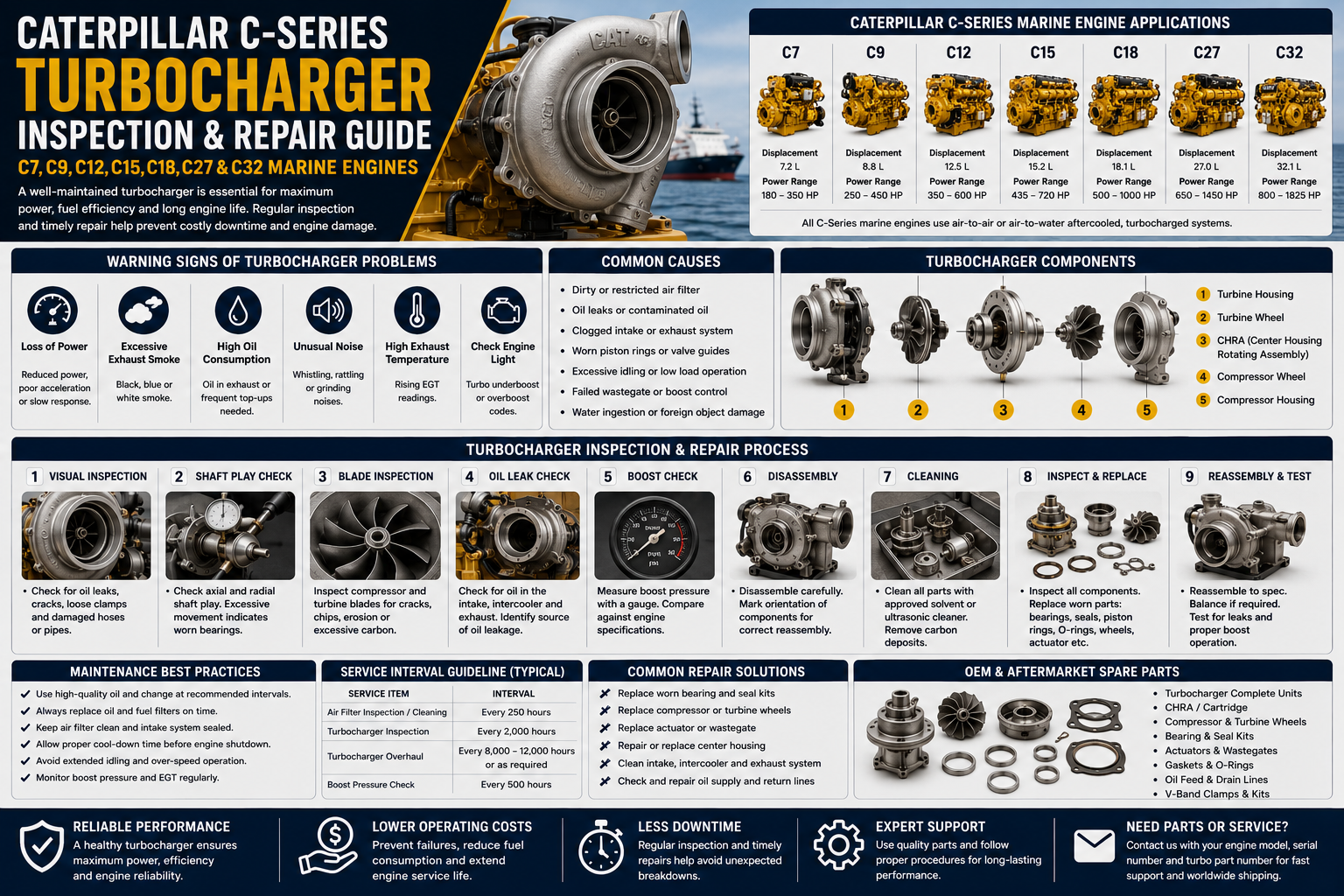

Caterpillar C-Series Turbocharger Inspection & Repair: C7, C9, C12, C15, C18, C27 & C32 Marine Engines
The turbocharger on a Caterpillar C-Series marine engine plays a major role in how the engine develops power.
It takes energy that would otherwise leave through the exhaust system and uses it to compress incoming air.
More air allows the engine to burn fuel efficiently and produce the power required to move a yacht, fishing vessel, workboat, passenger craft, patrol vessel, or commercial vessel.
Most of the time, nobody thinks much about the turbocharger.
Until something changes.
Maybe the engine begins producing more black smoke.
Perhaps it no longer reaches normal RPM.
Acceleration becomes slower.
Exhaust temperature starts increasing.
Boost pressure is lower than usual.
Or the engineer notices oil around the compressor housing.
These are all reasons to investigate.
But one point should be understood before replacing anything:
A low-boost problem does not automatically mean the turbocharger has failed.
The Caterpillar marine engine's air intake, aftercooler, exhaust, fuel system, lubrication system, and vessel load all influence turbocharger performance.
This guide explains Caterpillar C-Series turbocharger inspection and repair, including the different C-Series marine engine types, common warning signs, turbocharger damage, troubleshooting, rebuilding, replacement, and related marine spare parts.
1. Which Caterpillar C-Series Marine Engines Does This Guide Cover?
The Caterpillar C-Series covers a broad range of engine sizes.
Common marine engine families include:
Caterpillar C4.4
A compact engine family used in smaller marine, auxiliary, and generator applications.
Caterpillar C7 / C7.1
Compact six-cylinder engine families used in various marine propulsion and auxiliary applications.
Caterpillar C9 / C9.3
Larger inline-six engines used in workboats, commercial craft, generators, and other marine installations.
Caterpillar C12
A well-known inline-six engine used in marine propulsion and commercial applications.
Caterpillar C15
A larger inline-six engine capable of substantial marine power.
Caterpillar C18
One of the most recognized Caterpillar marine engine families, used in commercial vessels, yachts, fishing vessels, patrol craft, and generator applications.
Caterpillar C27
A large V-engine platform used in higher-output marine applications.
Caterpillar C32
A 12-cylinder engine family used in high-output marine propulsion and generator installations.
Caterpillar C32B
A later development of the C32 platform with different engine and turbocharging specifications depending on configuration.
The important lesson is:
“Caterpillar C-Series turbocharger” is far too broad for parts identification.
You need the exact engine.
2. Why the Exact Caterpillar C-Series Engine Matters
Consider two requests:
“Need Caterpillar turbocharger.”
and:
Engine: Caterpillar C18 Marine
Serial Number: __________
Arrangement Number: __________
Rated Power: __________
Turbocharger Part Number: __________
The second request provides something useful.
Different engines—and even different ratings within the same engine family—may use different:
- Turbocharger specifications
- Turbine housings
- Compressor wheels
- Oil connections
- Exhaust connections
- Boost characteristics
Never select a turbocharger only because it looks similar.
3. What Does a Caterpillar Marine Turbocharger Actually Do?
A turbocharger has two major sides.
Turbine Side
Hot exhaust gas leaves the cylinders and passes through the turbine housing.
That exhaust energy spins the turbine wheel.
Compressor Side
The turbine wheel is connected to a compressor wheel through a shaft.
As the shaft spins, the compressor wheel compresses incoming air.
That air then travels toward the engine through the charge-air system.
A simplified flow looks like:
Exhaust gas
↓
Turbine wheel
↓
Turbo shaft
↓
Compressor wheel
↓
Compressed intake air
↓
Aftercooler / intake system
↓
Engine cylinders
The system sounds simple.
At operating speed, however, the turbocharger is a very precise high-speed machine.
4. Why Turbocharger Performance Matters
The turbocharger influences:
- Engine airflow
- Boost pressure
- Combustion quality
- Engine output
- Acceleration
- Exhaust temperature
- Smoke
- Fuel consumption
A poorly performing turbocharger can therefore affect the entire engine.
But something outside the turbocharger can create exactly the same symptoms.
That is why troubleshooting should consider the complete engine system.
5. Situation: The Caterpillar Marine Engine Starts Producing Black Smoke
One of the first complaints may be:
“The CAT is smoking black under load.”
The turbocharger may be involved.
But black smoke usually indicates that the engine has more fuel than it can burn cleanly with the available air.
Possible causes include:
- Reduced turbocharger boost
- Dirty air filter
- Air-intake restriction
- Charge-air leak
- Aftercooler restriction
- Injector problem
- Fuel-system problem
- Engine overload
- Propeller overload
- Hull fouling
The turbo should therefore be inspected, but not automatically replaced.
6. Situation: The Engine Has Lost Acceleration
A turbocharged marine diesel should respond predictably when load increases.
If acceleration becomes noticeably slower, investigate.
Possible causes include:
- Compressor fouling
- Turbine fouling
- Turbocharger bearing wear
- Charge-air leakage
- Exhaust leakage
- Restricted intake
- Restricted exhaust
- Fuel-delivery problems
- Excessive vessel load
Compare the engine with its previous behavior.
The key question is:
“What changed?”
7. Situation: Boost Pressure Is Lower Than Normal
Reduced boost can point toward several possibilities.
These include:
- Compressor-wheel damage
- Turbine damage
- Bearing wear
- Deposits
- Air-filter restriction
- Intake leakage
- Aftercooler restriction
- Charge-air hose failure
- Exhaust leak before the turbine
- Exhaust restriction
- Engine overload
Before ordering a turbocharger, inspect the systems around it.
A leaking charge-air connection can make a perfectly healthy turbocharger look weak.
8. Situation: Exhaust Temperature Starts Increasing
Exhaust-temperature trends are useful.
Suppose your Caterpillar C18 normally operates at a stable exhaust temperature at a particular cruise condition.
Then it begins running hotter under the same load.
Possible causes include:
- Reduced airflow
- Turbocharger deterioration
- Dirty aftercooler
- Injector problem
- Engine overload
- Exhaust restriction
- Cooling-system deterioration
Do not wait until the engine reaches an alarm condition.
A gradual trend can provide an earlier warning.
9. Situation: One Engine Behaves Differently From the Other
Many marine vessels use twin engines.
This creates a valuable comparison.
For example:
Port C18
vs.
Starboard C18
Compare:
- Boost pressure
- Exhaust temperature
- Engine load
- Smoke
- Fuel consumption
- Maximum RPM
- Acceleration
- Turbocharger sound
If one engine behaves differently under the same operating conditions, investigate why.
Twin-engine comparison can sometimes reveal a developing turbocharger problem much earlier.
10. Listen for Changes in Turbocharger Noise
A turbocharger normally has a characteristic sound.
New sounds should not be ignored.
Listen for:
- Unusual whistling
- Scraping
- Grinding
- Metallic contact
- Abnormally loud turbo noise
- Air leakage
A whistling sound may come from the turbocharger itself.
But it can also come from:
- Charge-air hose
- Intake connection
- Exhaust leak
- Gasket failure
Locate the source before replacing components.
11. Scraping or Rubbing Noise Is More Serious
If a compressor or turbine wheel begins contacting its housing, continued operation may cause severe damage.
Possible causes include:
- Bearing wear
- Shaft movement
- Foreign-object damage
- Internal turbocharger failure
If wheel-to-housing contact is suspected, the turbocharger should be inspected promptly.
12. Oil Around the Turbocharger
Oil traces deserve investigation.
Possible sources include:
- Turbo oil supply line
- Turbo oil return
- External engine oil leak
- Turbocharger seal area
- Intake contamination
Do not simply clean the oil away.
Determine where it originates.
Repeated oil leakage may indicate a problem that deserves repair.
13. Why Lubrication Is Critical
The turbocharger shaft and bearings depend heavily on clean lubricating oil.
Possible lubrication-related causes of turbocharger failure include:
- Low engine oil pressure
- Contaminated oil
- Restricted oil feed
- Restricted oil return
- Incorrect lubricant
- Excessive oil temperature
- Dirty oil passages
This creates an important maintenance rule:
When a turbocharger fails, inspect the lubrication system before installing the replacement.
14. Never Install a New Turbo Onto a Blocked Oil Supply
Imagine the old turbocharger failed from insufficient lubrication.
A technician installs a new turbocharger.
But nobody checks the oil-feed line.
The restriction remains.
The replacement turbocharger can fail for the same reason.
Before fitting the new unit, inspect:
- Oil feed
- Oil return
- Lines
- Connections
- Restrictions
- Contamination
- Leakage
A new turbo cannot repair a faulty lubrication circuit.
15. Compressor-Wheel Inspection
The compressor wheel should be inspected carefully.
Look for:
- Blade damage
- Bent edges
- Chips
- Foreign-object damage
- Deposits
- Housing contact
- Oil contamination
Even small blade damage can matter because the turbocharger operates at very high rotational speed.
Balance is critical.
16. What Causes Compressor-Wheel Damage?
Possible causes include:
- Foreign objects entering the intake
- Failed air-filter components
- Loose intake hardware
- Debris from previous repairs
- Internal wheel-to-housing contact
If the compressor wheel is damaged, do not only replace the turbocharger.
Find out what entered the intake system.
Otherwise, the replacement turbo may suffer the same damage.
17. Turbine-Wheel Inspection
The turbine side operates in an extremely hot exhaust environment.
Inspection may reveal:
- Carbon deposits
- Cracking
- Damaged blades
- Foreign-object damage
- Housing contact
- Heat-related deterioration
Turbine damage can sometimes originate upstream.
Abnormal combustion, for example, may expose the turbine to excessive temperature.
18. Carbon Deposits
Carbon accumulation can gradually reduce turbocharger efficiency.
The engine may still run.
But the crew starts noticing:
- Reduced boost
- More smoke
- Slower response
- Higher exhaust temperature
Slow deterioration can be difficult to notice because everyone gradually adapts to the changed engine behavior.
This is why recorded operating data is valuable.
19. Turbocharger Shaft and Bearing Inspection
Turbocharger bearing condition can affect:
- Shaft movement
- Wheel clearance
- Oil control
- Rotational stability
Technicians may inspect for:
- Radial movement
- Axial movement
- Rough rotation
- Wheel contact
- Bearing wear
But turbocharger clearances should be measured against the correct specification.
Do not judge serviceability only by:
“It feels loose.”
20. Aftercooler Problems Can Look Like Turbocharger Problems
This is a major troubleshooting point on Caterpillar C-Series marine engines.
The turbocharger compresses the air.
The aftercooler helps cool it.
If the aftercooler becomes restricted or loses efficiency, the engine can develop:
- Higher intake-air temperature
- Reduced performance
- Increased exhaust temperature
- Black smoke
The turbocharger may still be healthy.
Inspect the aftercooler before assuming the turbo must be replaced.
21. Charge-Air Leaks
Compressed air can escape through:
- Hoses
- Clamps
- Connections
- Gaskets
- Cooler joints
- Cracked piping
A leak can create:
- Reduced boost
- Smoke
- Poor acceleration
- Higher exhaust temperature
Inspect the entire path between turbocharger and engine intake.
22. Oil Mist Around a Charge-Air Connection
A small amount of oil mist in a charge-air system can sometimes make leaks easier to identify.
If one joint has oily residue spreading around it while others remain relatively clean, inspect that connection carefully.
It may be leaking pressurized air.
23. Exhaust Leaks Before the Turbocharger
The turbocharger depends on exhaust energy.
If exhaust escapes before reaching the turbine, less energy is available to spin the turbo.
Possible leak points include:
- Exhaust manifold
- Manifold gaskets
- Turbo mounting connection
- Fasteners
- Expansion connections
Possible symptoms include:
- Reduced boost
- Slow response
- Soot around the leak
- Higher engine-room temperature
- Exhaust smell
Fixing the leak may restore turbo performance without replacing the turbocharger.
24. Air-Filter Restriction
Check the simple things first.
A heavily restricted air filter can reduce turbocharger airflow.
The engine may show:
- Smoke
- Reduced power
- Higher exhaust temperature
Before ordering a high-value turbocharger, make sure the engine can actually breathe.
25. Propeller Overload Can Look Like Turbocharger Trouble
A marine engine is connected to a propulsion system.
That means the turbocharger does not operate independently of the propeller.
If the propeller is:
- Over-pitched
- Fouled
- Damaged
- Carrying fishing line
- Incorrectly sized
the engine can become overloaded.
Possible symptoms include:
- Black smoke
- Failure to reach rated RPM
- High exhaust temperature
- High engine load
The turbocharger may be working correctly.
The vessel is simply asking the engine for too much torque.
26. Hull Fouling Can Also Affect Turbo Performance
Marine growth increases vessel resistance.
That means the engines must work harder to achieve the same speed.
The crew may notice:
- Higher engine load
- More fuel consumption
- Increased smoke
- Higher exhaust temperature
Before rebuilding two turbochargers, check the hull and propellers.
Sometimes the problem is underneath the boat.
27. Caterpillar C7 / C7.1 Turbocharger Inspection
For the smaller C-Series engines, common inspection areas include:
- Compressor condition
- Turbine condition
- Oil supply
- Oil return
- Charge-air connections
- Air intake
- Exhaust connections
Always match replacement components against the complete engine identification.
C7 and C7.1 should not automatically be treated as the same engine.
28. Caterpillar C9 / C9.3 Turbocharger Inspection
For C9 and C9.3 engines, inspect the turbocharger together with:
- Intake system
- Charge-air cooling
- Exhaust system
- Fuel system
- Engine load
If boost is low but the turbocharger looks mechanically sound, search for leakage or restriction elsewhere.
29. Caterpillar C12 Turbocharger Inspection
Older C12 installations may have accumulated substantial operating hours.
Pay particular attention to:
- Turbo bearing condition
- Exhaust deposits
- Oil leakage
- Charge-air hoses
- Exhaust manifold connections
- Previous turbocharger repairs
Existing turbocharger identification is useful when sourcing replacements.
30. Caterpillar C15 Turbocharger Inspection
The C15 can operate under heavy commercial load.
That makes trend monitoring particularly useful.
Record:
- Boost
- Exhaust temperature
- Engine load
- Oil pressure
- Maximum loaded RPM
A gradual change can indicate deterioration before the turbocharger fails completely.
31. Caterpillar C18 Turbocharger Inspection
The Caterpillar C18 marine engine is commonly used where high power and compact installation are important.
Turbocharger-related troubleshooting should include:
- Air filters
- Turbocharger condition
- Aftercooler
- Charge-air hoses
- Exhaust system
- Fuel injectors
- Engine load
- Propeller condition
A C18 producing black smoke should not automatically receive new turbochargers.
Find the actual cause first.
32. Caterpillar C27 Turbocharger Inspection
The C27 belongs to a larger engine class.
For major turbocharger work, accurate identification becomes especially important.
Record:
- Engine serial number
- Engine rating
- Existing turbocharger number
- Turbo position where relevant
- Repair history
The cost of incorrect parts rises quickly as engine size increases.
33. Caterpillar C32 Turbocharger Inspection
The Caterpillar C32 is a large V12 engine family.
Turbocharger condition is critical to:
- Power
- Airflow
- Exhaust temperature
- Smoke
- Engine response
On a V12, bank-to-bank comparisons can also be useful.
Compare:
- Exhaust temperatures
- Boost behavior
- Smoke
- Turbo noise
One side behaving differently can help narrow the investigation.
34. Caterpillar C32B Turbocharger Parts Are Not Automatically C32 Parts
The C32B belongs to the C32 family evolution, but it should not be assumed that every turbocharger-related component is interchangeable with earlier C32 engines.
Always verify:
exact engine model + serial number + existing turbo number.
This is particularly important for expensive air-system components.
35. When Should a Caterpillar Marine Turbocharger Be Rebuilt?
There is no single operating-hour number that should automatically be applied to every C-Series turbocharger.
Inspection and repair depend on:
- Engine model
- Turbo specification
- Operating hours
- Vessel duty
- Engine loading
- Oil condition
- Maintenance history
- Measured wear
- Symptoms
A heavily used commercial workboat and an occasionally operated yacht may have very different service histories.
36. What Happens During Professional Turbocharger Repair?
Depending on turbo type and condition, professional repair may involve:
- Complete cleaning
- Disassembly
- Compressor inspection
- Turbine inspection
- Shaft measurement
- Bearing inspection
- Seal inspection
- Housing inspection
- Replacement of service parts
- Clearance measurement
- Balancing
- Reassembly
- Testing
A turbocharger rebuild should involve much more than making it look clean.
37. Rebuild or Replace?
Rebuild May Make Sense When:
- Major housings remain usable
- Wheel assemblies remain repairable
- Correct service parts are available
- Proper balancing equipment is available
- Repair cost is economically sensible
Replacement May Make More Sense When:
- Turbine damage is severe
- Compressor damage is severe
- Shaft is badly damaged
- Housing is cracked
- Repair cost approaches replacement cost
- Vessel downtime makes repair time impractical
The best option depends on both technical condition and vessel operation.
38. New vs. Remanufactured Turbocharger
A replacement option may be:
- New genuine
- OEM-quality
- New aftermarket
- Professionally remanufactured
- Reconditioned
Do not assume all remanufactured turbochargers received the same repair.
Ask what was done.
A proper remanufacturing process should involve inspection, measurement, replacement of required components, balancing, and testing.
Fresh paint is not proof of rebuilding quality.
39. Be Careful With Very Cheap Turbochargers
A turbocharger has to match the engine's airflow and exhaust requirements.
An incorrect unit can create:
- Poor boost
- High exhaust temperature
- Smoke
- Slow acceleration
- Abnormal engine loading
The fact that a turbocharger bolts onto the exhaust manifold does not mean it belongs on that engine.
40. Why the Turbocharger Part Number Matters
Before ordering a replacement, inspect the turbocharger identification plate or markings.
Record:
Engine Model: __________
Engine Serial Number: __________
Arrangement Number: __________
Turbocharger Manufacturer: __________
Turbocharger Number: __________
Rated Engine Power: __________
This is far more reliable than ordering:
“C18 marine turbo.”
41. Why the Caterpillar Serial Number Matters
Caterpillar engine families contain different generations and configurations.
For example:
C18
is useful.
But:
C18 + serial prefix + full serial number
is much more useful.
And:
C18 + serial number + arrangement information + turbocharger part number
provides an even stronger basis for parts identification.
42. Inspect the Turbocharger After an Engine Failure
If another engine problem occurred before the turbocharger trouble, inspect the turbo carefully.
Examples include:
- Severe injector failure
- High exhaust temperature
- Internal engine damage
- Oil-pressure loss
- Intake-system failure
The turbocharger may have been affected by the original engine problem.
43. What to Check After a Turbocharger Failure
Before fitting a replacement, consider inspecting:
- Air filter
- Intake piping
- Charge-air cooler
- Charge-air hoses
- Exhaust manifold
- Exhaust connections
- Oil supply line
- Oil return
- Engine oil
- Oil filter
- Relevant cylinders
If debris entered another system, locate it before starting the engine.
44. Foreign-Object Damage
Foreign-object damage should always trigger:
“Where did the object come from?”
On the compressor side, inspect:
- Air filter
- Intake piping
- Loose hardware
On the turbine side, investigate whether material originated inside the engine or exhaust system.
Replacing the turbo without finding the debris source leaves the new turbo vulnerable.
45. Turbocharger Maintenance Starts With Engine Oil
A well-maintained turbocharger depends heavily on good engine lubrication.
Important areas include:
- Correct oil specification
- Correct oil level
- Clean oil
- Correct filter
- Stable oil pressure
- Proper operating temperature
Neglected engine oil does not only affect bearings and pistons.
It can also shorten turbocharger life.
46. Warm-Up Matters
A cold engine and its oil need time to stabilize.
Immediate heavy loading after startup can place additional stress on lubricated components.
Operate the engine according to its proper procedures before demanding maximum power.
Good operating practice supports both engine and turbocharger life.
47. Cool-Down After Heavy Operation
After prolonged high-load operation, turbocharger components can be extremely hot.
Operating procedures should allow engine temperatures to stabilize appropriately before shutdown.
The exact procedure should follow the requirements for the specific engine installation.
The point is simple:
Do not treat a high-output marine diesel like an on/off switch.
48. Keep an Operating Baseline
Record normal engine behavior.
For example:
| ParameterRecord Normal Condition | |
| Boost pressure | Vessel baseline |
| Exhaust temperature | Vessel baseline |
| Engine load | Vessel baseline |
| Maximum loaded RPM | Vessel baseline |
| Oil pressure | Vessel baseline |
| Smoke | Normal appearance |
| Turbocharger sound | Normal sound |
| Acceleration | Normal response |
Once you know normal, changes become much easier to identify.
49. Compare Similar Conditions
Do not compare:
idle at the dock
with:
full-load offshore operation.
For useful trending, compare similar:
- Engine RPM
- Vessel speed
- Engine load
- Sea conditions
- Hull condition
Good data requires comparable operating conditions.
50. Warning Signs That Deserve Investigation
Watch for:
- Black smoke
- Reduced boost
- High exhaust temperature
- Slow acceleration
- Oil leakage
- New turbocharger noise
- Failure to reach normal RPM
- Excessive fuel consumption
- Different behavior between engines
One symptom can have many explanations.
Several related symptoms make the need for investigation stronger.
51. Common Caterpillar C-Series Turbocharger Spare Parts
Depending on engine and turbocharger configuration, requirements may include:
- Complete turbocharger
- Turbo cartridge / core assembly
- Bearings
- Seals
- Compressor components
- Turbine components
- Housings
- Gaskets
- O-rings
- Oil-line seals
- Exhaust gaskets
- Intake gaskets
- Fasteners
Compatibility must be verified against the exact engine and turbocharger.
52. Related Caterpillar Air-System Parts
Turbocharger troubleshooting may also involve:
- Air filters
- Intake hoses
- Charge-air hoses
- Aftercoolers
- Charge-air cooler components
- Clamps
- Intake gaskets
- Exhaust manifolds
- Exhaust gaskets
- Sensors
Replacing only the turbocharger while ignoring the rest of the airflow system can leave the original problem unresolved.
53. Caterpillar Fuel Injectors and Turbocharger Performance
Fuel and air have to remain balanced.
A malfunctioning injector can create excess fuel in one cylinder.
This may contribute to:
- Smoke
- High cylinder exhaust temperature
- Abnormal turbine loading
If one cylinder behaves differently, do not automatically blame the turbocharger.
Compare cylinder performance.
54. Sensors Can Also Create Misleading Turbocharger Symptoms
Electronic C-Series engines rely on multiple sensors.
Depending on engine, monitored values may include:
- Boost pressure
- Intake temperature
- Engine speed
- Fuel-related parameters
- Exhaust-related conditions
A faulty reading can make a mechanical problem appear larger—or hide a real one.
Confirm physical conditions where possible.
55. Frequently Asked Questions
Which Caterpillar C-Series Marine Engines Use Turbochargers?
Many C-Series marine engines use turbocharging, including various C7/C7.1, C9/C9.3, C12, C15, C18, C27, C32 and C32B configurations.
Does Every Caterpillar C-Series Engine Use the Same Turbo?
No. Turbo specification depends on the engine family, rating, serial number and configuration.
Does Black Smoke Mean the Turbo Is Bad?
Not automatically. Air restriction, charge-air leakage, dirty aftercoolers, injector problems and engine overload can also cause black smoke.
Can a Dirty Aftercooler Cause Low Power?
Yes. Reduced air-system efficiency can affect performance even if the turbocharger remains serviceable.
Can an Exhaust Leak Cause Low Boost?
Yes. If exhaust gas escapes before reaching the turbine, less energy is available to drive the turbocharger.
Can Low Oil Pressure Damage the Turbocharger?
Yes. Turbocharger bearings depend on proper lubrication.
Can a Caterpillar Turbocharger Be Rebuilt?
Many turbochargers can be professionally rebuilt depending on condition and availability of correct repair components.
Should I Replace the Turbo if Boost Is Low?
Not before inspecting the complete intake, charge-air, exhaust, fuel and loading systems.
Should Both Turbos Be Replaced Together?
Not automatically. Each unit should be evaluated based on condition and operating data.
What Information Do I Need to Order a Caterpillar Turbocharger?
Provide the:
engine model + serial number + serial prefix + arrangement number + existing turbocharger number + rated power + photographs.
Caterpillar C-Series Marine Engine Types
Alfa Marine Spare Parts can assist with inquiries involving engine families such as:
- Caterpillar C4.4
- Caterpillar C7
- Caterpillar C7.1
- Caterpillar C9
- Caterpillar C9.3
- Caterpillar C12
- Caterpillar C15
- Caterpillar C18
- Caterpillar C27
- Caterpillar C32
- Caterpillar C32B
The exact engine and configuration should always be verified before sourcing turbocharger components.
Caterpillar C-Series Turbocharger & Marine Engine Spare Parts
Parts requirements may include:
- Turbochargers
- Turbocharger cartridges
- Turbo repair components
- Turbocharger gaskets
- Aftercoolers
- Charge-air components
- Air filters
- Exhaust components
- Cylinder heads
- Fuel injectors
- Fuel pumps
- Freshwater pumps
- Seawater pumps
- Oil pumps
- Pistons
- Piston rings
- Cylinder liners
- Main bearings
- Connecting-rod bearings
- Connecting rods
- Gaskets
- O-rings
- Seals
- Filters
- Sensors
- Wiring components
- Overhaul parts
Depending on availability and engine configuration, parts requirements may include OEM-quality, aftermarket, remanufactured, reconditioned or other suitable replacement components.
Browse Our Complete Catalog
Marine engine brands:
https://alfamarinespareparts.com/our-brand
Marine spare parts:
https://alfamarinespareparts.com/spareparts
Contact Alfa Marine Spare Parts
For Caterpillar C-Series marine turbochargers and engine spare parts:
Email: request@alfamarinespareparts.com
For faster parts identification, send:
Caterpillar engine model + serial number + serial prefix + arrangement number + existing turbocharger number + rated power + quantity + photographs + delivery location.
Final Word
A turbocharger problem on a Caterpillar C-Series marine engine should never be viewed only as a turbocharger problem.
The turbocharger sits between several systems.
Before it:
the air intake.
Driving it:
the exhaust system.
After it:
the charge-air cooler and intake system.
Supporting it:
the engine lubrication system.
And depending on its airflow:
the engine's fuel and combustion system.
That means:
black smoke does not automatically mean bad turbocharger.
Low boost does not automatically mean bad turbocharger.
High exhaust temperature does not automatically mean bad turbocharger.
A dirty aftercooler can create similar symptoms.
A leaking charge-air hose can create similar symptoms.
A cracked exhaust manifold can reduce turbine energy.
A blocked air filter can restrict airflow.
A poor injector can change exhaust conditions.
And a fouled propeller can overload a healthy engine until everyone starts blaming the turbo.
The most useful question is:
“What changed?”
Then inspect the system logically.
Air intake → turbocharger → charge-air cooler → engine → exhaust → turbocharger.
Check oil supply as well.
And if the turbocharger really has failed, do not stop with:
“Replace the turbo.”
Ask:
“Why did it fail?”
Because a new C18, C32, C15 or C9 turbocharger installed onto the same blocked oil line, contaminated intake, leaking exhaust connection or overloaded engine may eventually suffer exactly the same damage.
The best turbocharger repair is therefore not simply the one that puts a new turbo on the engine.
It is the repair that identifies and removes the reason the old one failed.