
Caterpillar 3412 Marine Engine Losing Power Under Load: Fuel, Turbo & Cooling Problems
A Caterpillar 3412 marine engine losing power under load does not automatically mean the engine needs an overhaul. When a 3412 starts normally, idles smoothly and performs well at low speed but struggles as vessel load increases, the change in operating conditions provides an important diagnostic clue.
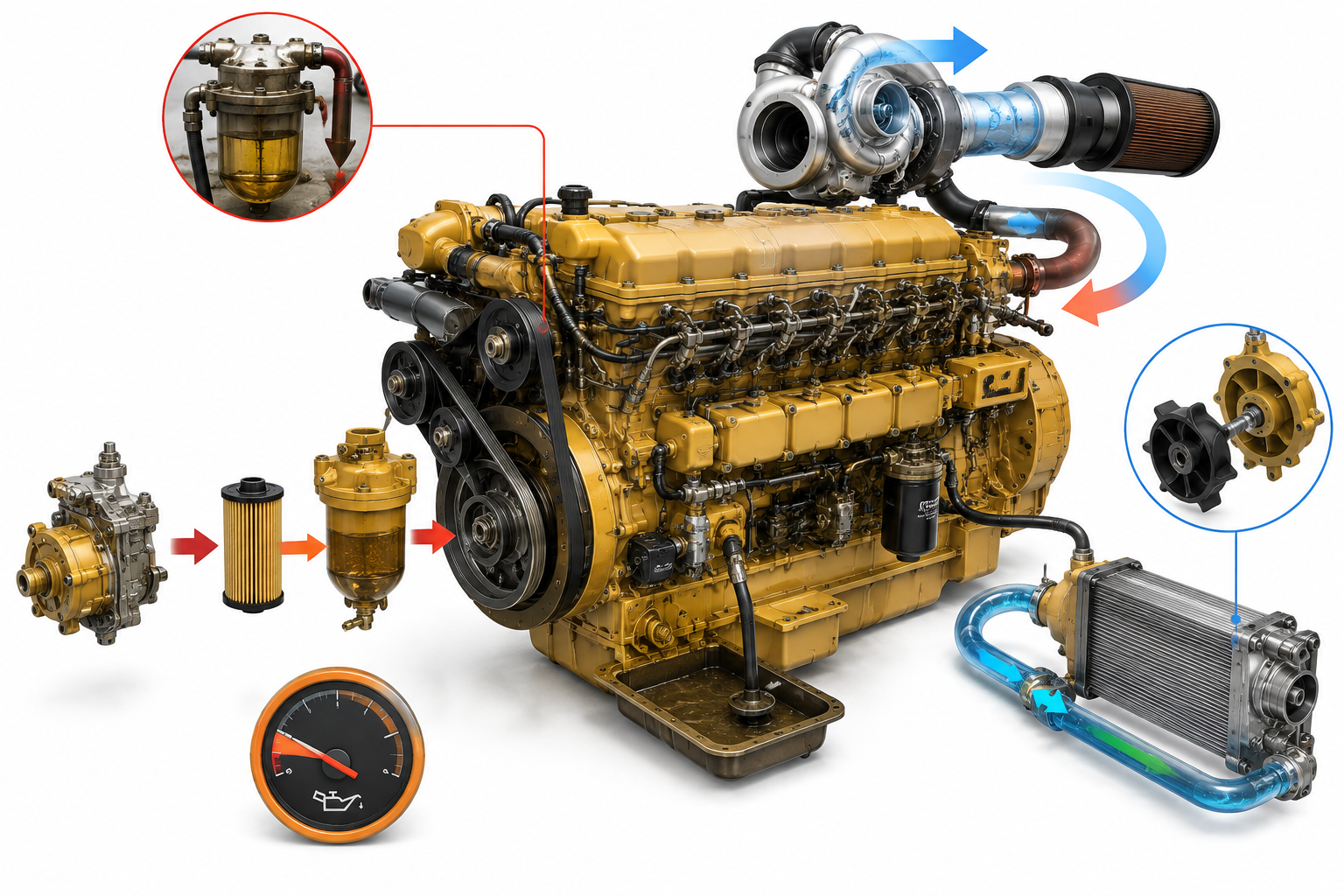
Under load, the engine requires substantially more fuel and combustion air. Turbocharger speed increases, exhaust flow rises and the cooling system must reject considerably more heat. A restriction or worn component that causes almost no noticeable problem at idle can therefore become significant when the engine is working hard.
The Caterpillar 3412 Marine Engine is a V12 diesel engine family widely encountered in commercial vessels, fishing vessels, tugboats, workboats, offshore applications, yachts and marine generator installations.
When troubleshooting power loss, the most useful question is not simply:
“Why has my Caterpillar 3412 lost power?”
Instead, determine:
“What changes when the engine is placed under load?”
1. Check Fuel Supply Before Blaming the Injectors
Fuel injectors are often suspected when a Caterpillar 3412 develops poor acceleration, smoke or reduced power. However, the injection system cannot perform correctly unless it receives an adequate and consistent fuel supply.
Imagine a 3412 that starts normally and runs smoothly at low RPM. As the vessel accelerates, engine speed initially increases but eventually stops climbing even though more throttle is requested.
A partially restricted fuel filter can produce this type of symptom.
At idle, fuel consumption is relatively low, so enough fuel may pass through the restriction to keep the engine running normally. Under heavy load, fuel demand rises substantially and the restriction becomes much more important.
Before moving directly toward injectors or injection-pump components, inspect the primary fuel-water separator, secondary fuel filters, tank pickup, fuel lines, shut-off valves and connections.
Air entering the suction side of the fuel system also deserves attention. A connection can allow air into the system without necessarily producing an obvious external diesel leak.
If replacing the fuel filters restores power but the same problem returns shortly afterward, investigate why the filters are becoming restricted. Contaminated fuel, sludge, water or tank debris can make repeated filter replacement a temporary treatment rather than a permanent repair.
2. Black Smoke and Low Boost Can Point Toward the Air System
Exhaust smoke becomes much more useful diagnostically when interpreted together with engine RPM, boost pressure and load.
If a Caterpillar 3412 cannot achieve expected RPM and begins producing heavy black smoke, the engine may be receiving fuel without enough combustion air to burn it efficiently.
That shifts attention toward the air intake, turbocharger, aftercooler, intake manifold and exhaust system.
| Symptom under loadArea worth investigating | |
| Power loss with relatively little smoke | Fuel supply, engine load, controls or mechanical condition |
| Heavy black smoke + low power | Air restriction, low boost, turbocharger or excessive load |
| Rising temperature + power loss | Cooling system, airflow or engine overload |
| Surging or unstable RPM | Fuel supply, air entering fuel system or controls |
| Abnormal turbo noise + low boost | Turbocharger, intake or exhaust system |
These symptoms do not prove that a particular component has failed. Instead, they help determine which system should be tested next.
Does Low Boost Mean the Turbocharger Has Failed?
Not necessarily.
A damaged turbocharger can certainly reduce boost and engine power, but the turbocharger should not be replaced based only on black smoke or a low boost reading.
The complete air path needs to be considered.
Restrictions before the compressor, leaks after the compressor, fouled charge-air cooling components and exhaust restrictions can all reduce the amount of air available for combustion.
One relevant Caterpillar component is the Caterpillar 243-2567 Turbocharger, which is listed for Caterpillar 3412E among its applications.
Relevant references include:
243-2567 — Turbocharger
10R-2313 — Reman turbocharger reference
The important point is that 243-2567 should not be assumed to fit every Caterpillar 3412. Turbocharger selection should be verified against the engine serial number, arrangement number and existing turbocharger identification.
3. Caterpillar 3412 Seawater Pump Problems Can Appear Under Load
Cooling-system capacity becomes increasingly important as a marine engine produces more power.
A Caterpillar 3412 may therefore operate normally alongside the dock but begin developing higher temperatures during a sea trial.
Under load, combustion heat rises substantially and the cooling system must continuously remove that additional thermal energy.
A restriction on the seawater side can therefore remain almost invisible at idle and become obvious only after engine load increases.
Areas worth inspecting include the seawater intake, seacock, seawater strainer, suction hose, auxiliary seawater pump, heat exchanger, aftercooler circuit where applicable and associated cooling components.
One particularly relevant pump is the Caterpillar 6I-1898 Auxiliary Sea Water Pump.
Part numbers associated with different Caterpillar 3412 cooling-system applications include:
| Part NumberComponent / Reference | |
| 6I-1898 | Auxiliary / seawater pump group |
| 0R-7722 | Reman seawater pump reference associated with 6I-1898 |
| 197-4855 | Auxiliary seawater pump |
| 0R-7731 | Reman pump reference associated with 197-4855 |
| 7C-3613 | Auxiliary seawater pump for selected applications |
These numbers illustrate why a request for simply a “Caterpillar 3412 seawater pump” may not contain enough information to identify the correct component.
The exact engine configuration matters.
Why Replacing Only the Impeller May Not Restore Cooling
A damaged impeller is an obvious component to investigate when seawater flow decreases, but the impeller is only one part of the pump.
The pump housing should also be inspected for corrosion, erosion, cavitation damage, internal scoring and damage around sealing surfaces.
A new impeller operating inside a severely worn housing may still fail to provide adequate water flow.
Missing impeller blades also deserve attention.
If pieces have broken away from an old impeller, don't automatically assume they have disappeared harmlessly overboard. Fragments can travel downstream and contribute to restrictions elsewhere in the cooling circuit.
The diagnostic objective is therefore not simply to determine whether the pump rotates. It is to determine whether the complete seawater circuit can provide sufficient flow when the Caterpillar 3412 is operating under load.
4. The Engine May Be Healthy but the Vessel Is Overloading It
Not every Caterpillar 3412 power problem originates inside the engine.
Consider an engine that previously reached normal full-load RPM but now struggles to achieve the same speed.
The fuel system has been inspected, boost appears reasonable, cooling performance is acceptable and no obvious mechanical problem has been identified.
At that point, the vessel itself deserves attention.
A heavily fouled hull, damaged propeller, excessive propeller pitch, increased vessel displacement or driveline problem can increase the load imposed on the engine.
An overloaded diesel may show a combination of reduced maximum RPM, black smoke, increased exhaust temperature and rising coolant temperature.
The engine may be producing substantial torque, but the vessel is demanding more from it than under previous operating conditions.
This is why sea-trial information can be extremely valuable when diagnosing a Caterpillar 3412 Marine Engine.
During a controlled sea trial, compare RPM, boost pressure, coolant temperature, oil pressure and exhaust temperatures against your original sea-trial data. This comparison helps isolate whether the root cause is an engine restriction, an external system fault or a physical overload from the vessel itself.
The relationship between these measurements is often more informative than any single gauge reading.
5. Caterpillar 3412 Part Numbers Must Match the Exact Engine
The Caterpillar 3412 Marine Engine Spare Parts page provides engine-specific parts and technical information for the 3412 family.
Depending on the exact engine configuration, parts requirements can include fuel injectors, injection components, turbochargers, seawater pumps, freshwater pumps, cylinder heads, pistons, cylinder liners, connecting rods, main bearings, connecting-rod bearings, crankshafts, camshafts, gaskets, seals and complete overhaul components.
Some relevant part numbers discussed in this article include:
| Caterpillar P/NComponentApplication Reference | ||
| 243-2567 | Turbocharger | Listed for 3412E application |
| 10R-2313 | Reman turbo reference | Associated with 243-2567 |
| 6I-1898 | Auxiliary seawater pump | 3412 / 3412D applications |
| 0R-7722 | Reman seawater pump | Associated with 6I-1898 |
| 197-4855 | Auxiliary seawater pump | Selected 3412 applications |
| 0R-7731 | Reman pump reference | Associated with 197-4855 |
| 7C-3613 | Auxiliary seawater pump | Selected 3412-family applications |
For specific component information, see the Caterpillar 6I-1898 Auxiliary Sea Water Pump and Caterpillar 243-2567 Turbocharger pages.
These part numbers should be treated as application-specific references rather than universal Caterpillar 3412 fitment numbers.
Before ordering a seawater pump, turbocharger, injector, cylinder head, piston, liner, bearing or overhaul kit, provide the identifying information from the actual engine.
A useful parts request contains:
Engine: Caterpillar 3412 / 3412C / 3412D / 3412E
Engine Serial Number (ESN): ___
Arrangement Number (A/R): ___
Existing Part Number: ___
Quantity: ___
Photographs: Recommended
Delivery Location / Port: ___
This gives the parts supplier a much stronger basis for identifying the correct component.
Frequently Asked Questions
Why does my Caterpillar 3412 run normally at idle but lose power underway?
A restriction that has little effect at idle can become significant as fuel demand, airflow, cooling demand and exhaust flow increase. Fuel restrictions, insufficient boost, cooling problems and excessive vessel load are all areas worth investigating.
Does black smoke mean my Caterpillar 3412 turbocharger has failed?
Not automatically. Black smoke can indicate insufficient combustion air relative to fuel delivery, but the restriction may be elsewhere in the intake, aftercooler or exhaust system. Excessive vessel load can also contribute.
What is Caterpillar part number 243-2567?
243-2567 is a Caterpillar turbocharger reference associated with Caterpillar 3412E among its applications. 10R-2313 is associated with the reman option. See the Caterpillar 243-2567 Turbocharger page for product information.
What is Caterpillar part number 6I-1898?
6I-1898 is an auxiliary seawater pump associated with Caterpillar 3412 and 3412D applications. See the Caterpillar 6I-1898 Auxiliary Sea Water Pump page.
Which seawater pump fits my Caterpillar 3412?
The engine model alone may not be enough to determine the correct pump. Different configurations can use different assemblies, including 6I-1898, 197-4855 and 7C-3613. Use the engine serial number, arrangement number and existing pump number to verify compatibility.
Can a fouled hull make a Caterpillar 3412 lose RPM?
Yes. Increased hull resistance or excessive propeller load can prevent an otherwise healthy engine from reaching its previous operating RPM. Compare current sea-trial data with known-good vessel performance and investigate the propulsion system as well as the engine.
What information should I provide when requesting Caterpillar 3412 parts?
Provide the engine model, engine serial number, arrangement number, existing part number, quantity, photographs where available and delivery location or port.
Conclusion: Solve Your 3412 Power Loss Permanently
Diagnosing a Caterpillar 3412 power loss under load requires a systematic approach. Checking straightforward restrictions first—such as fuel filtration, fuel supply and air-intake restrictions—before moving toward expensive component replacement or engine overhaul can save troubleshooting time and reduce unnecessary costs.
The Caterpillar 3412's performance under load depends on several systems working together. Fuel delivery must remain adequate, the turbocharger and air system must provide sufficient combustion air, and the marine cooling system must reject the additional heat generated as engine load increases.
For that reason, the auxiliary seawater pump, heat exchangers, fuel supply system, turbocharger and associated air system should be considered together when diagnosing a 3412 that performs normally at the dock but loses power, smokes or runs hot underway.
Need Caterpillar 3412 Replacement Parts?
If troubleshooting identifies a problem with the cooling or air system, Alfa Marine Spare Parts can assist with components including the 197-4855 auxiliary seawater pump, 6I-1898 auxiliary seawater pump and 243-2567 turbocharger, together with other Caterpillar 3412 engine components depending on availability and exact engine configuration.
As an independent marine spare-parts supplier, Alfa Marine Spare Parts supports shipowners, ship managers, shipyards, marine repair companies, engine rebuilders, marine engineers, commercial vessels, workboats, fishing vessels, tugboats and yachts.
International shipments can be arranged to customers, workshops, shipyards, freight forwarders and ports worldwide.
For additional engine and parts information, visit Caterpillar 3412 Marine Engine Spare Parts.
Request a Fast Quote Today
To help identify the correct parts for your Caterpillar 3412 engine arrangement, send:
- Engine Model & Serial Number (ESN)
- Engine Arrangement Number (A/R)
- Required Part Numbers & Quantities
- Photos of the existing component where available
- Delivery Location / Port
Email: request@alfamarinespareparts.com
Submit your complete requirement through the Request a Quote | Alfa Marine Spare Parts page.
The better approach when diagnosing Caterpillar 3412 power loss is to establish what changed, when the symptom appears and what happens simultaneously to RPM, boost pressure, coolant temperature, oil pressure and exhaust temperature. Comparing those readings with known-good sea-trial data can help distinguish a fuel, air or cooling restriction from an external system problem or excessive vessel load. You can view marine engine parts and catalog information at Alfa Marine Spare Parts.