Marine Diesel Engine Losing Power Under Load: What to Check First
A marine diesel engine that runs smoothly alongside the dock but begins losing power once the vessel is underway is giving you an important diagnostic clue. At idle or low load, the engine needs relatively little fuel and air. As the throttles are advanced, fuel demand, airflow, turbocharger speed, exhaust flow and cooling demand all increase.
A restriction that is almost invisible at idle can therefore become a serious performance problem under load.
This is why a marine diesel engine losing power under load should not immediately be diagnosed as an injector or turbocharger failure. A partially restricted fuel filter, contaminated fuel supply, leaking charge-air hose, dirty aftercooler, deteriorating turbocharger or even excessive propeller load can produce similar symptoms.
The same diagnostic principle applies across different marine engines, including the Cummins QSM11, Caterpillar C32 and other Caterpillar marine engines and MTU Series 4000.
The important question is not simply “Why has the engine lost power?” It is “What changes when the engine is placed under load?”
1. Start With Fuel Supply Before Blaming the Injectors
When a marine diesel loses power, injectors are often among the first components suspected. Sometimes they are responsible, but the fuel must first reach the injection system in sufficient quantity and at the required conditions.
A partially restricted fuel filter is a good example.
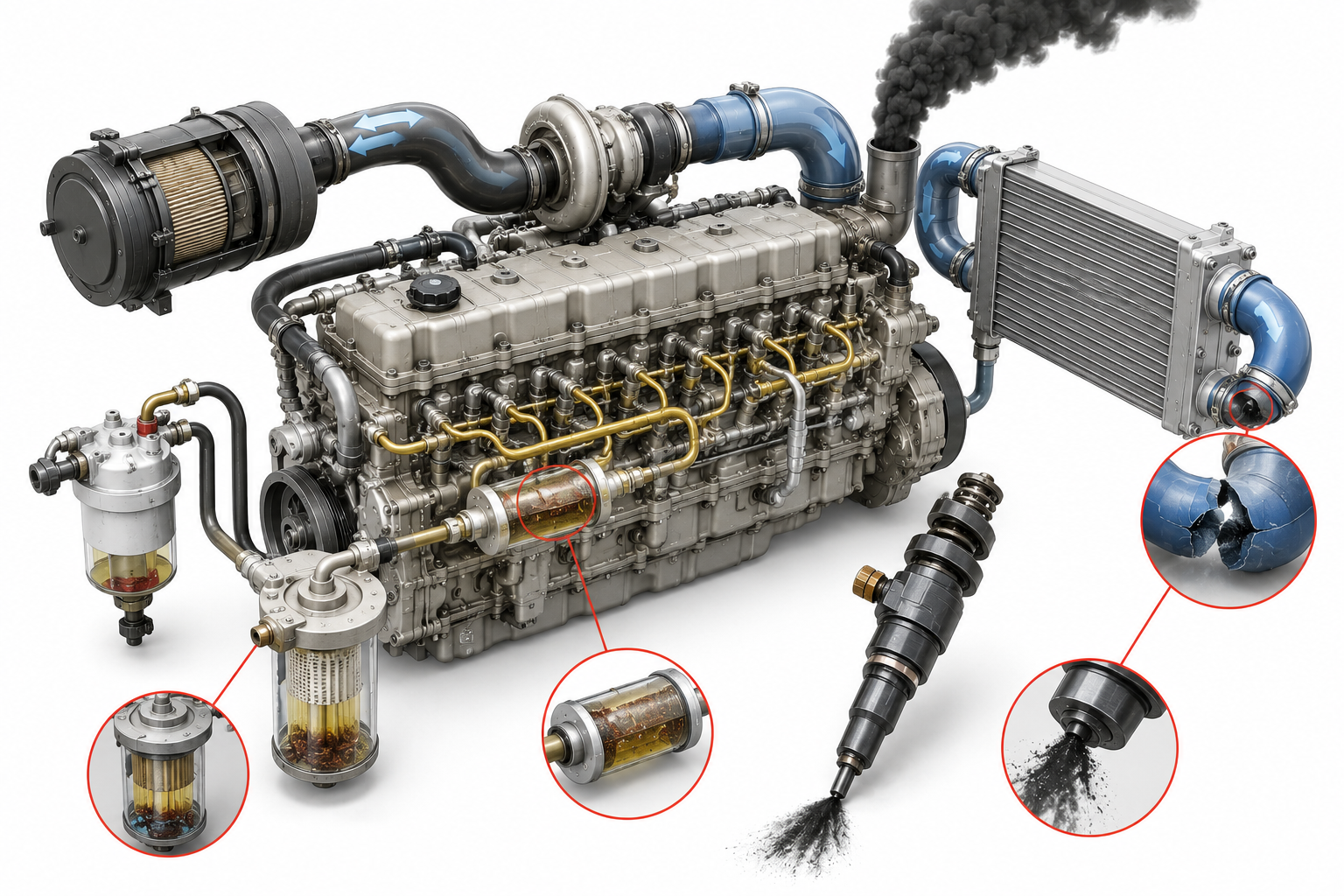
At idle, fuel demand is relatively low. Enough fuel may pass through the restriction for the engine to run smoothly, making everything appear normal. As the vessel accelerates and engine load increases, the injection system requires considerably more fuel.
The same restriction can then become large enough to limit supply.
You may notice slow acceleration, an inability to achieve expected RPM, surging or a gradual loss of power as load increases.
Before replacing injectors or expensive fuel-system components, inspect the supply side. Check the primary fuel-water separator, filters, tank pickup, shut-off valves, fuel hoses and connections.
Water, sludge or other tank contamination can also cause filters to block repeatedly. If a new filter improves performance but the same problem returns shortly afterwards, the filter itself may only be showing you a problem farther upstream.
Air entering the suction side deserves attention as well. A small connection leak may not necessarily allow diesel to escape outward, but it can allow air into the system when fuel demand increases.
On a Cummins QSM11 marine engine, for example, fuel-system diagnosis should be considered alongside actual engine load and operating data rather than assuming immediately that the injectors have failed. Your QSM11 page also identifies fuel filters, fuel-water separators, injectors, fuel-pump components and fuel-supply components among the relevant parts categories.
The useful diagnostic question becomes:
Is the injection system failing to deliver fuel correctly, or is enough fuel simply not reaching it?
Those two problems can produce similar symptoms but require very different repairs.
2. Black Smoke and Loss of Power: Look at the Air Side
A diesel engine requires more air as more fuel is injected. If fuel is available but the engine cannot receive or retain the required amount of combustion air, performance begins to deteriorate.
This is why black smoke combined with loss of power is particularly useful diagnostically.
The restriction can occur before the turbocharger through an air-intake problem, but it can also occur after the turbocharger.
A loose clamp, cracked hose or leaking charge-air connection can allow compressed air to escape before it reaches the cylinders. At low engine load, the effect may be relatively small. Once boost increases, considerably more compressed air can escape through the same leak.
You can then see a pattern such as:
poor acceleration + reduced boost + black smoke + increasing exhaust temperature.
Before condemning the turbocharger, inspect the complete air path.
Look for damaged hoses, loose clamps, leaking connections and evidence of oil mist around charge-air joints. Oil staining can sometimes help identify a connection where boosted air has been escaping.
Aftercooler condition also matters. Reduced charge-air cooling performance can affect the density of the air entering the engine and contribute to poor high-load performance.
This becomes particularly important on high-output engines such as the MTU Series 4000. Your Series 4000 page confirms that the family uses turbocharging and charge-air cooling and covers V8, V12, V16 and V20 configurations.
Don't Diagnose a Turbocharger From Smoke Alone
Black smoke does not automatically mean the turbocharger has failed.
Restricted intake air, a leaking charge-air connection, aftercooler problems, exhaust restriction, abnormal fueling or excessive engine load can all change the relationship between available air and injected fuel.
Listen to the engine as well.
A new whistle, scraping sound or other change in turbocharger noise deserves investigation, especially when it appears together with reduced boost or loss of performance.
The goal is to determine why the cylinders are not receiving the correct air-to-fuel relationship, rather than simply replacing the most expensive component in the system.
3. The Engine May Be Healthy — The Vessel Could Be Overloading It
Sometimes one of the most important parts of an engine diagnosis is outside the engine room.
Imagine a vessel that previously reached its expected full-load RPM without difficulty. Over time, acceleration becomes slower, black smoke becomes more noticeable and the engine can no longer achieve the same RPM at wide-open throttle.
It is tempting to start replacing engine components.
But first ask:
Has the load on the engine changed?
A heavily fouled hull increases resistance through the water. Marine growth or damage on the propeller can also increase engine load. Incorrect propeller pitch, excessive vessel weight or drivetrain problems can produce similar effects.
The engine attempts to overcome that additional load, but RPM may remain below normal while fuel consumption, exhaust temperature and thermal stress increase.
This creates several useful symptom combinations:
| What you observeWhat deserves investigation | |
| Low RPM + black smoke | Air restriction, low boost or excessive engine load |
| Power loss only at high load | Fuel restriction, charge-air leakage or vessel loading |
| Increasing exhaust temperature | Airflow, fueling and actual engine load |
| One engine weaker on a twin installation | Compare the two engine systems |
| Both engines progressively underperform | Consider hull, propeller and common vessel conditions |
| Power loss + rising coolant temperature | Check engine loading and cooling capacity together |
This applies whether the vessel is powered by a Caterpillar C32, Cummins QSM11, MTU Series 4000 or another marine diesel platform.
If power loss is accompanied by increasing engine temperature, the two symptoms may be related. An overloaded engine produces additional heat at the same time that it struggles to achieve the expected RPM.
4. Use RPM, Boost, Smoke and Temperature Together
One measurement rarely gives you the complete diagnosis.
The real value comes from seeing how several parameters change at the same time.
Suppose a Cummins QSM11 begins losing power above a particular RPM.
If boost also drops and black smoke increases, the intake, turbocharger and charge-air system become more interesting.
If the engine loses power without excessive smoke while fuel supply deteriorates under load, the fuel system deserves greater attention.
If boost appears reasonable but the engine cannot achieve its previous full-load RPM while smoke and temperature increase, vessel loading should also be investigated.
Twin-engine vessels provide an especially useful diagnostic reference.
If two similar engines are operating under approximately the same vessel conditions but the port engine develops normal boost and reaches expected RPM while the starboard engine does not, compare the systems between the two engines.
A practical operating log can help:
| ParameterIdleCruiseHigh Load | |||
| Engine RPM | ___ | ___ | ___ |
| Engine load | ___ | ___ | ___ |
| Boost pressure | ___ | ___ | ___ |
| Coolant temperature | ___ | ___ | ___ |
| Fuel pressure | ___ | ___ | ___ |
| Exhaust temperature | ___ | ___ | ___ |
| Exhaust smoke | ___ | ___ | ___ |
| Active fault codes | ___ | ___ | ___ |
On electronically controlled engines, fault information should be recorded together with the conditions under which the alarm occurred.
Don't simply record “low boost alarm.”
Record what the engine was doing:
RPM + load + boost + temperature + smoke + vessel speed + operating condition.
That information gives the engineer something useful to diagnose.
5. Different Marine Engine Brands, Same Diagnostic Principle
The exact fuel, turbocharger, charge-air and electronic systems differ between manufacturers, so model-specific information remains important.
A Cummins QSM11, Caterpillar C32 and MTU Series 4000 do not use identical systems.
The broader diagnostic method, however, remains useful across many marine diesel platforms.
The same approach can be applied to Perkins, Yanmar, Komatsu, Scania, Detroit Diesel, DEUTZ, John Deere, Mitsubishi, MAN, Volvo Penta, Doosan and Wärtsilä marine engines.
Don't begin by replacing a component because that component is commonly associated with the symptom.
Instead ask:
Is enough fuel reaching the engine?
Is enough air entering the engine?
Is the turbocharger producing the expected boost?
Is that boost actually reaching the cylinders?
Can the exhaust gases leave the engine correctly?
Is the vessel placing an abnormal load on the engine?
Once the fault has been narrowed to a particular system, the exact engine model and serial number become essential.
For example, the MTU Series 4000 family alone includes multiple engine configurations. Alfa Marine's live engine pages include individual models such as the MTU 8V4000 M53, MTU 12V4000 M93, MTU 16V4000 M53, MTU 16V4000 M63 and MTU 16V4000 M73. Those individual pages should be used when diagnosing or ordering parts for a specific engine rather than assuming that every Series 4000 configuration uses the same components.
Before Ordering Marine Engine Parts
Once testing identifies a component that requires replacement, accurate engine information becomes essential.
Avoid sending only a description such as:
“Cummins injector”
“CAT turbocharger”
“MTU fuel pump”
or
“marine engine sensor.”
Engine families can contain different ratings, configurations and component specifications.
Instead, provide:
Engine manufacturer + complete engine model + engine serial number + existing part number + quantity + photographs + delivery location
For specific engine requirements, browse:
Cummins QSM11 Marine Engine Parts
Caterpillar | Alfa Marine Spare Parts
MTU Series 4000 Marine Engine Parts
Alfa Marine Spare Parts can assist with requirements including fuel injectors, fuel pumps, filters, turbochargers, aftercooler components, sensors, cooling pumps, cylinder-head components, gaskets and engine overhaul parts.
Frequently Asked Questions
Why does my marine diesel engine lose power only under load?
At higher load, the engine requires considerably more fuel and air. A fuel restriction, charge-air leak, turbocharger problem, intake restriction or excessive vessel load may therefore become noticeable only after the throttles are advanced.
Why does my marine engine lose power and produce black smoke?
Black smoke combined with reduced power suggests that the relationship between fuel and available combustion air should be investigated. Check intake restriction, boost pressure, charge-air leakage, turbocharger condition and actual engine loading before assuming that the injectors are faulty.
Can a blocked fuel filter cause an engine to run normally at idle?
Yes. A partially restricted filter may provide sufficient fuel at low demand but become inadequate as engine load and fuel consumption increase.
Can a dirty hull make a marine diesel engine lose power?
Yes. Increased hull or propeller resistance increases the load placed on the propulsion engine. If the engine can no longer reach its expected full-load RPM, vessel condition should be considered alongside engine-related causes.
Does low boost always mean the turbocharger has failed?
No. Intake restriction, charge-air leakage, aftercooler problems, exhaust-side issues and abnormal engine loading can also influence boost performance.
What information should I send when ordering replacement parts?
Provide the engine manufacturer, complete engine model, engine serial number, existing part number, quantity and delivery destination. Clear photographs can also help identify an existing component.
Need Marine Diesel Engine Parts?
If your diagnosis identifies a faulty fuel injector, fuel pump, filter, turbocharger, aftercooler component, sensor, pump, gasket or another marine engine component, Alfa Marine Spare Parts can assist with parts identification and availability.
For the fastest quotation, send:
Engine model + engine serial number + part number + quantity + delivery destination
Email: request@alfamarinespareparts.com
Request a Quote | Alfa Marine Spare Parts
You can also browse the Cummins QSM11 parts page, Caterpillar | Alfa Marine Spare Parts or MTU Series 4000 parts page for engine-specific information.
When a marine diesel engine loses power under load, the most expensive component is not necessarily the component at fault. Following the changes in fuel supply, airflow, boost, exhaust behavior and actual vessel load usually provides a much better path toward finding the real cause.