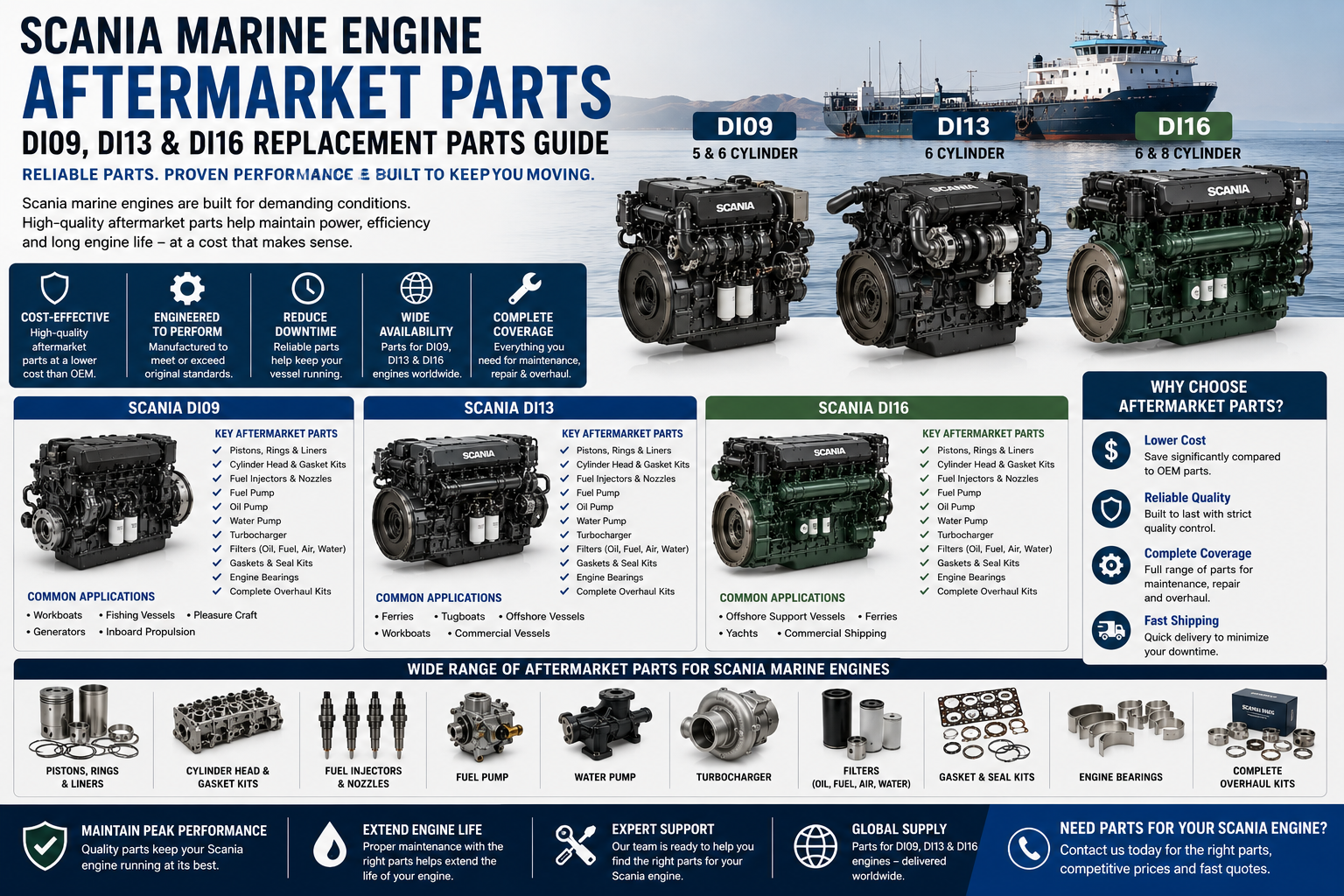
Scania Marine Engine Aftermarket Parts: DI09, DI13 & DI16 Replacement Parts Guide
The Scania DI09, DI13 and DI16 marine engine families are widely used in commercial vessels because they combine strong torque, compact installation dimensions and a modular engine design that makes them suitable for many different marine applications.
Depending on the engine model and power rating, Scania marine engines can be found in:
- Fishing vessels
- Pilot boats
- Patrol craft
- Passenger vessels
- Workboats
- Rescue boats
- Ferries
- Commercial yachts
- Marine generator sets
- Auxiliary installations
As these engines accumulate operating hours, owners and marine engineers eventually face the same question:
Should we use genuine parts, OEM-quality components, remanufactured parts or aftermarket Scania marine engine parts?
There is no single answer for every component.
A good-quality aftermarket gasket, filter or external pump may offer excellent value.
But critical parts such as:
injectors, pistons, cylinder liners, bearings, cylinder heads and turbochargers
need much more careful consideration.
The objective should never simply be:
“Find the cheapest Scania marine engine parts.”
A better approach is:
“Find the correct quality part for the exact Scania engine, duty and application.”
1. Which Scania Marine Engines Does This Guide Cover?
The main modern Scania marine engine families include:
Scania DI09
The compact 9-liter inline five-cylinder family.
Scania DI13
The versatile 13-liter inline six-cylinder family.
Scania DI16
The larger 16-liter V8 family.
These engines may be configured for:
- Marine propulsion
- Marine auxiliary duty
- Generator applications
- Heat-exchanger cooling
- Keel cooling
- Different commercial duty ratings
That last point is important.
Two engines may both say:
Scania DI13
while having different:
- Power ratings
- Fuel-system components
- Cooling arrangements
- Turbochargers
- Electronics
- Accessories
Always identify the complete engine before ordering parts.
2. Scania DI09 Aftermarket Parts
The Scania DI09 is the smallest of the main modern Scania marine families.
It uses an inline five-cylinder architecture and is often attractive for vessels requiring good commercial power without moving to the physical size of a DI13 or DI16.
Common aftermarket parts requirements can include:
- Oil filters
- Fuel filters
- Air filters
- Water pumps
- Thermostats
- Injectors
- Turbochargers
- Gaskets
- Seals
- Sensors
- Cylinder-head components
- Pistons
- Piston rings
- Cylinder liners
- Main bearings
- Connecting-rod bearings
For routine service components, aftermarket options can be practical.
For major internal parts, exact identification becomes much more important.
3. Scania DI13 Aftermarket Parts
The Scania DI13 is one of the most versatile Scania marine engines.
Its inline-six configuration is commonly suited to:
- Pilot boats
- Patrol craft
- Fishing vessels
- Passenger vessels
- Workboats
- Commercial marine applications
Because the DI13 family exists in several power ratings and configurations, never assume every DI13 uses identical:
- Injectors
- Turbochargers
- Sensors
- Cooling pumps
- Electronic components
A request saying:
“Need Scania DI13 injector.”
should preferably include:
Complete engine designation: __________
Engine serial number: __________
Current injector part number: __________
Rated power: __________
Quantity: __________
This significantly reduces the chance of ordering the wrong component.
4. Scania DI16 Aftermarket Parts
The Scania DI16 is the V8 heavyweight of the family.
Its high power density makes it particularly suitable for:
- Fast workboats
- Patrol vessels
- Pilot boats
- Passenger craft
- Large fishing vessels
- Commercial yachts
- Government craft
The DI16 also means more components.
A V8 overhaul can involve:
- Eight pistons
- Eight cylinder positions
- Multiple cylinder-head components
- Eight injector positions
- Main and connecting-rod bearings
- Multiple gaskets and sealing systems
- Turbocharger and cooling components
That makes planning particularly important.
A major overhaul should ideally be treated as a complete parts requirement, rather than purchasing components one by one after the engine has already been dismantled.
5. Aftermarket Scania Cylinder Heads
The cylinder head is one of the most critical engine components.
Cylinder-head problems may develop from:
- Overheating
- Valve-seat wear
- Valve-guide wear
- Corrosion
- Cracking
- Injector-related damage
- Poor previous machining
- Excessive operating hours
Aftermarket cylinder heads may be available for certain Scania applications.
But this is not a component where price should be the only consideration.
Check:
- Casting quality
- Machining
- Valve-seat installation
- Injector bore accuracy
- Coolant passage dimensions
- Surface finish
A cheap head becomes expensive very quickly if it has to be removed again.
6. Should You Rebuild or Replace a Scania Cylinder Head?
A cylinder head does not always need complete replacement.
A professional workshop may be able to:
- Pressure test it
- Check for cracks
- Measure flatness
- Replace valve guides
- Replace valve seats
- Recondition valves
- Restore sealing surfaces within allowable limits
Replacement becomes more attractive when the existing head suffers from:
- Severe cracking
- Extensive corrosion
- Excessive previous machining
- Major seat damage
- Structural deterioration
The correct decision should be based on measurement and inspection, not appearance alone.
7. Scania Marine Engine Overhaul Kits
A complete Scania overhaul may involve much more than pistons and rings.
Depending on engine condition and planned scope, requirements can include:
- Pistons
- Piston rings
- Cylinder liners
- Liner seals
- Main bearings
- Connecting-rod bearings
- Thrust bearings
- Complete gasket set
- O-rings
- Oil seals
- Cylinder-head components
- Valve components
- Injectors
- Water pumps
- Oil pump components
The most important thing about an overhaul kit is not how many items are inside the box.
It is:
whether every component actually matches the engine.
8. Why Scania Engine Serial Numbers Matter
With marine engines, the family name is only the beginning.
For example:
DI13
does not identify every production detail.
Two DI13 engines may differ because of:
- Power rating
- Emissions specification
- Marine application
- Production revision
- Turbocharger specification
- Fuel-system configuration
- Cooling arrangement
Before ordering expensive parts, provide:
complete engine designation + engine serial number + current part number.
This is much safer than searching:
“Scania DI13 parts.”
9. Scania Part Numbers: Don't Assume One Number Fits Every DI13 or DI16
Scania component numbers can change between:
- Engine generations
- Power ratings
- Serial-number ranges
- Updated component designs
- Superseded part numbers
For this reason, a part-number list found online should never be treated as universal fitment.
The safest approach is:
Step 1: Identify complete Scania engine model.
Step 2: Record engine serial number.
Step 3: Record existing component part number.
Step 4: Check whether that number has been superseded.
Step 5: Verify dimensions/specification before ordering aftermarket equivalents.
This is especially important for:
- Injectors
- Turbochargers
- Water pumps
- Sensors
- Cylinder heads
- Pistons
- Bearings
10. Aftermarket Scania Fuel Injectors
Modern Scania marine engines use sophisticated electronically controlled fuel systems.
Injector performance affects:
- Engine power
- Starting
- Fuel consumption
- Smoke
- Exhaust temperature
- Cylinder balance
- Engine response
Possible signs of injector problems can include:
- Rough running
- Difficult starting
- Excessive smoke
- Increased fuel consumption
- Unequal cylinder temperatures
- Reduced power
But do not replace injectors simply because an engine smokes.
Other possible causes include:
- Turbocharger problems
- Air restriction
- Poor compression
- Fuel contamination
- Excess engine load
- Sensor problems
Diagnosis should come before parts replacement.
11. New vs. Remanufactured Scania Injectors
For some engines, there may be several options:
- New genuine
- OEM-quality
- New aftermarket
- Professionally remanufactured
A properly remanufactured injector can sometimes be a cost-effective option.
But ask:
Was it actually calibrated?
Was it tested?
Were critical internal parts replaced?
Is a test report available?
Simply cleaning an injector and painting the body does not make it remanufactured.
12. Scania High-Pressure Fuel Pumps
Modern Scania fuel systems rely on precise high-pressure fuel delivery.
The high-pressure pump works under demanding conditions and close internal tolerances.
Contaminated fuel can damage:
- Pumping elements
- Control components
- Injectors
- Pressure-regulation components
This is why fuel cleanliness matters so much.
Before replacing a high-pressure pump because of low fuel pressure, also investigate:
- Fuel filters
- Tank condition
- Low-pressure supply
- Air leaks
- Pressure-control components
- Sensors
A blocked fuel filter can sometimes make a healthy pump appear weak.
13. Fuel Filters: Cheap Protection for Expensive Components
Fuel filters are one of the least expensive components in the fuel system.
The components they protect are among the most expensive.
A good filter helps protect against:
- Dirt
- Rust
- Water
- Tank sediment
- Other contaminants
When changing a filter, inspect the old one.
If it contains excessive:
- Water
- Sludge
- Rust
- Black contamination
do not simply install another filter and forget about it.
The tank or fuel supply may need investigation.
14. Aftermarket Scania Turbochargers
The turbocharger plays a major role in DI09, DI13 and DI16 performance.
A deteriorating turbocharger can contribute to:
- Reduced boost
- Black smoke
- Slow acceleration
- Higher exhaust temperature
- Increased fuel consumption
- Reduced engine output
Aftermarket turbochargers are available, but this is another component where specification matters.
Confirm:
- Exact engine model
- Power rating
- Turbocharger number
- Compressor specification
- Turbine specification
- Exhaust housing
- Oil connections
- Wastegate or control arrangement where applicable
Two turbochargers that look identical externally can behave very differently.
15. Rebuilding a Scania Turbocharger
A turbocharger may sometimes be rebuilt rather than replaced.
A professional rebuild should include appropriate inspection of:
- Shaft
- Bearings
- Compressor wheel
- Turbine wheel
- Seals
- Housings
- Clearances
- Balance
High-speed rotating equipment should be treated seriously.
A badly rebuilt turbocharger can damage itself—and potentially the engine.
16. Scania Marine Freshwater Pumps
The engine's coolant circulation pump helps move coolant through the closed cooling circuit.
Possible pump problems include:
- Bearing wear
- Seal leakage
- Corrosion
- Shaft damage
- Impeller deterioration
Symptoms can include:
- Coolant leakage
- Increased operating temperature
- Unusual bearing noise
But overheating does not automatically mean:
bad freshwater pump.
Also check:
- Thermostats
- Heat exchanger
- Coolant level
- Coolant condition
- Cooling passages
- Seawater flow where applicable
Cooling is a system.
17. Scania Marine Seawater Pumps
Heat-exchanger-cooled marine installations can use raw seawater as the final means of removing engine heat.
The seawater side can suffer from:
- Salt deposits
- Corrosion
- Scale
- Debris
- Pump wear
- Seal leakage
Depending on the installation, seawater-pump parts can include:
- Pump assembly
- Shaft
- Bearings
- Seals
- Impeller components
- Gaskets
A reduced-flow problem should be investigated before it becomes a high-temperature alarm.
18. Heat Exchangers
The heat exchanger separates engine coolant from seawater.
Over time it can become affected by:
- Scale
- Marine growth
- Internal deposits
- Corrosion
- Damaged tubes
- Reduced water flow
A heat exchanger can look clean externally while being partially restricted internally.
A useful question is:
“Is the engine running hotter than it used to under the same conditions?”
Temperature trends can reveal deterioration before an actual overheating event occurs.
19. Keel-Cooled Scania Engines Are Different
Not every Scania marine engine uses a conventional seawater heat exchanger.
Some commercial installations use keel cooling.
This may change:
- Water-pump arrangements
- Hose routing
- Cooler requirements
- Thermostat configuration
- Charge-air cooling arrangements
That means you should never order cooling-system parts using only:
“Scania DI13 marine.”
Also establish whether the vessel is:
heat-exchanger cooled
or:
keel cooled.
20. Aftermarket Scania Oil Pumps
The oil pump protects critical rotating components.
Lubrication reaches areas such as:
- Main bearings
- Connecting-rod bearings
- Camshaft components
- Turbocharger
- Other lubricated parts
If oil pressure falls, possible causes include:
- Low oil level
- Incorrect lubricant
- Excessive oil temperature
- Worn bearings
- Pump wear
- Pressure-regulator problem
- Internal leakage
- Sensor problem
Do not replace the oil pump until the actual cause has been established.
21. Aftermarket Scania Pistons
Pistons are highly engine-specific components.
Before ordering aftermarket pistons, verify:
- Diameter
- Bowl design
- Compression height
- Pin dimensions
- Ring configuration
- Engine rating
- Exact engine version
The piston crown is part of the combustion chamber.
Therefore:
a piston that physically fits is not automatically the correct piston.
This is particularly important on engines with different power ratings within the same family.
22. Scania Piston Rings
Piston rings help control:
- Compression
- Oil consumption
- Blow-by
Worn or damaged rings can contribute to:
- Low compression
- Increased crankcase pressure
- Increased oil consumption
- Poor starting
- Reduced performance
But new rings should not simply be installed into a badly worn liner.
The piston, rings and liner need to be evaluated together.
23. Scania Cylinder Liners
Replaceable cylinder liners are an important feature in heavy-duty diesel engine rebuilding.
During inspection, look for:
- Scoring
- Polishing
- Excessive wear
- Cavitation
- Corrosion
- Abnormal running patterns
Also inspect liner sealing areas carefully.
On applicable wet-liner designs, sealing components are critical because they help prevent engine coolant from entering areas where it does not belong.
24. Liner Seals and O-Rings
These small parts deserve more respect than they usually receive.
A cylinder-liner seal may cost relatively little.
But failure can lead to:
- Coolant leakage
- Oil contamination
- Corrosion
- Engine damage
- Repeated overhaul labor
During overhaul, use the correct:
- O-ring material
- Installation position
- Lubrication method
- Assembly procedure
Do not improvise.
25. Main Bearings and Connecting-Rod Bearings
High-quality aftermarket bearings can be suitable for Scania engines when the dimensions and material specification are correct.
But never assume the crankshaft is perfect simply because new bearings are available.
Measure:
- Journal diameter
- Surface condition
- Clearance
- Ovality where appropriate
During disassembly, examine the old bearings.
They can reveal:
- Oil starvation
- Contamination
- Misalignment
- Abnormal loading
- Heat damage
The old part can sometimes tell you why the engine failed.
26. Scania Connecting Rods
Connecting rods work under enormous cyclic loading.
Inspect for:
- Cracks
- Distortion
- Big-end condition
- Small-end wear
- Fastener condition
- Bearing-seat damage
If replacing a connecting rod with aftermarket material, manufacturing quality and dimensional accuracy are critical.
This is not a component where visual similarity is sufficient.
27. Scania Crankshafts
A crankshaft is one of the most expensive major components in an engine.
Before replacing it, determine whether the existing crankshaft can be:
- Measured
- Inspected
- Polished
- Professionally repaired within allowable limits
Aftermarket crankshafts may be available for some Scania applications, but this is a high-risk component.
Check:
- Material
- Heat treatment
- Journal dimensions
- Surface finish
- Balance
- Manufacturing source
Saving money on an unknown-quality crankshaft can become very expensive.
28. Full Scania Gasket Sets
Overhaul gasket sets may include:
- Cylinder-head sealing components
- Rocker-cover gaskets
- Intake gaskets
- Exhaust gaskets
- Oil-pan seals
- Front seals
- Rear seals
- Pump gaskets
- O-rings
- Miscellaneous seals
Quality matters particularly where:
- Oil pressure
- Coolant
- Combustion pressure
are involved.
A gasket set should also match the exact engine version, not just the general family.
29. Scania Thermostats
Thermostats control coolant circulation according to temperature.
Possible problems include:
Stuck Closed
Can contribute to overheating.
Stuck Open
Can cause prolonged low operating temperature.
Correct operating temperature is important for:
- Combustion
- Lubrication
- Fuel efficiency
- Engine wear
A thermostat that fits into the housing but has the wrong opening temperature is not an equivalent replacement.
30. Aftermarket Scania Sensors
Modern Scania marine engines depend heavily on electronic monitoring.
Possible sensors may monitor:
- Oil pressure
- Coolant temperature
- Fuel pressure
- Boost pressure
- Engine speed
- Air conditions
Aftermarket sensors are available for some applications.
However, incorrect sensor calibration can create misleading readings even if the component physically fits.
For electronic components, exact part-number verification is particularly important.
31. Scania Engine Control and Wiring Components
Modern marine engines also rely on:
- Electronic control units
- Wiring harnesses
- Connectors
- Relays
- Solenoids
- Sensors
Marine engine rooms expose electrical components to:
- Heat
- Moisture
- Salt
- Vibration
Before replacing an expensive ECU, inspect:
- Power supply
- Grounds
- Connectors
- Harness condition
- Communication wiring
A damaged wire can sometimes create a fault that appears to be an expensive electronic component failure.
32. Aftermarket Scania Oil Filters and Fuel Filters
Filters are among the most practical aftermarket categories.
But check more than thread size.
An equivalent filter should match requirements for:
- Flow capacity
- Filtration efficiency
- Bypass function
- Seal dimensions
- Pressure resistance
A filter that screws on correctly can still be the wrong filter internally.
33. Starter Motors
When ordering an aftermarket starter, check:
- Voltage
- Power
- Tooth count
- Mounting
- Rotation
- Solenoid orientation
- Electrical connections
For marine engines, also consider environmental protection and installation conditions.
34. Alternators
Alternators can differ considerably depending on the vessel's electrical system.
Confirm:
- 12 V / 24 V or other installation voltage
- Amperage
- Pulley arrangement
- Mounting
- Belt configuration
- Connector arrangement
Do not select an alternator only because the mounting holes look similar.
35. Which Scania Aftermarket Parts Are Lower Risk?
Good-quality aftermarket alternatives are often attractive for routine service items such as:
- Filters
- Belts
- Hoses
- Simple seals
- Some gaskets
- Thermostats
- Certain external service components
More critical components require much more scrutiny:
- Injectors
- High-pressure fuel pumps
- Turbochargers
- Cylinder heads
- Pistons
- Liners
- Bearings
- Connecting rods
- Crankshafts
- Electronic control components
The more expensive the possible engine damage, the more important component quality becomes.
36. When Should You Prefer Genuine or OEM?
Genuine or OEM-quality components may make more sense when:
- The engine operates commercially for many hours
- Component tolerances are extremely critical
- Failure could disable the vessel
- Electronic calibration matters
- Exact aftermarket quality cannot be verified
- The price difference is small relative to downtime
Aftermarket should be treated as another quality option, not automatically as a low-cost option.
37. Best Scania Marine Spares to Keep Onboard
Depending on vessel operation, useful onboard spares can include:
- Oil filters
- Fuel filters
- Belts
- Thermostats
- O-rings
- Gaskets
- Hose clamps
- Seawater-pump service components where applicable
- Sensors
- Relays
- Spare injector depending on operating requirements
For vessels operating remotely, additional critical spares may be justified.
The onboard stock should be based on:
- Engine hours
- Vessel route
- Number of engines
- Previous failures
- Local parts availability
- Maintenance strategy
38. How to Avoid Buying the Wrong Scania Marine Part
Before requesting parts, provide:
Brand: Scania
Engine Family: DI09 / DI13 / DI16
Complete Engine Designation: __________
Engine Serial Number: __________
Rated Power: __________
Rated RPM: __________
Application: Propulsion / Generator / Auxiliary
Cooling: Heat exchanger / Keel cooled
Current Part Number: __________
Quantity: __________
Photographs: Attached
This information is far more useful than:
“Need Scania DI16 parts.”
39. Recommended Scania Aftermarket Parts Categories
Routine Maintenance
- Oil filters
- Fuel filters
- Air filters
- Belts
- Thermostats
- Gaskets
- O-rings
- Seals
Cooling System
- Freshwater pumps
- Seawater pumps
- Thermostats
- Heat-exchanger service components
- Hoses
- Cooler components
Fuel System
- Injectors
- High-pressure pumps
- Feed pumps
- Pressure-control components
- Sensors
- Fuel-system seals
Air System
- Turbochargers
- Turbo repair components
- Charge-air components
- Intake gaskets
Internal Engine
- Pistons
- Piston rings
- Cylinder liners
- Connecting rods
- Main bearings
- Rod bearings
- Cylinder heads
- Valves
- Crankshaft components
Electrical
- Sensors
- Starters
- Alternators
- Wiring components
- Relays
- Solenoids
40. Frequently Asked Questions
Are Aftermarket Parts Available for Scania Marine Engines?
Yes. Aftermarket and replacement components are available for many Scania marine applications, including DI09, DI13 and DI16 engines.
Which Scania Marine Engine Families Are Most Common?
Modern marine applications primarily include the DI09, DI13 and DI16 engine families.
Can I Use Aftermarket Scania Injectors?
Yes, but injector specification and calibration must match the exact engine. Injector quality is especially important because incorrect fuel delivery can damage the engine.
Can I Buy an Aftermarket Scania Turbocharger?
Yes, depending on engine model. Always match the complete turbocharger specification and engine rating rather than selecting one by appearance.
Can I Use an Aftermarket Scania Cylinder Head?
Quality replacement heads may be suitable, but casting, machining and valve-seat quality should be verified carefully.
Are Scania DI13 and DI16 Parts Interchangeable?
Some modular design principles may be shared across Scania engine families, but major components should never be assumed interchangeable without verification.
Are Marine and Industrial Scania Parts the Same?
Some internal components may overlap, but marine engines can use different cooling systems, exhaust arrangements, turbocharger specifications, electronics and accessories.
Can I Use Aftermarket Bearings?
Yes, provided the bearing dimensions, material specification and application match the engine and the crankshaft has been properly measured.
Should I Buy a Complete Overhaul Kit?
A complete kit can make overhaul planning easier, but it must be built around the exact engine designation, serial number and repair scope.
What Information Is Needed for a Scania Parts Quote?
Provide:
complete engine model + serial number + existing part number + quantity + photographs + delivery location.
Scania Marine Engine Aftermarket Spare Parts
Alfa Marine Spare Parts can assist with aftermarket and replacement parts inquiries for:
- Scania DI09 Marine Engine
- Scania DI13 Marine Engine
- Scania DI16 Marine Engine
- Scania marine propulsion engines
- Scania marine generator engines
- Scania auxiliary marine engines
- Selected older Scania marine applications
Parts requirements may include:
- Cylinder heads
- Injectors
- Fuel pumps
- Turbochargers
- Freshwater pumps
- Seawater pumps
- Oil pumps
- Pistons
- Piston rings
- Cylinder liners
- Bearings
- Connecting rods
- Gaskets
- Filters
- Sensors
- Starters
- Alternators
- Electronic components
- Overhaul parts
Depending on availability, components may be offered as OEM-quality, aftermarket, remanufactured or reconditioned alternatives.
Browse Our Complete Catalog
Marine engine brands:
https://alfamarinespareparts.com/our-brand
Marine spare parts:
https://alfamarinespareparts.com/spareparts
Contact Alfa Marine Spare Parts
For Scania DI09, DI13 and DI16 marine engine aftermarket parts:
Email: request@alfamarinespareparts.com
For faster parts identification, provide:
Scania engine model + serial number + existing part number + rated power + quantity + photographs + delivery location.
Final Word
The Scania DI09, DI13 and DI16 marine engine families are strong candidates for aftermarket support because they are widely used in commercial marine applications and contain many service and overhaul components that may be available from different supply channels.
But aftermarket does not mean:
“buy the cheapest version.”
A good aftermarket component should be selected because it offers the correct:
material
dimensions
manufacturing quality
performance
and:
compatibility.
Routine components such as filters, seals and certain external service items can often be sourced successfully through the aftermarket.
Critical components such as:
injectors, fuel pumps, turbochargers, cylinder heads, pistons, liners, bearings, connecting rods and crankshafts
deserve much greater scrutiny.
And regardless of which option you choose—genuine, OEM-quality, aftermarket, remanufactured or reconditioned—the most important rule remains:
Identify the exact Scania engine before ordering the part.
A DI13 is an engine family.
The complete engine designation and serial number tell you which DI13 you actually have.
That distinction can be the difference between a repair that goes smoothly and an engine sitting dismantled while everybody waits for the correct component to arrive.