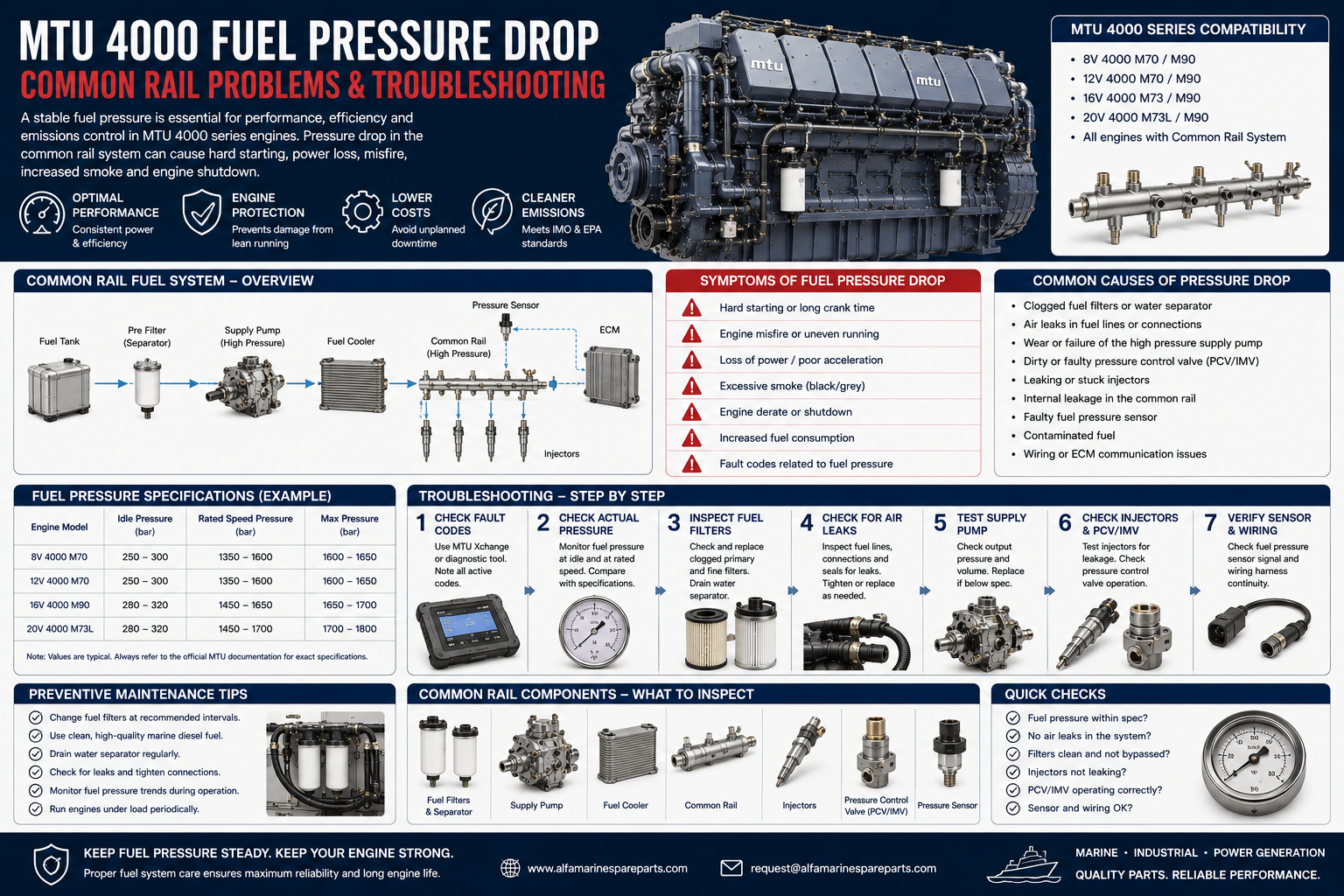
An MTU 4000 fuel pressure drop is one of the most frustrating common-rail system issues to diagnose because the engine often continues running normally while the system secretly struggles. At idle, everything may look perfectly stable: the engine starts without effort, runs smoothly, and produces no obvious exhaust smoke.
However, the moment the vessel accelerates and engine load increases, fuel demand rises rapidly. Suddenly, the actual rail pressure can no longer keep pace with what the engine-control system expects. This discrepancy quickly triggers severe performance issues, including:
- Reduced engine power output
- Sluggish acceleration and engine derating
- Hard starting sequences or uneven running
- Persistent fuel-pressure alarms and rail-pressure faults
- Intermittent shutdowns under heavy load
The most common mistake mechanics make is immediately assuming the high-pressure fuel pump has failed. While a worn pump is always possible, a drop in rail pressure can just as easily stem from restricted filters, insufficient low-pressure fuel supply, excessive injector return flow, a faulty common rail pressure control valve, contaminated diesel, air ingress, or electrical sensor faults. To fix the issue, you must systematically determine where the common-rail system is losing its ability to maintain pressure.
Part 1: Understanding MTU Series 4000 Common-Rail Architecture
1. Applicable Marine Engine Series
The MTU Series 4000 marine family spans V8, V12, V16, and V20 engine configurations. You will frequently find these common-rail setups across standard commercial and high-performance marine families, including:
- MTU 8V 4000: M53, M53R, M54, and M63 variants.
- MTU 12V 4000: M53, M63, M64, M65, M73, M73L, and M93/M93L lines.
- MTU 16V 4000: M53, M63, M65, M73, M73L, and M93/M93L heavy-duty variants.
- MTU 20V 4000: M65L, M73, M73L, and high-speed M93/M93L profiles.
Because fuel-system components vary significantly depending on the engine generation, application rating, and exact serial number, you should never order a replacement pressure valve, injector, or high-pressure pump based purely on the generic "MTU 4000" label.
🛒 Sourcing Genuine Components? Make sure you have your exact serial number ready and browse our inventory of Genuine & Aftermarket MTU Engine Parts for a perfect fit.
2. How the Fuel Path Operates Under Heavy Load
To understand pressure drops, you must track the standard fuel delivery sequence:
fuel tank → water separator → filters → low-pressure supply → high-pressure pump → pressure control → common rail → injectors.
The common rail acts as a high-pressure fuel reservoir supplying all injectors simultaneously. The engine control unit (ECU) constantly monitors the gap between "requested pressure" and "actual pressure."
At idle, the engine needs very little fuel volume, allowing a weak or slightly failing system to bypass detection. But under acceleration, a small restriction—such as a partially clogged fuel filter or minor air entry—instantly starves the high-pressure pump, exposing fuel system weaknesses that were hidden at low RPM.
Part 2: Troubleshooting Control Valves, Sensors & Injector Leakage
3. Diagnosing the Common Rail Pressure Control Valve
The common rail pressure control valve is responsible for bleeding off excess fuel to regulate rail pressure smoothly. If this control valve sticks or responds too slowly, pressure control becomes highly unstable.
| SymptomPotential Root Cause | |
| Rail pressure fluctuating wildly | Sticking pressure control valve or contaminated fuel |
| Actual pressure cannot match requested pressure | Internal valve wear or severe fuel system debris |
| Intermittent engine derating under load | Electrical connector corrosion at the control valve |
If you find dirt, rust, or fine metallic particles inside a removed pressure control valve, replacing the valve alone will not solve your problem. You must immediately inspect your fuel tanks and low-pressure pumps to locate the source of the contamination before it ruins your new parts.
4. Can a Faulty Rail Pressure Sensor Lie to the ECU?
Yes. The ECU makes all fuel adjustments based entirely on data from the rail pressure sensor. If the sensor itself fails, or if there is corrosion inside its electrical connector, it may send an incorrect low-pressure signal. The ECU will believe a fuel pressure drop is occurring even if mechanical pressures are perfectly normal. Always verify sensor electrical circuits before pulling heavy mechanical components.
5. Identifying Worn MTU Fuel Injector Symptoms
Internal injector wear is a massive contributor to systemic pressure drops. Classic MTU fuel injector failure symptoms include rough running, excessive exhaust smoke, cylinder temperature imbalances, and hard starting.
However, an injector can easily cause a total rail pressure drop without showing any external fuel leaks. This happens due to excessive internal injector return flow. If the internal needle valves or command chambers inside the injectors wear down, too much high-pressure fuel escapes straight out of the injector’s return circuit and goes back to the tank.
On large-scale MTU 16V 4000 or 20V 4000 engines, small amounts of internal leakage across 16 or 20 separate injectors quickly add up to a major volume loss. The high-pressure pump works at maximum capacity, yet actual rail pressure plunges because fuel is constantly bleeding back to the tank through the worn injectors.
🛠️ Fix Injector Misfires Fast: Don't let excessive return flow stall your vessel. Explore our complete range of high-efficiency MTU Common Rail Fuel Injectors and Seal Kits to restore full rail pressure.
Conclusion & Next Diagnostic Steps