DEUTZ Marine Engine Oil & Filter Changes: How Proper Lubrication Extends Engine Life and Reduces Wear
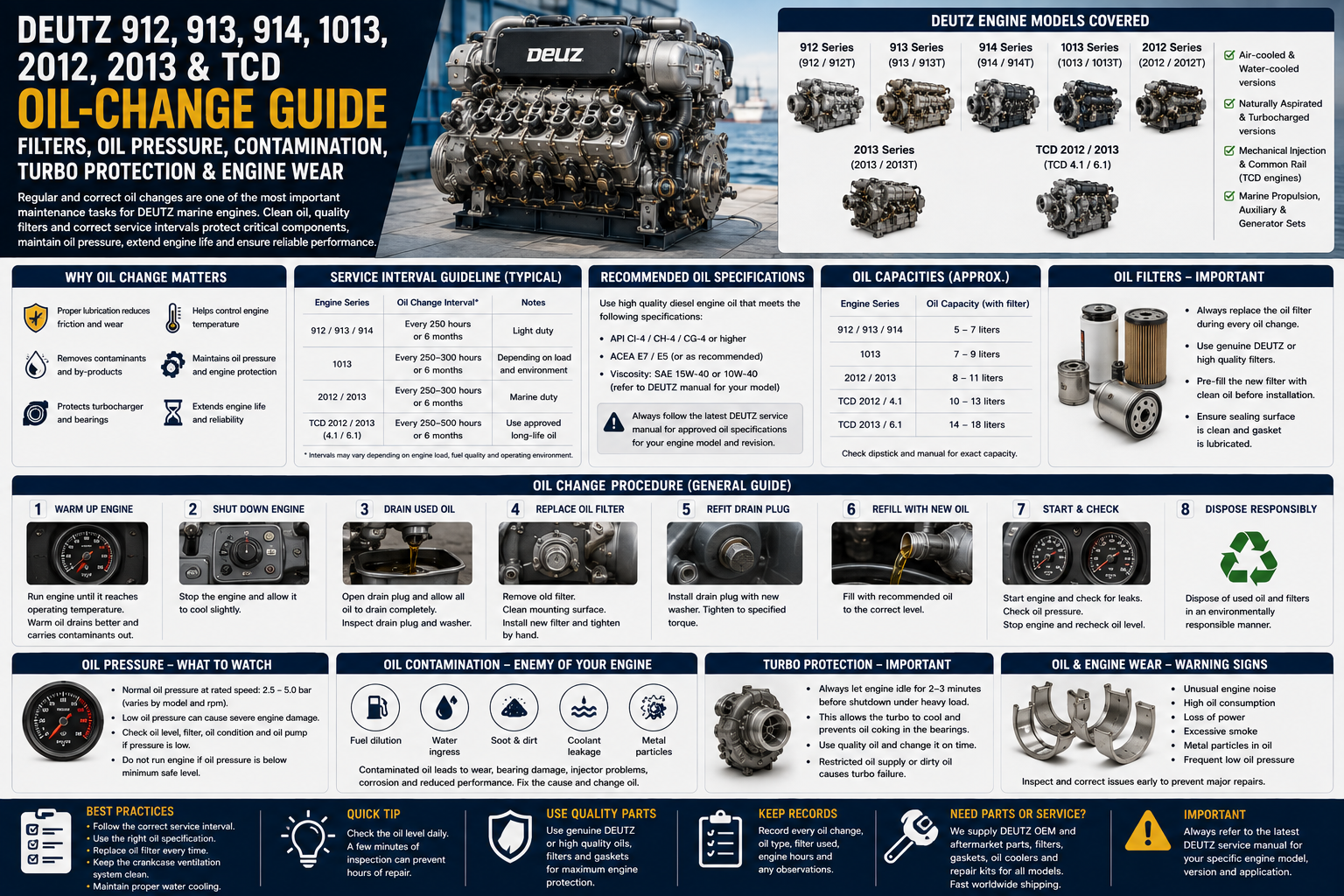
Oil changes are among the simplest maintenance jobs performed on a DEUTZ marine diesel engine, but they are also among the most important.
Engine oil does far more than lubricate moving components.
It helps:
- Reduce friction and wear
- Carry heat away from critical components
- Protect bearings
- Lubricate pistons and cylinder components
- Protect the valve train
- Lubricate turbochargers where applicable
- Suspend soot and contamination
- Protect internal surfaces against corrosion
- Carry contaminants toward the oil filter
As the oil accumulates operating hours, its condition changes.
Soot accumulates.
Contamination increases.
Additives become depleted.
Fuel or coolant contamination may occur.
The oil filter also collects increasing amounts of debris.
For a marine engine working for long periods under continuous load, ignoring oil and filter maintenance can gradually turn a relatively inexpensive service job into a major engine repair.
This guide explains DEUTZ marine engine oil and filter changes, the engine types commonly encountered in marine applications, warning signs to watch for, and why used engine oil can provide valuable information about what is happening inside the engine.
1. Which DEUTZ Marine Engine Types Does This Apply To?
DEUTZ engines have been used for marine propulsion, auxiliary machinery, generators and marinized industrial installations for decades.
Common families encountered include:
DEUTZ 912 Series
- DEUTZ F2L 912
- DEUTZ F3L 912
- DEUTZ F4L 912
- DEUTZ F5L 912
- DEUTZ F6L 912
These older air-cooled engines are known for relatively simple mechanical construction.
DEUTZ 913 Series
- DEUTZ F4L 913
- DEUTZ F6L 913
- DEUTZ BF4L 913
- DEUTZ BF6L 913
- DEUTZ BF6L 913C
DEUTZ 914 Series
- DEUTZ F3L 914
- DEUTZ F4L 914
- DEUTZ F6L 914
- DEUTZ BF4L 914
- DEUTZ BF6L 914
DEUTZ 1011 Series
- DEUTZ F2L 1011
- DEUTZ F3L 1011
- DEUTZ F4L 1011
- DEUTZ BF4L 1011
DEUTZ 1012 Series
- DEUTZ BF4M 1012
- DEUTZ BF6M 1012
- DEUTZ BF4M 1012C
- DEUTZ BF6M 1012C
DEUTZ 1013 Series
- DEUTZ BF4M 1013
- DEUTZ BF6M 1013
- DEUTZ BF4M 1013C
- DEUTZ BF6M 1013C
- DEUTZ BF6M 1013EC
DEUTZ 1015 Series
- DEUTZ BF6M 1015
- DEUTZ BF6M 1015C
- DEUTZ BF8M 1015
- DEUTZ BF8M 1015C
DEUTZ 2011 Series
- DEUTZ F2L 2011
- DEUTZ F3L 2011
- DEUTZ F4L 2011
- DEUTZ BF4L 2011
DEUTZ 2012 Series
- DEUTZ BF4M 2012
- DEUTZ BF6M 2012
- DEUTZ BF4M 2012C
- DEUTZ BF6M 2012C
- DEUTZ TCD 2012 variants
DEUTZ 2013 Series
- DEUTZ BF4M 2013
- DEUTZ BF6M 2013
- DEUTZ BF4M 2013C
- DEUTZ BF6M 2013C
- DEUTZ TCD 2013 variants
Newer DEUTZ TCD Families
These can include engines from families such as:
- DEUTZ TCD 2.9
- DEUTZ TCD 3.6
- DEUTZ TCD 4.1
- DEUTZ TCD 6.1
- DEUTZ TCD 7.8
- DEUTZ TCD 12.0
- DEUTZ TCD 16.0
The lubrication requirements are not identical across all of these engines.
Always use the oil specification, capacity and service interval applicable to the exact DEUTZ engine model and application.
2. Why Is Engine Oil So Important?
Inside a running DEUTZ engine, many components are moving under substantial load.
These include:
- Crankshaft
- Main bearings
- Connecting-rod bearings
- Connecting rods
- Pistons
- Piston pins
- Cylinder components
- Camshaft
- Valve-train components
- Turbocharger bearings on turbocharged engines
Without a reliable lubricating film, metal surfaces can contact each other.
That creates:
friction → heat → wear → component damage.
Oil creates the protective film separating many of these surfaces.
3. Engine Oil Does More Than Reduce Friction
It is easy to think:
Engine oil = lubrication.
But it also contributes to:
Cooling
Oil carries heat away from highly loaded internal components.
Cleaning
Contamination is suspended in the oil and transported toward the filtration system.
Corrosion Protection
Correct oil helps protect internal metal surfaces.
Sealing
Oil contributes to sealing between piston rings and cylinder surfaces.
Turbocharger Protection
On turbocharged DEUTZ engines, lubricating oil is critical to turbocharger bearing life.
This is why oil condition can affect several engine systems at once.
4. What Happens to Oil as Engine Hours Increase?
Fresh engine oil begins with a controlled formulation and additive package.
During operation, it is exposed to:
- Heat
- Combustion by-products
- Soot
- Acids
- Moisture
- Wear particles
- Possible fuel dilution
- Possible coolant contamination
Eventually the oil can no longer perform exactly as it did when new.
That is why topping up oil indefinitely is not equivalent to changing it.
5. Why the Oil Filter Matters
The oil filter captures contamination circulating through the lubrication system.
Depending on the engine and operating condition, this can include:
- Carbonaceous material
- Dirt
- Wear particles
- Other debris
Without effective filtration, contaminants continue circulating through components such as:
bearings → crankshaft → camshaft → valve train → turbocharger lubrication circuit.
The filter is therefore one of the least expensive components protecting some of the most expensive components in the engine.
6. Do Not Change the Oil and Ignore the Filter
Replacing contaminated oil while leaving an excessively used filter in service defeats part of the purpose of the maintenance.
Oil and filtration should be considered together according to the service requirements for the particular engine.
A relatively inexpensive filter can protect:
- Crankshaft bearings
- Connecting-rod bearings
- Camshaft
- Turbocharger
- Other lubricated components
Saving money on filtration can become extremely expensive later.
7. How Often Should DEUTZ Marine Engine Oil Be Changed?
There should not be one generic number applied to every DEUTZ engine.
A:
F6L 912
and a:
TCD 16.0
are very different engines.
The correct oil-change interval depends on factors including:
- Engine model
- Engine generation
- Oil specification
- Operating load
- Fuel quality
- Application
- Operating environment
- Oil capacity
- Service history
Always use the maintenance schedule applicable to the exact engine.
8. Operating Hours Are Not the Only Consideration
Marine engines can operate very differently.
Consider two engines.
Engine A
Runs regularly for long periods at stable operating temperature.
Engine B
Starts occasionally, operates for short periods and then sits unused for months.
Engine B may accumulate far fewer operating hours.
That does not automatically mean its oil is in better condition.
Long storage can introduce issues involving:
- Moisture
- Condensation
- Corrosion
- Oil aging
Calendar time can therefore matter as well as operating hours.
9. Situation: The Oil Becomes Black Quickly
Diesel-engine oil normally darkens during service.
Dark oil alone does not automatically indicate engine failure.
The oil is designed to hold combustion-related contamination in suspension.
What matters more is whether there has been a significant change from the engine's normal pattern.
For example:
“The oil always becomes dark after normal operation.”
is different from:
“The new oil suddenly becomes unusually contaminated almost immediately.”
Changes deserve investigation.
10. Situation: The Oil Level Keeps Dropping
If the engine repeatedly requires oil, determine where it is going.
Possible causes include:
- External leakage
- Turbocharger-related oil consumption
- Valve-related oil consumption
- Piston-ring or cylinder wear
- Crankcase ventilation problems
Do not simply continue adding oil without investigating increasing consumption.
Record oil consumption.
Trends can reveal developing engine wear.
11. Situation: The Oil Level Is Increasing
An increasing oil level can be more concerning than many operators realize.
Oil should not mysteriously multiply inside the sump.
Possible causes can include contamination from another fluid, such as:
- Fuel
- Coolant
depending on the engine and failure condition.
If the level is rising without oil being added, investigate.
Do not assume:
“More oil is better.”
Something may be entering the lubrication system.
12. Fuel Dilution of Engine Oil
Fuel entering the lubricating oil can reduce viscosity and lubrication quality.
Possible symptoms include:
- Rising oil level
- Diesel smell
- Thinner oil
- Reduced oil pressure
- Increased wear
Potential causes depend on engine design but can involve fuel-system or combustion-related problems.
If fuel dilution is suspected, changing the oil alone is not enough.
Find the source.
13. Coolant in the Engine Oil
On liquid-cooled DEUTZ engines, coolant contamination requires immediate investigation.
Possible symptoms can include:
- Milky oil
- Unusual sludge
- Rising oil level
- Coolant loss
Possible causes depend on engine configuration and can involve:
- Cylinder-head sealing
- Oil cooler
- Internal sealing components
- Other internal leakage
Do not continue operating an engine with significant coolant-contaminated oil simply because oil pressure still appears normal.
14. What About Air-Cooled DEUTZ 912, 913 and 914 Engines?
This is one of the major differences between older DEUTZ families and many later engines.
Engines such as the 912, 913 and 914 families are known for air cooling.
Therefore, troubleshooting an F6L 912 should not automatically follow the same coolant-related logic used on a BF6M 1013 or other liquid-cooled engine.
This is why knowing the engine family matters.
15. Oil Maintenance on DEUTZ 912 Engines
Older DEUTZ 912 engines may look simple compared with modern electronically controlled diesels.
But they still depend heavily on good lubrication.
Pay attention to:
- Oil level
- Oil condition
- Correct oil specification
- Oil filtration
- Leakage
- Oil pressure
- Service intervals
Simple engine architecture does not make dirty oil harmless.
16. Oil Maintenance on DEUTZ 913 & 914 Engines
The same basic principle applies to the 913 and 914 families.
Turbocharged BF versions make oil maintenance especially important because the lubrication system may also support the turbocharger.
Poor oil maintenance can therefore affect both:
the engine
and:
the turbocharger.
17. DEUTZ 1012 & 1013 Oil Maintenance
Later liquid-cooled DEUTZ engines introduce different operating and cooling arrangements.
On these engines, oil inspection should also consider the possibility of interaction with systems such as:
- Oil cooling
- Engine cooling
- Turbocharging
If oil condition changes unexpectedly, investigate rather than simply resetting the maintenance clock with fresh oil.
18. DEUTZ 2012 & 2013 Oil Maintenance
For 2012 and 2013 families, correct lubrication becomes increasingly important as engine output and component loading increase.
Monitor:
- Oil pressure
- Oil temperature
- Consumption
- Filter condition
- Leakage
- Oil analysis where appropriate
Historical operating data can be extremely useful.
19. Newer DEUTZ TCD Engines
Modern TCD engines combine high-output diesel technology with more sophisticated fuel and electronic-control systems.
Do not assume the oil used in an older mechanical DEUTZ engine is automatically appropriate for a modern TCD.
Oil requirements can depend on:
- Engine generation
- Emissions technology
- Fuel
- Application
- Required lubricant specification
Always verify the correct lubricant for the exact engine.
20. Turbocharger Protection Starts With Engine Oil
On a turbocharged DEUTZ engine, the turbocharger shaft operates at very high rotational speed.
Its bearings depend on reliable lubrication.
Poor oil condition can contribute to:
- Bearing wear
- Deposits
- Restricted oil passages
- Turbocharger damage
If a turbocharger fails from lubrication problems and you install another turbo without correcting the oil problem, the replacement can fail too.
21. Oil Supply and Return Lines Matter
During turbocharger repair, inspect:
- Oil feed line
- Oil return
- Connections
- Restrictions
- Leakage
Fresh oil cannot protect a turbocharger if the oil cannot reach it correctly.
22. Oil Pressure Is a Health Indicator
Know what normal oil pressure looks like for the particular engine under normal operating conditions.
Then watch for changes.
A gradual decrease may deserve investigation.
Possible areas include:
- Oil level
- Oil viscosity
- Oil temperature
- Filter condition
- Pump condition
- Bearing clearances
- Internal leakage
Do not wait for complete pressure loss.
23. Low Oil Pressure Does Not Automatically Mean a Bad Oil Pump
This is important.
A technician may see low oil pressure and immediately order an oil pump.
But possible causes include:
- Low oil level
- Incorrect oil
- Excessive oil temperature
- Filter problem
- Worn bearings
- Internal leakage
- Sensor or indication problem
- Oil-pump wear
Measure and diagnose before replacing expensive components.
24. High Oil Pressure Can Also Require Investigation
Abnormally high oil pressure can point toward issues such as:
- Incorrect oil viscosity
- Cold oil
- Flow restriction
- Pressure-control problems
Again, compare with the engine's established normal behavior.
A gauge reading is most useful when you know what normal looks like.
25. Oil Temperature Matters
Oil that is too cold and oil that is excessively hot behave differently.
High oil temperature can reduce viscosity and may indicate:
- Heavy engine load
- Cooling problems
- Oil-cooler problems
- Lubrication-system problems
Do not monitor pressure without considering temperature.
The two are related.
26. Inspect the Old Oil Before Disposing of It
Do not drain the engine and immediately forget about the old oil.
Look at it.
Ask:
- Is there water?
- Does it smell strongly of fuel?
- Is there unusual sludge?
- Is metallic material visible?
- Is the appearance different from previous changes?
The old oil can contain evidence of what happened inside the engine since the last service.
27. Inspect the Used Oil Filter Too
The used filter can also provide valuable information.
Depending on the filter design and appropriate inspection procedure, unusual debris may indicate internal wear.
Possible material can originate from:
- Bearings
- Gears
- Other lubricated components
A filter is not only a service part.
It can also be a diagnostic clue.
28. Metal in the Oil Is Not Something to Ignore
If visible metallic particles appear in the oil or filter, determine where they came from.
Possible sources include:
- Bearing wear
- Gear wear
- Valve-train wear
- Other internal components
Do not simply install new oil and hope the metal disappears.
The source still exists.
29. Oil Analysis Can Reveal Problems Before Failure
For commercial vessels and engines with high utilization, periodic oil analysis can be useful.
Laboratory testing can evaluate trends involving:
- Wear metals
- Fuel dilution
- Water
- Viscosity
- Contamination
- Oil degradation
The greatest value often comes from trending.
One sample is useful.
Ten samples from the same engine can tell a story.
30. Build an Oil-Analysis History
Imagine iron levels are:
Sample 1 → normal
Sample 2 → normal
Sample 3 → slightly higher
Sample 4 → significantly higher
That trend deserves attention.
Maintenance is much stronger when decisions are based on changes rather than waiting for complete failure.
31. Keep Oil-Change Records
Record:
- Date
- Engine hours
- Oil brand/specification
- Quantity
- Filter part number
- Oil pressure before service
- Oil pressure after service
- Oil consumption
- Observations
For twin-engine vessels, record port and starboard engines separately.
This makes comparison much easier.
32. Twin Engines Give You a Useful Comparison
Suppose a vessel has two identical DEUTZ engines.
Both operate similar hours.
But:
Port engine uses 1 litre between services.
Starboard engine uses 6 litres.
That difference deserves investigation.
The second engine is telling you something.
33. Do Not Mix Oils Randomly
Adding whatever oil happens to be available can create uncertainty about:
- Viscosity
- Additive compatibility
- Performance specification
Use the correct lubricant specification for the particular DEUTZ engine.
Especially on modern engines, do not select oil based only on:
“It is diesel engine oil.”
34. Oil Viscosity Matters
Oil must flow adequately during startup while maintaining a protective film under operating conditions.
An incorrect viscosity can influence:
- Starting lubrication
- Oil pressure
- High-temperature protection
- Turbocharger lubrication
Use the viscosity grade appropriate for the engine and operating environment.
35. Marine Operating Conditions Can Be Severe
A marine diesel may operate:
- Continuously for many hours
- At relatively high load
- In a hot engine room
- In humid conditions
- After long periods of inactivity
That combination makes good lubrication maintenance particularly important.
36. Short Running Can Be Hard on Oil Too
An engine that only operates briefly may not always reach stable operating temperature long enough to manage moisture effectively.
This can contribute to:
- Condensation
- Moisture accumulation
- Internal corrosion
Low engine hours do not always mean easy service.
37. Long Storage Requires Attention
Before returning a DEUTZ marine engine to operation after extended storage, inspect:
- Oil condition
- Oil level
- Filters
- Leakage
- Signs of moisture
If the service history is uncertain, establishing a fresh maintenance baseline can be valuable.
38. Oil Leaks Should Not Become "Normal"
Older engines sometimes accumulate small leaks that crews gradually accept.
But leakage can indicate deterioration of:
- Gaskets
- O-rings
- Seals
- Hoses
- Connections
Oil leakage also makes the engine dirty.
A dirty engine makes new leaks harder to identify.
39. Clean Engines Are Easier to Maintain
Keeping the engine reasonably clean makes it easier to identify:
- Fresh oil leakage
- Filter leakage
- Turbo oil-line leakage
- Gasket problems
- Damaged hoses
Cleaning is therefore not only cosmetic.
It supports inspection.
40. Check for Leaks After an Oil Change
After servicing, inspect:
- Oil filter
- Drain plug
- Filter housing
- Connections
- Areas disturbed during maintenance
A incorrectly seated filter seal can create rapid oil loss.
Never assume the job is complete simply because the new oil is inside the engine.
41. Verify the Oil Level After Running
After the engine has been serviced and operated according to the correct procedure, recheck the oil level under the specified checking conditions.
Oil may fill:
- Filter housing
- Oil passages
- Other lubrication-system areas
The correct level should be confirmed rather than guessed from the quantity poured into the engine.
42. Do Not Overfill the Engine
More oil is not necessarily better.
Overfilling can create problems depending on engine design and operating condition.
Always fill to the correct level.
The dipstick or specified measurement procedure exists for a reason.
43. Oil Filter Quality Matters
The filter must provide appropriate:
- Filtration
- Flow
- Pressure capability
- Internal construction
- Sealing
A filter that physically fits is not automatically technically suitable.
This matters particularly on engines where lubrication protects high-value components such as turbochargers and crankshaft bearings.
44. Cheap Maintenance Can Become Expensive Repair
Compare the cost of:
oil + filters
with the cost of:
- Crankshaft
- Main bearings
- Connecting-rod bearings
- Turbocharger
- Camshaft
- Complete overhaul
Routine lubrication service is inexpensive compared with repairing damage caused by poor lubrication.
45. Common DEUTZ Lubrication-System Parts
Depending on engine family, maintenance and repair requirements may include:
- Oil filters
- Oil pumps
- Oil coolers
- Oil pressure sensors
- Oil temperature sensors
- Oil lines
- Oil pans
- Dipsticks
- Filter housings
- Gaskets
- O-rings
- Seals
- Turbocharger oil lines
- Bearings
Exact parts should always be matched to the engine model and serial number.
46. Parts Often Inspected When Oil Problems Are Found
An abnormal oil condition may lead to inspection of:
- Main bearings
- Connecting-rod bearings
- Crankshaft
- Camshaft
- Turbocharger
- Pistons
- Cylinder liners
- Oil pump
- Oil cooler
- Valve train
The oil system connects many of the engine's most important components.
47. What Information Should You Send When Ordering DEUTZ Service Parts?
Instead of:
“Need DEUTZ oil filter.”
send:
Manufacturer: DEUTZ
Complete Engine Model: __________
Engine Serial Number: __________
Existing Filter Part Number: __________
Required Part: __________
Quantity: __________
Application: Propulsion / Generator / Auxiliary
Photos: Attached
For example:
Engine: DEUTZ BF6M 1013C
Serial Number: __________
Oil Filter Number: __________
Quantity: 4
This greatly reduces identification errors.
48. Frequently Asked Questions
Why Are Oil Changes Important on a DEUTZ Marine Engine?
Fresh, correctly specified oil helps maintain lubrication, cooling, cleanliness and internal component protection.
Can Old Oil Damage the Turbocharger?
Poor oil condition, contamination or lubrication-system problems can contribute to turbocharger bearing damage.
Should the Oil Filter Be Changed With the Oil?
Follow the maintenance schedule for the exact engine. Oil filtration is an essential part of protecting the lubrication system.
Why Is My DEUTZ Engine Using More Oil?
Possible causes include leakage, turbocharger-related consumption, valve-related issues or cylinder/piston-ring wear.
Why Is My Oil Level Increasing?
Another fluid may be entering the lubrication system. Fuel or coolant contamination are possibilities depending on the engine and fault.
Is Black Diesel Oil Automatically Bad?
No. Diesel oil commonly darkens during operation. Sudden changes, abnormal contamination or laboratory trends are more useful indicators.
Can I Use the Same Oil in a DEUTZ F6L 912 and a Modern TCD Engine?
Do not assume so. Use the lubricant specification applicable to the exact engine.
Are DEUTZ 912, 913 and 914 Engines Liquid-Cooled?
These families are known for air-cooled configurations, which distinguishes them from many later liquid-cooled DEUTZ families.
Can Oil Analysis Help Prevent Engine Failure?
It can help identify developing trends involving contamination, fuel dilution and wear metals before obvious mechanical symptoms appear.
DEUTZ Marine Engine Types
Common DEUTZ engines encountered in marine, auxiliary and marinized applications include:
- DEUTZ F2L 912
- DEUTZ F3L 912
- DEUTZ F4L 912
- DEUTZ F5L 912
- DEUTZ F6L 912
- DEUTZ F4L 913
- DEUTZ F6L 913
- DEUTZ BF4L 913
- DEUTZ BF6L 913
- DEUTZ BF6L 913C
- DEUTZ F3L 914
- DEUTZ F4L 914
- DEUTZ F6L 914
- DEUTZ BF4L 914
- DEUTZ BF6L 914
- DEUTZ 1011 Series
- DEUTZ 1012 Series
- DEUTZ 1013 Series
- DEUTZ 1015 Series
- DEUTZ 2011 Series
- DEUTZ 2012 Series
- DEUTZ 2013 Series
- DEUTZ TCD engine families
Because lubrication requirements vary considerably between these generations, always identify the complete engine designation before selecting oil, filters or lubrication-system components.
DEUTZ Marine Engine Oil, Filter & Lubrication Parts
Alfa Marine Spare Parts can assist with inquiries for DEUTZ marine and marinized engine components including:
- Oil filters
- Oil pumps
- Oil coolers
- Filter housings
- Oil pressure sensors
- Oil temperature sensors
- Gaskets
- O-rings
- Seals
- Bearings
- Turbocharger lubrication components
- Fuel filters
- Air filters
- Cylinder heads
- Fuel injectors
- Water pumps
- Turbocharger components
- Pistons
- Piston rings
- Cylinder liners
- Connecting rods
- Crankshaft components
- Overhaul parts
Browse Our Complete Catalog
Marine engine brands:
https://alfamarinespareparts.com/our-brand
Marine spare parts:
https://alfamarinespareparts.com/spareparts
Contact Alfa Marine Spare Parts
For DEUTZ marine engine oil filters, oil pumps, coolers, gaskets, seals and engine spare parts:
Email: request@alfamarinespareparts.com
For faster identification, provide:
DEUTZ engine model + serial number + existing part number + required quantity + photographs + delivery location.
Final Word
An oil change on a DEUTZ marine engine can look like ordinary maintenance:
Drain old oil.
Replace filter.
Add new oil.
Check level.
Done.
But there is much more information available during that service.
Look at the old oil.
Look at the old filter.
Compare oil consumption with the previous service.
Check whether the level was falling—or unexpectedly rising.
Look for water.
Look for fuel dilution.
Look for metal.
Check oil pressure before and after service.
And record what you find.
The objective is not simply to put fresh oil into the engine.
It is to understand what happened during the hundreds of operating hours since the last oil change.
On an older DEUTZ F6L 912 or BF6L 913, good oil maintenance protects a simple mechanical engine that may have already accumulated many years of service.
On a BF6M 1013 or BF6M 2013, it protects a more highly loaded engine and its turbocharging system.
And on a newer DEUTZ TCD engine, correct lubrication remains fundamental to protecting high-value internal components.
The oil is therefore more than a lubricant.
It is also one of the best sources of information about what is happening inside your DEUTZ engine.