
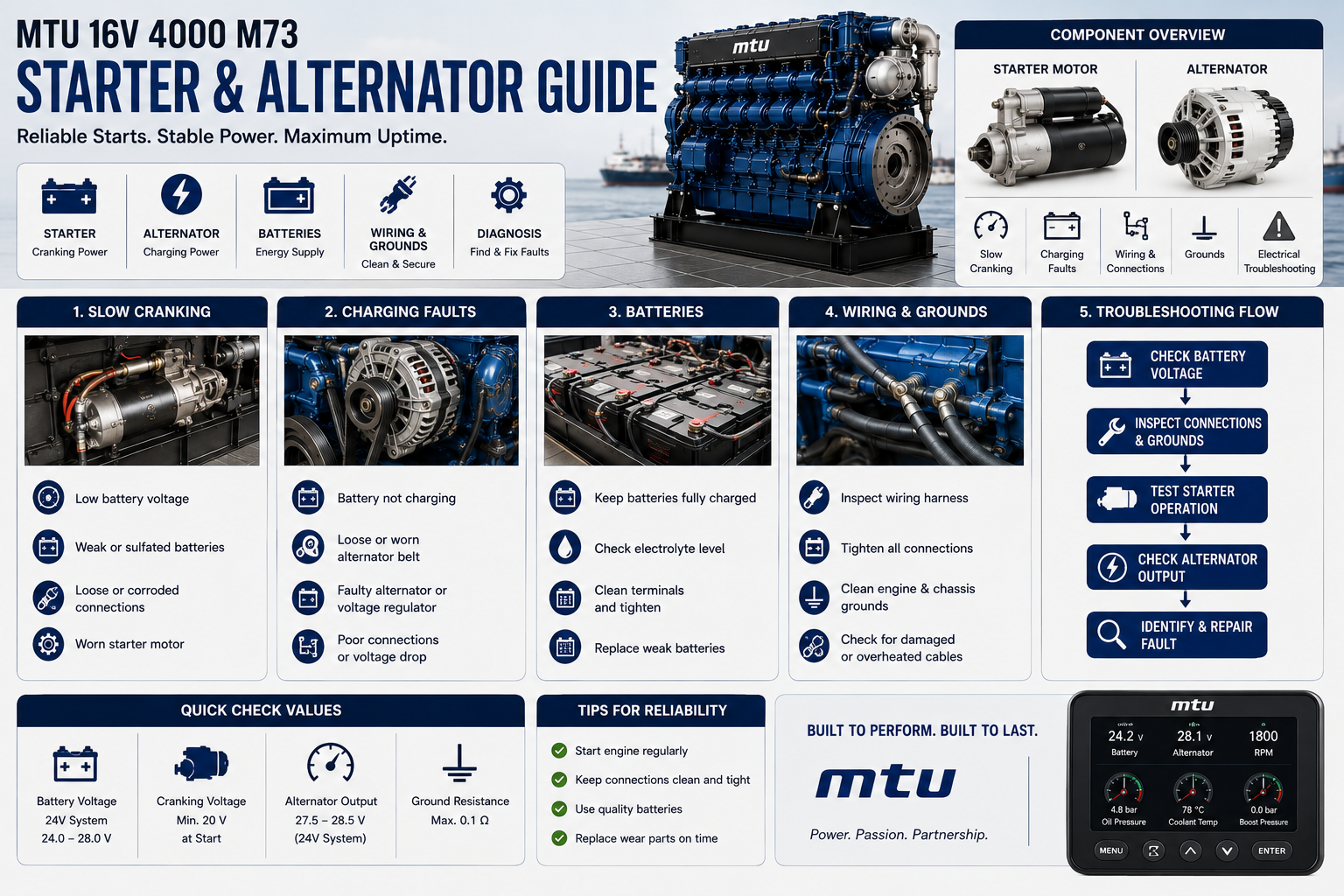

Starters & Alternators for MTU 16V 4000 M73 Marine Engines
The MTU 16V 4000 M73 marine engine depends on a reliable electrical system every time the vessel starts, operates, shuts down and prepares for its next voyage.
Two components are particularly important:
the starter motor and the alternator.
The starter has one demanding job: turn a large V16 diesel engine fast enough for successful starting.
The alternator has another: support the engine's electrical system and maintain the batteries while the engine is operating.
When either begins to deteriorate, the first symptoms can be deceptively simple.
The MTU turns over more slowly than normal.
Starting becomes intermittent.
Battery voltage gradually falls.
The starter clicks but does not crank.
An alternator becomes unusually hot.
Or the engine starts perfectly after shore-power charging but develops the same problem again after operating.
These symptoms should not immediately lead to replacing the starter or alternator.
On an MTU 16V 4000 M73, batteries, cables, connections, charging circuits and control components all need to be considered.
1. MTU 16V 4000 M73 Marine Engine
The 16V 4000 M73 belongs to MTU's Series 4000 high-speed marine diesel family.
The basic engine configuration includes:
Engine family: MTU Series 4000
Configuration: V16
Cycle: Four-stroke diesel
Aspiration: Turbocharged and charge-air cooled
Application: High-output marine propulsion
The M73 is found in demanding applications where starting reliability is particularly important, including fast commercial and specialized vessels.
With an engine of this size, electrical problems that might seem minor on a small diesel can become significant very quickly.
2. What Does the Starter Motor Do?
The starter converts electrical energy stored in the starting batteries into mechanical rotation.
When the start command is given, the starting circuit must deliver sufficient current for the starter to rotate the engine.
The process is essentially:
Starting batteries → cables and switching/control circuit → starter → engine rotation → combustion begins
Once the engine starts and reaches self-sustaining speed, the starter disengages.
The process may last only seconds, but the electrical demand is very high.
3. Why Starting a 16V 4000 Is Different From Starting a Small Marine Diesel
The 16V 4000 M73 is a large-displacement V16 engine.
The starter must overcome:
- Engine compression
- Internal friction
- Oil resistance
- Rotating-component inertia
Cold oil, weak batteries or excessive electrical resistance can make the job considerably harder.
This is why cranking speed can be an important diagnostic clue.
4. The MTU Cranks Slowly
Suppose the start command works, but you immediately notice:
rrrr... rrrr... rrrr...
instead of the normal strong cranking sound.
Do not automatically conclude:
“Bad starter.”
Check the complete starting system.
Possible causes include:
- Discharged batteries
- Deteriorated batteries
- Loose battery terminals
- Corroded connections
- Excessive cable resistance
- Poor grounding
- Starter deterioration
- High mechanical resistance
The starter is only one component in the circuit.
5. Battery Voltage Can Look Good Until You Crank
This is an important troubleshooting point.
A battery can show apparently reasonable voltage with no load and still perform poorly when the starter demands high current.
Therefore, checking only static battery voltage may not tell the complete story.
Watch what happens during cranking.
A significant voltage drop can direct troubleshooting toward:
- Battery condition
- Connections
- Cabling
- Starting circuit
6. Voltage-Drop Testing
One of the most useful ways to diagnose a heavy-duty starting circuit is to measure voltage drop while the circuit is actually working.
Excessive resistance can develop at:
- Battery terminals
- Cable connections
- Isolation switches
- Starter connections
- Ground connections
- Damaged cables
A cable can look perfectly acceptable externally while having excessive resistance internally.
7. Do Not Forget the Ground Side
Technicians sometimes spend most of their time checking the positive supply.
But the electrical circuit must also have a reliable return path.
Inspect:
- Engine grounds
- Battery grounds
- Ground cables
- Connections
- Corrosion
- Loose fasteners
A poor ground can produce symptoms very similar to a weak starter.
8. Starter Clicks but the MTU Does Not Crank
You give the start command.
Click.
Nothing.
Possible areas to investigate include:
- Battery state
- Battery connections
- Starter solenoid
- Starter motor
- Starting relay/control circuit
- Cable connections
- Grounding
Do not repeatedly operate the starter without identifying why the engine is not cranking.
9. Starter Does Absolutely Nothing
This is different from slow cranking.
If there is no starter response at all, investigate the control side as well as the high-current circuit.
Possible areas include:
- Start command
- Control power
- Relays
- Interlocks
- Wiring
- Connectors
- Starter solenoid
- Battery isolation
The absence of starter movement does not automatically mean the starter motor itself has failed.
10. Starter Works Sometimes
Intermittent faults can be frustrating.
The engine starts ten times normally.
Then:
nothing.
Later it starts again.
Possible causes can include:
- Loose connection
- Corroded terminal
- Starter solenoid deterioration
- Internal starter wear
- Relay problems
- Wiring faults
Intermittent electrical problems often respond to vibration, temperature and component position.
Record when the failure occurs.
11. Starter Works When Cold but Not When Hot
Temperature-related starting problems can provide useful diagnostic information.
If the starter performs normally when the engine is cold but struggles after the engine room becomes hot, investigate:
- Starter condition
- Connections
- Cable resistance
- Battery condition
- Heat exposure
Do not assume that because the engine started successfully that morning, the starter system is healthy.
12. Starter Motor Overheating
Starter motors are designed for short operating periods.
Repeated long cranking attempts can generate substantial heat.
If the MTU does not start, continuously operating the starter can create an additional problem on top of the original starting fault.
The better approach is:
stop → identify why the engine is not starting → correct the cause.
13. What Can Cause Excessive Cranking?
The starter may be perfectly healthy while another system prevents the engine from starting.
Possible areas include:
- Fuel supply
- Fuel pressure
- Engine controls
- Sensors
- Air in the fuel system
- Electrical control problems
Do not destroy a good starter trying to compensate for a fuel or control-system problem.
14. Starter Pinion and Ring Gear
The starter must mechanically engage the engine's starting gear arrangement.
Problems can involve:
- Starter pinion
- Engagement mechanism
- Ring-gear teeth
- Starter mounting
A grinding sound during starting deserves attention.
15. Grinding Noise During Starting
A new metallic grinding sound should not be ignored.
Possible causes can include:
- Incorrect starter engagement
- Damaged starter pinion
- Damaged ring-gear teeth
- Loose starter mounting
- Incorrect starter installation
Continuing to start the engine repeatedly can make the damage worse.
16. Starter Spins but the Engine Does Not Turn
If you can clearly hear the starter motor rotating but the engine is not being cranked correctly, investigate the starter engagement mechanism.
This is different from an electrical supply problem.
Listening carefully to the starting sequence can therefore provide useful diagnostic information.
17. What Does the Alternator Do?
Once the MTU 16V 4000 M73 is running, the charging system has to support the electrical system and replenish energy removed from the starting batteries.
In simplified form:
Engine rotation → alternator → electrical output → batteries and onboard electrical system
A healthy alternator helps ensure that the batteries are ready for the next start.
18. Why an Alternator Problem May First Look Like a Battery Problem
Imagine this situation.
Monday:
Engine starts normally.
Tuesday:
Cranking seems slightly slower.
Wednesday:
Engine struggles to start.
You replace or recharge the batteries.
Everything works again.
Several days later:
same problem.
Now the question should become:
“Are the batteries actually being charged correctly?”
The batteries may be the victim rather than the cause.
19. Signs of Alternator or Charging Problems
Possible symptoms include:
- Low charging voltage
- Battery warning
- Repeatedly discharged batteries
- Unstable electrical voltage
- Alternator overheating
- Abnormal bearing noise
- Charging that changes unexpectedly with RPM
Investigate the complete charging circuit before replacing the alternator.
20. Alternator Output Should Be Checked Under Real Conditions
A useful charging-system test considers what happens while the engine is operating.
Look at:
- System voltage
- Alternator output
- Battery condition
- Electrical load
- Engine RPM
A charging problem may only become apparent when significant electrical loads are operating.
21. Low Charging Voltage
Possible causes include:
- Alternator problem
- Drive problem
- Wiring resistance
- Loose connection
- Battery condition
- Charging-control problem
Do not diagnose the alternator from one voltage reading alone.
Verify the system.
22. Alternator Produces No Charge
If the engine starts but battery voltage does not show the expected charging behavior, inspect:
- Alternator connections
- Alternator drive
- Wiring
- Protection devices
- Control/excitation circuit
- Alternator itself
Start with simple external checks before removing the alternator.
23. Alternator Drive Condition
The alternator must be mechanically driven by the engine.
Depending on the exact installation, inspect the applicable drive arrangement for:
- Wear
- Incorrect tension
- Damage
- Misalignment
- Contamination
If the alternator is not being driven correctly, electrical troubleshooting alone will not solve the problem.
24. Alternator Bearing Noise
Listen during routine engine-room inspections.
A new:
whine, rumble or grinding sound
near the alternator deserves investigation.
Bearing deterioration can eventually lead to more serious alternator damage.
25. Alternator Overheating
An alternator that becomes abnormally hot may be experiencing:
- Excessive electrical load
- Internal deterioration
- Bearing problems
- Poor ventilation
- Connection problems
Compare the condition with the vessel's established normal behavior.
26. Oil and Coolant Contamination
Alternators and starters are electrical components.
They do not benefit from being covered in:
- Engine oil
- Coolant
- Seawater
- Fuel
If an alternator repeatedly becomes contaminated, do not only replace or clean the alternator.
Find the leak.
The leaking engine component may be the true cause of repeated electrical failures.
27. Saltwater Is Particularly Dangerous
Marine engine rooms create additional challenges because electrical components can be exposed to moisture and salt.
Salt contamination can accelerate:
- Corrosion
- Connector deterioration
- Terminal damage
- Electrical leakage
After any seawater incident in the engine room, electrical equipment should be inspected carefully.
28. Wiring Harnesses Matter
A perfectly healthy starter or alternator cannot compensate for damaged wiring.
Inspect for:
- Chafing
- Heat damage
- Corrosion
- Loose connectors
- Broken insulation
- Poor cable support
On a large turbocharged engine, pay particular attention to wiring routed near hot exhaust components.
29. Turbochargers and Electrical Components
The title “MTU 4000 Turbo Engine” is relevant because Series 4000 engines are turbocharged, but the turbocharger itself does not directly power the starter or alternator.
The connection is mainly environmental and operational.
Turbochargers and exhaust systems create considerable heat.
Therefore, nearby:
- Wiring
- Connectors
- Starter cables
- Alternator wiring
must be properly protected and routed.
30. Exhaust Leaks Can Damage Electrical Components
Suppose an exhaust connection develops a small leak.
Hot exhaust gas is directed toward a wiring harness.
At first:
nothing happens.
After continued operation:
- Insulation hardens
- Wiring becomes brittle
- Connectors deteriorate
Eventually an electrical fault develops.
The original problem was not electrical.
It was an exhaust leak.
This is why engine systems should be inspected together.
31. Twin MTU 16V 4000 M73 Engines Give You a Useful Reference
A twin-engine vessel provides a valuable troubleshooting advantage.
Suppose:
Port engine: strong cranking
Starboard engine: slow cranking
Compare:
- Battery voltage
- Cranking voltage
- Cable temperature
- Charging voltage
- Starter behavior
The healthy engine can provide a useful operating reference.
32. Compare Alternator Performance Between Engines
The same approach can help with charging problems.
If both engines have comparable electrical configurations but one consistently shows different charging behavior, investigate why.
However, make sure the electrical loads and battery banks are actually comparable before drawing conclusions.
33. Hot Battery Cables Are a Warning Sign
A connection with excessive resistance can generate heat when high current flows through it.
If a starter cable or terminal becomes unusually hot during cranking, investigate.
Possible causes include:
- Loose connection
- Corrosion
- Damaged cable
- High resistance
Do not simply tighten everything without first isolating the electrical system according to proper procedures.
34. Batteries Are Part of the Starting System
Starter troubleshooting should include the batteries.
Check:
- Battery condition
- Charge state
- Connections
- Cable condition
- Battery-bank configuration
Replacing a starter when the actual problem is weak batteries wastes both time and money.
35. Repeated Dead Batteries Need a Cause
If batteries repeatedly become discharged, ask:
Why?
Possible causes include:
- Alternator not charging correctly
- Electrical load while engine is stopped
- Battery deterioration
- Connection problem
- Charging-system fault
Simply recharging the batteries resets the symptom.
It does not necessarily repair the fault.
36. Starting Problems After Maintenance
If the 16V 4000 M73 started normally before maintenance and suddenly develops an electrical problem afterward, inspect what was disturbed.
Check:
- Battery isolators
- Ground cables
- Starter cables
- Harness connectors
- Sensors
- Control connections
The timing of the failure can be one of your strongest diagnostic clues.
37. Problems After Starter Replacement
A newly installed starter does not guarantee the starting system is correct.
If problems remain, check:
- Correct starter specification
- Mounting
- Electrical connections
- Ground path
- Battery condition
- Starter control
- Engagement
Never assume:
new part = confirmed good system.
38. Problems After Alternator Replacement
The same applies to alternators.
After replacement, verify:
- Correct alternator type
- Electrical connections
- Drive arrangement
- Charging output
- Battery condition
- Control circuit
Incorrect installation can damage a new component.
39. Starter & Alternator Parts Should Not Be Ordered Only by Engine Family
“MTU 4000 starter” is not enough information.
Series 4000 includes numerous engines.
Examples include:
- 8V 4000 M53
- 12V 4000 M53
- 12V 4000 M65L
- 12V 4000 M73
- 12V 4000 M93
- 16V 4000 M53
- 16V 4000 M63
- 16V 4000 M73 MTU 16V 4000 M73 Marine Engine Spare Parts | OEM & Replacement Parts | Alfa Marine Spare Parts
- 16V 4000 M93
- 20V 4000 M65L
- 20V 4000 M73
- 20V 4000 M93L
Different versions and installations can use different electrical components.
40. Why the MTU Engine Serial Number Matters
Even if you know the engine is a:
16V 4000 M73
the serial number remains valuable.
Production changes and installation specifications can affect:
- Starter configuration
- Alternator
- Electrical connections
- Sensors
- Wiring
- Other components
Always use the serial number when possible.
41. Starter Identification
When identifying a replacement starter, useful information includes:
Engine: MTU 16V 4000 M73
Engine Serial Number: __________
Starter Manufacturer: __________
Starter Part Number: __________
Voltage: __________
Photographs: __________
Quantity: __________
Do not select a starter because it physically looks similar.
42. Alternator Identification
For alternators, provide:
Engine: MTU 16V 4000 M73
Engine Serial Number: __________
Alternator Manufacturer: __________
Alternator Part Number: __________
System Voltage: __________
Rated Output: __________
Photographs: __________
Quantity: __________
The alternator's own identification plate can be extremely useful.
43. Starter and Alternator Inspection Checklist
During routine inspection:
☐ Check battery condition
☐ Inspect battery terminals
☐ Inspect starter cables
☐ Inspect engine grounds
☐ Listen to starter cranking speed
☐ Listen for grinding during engagement
☐ Check alternator charging behavior
☐ Inspect alternator drive
☐ Listen for bearing noise
☐ Check for oil/coolant contamination
☐ Inspect electrical connectors
☐ Inspect wiring near hot turbo/exhaust components
The goal is to identify change before the engine refuses to start.
44. Common MTU 16V 4000 M73 Starting & Charging Parts
Depending on the exact engine and vessel installation, service requirements can include:
- Starter motors
- Starter solenoids
- Starter relays
- Alternators
- Charging components
- Battery cables
- Ground cables
- Electrical terminals
- Connectors
- Wiring harnesses
- Sensors
- Control components
- Mounting hardware
Correct identification should always be based on the exact engine and existing component.
45. Other Components Worth Checking
A starting or charging complaint may also involve:
- Batteries
- Battery isolators
- Engine wiring harness
- Engine control system
- Relays
- Fuses/protection devices
- Ground connections
- Fuel-system controls
- Engine sensors
This is why replacing the starter should not be the first response to every no-start complaint.
46. Frequently Asked Questions
Why Does My MTU 16V 4000 M73 Crank Slowly?
Possible causes include weak batteries, excessive cable resistance, poor grounds, loose connections or starter deterioration.
Why Does the Starter Only Click?
The problem can involve insufficient battery power, high resistance, the starter solenoid, starter motor or starting-control circuit.
Why Does the Starter Work Sometimes?
Intermittent faults can be caused by loose connections, internal starter wear, relay problems, wiring faults or solenoid deterioration.
Why Are My Batteries Going Flat?
Possible causes include battery deterioration, insufficient alternator charging, excessive electrical load while stopped or electrical-system problems.
Can an Alternator Fail Without Stopping the Engine?
Yes. Depending on the vessel's electrical configuration, the engine may continue operating while the charging system is malfunctioning.
Can a Bad Ground Cause Slow Cranking?
Yes. Excessive resistance on the ground side can significantly reduce starter performance.
Can a Starter Be Damaged by Cranking Too Long?
Repeated extended cranking can generate excessive starter heat and contribute to damage.
Should I Replace the Starter if the Engine Cranks Slowly?
Not before checking batteries, cables, terminals, grounds and voltage drop.
Can an Exhaust Leak Damage Alternator Wiring?
Yes. Hot exhaust gas can damage nearby insulation, cables and connectors.
What Information Is Needed to Order an MTU 4000 Starter or Alternator?
Provide the complete engine model, engine serial number, electrical-system voltage, existing component number, component identification plate and photographs.
MTU Series 4000 Engine Types
Starter and alternator requirements can be encountered across Series 4000 marine engines including:
MTU 8V 4000
MTU 12V 4000
MTU 20V 4000
with marine M-designations including M53, M63, M65, M73 and M93 families depending on generation and application.
For this article, the specific engine is the:
MTU 16V 4000 M73 Marine Engine
Using one exact engine type makes parts identification much more meaningful than referring generically to an “MTU 4000 turbo engine.”
Browse Our Complete Catalog
Marine engine brands:
https://alfamarinespareparts.com/our-brand
Marine spare parts:
https://alfamarinespareparts.com/spareparts
Contact Alfa Marine Spare Parts
For MTU 16V 4000 M73 starter motors, alternators and marine engine electrical parts:
Email: request@alfamarinespareparts.com
For faster identification, provide:
engine model + engine serial number + starter/alternator part number + voltage + photographs + quantity + delivery location.
Final Word
When an MTU 16V 4000 M73 develops starting or charging problems, do not look at the starter and alternator as isolated components.
Think of the complete electrical path.
For starting:
battery → cables → connections → controls → starter → engine.
For charging:
engine drive → alternator → wiring → batteries → electrical system.
If the engine cranks slowly, the starter may be worn.
But the real problem could also be a weak battery or high-resistance connection.
If batteries repeatedly become discharged, they may be old.
But the alternator may also not be replenishing the energy used during starting.
And if starter or alternator wiring repeatedly fails near the turbocharger or exhaust system, excessive heat may be the underlying problem.
On an engine as substantial as the MTU 16V 4000 M73, the most valuable warning is often not complete failure.
It is a change from normal behavior.
Slower cranking.
A new starter noise.
Lower charging voltage.
An unusually hot cable.
Intermittent starting.
These are the clues worth investigating before the day arrives when you press the start button and the engine does nothing.