Why Your Marine Diesel Engine Overheats Under Load (But Runs Fine at the Dock)
A marine diesel engine that maintains normal temperature alongside the quay but begins running hot as soon as the vessel reaches cruising speed is showing an important diagnostic pattern. The cooling system is coping with the relatively small heat load produced at idle, but something changes when engine load, fuel consumption and heat rejection increase.
That does not automatically mean the seawater pump has failed. A restricted sea strainer, deteriorated suction hose, fouled heat exchanger, reduced pump performance, aftercooler fouling or even excessive vessel load can produce a similar result.
This is why overheating under load should be investigated as a complete operating condition rather than as the failure of one component.
The same principle applies whether you are troubleshooting a Caterpillar C32, Cummins QSM11, or an MTU Series 4000: first determine what changes between low-load and high-load operation.
1. Start With the Seawater Side of the Cooling System
When an engine overheats only under load, seawater flow is one of the first areas worth investigating.
At idle, the engine produces considerably less heat and therefore requires less heat rejection. A partially restricted cooling system may still move enough seawater to maintain an apparently normal temperature at the dock.
Once the vessel is underway, the situation changes. Higher engine load means more fuel is burned and substantially more heat has to be transferred from the engine and eventually rejected through the seawater side.
A restriction that was almost invisible at idle can now become significant.
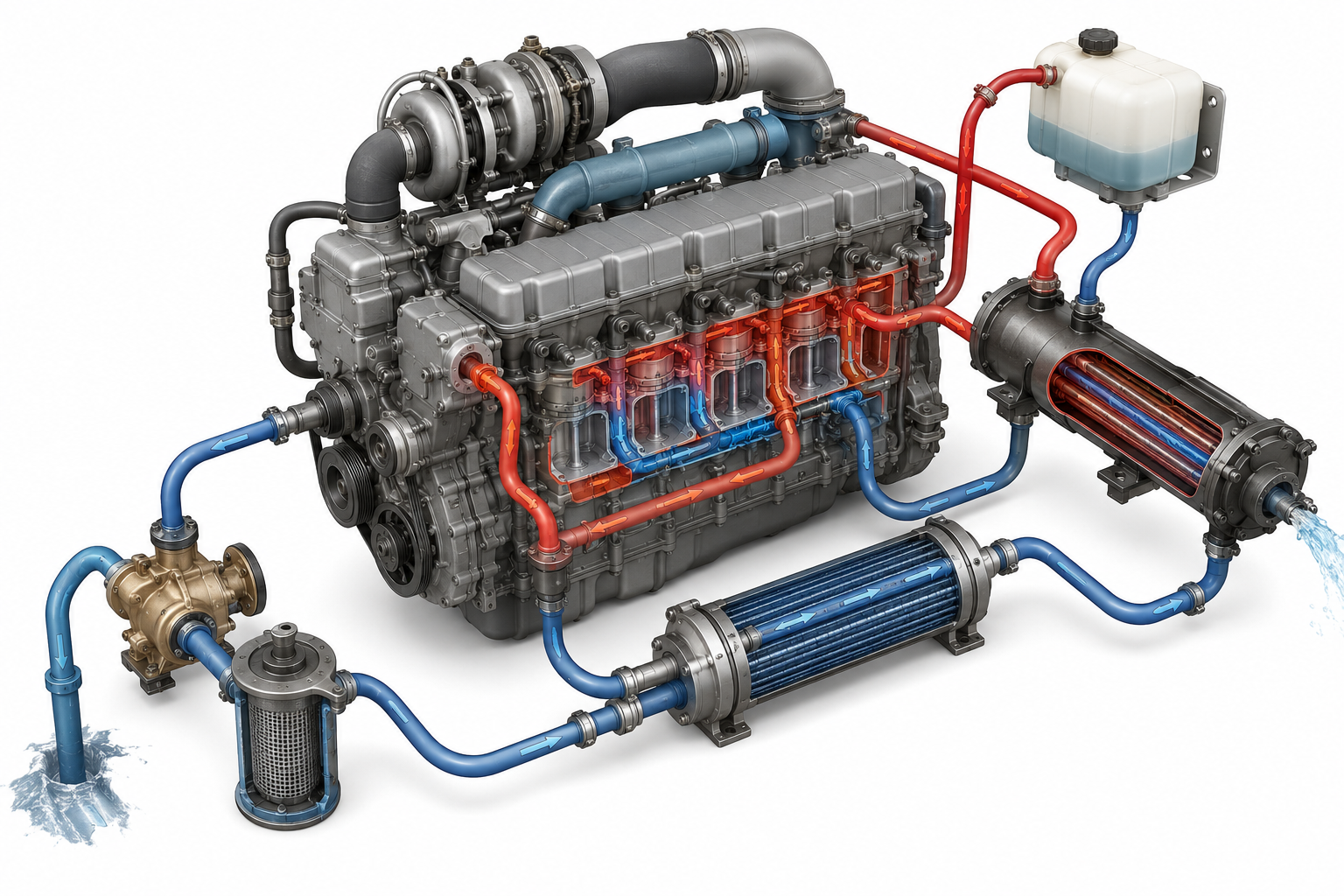
Check the complete seawater path rather than only the pump:
- Seawater inlet and through-hull
- Sea strainer
- Suction hoses and connections
- Seawater pump
- Impeller or internal pumping components
- Heat exchanger
- Aftercooler where applicable
- Oil or gear coolers in the seawater circuit
- Discharge side
One particularly deceptive problem is a deteriorated suction hose. A hose can look perfectly acceptable when the engine is stopped yet deform internally when pump suction increases at higher RPM.
The result can be an engine that cools normally at idle but progressively overheats underway.
What a Missing Impeller Blade Can Tell You
If a flexible impeller has lost one or more vanes, replacing the impeller is only part of the repair.
The missing rubber has gone somewhere.
Fragments can travel downstream and become trapped at cooler inlets, heat-exchanger passages or other restrictions. A new impeller may therefore restore the pump while the cooling system still suffers from inadequate flow.
That is why finding all missing pieces can be just as important as fitting the replacement impeller.
2. Why the Same Symptom Can Mean Different Things on a C32, QSM11 or MTU 4000
The basic physics of heat rejection applies to every marine diesel engine, but the cooling arrangement and likely inspection points vary considerably between engine families.
Caterpillar C32: Look Beyond the Temperature Gauge
On a Caterpillar C32 marine engine, an under-load temperature increase should lead to an inspection of the entire cooling path rather than an immediate assumption that the thermostat or pump has failed.
Seawater restriction, cooler fouling and deteriorating pump performance can all reduce the amount of heat the system can reject as engine load rises.
The aftercooler deserves attention as well.
If the engine is running hotter while simultaneously showing abnormal boost behavior, excessive smoke or reduced performance, the cooling and charge-air systems should be considered together. Fouling or restriction can affect more than one operating parameter, which is why comparing coolant temperature, boost, RPM, load and exhaust behavior is much more useful than looking at temperature alone.
When ordering replacement components, use the complete C32 engine serial number rather than relying only on the model designation.
Cummins QSM11: Don't Ignore the Suction Side
A Cummins QSM11 marine engine that runs normally at idle but becomes hot underway provides a good example of why the seawater suction side matters.
As engine load and RPM increase, the seawater pump must support the cooling system's greater demand. A weakened hose, restricted strainer, blocked inlet or other suction-side problem may become much more significant at that point.
A hose that deforms under suction can be especially difficult to diagnose because it may return to its normal shape when RPM is reduced.
This creates a frustrating pattern:
Cruising speed → temperature rises
RPM reduced → temperature begins falling
Back at the dock → everything appears normal again
When this happens, inspect the system under conditions as close as safely possible to those that produce the fault. Static inspection alone may not reveal a restriction that appears only under greater flow demand.
MTU Series 4000: Identify Which Cooling Circuit You Are Diagnosing
Cooling-system diagnosis becomes more involved on an MTU Series 4000 because applicable configurations can use separate seawater and internal coolant circuits.
That makes the phrase “MTU 4000 water pump” too broad for accurate diagnosis or parts identification.
Several part numbers may be encountered in Series 4000 cooling-system work, including:
| Part numberComponent / reference | |
| X59420700008 | Seawater pump associated with an MTU 16V4000 R43L application |
| X52620200081 | High-temperature water-pump assembly |
| X52420300001 | Low-temperature water pump |
| X00036684 | Coolant pump reference |
| 5272010805 | Water-pump shaft |
| X00026765 | Water-pump rotary seal |
These components should not be treated as interchangeable simply because they belong to Series 4000 cooling applications.
For example, loss of seawater-pump efficiency affects the system's ability to reject heat externally, while a problem within an internal coolant circuit affects coolant circulation on that side of the system.
The diagnostic question therefore becomes:
Which circuit is actually losing cooling capacity?
That is much more useful than simply concluding that the engine “needs a water pump.”
3. Pump Wear, Cavitation and Heat-Exchanger Fouling
A seawater pump can still rotate and move water while no longer delivering the performance required at high engine load.
Internal wear, erosion, shaft or seal problems and cavitation can gradually reduce effective pump performance. The difference may be difficult to notice at low RPM because the engine's cooling requirement is also low.
Cavitation is particularly useful as a diagnostic clue.
If inspection reveals characteristic pitting or erosion around the pump's internal surfaces, don't treat the damage only as a reason to replace the pump. Consider why the pump experienced poor inlet conditions in the first place.
A restricted strainer, partially closed valve, suction restriction or air entering upstream of the pump can contribute to conditions that promote cavitation.
Replacing a damaged pump without correcting the underlying hydraulic problem can allow the same failure pattern to return.
The Weep Hole Is There for a Reason
Leakage around a pump's tell-tale or weep hole should also be investigated.
On applicable MTU Series 4000 pump assemblies, for example, X00026765 is associated with a rotary seal and 5272010805 with a water-pump shaft.
When rebuilding a pump, replacing the seal without inspecting the shaft and other related components can result in another leak if the sealing surface is already worn or damaged.
The same engineering principle applies beyond MTU: repeated seal failure is a reason to investigate the mechanical condition surrounding the seal rather than simply installing another seal.
Don't Condemn the Pump Before Checking the Heat Exchanger
A perfectly serviceable pump cannot compensate indefinitely for a heavily restricted heat exchanger.
Scale, deposits, marine growth and debris can reduce heat-transfer efficiency or restrict water flow. The engine may therefore maintain normal temperature at light load but lose that ability when heat production increases.
Where appropriate and safely possible, comparing temperatures across the cooling system can help identify where heat transfer is no longer behaving normally.
The important point is to diagnose the system, not just the most obvious replaceable component.
4. The Cooling System May Be Healthy — The Engine Could Be Overloaded
Not every under-load overheating problem begins inside the engine room.
A heavily fouled hull, damaged propeller, excessive propeller pitch or another source of abnormal resistance can force the engine to work harder than expected.
Suppose an engine previously reached its rated operating RPM cleanly, but now struggles to reach the same speed while producing more black smoke and higher temperatures.
Before replacing cooling components, ask what changed on the vessel.
A heavily fouled underwater surface increases resistance. An incorrectly matched or damaged propeller can change engine loading. Additional vessel weight and other mechanical problems can have similar effects.
This becomes particularly relevant when overheating is accompanied by:
Failure to achieve expected full-load RPM
Increasing black smoke
Higher exhaust temperatures
Poor acceleration
Higher coolant temperature
A Caterpillar C32, Cummins QSM11, MTU 4000 or another marine diesel can have a perfectly functional cooling system and still experience excessive thermal stress if the engine is being overloaded.
The engine and vessel therefore need to be considered as one system.
5. Diagnose the Pattern Before Replacing Parts
The most useful question when an engine overheats underway is not:
“Which part should I replace?”
It is:
“What changes when the engine is placed under load?”
Start by comparing the engine's behavior at idle, moderate load and the operating condition where temperature begins rising.
Record:
| ParameterIdleCruise / LoadWhat to look for | |||
| Coolant temperature | ___ | ___ | Rate of temperature increase |
| Engine RPM | ___ | ___ | Can rated RPM be achieved? |
| Engine load | ___ | ___ | Abnormally high load? |
| Boost pressure | ___ | ___ | Change from normal baseline |
| Exhaust smoke | ___ | ___ | Black, blue or white |
| Seawater flow | ___ | ___ | Reduction at higher demand |
| Suction hose | Normal | ___ | Deformation/collapse |
| Sea strainer | ___ | ___ | Restriction/debris |
| Pump leakage | ___ | ___ | Tell-tale/weep-hole leakage |
| Heat exchanger | ___ | ___ | Fouling or flow restriction |
Trends are often more useful than a single alarm event.
If the engine has historically operated at one stable temperature and now runs several degrees hotter at the same RPM, vessel speed, sea temperature and load, something has changed even if the reading has not yet reached the alarm threshold.
That change deserves investigation.
Before Ordering Cooling-System Parts
Once the fault has been identified, accurate engine information becomes essential.
Do not order a component simply as a:
“C32 seawater pump”
“QSM11 water pump”
or
“MTU 4000 cooling pump.”
Provide the complete engine model, engine serial number, existing part number and quantity required. Photographs of the identification plate and existing component can also help when dealing with older or modified installations.
For engine-specific parts information:
Caterpillar C32 Marine Engine Parts
Cummins QSM11 Marine Engine Parts
MTU Series 4000 Marine Engine Parts
Frequently Asked Questions
Why does my marine diesel engine overheat only at high RPM?
The cooling system may have enough capacity at low load but insufficient heat-rejection capacity as engine output increases. Possible causes include restricted seawater flow, a deteriorated suction hose, pump wear, heat-exchanger fouling or another cooling-system restriction. Excessive engine loading can produce a similar pattern.
Can a blocked sea strainer cause overheating only under load?
Yes. A partially restricted strainer may still pass enough seawater at idle. As cooling demand increases, the restriction can become significant enough to reduce effective seawater flow.
Can a seawater hose collapse only when the engine is running?
A deteriorated suction hose can deform when pump suction increases and return toward its normal shape after RPM is reduced, making the problem difficult to identify during a static inspection.
Does overheating mean the seawater pump needs replacing?
No. The pump is only one possible cause. The seawater inlet, strainer, hoses, heat exchangers, aftercoolers, internal coolant circuits and engine loading should be considered before replacing components.
Why does my engine overheat and produce black smoke at the same time?
That combination can point toward excessive engine load, restricted airflow, charge-air problems or other conditions that increase combustion and thermal stress. Compare engine RPM, boost, load, exhaust behavior and cooling performance rather than diagnosing from smoke or temperature alone.
What information should I provide when ordering marine engine cooling parts?
Send the engine manufacturer, complete engine model, engine serial number, existing part number, quantity and delivery destination. Photographs are useful when the exact component needs confirmation.
Need Marine Engine Cooling Parts?
If your inspection identifies a seawater pump, coolant pump, seal, shaft, heat exchanger, gasket or another cooling-system component that requires replacement, Alfa Marine Spare Parts can assist with parts identification and availability for marine diesel engines.
For a quotation, send:
Engine model + serial number + part number + quantity + delivery destination
📧 Email: request@alfamarinespareparts.com
Request a Quote
For engine-specific requirements, visit our Caterpillar C32, Cummins QSM11, or MTU Series 4000 parts pages.
An engine that runs cool at the dock but overheats underway is giving you a valuable clue. The fault appears when demand increases. Following that change through the seawater system, coolant circuits and actual engine load is usually a better starting point than replacing the first component that looks suspicious.