Key Design Features of the MTU Series 4000 Marine Engine Family
The MTU Series 4000 marine engine family is one of the best-known high-output diesel engine platforms used in demanding marine propulsion applications.
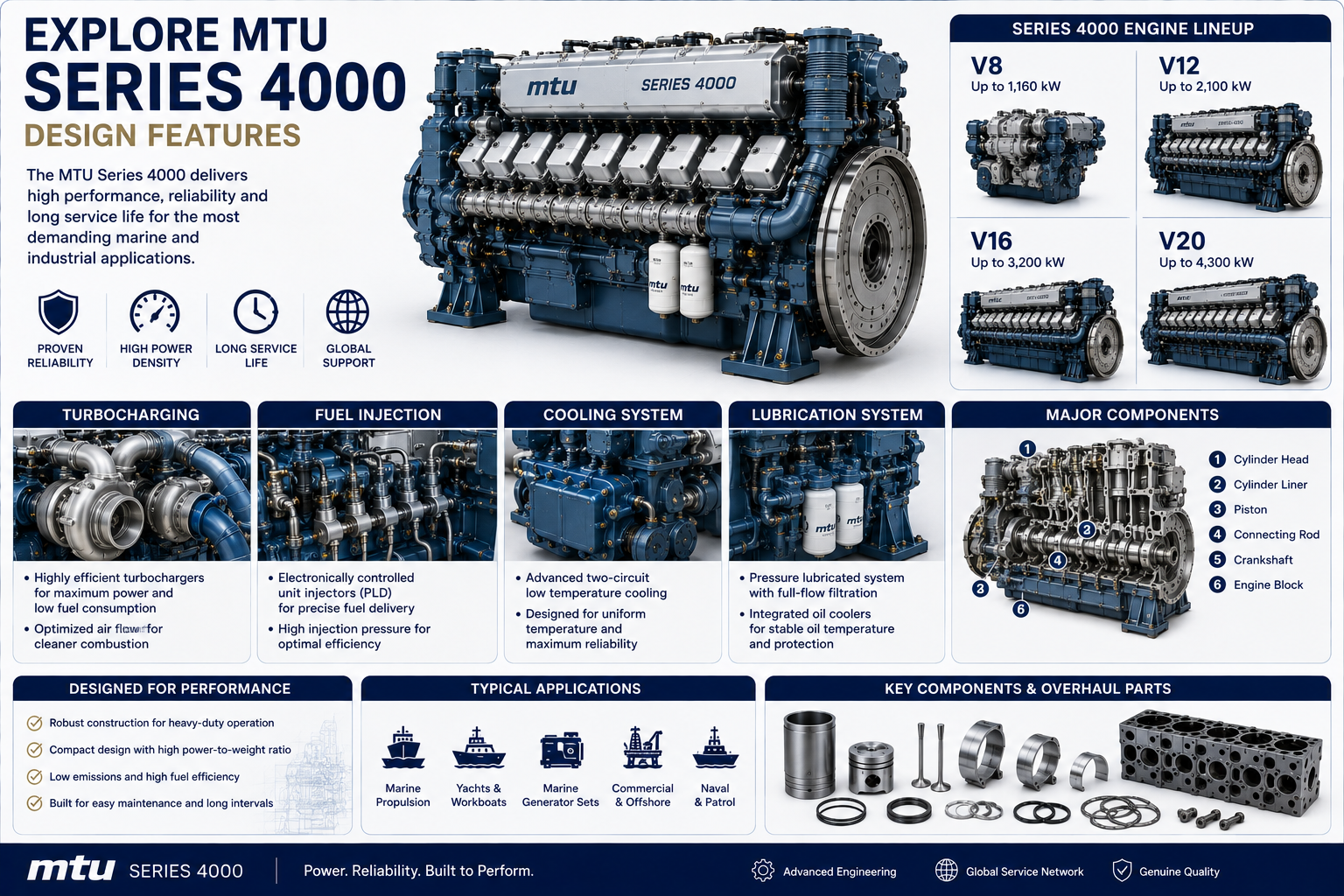
Depending on the engine version and generation, the Series 4000 family includes V8, V12, V16 and V20 configurations, allowing the basic engine platform to cover very different vessel sizes and operating profiles.
Series 4000 engines can be found in applications such as:
- Motor yachts and superyachts
- Fast ferries
- Patrol vessels
- Workboats
- Tugboats
- Offshore and commercial vessels
- Naval and government craft
- Marine generator applications
What makes the Series 4000 particularly interesting is not simply its power output.
Its design combines a compact V-engine layout, turbocharging, charge-air cooling, electronically controlled fuel delivery and a heavy-duty internal structure designed to handle substantial marine loads.
This guide looks at the key design features of the MTU Series 4000 engine family, the differences between major configurations and the components marine engineers should understand when maintaining or overhauling these engines.
1. V-Engine Architecture
One of the defining characteristics of the Series 4000 is its V-engine configuration.
Depending on model, Series 4000 engines are available as:
8V 4000 — V8
12V 4000 — V12
16V 4000 — V16
20V 4000 — V20
Using a V configuration allows a large number of cylinders to be packaged into a relatively compact engine.
For marine installations, this is important because engine-room space is valuable.
Increasing cylinder count also allows the Series 4000 platform to reach much higher power levels without requiring an entirely different engine architecture.
2. Four-Stroke Diesel Design
MTU Series 4000 engines use the four-stroke diesel combustion cycle.
Each cylinder operates through:
Intake → Compression → Combustion/Power → Exhaust
This cycle repeats continuously while the engine operates.
Although this sounds basic, the performance of a high-output Series 4000 depends on extremely precise coordination between:
- Fuel injection
- Air supply
- Turbocharging
- Valve timing
- Cooling
- Lubrication
- Electronic engine control
A problem in one system can therefore affect several others.
3. Large-Displacement Engine Platform
Series 4000 engines are large-displacement high-speed diesels.
A commonly encountered Series 4000 architecture uses approximately 4.77 liters of displacement per cylinder.
That gives approximately:
8V 4000 — 38.2 liters
12V 4000 — 57.3 liters
16V 4000 — 76.3 liters
20V 4000 — 95.4 liters
Exact specifications should always be checked for the particular engine generation and model.
This displacement helps explain why Series 4000 engines can generate substantial marine propulsion power while retaining a relatively compact high-speed diesel configuration.
4. Strong Crankcase Construction
At the center of the engine is a structure designed to support substantial combustion and mechanical loading.
The crankcase has to maintain the correct relationship between:
- Crankshaft
- Main bearings
- Cylinder assemblies
- Connecting rods
- Cylinder heads
This structural stability is especially important on V16 and V20 versions where the crankshaft is long and combustion forces are substantial.
During overhaul, the crankcase should therefore never be treated as merely the housing surrounding the engine.
It is a precision structural component.
5. Heavy-Duty Crankshaft
The MTU Series 4000 crankshaft converts combustion force into rotary power.
The force path is:
Combustion
↓
Piston
↓
Connecting rod
↓
Crankshaft
↓
Flywheel/coupling
↓
Marine transmission
The crankshaft operates with:
- Main bearings
- Connecting-rod bearings
- Thrust components
- Lubrication passages
Correct lubrication and bearing clearance are essential to crankshaft life.
6. Individual Cylinder Construction
One major advantage of large marine diesel architecture is the ability to service important cylinder-related components individually.
Major components include:
- Cylinder heads
- Pistons
- Piston rings
- Cylinder liners
- Connecting rods
- Bearings
- Fuel injectors
This becomes particularly useful during major overhaul because individual cylinder positions can be inspected and repaired according to their actual condition.
7. Replaceable Cylinder Liners
Cylinder liners provide the running surface for the pistons.
They operate under demanding conditions involving:
- High combustion pressure
- High temperature
- Continuous piston-ring contact
- Cooling-system exposure
During overhaul, liner condition may be evaluated for:
- Wear
- Scoring
- Surface condition
- Corrosion
- Cavitation-related damage
- Sealing-area condition
Liner sealing components are equally important.
A small sealing problem can eventually allow coolant contamination where it should never occur.
8. High-Strength Pistons
Series 4000 pistons operate in a severe environment.
Each piston must withstand:
- Combustion pressure
- High crown temperature
- Repeated acceleration
- Side loading
- Continuous ring movement
Piston condition is closely related to:
- Injector performance
- Cylinder cooling
- Lubrication
- Air supply
- Engine load
A damaged piston should therefore trigger investigation into why it was damaged, rather than only replacement of the piston.
9. Piston Cooling
High-output diesel pistons generate substantial heat.
Oil-based piston cooling helps remove heat from critical piston areas.
If piston cooling becomes inadequate, piston temperatures can increase considerably.
During an overhaul involving piston damage, oil supply and cooling should therefore be considered as part of the investigation.
10. Connecting-Rod Design
Connecting rods transfer combustion force from the pistons to the crankshaft.
Each connecting rod operates with:
- Piston-pin connection
- Big-end bearing
- Crankshaft journal
The rod experiences alternating tensile and compressive forces thousands of times every minute.
During overhaul, connecting rods may require inspection for:
- Big-end condition
- Alignment
- Bushings
- Bearing surfaces
- Fasteners
11. Individual Cylinder Heads
The cylinder heads contain several critical engine functions.
Depending on the Series 4000 version, head-related components include:
- Intake valves
- Exhaust valves
- Valve seats
- Valve guides
- Injector installation
- Cooling passages
Individual cylinder heads provide practical advantages during service because a problem affecting one cylinder does not necessarily require treating the entire bank as one cylinder-head assembly.
12. Four-Valve Cylinder Head Concept
Series 4000 engine architecture uses multiple valves per cylinder to provide effective airflow through the combustion chamber.
A four-valve arrangement allows improved intake and exhaust flow compared with a simpler two-valve arrangement.
Better breathing becomes increasingly important as:
- Engine RPM increases
- Fuel delivery increases
- Turbocharger boost increases
- Power density increases
Airflow is therefore fundamental to Series 4000 performance.
13. Turbocharging
One of the most important design characteristics of the MTU 4000 family is turbocharging.
A turbocharger uses exhaust-gas energy to compress incoming combustion air.
The process is approximately:
Exhaust gas → turbine → turbocharger shaft → compressor → compressed intake air
More air allows the engine to burn more fuel efficiently and produce considerably more power than a naturally aspirated engine of similar displacement.
14. Why Turbocharger Condition Matters
The turbocharger operates at extremely high rotational speeds.
Its condition directly influences:
- Boost pressure
- Airflow
- Exhaust temperature
- Smoke
- Fuel efficiency
- Engine power
Possible warning signs of turbocharger problems include:
- Low boost
- Black smoke
- Higher exhaust temperature
- Reduced power
- Abnormal turbo noise
- Oil leakage
A turbocharger problem can therefore appear elsewhere as an apparent combustion problem.
15. Charge-Air Cooling
Compressing air increases its temperature.
Hotter air is less dense.
Series 4000 engines therefore use charge-air cooling to reduce the temperature of compressed intake air before it reaches the cylinders.
The airflow path becomes approximately:
Air intake → turbocharger compressor → charge-air cooler → intake manifold → cylinders
Cooler, denser air improves the amount of oxygen available for combustion.
16. Why Charge-Air Cooler Condition Is Important
If the charge-air cooler becomes restricted or contaminated, engine performance can suffer.
Possible effects include:
- Reduced airflow
- Higher intake-air temperature
- Higher exhaust temperature
- Reduced power
- Increased smoke
Marine engines also require particular attention to cooling-system cleanliness because seawater-side deposits can reduce heat-transfer performance.
17. Electronic Fuel Injection
Modern Series 4000 engines use electronically controlled fuel systems.
Electronic management allows the engine to control fuel delivery according to operating conditions.
The system considers information from sensors monitoring parameters such as:
- Engine speed
- Temperature
- Pressure
- Load
- Air conditions
This allows considerably more precise control than older purely mechanical diesel fuel systems.
18. Common-Rail Technology in Later Series 4000 Generations
Later generations of the Series 4000 use advanced common-rail fuel-injection technology.
The basic principle is:
Fuel supply → high-pressure generation → fuel rail → electronically controlled injectors → cylinders
Separating pressure generation from individual injection events provides greater control over injection timing and quantity.
This supports:
- Efficient combustion
- High power density
- Improved operating behavior
- Emissions management
It also means fuel cleanliness becomes extremely important.
19. High-Pressure Fuel System
Modern injection components operate at extremely high pressures and very small internal clearances.
Contamination that might have caused limited problems in an older mechanical diesel can severely damage modern fuel-system components.
Fuel-system protection therefore depends heavily on:
- Correct filtration
- Clean fuel
- Water separation
- Proper service procedures
- Clean working practices
A dirty fuel tank can eventually become an injector problem.
20. Electronically Controlled Injectors
The injectors must deliver fuel accurately into each cylinder.
Injector condition can influence:
- Starting
- Power
- Smoke
- Exhaust temperature
- Fuel consumption
- Cylinder balance
One problematic injector can create a cylinder-specific issue even while the rest of the engine appears healthy.
This makes cylinder-to-cylinder comparison valuable during troubleshooting.
21. Electronic Engine Management
The Series 4000 engine management system coordinates and monitors important operating functions.
Depending on generation and installation, the control system can monitor parameters including:
- Engine speed
- Oil pressure
- Coolant temperature
- Fuel conditions
- Boost pressure
- Exhaust-related parameters
- Sensor status
- Alarm conditions
Electronic monitoring gives crews far more operating information than traditional mechanical gauges alone.
22. Sensor-Based Monitoring
Sensors are distributed throughout the engine.
They provide information to the engine-control system.
This makes it possible to detect abnormal operating conditions before they necessarily become catastrophic failures.
But sensors themselves can also fail.
Therefore:
an alarm does not automatically mean the mechanical component has failed.
Always confirm the actual operating condition.
23. Cooling-System Architecture
A high-output engine generates substantial heat.
The cooling system therefore protects:
- Cylinder heads
- Cylinder liners
- Turbocharging-related components
- Charge-air system
- Lubricating oil
- Other temperature-sensitive areas
Marine installations also typically depend on seawater-side heat rejection.
This introduces additional maintenance challenges.
24. Freshwater and Seawater Circuits
Marine cooling commonly involves two sides:
Freshwater / Engine-Coolant Side
Circulates treated coolant through the engine.
Seawater Side
Removes heat from the freshwater circuit through heat exchangers or related marine cooling equipment.
This keeps corrosive seawater from circulating directly through many internal engine cooling passages.
25. Heat Exchangers
Heat exchangers transfer engine heat toward the seawater circuit.
Their performance depends on:
- Clean surfaces
- Adequate coolant flow
- Adequate seawater flow
- Correct temperatures
Marine growth, scale and deposits can reduce heat transfer.
The engine may still run, but gradually operate hotter.
That gradual change is worth investigating.
26. Seawater Pumps
The seawater pump supplies cooling water through the marine side of the cooling system.
Problems can involve:
- Impeller deterioration
- Seal leakage
- Internal wear
- Restricted intake
- Blocked strainers
Reduced seawater flow can affect several engine temperatures simultaneously.
27. Lubrication System
The Series 4000 lubrication system protects some of the most expensive components in the engine.
Oil supports:
- Crankshaft bearings
- Connecting-rod bearings
- Pistons
- Turbochargers
- Valve-train components
- Other moving assemblies
Oil therefore performs several jobs:
lubrication + cooling + cleaning + corrosion protection.
28. Oil Cooling
Engine oil absorbs substantial heat.
The oil-cooling system helps keep lubricant temperature within its intended operating range.
If oil becomes excessively hot:
- Viscosity can decrease
- Bearing protection can deteriorate
- Oil degradation can accelerate
Oil temperature should therefore be considered together with oil pressure.
29. Full-Flow Oil Filtration
Oil filters remove contaminants before lubricating oil reaches sensitive engine components.
During servicing, the removed filter can also become a useful diagnostic tool.
Finding:
- Metal
- Bearing material
- Unusual sludge
can provide early evidence of internal engine problems.
30. Modular Engine-Family Concept
One reason the Series 4000 family covers such a broad power range is its modular approach.
The platform can be configured around different cylinder counts:
V8 → V12 → V16 → V20
while maintaining common engineering principles.
This provides benefits for:
- Maintenance familiarity
- Spare-parts management
- Technician training
- Fleet standardization
However, this does not mean every component is interchangeable between every Series 4000 engine.
31. Different Marine Ratings
Not every Series 4000 engine is intended to perform the same duty.
Different M-designations and ratings are optimized for different operating profiles.
Examples across the broader family include designations such as:
- M53
- M63
- M65
- M73
- M93
with additional suffixes and later variants depending on generation.
Some versions are intended for heavier continuous commercial operation, while others are optimized for high-output applications such as fast yachts.
This matters enormously when selecting an engine.
32. High Power Density
One major Series 4000 characteristic is its ability to generate substantial power relative to engine size.
This is particularly attractive in:
- Fast vessels
- Yachts
- Patrol craft
- Applications with limited machinery-space volume
But high power density also means systems such as:
- Cooling
- Lubrication
- Fuel delivery
- Turbocharging
must remain in good condition.
There is less room for neglected maintenance when an engine is producing very high output.
33. Compact Installation
Marine engine rooms rarely have unlimited space.
The V-engine architecture helps package substantial displacement into a relatively compact footprint.
This can leave more room for:
- Marine transmissions
- Generator sets
- Exhaust equipment
- Fuel systems
- Pumps
- Other vessel machinery
Service access, however, still needs to be considered when the vessel is designed.
34. Power-to-Weight Considerations
Weight matters particularly in high-speed vessels.
Reducing propulsion-system weight can improve:
- Vessel performance
- Payload
- Fuel efficiency
- Installation flexibility
The Series 4000 family has therefore been particularly important in marine sectors where both high power and relatively compact installation are required.
35. V8 4000 Configuration
The 8V 4000 provides the smallest cylinder count within the core Series 4000 V-engine family.
It can be suitable where:
- Less power is required
- Machinery space is limited
- Lower engine weight is desirable
It retains many of the same fundamental engineering concepts found in the larger configurations.
36. 12V 4000 Configuration
The 12V 4000 provides a substantial increase in displacement and power.
Marine types across different generations include examples such as:
- 12V 4000 M53
- 12V 4000 M63
- 12V 4000 M65
- 12V 4000 M73
- 12V 4000 M93
The V12 configuration is found across both commercial and high-performance marine applications depending on rating.
37. 16V 4000 Configuration
The 16V 4000 moves the platform into considerably higher power levels.
Examples across different generations include:
- 16V 4000 M53
- 16V 4000 M63
- 16V 4000 M65
- 16V 4000 M73
- 16V 4000 M93
The V16 configuration is commonly associated with larger vessels requiring substantial propulsion power.
38. 20V 4000 Configuration
The 20V 4000 represents the largest cylinder-count configuration in the core Series 4000 family.
Twenty cylinders allow the engine to achieve very high output while retaining the basic engineering approach of the Series 4000 platform.
These engines can be encountered in demanding commercial and high-performance applications.
39. M53-Type Applications
M53-family Series 4000 engines are associated with commercial marine duty profiles.
Depending on exact version, these engines can be encountered in applications where:
- Reliability
- High annual operating hours
- Robust operation
are particularly important.
The exact duty rating must always be checked for the specific engine.
40. M73-Type Applications
M73-family engines occupy another important part of the Series 4000 marine range.
Examples include engines such as:
- MTU 12V 4000 M73
- MTU 16V 4000 M73
- MTU 20V 4000 M73 variants
These engines are encountered in powerful marine propulsion installations requiring substantial output.
41. M93-Type Applications
The M93 family is strongly associated with high-performance marine propulsion.
Depending on version, applications can include:
- Large motor yachts
- Fast vessels
- Performance-oriented marine installations
These engines combine high power density with advanced turbocharging, cooling, fuel and electronic-control systems.
42. Starting System
A large Series 4000 engine requires a powerful starting system.
Important components include:
- Starter motor
- Starting batteries
- Battery cables
- Solenoids
- Relays
- Ground connections
- Control circuits
Slow cranking should not automatically be blamed on the starter.
Check the entire electrical path.
43. Alternator and Charging System
The charging system maintains the batteries and supports electrical requirements while the engine is running.
Problems can involve:
- Alternator
- Wiring
- Grounds
- Drive components
- Batteries
- Charging controls
A repeated dead-battery problem may therefore actually be a charging-system problem.
44. Exhaust-System Design
Exhaust gases leaving the cylinders travel through the exhaust system toward the turbochargers and eventually out of the vessel.
Exhaust-system condition affects:
- Turbocharger performance
- Engine-room temperature
- Backpressure
- Safety
Exhaust leaks should be taken seriously.
Hot gas can damage nearby:
- Wiring
- Hoses
- Insulation
- Sensors
45. Engine Monitoring Helps Prevent Expensive Damage
Modern monitoring makes it possible to track changes in:
- Oil pressure
- Coolant temperature
- Engine speed
- Load
- Boost
- Exhaust behavior
- Alarm history
The most valuable information is often not an alarm.
It is a change from the engine's established normal behavior.
46. Condition Trending
Imagine a 16V 4000 that normally operates with stable:
- Oil pressure
- Coolant temperature
- Boost
- Exhaust temperatures
Over several months, one exhaust temperature gradually begins increasing.
The engine still runs.
No catastrophic alarm occurs.
But the trend may indicate an emerging:
- Injector problem
- Airflow problem
- Valve problem
- Cylinder condition issue
Finding that early can prevent a much more expensive repair.
47. Serviceability
Large engines must eventually be overhauled.
Series 4000 architecture allows major components to be serviced individually.
Overhaul-related components can include:
- Cylinder heads
- Liners
- Pistons
- Connecting rods
- Bearings
- Injectors
- Turbochargers
- Pumps
This makes condition-based repair of individual engine sections possible where technically appropriate.
48. Why the Serial Number Matters
Knowing that an engine is:
MTU 16V 4000
is not always enough for spare-parts identification.
A better identification is:
MTU 16V 4000 M73 + engine serial number.
Different:
- Generations
- Ratings
- Production revisions
- Applications
can use different components.
This becomes especially important for expensive parts such as:
- Crankshafts
- Pistons
- Connecting rods
- Injectors
- Turbochargers
- Control components
49. Important MTU Series 4000 Spare Parts
Maintenance and overhaul requirements can include:
Internal Engine Parts
- Crankshafts
- Main bearings
- Rod bearings
- Connecting rods
- Pistons
- Piston rings
- Cylinder liners
- Cylinder heads
- Valves
- Valve guides
Fuel-System Parts
- Fuel injectors
- Fuel pumps
- Fuel filters
- High-pressure fuel components
Air & Exhaust Parts
- Turbochargers
- Charge-air coolers
- Exhaust components
- Intake components
Cooling Parts
- Coolant pumps
- Seawater pumps
- Heat exchangers
- Thermostatic components
- Gaskets and seals
Lubrication Parts
- Oil pumps
- Oil coolers
- Oil filters
- Bearings
- Oil seals
Electrical Parts
- Starter motors
- Alternators
- Sensors
- Wiring components
- Control-system components
50. Frequently Asked Questions
What Cylinder Configurations Are Available in the MTU Series 4000 Family?
The core family includes V8, V12, V16 and V20 configurations, depending on generation and application.
Are All MTU 4000 Engines the Same?
No. Different cylinder counts, generations, ratings and M-designations can have significant differences.
Are MTU Series 4000 Engines Turbocharged?
Yes, turbocharging is a fundamental feature of the marine Series 4000 architecture.
Why Is Charge-Air Cooling Important?
Cooling compressed intake air increases air density and helps support efficient high-output combustion.
Do Series 4000 Engines Use Electronic Fuel Injection?
Modern Series 4000 generations use sophisticated electronically controlled fuel-injection systems, including common-rail technology in later generations.
Are Parts Interchangeable Between 12V, 16V and 20V 4000 Engines?
Some engineering concepts and certain components may be shared within particular generations, but interchangeability should never be assumed. Verify the exact engine and serial number.
What Information Should Be Used When Ordering Parts?
Provide the complete engine designation, engine serial number, existing part number where available, required quantity and photographs.
Browse Our Complete Catalog
Marine engine brands:
https://alfamarinespareparts.com/our-brand
Marine spare parts:
https://alfamarinespareparts.com/spareparts
Contact Alfa Marine Spare Parts
For MTU Series 4000 marine engine spare parts:
Email: request@alfamarinespareparts.com
For faster parts identification, provide:
complete engine type + M-designation + engine serial number + existing part number + quantity + photographs + delivery location.
Final Word
The success of the MTU Series 4000 marine engine family comes from more than one individual design feature.
It is the way multiple systems work together:
strong V-engine architecture
high-output turbocharging
charge-air cooling
precise fuel injection
individual cylinder components
heavy-duty crankshaft and bearings
effective lubrication and cooling
electronic engine management
advanced condition monitoring
The V8, V12, V16 and V20 configurations allow the same broader engine family to serve very different vessels and power requirements.
But increased power also increases the importance of maintenance.
A restricted charge-air cooler can affect combustion.
A weak injector can affect one cylinder.
Contaminated oil can damage bearings.
Poor seawater flow can increase engine temperature.
And a small bearing problem can eventually damage an expensive crankshaft.
That is why understanding the design of the MTU Series 4000 is useful for more than identifying components.
It helps marine engineers understand how one system affects another—and why seemingly small changes in engine behavior deserve attention before they become major failures.