
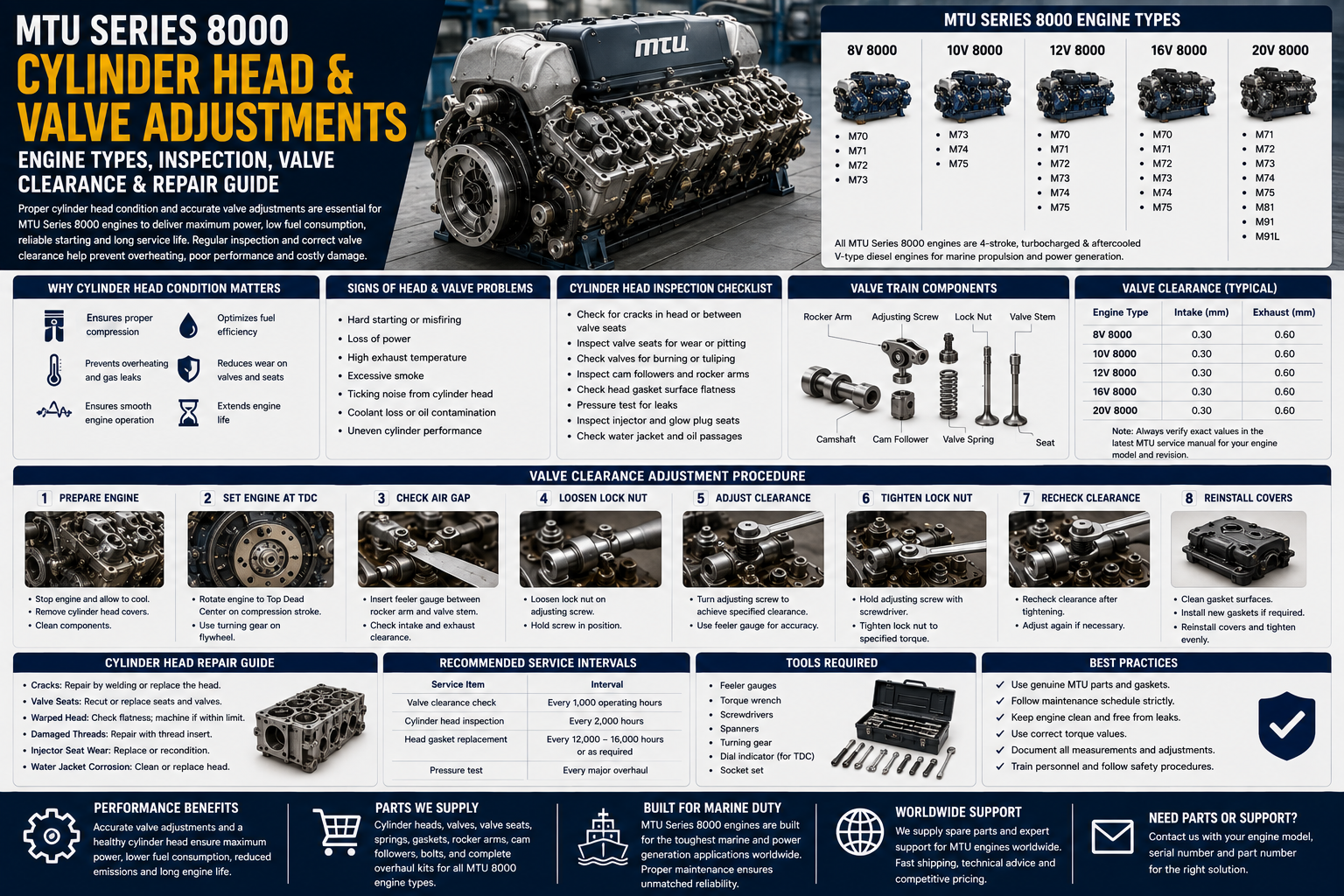

MTU Series 8000 Cylinder Head & Valve Adjustments: Engine Types, Inspection, Valve Clearance & Repair Guide
The cylinder head and valve train on an MTU Series 8000 marine engine operate in one of the most demanding areas of the entire engine.
Every cylinder has to manage enormous combustion pressure and temperature while the intake and exhaust valves repeatedly open and close under heavy marine operating conditions.
When everything is correct, the engine can maintain:
- Stable combustion
- Balanced cylinder temperatures
- Good compression
- Correct airflow
- Efficient fuel use
- Reliable power output
But cylinder-head and valve problems often begin quietly.
An engineer might first notice:
one cylinder running hotter than the others.
Or:
a change in exhaust temperature.
Perhaps the engine develops an unusual valve-train noise.
Starting becomes slightly more difficult.
Smoke increases.
Or a routine inspection reveals that valve clearances have changed.
These signs should not automatically lead to:
“The cylinder head needs replacement.”
The correct approach is to understand what has changed, measure the valve train carefully, compare cylinders, and determine whether the problem involves adjustment, wear, cooling, combustion, or the cylinder head itself.
This guide looks at cylinder-head inspection and valve adjustment for the MTU Series 8000 marine engine family, including the different 20V 8000 engine types.
1. Which MTU Series 8000 Marine Engine Types Does This Guide Cover?
The MTU Series 8000 is a high-output marine diesel engine family built around a large V20 architecture.
Marine engineers may encounter several Series 8000 designations depending on generation, rating, and vessel application.
These include:
MTU 20V 8000 M70
An earlier Series 8000 marine configuration used in high-output marine propulsion applications.
MTU 20V 8000 M71
Another Series 8000 V20 marine version with its own engine rating and component configuration.
MTU 20V 8000 M72
A further development within the 20V 8000 marine family.
MTU 20V 8000 M81
An important Series 8000 marine engine configuration used for demanding propulsion applications.
MTU 20V 8000 M90
Another high-output member of the 20V Series 8000 family.
MTU 20V 8000 M91
A later Series 8000 marine configuration.
MTU 20V 8000 M91L
A high-output Series 8000 marine version intended for demanding vessel applications.
The important point is:
“MTU 8000 cylinder head” is not enough information for parts identification.
A request should preferably include:
MTU 20V 8000 + complete M-designation + engine serial number + current component part number.
2. Why Cylinder-Head Condition Matters So Much on an MTU 8000
The cylinder head forms part of the combustion chamber.
It has to manage:
- Combustion pressure
- High temperature
- Intake airflow
- Exhaust flow
- Fuel injection
- Valve operation
- Cooling
- Sealing between combustion and other engine systems
A problem in the cylinder head can therefore influence much more than one mechanical component.
It can affect:
- Compression
- Combustion
- Exhaust temperature
- Engine power
- Smoke
- Cooling
- Fuel consumption
That makes the cylinder head an important diagnostic area when one cylinder begins behaving differently from the others.
3. Why a 20-Cylinder Engine Gives Engineers an Advantage
An MTU 20V 8000 has twenty cylinders.
That gives the engineer something very useful:
nineteen other cylinders for comparison.
Suppose most cylinders show reasonably similar operating behavior.
But one cylinder suddenly develops:
- Higher exhaust temperature
- Different valve clearance
- Abnormal combustion
- Different injector behavior
That cylinder deserves attention.
Instead of immediately dismantling the complete engine, you can start by asking:
“What is different about this cylinder?”
4. What Does the MTU 8000 Cylinder Head Contain?
The exact configuration depends on engine version, but cylinder-head-related components can include areas such as:
- Intake valves
- Exhaust valves
- Valve seats
- Valve guides
- Valve springs
- Valve rotators or related valve-train components where fitted
- Rocker or actuating components
- Injector location
- Cooling passages
- Sealing surfaces
These components have to work together.
A perfect valve cannot compensate for a badly damaged valve seat.
And a new cylinder head cannot solve an injector problem that caused the original thermal damage.
5. What Is Valve Clearance?
Valve clearance is the controlled mechanical clearance within the valve-actuation system when the valve is in the appropriate closed position.
The engine needs this clearance because components change dimensions as operating temperature changes.
If the clearance is incorrect, the valve timing and seating behavior can be affected.
That is why valve adjustment should be treated as a precision maintenance procedure, not simply:
“tighten it until it sounds right.”
6. Why Correct Valve Clearance Matters
Correct valve clearance helps ensure that valves:
- Open correctly
- Close correctly
- Seat properly
- Transfer heat correctly
- Follow the intended valve timing
Incorrect clearance can affect engine operation.
The consequences depend partly on whether the clearance is:
too large
or:
too small.
7. What Happens if Valve Clearance Becomes Too Large?
Excessive clearance can contribute to:
- Increased valve-train noise
- Altered valve opening
- Reduced effective valve movement
- Mechanical impact in valve-train components
- Accelerated wear
An engineer may first hear:
a tapping or clicking sound.
But noise alone should not be used to determine valve clearance.
Measure it.
8. What Happens if Valve Clearance Becomes Too Small?
Insufficient clearance can be particularly concerning because it may prevent the valve from seating correctly under operating conditions.
Possible consequences can include:
- Poor sealing
- Compression loss
- Hot valve condition
- Valve-seat damage
- Exhaust-temperature changes
- Difficult starting
- Reduced power
A valve that cannot fully seat may also have difficulty transferring heat correctly into the cylinder head.
That can eventually contribute to valve damage.
9. Situation: One Exhaust Valve Keeps Losing Clearance
Suppose a valve clearance is adjusted correctly.
Then during the next inspection it has changed again.
Do not simply adjust it repeatedly forever.
Ask:
“Why is the clearance changing?”
Possible areas to investigate include:
- Valve-seat wear
- Valve-face wear
- Valve-train component wear
- Actuating-component condition
- Thermal damage
Repeated changes can be evidence of a developing mechanical condition.
10. Situation: One Valve Clearance Keeps Getting Larger
The opposite trend can also be informative.
Increasing clearance may indicate wear somewhere within the valve actuation system.
Inspect the associated:
- Valve-train components
- Contact surfaces
- Rocker-related components
- Adjusting mechanism
- Valve stem area
Again, the trend matters.
A single measurement tells you the clearance today.
A maintenance history tells you how it got there.
11. Record Valve Clearance Before Adjusting It
This is a simple but valuable practice.
Do not immediately correct every measurement.
First record what you found.
For example:
Cylinder 1 Intake: __________
Cylinder 1 Exhaust: __________
Cylinder 2 Intake: __________
Cylinder 2 Exhaust: __________
Continue for all cylinders being inspected.
Why?
Because the original measurements can reveal patterns.
If nineteen valves are reasonably similar and one is dramatically different, that is important diagnostic information.
12. Do Not Use a Generic Valve-Clearance Number
This is especially important on a Series 8000 engine.
Do not assume one valve-clearance specification applies universally to every:
- M70
- M71
- M72
- M81
- M90
- M91
- M91L
configuration.
Valve-adjustment procedures and specifications should always be taken from the technical documentation applicable to the exact engine model and serial number.
The correct engine specification should override generic internet values.
13. Engine Temperature Matters During Valve Adjustment
Valve-clearance procedures are often defined around a particular engine thermal condition.
Therefore, do not assume a clearance value specified for one temperature condition can simply be used under another.
Before adjustment, confirm:
- Required engine temperature condition
- Correct crankshaft position
- Correct cylinder position
- Correct valve being measured
- Applicable specification
Precision maintenance begins before the feeler gauge is inserted.
14. Correct Cylinder Position Is Essential
The valve being measured must be in the correct position within the engine cycle.
If the camshaft is still acting on the valve mechanism, the measurement will be wrong.
On a large V20 engine, technicians need a systematic approach.
Keep track of:
- Cylinder numbering
- Engine bank
- Crankshaft position
- Firing sequence
- Valve position
Do not rely on memory during a twenty-cylinder valve-adjustment job.
15. Organize the Valve Adjustment Cylinder by Cylinder
A V20 engine can become confusing quickly.
Use a written inspection sheet.
For each cylinder record:
| CylinderIntake BeforeIntake AfterExhaust BeforeExhaust AfterNotes | |||||
| 1 | ___ | ___ | ___ | ___ | ___ |
| 2 | ___ | ___ | ___ | ___ | ___ |
| 3 | ___ | ___ | ___ | ___ | ___ |
| 4 | ___ | ___ | ___ | ___ | ___ |
| etc. |
This creates valuable history for the next inspection.
16. Compare Both Cylinder Banks
An MTU 20V 8000 has two cylinder banks.
Compare them.
Look for patterns such as:
- One bank running hotter
- One bank requiring more valve adjustments
- Different exhaust-temperature trends
- Different turbocharger behavior
- Cooling differences
If several cylinders on one bank show similar abnormalities, the problem may extend beyond an individual cylinder head.
17. Exhaust Temperature Is a Useful Cylinder-Head Clue
Exhaust temperature can help identify combustion differences.
Suppose one cylinder runs significantly hotter than neighboring cylinders.
Possible causes can include:
- Injector problem
- Exhaust valve issue
- Valve-clearance problem
- Poor compression
- Fuel-delivery imbalance
- Cylinder condition
Do not immediately conclude:
“bad cylinder head.”
Use exhaust temperature as one piece of diagnostic evidence.
18. A Cold Cylinder Can Also Tell You Something
A cylinder running noticeably cooler than the others can also indicate a problem.
Possible causes include:
- Weak fuel injection
- Poor combustion
- Low compression
- Injector problem
- Valve sealing problem
Engine diagnosis is not only about finding the hottest cylinder.
Sometimes the unusually cold cylinder is the one that needs attention.
19. Exhaust-Valve Condition Deserves Special Attention
The exhaust valve operates in an extremely hot environment.
It has to seal the combustion chamber while repeatedly being exposed to hot exhaust gas.
Possible exhaust-valve problems can include:
- Seat wear
- Face damage
- Thermal damage
- Deposits
- Poor sealing
- Stem or guide wear
A damaged exhaust valve can cause progressively worsening cylinder performance.
20. Why Valve Seating Matters
When the valve closes, it should seal correctly against its seat.
Proper seating supports:
- Compression
- Combustion
- Heat transfer
If sealing deteriorates, hot combustion gas can pass through areas where it should not.
This can accelerate damage.
A small sealing problem can therefore eventually become a badly burnt valve or seat.
21. Valve-Seat Inspection
When a cylinder head is removed, inspect valve seats carefully.
Look for:
- Pitting
- Burning
- Cracking
- Uneven contact
- Excessive wear
- Recession
- Deposits
Do not simply grind everything until it looks shiny.
The correct geometry and dimensions matter.
22. Valve-Guide Wear
Valve guides keep valve-stem movement controlled.
Excessive guide wear can influence:
- Valve alignment
- Seating
- Oil control
- Valve-train behavior
During cylinder-head overhaul, valve stems and guides should be evaluated according to the applicable wear limits.
Do not replace the valve while ignoring a badly worn guide.
23. Valve Springs Matter Too
Valve springs are often overlooked because they are visually simple components.
But they have to control valve movement repeatedly at operating speed.
Inspect for:
- Damage
- Cracking
- Corrosion
- Abnormal wear
- Loss of required characteristics
A valve train is a system.
The valve itself is only one component.
24. Rocker and Valve-Actuation Components
Valve adjustment occurs through a larger mechanical system.
Inspect contact surfaces for:
- Wear
- Pitting
- Scoring
- Abnormal movement
- Loose components
If a valve adjustment repeatedly changes, inspect the entire actuation path rather than only the adjustment screw.
25. Unusual Valve-Train Noise
New mechanical noise should be investigated.
Possible sounds can include:
- Tapping
- Clicking
- Knocking
- Irregular mechanical noise
Possible causes include:
- Excessive valve clearance
- Worn valve-train components
- Loose adjustment
- Mechanical damage
But do not diagnose by sound alone.
Sound tells you where to look.
Measurement tells you what is wrong.
26. Situation: Difficult Starting After Cylinder-Head Work
Suppose an MTU 8000 received cylinder-head or valve work and now starts poorly.
Possible areas to recheck include:
- Valve adjustment
- Injection-system installation
- Cylinder sealing
- Timing-related setup
- Electrical connections
- Assembly errors
Do not immediately assume an unrelated fuel-system problem developed at exactly the same time.
Start with the systems that were disturbed during the repair.
27. Cylinder Compression and Valve Condition
A leaking intake or exhaust valve can reduce effective compression.
Possible symptoms include:
- Hard starting
- Poor combustion
- Low cylinder contribution
- Smoke
- Uneven running
Compression-related diagnosis can help determine whether the problem lies in:
- Valves
- Piston rings
- Cylinder liner
- Other combustion-chamber sealing areas
Do not remove a cylinder head solely because one exhaust temperature looks unusual.
Gather evidence.
28. Injector Problems Can Look Like Valve Problems
This is important.
An injector can cause:
- High exhaust temperature
- Poor combustion
- Smoke
- Cylinder imbalance
These symptoms may also appear with valve problems.
Before dismantling a cylinder head, consider the injector and fuel system.
On an expensive V20 engine, correct diagnosis matters enormously.
29. Valve Problems Can Also Look Like Injector Problems
The opposite happens too.
An engineer sees abnormal combustion and replaces the injector.
The problem remains.
Why?
The valve was leaking.
This is why cylinder diagnosis should combine:
- Injector information
- Exhaust temperatures
- Valve clearance
- Compression-related information
- Cylinder condition
Avoid replacing parts based on one symptom.
30. Turbocharger Performance Can Influence Cylinder Temperatures
The MTU Series 8000 depends heavily on turbocharging.
Reduced airflow can cause combustion conditions to change across multiple cylinders.
If an entire bank or many cylinders are showing elevated exhaust temperatures, consider:
- Turbocharger condition
- Charge-air cooling
- Intake restrictions
- Air leakage
Do not adjust twenty valves because the actual problem is insufficient charge air.
31. Cooling-System Problems Can Damage Cylinder Heads
The cylinder head depends on proper cooling.
Cooling problems can contribute to:
- Excessive thermal stress
- Distortion
- Cracking
- Valve-seat problems
- Sealing problems
If a cylinder head has suffered thermal damage, investigate why the engine overheated.
Possible causes may involve:
- Cooling pump
- Heat exchanger
- Restricted passages
- Coolant condition
- Seawater side
- Thermostatic control
A replacement cylinder head connected to the same cooling problem can eventually suffer the same fate.
32. Coolant Quality Matters
The cooling system protects more than engine temperature.
Correct coolant chemistry helps protect internal passages and components against:
- Corrosion
- Deposits
- Cavitation-related effects
- Contamination
Poor coolant maintenance can gradually affect cylinder-head cooling passages.
The damage may develop long before an overheating alarm appears.
33. Inspect Cooling Passages During Cylinder-Head Repair
When a cylinder head is removed, do not inspect only the combustion side.
Also consider:
- Cooling passages
- Deposits
- Corrosion
- Blockage
A head with restricted cooling may repeatedly experience local hot spots even after valves have been repaired.
34. Do Not Clean Away Evidence Too Quickly
When a cylinder head is removed, technicians naturally want to clean everything.
Before doing that, inspect and document:
- Combustion deposits
- Valve coloration
- Injector area
- Piston crown appearance
- Exhaust-port condition
Differences between cylinders can provide diagnostic clues.
Take photographs first.
Clean afterwards.
35. Compare All Twenty Cylinders During Major Work
On a V20 engine, comparison becomes extremely valuable.
Look for cylinders showing:
- Different deposit patterns
- Different valve coloration
- Unusual piston crown appearance
- Abnormal valve-seat wear
If nineteen cylinders look similar and one does not, investigate why.
36. When Can a Cylinder Head Be Reconditioned?
A cylinder head may be suitable for professional reconditioning when the main structure remains within allowable limits.
Work may include:
- Cleaning
- Crack inspection
- Pressure testing where applicable
- Valve replacement
- Valve-seat work
- Valve-guide replacement
- Surface inspection
- Dimensional checks
The exact repair limits should follow the applicable technical procedures for the specific engine.
37. When Is Replacement Better Than Repair?
Replacement may be more sensible when the cylinder head has:
- Serious cracking
- Severe corrosion
- Major structural damage
- Excessive previous machining
- Extensive valve-seat damage
- Damage outside permitted repair limits
There is little value in repeatedly machining a head that can no longer reliably meet specification.
38. New vs. Remanufactured Cylinder Heads
Depending on availability, the options may include:
New
Newly manufactured cylinder-head assembly or casting.
Remanufactured
A used head that has undergone controlled disassembly, cleaning, inspection, measurement, replacement of required components, machining where permitted, assembly and testing.
Reconditioned
A repaired used cylinder head.
The repair scope can vary.
Always ask what was actually done.
39. Fresh Paint Does Not Mean a Cylinder Head Is Rebuilt
This principle appears throughout the marine-parts industry.
A used cylinder head can be:
cleaned
painted
and:
photographed nicely
without being properly remanufactured.
For a major engine such as an MTU 8000, ask about:
- Crack inspection
- Pressure testing
- Valve guides
- Valve seats
- Valves
- Dimensional measurements
- Surface condition
The internal work matters more than appearance.
40. Keep Cylinder-Head Components Organized During Disassembly
A twenty-cylinder engine contains a substantial number of parts.
Do not allow components from different cylinders to become mixed unnecessarily.
Identify:
- Cylinder number
- Bank
- Intake components
- Exhaust components
- Adjusting parts
- Reusable components
Keeping everything organized can help preserve wear-pattern information.
41. Use Clean Working Practices
Cylinder-head and valve-train work requires cleanliness.
Protect:
- Oil passages
- Fuel connections
- Intake openings
- Cooling passages
- Sealing surfaces
A large marine diesel should not be assembled with dirt entering open engine passages.
Cleanliness is part of engine reliability.
42. Inspect Sealing Surfaces
Cylinder-head sealing depends on the condition of the mating surfaces.
Inspect for:
- Damage
- Corrosion
- Fretting
- Debris
- Surface irregularities
A new gasket cannot compensate for a badly damaged sealing surface.
43. Gaskets, O-Rings & Seals Matter
Large engine repairs naturally focus attention on expensive parts:
- Cylinder heads
- Valves
- Injectors
- Pistons
But the engine also depends on relatively small sealing components.
These may include:
- O-rings
- Gaskets
- Oil seals
- Cooling-system seals
A small damaged O-ring can stop the entire cylinder-head assembly from being completed correctly.
44. Do Not Automatically Reuse Old Seals
If technical procedures specify replacement during disassembly, use the appropriate new sealing components.
Reusing a tired seal to save a small amount of money makes very little sense during work on an MTU Series 8000.
The labor required to reopen the engine can cost vastly more than the seal.
45. Valve Adjustment After Cylinder-Head Installation
After cylinder-head work, valve adjustment becomes an important part of the reassembly process.
Technicians should follow the exact procedure for:
- Engine model
- Cylinder position
- Engine temperature
- Valve clearance
- Adjustment sequence
- Tightening requirements
Do not substitute specifications from another MTU Series 8000 variant without verification.
46. Recheck After Major Work Where Required
Depending on the applicable maintenance procedure, certain adjustments or inspections may require follow-up after the engine has returned to operation.
This is one reason accurate service documentation matters.
Record:
- Work completed
- Clearances
- Components replaced
- Cylinder numbers
- Engine hours
- Date
The information becomes valuable at the next inspection.
47. Build a Valve-Clearance History
A valve-adjustment sheet becomes increasingly valuable over the life of the engine.
For each inspection record:
- Engine hours
- Cylinder
- Intake clearance before adjustment
- Exhaust clearance before adjustment
- Final setting
- Abnormal observations
After several inspections, patterns can emerge.
For example:
Cylinder 14 exhaust clearance keeps reducing faster than every other cylinder.
That deserves investigation.
48. Do Not Treat Adjustment as the Repair
This is one of the most important lessons.
If a valve repeatedly moves out of specification, adjustment may only correct the symptom.
You still need to determine:
Why is it changing?
Possible causes may include:
- Valve-seat recession
- Valve wear
- Guide wear
- Valve-train wear
- Thermal problems
Repeatedly adjusting a developing failure does not prevent the failure.
49. Common Warning Signs of MTU 8000 Cylinder-Head Problems
Watch for:
- Abnormal exhaust temperature
- Repeated valve-clearance changes
- Increased valve-train noise
- Difficult starting
- Compression-related problems
- Smoke
- Coolant loss
- Cylinder imbalance
- Abnormal combustion deposits
- Valve damage
One symptom may have several causes.
Several symptoms occurring together provide stronger evidence.
50. Situation: Coolant Loss With No Obvious External Leak
If coolant level falls but there is no obvious external leak, further investigation is required.
Possible internal areas may include:
- Cylinder-head sealing
- Cooling passages
- Other cooling-system components
Do not continue topping up coolant indefinitely without finding the source.
Loss of coolant is a symptom.
The leak still exists somewhere.
51. Situation: Exhaust Temperature Rises After Injector Replacement
Suppose an injector is replaced but the cylinder still runs hot.
Do not immediately replace the new injector again.
Check:
- Valve clearance
- Valve sealing
- Compression
- Cylinder condition
- Installation
- Fuel-system setup
A correct diagnosis should become narrower as tests eliminate possibilities.
52. Situation: Valve Adjustment Is Correct but the Cylinder Still Runs Poorly
If valve clearances are correct but the cylinder remains abnormal, move to other areas.
Consider:
- Injector performance
- Compression
- Cylinder liner
- Piston rings
- Fuel delivery
- Valve sealing
- Electronic control
A correctly adjusted valve train does not prove the cylinder head is healthy.
53. MTU 20V 8000 M81 Cylinder-Head Inspection
For the MTU 20V 8000 M81, cylinder-head maintenance should be organized cylinder by cylinder.
Record:
- Cylinder position
- Exhaust-temperature history
- Valve-clearance measurements
- Injector condition
- Head service history
For major repairs, always identify the engine using its full model and serial number before ordering components.
54. MTU 20V 8000 M91 Cylinder-Head Inspection
The same principles apply to the MTU 20V 8000 M91.
Do not assume parts or adjustment data from the M81 automatically apply to the M91.
Verify the exact engine documentation and serial number.
55. MTU 20V 8000 M91L Valve & Cylinder-Head Work
The MTU 20V 8000 M91L is another Series 8000 configuration where correct identification is critical.
For parts requests, provide:
Engine: MTU 20V 8000 M91L
Serial Number: __________
Cylinder Number: __________
Part Required: __________
Existing Part Number: __________
Quantity: __________
Photos: Attached
This can help avoid confusion between different Series 8000 configurations.
56. Common MTU 8000 Cylinder-Head & Valve Spare Parts
Depending on the exact engine and repair scope, requirements may include:
- Complete cylinder heads
- Bare cylinder heads
- Intake valves
- Exhaust valves
- Valve guides
- Valve seats
- Valve springs
- Valve-train components
- Adjusting components
- Cylinder-head gaskets
- O-rings
- Oil seals
- Cooling-system seals
- Fasteners
- Injector-related sealing components
Exact compatibility should always be confirmed using the engine serial number and existing part numbers.
57. Other Parts Often Inspected During Cylinder-Head Work
Cylinder-head work may also lead to inspection of:
- Fuel injectors
- Pistons
- Piston crowns
- Cylinder liners
- Exhaust components
- Cooling passages
- Turbocharger-related conditions
- Fuel-system components
A cylinder head does not operate independently of the rest of the engine.
58. Information to Send When Ordering MTU 8000 Cylinder-Head Parts
A strong parts request includes:
Manufacturer: MTU
Engine Series: 8000
Complete Model: 20V 8000 M81 / M91 / M91L / Other
Serial Number: __________
Rated Power: __________
Rated RPM: __________
Cylinder Number: __________
Required Part: __________
Existing Part Number: __________
Quantity: __________
Photographs: Attached
Delivery Location: __________
That is much more useful than:
“Need MTU 8000 cylinder-head parts.”
59. Frequently Asked Questions
How Many Cylinders Does an MTU 20V 8000 Have?
The designation 20V indicates twenty cylinders arranged in a V configuration.
Are All MTU 20V 8000 Cylinder Heads the Same?
Do not assume so. Engine version, production configuration and part-number revisions should be verified using the full model and serial number.
What MTU Series 8000 Engine Types Are Commonly Encountered?
Series 8000 marine designations include variants such as:
- 20V 8000 M70
- 20V 8000 M71
- 20V 8000 M72
- 20V 8000 M81
- 20V 8000 M90
- 20V 8000 M91
- 20V 8000 M91L
Can Incorrect Valve Clearance Cause High Exhaust Temperature?
Valve-clearance and valve-sealing problems can influence combustion and exhaust conditions, but fuel injection, airflow and cylinder condition should also be considered.
Does Valve Noise Mean the Clearance Is Wrong?
It can be one possibility, but mechanical noise should be investigated and clearances should be measured rather than diagnosed by sound alone.
Can an MTU 8000 Cylinder Head Be Reconditioned?
Depending on condition and applicable repair limits, professional inspection and reconditioning may be possible.
When Should a Cylinder Head Be Replaced?
Replacement may be appropriate when cracking, corrosion, structural damage, previous machining or other deterioration exceeds acceptable repair limits.
Should the Injector Be Checked During Cylinder-Head Diagnosis?
Yes. Fuel-injection problems can produce symptoms similar to valve or cylinder-head problems.
Should I Use the Same Valve Clearance for Every MTU 8000 Model?
Do not assume that. Use the exact specification and procedure applicable to the particular engine model and serial number.
What Information Do I Need When Ordering MTU 8000 Cylinder-Head Parts?
Provide:
complete engine model + serial number + existing part number + cylinder position + quantity + photographs.
MTU Series 8000 Marine Engine Types
Common Series 8000 marine designations include:
- MTU 20V 8000 M70
- MTU 20V 8000 M71
- MTU 20V 8000 M72
- MTU 20V 8000 M81
- MTU 20V 8000 M90
- MTU 20V 8000 M91
- MTU 20V 8000 M91L
Different versions can use different component specifications.
Always confirm the complete engine designation and serial number before ordering cylinder-head or valve-train components.
MTU 8000 Cylinder Head, Valve & Engine Spare Parts
Alfa Marine Spare Parts can assist with inquiries for MTU Series 8000 marine engine maintenance, repair and overhaul components, including:
- Complete cylinder heads
- Cylinder-head components
- Intake valves
- Exhaust valves
- Valve guides
- Valve seats
- Valve springs
- Valve-train components
- Fuel injectors
- Turbocharger components
- Freshwater pumps
- Seawater pumps
- Oil pumps
- Pistons
- Piston rings
- Cylinder liners
- Connecting rods
- Main bearings
- Connecting-rod bearings
- Crankshaft components
- Gaskets
- O-rings
- Seals
- Filters
- Sensors
- Overhaul components
Depending on the component and availability, requirements may include genuine, OEM-quality, aftermarket, remanufactured or reconditioned options.
Browse Our Complete Catalog
Marine engine brands:
https://alfamarinespareparts.com/our-brand
Marine spare parts:
https://alfamarinespareparts.com/spareparts
Contact Alfa Marine Spare Parts
For MTU Series 8000 cylinder heads, valves, valve-train components and marine engine spare parts:
Email: request@alfamarinespareparts.com
For faster identification, provide:
MTU 8000 complete engine model + serial number + existing part number + cylinder position + quantity + photographs + delivery location.
Final Word
Valve adjustment on an MTU Series 8000 marine engine may appear to be a relatively straightforward maintenance job.
Measure the clearance.
Adjust it.
Close the engine.
Done.
But the measurement itself can tell you much more.
A valve that stays stable from inspection to inspection is one thing.
A valve that repeatedly loses clearance is another.
One cylinder running hotter than the other nineteen deserves attention.
One cylinder head showing different deposit patterns deserves attention.
One bank developing a pattern that the other does not deserves attention.
That is why a valve-adjustment sheet should not simply record:
“Adjusted — OK.”
Record what the clearances were before adjustment.
Build a history.
Watch the trends.
And remember that valve problems do not exist in isolation.
An injector problem can damage combustion conditions.
Insufficient cooling can damage a cylinder head.
Poor valve seating can reduce compression.
Incorrect valve clearance can affect seating and valve operation.
Turbocharger and charge-air problems can influence temperatures across many cylinders.
The most useful question is therefore not:
“Do the valves need adjusting?”
It is:
“Why did this valve need adjusting?”
Sometimes the answer is normal maintenance.
Sometimes it is the first warning of valve-seat wear, guide wear, thermal stress or another developing problem.
On an MTU 20V 8000, discovering that difference early can prevent a much larger repair later.