MTU 16V 2000 M96L Marine Engine Gauges: What Every Reading Can Tell You
The MTU 16V 2000 M96L marine engine is a high-performance marine diesel where instrumentation is much more than a collection of numbers on a display.
Engine speed changes.
Oil pressure starts trending downward.
Coolant temperature slowly increases.
Charge-air temperature becomes higher than usual.
One exhaust bank begins operating differently.
Fuel consumption increases while vessel speed stays the same.
Or the port engine begins showing different values from the starboard engine.
These changes can provide useful clues long before a developing problem becomes a serious failure.
The important question is not only:
“Is there an alarm?”
It is:
“Is this MTU 16V 2000 M96L operating differently from its established normal condition?”
1. The MTU 16V 2000 M96L Marine Engine
The MTU 16V 2000 M96L is a V16 high-speed marine diesel from the MTU Series 2000 family.
It is associated particularly with high-performance marine propulsion applications such as:
- Motor yachts
- Large yachts
- Fast commercial craft
- High-speed passenger vessels
- Other high-performance marine installations
Because the engine combines high power density with electronic engine management, monitoring operating parameters is especially important.
The exact information displayed depends on the vessel's instrumentation and control-system configuration.
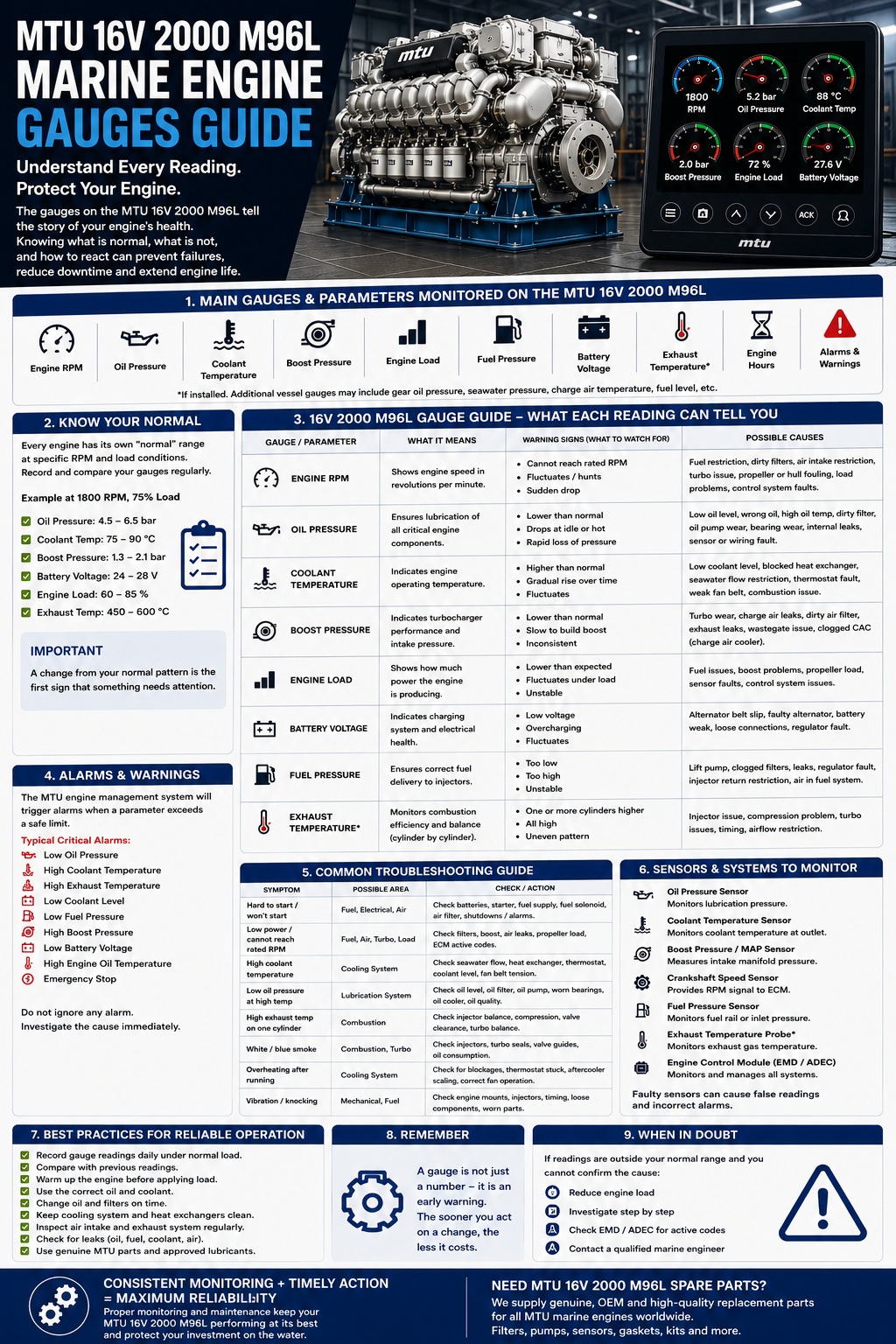
2. What Can Be Monitored on an MTU 16V 2000 M96L?
Depending on the installation and monitoring system, operators may have access to information involving:
- Engine RPM
- Engine oil pressure
- Coolant temperature
- Oil temperature
- Coolant pressure
- Fuel-related parameters
- Charge-air pressure
- Charge-air temperature
- Exhaust temperature information
- Engine load
- Fuel consumption
- Battery/system voltage
- Engine operating hours
- Engine warnings
- Fault messages
Additional vessel instrumentation can monitor:
- Marine gear oil pressure
- Marine gear oil temperature
- Seawater pressure
- Raw-water flow
- Exhaust-system parameters
Not every installation displays every parameter.
3. Know Your Normal MTU Readings
This is one of the most useful habits an engineer can develop.
Do not only memorize alarm limits.
Know what the engine normally shows.
For example, record normal readings at:
Idle
1,000 RPM
1,500 RPM
Normal cruise
High-load operation
Then compare future readings under similar operating conditions.
A reading does not necessarily need to reach an alarm limit before it becomes interesting.
A gradual change from the established baseline can already indicate that something is developing.
4. Engine RPM
Engine speed is one of the simplest parameters, but also one of the most useful.
Monitor RPM during:
- Starting
- Idle
- Gear engagement
- Acceleration
- Cruising
- High-load operation
If the 16V 2000 M96L previously reached its expected loaded RPM but no longer does, investigate why.
5. MTU Cannot Reach Normal Loaded RPM
Possible areas to investigate include:
- Fuel supply
- Air intake
- Turbocharging system
- Charge-air system
- Exhaust system
- Engine controls
- Propeller loading
- Hull fouling
- Marine gear
- Vessel loading
Do not automatically assume the engine needs an overhaul.
A propulsion-load problem can make a healthy engine appear underpowered.
6. High Engine Load + Low Vessel Speed
This combination deserves attention.
Suppose:
Engine load increases
while:
vessel speed decreases.
Before opening the engine, inspect:
- Hull condition
- Propellers
- Running gear
- Vessel loading
- Marine transmission
Marine growth alone can significantly change how hard the engines must work.
7. Engine Oil Pressure
Oil pressure is one of the most important parameters on any high-output marine diesel.
Lubricating oil protects critical components including:
- Crankshaft bearings
- Connecting-rod bearings
- Camshaft and valve-train components
- Turbocharger bearings
- Other lubricated engine components
A genuine loss of lubrication pressure can become serious very quickly.
8. What Can Cause Low Oil Pressure?
Possible causes can include:
- Low oil level
- Incorrect lubricant
- Excessively high oil temperature
- Oil-filter problems
- Oil-pump deterioration
- Internal leakage
- Excessive bearing clearances
- Pressure-sensor problems
- Wiring or monitoring faults
Do not automatically replace the oil pump because the display shows low pressure.
First determine whether the pressure is genuinely low.
9. Sudden Oil Pressure Drop
A sudden reduction deserves immediate attention.
Check:
- Oil level
- Oil leakage
- Oil temperature
- Filter condition
- Engine warnings
- Other lubrication parameters
If actual lubrication pressure has been lost, continued operation may cause extensive engine and turbocharger damage.
10. Oil Pressure and Oil Temperature Belong Together
Hot oil becomes less viscous.
Therefore:
oil pressure
should often be interpreted together with:
oil temperature.
Suppose oil pressure becomes lower while oil temperature becomes higher.
The better question may not be:
“Why is oil pressure dropping?”
It may be:
“Why is the engine oil becoming hotter?”
One parameter can help explain another.
11. Engine Oil Temperature
Increasing oil temperature can be associated with:
- Heavy engine load
- Reduced cooling performance
- Oil-cooler problems
- High engine-room temperature
- Lubrication-system problems
Look at the trend.
A slow increase over several months can be more useful diagnostically than one isolated high reading.
12. Coolant Temperature
Coolant temperature is another critical parameter.
The cooling system must remove enormous amounts of heat from a high-output V16 engine.
Possible causes of increasing temperature can involve:
- Coolant level
- Freshwater circulation
- Heat exchangers
- Thermostatic control
- Seawater supply
- Raw-water pumps
- Sea strainers
- Coolers
- Engine load
The temperature reading identifies the symptom.
It does not identify the failed component.
13. MTU Runs Hot Only at High Load
This is a particularly useful symptom.
At lower output, a partially restricted cooling system may still remove enough heat.
Increase engine load and heat production rises dramatically.
If temperature rises mainly during high-speed operation, investigate areas such as:
- Raw-water intake
- Sea strainer
- Seawater pumps
- Heat exchangers
- Coolers
- Cooling-water circulation
- Engine loading
The system may still be working.
It simply may not have enough capacity anymore.
14. Slowly Increasing Coolant Temperature
Imagine your normal cruising temperature has remained stable for years.
Then you notice:
Month 1: Normal
Month 2: Slightly higher
Month 3: Higher again
Month 4: Higher again
The engine may never have triggered an alarm.
But the trend is telling you something.
Possible causes can include:
- Progressive cooler fouling
- Reduced seawater flow
- Pump deterioration
- Cooling-system deposits
- Increased vessel load
Do not wait for an overheating alarm before investigating.
15. Twin MTU 16V 2000 M96L Engines Are Useful Diagnostic References
Many yacht installations use twin propulsion engines.
That gives the engineer an excellent comparison.
For example:
Port 16V 2000 M96L: stable temperature
Starboard 16V 2000 M96L: consistently hotter
under similar operating conditions.
Now compare:
- Engine load
- Seawater flow
- Cooling-system condition
- Charge-air temperature
- Fuel consumption
- Oil pressure
- Exhaust behavior
The difference itself becomes useful diagnostic information.
16. Charge-Air Pressure
The turbocharging system supplies compressed air to the engine.
If charge-air or boost pressure becomes lower than the established normal value at comparable load, investigate:
- Air-intake restriction
- Turbocharger condition
- Charge-air leakage
- Charge-air cooler condition
- Exhaust-side problems
- Engine load
Do not immediately assume:
“Bad turbocharger.”
The turbocharger is only one part of the air system.
17. Low Boost + Increased Smoke
This combination is especially informative.
If you see:
lower boost
together with:
increasing smoke,
the engine may not be receiving sufficient air for clean combustion.
Possible areas include:
- Intake restriction
- Turbocharger
- Charge-air leakage
- Charge-air cooling
- Exhaust system
Look at the complete airflow path.
18. Charge-Air Temperature
Charge-air temperature is important on a high-output engine.
Hotter intake air is less dense.
That means less oxygen mass is available in the same volume.
Higher-than-normal charge-air temperature may involve:
- Charge-air cooler fouling
- Reduced cooling-water flow
- High seawater temperature
- High engine-room temperature
- Heavy engine loading
Again, compare under similar conditions.
19. Why Charge-Air Cooling Matters
Imagine boost pressure appears reasonably normal, but:
- Charge-air temperature increases
- Exhaust temperatures rise
- Engine performance changes
The problem may involve cooling of the compressed air rather than the turbocharger itself.
This is why replacing parts based on one parameter can lead to unnecessary repairs.
20. Turbocharger Monitoring
The 16V 2000 M96L depends heavily on effective turbocharging.
Changes associated with turbocharger or air-system problems can include:
- Lower boost
- Higher exhaust temperature
- Increased smoke
- Reduced power
- Abnormal turbocharger sound
- Failure to achieve expected performance
Several symptoms appearing together provide stronger evidence than one reading alone.
21. Listen to the Turbochargers Too
Instrumentation is important.
So are your ears.
Pay attention to new:
- Whistling
- Rubbing
- Scraping
- Unusual spool sounds
A new turbocharger noise combined with a change in boost pressure deserves investigation.
22. Fuel-Related Parameters
Depending on the vessel monitoring configuration, fuel-system information can help identify supply problems.
Possible causes of abnormal fuel delivery include:
- Filter restriction
- Fuel contamination
- Supply-line restriction
- Air entering the fuel system
- Pump-related problems
A high-output engine needs a consistent supply of clean fuel.
23. Fuel Problems Often Appear Under Load First
At idle, fuel demand is relatively low.
During high-speed operation, demand increases substantially.
A partially restricted filter may therefore allow the engine to idle perfectly but cause problems at high output.
Symptoms can include:
- Reduced power
- Failure to reach expected RPM
- Unstable operation
- Changed fuel pressure
This is why:
“It runs perfectly at the dock”
does not prove the fuel system is healthy.
24. Fuel Consumption
Where fuel-rate information is displayed, use it as a trend indicator.
Compare:
- Fuel consumption
- RPM
- Engine load
- Vessel speed
- Port engine
- Starboard engine
Suppose the engine consumes more fuel than last season while the yacht travels slower.
Do not immediately blame the injectors.
Investigate:
- Hull fouling
- Propeller condition
- Vessel loading
- Engine performance
25. Port vs. Starboard Fuel Consumption
Twin-engine installations provide another useful comparison.
If:
Port engine: 200 L/h
Starboard engine: 230 L/h
under apparently comparable operating conditions, do not automatically conclude the starboard engine has a fuel-system problem.
First verify:
- Actual engine load
- RPM
- Propeller condition
- Gear ratio/configuration
- Instrument accuracy
- Vessel operating conditions
Comparison is useful only when the operating conditions are truly comparable.
26. Exhaust Temperature
Where exhaust-temperature information is available, it can provide useful insight into combustion.
Watch for:
- Overall temperature increase
- Bank-to-bank differences
- Abnormal trends
A significant change deserves investigation.
27. One Bank Runs Hotter
Because the 16V 2000 M96L is a V16 engine, bank-to-bank comparison can be useful where suitable instrumentation provides the information.
A persistent difference may lead you to investigate:
- Fuel delivery
- Air distribution
- Exhaust system
- Turbocharging
- Sensors
- Engine load distribution
Do not diagnose the cause from temperature alone.
Use the reading to determine where further testing is needed.
28. All Exhaust Temperatures Rise
If temperatures rise across the engine rather than in one localized area, consider system-wide causes.
These can include:
- Increased engine load
- Air restriction
- Turbocharging deterioration
- Charge-air cooling problems
- Exhaust restriction
Patterns matter.
29. Electrical System Voltage
Modern electronically managed marine engines depend heavily on reliable electrical power.
Monitor:
- System voltage
- Battery condition
- Charging behavior
Low or unstable voltage can involve:
- Batteries
- Alternator
- Connections
- Grounds
- Wiring
Electrical problems can sometimes produce symptoms that appear to be control-system or sensor problems.
30. Engine Hours
Engine operating hours should always be recorded accurately.
Hours are important for planning:
- Oil service
- Filter replacement
- Cooling-system maintenance
- Valve-related inspection
- Turbocharger inspection
- Major scheduled maintenance
Without accurate operating hours, preventive maintenance becomes guesswork.
31. Engine Load
Engine-load information can be extremely valuable.
For example:
High temperature + normal load
may point more strongly toward cooling-system deterioration.
But:
High temperature + abnormally high load
may indicate that the vessel is forcing the engine to work harder.
The same temperature symptom can therefore have completely different causes.
32. Why Vessel Load Matters
An engine does not operate independently from the vessel.
The 16V 2000 M96L is connected to:
- Marine gear
- Shaft
- Propeller
- Hull
Problems anywhere in this system can change engine readings.
33. Hull Fouling
Marine growth increases resistance through the water.
That can result in:
- Increased engine load
- Increased fuel consumption
- Higher exhaust temperatures
- Higher coolant temperatures
- Reduced vessel speed
The engine may be completely healthy.
It is simply working harder.
34. Propeller Fouling
A fouled propeller can produce similar symptoms:
- Reduced loaded RPM
- Increased engine load
- Increased fuel consumption
- Reduced speed
- Higher temperatures
Before diagnosing an expensive engine problem, consider the entire propulsion system.
35. Marine Gear Pressure
The transmission has its own operating parameters.
Where monitored, watch:
- Gear oil pressure
- Gear oil temperature
- Gear alarms
An apparent propulsion problem can originate in the gearbox rather than the MTU engine.
36. Marine Gear Temperature
Increasing gearbox temperature can involve:
- Oil level
- Oil condition
- Cooling
- Excessive load
- Internal transmission problems
If engine and gearbox temperatures rise together, look for common factors.
Cooling-water supply may be one depending on the vessel installation.
37. Seawater Pressure or Flow
Some vessel installations provide raw-water monitoring.
This can be particularly useful.
A reduction can indicate:
- Blocked sea strainer
- Intake obstruction
- Pump deterioration
- Hose restriction
- Cooler restriction
Detecting reduced seawater flow before engine temperature rises significantly can prevent an overheating event.
38. Warning Messages
Electronic engine monitoring can provide warnings before conditions become severe.
Do not simply acknowledge the warning and continue operating without understanding why it occurred.
Record:
- Warning message
- Engine RPM
- Engine load
- Temperature
- Pressure
- Time
- Sea conditions
Context makes later troubleshooting much easier.
39. Warning vs. Engine Protection
Depending on the exact control configuration, abnormal conditions may trigger different levels of response.
These can include:
- Warning
- Alarm
- Power limitation
- Engine-protection action
Engine protection exists for a reason.
Repeatedly operating through warnings without correcting the underlying condition can turn a manageable problem into expensive damage.
40. Never Assume "It's Just a Sensor"
Sometimes it is.
But verify.
If the system reports:
low oil pressure
confirm actual pressure.
If it reports:
high coolant temperature
confirm actual temperature.
If it reports:
abnormal charge-air pressure
inspect the air system.
The sensor may be wrong.
The engine may also be telling the truth.
41. Sensor and Wiring Problems
Incorrect readings can originate from:
- Failed sensor
- Damaged wiring
- Corroded connector
- Loose connection
- Grounding problem
- Monitoring-system fault
Marine engine rooms expose electrical components to:
- Heat
- Vibration
- Moisture
- Salt
Electrical inspection is therefore an important part of gauge troubleshooting.
42. Gauge Problems Immediately After Maintenance
Timing matters.
Suppose an abnormal temperature reading begins immediately after cooling-system work.
Check:
- What was disconnected
- Coolant filling
- Air in the system
- Connectors
- Sensors
- Cooling-water valves
If a problem appears immediately after maintenance, inspect the work that was just performed before assuming an unrelated component suddenly failed.
43. Abnormal Readings After Turbocharger Work
If boost or exhaust readings change immediately after turbocharger work, inspect:
- Air connections
- Charge-air piping
- Clamps
- Exhaust connections
- Sensors
- Turbocharger installation
A small charge-air leak can have a significant effect under high load.
44. Abnormal Readings After Fuel-System Work
If engine performance changes after fuel-system maintenance, inspect:
- Fuel connections
- Filters
- Air in the fuel system
- Electrical connections
- Components that were disturbed
Again:
what changed immediately before the symptom appeared?
That question can save hours of troubleshooting.
45. Use Several Parameters Together
This is one of the best ways to interpret an MTU engine.
Situation 1
High coolant temperature + normal engine load
Investigate cooling performance.
Situation 2
High coolant temperature + high engine load
Investigate both cooling and vessel loading.
Situation 3
Low boost + increased smoke
Investigate turbocharging and charge-air systems.
Situation 4
Higher oil temperature + lower oil pressure
Investigate why lubrication temperature has increased.
Situation 5
Higher fuel consumption + lower vessel speed + increased engine load
Inspect hull, propeller and drivetrain condition.
The engine tells a story through combinations of parameters.
46. Keep an MTU 16V 2000 M96L Operating Log
A practical log can include:
| ParameterPort EngineStarboard EngineNotes | |||
| Engine Hours | ___ | ___ | |
| Engine RPM | ___ | ___ | |
| Engine Load | ___ | ___ | |
| Oil Pressure | ___ | ___ | |
| Oil Temperature | ___ | ___ | |
| Coolant Temperature | ___ | ___ | |
| Charge-Air Pressure | ___ | ___ | |
| Charge-Air Temperature | ___ | ___ | |
| Fuel Consumption | ___ | ___ | |
| Exhaust Temperature | ___ | ___ | Where monitored |
| System Voltage | ___ | ___ | |
| Gear Pressure | ___ | ___ | |
| Gear Temperature | ___ | ___ | |
| Warnings | ___ | ___ |
Record readings under similar operating conditions whenever possible.
47. Why Trends Are So Valuable
Suppose you have no historical records.
The engineer says:
“The starboard engine seems hotter.”
Now compare that with having six months of data showing:
Month 1: Normal
Month 2: +1°C
Month 3: +2°C
Month 4: +3°C
Month 5: +4°C
Now you know something is progressively changing.
The same principle applies to:
- Oil pressure
- Oil temperature
- Charge-air temperature
- Boost pressure
- Fuel consumption
- Engine load
48. Do Not Compare Different Operating Conditions
A reading taken at idle cannot fairly be compared with one taken at full load.
For useful trend analysis, compare data at similar:
- Engine RPM
- Engine load
- Oil temperature
- Vessel speed
- Operating conditions
Otherwise the difference may simply reflect normal operation.
49. Common MTU Gauge and Monitoring-Related Components
Depending on the exact engine and installation, troubleshooting may involve components such as:
- Pressure sensors
- Temperature sensors
- Speed sensors
- Wiring harnesses
- Electrical connectors
- Monitoring modules
- Engine control components
- Alarm-system components
- Instrumentation
Correct identification is essential.
50. A Gauge Reading Can Lead to a Mechanical Repair
The monitoring system may identify the symptom, while the actual problem involves:
- Oil pump
- Coolant pump
- Seawater pump
- Heat exchanger
- Charge-air cooler
- Thermostatic components
- Turbocharger
- Fuel-system components
- Oil cooler
- Injector
- Exhaust component
For example:
high coolant temperature
does not mean:
replace temperature sensor.
It may mean the sensor is correctly reporting a cooling-system problem.
51. Information Needed When Ordering MTU 16V 2000 M96L Parts
Instead of sending:
“Need MTU pressure sensor.”
provide:
Manufacturer: MTU
Engine Model: 16V 2000 M96L
Engine Serial Number: __________
Rated Power: __________
Rated RPM: __________
Existing Part Number: __________
Part Required: __________
Displayed Fault/Warning: __________
Quantity: __________
Photographs: Attached
Delivery Location: __________
The engine serial number and existing component number are particularly valuable for correct identification.
52. Frequently Asked Questions
What Are the Most Important Gauges on an MTU 16V 2000 M96L?
Important monitored parameters can include engine RPM, oil pressure, oil temperature, coolant temperature, engine load, charge-air information, fuel-related data and system voltage. Exact information depends on the vessel's monitoring configuration.
Why Is My MTU Oil Pressure Lower When Hot?
Oil viscosity decreases as temperature increases. However, a significant change from established normal pressure should be investigated.
Why Does My 16V 2000 M96L Run Hot Only at High Speed?
Possible causes include reduced seawater flow, cooler fouling, cooling-system deterioration or increased engine load.
Why Is Boost Pressure Lower Than Before?
Possible causes include air restriction, charge-air leakage, turbocharger deterioration, cooler problems or changes in engine load.
Can a Dirty Charge-Air Cooler Affect Performance?
Yes. Reduced charge-air cooling can contribute to higher intake temperatures and changes in combustion and engine performance.
Can Hull Fouling Affect MTU Engine Readings?
Yes. Hull and propeller fouling can increase engine load and fuel consumption while reducing vessel speed.
Should Twin MTU Engines Have Exactly the Same Readings?
Not necessarily. However, significant differences under comparable operating conditions deserve investigation.
Can a Sensor Cause a False Alarm?
Yes. Sensors, wiring and connectors can fail. Always verify the actual mechanical condition before assuming the warning is false.
Can Low Voltage Affect Engine Monitoring?
Electrical supply problems can affect electronic systems and instrumentation, so charging voltage and electrical connections should be checked.
Should I Record Gauge Readings?
Yes. Historical operating data can make gradual deterioration much easier to identify.
MTU 16V 2000 M96L Gauge & Engine Spare Parts
Parts associated with monitoring and related engine systems can include:
- Oil-pressure sensors
- Temperature sensors
- Pressure sensors
- Engine speed sensors
- Wiring harnesses
- Electrical connectors
- Engine control components
- Alarm components
- Oil pumps
- Coolant pumps
- Seawater pumps
- Heat exchangers
- Charge-air coolers
- Oil coolers
- Turbochargers
- Fuel-system components
- Injectors
- Gaskets
- Seals
- Filters
- Overhaul components
Correct parts identification should always be based on the MTU 16V 2000 M96L engine serial number and existing component part number.
Browse Our Complete Catalog
Marine engine brands:
https://alfamarinespareparts.com/our-brand
Marine spare parts:
https://alfamarinespareparts.com/spareparts
Contact Alfa Marine Spare Parts
For MTU 16V 2000 M96L marine engine gauges, sensors, turbocharger, cooling, fuel-system and engine spare parts:
Email: request@alfamarinespareparts.com
For faster identification, provide:
MTU 16V 2000 M96L serial number + existing part number + required component + quantity + photographs + delivery location.
Final Word
The monitoring system on an MTU 16V 2000 M96L marine engine should not be treated simply as something that produces an alarm after a problem becomes serious.
Its real value is showing change.
Oil pressure is slightly lower than last season.
Coolant temperature is slowly increasing.
Charge-air temperature is higher.
Boost pressure is falling.
Fuel consumption has increased.
The starboard engine is working harder than the port engine.
Each change gives you another piece of information.
The useful approach is:
know the normal readings → record them → compare them → investigate meaningful changes.
A slightly higher coolant temperature may be the beginning of cooler fouling.
Lower boost may come from a charge-air leak rather than a failed turbocharger.
Higher fuel consumption may come from a fouled hull rather than damaged injectors.
And lower oil pressure may be connected to increasing oil temperature rather than immediately proving that the oil pump has failed.
The gauges do not replace mechanical inspection.
They tell you where to start looking.
And on a high-performance engine such as the MTU 16V 2000 M96L, identifying a developing problem early can make the difference between planned maintenance and an expensive unscheduled repair.