
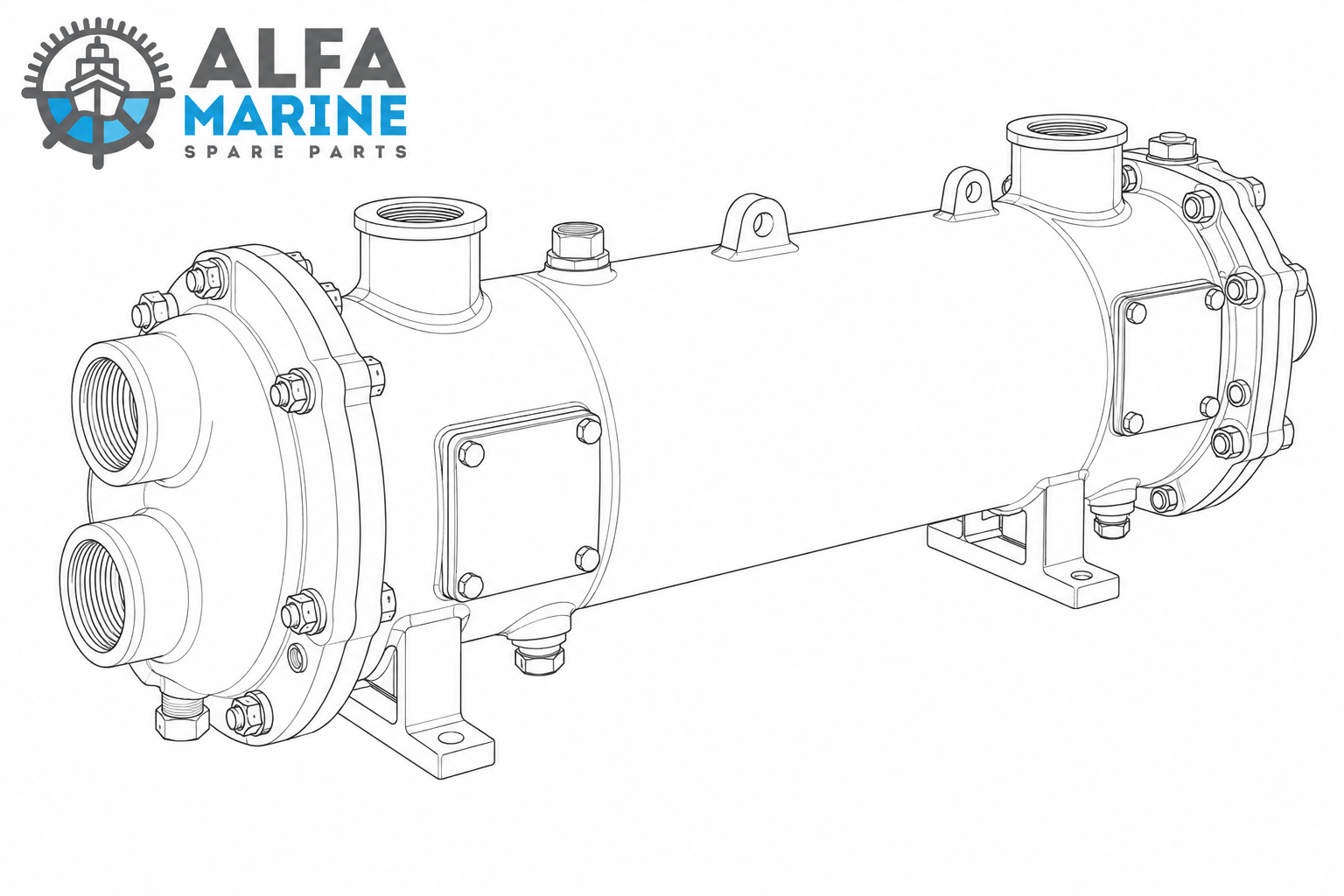
Doosan L136TI Marine Engine Heat Exchanger Replacement: Repair, Clean or Replace?
Your Doosan L136TI marine engine is starting to run hotter than normal.
At low load, everything may look fine.
But when the vessel gets underway and the engine is working harder, the coolant temperature begins climbing.
Maybe you've already checked the seawater strainer.
Maybe the seawater pump appears to be working.
Or perhaps you've removed the end cover from the heat exchanger and found corrosion, scale or blocked tubes.
So the question becomes:
“Do I need to replace the Doosan L136TI heat exchanger?”
Not necessarily.
Before replacing the complete exchanger, it makes sense to understand why the engine is overheating and what condition the existing heat exchanger is actually in.
In this guide, we'll look at Doosan L136TI heat exchanger replacement, cleaning, cooling problems, seawater flow, corrosion and correct parts identification.
For additional engine components, visit our Doosan L136TI Marine Engine Parts page.
What Does the Heat Exchanger Do on a Doosan L136TI?
The heat exchanger is one of the most important components in the marine cooling system.
The engine has a closed freshwater/coolant circuit.
The marine installation also uses seawater to remove heat.
Inside the heat exchanger, heat from the engine coolant is transferred to the seawater without the two fluids normally mixing.
In simple terms:
Hot engine coolant → heat exchanger → heat transferred to seawater → cooled engine coolant returns to the engine
When the heat exchanger loses efficiency, the engine can begin running hotter.
This may happen gradually.
That's why a heat exchanger doesn't have to fail completely before it starts causing problems.
Is the Doosan L136TI Heat Exchanger Different From the L136?
Potentially, yes.
The Doosan L136 family includes several configurations such as:
These engines belong to the same family, but they shouldn't automatically be treated as identical when sourcing cooling-system components.
The L136TI is a turbocharged and intercooled configuration, and its cooling arrangement includes components associated with the heat exchanger and intercooler system.
So don't order a replacement heat exchanger simply because an advertisement says:
“Fits Doosan L136.”
Start with:
Complete engine model + engine serial number + existing heat exchanger information
If possible, also send clear photographs of the complete exchanger.
How Do I Know If My Doosan L136TI Heat Exchanger Has a Problem?
One of the most common complaints is:
“The engine runs normally at idle but gets hot under load.”
That can be consistent with reduced cooling capacity.
At low engine load, the cooling system may still be capable of controlling temperature.
As engine load increases, more heat has to be removed.
If seawater flow through the exchanger is restricted, engine temperature can then begin rising.
Other signs worth investigating include:
- Higher-than-normal coolant temperature
- Overheating under load
- Reduced seawater flow
- Visible corrosion
- Salt deposits
- Blocked exchanger tubes
- Coolant leakage
- Seawater leakage
- Damaged end covers
- Repeated cooling-system problems
But none of these automatically prove that the complete heat exchanger needs replacing.
Diagnosis comes first.
Does Doosan Recommend Cleaning the L136TI Heat Exchanger?
Yes.
Doosan's service information specifically discusses heat-exchanger and water-cooling-line cleaning.
The manual explains that if the heat-exchanger tubes become clogged by debris or affected by corrosion, the volume of seawater supplied through the exchanger can gradually decrease.
The result can be:
Reduced cooling efficiency → increasing engine temperature → overheating
The service procedure includes removing the heat-exchanger side covers and cleaning the tubes.
This is important because sometimes the correct repair isn't:
Replace the entire heat exchanger.
It may simply be:
Remove → inspect → clean → pressure/check → reinstall
provided the exchanger remains structurally serviceable.
My Doosan L136TI Is Overheating. Is the Heat Exchanger Definitely Bad?
No.
This is one of the most important things to understand.
Overheating is a symptom.
The heat exchanger is only one possible cause.
Before ordering an expensive replacement exchanger, inspect the complete cooling circuit.
Depending on the installation, that can include:
- Seacock
- Seawater intake
- Sea strainer
- Seawater pump
- Pump impeller
- Seawater hoses
- Heat exchanger
- Intercooler
- Thermostats
- Freshwater pump
- Engine coolant
- Cooling pipes
- Exhaust cooling arrangement
Imagine replacing the complete heat exchanger only to discover that the real problem was a damaged seawater-pump impeller.
That's an expensive way to diagnose an engine.
What Happens When Heat Exchanger Tubes Become Blocked?
The exchanger contains multiple small passages through which cooling water flows.
Over time, these passages can become restricted by material such as:
- Salt deposits
- Scale
- Sediment
- Marine growth
- Corrosion products
- Pieces of damaged pump impeller
- Other debris entering the seawater circuit
The restriction doesn't necessarily block every tube.
That's why the problem can develop gradually.
For example:
Clean exchanger: sufficient cooling at idle and full load.
Partially restricted exchanger: sufficient cooling at idle but marginal cooling under heavy load.
Severely restricted exchanger: overheating even at moderate load.
This is why an engine that only overheats when pushed harder deserves a careful cooling-system inspection.
I Found Rubber Pieces Inside the Heat Exchanger. Where Did They Come From?
A damaged seawater-pump impeller is one possibility.
Flexible impeller blades can break apart.
The missing pieces then travel downstream with the seawater.
Some of those pieces can become trapped inside coolers or heat-exchanger passages.
So if you remove the seawater-pump cover and discover that several impeller blades are missing, don't just install another impeller.
Ask:
Where are the missing pieces?
Inspect the downstream cooling circuit as appropriate.
Otherwise, the new impeller may be working correctly while the engine still overheats because the old rubber fragments are restricting seawater flow.
Can I Clean the Doosan L136TI Heat Exchanger Instead of Replacing It?
Potentially, yes.
If the exchanger is structurally sound and the main problem is internal fouling, cleaning may restore cooling performance.
Doosan's service information specifically describes removing the exchanger covers and cleaning clogged exchanger tubes.
But cleaning isn't always the answer.
Suppose you dismantle the exchanger and find:
- Heavy internal corrosion
- Damaged tube surfaces
- Cracked housing
- Serious erosion
- Leakage between circuits
- Damaged sealing surfaces
- Previous poor-quality repairs
At that point, replacement or professional reconditioning may make more sense.
The condition of the component should determine the repair.
When Should I Replace the Complete Heat Exchanger?
Complete replacement becomes more reasonable when the existing exchanger is no longer reliably serviceable.
Examples can include:
Severe corrosion
If the housing or internal cooling surfaces have deteriorated significantly, cleaning doesn't restore the lost material.
Damaged exchanger core
A damaged core may allow leakage or inadequate heat transfer.
Repeated leakage
If the exchanger has already been repaired multiple times and continues leaking, replacement may be more practical.
Cracked housing or cover
Structural damage deserves careful evaluation.
Internal leakage between coolant and seawater
This can indicate a more serious exchanger failure.
Extensive erosion
Years of seawater exposure can gradually damage cooling components.
The key question isn't:
“Can somebody repair it?”
The better question is:
“Will the repaired exchanger be reliable in marine service?”
Can a Heat Exchanger Cause Coolant Loss?
Potentially.
If the exchanger develops an internal leak, coolant can be lost from the closed engine-cooling circuit.
But coolant loss can also come from many other places.
Before blaming the exchanger, inspect:
- Hoses
- Clamps
- Water pump
- Thermostat housing
- Expansion tank
- Cooling pipes
- Gaskets
- Engine components
- Heat exchanger
A pressure test can be useful when the source isn't visually obvious.
Can Seawater Enter the Engine Coolant?
Under normal operation, the seawater and freshwater/coolant circuits remain separated.
If an internal heat-exchanger failure occurs, cross-contamination may become possible.
Signs requiring investigation can include:
- Unexplained coolant-level changes
- Abnormal coolant appearance
- Repeated coolant loss
- Unexpected pressure behaviour
- Corrosion or contamination in the cooling circuit
Don't continue operating the engine indefinitely if you suspect the two cooling circuits are communicating.
Identify the cause.
Should I Pressure-Test the Heat Exchanger?
When leakage is suspected, pressure testing can be very useful.
A professional cooling-system or heat-exchanger workshop can often test the exchanger for leakage after removal.
This can help answer an important question:
Is the exchanger actually leaking, or is the cooling problem somewhere else?
That's particularly valuable before purchasing a complete replacement.
How Is the Doosan L136TI Heat Exchanger Removed?
The Doosan service manual provides a specific removal procedure.
In general, the procedure involves disconnecting the relevant hoses and intercooler/cooling connections before removing the exchanger fixing bolts.
The manual also makes an important point:
The intercooler is associated with the heat-exchanger installation on the L136TI.
This means removal shouldn't be treated as simply undoing two hoses and lifting out a small standalone cooler.
Before removal:
- Allow the engine to cool
- Isolate the seawater supply
- Drain coolant as required
- Identify all hose positions
- Mark connections if necessary
- Inspect clamps and hoses
- Prepare for residual coolant and seawater
- Support components correctly
If you're unfamiliar with the system, use the applicable service manual or an experienced marine diesel technician.
What Should I Inspect Once the Heat Exchanger Is Removed?
Don't immediately throw the old exchanger away.
It can tell you a lot about what's happening inside the cooling system.
Inspect:
Heat Exchanger Tubes
Look for blockage, deposits, corrosion and damage.
End Covers
Inspect for corrosion, erosion and damaged sealing surfaces.
Housing
Check for cracking, corrosion and previous repairs.
Gaskets and Seals
Look for hardened, damaged or incorrectly installed sealing components.
Hose Connections
Inspect the hose necks and connection points.
Seawater Deposits
Heavy salt or mineral deposits may indicate long-term cooling-system issues.
Foreign Material
Look for impeller fragments or other debris.
Coolant Side
Inspect for scale, sludge or contamination where accessible.
The old component can help identify why the failure occurred.
Should I Replace the Gaskets When Installing the Heat Exchanger?
If the exchanger has been dismantled, sealing components deserve attention.
Reusing old compressed, hardened or damaged gaskets can create a new leak immediately after the repair.
When sourcing a replacement exchanger or rebuilding the existing one, identify the required:
- Gaskets
- O-rings
- Seals
- Hose clamps
- Hoses
- Mounting hardware where required
A successful repair isn't just about the large heat exchanger itself.
Small sealing components matter too.
Should I Replace the Hoses at the Same Time?
Not automatically.
Inspect them.
Look for:
- Cracking
- Hardening
- Swelling
- Soft spots
- Surface damage
- Internal deterioration
- Damaged hose ends
- Corroded clamps
If an old hose is already deteriorated and you've removed it during a major cooling-system repair, replacing it may make sense.
But there is no reason to replace a healthy hose simply because the exchanger is being serviced.
Should I Check the Seawater Pump Before Installing a New Heat Exchanger?
Absolutely.
A new heat exchanger won't solve a seawater-supply problem.
Before putting the engine back into service, verify that the seawater side can actually supply sufficient cooling water.
Inspect the applicable:
- Seawater pump
- Impeller
- Pump cover
- Pump shaft
- Seals
- Intake hose
- Seacock
- Sea strainer
If the old exchanger became blocked with broken impeller pieces, finding and correcting the original impeller problem is particularly important.
Should I Check the Thermostats?
Yes.
The Doosan L136TI cooling system also uses thermostatic control.
A thermostat problem can contribute to abnormal engine temperature.
If the engine is overheating, don't assume the heat exchanger is responsible until the rest of the cooling system has been evaluated.
A sensible diagnosis might look like:
Check seawater intake → check seawater pump → inspect heat exchanger → check coolant circulation → check thermostats → verify engine temperature
rather than immediately replacing the most expensive cooling component.
Doosan L136 vs L136T vs L136TI Heat Exchanger
This distinction matters when ordering parts.
The engine family includes:
Doosan L136T
Doosan L136TI
and other related configurations.
Doosan's parts catalogue covers multiple heat-exchanger arrangements within this engine family.
That doesn't mean every exchanger and every internal component is interchangeable.
Always provide the complete model.
For example:
L136TI
is much more useful than:
L136
And even better:
L136TI + engine serial number + existing exchanger number + photographs
For additional parts information, visit:
Doosan L136 Marine Engine Parts
Doosan L136T Marine Engine Parts
Doosan L136TI Marine Engine Parts
Can I Use an Aftermarket Doosan L136TI Heat Exchanger?
Potentially, provided the replacement is correctly specified for the engine and installation.
Depending on availability, heat-exchanger requirements may be supplied as:
- Genuine components
- OEM-quality components
- Aftermarket replacements
- Reconditioned components
What matters is correct compatibility.
Check dimensions, connections, mounting points, cooling capacity and application before installation.
A heat exchanger that physically looks similar isn't automatically the correct replacement.
Can My Existing Doosan Heat Exchanger Be Reconditioned?
Depending on its condition, yes.
Marine heat exchangers can sometimes be:
- Cleaned
- Descaled
- Pressure tested
- Repaired
- Reconditioned
But reconditioning only makes sense if the underlying component remains suitable for reliable service.
A badly corroded exchanger shouldn't automatically be repaired simply because repairing it is technically possible.
Doosan L136TI Heat Exchanger Replacement Checklist
Before ordering a replacement:
1. Confirm the complete engine model
Make sure the engine is actually an L136TI.
2. Record the engine serial number
Don't rely only on the model family.
3. Find the existing heat-exchanger number
Check for plates, markings, casting numbers or identification.
4. Take photographs
Photograph the complete exchanger and all connections.
5. Diagnose the cooling problem
Confirm why you believe the exchanger needs replacing.
6. Inspect the seawater system
Check the intake, strainer, pump and impeller.
7. Inspect the exchanger
Look for blockage, corrosion, leakage and physical damage.
8. Consider cleaning or pressure testing
The exchanger may still be serviceable.
9. Identify required seals and gaskets
Don't overlook small components.
10. Verify the replacement before installation
Compare connections, mounting and configuration with the removed unit.
Doosan L136TI Heat Exchanger FAQs
Can a blocked Doosan L136TI heat exchanger cause overheating?
Yes.
Restricted exchanger tubes can reduce seawater flow and cooling capacity, potentially causing the engine temperature to rise.
Why does my L136TI only overheat at high rpm?
A partially restricted cooling system may still remove enough heat at low engine load but become inadequate as engine output and heat generation increase.
The heat exchanger is one possible cause, but the seawater pump, intake, strainer, thermostats and other cooling components should also be checked.
Can the L136TI heat exchanger be cleaned?
Yes, depending on its condition.
Doosan's service information specifically describes removing the heat-exchanger covers and cleaning clogged exchanger tubes.
If the exchanger is badly corroded or damaged, cleaning alone may not be sufficient.
How often should the Doosan L136TI cooling system be cleaned?
The Doosan service information specifies a 1,200-hour cooling-system cleaning interval.
Actual inspection requirements can also depend on operating conditions, seawater quality, vessel use and previous maintenance.
Should I replace the heat exchanger if the tubes are blocked?
Not automatically.
If the exchanger is structurally sound, professional cleaning may restore performance.
Replacement becomes more appropriate when there is significant corrosion, leakage, structural damage or a core that is no longer reliably serviceable.
Can a broken seawater-pump impeller block the heat exchanger?
Yes.
Fragments from a damaged flexible impeller can travel downstream and become trapped in cooling passages.
If blades are missing from an old impeller, inspect downstream components rather than assuming the pieces have disappeared.
Does the Doosan L136TI use the same heat exchanger as the L136?
Don't assume so.
The L136, L136T and L136TI are different engine configurations.
Use the complete engine designation, serial number and existing heat-exchanger information when identifying a replacement.
What information do I need to order a Doosan L136TI heat exchanger?
Send:
Engine model: Doosan L136TI
Engine serial number:
Existing heat-exchanger part number:
Casting or identification number:
Required quantity:
Photographs:
Delivery country or port:
Clear photographs of the exchanger from several angles are particularly useful if the identification number is difficult to read.
Related Doosan Marine Engine Pages
For additional engine components, visit:
Doosan L136 Marine Engine Parts
Doosan L136T Marine Engine Parts
Doosan L136TI Marine Engine Parts
For other engine families, browse our Doosan Marine Engine Parts catalogue.
Need a Doosan L136TI Heat Exchanger?
Looking for a Doosan L136TI marine engine heat exchanger, heat-exchanger core, end cover, gasket, seal or related cooling-system component?
Send us your:
Complete engine model
Engine serial number
Existing heat-exchanger number
Casting or identification numbers
Required quantity
Clear photographs
Delivery country or port
If the original number is no longer readable, photographs of the complete exchanger, hose connections and mounting arrangement can help with identification.