
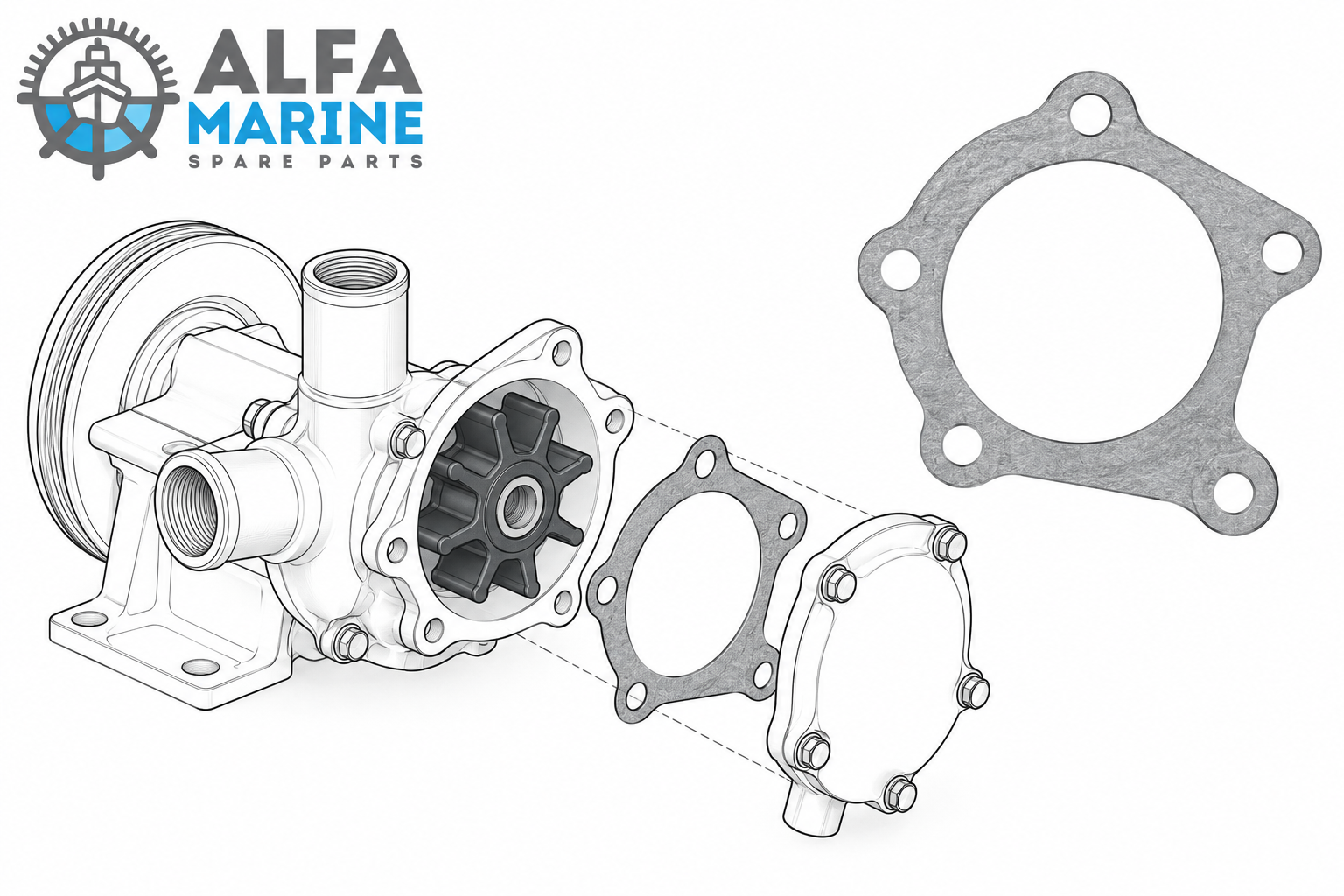
Doosan L066TI Raw Water Pump Gasket 65.06901A0033: Leak Checks & Parts Identification
A seawater leak has appeared around the Doosan L066TI raw-water pump. Do you need a new pump, an internal seal, or simply the pump mounting gasket?
One important Doosan reference to know is:
65.06901A0033 — Gasket; Sea Water Pump
But the location of the leak matters.
If seawater is escaping from the joint between the pump and its mounting surface, the gasket is an important component to inspect. If the water is coming from the pump shaft or internally from the pump, replacing the mounting gasket may not solve the problem.
This guide explains how to identify the Doosan L066TI seawater-pump gasket, distinguish a gasket leak from a pump problem, inspect the installation and provide the correct information when sourcing replacement parts.
Doosan L066TI Marine Engine Parts
What Is the Doosan L066TI Raw-Water Pump Gasket Part Number?
An important documented reference is:
65.06901A0033 — Gasket; Sea Water Pump
This reference identifies a sea water pump gasket.
It is important not to confuse the gasket with an internal mechanical pump seal. They perform different functions and address different leakage points.
Before ordering, confirm the exact L066TI engine and installed pump whenever possible.
For parts identification, provide:
- Complete engine model
- Engine serial number
- Existing gasket part number
- Existing pump identification
- Required quantity
- Clear photographs
Raw-Water Pump or Freshwater Pump?
Before ordering a gasket, make sure the correct pump has been identified.
The raw-water or seawater pump circulates seawater through the applicable marine cooling circuit.
The freshwater/coolant pump circulates engine coolant through the closed engine-cooling circuit.
They are not the same component.
Therefore, a request such as:
“Need Doosan L066TI water pump gasket.”
may not provide enough information.
For the component discussed in this article, the relevant documented reference is:
65.06901A0033 — Gasket; Sea Water Pump
Is 65.06901A0033 a Mechanical Pump Seal?
No.
This distinction is particularly important when troubleshooting a seawater leak.
65.06901A0033 is a gasket reference.
A mechanical seal is an internal pump component associated with sealing around rotating parts of the pump.
So before ordering 65.06901A0033, determine where the water is actually appearing.
Leak from the pump mounting joint
If seawater is appearing between the pump and the surface where it is mounted, inspect the gasket and mating surfaces.
Leak from the shaft area
If water is appearing around the pump shaft or another internal section of the pump, investigate the pump itself.
Installing a new mounting gasket will not repair an internal pump defect.
How Can You Tell If the Raw-Water Pump Gasket Is Leaking?
Start by cleaning the pump and surrounding area.
Old salt deposits and accumulated moisture can make the source of a small leak difficult to identify.
Once the area is clean, inspect the pump while looking specifically at:
- Pump-to-engine mounting joint
- Shaft area
- Pump housing
- Hose connections
- Clamps
- Fittings
- Nearby cooling-system connections
If the pump housing and hoses remain dry but seawater appears directly along the mounting joint, the gasket becomes a logical component to inspect.
If water originates somewhere else, replacing the mounting gasket may be unnecessary.
What Causes a Doosan L066TI Pump Gasket to Leak?
A gasket leak does not necessarily mean the gasket itself is the only problem.
Possible causes around the mounting joint can include:
- Hardened gasket
- Compressed gasket
- Torn or damaged gasket
- Corrosion on the mating surface
- Old gasket material remaining on the surface
- Scratched sealing surface
- Uneven mating surface
- Damaged pump housing
- Incorrect installation
- Problems with mounting hardware
This is why simply removing the old gasket and installing another one is not always enough.
The sealing surfaces should also be inspected.
What Should You Inspect After Removing the Pump?
Once the raw-water pump has been removed, inspect the complete mounting area before reassembly.
1. Existing gasket
Check whether it is:
- Torn
- Hardened
- Crushed
- Split
- Stuck to the surface
- Missing sections
2. Pump mounting surface
Look for:
- Corrosion
- Pitting
- Scratches
- Old gasket material
- Previous sealant
- Physical damage
3. Engine-side mating surface
The opposite sealing surface also needs to be clean and undamaged.
4. Pump housing
Inspect the housing for corrosion, cracks or other visible deterioration.
5. Pump shaft
Check for obvious abnormal movement or signs of leakage from the shaft area.
The objective is not simply to replace a gasket. It is to make sure the new gasket has suitable surfaces to seal against.
Should You Reuse the Old 65.06901A0033 Gasket?
If the gasket has been compressed, damaged, hardened or disturbed during removal, reusing it is generally not advisable.
A gasket can appear reasonably intact while no longer providing the same sealing condition after the pump has been removed.
Consider the practical consequence.
The pump is removed, inspected and reinstalled. The cooling system is restored and the engine is started.
Then a small leak appears from the mounting joint because the old gasket was reused.
The pump has to come off again.
For this reason, the condition of the gasket should be considered during any pump removal and reinstallation.
How Should the Gasket Surfaces Be Prepared?
Surface preparation is important.
Carefully remove:
- Old gasket material
- Dirt
- Oil
- Loose corrosion
- Deposits
- Previous sealing material
Do not aggressively damage the metal while cleaning.
A deep scratch or gouge across a sealing surface can itself become a leakage path.
Before installation, the mating surfaces should be clean, suitable for sealing and free from old gasket material.
Follow the applicable service procedure for installation of the pump and gasket.
Should Sealant Be Used With the Gasket?
Do not assume that applying more sealant creates a better repair.
Use the applicable installation procedure for the specific pump and gasket arrangement.
Excessive sealant can potentially interfere with proper seating and can make future disassembly more difficult.
If a sealing compound is specified for the installation, use the appropriate type and amount according to the applicable service instructions.
What If Water Is Leaking From the Pump Shaft?
This is where buying only 65.06901A0033 could result in ordering the wrong repair component.
If leakage is clearly originating from the shaft area rather than the mounting joint, inspect the pump for possible internal problems.
Areas requiring investigation can include:
- Internal sealing components
- Shaft condition
- Bearings
- Corrosion
- Pump housing
- Excessive shaft movement
- Internal wear
A mounting gasket cannot correct mechanical wear inside the pump.
If the pump has significant shaft play, internal leakage or substantial corrosion, further pump repair or replacement may be required.
Should You Inspect the Pump While It Is Removed?
Yes.
Removing a marine raw-water pump takes time, so it makes sense to inspect the component while access is available.
Look for:
- Corrosion
- Housing damage
- Shaft movement
- Evidence of leakage
- Worn mounting surfaces
- Damaged connections
- Previous repairs
- General deterioration
The gasket may be the only component that needs replacing.
But discovering a worn pump before reinstalling it can prevent repeating the same work later.
What If the Pump Mounting Surface Is Corroded?
This deserves particular attention on seawater-system components.
Corrosion or pitting around the gasket seating area can prevent a new gasket from sealing correctly.
Minor surface corrosion does not automatically mean the entire pump must be replaced.
However, significant deterioration of the sealing surface should be assessed before installing a new gasket.
Simply tightening the pump harder against a damaged sealing surface is not a proper substitute for correcting the underlying problem.
Can a Raw-Water Pump Problem Cause the L066TI to Overheat?
Potentially.
The raw-water pump is part of the engine's marine cooling arrangement, so insufficient seawater circulation can reduce cooling performance.
However, an overheating L066TI does not automatically have a failed raw-water pump or gasket.
If seawater flow is inadequate, other areas to inspect can include:
- Seawater intake
- Sea strainer
- Suction hose
- Raw-water pump
- Pump drive
- Seawater hoses
- Heat exchanger
- Other restrictions in the seawater circuit
The engine's freshwater/coolant side may also require investigation depending on the symptoms.
A small external gasket leak can exist at the same time as an overheating problem without being the primary cause of the overheating.
Low Seawater Flow: Is 65.06901A0033 the Problem?
Usually, the mounting gasket would not be the first component to suspect solely because seawater flow is low.
For low seawater flow, inspect the path through the system:
Seawater intake → strainer → suction hose → raw-water pump → discharge circuit → heat exchanger
Possible problems can include:
- Blocked intake
- Dirty strainer
- Restricted hose
- Air entering the suction side
- Pump problem
- Pump-drive problem
- Cooling-system restriction
- Fouled heat exchanger
The gasket becomes particularly relevant when there is visible leakage at the pump mounting joint or when the pump has been removed and requires reinstallation.
Related Doosan L066TI Water-Pump Part Numbers
Other documented L066TI water-pump-related references can appear when sourcing cooling-system components.
These include:
65.06520-6006 — Mechanical water-pump seal
65.06506-0016 — Water-pump impeller
There is an important qualification.
These two references should not automatically be treated as confirmed internal components of the same seawater-pump assembly associated with gasket 65.06901A0033.
Their exact pump and cooling-system application should be checked before ordering.
This distinction matters because the L066TI marine cooling arrangement can involve more than one water-pump function.
Doosan L066 vs L066TI Water-Pump Parts
The Doosan L066 and Doosan L066TI belong to the same wider engine family, but that does not mean every cooling-system component is automatically interchangeable.
For engine-specific parts information:
Doosan L066 Marine Engine Parts
Doosan L066TI Marine Engine Parts
For pump and gasket enquiries, provide the complete engine designation rather than simply “Doosan L066.”
What Information Should You Send When Ordering 65.06901A0033?
For the most useful parts enquiry, send:
- Engine model: Doosan L066TI
- Engine serial number
- Existing gasket number
- Existing pump number
- Pump manufacturer, if shown
- Required quantity
- Clear photographs
- Delivery destination
If you are requesting the gasket discussed in this guide, include:
65.06901A0033 — Gasket; Sea Water Pump
If the existing number cannot be confirmed, include clear photographs of:
- Engine data plate
- Installed pump
- Pump identification
- Existing gasket
- Pump mounting arrangement
Do not guess the part number based only on gasket shape.
Doosan L066TI Raw-Water Pump Gasket FAQs
What is the Doosan L066TI raw-water pump gasket part number?
An important documented reference is 65.06901A0033 — Gasket; Sea Water Pump. The exact engine and installed pump should still be confirmed before ordering.
Is 65.06901A0033 a mechanical seal?
No. 65.06901A0033 is a gasket reference. A mechanical pump seal is a different component.
How do I know if the gasket is causing the leak?
If seawater is appearing directly from the pump mounting joint, inspect the gasket and mating surfaces. If the leak originates from the shaft or internally from the pump, replacing the mounting gasket may not solve the problem.
Should I replace the gasket when removing the pump?
If the gasket has been disturbed, compressed, torn, hardened or damaged during removal, fitting a new correctly specified gasket during reassembly is generally sensible.
Why is the pump still leaking after installing a new gasket?
Check the actual leakage point. Possible causes include damaged mating surfaces, corrosion, pump housing damage, shaft leakage, hose connections or an internal pump problem.
Can a bad raw-water pump cause overheating?
Insufficient seawater circulation can contribute to overheating, but restrictions at the intake, strainer, hoses or heat exchanger and problems elsewhere in the cooling system can produce similar symptoms.
Is the raw-water pump the same as the freshwater pump?
No. The raw-water pump circulates seawater through the applicable marine cooling circuit. The freshwater pump circulates engine coolant through the closed cooling circuit.
Is 65.06520-6006 the mechanical seal for the same seawater pump?
65.06520-6006 is documented in your source material as an L066TI water-pump mechanical-seal reference, but it should not automatically be treated as an internal component of the same seawater-pump assembly associated with 65.06901A0033. Confirm the exact pump application before ordering.
Need a Doosan L066TI Raw-Water Pump Gasket?
Looking for a Doosan L066TI raw-water pump gasket, seawater pump or related cooling-system component?
For the gasket covered in this guide, the important reference is:
65.06901A0033 — Gasket; Sea Water Pump
Send us the complete engine model, engine serial number, existing gasket or pump number, quantity, photographs and delivery destination.