
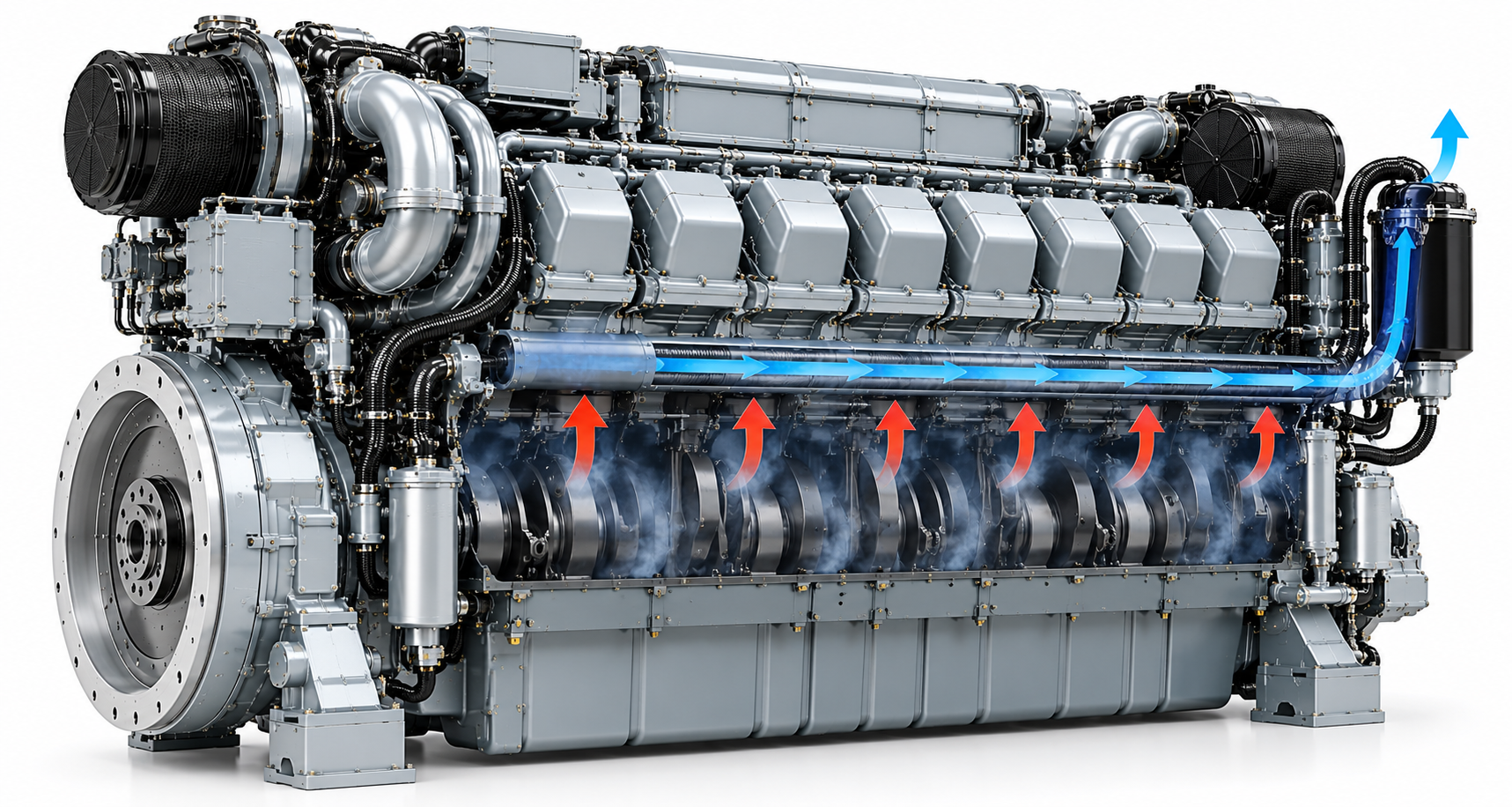
MTU Series 4000 Crankcase Pressure & Blow-By: What Causes It?
You walk into the engine room and notice something that wasn't there before.
There's more oil mist around the MTU Series 4000 engine.
The breather looks wetter than usual.
Oil consumption has started creeping upward.
Then the engineer says:
“I think we've got too much blow-by.”
The immediate thought might be:
Piston rings.
Or worse:
The engine needs an overhaul.
But don't order pistons, liners and ring sets just yet.
Excessive crankcase pressure can certainly be related to internal engine wear, but that's only part of the story. A problem with the crankcase breather or oil-separation system can produce symptoms that deserve investigation too.
The useful question isn't simply:
“Does this engine have blow-by?”
It's:
“Why has the crankcase condition changed?”
Let's work through it the way an engineer might approach the problem aboard a vessel.
For engine-specific components, visit our MTU Series 4000 Marine Engine Spare Parts page.
Need a specific component? Request a Quote or email request@alfamarinespareparts.com.
First, What Do We Mean by Blow-By?
Inside a running diesel engine, combustion creates very high pressure above each piston.
The piston rings help seal that pressure inside the cylinder.
But the seal isn't absolutely perfect.
A certain amount of gas can make its way past the rings and into the crankcase. That's what we commonly call blow-by.
So some crankcase gas doesn't automatically mean something is wrong.
What gets our attention is a change.
Maybe the engine used to have very little visible mist around the breather and now there's considerably more.
Maybe oil consumption has increased at the same time.
Maybe the crankcase pressure seems different when the engine is under load.
That's when it's worth investigating.
Does High Blow-By Mean the Piston Rings Are Worn?
This is probably the first question most people ask.
And the answer is:
Possibly—but don't jump there immediately.
Piston rings and cylinder liners are important parts of the cylinder sealing system, so wear or damage can increase the amount of combustion gas reaching the crankcase.
But before opening a Series 4000 engine, there is something much easier to investigate:
the crankcase ventilation system.
If the engine can't breathe correctly through its intended ventilation arrangement, crankcase pressure can be affected even though the first assumption may be internal engine wear.
Start With the Crankcase Breather
Suppose the chief engineer calls purchasing and says:
“We're getting oil around the crankcase breather. Get me piston rings and liner sets.”
Before placing that order, ask:
Has the breather system actually been checked?
Depending on the Series 4000 configuration, the crankcase ventilation arrangement can involve oil-separation and breather components such as separator elements, filters, diaphragms, seals and associated lines.
If something is contaminated, restricted or damaged, the system may not operate as intended.
That doesn't mean every crankcase-pressure problem is caused by the breather.
It means the breather is a sensible place to investigate before dismantling a major engine.
What Is the Oil Separator Doing?
Crankcase gases don't contain only gas.
They can carry a fine oil mist with them.
The oil-separation system is there to help separate that oil from the crankcase ventilation flow.
If the separator becomes contaminated or restricted, or another part of the breather system isn't functioning correctly, you may start seeing symptoms around the ventilation system.
So when somebody reports:
“There's oil coming from the breather.”
don't immediately translate that into:
“The liners are finished.”
Check the ventilation system first.
Real Situation: Oil Around the Breather
Imagine the engine has been operating normally for months.
Then somebody notices oil around the crankcase breather.
Over the next few days it becomes more noticeable.
At this point, I'd want answers to several questions:
When was the breather last serviced?
Is the separator clean?
Are the ventilation lines clear?
Is the filter element restricted?
Are the seals in good condition?
Has anything recently changed with the engine?
Has oil consumption also increased?
One symptom isn't enough to tell the whole story.
You're looking for a pattern.
The Breather Looks Fine. What Next?
Now we move deeper.
Suppose the breather and separator system has been inspected and nothing obvious is found.
Crankcase symptoms are still higher than normal.
Now piston-ring, piston and cylinder-liner condition become more interesting.
But even here, you don't necessarily know that every cylinder has a problem.
One cylinder may be behaving very differently from the rest.
That's why cylinder-by-cylinder information becomes valuable.
Piston Rings Can Tell You a Lot
The piston rings have a difficult job.
They need to maintain combustion sealing while the piston is moving thousands of times per minute under high temperature and pressure.
If ring sealing deteriorates, more combustion gas can reach the crankcase.
Problems can involve:
- Ring wear
- Ring damage
- Sticking
- Deposits
- Piston groove problems
- Cylinder-liner condition
But here's the important part:
Finding worn rings isn't necessarily the end of the diagnosis.
You still want to know:
Why did they wear?
If abnormal combustion, lubrication, overheating or another condition contributed to the damage, installing new rings without addressing the cause may simply start the same process again.
What About the Cylinder Liners?
The rings don't work alone.
They seal against the cylinder-liner surface.
If the liner condition deteriorates, ring sealing can deteriorate with it.
During inspection, engineers may find things such as:
- Scoring
- Polishing
- Unusual wear
- Surface damage
- Deposits
- Discoloration
Sometimes the difference between cylinders is obvious.
Other times it isn't.
And this is where measurement matters.
A liner can look reasonable and still require proper dimensional evaluation against the applicable service criteria.
Likewise, a visible mark doesn't automatically mean the liner must be replaced.
A Borescope Can Give You an Early Clue
Before pulling the engine apart, a borescope inspection can sometimes provide useful information.
You're not expecting a borescope to answer every question.
You're looking for clues.
Imagine inspecting a 16-cylinder Series 4000.
Fifteen cylinders look broadly similar.
Then you reach one cylinder and think:
“That doesn't look like the others.”
Maybe there is heavier marking.
Maybe the deposits look different.
Maybe the piston crown condition stands out.
Now compare that with the operating history.
Was that cylinder running hotter?
Has its injector caused trouble before?
Has it shown unusual exhaust temperature?
Suddenly you have somewhere specific to investigate.
One Bad Cylinder Can Matter
This is why I wouldn't immediately order a complete set of pistons and liners because someone reports excessive blow-by.
Suppose one cylinder has a ring or liner problem while the others remain within acceptable condition.
The repair requirement could look very different from an engine where widespread wear is found across multiple cylinders.
Diagnosis determines the parts list.
Not the other way around.
Don't Mix Everything Together During Disassembly
If the engine does have to come apart, keep the diagnostic information.
A piston removed from cylinder A1 should remain identifiable as:
A1.
The same applies to rings, bearing shells and other components where relevant to the investigation.
Photograph components before cleaning them.
Record what came from where.
Why?
Because once everything has been cleaned and mixed together, you've lost part of the story.
A strange deposit pattern on one piston might make much more sense when you know that the same cylinder had abnormal exhaust temperature.
Could the Piston Itself Be Part of the Problem?
Yes.
The piston, rings and liner work together.
If there is damage around the piston or ring grooves, ring operation can be affected.
During inspection, engineers may look at:
Piston crown
Ring grooves
Piston skirt
Piston-pin area
Deposits
Signs of overheating
Abnormal wear
Again, don't inspect these components in isolation.
Compare what you find with the history of that cylinder.
Check the Oil Level Before Making Things Complicated
This sounds almost too simple for an MTU Series 4000 troubleshooting article.
But simple checks matter.
Verify:
Is the oil level correct?
Is the correct lubricant being used?
Has the oil level recently changed?
Has oil consumption increased?
Is there evidence of contamination?
If the oil level isn't where it should be, don't simply correct it and walk away.
Ask why.
Understanding the trend can be more valuable than one reading.
“We're Using More Oil Than Before”
That is useful information.
Not a diagnosis—but useful information.
Suppose you have:
Increasing oil consumption
plus:
More crankcase mist
plus:
Higher crankcase pressure
plus:
Abnormal cylinder findings.
Now the evidence is starting to point in a direction.
Compare that with:
“I saw some oil near the breather this morning.”
Very different situation.
Good troubleshooting comes from combining evidence.
What If the Engine Is Smoking Blue?
Blue or blue-grey exhaust smoke can indicate lubricating oil reaching the combustion process.
But again, don't jump straight to piston rings.
Ask:
When does it smoke?
At startup?
At idle?
Under acceleration?
Under sustained load?
Has oil consumption changed?
What do the turbochargers look like?
What does cylinder inspection show?
The smoke is a clue.
It isn't the entire diagnosis.
Don't Forget the Turbochargers
If you're investigating oil consumption and smoke, turbocharger condition deserves attention too.
An oil-related turbocharger problem can contribute to smoke and oil consumption without necessarily meaning the piston rings are worn out.
That's why:
Blue smoke + oil consumption
doesn't automatically equal:
“Order piston rings.”
Look at the engine as a complete system.
What Are the Injectors Doing?
Now imagine one cylinder looks noticeably different from the others.
Before condemning the piston and liner, ask what has been happening with combustion in that cylinder.
Has its injector been performing correctly?
Has exhaust temperature been unusual?
Are deposits different?
Has there been previous fuel-system work?
Poor combustion can leave clues inside the cylinder.
If one cylinder stands out, fuel injection deserves consideration as part of the investigation.
For engine-specific fuel and overhaul components, browse our MTU Series 4000 Marine Engine Spare Parts page.
What About the Air Side?
Fuel is only half of combustion.
The engine also needs the correct air supply.
Depending on the symptoms, the wider investigation may include:
- Air filters
- Turbochargers
- Charge-air coolers
- Air passages
- Connections
- Hoses
- Clamps
An air-side problem doesn't automatically explain high crankcase pressure.
But poor air supply can affect combustion and engine performance, so it shouldn't be ignored when you're trying to understand why cylinder condition has changed.
“It Only Happens Under Load”
That's important information.
Don't just report:
“Engine has blow-by.”
Tell the technician when it happens.
For example:
Idle: little visible change
50% load: noticeable mist
High load: crankcase symptoms become considerably stronger
That tells us much more.
Also note whether the symptoms change as the engine warms up.
A condition that only appears at high load can point the investigation in a different direction from something equally obvious at idle.
What Should the Engineer Write Down?
You don't need a complicated report to start.
Record:
Engine hours
RPM
Engine load
Oil level
Recent oil consumption
Visible exhaust smoke
Exhaust temperatures
Breather condition
Separator condition
Recent maintenance
Recent injector work
Previous overheating events
Fault history
Anything unusual found during cylinder inspection
Then look at everything together.
That's much more useful than one message saying:
“MTU engine has high crankcase pressure.”
Before Opening the Engine, Work From Easy to Difficult
A Series 4000 teardown isn't a small job.
So don't begin with the most expensive possibility unless the evidence already points there.
A sensible thought process is:
First: confirm the problem.
Has crankcase pressure actually changed from normal?
Then: check the basics.
Oil level, condition and obvious operating changes.
Then: inspect the ventilation system.
Breather, separator and associated components.
Then: review the engine data.
Oil consumption, exhaust temperatures, alarms and performance.
Then: look at cylinder condition.
Use the appropriate inspection methods.
Finally: decide whether internal disassembly is justified.
That's a much better progression than:
Oil mist → piston rings → overhaul.
Real Situation: Everyone Thought It Needed Rings
Here's a situation that illustrates the point.
The crew reports excessive crankcase pressure.
Oil is appearing around the breather.
Somebody says:
“The rings must be worn.”
Purchasing starts preparing a large parts request.
Before anything is ordered, the crankcase ventilation system is inspected.
The separator or filter system is heavily contaminated and requires service.
It's serviced according to the applicable procedure.
Then the engine is reassessed.
Does that prove every blow-by complaint is caused by the breather?
Absolutely not.
It proves something more useful:
Check the simple, serviceable possibilities before assuming major internal engine damage.
And Sometimes the Rings Really Are the Problem
Now take the opposite case.
The breather system is inspected.
Everything is clear and functioning correctly.
Oil level is correct.
But crankcase pressure remains abnormal.
Oil consumption is increasing.
Cylinder inspection reveals liner damage.
Further investigation finds ring-related problems.
Now you have evidence supporting internal engine work.
That's very different from guessing based on oil mist alone.
What Parts Might Eventually Be Needed?
Only after the cause becomes clearer should the parts requirement start taking shape.
If the problem is within the crankcase ventilation system, the requirement might involve applicable:
- Separator components
- Filter elements
- Diaphragms
- O-rings
- Gaskets
- Breather components
If internal cylinder wear is confirmed, the requirement can become very different:
- Piston rings
- Pistons
- Cylinder liners
- Liner seals
- Related gaskets and seals
And if the investigation finds other contributing problems, requirements could extend into:
- Injectors
- Turbocharger components
- Cylinder-head components
- Bearings
- Other overhaul components
The important point is:
Don't buy the entire list because the engine has blow-by.
Let the diagnosis build the parts list.
Don't Order “MTU 4000 Breather Parts”
The Series 4000 is a large engine family.
Different configurations and generations can use different components.
So instead of sending:
“Need MTU 4000 breather filter.”
send:
Engine: MTU 16V 4000 M73
Serial number: [number]
Existing part number: [number]
Part required: Crankcase breather / oil separator
Quantity: [quantity]
If the number is difficult to read, include clear photographs.
The complete engine designation and serial number matter when identifying Series 4000 components.
When Does Blow-By Become an Overhaul Question?
There isn't one magic symptom that means:
“Time to rebuild the engine.”
The decision becomes more serious when several findings begin appearing together.
For example:
Crankcase pressure continues increasing
Oil mist becomes excessive
Oil consumption rises
Cylinder inspection shows abnormal wear
Ring or liner damage is confirmed
Engine performance changes
Other internal wear is discovered
Now you're no longer dealing with one isolated symptom.
You're looking at the overall condition of the engine.
That's when a larger repair or overhaul plan may become appropriate.
MTU Series 4000 Blow-By FAQs
Is some blow-by normal on an MTU Series 4000?
Some combustion-gas movement into the crankcase occurs in diesel engines.
What deserves attention is a noticeable or measured change from the engine's normal condition, particularly when accompanied by other symptoms.
Does excessive blow-by mean I need new piston rings?
Not automatically.
Ring and liner condition can contribute to excessive blow-by, but the crankcase ventilation and oil-separation system should also be considered.
Diagnose the cause before ordering internal engine parts.
Can a restricted crankcase breather increase crankcase pressure?
A restriction in the intended crankcase ventilation path can affect crankcase pressure.
Applicable breather and separator components should therefore be inspected as part of the investigation.
Can worn cylinder liners cause blow-by?
Liner condition can affect how effectively the piston rings seal.
Abnormal liner wear or damage can therefore contribute to increased combustion-gas leakage into the crankcase.
Can one cylinder cause noticeably higher blow-by?
A cylinder with abnormal piston, ring or liner condition can contribute more crankcase gas than the others.
That's one reason cylinder-by-cylinder inspection can be valuable.
Does blue smoke confirm worn piston rings?
No.
Blue or blue-grey smoke can indicate lubricating oil entering combustion, but the source still needs to be identified.
Look at oil consumption, turbocharger condition, cylinder condition and the other available evidence.
Should I replace the crankcase breather filter first?
Don't use random parts replacement as a diagnostic method.
Inspect and service the ventilation system according to the requirements for the specific engine, then reassess the condition.
What information should I provide when ordering MTU Series 4000 breather or internal engine parts?
Send:
Complete engine designation
Engine serial number
Existing part number
Part description
Quantity
Photographs can also help when the existing component is difficult to identify.
Request MTU Series 4000 Engine Parts
Investigating excessive crankcase pressure, blow-by or oil mist on an MTU Series 4000 engine?
Find the cause first.
Then build the parts requirement around what the inspection actually shows.
Alfa Marine Spare Parts can assist with sourcing applicable Series 4000 components for maintenance, repair and overhaul requirements.
Depending on the engine configuration and diagnosis, requirements may include:
Crankcase breather components
Oil-separation components
Filter elements
O-rings and gaskets
Piston rings
Pistons
Cylinder liners
Liner seals
Injectors
Turbocharger components
Cylinder-head components
Bearings
Overhaul gaskets and seals
For accurate identification, send:
Complete engine model:
Engine serial number:
Existing part number:
Part description:
Quantity:
Vessel application:
Delivery destination:
Browse our MTU Series 4000 Marine Engine Spare Parts page.
Email: request@alfamarinespareparts.com