
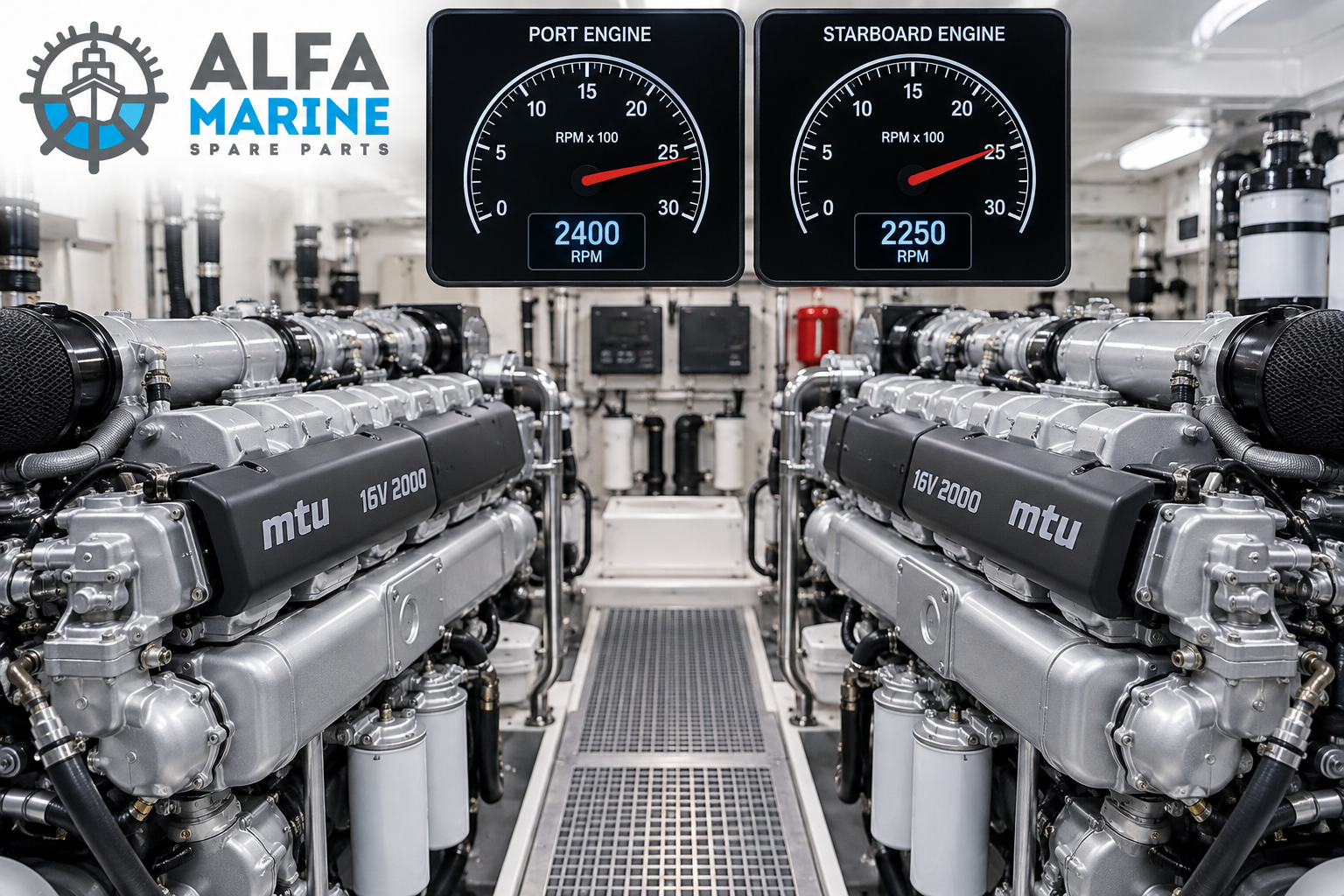

MTU 16V2000 M96L One Engine Not Reaching Full RPM: Port vs Starboard Diagnosis
“Port is fine. Starboard is about 150 RPM down.”
For a yacht engineer, that is a much more useful message than:
“The MTU has low power.”
You have two MTU 16V2000 M96L engines in the same yacht.
Same trip.
Same sea.
Same fuel.
Same general operating conditions.
Yet when the throttles go forward, one engine continues pulling while the other stops short of the RPM you normally expect.
There may be no dramatic alarm.
No horrible mechanical noise.
Maybe there isn't even much smoke.
The captain simply notices that the yacht doesn't feel as balanced as it normally does.
So where do you start?
Not by ordering a turbocharger.
And definitely not by ordering sixteen injectors.
You already have something extremely useful sitting a few metres away:
the other engine.
For parts and engine components, browse our MTU Marine Engine Parts.
If you already know the MTU part number you need, you can also send Alfa Marine a parts enquiry.
Two M96L Engines Give You a Built-In Comparison
Let's imagine the yacht normally runs something like this:
Port: reaches expected loaded RPM
Starboard: stops roughly 100–200 RPM lower
Don't immediately ask:
“What's wrong with starboard?”
First ask:
“What's different between port and starboard?”
That small change in thinking is useful.
You have two engines operating in almost the same environment.
If one behaves normally, it gives you a reference.
Run them under comparable conditions and start looking for differences.
RPM is only the beginning.
What does the engine data show?
What do you hear?
What do you see?
What changed recently?
The answer is often hiding in the difference between the two engines.
“But Starboard Sounds Completely Normal”
It might.
An engine doesn't need to sound terrible to be down on performance.
That's why these problems can be frustrating.
The M96L may start normally.
Idle normally.
Accelerate normally through the lower range.
Then, when the yacht asks for full power, it simply doesn't finish the job.
That's the point where the captain says:
“It used to make that RPM.”
That sentence is important.
If the engine genuinely reached its normal loaded RPM before and no longer does, something has changed.
Now we need to find out what.
Ask the Captain When It Started
Before opening the engine-room toolbox, ask a few questions.
Was the RPM difference noticed suddenly?
Has it slowly become worse?
Did it begin after the yacht came out of the yard?
After a fuel delivery?
After turbocharger work?
After cooling-system maintenance?
After propeller work?
After a long period sitting?
This isn't small talk.
The timeline can save hours.
If starboard was fine before yesterday's maintenance and down on RPM today, that is very different from an engine that has gradually lost performance over six months.
“It Reaches RPM Without Load. Doesn't That Mean the Engine Is Fine?”
Not necessarily.
An engine spinning with little propulsion load isn't being asked to do the same job as an engine pushing a large yacht through the water.
At higher load, the M96L needs enough fuel, enough air, correct boost, effective charge-air cooling and proper engine control.
And the propulsion side has to allow the engine to operate as intended.
A weakness that isn't obvious at light load can become very obvious once the engine has to make serious power.
So don't stop the investigation because someone says:
“It revs fine in neutral.”
The complaint is about RPM under load.
Test the problem under the conditions where it actually happens.
Put Port and Starboard Side by Side
Now the comparison becomes valuable.
Don't collect one random reading from port and another twenty minutes later from starboard.
Compare them under similar vessel conditions.
Look at available engine information such as:
- RPM
- Engine load
- Relevant fuel data
- Boost or charge-air information
- Coolant temperature
- Oil temperature
- Exhaust-related data where available
- Active alarms
- Stored fault information
You're not looking for one magical number.
You're looking for the point where the two engines stop behaving alike.
Maybe both engines track almost identically until higher load.
Then starboard begins falling behind.
That's useful.
“Could It Just Be the Fuel Filters?”
Absolutely possible.
And that's exactly the kind of thing worth checking before expensive parts are ordered.
At lower load, a partially restricted fuel supply may still provide enough fuel.
As demand rises, the restriction matters more.
Ask:
When were the filters changed?
Is there contamination?
Is there water present?
Could air be entering the fuel system?
Did the problem begin after bunkering?
If the yacht took fuel yesterday and starboard developed a performance issue today, don't ignore that coincidence.
But here's another useful question:
If both engines use the same fuel, why is only one engine affected?
That doesn't rule fuel out.
It simply tells you to investigate the affected engine's fuel supply path more closely.
“We Changed the Filters. Still 150 RPM Down.”
Good.
You learned something.
This is how diagnosis should progress.
You checked a reasonable possibility.
The symptom didn't change.
Now move on.
Don't keep installing fuel-system parts simply because the problem feels like a fuel problem.
What does starboard do differently when boost begins building?
Walk Around the Engine
Seriously.
Before reaching for expensive diagnostic conclusions, look around the M96L.
Look at the air and charge-air connections.
Look for a hose that doesn't sit the same way as the one on port.
A clamp that has moved.
Oil mist around a connection.
Something recently disturbed during maintenance.
A damaged hose.
An unusual stain.
A connection that looks wet or dirty.
On a twin installation, you can physically compare one engine with the other.
That is an advantage.
Use it.
Sometimes the healthy engine shows you what the affected engine is supposed to look like.
Could a Charge-Air Leak Cause the RPM Difference?
A problem in the charge-air system can affect engine performance, particularly as load increases.
And this is exactly the type of fault that can be less obvious when the engine isn't working hard.
If boost pressure rises and some of that compressed air escapes before reaching the engine as intended, performance can suffer.
Look for evidence rather than automatically replacing components.
Is there a loose connection?
Damaged hose?
Oil staining?
Different boost-related data between the two engines?
Was charge-air work recently performed?
If you'd like more background on this system, our existing MTU 12V2000 M96L Charge Air Cooler Maintenance article explains why charge-air condition matters to Series 2000 engine performance.
“Everyone Says It's the Turbo”
Turbochargers get blamed for a lot.
Sometimes correctly.
Sometimes because they're one of the first components people associate with low power.
If starboard isn't producing the expected boost under load, the turbocharging system certainly deserves investigation.
But:
low boost does not automatically equal failed turbocharger.
The engine has an entire air path.
Intake.
Turbocharging.
Charge-air cooling.
Connections.
Exhaust side.
Engine load.
Before condemning the turbocharger, understand why the boost or air delivery is different.
Look for:
- Abnormal turbocharger noise
- Compressor damage
- Contamination
- Oil leakage
- Air-side leakage
- Loose connections
- Exhaust-side problems
- Differences in operating data compared with port
The healthy engine is again your reference.
What If Starboard Smokes More Than Port?
Now the conversation becomes more interesting.
Don't just report:
“It smokes.”
What colour?
When?
For how long?
Only when accelerating?
Only at high load?
Does it clear?
Does port do the same thing?
For example, darker exhaust appearing as the affected engine struggles under load can make the air/fuel relationship particularly interesting.
But smoke by itself still doesn't identify the failed part.
Use it as another clue.
Think of the diagnosis as several pieces of information gradually pointing in the same direction.
“Should We Test the Injectors?”
If the evidence points toward the injection system, investigate it.
But don't make sixteen injectors your first diagnostic experiment.
That's an expensive way to discover that the real problem was somewhere else.
Ask whether there is evidence of a cylinder-specific problem.
Does the engine run unevenly?
Are there relevant diagnostic findings?
Does one cylinder behave differently from the others?
Is there abnormal exhaust behaviour?
Did the problem appear suddenly?
Those details matter.
If you're trying to identify an existing injector number, our MTU Fuel Injector Part Number Identification Guide explains why the engine model alone isn't enough for correct injector identification.
Then the Engineer Says: “Both Engines Are Actually Down”
Now stop.
That changes the diagnosis.
Earlier we thought:
Port normal / starboard low.
If you check the yacht's previous operating records and discover that both engines are now below their historical loaded RPM, the problem may not be isolated to starboard after all.
Now ask what both engines share.
Fuel?
Vessel condition?
Propellers?
Hull?
Operating load?
Something changed during the yard period?
This is why previous operating records are so valuable.
Memory is useful.
Numbers are better.
Go Outside the Engine Room
This is the part nobody likes when they've already decided the engine is the problem.
Check the yacht.
A fouled hull increases resistance.
Propeller condition affects load.
Damage or fouling on running gear can change how hard an engine has to work.
And if one propeller has a problem, you can potentially create a difference between two otherwise healthy engines.
So if one M96L won't reach the RPM it used to, the investigation shouldn't end at the engine-room door.
Sometimes the engine is doing exactly what it should while the propeller is asking too much from it.
“But the Yacht Just Came Out of the Yard”
That doesn't automatically eliminate the propulsion side.
In fact, it gives you another question:
What was changed in the yard?
Propeller work?
Running-gear work?
Engine maintenance?
Fuel-system work?
Air-system work?
Cooling work?
Something disconnected and reinstalled?
If the yacht entered the yard with both engines reaching expected RPM and left with starboard 150 RPM down, that's an important timeline.
Start with what changed.
What If There Are No Alarms?
That's possible.
No alarm doesn't mean every mechanical system is performing exactly as it did six months ago.
An engine-management system can tell you a great deal, but a performance complaint can still require mechanical inspection and comparison.
This is where trending helps.
Our MTU 16V2000 M96L Marine Engine Gauges guide discusses monitoring RPM and other operating information over time.
For this particular problem, though, don't simply ask:
“Is the reading inside the allowable range?”
Also ask:
“Is starboard behaving differently from port?”
and:
“Is it behaving differently from last season?”
Those questions can reveal gradual deterioration before an alarm ever appears.
Fuel Consumption Can Give You Another Clue
If you have reliable historical data, don't throw it away.
Has fuel consumption changed?
Has vessel speed at the same operating condition changed?
Is one engine carrying a noticeably different load?
Our MTU 16V2000 Fuel Consumption & Cruising Speed Guide covers why RPM alone doesn't tell the whole story and why hull and propeller condition can affect engine load.
That article answers the fuel-consumption question.
This article answers a different one:
Why is one M96L no longer keeping up with the other?
Don't Turn This Into a Parts Lottery
This is the mistake we're trying to avoid:
150 RPM low → change filters
Still low.
Change sensor
Still low.
Change injectors
Still low.
Change turbocharger
Still low.
At that point you've spent a great deal of money and still don't know what caused the original symptom.
Instead, move from evidence to component.
Not component to component.
When You Finally Identify the Part, Get the Identification Right
Once you've actually found the problem, there's one more trap:
ordering by “MTU 16V2000 M96L” alone.
Don't.
For an MTU parts enquiry, send as much identification as possible:
Engine: MTU 16V2000 M96L
Engine serial number
Existing part number
Quantity
Port or starboard
Photographs where useful
Vessel/application
Delivery destination
Two components can look extremely similar and still not be the correct part for the same engine configuration.
Browse our MTU Marine Engine Parts catalogue or request an MTU parts quotation.
So, Port Is Fine and Starboard Is 150 RPM Down. What Would We Do?
We'd resist the temptation to name a failed part immediately.
Instead:
Confirm the RPM difference under comparable load.
Check what changed before the problem started.
Compare engine data.
Check fuel supply.
Inspect the intake and charge-air system.
Compare boost-related behaviour.
Look for evidence of an injection or cylinder-specific problem.
Check fault history and sensor information.
And don't forget the propeller and hull.
At each stage, compare starboard with port.
That's the advantage of having two M96Ls in the same engine room.
Need MTU 16V2000 M96L Parts?
Once the cause has been identified, Alfa Marine Spare Parts can assist with sourcing MTU 16V2000 M96L engine parts for yacht maintenance, repair and overhaul requirements.
Enquiries can include:
- Fuel-system components
- Fuel injectors
- Turbocharger components
- Charge-air components
- Cooling-system parts
- Seawater-pump components
- Sensors
- Engine-control components
- Gaskets and seals
- Cylinder-head components
- Pistons and liners
- Bearings
- Overhaul components
Exact application should be checked against the engine serial number and existing part number.
For faster identification, send:
MTU 16V2000 M96L + serial number + part number + quantity + delivery destination
Request an MTU Parts Quote
Email request@alfamarinespareparts.com
Browse MTU Engine Parts.
Browse MTU Marine Engine Parts.
The message might start with:
“Starboard is 150 RPM down.”
That's enough to start asking questions.
It isn't enough to start ordering parts.
Use the healthy engine as your reference, find what changed, and only then decide what actually needs replacing.