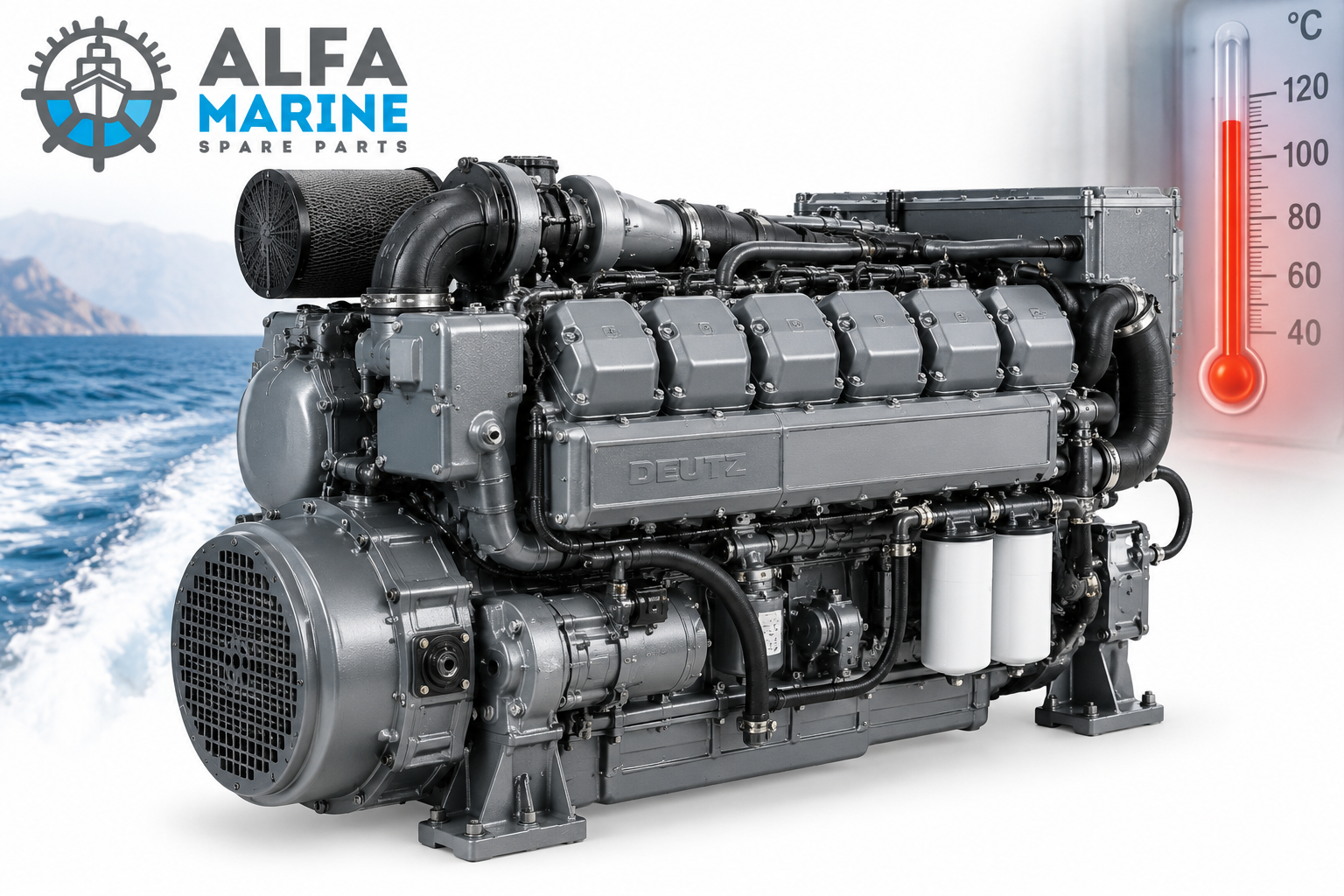
Deutz BF8M1015C Marine Engine Overheating Under Load: What Should You Check?
“The temperature is normal when we're running slowly. As soon as we put the engine under load, it starts climbing.”
That tells us much more than simply saying:
“My DEUTZ is overheating.”
If your Deutz BF8M1015C marine engine overheats under load but stays at a normal temperature at lower RPM, don't immediately start ordering cooling-system parts.
The engine is giving you a clue.
At light load, it produces less heat. The cooling system may still have enough capacity to keep the temperature under control.
Ask the engine for considerably more power and everything changes.
More heat has to leave the engine. Coolant circulation becomes more important. The charge-air system works harder. And on a marine installation, the cooling system has to transfer all that additional heat away efficiently.
If the temperature starts climbing only when the BF8M1015C is working hard, we'd start with one question:
What part of the system can cope at low load but not at high load?
For replacement components, browse our Deutz Engine Parts.
Already have a DEUTZ part number? Send us your BF8M1015C parts enquiry.
First, What Is the Deutz BF8M1015C?
The BF8M1015C belongs to the DEUTZ 1015 engine family.
It is a water-cooled V8 diesel engine with approximately 15.87 litres displacement, a 132 mm bore, 145 mm stroke, turbocharging and charge-air cooling.
Why does that matter when we're talking about overheating?
Because when this engine is working hard, a substantial amount of heat has to be removed.
Imagine this situation.
You leave the berth.
Temperature looks fine.
You increase RPM.
Still fine.
The engine is then placed under sustained load.
A few minutes later, the temperature starts climbing.
You reduce power and eventually the temperature begins falling again.
That pattern matters.
Why Doesn't My BF8M1015C Overheat at Idle?
Because idle isn't asking very much from the engine.
A cooling system can be partially restricted or operating below its intended capacity and still maintain an acceptable temperature when the engine isn't producing much power.
That's what can make this problem confusing.
You start the BF8M1015C at the dock.
Let it run.
Everything looks normal.
You increase RPM without putting much real load on the engine.
Still normal.
Then the vessel gets underway and the engine actually has to work.
Now the temperature climbs.
The cooling system hasn't necessarily suddenly failed.
It may simply have reached the point where it cannot remove heat as quickly as the engine is producing it.
That's an important difference.
Should I Replace the BF8M1015C Water Pump?
Maybe.
But we wouldn't order the water pump simply because the engine is overheating.
A worn or damaged coolant pump can reduce circulation, but changing the pump without confirming the problem can become an expensive experiment.
Instead, look at the whole cooling circuit.
Ask:
Is enough coolant circulating?
Can the coolant release its heat effectively?
Are the thermostats operating correctly?
Is there air trapped in the system?
Is something restricting coolant or seawater flow?
Is the engine being overloaded?
Is the charge-air cooling system operating correctly?
That's a better starting point than simply asking:
“Which water pump fits my BF8M1015C?”
Watch What the Temperature Actually Does
Instead of writing down:
“Engine overheats.”
Write down what happens.
For example:
Idle — normal
Low load — normal
Medium load — temperature stable
High sustained load — temperature starts climbing
Load reduced — temperature gradually falls
Now you have useful information.
Compare that with an engine where the temperature rises continuously from startup and never stabilizes.
Or an engine where the temperature indication suddenly jumps from normal to extremely high.
Those aren't necessarily the same problem.
The more accurately you describe when the BF8M1015C gets hot, the easier it becomes to decide where to look.
Could the BF8M1015C Thermostat Cause Overheating?
Yes, thermostat operation deserves attention.
A thermostat that doesn't operate correctly can interfere with coolant circulation as engine temperature and load increase.
One thermostat reference associated specifically with the Deutz BF8M1015C/CP is:
0426 2003 / 04262003
But there's an important distinction:
Finding the correct thermostat part number doesn't prove the thermostat is causing your overheating problem.
Inspect and diagnose first.
Then order.
And before supplying engine components, we'd still recommend checking the engine serial number and existing part number because configurations can differ.
Request BF8M1015C Cooling System Parts
“We Already Changed the Thermostat”
Good.
Now you have another piece of information.
Suppose the new thermostat is fitted and the BF8M1015C still behaves exactly the same way.
Don't continue replacing parts randomly.
Go back to the cooling path.
Heat has to move:
Engine → coolant → cooling circuit → heat exchanger/cooling system → away from the engine
A restriction or efficiency problem anywhere along that route can reduce the amount of heat the system can remove.
A thermostat is only one part of that chain.
What About the Coolant Pump?
Now the pump deserves closer attention.
The coolant pump has to maintain circulation through the engine.
Reduced pump performance may not immediately become obvious at low engine load.
Once heat production increases, adequate circulation becomes much more important.
Look for evidence.
Is the pump leaking?
Is there bearing noise or movement?
Has it previously been rebuilt?
Is there evidence of poor coolant circulation?
What condition is the impeller in?
Could a restriction somewhere else be limiting flow?
The pump, thermostats, cooler, hoses, pipework and internal coolant passages all work as one system.
Treat them that way.
“We Cleaned the Cooler Last Year”
That's useful information.
It doesn't necessarily mean the cooler is clean today.
Marine cooling systems operate in an environment where deposits, contamination and restricted passages can gradually reduce heat-transfer efficiency.
And gradual deterioration can produce exactly the sort of complaint we're discussing.
At low load:
Enough cooling capacity.
At high load:
Not enough cooling capacity.
If your BF8M1015C has gradually started running hotter over several months, rather than suddenly overheating one morning, declining heat-transfer efficiency deserves attention.
Don't Look Only at the Engine Coolant
This is where a marine installation can differ significantly from the same basic engine used in another application.
The engine coolant may be circulating correctly and still struggle to lose enough heat if the vessel's external cooling side isn't doing its job.
Depending on the installation, check the relevant seawater and heat-exchanger components.
Look at:
- Seawater intake
- Sea strainer
- Raw-water pump
- Hoses and pipework
- Heat exchanger
- Cooler passages
- Discharge flow
A partially blocked sea strainer can create a symptom that looks much more expensive than the actual problem.
So can debris or marine growth around an intake.
Check the simple things before dismantling the engine.
“But I Can See Seawater Coming Out”
That's good.
But it doesn't answer the whole question.
The system can have seawater flow without having enough seawater flow.
That's the important distinction.
A restricted cooling circuit might move enough water to keep the engine comfortable at low power.
Under heavy load, that same flow may no longer be sufficient.
So don't judge the entire cooling system simply because you can see water moving.
Why Does My BF8M1015C Overheat Only at Full Power?
This is one of the most useful clues you can give an engineer.
If the temperature stays normal through most of the operating range and begins climbing only under high sustained load, investigate anything that limits the system's maximum cooling capacity.
Possible areas include:
- Reduced coolant circulation
- Restricted heat exchanger
- Insufficient seawater flow
- Thermostat problems
- Air trapped in the cooling system
- Incorrect coolant condition
- Restricted cooling passages
- Charge-air cooling problems
- Excessive engine load
And notice something important.
Not everything on that list is a failed cooling-system component.
Sometimes the engine is getting hot because it's being asked to work harder than it should.
Could the Propeller Be Making the Engine Run Hot?
Yes — and this is where troubleshooting leaves the engine room.
Suppose the cooling system appears reasonably healthy, but the BF8M1015C still gets hot when maximum power is requested.
Ask:
Is the engine overloaded?
A propeller problem can increase engine load.
A heavily fouled propeller can increase load.
So can a fouled hull.
And changes to the vessel or propulsion system can alter how hard the engine has to work.
Think about when the overheating started.
Was it after:
- Propeller work?
- Gearbox work?
- Hull fouling?
- Vessel modification?
- Major loading changes?
- Engine repairs?
If the temperature problem appeared immediately after something else changed, don't ignore the timing.
“We Cleaned the Hull and the Temperature Improved”
That's valuable information.
A fouled hull increases resistance through the water.
The propulsion system then has to work harder to achieve the same vessel performance.
Cleaning the hull doesn't prove that every cooling-system component is perfect.
But if engine temperature improves noticeably afterwards, you've learned something important about the load the engine was experiencing.
Sometimes a marine-engine temperature problem isn't caused entirely by something bolted to the engine.
Don't Forget the Charge-Air System
The BF8M1015C is turbocharged and charge-air cooled.
That means the air side also deserves attention when the engine is working hard.
At low load, a problem here might not be particularly obvious.
As power, boost and fuel demand increase, it becomes more important.
Check for:
- Restricted charge-air cooling
- Contaminated cooler surfaces
- Air leaks
- Damaged hoses
- Loose connections
- Turbocharger problems
- Abnormally high intake-air temperatures
If the engine isn't getting the air conditions it expects under load, combustion and exhaust temperatures can be affected.
So again:
Don't automatically turn every high-coolant-temperature complaint into a water-pump replacement.
“The Problem Started After We Serviced the Cooling System”
That changes the conversation.
What exactly was done?
Were the thermostats replaced?
Was coolant drained?
Were hoses removed?
Was the cooler dismantled?
Was the water pump changed?
If the engine ran normally before the work and began overheating immediately afterwards, investigate what changed.
For example, air may have entered the cooling circuit during draining and refilling.
A hose may not be routed correctly.
A connection may be restricted.
A replacement component may not match the original configuration.
Sometimes the best troubleshooting question isn't:
“What failed?”
It's:
“What happened immediately before the problem started?”
Can I Keep Running the BF8M1015C at Reduced Load?
Reducing engine load may bring the temperature back down because less heat is being produced.
But that doesn't mean the original problem has disappeared.
If the engine previously operated normally at a particular load and can now remain within acceptable temperature only when power is reduced, something has changed.
Find out what.
Continuing to operate an engine with a genuine overheating problem can turn a cooling-system repair into a considerably larger engine repair.
Should I Change the Water Pump, Thermostat or Heat Exchanger First?
None of them simply because they're common overheating parts.
That's the expensive way to troubleshoot.
Instead, use the symptoms to narrow the problem.
Overheats immediately?
Investigate accordingly.
Only overheats under sustained load?
Look closely at cooling capacity and engine load.
Started overheating immediately after maintenance?
Go back over the work performed.
Temperature gradually became worse over several months?
Think about progressive restriction, contamination, wear or deterioration.
One engine on a twin-engine vessel runs hotter than the other?
That comparison can be extremely useful.
The objective isn't to find a part you can replace.
It's to find why the temperature is increasing.
What Information Should I Send When Ordering BF8M1015C Parts?
This can save a surprising amount of time.
Instead of sending:
“Need DEUTZ water pump.”
Send:
Engine: Deutz BF8M1015C
Engine serial number: XXXXX
Existing part number: XXXXX
Quantity: 1
Vessel/application: XXXXX
Delivery: Miami / Dubai / Rotterdam / Genoa / etc.
And if the part number isn't readable, include clear photographs of the component and engine identification plate.
That's much safer than identifying a component from the engine model alone.
Send Your BF8M1015C Parts Enquiry
Deutz BF8M1015C Overheating Under Load: The Main Thing to Remember
If your BF8M1015C stays cool at low load but overheats when it's asked to work hard, don't ignore that pattern.
The cooling system may still be functioning.
It may simply no longer have enough capacity for the heat being produced.
That can happen because of:
Reduced flow.
Reduced heat transfer.
A restriction.
A thermostat problem.
A pump problem.
Poor charge-air cooling.
Excessive engine load.
Or several smaller problems happening at the same time.
The fact that the engine gets hot under load is not just part of the complaint.
It's part of the diagnosis.
Need Deutz BF8M1015C Marine Engine Parts?
Alfa Marine Spare Parts can assist with sourcing Deutz BF8M1015C engine parts for maintenance, cooling-system repairs and overhaul requirements.
Enquiries can include:
- Water pumps
- Thermostats
- Cooling-system components
- Gaskets and seals
- Temperature sensors
- Turbocharger components
- Charge-air components
- Fuel-system parts
- Cylinder-head components
- Pistons and liners
- Bearings
- Overhaul components
Availability and exact application should always be confirmed against the engine configuration.
For identification, send:
Deutz BF8M1015C + engine serial number + existing part number + quantity + delivery destination
Request a Deutz BF8M1015C Parts Quote
Email: request@alfamarinespareparts.com
Browse our Deutz Engine Parts.
You can also browse our Marine Spare Parts Catalogue.
If you don't have the part number, send us photographs of the existing component and the engine identification plate.
A message that begins with “my BF8M1015C overheats under load” doesn't necessarily end with a new water pump.
First find the cause.
Then order the part.