
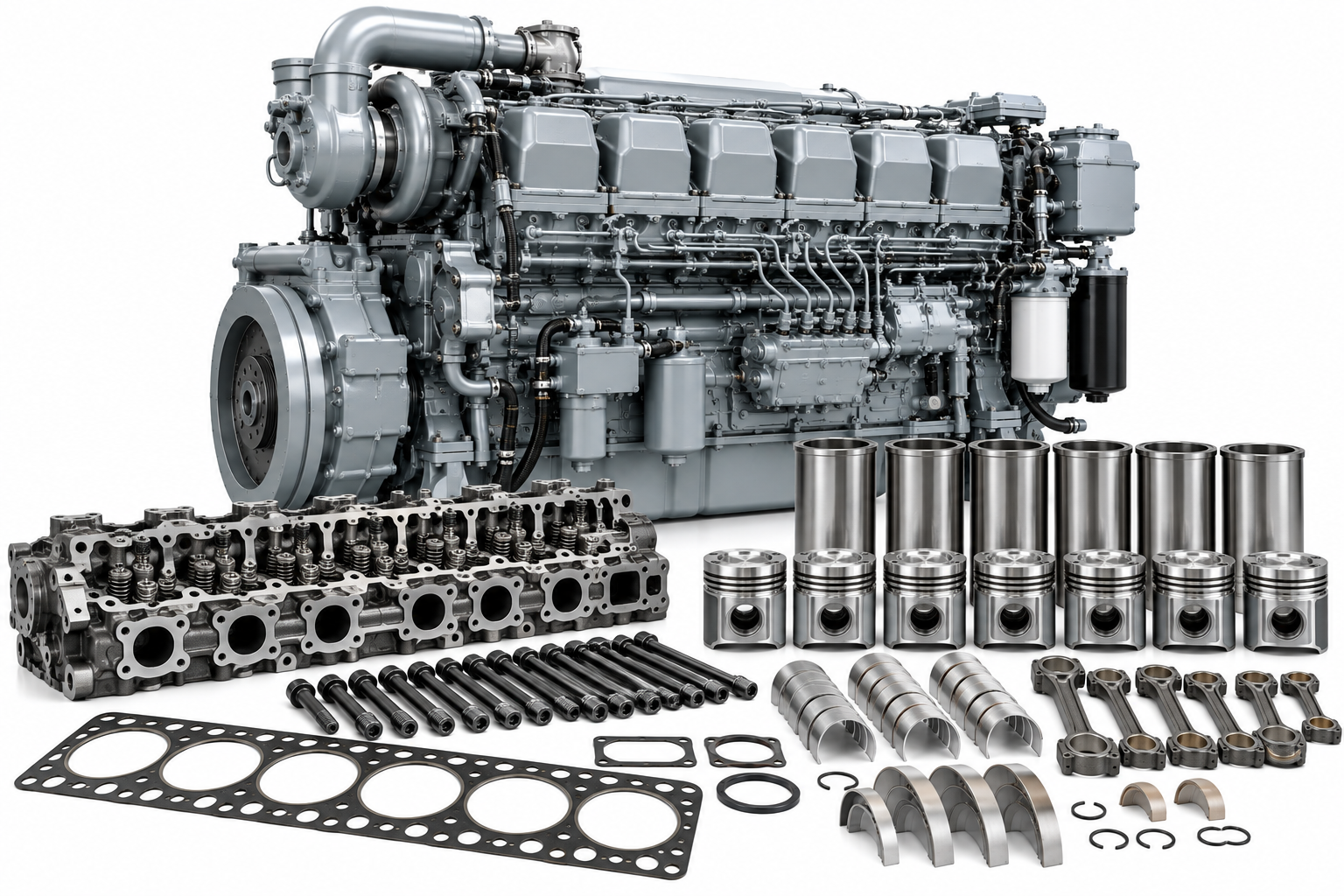
Mitsubishi S6R2-MPTK Torque Specs: Cylinder Head, Bearings & Engine Bolts
You're rebuilding a Mitsubishi S6R2-MPTK marine diesel engine and the cylinder head is ready to go back on.
The gasket has been replaced. The mating surfaces have been prepared. The bolts are ready.
Now comes the important question:
What is the correct Mitsubishi S6R2-MPTK cylinder head bolt torque?
The documented specification for the applicable M22 × 2.5 cylinder-head bolts is:
539 ± 27 N·m — under the specified wet tightening condition.
But that number alone isn't the complete answer.
Mitsubishi also specifies how the fasteners are prepared, the order in which they are tightened and the tightening procedure itself.
That's important because on a large marine diesel engine, getting the torque wrench to the correct number does not necessarily mean the joint has been assembled correctly.
In this guide, we'll look at important Mitsubishi S6R2-MPTK torque specifications, including cylinder-head and connecting-rod fasteners, and explain what engineers should check before applying any torque value during an overhaul.
For replacement components, browse our Mitsubishi Marine Engine Parts catalogue.
Need a specific component? Request a Quote or email request@alfamarinespareparts.com.
Which Mitsubishi S6R2 Engine Does This Guide Cover?
This guide focuses on the Mitsubishi S6R2-MPTK / applicable S6R2-(T2)MPTK marine engine family.
The Mitsubishi S6R2-MPTK is a 29.96-litre inline six-cylinder four-stroke diesel used in marine propulsion and auxiliary applications.
Key engine characteristics include:
| SpecificationMitsubishi S6R2-MPTK | |
| Engine type | Four-stroke diesel |
| Configuration | Inline 6-cylinder |
| Displacement | 29.96 L |
| Cylinder bore | 170 mm |
| Piston stroke | 220 mm |
| Compression ratio | 14.0:1 |
| Aspiration | Turbocharged |
| Cooling | Water cooled |
| Applications | Marine propulsion / auxiliary |
Individual ratings and configurations can differ.
That matters because you should never assume a torque specification found for one Mitsubishi engine automatically applies to another engine simply because the engines belong to the same family.
Before beginning critical engine assembly work, confirm the complete engine designation and applicable service documentation.
What Is the Mitsubishi S6R2-MPTK Cylinder Head Bolt Torque?
For the documented S6R2-MPTK configuration, the applicable cylinder-head bolt specification is:
| ComponentThreadTightening Specification | ||
| Cylinder head bolt | M22 × 2.5 | 539 ± 27 N·m |
| Equivalent | — | 55 ± 2.75 kgf·m |
| Equivalent | — | 398 ± 20 lbf·ft |
The important detail is that Mitsubishi identifies this as a wet tightening specification.
So if you're standing next to an S6R2 with a torque wrench set to 539 N·m, don't start tightening yet.
First verify:
Are the threads prepared correctly?
Are the applicable bearing surfaces lubricated as specified?
Are you following the correct tightening sequence?
Are you following the specified tightening method?
The number on the torque wrench is only one part of the procedure.
What Does “Wet Torque” Mean on a Mitsubishi S6R2?
This is one of the most important points in the entire article.
A wet torque specification means the applicable fastener is tightened under a specified lubricated condition rather than simply being installed dry.
For the documented S6R2-MPTK cylinder-head procedure, engine oil is applied to the specified:
- Cylinder-head bolt threads
- Bolt seating surfaces
- Washer surfaces
The applicable service procedure should be followed regarding preparation and excess oil.
Why does this matter?
Because much of the torque applied to a fastener is affected by friction.
Change the friction and you change the relationship between:
Torque wrench reading → fastener tension → resulting clamping force
This is why:
539 N·m wet should not be interpreted as 539 N·m under any thread condition.
How Should Mitsubishi S6R2 Cylinder Head Bolts Be Tightened?
Mitsubishi documentation provides a defined tightening procedure.
For the applicable torque method, the cylinder-head bolts are progressively tightened in the specified sequence to:
539 ± 27 N·m
The documented procedure includes loosening and repeating the tightening process as specified.
Mitsubishi also documents a controlled-angle method using:
294 ± 14.7 N·m
followed by:
65 ± 3°
The complete procedure includes the corresponding loosening and repeat-tightening steps.
This is why copying a single torque number from an internet discussion is risky.
The actual service information contains:
Torque + lubrication condition + sequence + tightening procedure
Those instructions belong together.
Does the S6R2 Cylinder Head Tightening Sequence Matter?
Yes.
Imagine installing the cylinder head and tightening every bolt on one side to full torque before moving to the other side.
Even if every bolt eventually reaches 539 N·m, you have not necessarily followed the manufacturer's procedure.
The bolts should be tightened progressively in the specified Mitsubishi sequence.
This helps apply clamping force across the cylinder-head assembly as intended.
For actual engine work, use the tightening-sequence diagram from the service documentation applicable to your engine.
Do not invent a tightening order.
Real Workshop Situation: “We Tightened It to 539 N·m”
Consider this situation.
An S6R2 cylinder head has been removed after a sealing problem.
The old gasket is discarded, the mating surfaces are prepared and a replacement gasket is installed.
Someone searches online and finds:
S6R2 cylinder head torque: 539 N·m.
The mechanic sets the torque wrench to 539 N·m and tightens the bolts.
The number may be correct.
But we still need to ask:
- Were the applicable threads lubricated?
- Were the washer and seating surfaces prepared correctly?
- Was the correct tightening sequence followed?
- Was the specified repeat-tightening procedure followed?
- Was the correct engine/service specification being used?
- Was the torque wrench suitable and calibrated?
This illustrates an important rule:
A correct torque value used with the wrong procedure can still result in an incorrect installation.
What Is the Mitsubishi S6R2 Connecting Rod Bolt Torque?
This is another area where copying one number can cause problems.
The S6R2-MPTK documentation distinguishes connecting-rod bolts by their identification.
Documented values include:
| Connecting Rod BoltTightening Specification | |
| Applicable bolt identified “2” | 539 ± 27 N·m — wet |
| Applicable CS / CL arrangement | 637 ± 31.9 N·m — wet |
That is a substantial difference.
So if someone asks:
“What's the S6R2 conrod bolt torque?”
the correct response isn't simply one number.
The first question should be:
Which connecting-rod bolt is installed?
Why Does Bolt Identification Matter?
Mitsubishi documentation distinguishes applicable connecting-rod bolts using identification markings and arrangement information.
Before applying a connecting-rod bolt torque:
- Confirm the complete engine type.
- Identify the installed bolt.
- Verify its markings.
- Confirm its position where applicable.
- Check the required lubrication condition.
- Follow the correct tightening procedure.
- Perform the required post-assembly checks.
This is especially important for connecting rods because they are highly loaded internal engine components.
A generic torque chart should never replace the engine-specific procedure.
What About Mitsubishi S6R2 Main Bearing Cap Bolts?
Main-bearing installation is another job where the procedure matters as much as the torque value.
The Mitsubishi service instructions specify a defined tightening sequence and staged tightening procedure for the main-bearing caps.
For actual main-bearing installation, verify the exact specification from the service documentation applicable to your engine before tightening.
You should confirm:
- Main bearing position
- Bolt specification
- Lubrication condition
- Initial tightening stage
- Final tightening requirement
- Tightening sequence
- Required clearance and post-installation checks
For critical bearing work, we would rather tell an engineer to check the correct service document than publish an isolated number without enough context.
Mitsubishi S6R2 Rocker Shaft & Rocker Case Torque Specs
Cylinder-head work frequently also involves the valve mechanism.
Documented S6R2-MPTK specifications include:
| ComponentThreadTightening Torque | ||
| Rocker case | M12 × 1.25 | 108 ± 5.4 N·m |
| Rocker shaft | M14 × 2.0 | 147 ± 7.4 N·m |
| Rocker arm lock nut | M12 × 1.25 | 64 ± 3.2 N·m |
These values can be useful during cylinder-head and valve-train work.
As with every specification in this article, verify that the fastener and service information correspond to the exact engine being repaired.
Mitsubishi S6R2 Cylinder Head Nozzle Gland Stud Torque
For the applicable S6R2-MPTK configuration, the documented cylinder-head nozzle gland stud specification is:
73.5 ± 4.5 N·m
for the applicable M14 × 2.0 fastener.
The service information also provides assembly instructions for this area.
Do not separate the torque value from any specified thread treatment or installation procedure.
Mitsubishi S6R2 Accessory Drive Gear Nut Torque
For the applicable accessory-drive gear nut, the documented tightening specification is:
490 ± 24.5 N·m
for the applicable M30 × 1.5 thread.
Before applying this value, verify that the installed component and fastener match the documented configuration.
Mitsubishi S6R2 Air Cooler Torque Specs
Not every fastener on the engine needs hundreds of newton-metres.
The air-cooler system demonstrates how dramatically torque can vary between components:
| ComponentThreadTightening Torque | ||
| Air cooler | M12 × 1.25 | 108 ± 10.8 N·m |
| Air cooler cover | M8 × 1.25 | 16 ± 2 N·m |
| Air cooler element | M10 × 1.5 | 49 ± 5 N·m |
A technician who assumes:
“This bolt is fairly large, so I'll tighten it a little more”
can easily damage a component.
Use the specified value.
Mitsubishi S6R2 Exhaust Pipe V-Clamp Torque
At the other end of the scale, the documented specification for the applicable exhaust-pipe V-clamp is:
9 ± 0.45 N·m
for the applicable 1/4-28 UNF fastener.
This illustrates something worth remembering during every overhaul:
More torque does not mean a better installation.
Small clamps, fittings, covers and housings can be damaged by excessive tightening.
What Happens If an S6R2 Bolt Is Overtightened?
There's a common workshop temptation:
“Give it a little more just to be safe.”
With critical engine fasteners, that isn't safer.
Excessive tightening can potentially contribute to:
- Fastener stretching
- Thread damage
- Damaged bolt seats
- Component distortion
- Gasket damage
- Distorted sealing surfaces
- Difficult future disassembly
- Fastener or component failure
A torque specification is not a minimum target.
If the specification says:
539 ± 27 N·m
that does not mean:
539 N·m minimum, then tighten as much as you feel comfortable with.
Stay within the specified procedure.
What Happens If the Bolt Is Undertightened?
Too little clamping force creates a different set of problems.
Depending on the joint, possible consequences can include:
- Fastener loosening
- Coolant leakage
- Oil leakage
- Combustion-gas leakage
- Gasket failure
- Movement between mating surfaces
- Bearing problems
- Abnormal wear
Correct tightening is about achieving the intended fastener preload and joint clamping condition, not simply making a bolt “tight.”
Can I Use a Generic Bolt Torque Chart on an S6R2?
Not for critical engine assemblies.
Generic bolt charts can be useful for general reference, but they should not replace Mitsubishi's component-specific service information for critical parts such as:
- Cylinder-head bolts
- Connecting-rod bolts
- Main-bearing cap bolts
- Flywheel fasteners
- Fuel-injection equipment
- Valve-train components
- Critical lubrication components
There can be important differences in:
- Bolt material
- Thread pitch
- Lubrication
- Surface treatment
- Fastener design
- Required preload
- Tightening method
Use the engine-specific value whenever Mitsubishi provides one.
Can You Use Mitsubishi S6R Torque Specs on an S6R2?
Do not assume so.
The Mitsubishi S6R and S6R2 belong to a related engine lineage, but they are not identical engines.
The S6R2-MPTK discussed here has:
Bore: 170 mm
Stroke: 220 mm
Displacement: 29.96 L
Related S6R configurations can have different dimensions and component specifications.
Even within the wider S6R2 family, individual configurations and revisions can differ.
Always identify the complete engine model before applying a service specification.
“I Found Another Torque Value Online. Which One Is Correct?”
This happens regularly with older and widely used marine engines.
Two sources can appear to contradict each other when they're actually discussing:
- Different engine models
- Different engine revisions
- Different bolt types
- Different bolt markings
- Wet versus dry tightening
- Torque versus angle tightening
- Different component positions
- Revised service procedures
There can also simply be incorrect information online.
Before applying either number, compare:
Engine → Component → Fastener → Lubrication → Tightening method → Procedure
If those aren't identical, the two values may not be directly comparable.
Should Mitsubishi S6R2 Cylinder Head Bolts Be Reused?
Don't make that decision solely by looking at the bolt.
Critical fasteners should be inspected and assessed according to the applicable Mitsubishi service information.
Check for conditions such as:
- Damaged threads
- Corrosion
- Deformation
- Abnormal stretching
- Damaged seating surfaces
- Previous installation damage
If the service documentation requires replacement, or the fastener does not meet the applicable condition/service limits, replace it.
Should You Put Engine Oil on Every Mitsubishi Engine Bolt?
No.
The fact that the S6R2 cylinder-head procedure uses a wet tightening condition does not mean every fastener on the engine should be lubricated before tightening.
Depending on the assembly, Mitsubishi may specify:
- Dry installation
- Engine oil
- Another specified lubricant
- Thread-locking compound
- Sealant
Never change the fastener condition simply because lubrication makes installation easier.
Changing friction can change the resulting fastener load.
What Should You Check Before Tightening a Critical S6R2 Fastener?
Before applying a torque value, ask these questions:
Is this definitely the correct engine?
Check the complete engine designation.
Is this definitely the correct component?
Don't identify a bolt only by its diameter.
Does the bolt have an identification marking?
This is particularly important for connecting-rod bolts.
Is the torque wet or dry?
Follow the specified assembly condition.
Is there a tightening sequence?
Cylinder heads and bearing caps can require one.
Is tightening performed in stages?
Do not jump directly to final torque if the procedure requires progressive tightening.
Is angle tightening required?
Some procedures specify torque followed by an angular rotation.
Is the torque wrench appropriate?
A torque wrench should be suitable for the required range and properly maintained/calibrated.
Is the service information correct for this engine?
This is the final check before tightening anything critical.
Quick Mitsubishi S6R2-MPTK Torque Specs Reference
The following table summarizes several specifications discussed in this guide:
| ComponentDocumented Specification | |
| Cylinder head bolt | 539 ± 27 N·m — wet |
| Cylinder head controlled-angle initial torque | 294 ± 14.7 N·m + 65 ± 3° |
| Connecting rod bolt — applicable ID “2” | 539 ± 27 N·m — wet |
| Connecting rod bolt — applicable CS / CL | 637 ± 31.9 N·m — wet |
| Cylinder head nozzle gland stud | 73.5 ± 4.5 N·m |
| Rocker case | 108 ± 5.4 N·m |
| Rocker shaft | 147 ± 7.4 N·m |
| Rocker arm lock nut | 64 ± 3.2 N·m |
| Accessory drive gear nut | 490 ± 24.5 N·m |
| Air cooler | 108 ± 10.8 N·m |
| Air cooler cover | 16 ± 2 N·m |
| Air cooler element | 49 ± 5 N·m |
| Exhaust pipe V-clamp | 9 ± 0.45 N·m |
Important: Treat this as a quick reference, not a replacement for the applicable Mitsubishi workshop manual. Confirm the complete engine designation, fastener identification, lubrication condition, tightening sequence and complete installation procedure before carrying out engine work.
Mitsubishi S6R2-MPTK Torque Specs FAQs
What is the Mitsubishi S6R2-MPTK cylinder head bolt torque?
For the documented applicable M22 × 2.5 cylinder-head bolts, the specification is:
539 ± 27 N·m under the specified wet tightening condition.
The complete Mitsubishi tightening procedure and sequence should also be followed.
Do Mitsubishi S6R2 cylinder head bolts need oil?
For the documented S6R2-MPTK cylinder-head tightening procedure, engine oil is applied to the specified bolt threads and applicable seating/washer surfaces.
Do not assume this requirement applies to every fastener on the engine.
What is the S6R2 angle-tightening specification?
The documented controlled-angle method includes an initial tightening value of:
294 ± 14.7 N·m
followed by:
65 ± 3°
as part of the specified procedure.
Use the complete workshop procedure rather than these two figures alone.
What is the Mitsubishi S6R2 connecting rod bolt torque?
There isn't one universal value for every applicable S6R2 connecting-rod bolt.
Documented specifications include:
539 ± 27 N·m — wet
for an applicable bolt identified “2”, and:
637 ± 31.9 N·m — wet
for the applicable CS / CL arrangement.
Identify the installed bolt before selecting a specification.
Why are there two S6R2 connecting rod torque values?
Because the service documentation distinguishes applicable connecting-rod bolt configurations and identification markings.
Do not choose between the values based on appearance alone.
Can I use these torque values on an S6R?
Do not automatically do so.
The S6R and S6R2 are related but different engines. Confirm the service information applicable to the exact engine model.
Can I use these specifications on every S6R2-MPTK?
Use them only after confirming that the service information corresponds to the engine and fastener being serviced.
Engine configuration and service-document revisions matter.
Why does lubrication matter when tightening a bolt?
Lubrication changes friction at the threads and bearing surfaces.
That changes the relationship between applied torque and the resulting fastener tension.
This is why a wet torque specification should not automatically be applied to a dry fastener.
Should I tighten a bolt slightly more than specification for safety?
No.
More torque does not automatically produce a safer joint.
Follow the specified torque, tolerance, lubrication condition and tightening procedure.
Can I use an impact wrench for final tightening?
For critical engine fasteners requiring controlled torque or angle tightening, use the appropriate calibrated tightening equipment and follow the manufacturer's procedure rather than relying on an impact wrench to establish final tightening.
We are rebuilding an S6R2. What information should we provide when ordering parts?
Send:
Complete engine model
Engine serial number
Existing part number
Part description
Quantity
For difficult-to-identify components, photographs of the engine nameplate and existing component can also help.
Rebuilding a Mitsubishi S6R2-MPTK?
If you're carrying out a cylinder-head repair, piston overhaul, connecting-rod inspection, bearing replacement or complete Mitsubishi S6R2-MPTK overhaul, correct parts identification is just as important as correct tightening.
Alfa Marine Spare Parts can assist with sourcing applicable:
- Cylinder-head components
- Cylinder-head gaskets
- Pistons
- Piston rings
- Cylinder liners
- Connecting-rod components
- Main bearings
- Connecting-rod bearings
- Valve components
- Fuel-injection components
- Water pumps
- Oil pumps
- Cooling-system components
- Gaskets
- O-rings
- Seals
- Overhaul components
For accurate identification, provide the complete Mitsubishi engine model, engine serial number and existing part number whenever available.
Browse our Mitsubishi Marine Engine Parts catalogue.
Email: request@alfamarinespareparts.com