Why Won't My Detroit Diesel 6V92 / 8V92 / 12V92 / 16V92 Marine Reach Full RPM Under Load?
A Detroit Diesel 6V92, 8V92, 12V92 or 16V92 marine engine that runs normally at idle but cannot reach expected RPM under load is showing an important diagnostic symptom.
The problem does not automatically mean the injectors or turbocharger have failed.
There are two main possibilities:
The engine cannot produce its expected power, or the propulsion system is demanding more power than the engine can deliver at the expected RPM.
On Detroit Diesel Series 92 marine engines, important areas to investigate include:
- Restricted fuel supply
- Fuel filters
- Air entering the fuel system
- Fuel-supply problems
- Injector condition
- Injector and rack adjustment on mechanically controlled engines
- Governor operation on mechanical engines
- DDEC controls on electronically controlled versions
- Turbocharger performance on turbocharged engines
- Roots-type blower condition
- Air-intake restriction
- Aftercooler or charge-air cooler condition where fitted
- Exhaust restriction
- Compression and internal engine condition
- Excessive propeller or vessel load
The key diagnostic question is:
Is the engine failing to produce power, or is the vessel placing excessive load on the engine?
Detroit Diesel 6V92, 8V92, 12V92 and 16V92 Marine Engines
The Detroit Diesel Series 92 includes several V-engine configurations used in marine propulsion and auxiliary applications.
| EngineConfigurationEngine Family | ||
| 6V92 | V6 | Series 92 |
| 8V92 | V8 | Series 92 |
| 12V92 | V12 | Series 92 |
| 16V92 | V16 | Series 92 |
The 92 identifies the engine family and corresponds to approximately 92 cubic inches of displacement per cylinder.
Marine Series 92 engines were produced in different configurations, including naturally aspirated and turbocharged versions, with aftercooling on applicable variants.
Mechanical and electronically controlled DDEC configurations also exist.
This variation is important because an injector, turbocharger, blower or fuel-system component should not be selected from the basic 6V92, 8V92, 12V92 or 16V92 designation alone.Detroit Diesel 6V92 Marine Engine Spare Parts | Alfa Marine Spare Parts
Browse Detroit Diesel Marine Engine Parts.
Does the Engine Reach RPM in Neutral?
One of the first observations is whether the engine accelerates normally without propulsion load.
For example:
Neutral → engine accelerates normally
but:
In gear → engine cannot reach expected full-load RPM
This directs the investigation toward:
Engine power production + propulsion load
However, reaching high RPM in neutral does not prove that the engine is capable of producing full rated power.
An unloaded engine requires relatively little power to accelerate itself.
Problems involving:
- Fuel delivery
- Injectors
- Air supply
- Turbocharger
- Blower
- Exhaust
- Compression
may become obvious only when the propeller places significant load on the engine.
Start With the Fuel Supply
Before replacing injectors or turbochargers, determine whether sufficient fuel is reaching the engine.
A partially restricted fuel supply may support normal idle and light-load operation but become inadequate when fuel demand increases.
Check:
- Fuel level
- Fuel condition
- Tank pickup
- Shutoff valves
- Primary fuel filter
- Secondary fuel filter
- Fuel hoses
- Fuel lines
- Restricted fittings
- Fuel-supply pump
- Fuel-return circuit
The principle is straightforward:
Low load → relatively low fuel demand
High load → substantially higher fuel demand
A restricted filter or fuel line can therefore cause little trouble at idle while significantly reducing available power under load.
Check for Air Entering the Fuel System
Air intrusion can also contribute to low power.
Possible entry points include:
- Loose fittings
- Damaged hoses
- Filter seals
- Filter housings
- Fuel-line connections
- Suction-side leaks
A suction-side leak does not always produce an obvious external diesel leak.
Instead, air can enter the system while the engine is operating.
Possible symptoms include:
- Unstable RPM
- Hesitation
- Reduced power
- Difficult starting
- Uneven running
- Failure to reach expected RPM under load
Inspect the complete fuel supply before assuming that the injectors are responsible.
Detroit Diesel Series 92 Fuel Injectors
Injector condition directly affects combustion and engine power.
However, the injector system depends on the engine configuration.
Mechanically Controlled Series 92 Engines
Mechanically controlled Series 92 engines use mechanical unit injectors.
Correct injector adjustment and proper rack and governor operation are important for correct fuel delivery.
DDEC Series 92 Engines
DDEC-equipped Series 92 engines use electronically controlled unit injectors.
Low-power diagnosis on these engines can therefore also involve:
- Electronic injector operation
- Sensors
- Wiring
- Electrical connectors
- Electronic throttle input
- Engine-protection functions
- DDEC controls
A DDEC engine should not be diagnosed exactly like a mechanically governed Series 92 engine.
Can Bad Injectors Prevent Full RPM?
Yes.
Injector problems can contribute to:
- Reduced power
- Uneven cylinder contribution
- Excessive smoke
- Rough running
- Abnormal exhaust temperature
- Increased fuel consumption
- Difficult starting
- Failure to achieve expected RPM
But one important rule applies:
There Is No Universal Series 92 Injector
Different injector specifications can be used according to:
- Engine model
- Engine rating
- Marine configuration
- Mechanical or DDEC control
- Engine specification
Do not assume that an injector advertised simply as a “Detroit Diesel 92 Series injector” is correct for every 6V92, 8V92, 12V92 or 16V92.
Before ordering, provide:
Complete engine model + model number + Engine Serial Number + existing injector identification
Check Rack and Governor Operation on Mechanical Engines
On mechanically controlled Series 92 engines, correct injector, rack and governor operation is important.
Areas to inspect according to the correct service procedure include:
- Injector adjustment
- Rack movement
- Governor operation
- Throttle linkage
- Fuel-control movement
- Shutdown mechanism
If the fuel-control system cannot achieve the required position under load, the engine may not receive the fuel necessary to develop full power.
Replacing the turbocharger would not correct that problem.
Check DDEC Controls on Electronic Engines
If the engine is electronically controlled, the diagnostic approach changes.
Depending on the specific DDEC configuration, low-power diagnosis can include:
- Electronic injector operation
- Sensor inputs
- Wiring and connectors
- Electronic throttle input
- Engine-protection functions
- Active diagnostic faults
- Stored diagnostic faults
- Electronic engine-control operation
Before ordering electronic components, identify the exact engine and control-system configuration.
Can the Turbocharger Cause Low RPM Under Load?
Yes, on turbocharged Series 92 configurations.
The turbocharger helps provide the airflow required for efficient combustion as engine load increases.
Possible turbocharger-related problems include:
- Compressor fouling
- Turbine fouling
- Bearing wear
- Shaft damage
- Oil leakage
- Compressor-wheel damage
- Turbine-wheel damage
- Exhaust leakage before the turbine
- Restricted air intake
One useful symptom combination is:
Low RPM + reduced boost + black smoke
That pattern makes the engine's air system, turbocharger condition and propulsion load particularly important to investigate.
There Is No Universal Series 92 Turbocharger
Different turbocharger arrangements were used across the Series 92 family.
Even two engines carrying the same basic 8V92 designation may not necessarily use the same turbocharger.
Correct identification should include:
- Complete engine model
- Engine Serial Number
- Engine specification
- Existing turbocharger manufacturer
- Existing turbocharger model
- Existing part number
- Turbocharger identification plate
Do not order a turbocharger solely from the basic engine family.
Don't Forget the Roots-Type Blower
Detroit Diesel Series 92 engines are two-stroke diesel engines.
They use a Roots-type blower as part of the scavenging-air system.
This is an important difference from many four-stroke marine diesel engines.
On turbocharged Series 92 configurations, the blower remains part of the engine's air-handling system.
Therefore, a low-power investigation should not stop at:
“Is the turbocharger producing boost?”
Also investigate:
- Blower condition
- Blower drive
- Air intake
- Air restrictions
- Air-box condition
- Charge-air cooling where fitted
Insufficient scavenging air can directly affect combustion and available engine power.
Check the Aftercooler or Charge-Air Cooler
On applicable turbocharged and aftercooled Series 92 marine configurations, restricted charge-air cooling can reduce engine performance.
Possible problems include:
- Oil contamination
- Deposits
- Restricted air passages
- Restricted cooling-water passages
- Corrosion
- External leakage
- Internal leakage
Possible symptoms include:
- Reduced power
- Black smoke
- Increased intake-air temperature
- Higher exhaust temperature
- Poor performance under load
Do not condemn the turbocharger before checking the complete air path.
Black Smoke Is an Important Diagnostic Clue
If the engine cannot achieve expected RPM and produces heavy black smoke, investigate:
- Insufficient combustion air
- Turbocharger performance
- Blower condition
- Restricted air intake
- Charge-air cooler restriction
- Exhaust restriction
- Injector condition
- Excessive propulsion load
Black smoke means the diagnostic investigation should consider whether sufficient air is available to burn the delivered fuel correctly.
However, excessive propeller load can produce a similar symptom even when the turbocharger itself is serviceable.
What if There Is Little Black Smoke?
Low power with relatively little black smoke can point toward another direction.
Possible areas include:
- Insufficient fuel delivery
- Restricted fuel supply
- Blocked fuel filters
- Air entering the fuel system
- Fuel-supply problems
- Governor or fuel-control problems
- Electronic control problems on DDEC engines
- Injector-delivery problems
Smoke appearance is a useful clue, but it should not be used alone to identify the failed component.
Could an Exhaust Restriction Prevent Full RPM?
Yes.
The engine must be able to discharge exhaust gas efficiently.
Excessive exhaust restriction can interfere with engine breathing and turbocharger performance.
Inspect:
- Exhaust piping
- Exhaust hose
- Muffler
- Carbon buildup
- Internal hose collapse
- Exhaust-system modifications
- Water-related exhaust restrictions
A restriction may have relatively little effect at low exhaust flow but become significant as engine output increases.
Could Low Compression Cause Low Power?
Yes.
If the fuel, air and exhaust systems appear satisfactory, engine mechanical condition should be considered.
Possible causes include:
- Worn piston rings
- Cylinder-liner wear
- Valve leakage
- Incorrect valve adjustment
- Cylinder damage
- Cylinder-head problems
Possible accompanying symptoms include:
- Difficult starting
- White smoke when cold
- Increased blow-by
- Uneven running
- Reduced cylinder contribution
- Low power under load
Mechanical condition deserves particular attention on older Series 92 engines with substantial operating hours.
Is the Propeller Overloading the Engine?
This is one of the most important areas in marine low-RPM diagnosis.
The engine itself may be capable of producing power while the propulsion system is demanding too much.
Possible causes include:
- Fouled propeller
- Fouled hull
- Damaged propeller
- Excessive propeller pitch
- Incorrect propeller diameter
- Excessive vessel loading
- Gearbox problems
- Driveline resistance
A propulsion problem can be relatively difficult to notice at low RPM but become severe as engine and propeller speed increase.
What if the Problem Started After Propeller Work?
If the engine previously achieved expected full-load RPM but stopped doing so after propeller repair or replacement, investigate the propulsion system before dismantling the engine.
Check:
- Propeller diameter
- Propeller pitch
- Blade configuration
- Gear ratio
- Propeller condition
- Installation
Excessive propeller load can produce:
Low RPM + black smoke + elevated exhaust temperature
This can easily be mistaken for an injector, blower or turbocharger problem.
Fuel Problem, Air Problem or Propeller Problem?
Use the complete symptom pattern to guide the investigation.
| SymptomArea Worth Investigating | |
| Reaches RPM in neutral but not under load | Engine power / propulsion load |
| Low RPM + black smoke | Air / turbo / blower / overload |
| Low RPM + little smoke | Fuel delivery / control system |
| Reduced boost under load | Turbo / intake / exhaust / engine load |
| One cylinder behaves differently | Injector / compression / valve condition |
| Unstable RPM | Fuel supply / air intrusion / controls |
| Problem started after propeller work | Propeller / drivetrain |
| Gradual power loss | Filters / injectors / air system / mechanical wear |
| Sudden power loss | Fuel / air / controls / mechanical fault |
| Hard starting + low power | Injectors / compression / fuel system |
These observations provide diagnostic direction rather than proof of a particular component failure.
Compare Individual Cylinder Performance
Cylinder-to-cylinder comparison can provide useful information when investigating low power.
Differences may indicate:
- Injector condition
- Compression differences
- Valve problems
- Fuel-delivery differences
- Internal mechanical problems
Exhaust-temperature comparison can also be useful when measured correctly under comparable operating conditions.
The important information is often the difference between cylinders, rather than one temperature measurement by itself.
Practical Detroit Diesel Series 92 Low-RPM Check
A logical diagnostic sequence is:
- Confirm the expected full-load RPM for the exact engine and vessel.
- Determine whether the engine accelerates normally without propulsion load.
- Inspect primary and secondary fuel filters.
- Check fuel supply and return circuits.
- Check for air entering the fuel system.
- Verify fuel-supply performance.
- Identify whether the engine is mechanically controlled or DDEC.
- On mechanical engines, inspect throttle, governor and rack operation using the correct service procedure.
- On DDEC engines, check electronic controls and relevant diagnostics.
- Evaluate injector and individual-cylinder performance.
- Inspect the air intake.
- Inspect blower condition.
- Evaluate turbocharger performance where fitted.
- Inspect the aftercooler or charge-air cooler where fitted.
- Check the exhaust system for restriction.
- Compare individual-cylinder performance.
- Consider compression and internal mechanical condition.
- Inspect the hull and propeller.
- Verify propeller specification and drivetrain condition.
- Compare actual full-load performance with the correct engine and vessel specifications.
The objective is to determine whether the problem comes from:
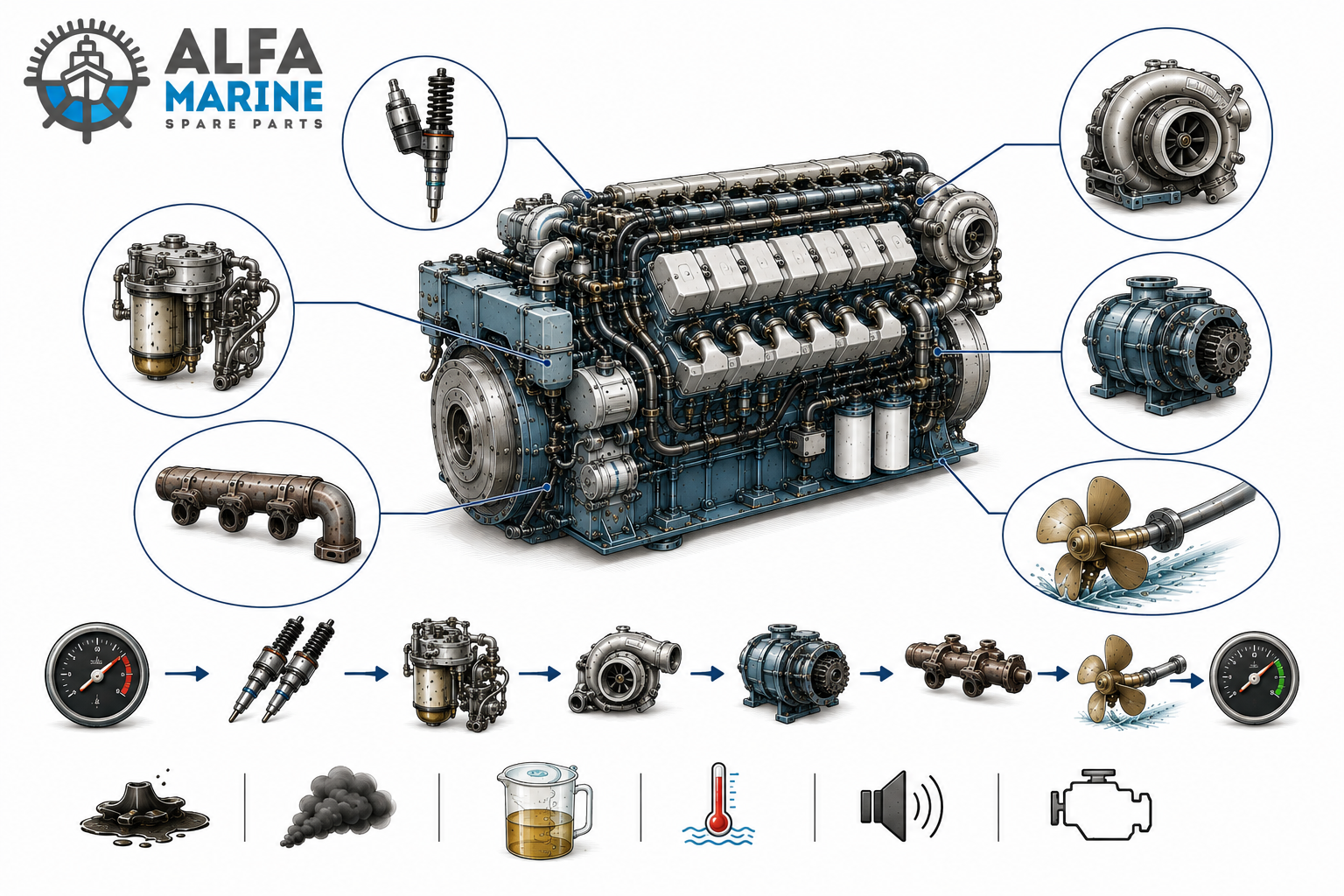
Fuel supply → engine controls → injectors → blower/turbo/air system → mechanical condition → propulsion load
rather than replacing expensive components without diagnosis.
Detroit Diesel 92 Series Marine Parts
Alfa Marine Spare Parts supplies selected replacement components for Detroit Diesel marine engines, including Series 92 applications.
Browse Detroit Diesel Marine Engine Parts.
You can also browse the complete Marine Spare Parts Catalog.
Series 92 parts enquiries can include:
- Mechanical unit injectors
- Electronic unit injectors
- Injector components
- Fuel pumps
- Fuel-system components
- Governors
- DDEC components
- Turbochargers
- Blower components
- Aftercooler components
- Oil coolers
- Water pumps
- Cylinder heads
- Pistons
- Cylinder liners
- Bearings
- Gasket sets
- Overhaul components
Exact application should always be verified against the individual engine.
Why Series 92 Part Identification Matters
A description such as:
“Detroit Diesel 8V92 Marine”
may not be sufficient to identify the correct injector, turbocharger, blower or fuel-system component.
Before ordering, provide:
- Complete engine designation
- Complete model number
- Engine Serial Number
- Existing component part number
- Injector identification
- Turbocharger identification
- Mechanical or DDEC configuration
- Marine application
- Engine rotation where relevant
- Component photographs
This is particularly important with older engines that may have been rebuilt or modified during their service life.
Request Detroit Diesel Series 92 Marine Parts
If your Detroit Diesel 6V92, 8V92, 12V92 or 16V92 marine engine cannot reach expected RPM under load, avoid immediately replacing injectors or the turbocharger.
First determine whether the problem originates from:
Fuel supply → controls → injectors → blower/turbo/air → mechanical condition → propulsion load
For accurate parts identification, provide:
Complete engine model + Engine Serial Number + existing part number + component photograph
Email: request@alfamarinespareparts.com
Request a Quote
Alfa Marine Spare Parts
Frequently Asked Questions
Why won't my Detroit Diesel 6V92 reach full RPM under load?
Possible causes include restricted fuel supply, injector or governor problems, insufficient airflow, blower or turbocharger problems, exhaust restriction, internal engine wear or excessive propeller load.
Why does my Detroit Diesel 8V92 reach RPM in neutral but not in gear?
An unloaded engine requires relatively little power. Under propulsion load, weaknesses in fuel delivery, airflow or engine condition become much more apparent. Excessive propeller load can produce the same symptom.
Do Detroit Diesel Series 92 engines use unit injectors?
Yes. Mechanically controlled engines use mechanical unit injectors, while applicable DDEC-equipped versions use electronically controlled unit injectors.
Is there one injector for every 6V92, 8V92, 12V92 and 16V92?
No. Injector specification depends on the exact engine configuration. Verify the engine model, model number, serial number, control system and existing injector identification.
Can a bad turbocharger prevent a 6V92 or 8V92 from reaching full RPM?
Yes, on turbocharged configurations. Insufficient airflow or boost can reduce available engine power under load.
Does the Detroit Diesel Series 92 use a blower?
Yes. Series 92 engines are two-stroke diesels and use a Roots-type blower as part of their scavenging-air system.
Can a dirty aftercooler cause low power?
Yes, where an aftercooler or charge-air cooler is fitted. Restriction can reduce air-system performance and contribute to low power, higher temperatures and smoke.
Can a propeller cause an 8V92 to lose RPM?
Yes. Propeller fouling, excessive pitch, incorrect diameter or other propulsion problems can prevent the engine from achieving expected full-load RPM.
Why does my 12V92 produce black smoke and not reach full RPM?
Investigate combustion-air supply, blower and turbocharger performance, charge-air cooling, exhaust restriction, injector condition and excessive propulsion load.
Can a 16V92 fuel restriction appear mainly under load?
Yes. A restriction may provide sufficient fuel for idle or light-load operation but become inadequate as fuel demand increases.
How do I identify the correct Detroit Diesel Series 92 parts?
Provide the complete engine model, model number, Engine Serial Number, existing component number and photographs. For injectors and turbochargers, include identification information from the existing components.