Marine Diesel Engine Starting Problems: Troubleshooting, Prevention & Maintenance Guide
Marine Diesel Engine Starting Problems: How to Diagnose, Prevent, and Solve Starting Issues
Introduction
There are few situations more frustrating for a marine engineer than turning the starter key and hearing… nothing.
Whether you're preparing to leave the dock, responding to an emergency, or starting the engine after routine maintenance, a starting problem can delay operations, disrupt schedules, and create unnecessary stress for everyone onboard.
Starting issues affect every type of marine diesel engine. From the MTU 16V4000 M73 powering high-performance yachts to the MTU 12V4000 M90 found in commercial vessels, the Caterpillar C32 and Caterpillar 3412 used in workboats and offshore applications, or reliable engines from Cummins and Detroit Diesel, every engine depends on a healthy starting system.
The good news is that many starting problems begin with small warning signs. A slower crank, a weak battery, poor electrical connections, or contaminated fuel can often be identified long before they develop into a complete no-start situation.
At Alfa Marine Spare Parts, we work with marine engineers, chief engineers, technical superintendents, shipyards, and vessel owners every day. We know that preventive maintenance and systematic troubleshooting are the keys to reducing downtime and improving engine reliability.
In this guide, we'll explain how marine diesel starting systems work, the most common causes of starting problems, and the practical steps you can take to keep your engine ready whenever it's needed.
Table of Contents
- The Cost of Starting Problems on the Water
- Understanding Your Marine Diesel Starting System
- The Three Key Starting Systems
- Marine Diesel vs Automotive Diesel Starting Systems
- Common Marine Diesel Starting Problems
- STARTS Prevention Framework
- Emergency Troubleshooting Toolkit
- Long-Term Maintenance Plan
- Advanced Diagnostics
- Frequently Asked Questions
- Related Marine Engine Parts
- Why Choose Alfa Marine Spare Parts
- Technical Reference
- Final Thoughts
The Cost of Starting Problems on the Water
A starting problem rarely occurs at a convenient moment.
Unlike road vehicles, marine engines often operate in situations where immediate engine availability is essential. A delayed engine start can affect vessel schedules, manoeuvrability, safety, and operational efficiency.
For commercial operators, unexpected downtime may result in:
- Missed departures.
- Delayed cargo operations.
- Increased maintenance costs.
- Lost charter revenue.
- Schedule disruptions.
For recreational boat owners, a starting problem can quickly turn a planned day on the water into an unexpected repair project.
The best way to avoid these situations is to recognise early warning signs before the engine refuses to start altogether.
Understanding Your Marine Diesel Starting System
Although different manufacturers use different engine designs, the starting principles remain remarkably similar across most marine diesel engines.
Whether you're working on a:
- MTU 16V4000 M73
- MTU 12V4000 M90
- Caterpillar C32
- Caterpillar 3412
- Cummins QSK19
- Cummins KTA19
- Detroit Diesel Series 60
the starting process depends on several systems working together.
A successful start requires:
- Electrical power.
- Starter motor engagement.
- Adequate fuel supply.
- Clean air.
- Correct engine timing.
- Sufficient compression.
If any one of these systems fails, the engine may crank slowly, refuse to fire, or fail to crank altogether.
Understanding how these systems interact makes troubleshooting much easier.
The Three Key Starting Systems
Every marine diesel engine relies on three primary systems during starting.
1. Electrical System
The electrical system provides the energy required to crank the engine.
Major components include:
- Batteries.
- Battery cables.
- Battery isolator.
- Starter solenoid.
- Starter motor.
- Alternator.
- Wiring harnesses.
- Electrical connections.
A weak battery or poor cable connection remains one of the most common causes of starting difficulties.
2. Fuel System
Once the engine begins turning, clean fuel must reach the injectors at the correct pressure.
Key components include:
- Fuel tank.
- Fuel filters.
- Water separator.
- Lift pump.
- Fuel injection pump.
- Fuel injectors.
- Fuel lines.
Even a fully charged battery cannot compensate for contaminated fuel or restricted fuel flow.
3. Mechanical System
The engine itself must also be mechanically capable of starting.
This depends on:
- Adequate compression.
- Correct valve timing.
- Proper lubrication.
- Healthy starter ring gear.
- Free engine rotation.
Mechanical issues are generally less common than electrical faults but should never be overlooked.
Marine Diesel vs Automotive Diesel Starting Systems
Marine diesel engines share many operating principles with automotive diesel engines, but they work in much more demanding environments.
Marine engines are regularly exposed to:
- Salt air.
- Moisture.
- Vibration.
- Extended idle periods.
- Seasonal storage.
- Continuous heavy loads.
These conditions increase the importance of preventive maintenance.
For example, electrical terminals that operate perfectly in a truck may corrode much faster inside a marine engine room.
Likewise, a vessel left inactive for several months may develop battery discharge, fuel contamination, or moisture-related electrical issues before the engine is ever started again.
Understanding these environmental differences helps explain why routine inspections are so important.
Engine Room Insight
Experienced Chief Engineers rarely wait until an engine refuses to start before investigating.
Instead, they pay attention to subtle warning signs such as:
- Slower cranking speed.
- Dimmer electrical displays.
- Longer starting times.
- Occasional clicking from the starter.
- Reduced battery voltage.
- Small fuel leaks.
These early symptoms often provide valuable opportunities to correct small issues before they become major operational problems.
Chief Engineer's Tip
Whenever a starting problem occurs, resist the temptation to replace parts immediately.
Instead, ask three simple questions:
✔ Is the battery supplying sufficient power?
✔ Is fuel reaching the engine correctly?
✔ Is the starter turning the engine normally?
Following a logical troubleshooting process usually identifies the cause much faster than replacing components by trial and error.
We'll continue with:
- Common Marine Diesel Starting Problems
- The Silent Treatment: Nothing Happens
- Slow Cranking
- Rapid Starter Clicking
- Engine Cranks But Will Not Start
- STARTS Prevention Framework
- Marine Diesel Emergency Toolkit
- Battery & Electrical Troubleshooting
- Fuel System Solutions
Common Marine Diesel Starting Problems, Emergency Troubleshooting & Prevention
Common Marine Diesel Starting Problems & Quick Diagnostic Guide
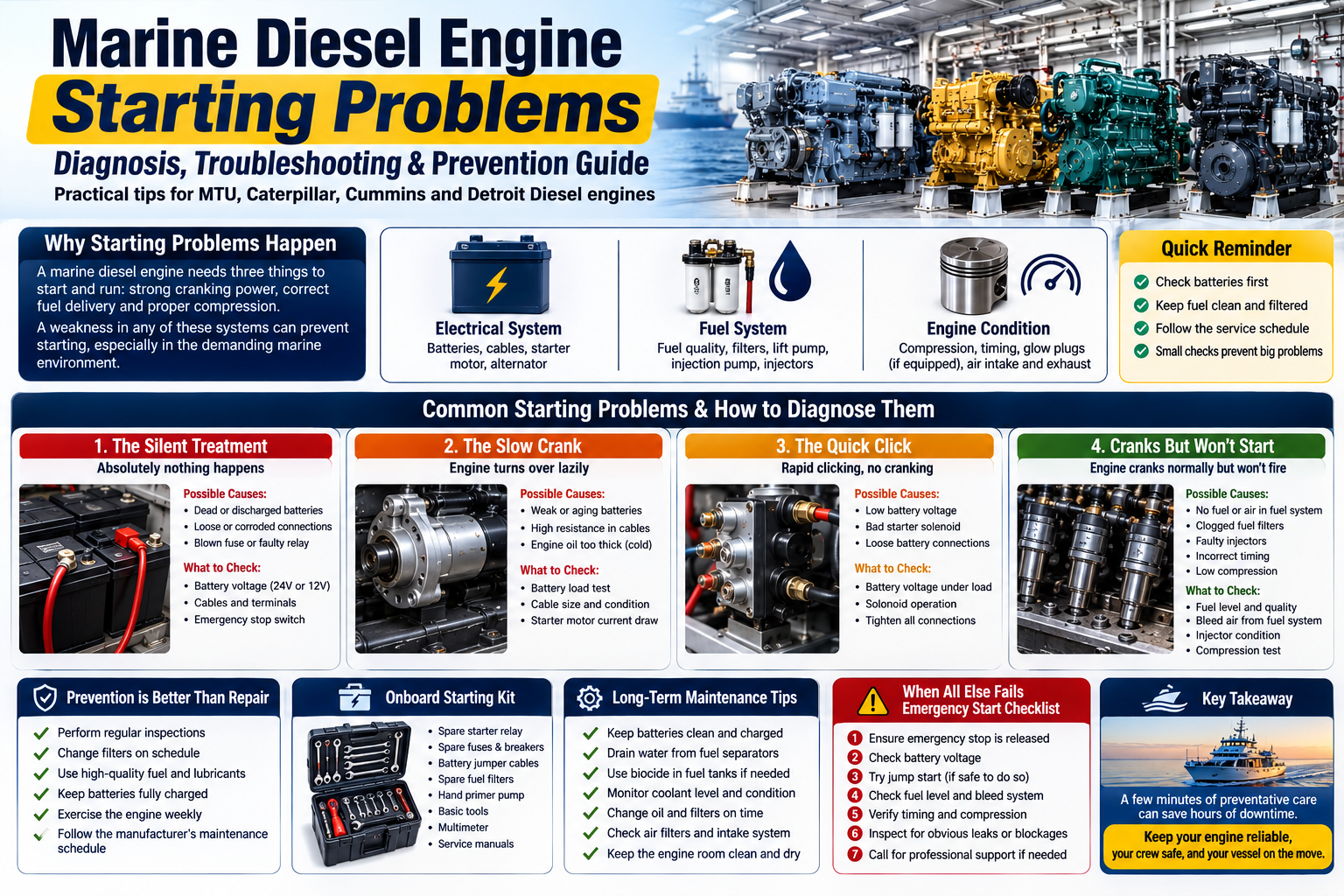
One of the biggest advantages of understanding your engine's starting system is that many problems follow predictable patterns.
Whether you're operating an MTU 16V4000 M73, MTU 12V4000 M90, Caterpillar C32, Caterpillar 3412, Cummins QSK19, Cummins KTA19, or a Detroit Diesel Series 60, recognising these symptoms can significantly reduce troubleshooting time.
Rather than replacing components at random, start by identifying exactly what the engine is doing—or not doing.
1. The Silent Treatment – Absolutely Nothing Happens
You turn the key or press the start button…
Nothing happens.
No crank.
No click.
No starter engagement.
This usually indicates that electrical power is not reaching the starter system.
Possible causes include:
- Discharged batteries.
- Battery isolation switch turned off.
- Loose battery terminals.
- Corroded electrical connections.
- Faulty starter relay.
- Blown fuse.
- Damaged wiring.
- Faulty ignition switch.
- Emergency stop activated.
Before replacing expensive components, always verify the condition of the electrical supply.
Many "dead engines" are simply suffering from poor battery connections.
2. The Slow Crank – Engine Turns Over Lazily
The starter engages, but the engine rotates much more slowly than normal.
This is one of the most common warning signs before complete starting failure.
Possible causes include:
- Weak batteries.
- Corroded battery cables.
- Poor earth connections.
- Worn starter motor.
- High resistance in electrical cables.
- Thick or contaminated engine oil.
- Mechanical resistance inside the engine.
If the engine normally cranks quickly but suddenly becomes sluggish, investigate immediately before the starter system becomes overloaded.
3. The Quick Click – Rapid Clicking, No Cranking
Rapid clicking from the starter solenoid usually indicates that the starter is attempting to engage but does not have enough electrical power to turn the engine.
Common causes include:
- Low battery voltage.
- Loose battery terminals.
- Corroded cable connections.
- Weak battery cells.
- Poor grounding.
Many marine engineers immediately begin by checking battery voltage before investigating other components.
4. Engine Cranks Normally but Will Not Start
Sometimes the starter turns the engine at normal speed, but combustion never begins.
In these situations, attention should shift from the electrical system to the fuel and air systems.
Possible causes include:
- Air trapped in the fuel system.
- Empty fuel tank.
- Blocked fuel filters.
- Contaminated diesel fuel.
- Water in the fuel.
- Fuel shut-off valve closed.
- Faulty lift pump.
- Injector problems.
This situation is frequently encountered after fuel filter replacement or extended engine storage.
5. Difficult Cold Starting
Cold weather creates additional challenges for every marine diesel engine.
Low temperatures can:
- Reduce battery capacity.
- Increase engine oil viscosity.
- Slow starter motor performance.
- Reduce fuel atomisation.
Engines that normally start easily may require additional attention during colder operating conditions.
Maintaining healthy batteries and using the correct engine oil significantly improves cold-start performance.
The Prevention Framework: STARTS for Marine Diesel
Experienced marine engineers understand that preventing starting problems is far easier than repairing them.
A useful way to remember the key preventive measures is the STARTS framework.
S – Service Batteries Regularly
Inspect:
- Battery voltage.
- Electrolyte condition (where applicable).
- Battery terminals.
- Cable connections.
- Charging system output.
Healthy batteries remain the foundation of every reliable starting system.
T – Test Electrical Connections
Electrical resistance caused by corrosion is a frequent source of starting issues.
Regularly inspect:
- Starter terminals.
- Battery cables.
- Ground straps.
- Alternator wiring.
- Electrical connectors.
Small amounts of corrosion can create surprisingly large voltage losses.
A – Always Monitor Fuel Quality
Clean fuel supports reliable starting.
Monitor:
- Fuel filters.
- Water separators.
- Fuel tanks.
- Fuel contamination.
- Diesel condition after long storage.
Preventing fuel contamination is often easier than removing it later.
R – Review the Starter System
Inspect:
- Starter motor.
- Starter solenoid.
- Ring gear.
- Mounting bolts.
- Electrical cables.
Listening for unusual starter noises often helps identify developing wear.
T – Track Engine Performance
Pay attention to:
- Cranking speed.
- Battery voltage.
- Starting time.
- Engine smoke.
- Unusual noises.
Gradual changes often provide early warning of developing problems.
S – Schedule Preventive Maintenance
Routine maintenance remains one of the most effective ways to avoid starting problems.
Follow recommended service intervals for:
- Batteries.
- Fuel filters.
- Starter system.
- Charging system.
- Electrical inspections.
Quick Fixes: The Marine Diesel Emergency Toolkit
Every vessel should carry basic equipment for diagnosing common starting problems.
Useful onboard items include:
- Digital multimeter.
- Battery tester.
- Spare fuses.
- Electrical contact cleaner.
- Battery terminal brush.
- Jumper leads where appropriate.
- Insulated hand tools.
- Flashlight.
- Spare fuel filters.
- Basic electrical connectors.
Many starting problems can be diagnosed quickly with simple tools.
Battery & Electrical Troubleshooting
When investigating electrical faults:
Start with the batteries.
Check:
- Battery voltage.
- Battery terminals.
- Cable tightness.
- Corrosion.
- Ground connections.
- Starter cable condition.
A systematic inspection often identifies faults without replacing unnecessary components.
Fuel System Solutions
If the electrical system is functioning correctly but the engine still refuses to start, inspect the fuel system.
Recommended checks include:
- Fuel level.
- Water separator.
- Fuel filters.
- Fuel shut-off valves.
- Fuel leaks.
- Air trapped in fuel lines.
- Fuel lift pump operation.
Maintaining clean fuel is essential for dependable engine starts.
Engine Room Insight
Experienced Chief Engineers know that starting problems rarely appear without warning.
An engine that gradually takes longer to start, cranks slightly slower, or occasionally hesitates is often telling you something.
Responding to these small warning signs usually prevents complete starting failure later.
Chief Engineer's Tip
Whenever troubleshooting a no-start condition, begin with the simplest possibilities before assuming major engine failure.
Ask yourself:
✔ Does the battery have sufficient voltage?
✔ Is the starter receiving power?
✔ Is clean fuel reaching the engine?
✔ Is the engine turning at normal cranking speed?
Following this logical sequence often saves valuable time and prevents unnecessary replacement of perfectly serviceable components.
We'll complete the guide with:
- Long-Term Solutions: Building a Prevention Plan
- Battery Management
- Fuel System Maintenance
- Starter System Care
- Advanced Troubleshooting Tools
- Hidden Costs of Ignoring Starting Problems
- Marine Diesel Maintenance Schedule
- RESCUE Emergency Checklist
- Frequently Asked Questions
- Related Marine Engine Parts
- Why Choose Alfa Marine Spare Parts
- Technical Reference
- Final Thoughts
Part 3 – Long-Term Prevention, Advanced Diagnostics & Taking Control of Your Marine Diesel Starting System
Long-Term Solutions: Building a Prevention Plan
The most effective way to avoid marine diesel engine starting problems is to prevent them before they occur.
Experienced marine engineers know that starting failures are rarely caused by a single catastrophic event. More often, they result from small issues that gradually develop over time—weak batteries, corroded terminals, contaminated fuel, worn starter motors, or neglected maintenance.
Whether you're operating an MTU 16V4000 M73, MTU 12V4000 M90, Caterpillar C32, Caterpillar 3412, Cummins QSK19, or a Detroit Diesel Series 60, a structured maintenance programme greatly improves starting reliability.
1. Battery Management
The battery system is the foundation of every successful engine start.
Regular battery maintenance should include:
- Checking battery voltage.
- Inspecting electrolyte levels (where applicable).
- Cleaning battery terminals.
- Tightening cable connections.
- Inspecting battery trays.
- Testing battery condition.
- Verifying alternator charging performance.
Many starting problems originate with batteries that appear healthy but have gradually lost capacity.
Routine testing allows replacement before complete failure occurs.
2. Fuel System Maintenance
Even the most powerful starter motor cannot start an engine if clean fuel is not reaching the injectors.
Preventive fuel system maintenance should include:
- Replacing fuel filters at recommended intervals.
- Draining water separators.
- Inspecting fuel tanks.
- Monitoring fuel quality.
- Checking for leaks.
- Inspecting fuel hoses.
- Keeping storage tanks clean.
Good fuel management reduces injector wear and improves cold-start performance.
3. Starter System Care
Although starter motors are built for demanding marine service, they still require routine inspection.
Maintenance should include checking:
- Starter mounting bolts.
- Solenoid operation.
- Electrical terminals.
- Ring gear condition.
- Cable insulation.
- Ground connections.
Abnormal starter noises often indicate wear before complete failure occurs.
Advanced Troubleshooting: Tools for In-Depth Checks
When routine inspections do not identify the cause of a starting problem, more advanced diagnostic equipment may be required.
Professional marine engineers commonly use:
- Digital multimeters.
- Battery load testers.
- Clamp meters.
- Insulation resistance testers.
- Fuel pressure gauges.
- Compression testers.
- Infrared thermometers.
- Electronic diagnostic software (where applicable).
These tools help identify faults quickly while reducing unnecessary parts replacement.
Investing in Prevention Pays Off
Preventive maintenance is almost always less expensive than emergency repairs.
Routine inspections help reduce:
- Unexpected engine failures.
- Emergency call-outs.
- Vessel downtime.
- Secondary engine damage.
- Lost operational time.
A planned maintenance programme also makes maintenance scheduling more predictable for fleet operators.
The Hidden Costs of Ignoring Starting Problems
A starting problem is rarely limited to the starter motor itself.
Repeated unsuccessful start attempts may result in:
- Battery damage.
- Starter motor overheating.
- Electrical cable damage.
- Fuel system air ingress.
- Increased maintenance costs.
- Operational delays.
Addressing problems early often prevents additional component failures.
A Practical Marine Diesel Maintenance Schedule
Daily
✔ Check battery voltage.
✔ Inspect for fuel leaks.
✔ Monitor engine starting time.
✔ Listen for unusual starter sounds.
Weekly
✔ Inspect battery terminals.
✔ Check electrical connections.
✔ Drain fuel water separators.
✔ Inspect starter cables.
Monthly
✔ Test battery condition.
✔ Inspect alternator output.
✔ Check starter mounting bolts.
✔ Inspect fuel hoses.
✔ Inspect earth connections.
Every Scheduled Service
✔ Replace fuel filters.
✔ Test charging system.
✔ Inspect starter motor.
✔ Inspect battery cables.
✔ Inspect engine wiring.
Following a structured maintenance schedule helps minimise unexpected starting failures.
Emergency Protocols When All Else Fails
If the engine refuses to start despite basic troubleshooting:
- Remain calm.
- Avoid repeated unnecessary starting attempts.
- Verify battery condition.
- Confirm fuel supply.
- Check emergency stop systems.
- Review engine alarms.
- Contact qualified technical support if necessary.
Repeated cranking without identifying the root cause may worsen the problem.
The RESCUE Checklist
A useful way to remember emergency troubleshooting is the RESCUE checklist.
R – Review alarms and indicators
Check engine displays, alarms, and warning lights.
E – Examine battery voltage
Verify batteries and electrical connections.
S – Supply fuel
Confirm clean fuel is available and reaching the engine.
C – Check electrical circuits
Inspect fuses, relays, starter cables, and wiring.
U – Understand the symptom
Is the engine:
- Completely silent?
- Clicking?
- Cranking slowly?
- Cranking normally but not firing?
Identifying the symptom greatly speeds diagnosis.
E – Escalate when necessary
If the problem cannot be safely identified onboard, consult qualified marine engineers or authorised service personnel.
Essential Onboard Kit
Every vessel should carry a basic starting-system troubleshooting kit.
Recommended items include:
- Digital multimeter.
- Battery tester.
- Spare fuses.
- Battery terminal cleaner.
- Contact cleaner.
- Basic electrical tools.
- Spare fuel filters.
- Flashlight.
- Insulated gloves.
- Maintenance logbook.
A well-equipped engine room allows faster diagnosis during unexpected situations.
Engine Room Insight
Experienced Chief Engineers know that the most reliable engines are not necessarily the newest—they are the ones that receive consistent preventive maintenance.
A five-minute battery inspection today may prevent several hours of troubleshooting next month.
Reliability is built through routine attention to small details.
Chief Engineer's Tip
Never ignore a starting system that "sometimes" works.
Intermittent faults usually become permanent faults at the least convenient time.
Investigate:
✔ Slower cranking.
✔ Occasional clicking.
✔ Voltage fluctuations.
✔ Longer starting times.
✔ Intermittent electrical faults.
Small warning signs almost always appear before complete failure.
Frequently Asked Questions
Why does my marine diesel engine crank but not start?
Common causes include:
- Air in the fuel system.
- Contaminated fuel.
- Blocked fuel filters.
- Fuel delivery problems.
- Electrical faults affecting fuel control systems.
A systematic inspection helps identify the root cause.
How long should marine batteries last?
Battery service life depends on:
- Maintenance.
- Charging practices.
- Operating environment.
- Temperature.
- Number of starting cycles.
Routine testing is more reliable than judging battery condition by age alone.
Can corroded battery terminals stop an engine from starting?
Yes.
Even minor corrosion increases electrical resistance, reducing the power available to the starter motor.
Regular cleaning and inspection help maintain reliable starting performance.
Is repeated cranking harmful?
Repeated unsuccessful starting attempts can:
- Overheat the starter motor.
- Drain batteries.
- Damage electrical components.
- Introduce unnecessary wear.
Always investigate the cause rather than repeatedly attempting to start the engine.
Why is preventive maintenance important?
Routine maintenance helps identify developing issues before they become operational failures.
This improves reliability, reduces downtime, and lowers long-term operating costs.
Related Marine Engine Parts
At Alfa Marine Spare Parts, we supply replacement components for many popular marine diesel engines, including:
- MTU Marine Engine Parts
- Caterpillar Marine Engine Parts
- Cummins Marine Engine Parts
- Detroit Diesel Marine Engine Parts
- MAN Marine Engine Parts
- Volvo Penta Marine Parts
- Yanmar Marine Parts
- Wärtsilä Marine Parts
Frequently requested starting-system components include:
- Starter Motors
- Starter Solenoids
- Alternators
- Battery Cables
- Fuel Filters
- Fuel Lift Pumps
- Fuel Injectors
- Water Separators
- Wiring Harnesses
- Engine Sensors
- Batteries
- Ring Gears
Why Choose Alfa Marine Spare Parts?
At Alfa Marine Spare Parts, we understand that dependable engine starts begin with dependable replacement parts.
Our experienced team helps identify compatible components using:
- Engine Model.
- Engine Serial Number.
- Arrangement Number.
- Existing Part Numbers.
- Technical Documentation.
We supply:
- Genuine Marine Parts.
- OEM Replacement Parts.
- Premium Aftermarket Components.
- Professionally Remanufactured Parts.
- Complete Engine Overhaul Components.
Whether you're maintaining an MTU 16V4000 M73, MTU 12V4000 M90, Caterpillar C32, Caterpillar 3412, Cummins, or Detroit Diesel Marine Engine, we're ready to help.
Industries We Support
We proudly support:
- Marine Engineers.
- Chief Engineers.
- Technical Superintendents.
- Shipyards.
- Commercial Shipping Companies.
- Offshore Operators.
- Fishing Fleets.
- Tugboat Operators.
- Passenger Ferry Companies.
- Government Fleets.
- Yacht Management Companies.
- Marine Service Companies.
- Boat Builders.
- Marine Equipment Distributors.
Worldwide Marine Spare Parts Supply
Alfa Marine Spare Parts supplies marine engine components worldwide, including:
- Spain
- Netherlands
- Germany
- Italy
- France
- Norway
- Greece
- United Kingdom
- United States
- Canada
- Brazil
- United Arab Emirates
- Saudi Arabia
- Qatar
- Nigeria
- South Africa
- Singapore
- Australia
We support commercial vessels, offshore fleets, fishing boats, ferries, patrol vessels, workboats, and recreational yachts across major maritime markets.
Browse Our Complete Marine Spare Parts Catalog
Looking for replacement parts for your marine diesel engine?
Browse our complete catalogue:
https://alfamarinespareparts.com/spareparts
Contact Alfa Marine Spare Parts
Need help identifying the correct replacement parts for your marine diesel engine?
Our experienced team is here to assist.
Website
https://alfamarinespareparts.com
Browse Our Marine Spare Parts Catalog
https://alfamarinespareparts.com/spareparts
request@alfamarinespareparts.com
Providing your engine model, serial number, arrangement number, or existing part number allows us to identify compatible replacement parts quickly and accurately.
Technical Reference
This guide is based on recognised marine engineering practices and maintenance principles applicable to marine diesel engines. Starting procedures, diagnostic methods, inspection routines, and maintenance requirements may vary depending on the engine model, installation, and operating conditions. Always consult the appropriate manufacturer service documentation before carrying out troubleshooting, maintenance, or repairs.
Taking Control of Your Marine Diesel Starting System
A dependable starting system is one of the foundations of reliable vessel operation. Whether your vessel is powered by an MTU 16V4000 M73, MTU 12V4000 M90, Caterpillar C32, Caterpillar 3412, Cummins, or Detroit Diesel Marine Engine, successful starts depend on healthy batteries, a clean fuel system, reliable electrical connections, and consistent preventive maintenance.
Most starting failures do not occur without warning. Slower cranking, occasional clicking, weak battery performance, or extended starting times often indicate that maintenance is required. Addressing these signs early can prevent unexpected downtime, reduce repair costs, and improve operational reliability.