Marine Diesel Engine Fuel Pumps Explained: Cummins, Detroit Diesel & Caterpillar
A marine diesel engine can have perfect compression, clean air, a healthy turbocharger, and a good cooling system—and still refuse to run correctly if the fuel system cannot deliver fuel at the correct pressure and quantity.
That is why the marine diesel fuel pump deserves more attention than it sometimes receives.
But there is an important complication:
“Fuel pump” does not mean exactly the same thing on every marine diesel engine.
A classic Detroit Diesel 6-71 has a very different fuel system from a modern Cummins QSB6.7.
And a Caterpillar C18 or C32 installation may use a different fuel-system architecture again.
Understanding these differences can make troubleshooting easier and can help prevent ordering the wrong component.
1. What Does a Marine Diesel Fuel Pump Actually Do?
At the simplest level, the fuel system has to move diesel from the vessel's fuel tank to the engine and ultimately into the combustion chamber.
But several different components may be involved.
Depending on engine design, you may have:
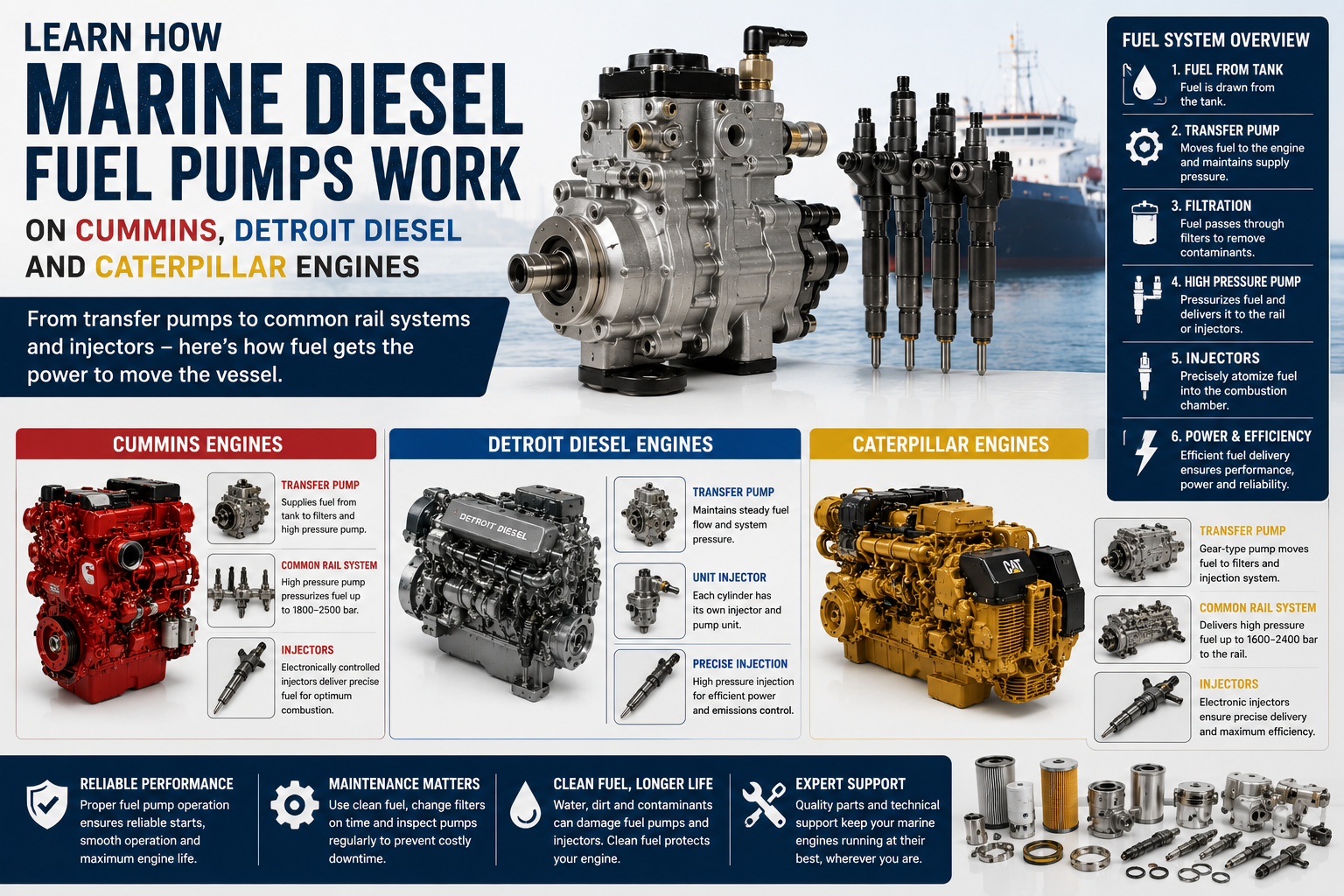
Fuel transfer/lift pump → filters → high-pressure pump or injector system → injectors → combustion chamber
The terminology matters.
When someone calls and says:
“I need a fuel pump.”
the first question should be:
Which fuel pump?
They might mean:
- Fuel transfer pump
- Lift pump
- Priming pump
- High-pressure fuel pump
- Injection pump
- Common-rail pump
Those are not automatically the same component.
2. Low-Pressure and High-Pressure Fuel Pumps Are Different
This is one of the easiest distinctions to understand.
Low-Pressure Side
The low-pressure side moves fuel from the vessel's tank through the filtration system toward the engine's injection equipment.
Components can include:
- Tank pickup
- Fuel lines
- Water separator
- Primary filter
- Transfer pump
- Secondary filter
High-Pressure Side
On engines using common-rail technology, another pump raises fuel pressure dramatically before fuel reaches the rail and injectors.
That is the high-pressure fuel pump.
So if a modern common-rail engine is suffering from low rail pressure, replacing the ordinary transfer pump without diagnosing the system may accomplish nothing.
3. Why Fuel Pressure Matters
A diesel engine does not simply need fuel.
It needs fuel delivered under the correct conditions.
Injection quality affects:
- Atomization
- Combustion
- Engine power
- Starting
- Smoke
- Fuel consumption
- Exhaust temperature
- Emissions
Modern common-rail engines take this to another level.
For example, Cummins states that its QSK95 high-pressure common-rail system can operate at injection pressures up to 2,500 bar.
At pressures like these, fuel cleanliness and correct service procedures become extremely important.
4. Cummins Marine Fuel Pumps: The System Depends on the Engine Generation
Cummins has produced marine engines across several generations.
That means there is no single “Cummins marine fuel pump.”
You may encounter engines from families such as:
- Cummins B Series
- Cummins 6BT
- Cummins 6BTA
- Cummins 6CTA
- Cummins NT855
- Cummins NTA855
- Cummins VTA28
- Cummins KTA19
- Cummins KTA38
- Cummins KTA50
- Cummins QSB
- Cummins QSC
- Cummins QSL
- Cummins QSM
- Cummins QSK
Older mechanical engines and newer electronically controlled engines can use fundamentally different fuel-system technology.
5. Older Cummins Fuel Systems vs. Modern Common Rail
This is where Cummins becomes particularly interesting.
An older Cummins marine engine may use a mechanical fuel system.
A modern Cummins QSB6.7 uses:
High-Pressure Common Rail
Cummins specifically lists HPCR as the QSB6.7 marine engine's fuel system.
Large modern Cummins engines can also use Modular Common Rail Fuel Systems (MCRS).
The QSK60 marine engine, for example, uses a modular common-rail system designed to maintain high injection pressure across changing engine speed and load.
So:
Cummins KTA fuel system ≠ Cummins QSB fuel system ≠ Cummins QSK common-rail system.
The engine model matters.
6. What Does a Cummins Common-Rail Fuel Pump Do?
Think of the common rail as a high-pressure fuel reservoir.
The high-pressure pump supplies this rail.
Then electronically controlled injectors determine when and how fuel is delivered into individual cylinders.
One advantage is that injection pressure can be less dependent on engine speed than in older mechanical systems.
Cummins explains that high-pressure common rail can improve combustion, fuel economy, injection control, and overall engine performance. Its current common-rail systems can operate at pressures up to 2,600 bar, depending on system design.
For a marine engineer, however, this also means:
contamination becomes a serious enemy.
7. Why Clean Fuel Matters So Much on Modern Cummins Engines
Imagine extremely small clearances operating at more than 2,000 bar.
Now introduce:
- Water
- Rust
- Dirt
- Metal particles
- Contaminated diesel
You can see the problem.
Fuel contamination can damage expensive:
- High-pressure pumps
- Injectors
- Control components
Cummins specifically emphasizes filtration protection on its high-pressure marine systems; for example, the QSK95 uses NanoNet filtration to protect against fuel contamination.
A relatively inexpensive filter can therefore protect fuel-system components worth thousands.
8. Detroit Diesel Fuel Pumps: A Completely Different Story
Now move from a modern Cummins common-rail engine to a classic Detroit Diesel.
Consider:
Detroit Diesel 6-71
8V71
6V92
8V92
These engines belong to Detroit Diesel's famous two-stroke generation.
Their fuel-system architecture is fundamentally different from a modern common-rail Cummins.
This is why saying:
“A diesel fuel pump works the same way on every engine.”
is incorrect.
9. Classic Detroit Diesel Uses Unit Injectors
On classic Detroit Diesel two-stroke engines, fuel is supplied at relatively low pressure to unit injectors.
The injector itself performs the high-pressure injection function at the cylinder.
That is very different from:
high-pressure pump → common rail → electronically controlled injectors.
So on a classic Detroit Diesel, the fuel pump you're discussing may actually be the pump responsible for circulating/supplying fuel to the injectors, rather than a modern high-pressure common-rail pump.
This distinction matters enormously when diagnosing fuel problems.
10. The Detroit Diesel Fuel Pump Has an Important Supply Job
The fuel pump must provide adequate fuel supply through the engine's fuel circuit.
If fuel delivery becomes insufficient, possible symptoms can include:
- Hard starting
- Reduced power
- Unstable operation
- Fuel starvation
- Engine shutdown
But don't automatically blame the pump.
A restriction elsewhere can create similar symptoms.
Always consider:
- Fuel tank
- Pickup tube
- Fuel lines
- Filters
- Air leaks
- Shutoff components
- Pump condition
- Injector condition
A new pump cannot pull fuel through a completely blocked filter.
11. Detroit Diesel Series 60 Changes Everything Again
Then Detroit Diesel introduced the Series 60.
Now we are dealing with a four-stroke electronically controlled engine rather than the classic mechanical Detroit two-stroke architecture.
MTU's marine Series 60 documentation identifies an engine gear-driven fuel lift pump together with electronically controlled unit injectors.
That is an excellent example of why the engine model must always be identified.
A:
Detroit Diesel 8V71
and a:
Detroit Diesel Series 60
both say Detroit Diesel on the engine.
But their fuel systems belong to very different generations.
12. Caterpillar Marine Fuel Pumps: Again, Engine Model Matters
Caterpillar has produced an enormous range of marine engines.
Common examples include:
- Caterpillar 3208
- Caterpillar 3304
- Caterpillar 3306
- Caterpillar 3406
- Caterpillar 3408
- Caterpillar 3412
- Caterpillar C9
- Caterpillar C12
- Caterpillar C15
- Caterpillar C18
- Caterpillar C32
- Caterpillar 3500 Series
- Caterpillar 3600 Series
- Caterpillar C280
You cannot discuss a Caterpillar marine fuel pump accurately without first knowing which engine generation is involved.
Older mechanically controlled engines and newer electronically managed engines can use very different fuel-delivery strategies.
13. Caterpillar Fuel Transfer Pumps
Current Caterpillar marine specifications provide a useful example.
The C18 commercial marine engine includes a gear-driven fuel transfer pump and a manual fuel priming pump.
The C32 commercial marine engine likewise includes a gear-driven fuel transfer pump, along with fuel filtration and priming equipment.
That transfer pump performs an important job:
getting an adequate supply of clean fuel to the engine's injection system.
If supply pressure or flow becomes inadequate, the injection system cannot work correctly.
14. Caterpillar Common-Rail Marine Engines
Some newer Caterpillar marine engines use common-rail technology.
For example, Caterpillar's current C7.1 marine propulsion engine uses a common-rail fuel system, which Caterpillar says supports optimized combustion and reduced emissions.
This creates the same important distinction we saw with Cummins:
fuel transfer pressure
is not the same as:
high-pressure injection/rail pressure.
When troubleshooting, know which side of the system you're measuring.
15. Cummins vs. Detroit Diesel vs. Caterpillar Fuel Systems
Here is a simplified comparison:
| Engine ExampleFuel-System CharacterPump Role | ||
| Older Cummins | Mechanical fuel system | Mechanical supply/injection functions depending on model |
| Cummins QSB6.7 | High-pressure common rail | Supply + high-pressure rail generation |
| Cummins QSK | Modular/high-pressure common rail on applicable models | High-pressure fuel delivery |
| Detroit Diesel 6-71 / 8V71 | Mechanical unit injector | Fuel supply/circulation to unit injectors |
| Detroit Diesel 6V92 / 8V92 | Mechanical unit injector | Fuel supply/circulation to unit injectors |
| Detroit Diesel Series 60 | Electronic unit injector | Gear-driven lift pump supplies electronically controlled injectors |
| Older Caterpillar | Model-dependent mechanical systems | Depends on engine family |
| Newer Cat common-rail engines | Electronically controlled common rail | Low-pressure supply + high-pressure injection system |
The important lesson is simple:
Do not diagnose the pump until you understand the fuel-system architecture.
16. What Are the Symptoms of a Failing Marine Diesel Fuel Pump?
Depending on the system, symptoms can include:
- Difficult starting
- Engine cranks but does not start
- Loss of power
- Engine hesitation
- Unstable rpm
- Fuel starvation under load
- Failure to reach rated rpm
- Engine shutdown
- Low fuel pressure
- Low rail pressure on common-rail engines
- Increased smoke
- Poor acceleration
But these symptoms do not prove the fuel pump has failed.
That distinction can save a lot of money.
17. “My Engine Loses Power Under Load—Is It the Fuel Pump?”
Maybe.
But before ordering one, check the rest of the fuel path.
A marine engine that runs normally at idle but loses power under heavy load may have insufficient fuel flow.
Possible causes include:
- Clogged primary filter
- Clogged secondary filter
- Blocked tank pickup
- Restricted fuel line
- Air entering the suction side
- Tank vent problem
- Contaminated fuel
- Weak transfer pump
- High-pressure pump problem
- Injector problem
The engine demands much more fuel under load than at idle.
A partially restricted system may therefore appear perfectly normal at the dock.
Then the vessel gets underway and the problem appears.
18. Don't Replace the Pump Before Checking the Filters
This sounds simple.
But it is worth emphasizing.
If fuel pressure is low, check the filters.
A badly restricted filter can make a healthy pump appear weak.
Ask:
When were the filters changed?
But don't stop there.
Inspect the old filters.
If they are unusually contaminated, ask:
Why?
A new filter solves the restriction.
It does not solve a contaminated fuel tank.
19. Air Leaks Can Look Like Fuel-Pump Problems
The suction side of a marine fuel system can sometimes draw air without leaking much fuel externally.
That makes diagnosis frustrating.
Possible symptoms include:
- Hard starting
- Unstable running
- Loss of prime
- Engine stopping
- Reduced power
Inspect:
- Hose connections
- Fittings
- Filter seals
- Water separator
- Gaskets
- Fuel lines
A tiny air leak can create a surprisingly large operational problem.
20. Water Is One of the Biggest Enemies of a Marine Fuel System
Marine environments and water unfortunately go together.
Diesel fuel systems and water do not.
Water contamination can contribute to:
- Corrosion
- Injector damage
- Pump damage
- Poor combustion
- Filter problems
- Microbial contamination
On high-pressure common-rail systems, the consequences can become particularly expensive.
If water repeatedly appears in the separator, don't simply drain it every day forever.
Find out:
How is the water entering the fuel?
21. Fuel Tank Condition Matters
Sometimes the engine receives all the blame.
But the real problem is several meters away.
Inside the fuel tank.
Older marine tanks can accumulate:
- Water
- Sediment
- Rust
- Microbial contamination
- Sludge
Rough seas can disturb material that has been sitting at the bottom of the tank for years.
Suddenly:
filters block.
The engine loses power.
And somebody orders a fuel pump.
Before replacing expensive engine components, consider what is actually arriving from the tank.
22. Fuel Priming Pumps Have a Different Job
A priming pump helps fill the fuel system and remove air after:
- Filter replacement
- Maintenance
- Fuel-system opening
- Loss of prime
It is not necessarily the pump responsible for maintaining the engine's full operating fuel requirement.
Caterpillar, for example, lists both fuel transfer pumps and manual priming pumps on current C18 and C32 marine engines
Again:
Know which pump you're talking about.
23. Why Common-Rail Fuel Pumps Are Expensive Components
Modern high-pressure pumps operate under extraordinary conditions.
Cummins common-rail pump systems can reach pressures up to 2,600 bar, depending on system design.
At those pressures, precision matters.
Internal components must operate with extremely close tolerances.
That is why:
- Contamination
- Incorrect fuel
- Poor filtration
- Water
can become so damaging.
Protecting the pump begins long before fuel reaches it.
24. Why Fuel Filters Are Cheap Insurance
Compare the cost of a fuel filter with:
- High-pressure pump
- Multiple injectors
- Labor
- Vessel downtime
The filter suddenly looks very inexpensive.
Good fuel-system maintenance starts with:
clean fuel + water separation + correct filtration.
This applies whether the engine is a classic Detroit Diesel or a modern common-rail Cummins or Caterpillar.
The technology may change.
The importance of clean fuel does not.
25. Should You Rebuild or Replace a Marine Fuel Pump?
That depends on:
- Pump type
- Engine model
- Damage
- Parts availability
- Repair specifications
- Workshop capability
- Cost
- Required turnaround time
Some mechanical pumps can be professionally rebuilt.
Modern high-pressure pumps require much more specialized equipment and cleanliness.
A pump should never be casually dismantled on a dirty workbench simply because:
“It's only a diesel pump.”
Precision fuel equipment deserves precision working conditions.
26. What Should You Check Before Ordering a Fuel Pump?
Before ordering, record:
Engine Manufacturer: __________
Engine Model: __________
Engine Serial Number: __________
Fuel Pump Part Number: __________
Pump Type: Transfer / Lift / High Pressure / Injection / Other
Rated Engine Power: __________
Rated RPM: __________
Application: Propulsion / Generator / Auxiliary
Quantity: __________
Photographs: Attached
This is especially important on older engines where components may have been changed during previous repairs.
27. Common Marine Fuel-System Spare Parts
Fuel-system inquiries may involve:
- Fuel transfer pumps
- Lift pumps
- High-pressure pumps
- Injection pumps
- Priming pumps
- Fuel injectors
- Unit injectors
- Common-rail injectors
- Fuel rails
- Fuel filters
- Water separators
- Pressure regulators
- Fuel lines
- Seals
- O-rings
- Sensors
- Electronic fuel-control components
The correct component depends entirely on the engine's fuel-system architecture.
28. Marine Engineer Tip: Start at the Tank
When troubleshooting fuel starvation, don't immediately start at the most expensive component.
Follow the fuel.
Tank
↓
Pickup
↓
Fuel line
↓
Water separator / primary filter
↓
Transfer or lift pump
↓
Secondary filtration
↓
Injection equipment
↓
Injector
↓
Cylinder
The exact layout varies by engine, but the principle is useful.
Find the point where fuel delivery stops meeting specification.
That is far more reliable than replacing components based on symptoms alone.
29. Frequently Asked Questions
What Does a Marine Diesel Fuel Pump Do?
It depends on the pump. A transfer or lift pump moves fuel through the low-pressure side, while a high-pressure pump on a common-rail engine creates the pressure required by the injection system.
Does Every Marine Diesel Have a High-Pressure Fuel Pump?
Not in the modern common-rail sense. Classic Detroit Diesel two-strokes, for example, use unit injectors and a different fuel-supply architecture.
Does the Cummins QSB6.7 Use Common Rail?
Yes. Cummins identifies the QSB6.7 marine engine as using a high-pressure common-rail fuel system.
Do Large Cummins QSK Marine Engines Use Common Rail?
Applicable QSK models do. For example, Cummins describes the QSK60 marine engine as using a Modular Common Rail Fuel System.
Does a Detroit Diesel Series 60 Have a Fuel Pump?
Yes. MTU marine documentation identifies a gear-driven fuel lift pump supplying electronically controlled unit injectors on the Series 60.
Do Caterpillar C18 and C32 Marine Engines Have Fuel Transfer Pumps?
Yes. Caterpillar's current specifications list gear-driven fuel transfer pumps on these marine engine families.
Does Caterpillar Use Common-Rail Fuel Systems?
Some current Caterpillar marine engines do. Caterpillar specifically identifies a common-rail fuel system on its current C7.1 marine propulsion engine.
Can a Clogged Fuel Filter Look Like a Bad Fuel Pump?
Yes. Restricted fuel flow can produce symptoms such as power loss and fuel starvation. Diagnosis should verify fuel pressure and restriction before the pump is condemned.
Can Water Damage a High-Pressure Fuel Pump?
Fuel contamination, including water, can damage precision fuel-system components. Filtration and water separation are particularly important on modern high-pressure systems.
Marine Diesel Fuel Pump Parts
Alfa Marine Spare Parts supports inquiries for marine diesel fuel-system components for engines including:
Cummins Marine Engines
Detroit Diesel Marine Engines
Caterpillar Marine Engines
Requirements can include transfer pumps, injection-system components, high-pressure pumps, injectors, filters, seals, and related fuel-system parts depending on engine type and availability.
When requesting a component, always provide the engine model, serial number, existing part number, and photographs where available.
Browse Our Complete Catalog
Marine engine brands:
Alfa Marine Spare Parts – Marine Engine Brands
Marine spare parts:
Alfa Marine Spare Parts – Spare Parts Catalog
Contact Alfa Marine Spare Parts
For marine diesel fuel pumps, injectors, filters, and related fuel-system components:
Email: request@alfamarinespareparts.com
Include:
engine manufacturer + engine model + serial number + fuel-pump part number + quantity + delivery location.
Final Word
A marine diesel fuel pump sounds like a simple component until you compare three different engines.
A classic Detroit Diesel 6-71 uses a mechanical unit-injector system where the fuel pump supplies fuel to injectors that perform the injection-pressure function themselves.
A modern Cummins QSB6.7 uses high-pressure common rail.
And Caterpillar's marine range includes engines with transfer-pump arrangements as well as newer common-rail technology depending on engine family.
The technology changed.
The basic rule did not:
A diesel engine needs clean fuel, adequate supply, correct pressure, and precise injection.
So when a marine engine loses power, becomes difficult to start, or develops a fuel-pressure problem, don't begin with:
“Which pump should we replace?”
Begin with:
“Where in the fuel system are we losing correct fuel delivery?”
That question can prevent unnecessary parts replacement—and lead you to the real problem much faster.
Meta Title: Marine Diesel Engine Fuel Pumps Explained | Alfa Marine Spare Parts
Meta Description: Learn how marine diesel fuel pumps work on Cummins, Detroit Diesel and Caterpillar engines, including transfer pumps, common rail and injectors.