Detroit Diesel Marine Engines: What Is the Difference, and Which Engine Fits Which Vessel?
When somebody says:
“I have a Detroit Diesel marine engine.”
that still leaves a lot of possibilities.
It could be an old 4-53 in a workboat.
A 6-71 might be powering a classic sportfishing boat or tug.
An 8V71 could be installed in a larger yacht.
A 6V92 or 8V92 may be working in a commercial vessel.
Or the engine could be a Detroit Diesel Series 60, representing an entirely different four-stroke generation.
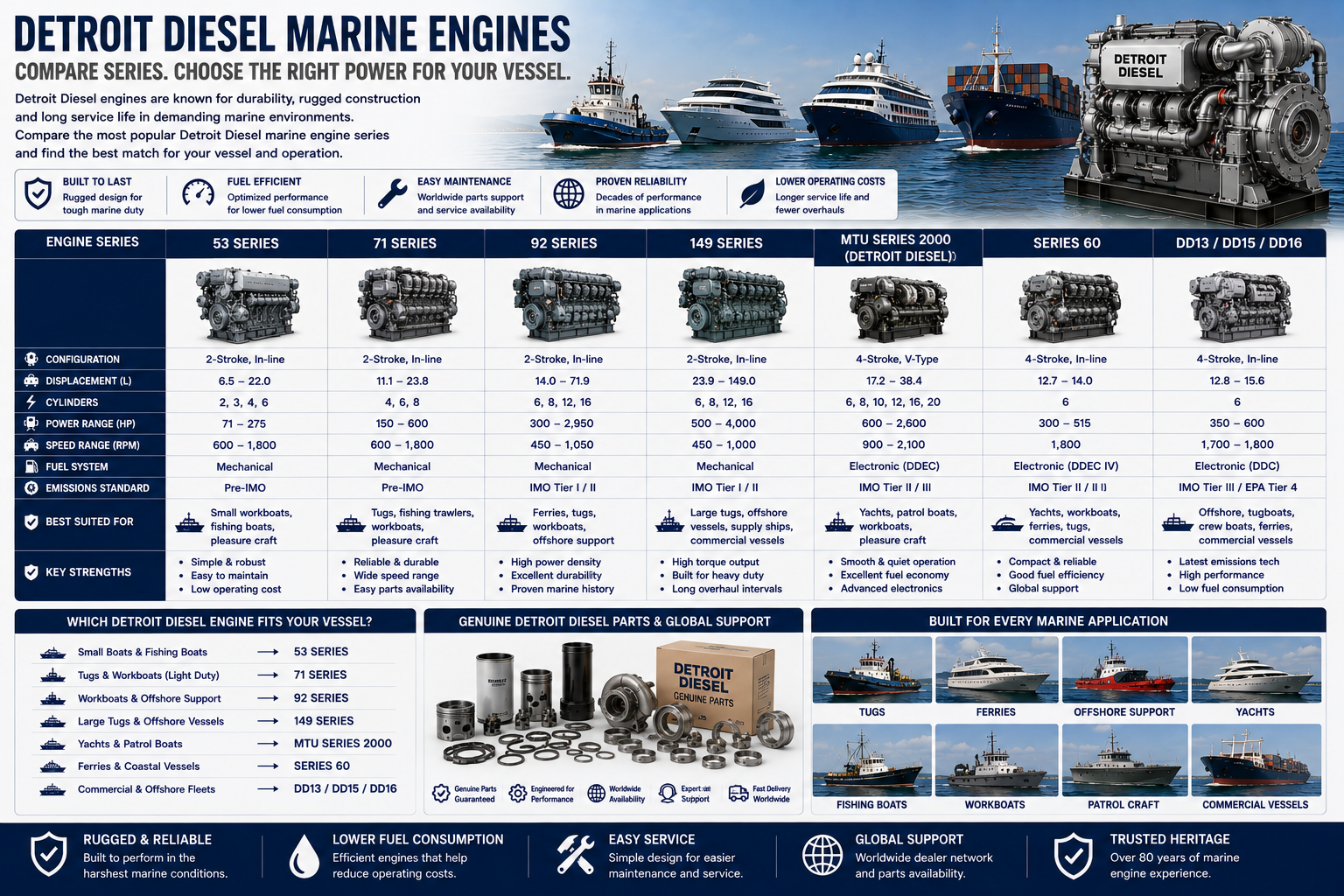
Detroit Diesel’s marine history is especially interesting because it includes several famous two-stroke diesel families, followed later by electronically controlled four-stroke engines. MTU’s historical documentation identifies the Series 71 as the original Detroit Diesel 2-Cycle family, followed by the Series 53, Series 149 and Series 92. The Series 60 arrived in 1987 as Detroit Diesel’s first four-stroke engine.
So the useful question is not:
“Which Detroit Diesel is best?”
It is:
“Which Detroit Diesel family is it, how many cylinders does it have, and what type of vessel is it powering?”
Understanding the Main Detroit Diesel Marine Engine Families
A simple way to understand the major Detroit Diesel families is:
| Detroit Diesel FamilyBasic CharacterTypical Marine Applications | ||
| Series 53 | Compact 2-stroke diesel | Small workboats, fishing vessels, auxiliaries |
| Series 71 | Classic 2-stroke workhorse | Yachts, fishing boats, tugs, generators |
| Series 92 | Larger high-output 2-stroke | Yachts, commercial vessels, workboats |
| Series 149 | Very large 2-stroke engine | Large commercial, industrial and marine applications |
| Series 60 | Electronic 4-stroke inline-six | Commercial vessels, yachts, patrol boats |
The numbers in the older Detroit Diesel family names originally referred to cubic inches of displacement per cylinder. For example, the Series 71 used approximately 71 cubic inches per cylinder, while the Series 53 and Series 92 used approximately 53 and 92 cubic inches per cylinder respectively.
That naming system makes Detroit Diesel unusual compared with many modern engine manufacturers.
Why Detroit Diesel Two-Stroke Engines Became So Famous
Most modern diesel engines are four-stroke.
Detroit Diesel became famous for doing things differently.
Its Series 53, 71, 92 and 149 engines use the two-stroke diesel cycle.
That means the engine completes its working cycle in one crankshaft revolution rather than two.
The result is a very recognizable engine design and sound.
Marine engineers often associate these engines with:
- High power for their era
- Compact construction
- Simple modular architecture
- Roots-type blower systems
- Distinctive exhaust sound
- Mechanical fuel systems on many versions
The Series 71 was introduced in 1938 and became the foundation for later Detroit Diesel 2-Cycle families.
Detroit Diesel Series 53: The Compact Two-Stroke
The Series 53 was introduced in the late 1950s.
MTU’s Detroit Diesel history identifies Series 53 as the next major family after the Series 71.
The “53” means approximately:
53 cubic inches displacement per cylinder.
Common configurations included engines such as:
3-53
4-53
6V53
and other variants.
These engines were compact and relatively light for the power they could produce.
Which Boats Suit a Series 53?
Think:
- Small commercial fishing boats
- Harbor workboats
- Small tugs
- Utility vessels
- Marine generators
- Older military or government craft
- Repowered classic boats
Series 53 Personality
The Compact Screamer
Small by Detroit Diesel standards, mechanically straightforward and unmistakably two-stroke.
Inline vs. V-Type Series 53
Detroit Diesel used both inline and V configurations.
An engine such as:
4-53
uses an inline four-cylinder arrangement.
A:
6V53
has six cylinders in a V configuration.
The V layout allows more cylinders to fit into a shorter engine package.
That is especially useful where engine-room length is limited.
But it also creates:
- Two cylinder banks
- More complex access
- More exhaust routing
- More components during overhaul
Detroit Diesel Series 71: The Legend
If there is one Detroit Diesel family that became a legend, it is the Series 71.
MTU describes it as the “grandfather” of the Detroit Diesel 2-Cycle family. It entered production in 1938 and originally appeared in inline configurations from one to six cylinders. Each cylinder displaced approximately 71 cubic inches, or about 1.16 liters.
That means the famous:
6-71
has roughly six times 71 cubic inches of displacement.
But Series 71 grew far beyond the inline-six.
Marine engineers may encounter:
- 3-71
- 4-71
- 6-71
- 6V71
- 8V71
- 12V71
- 16V71
depending on era and application.
Why Is the 6-71 So Famous?
The 6-71 is probably one of the most recognizable diesel engines ever built.
It has been used in:
- Boats
- Trucks
- Buses
- Military vehicles
- Generators
- Industrial equipment
In the marine world, you may find it in:
- Fishing boats
- Tugs
- Classic motor yachts
- Workboats
- Passenger craft
- Generator sets
Its reputation came from:
simple mechanical construction
modular design
wide parts availability
and
ability to run for very long periods when properly maintained.
MTU documents one Series 71 engine that reportedly remained in service for 62 years before retirement without a complete rebuild, illustrating just how durable the design could be in the right application.
Series 71: Inline vs. V Engines
The difference is important.
6-71
Inline six.
Long and relatively narrow.
Straightforward access.
8V71
V8 configuration.
Shorter for its cylinder count.
More total displacement and power.
12V71
V12.
Large commercial and high-output marine applications.
A 6-71 and a 12V71 share the same Series 71 heritage, but the total engine size and overhaul scope are completely different.
What Boats Use the 8V71?
The 8V71 became especially common in older:
- Motor yachts
- Sportfishing vessels
- Passenger boats
- Commercial workboats
- Tugs
- Military craft
For many yacht owners, an 8V71 represents the classic Detroit Diesel experience:
mechanical injection + blower + turbocharging on some versions + distinctive two-stroke sound.
Detroit Diesel 12V71: Serious Classic Marine Power
The 12V71 takes the same basic cylinder architecture and doubles down.
Now you have:
12 cylinders
two banks
and a much larger overhaul project.
Typical applications have included:
- Large yachts
- Workboats
- Tugs
- Government vessels
- Commercial craft
- Auxiliary machinery
MTU even documents a fireboat installation where two 12V Series 71 engines powered water pumps, while other Detroit Diesel engines handled propulsion and generation duties.
This shows how widely Detroit 2-Cycle engines were used onboard.
Detroit Diesel Series 92: More Displacement per Cylinder
The Series 92 arrived later.
MTU’s historical information states that the Series 92 was introduced in 1974, with approximately 1.51 liters displacement per cylinder.
The increase from 71 to 92 cubic inches per cylinder gave Detroit Diesel a larger platform for higher-output applications.
Common models included:
- 6V92
- 8V92
- 12V92
- 16V92
depending on application.
Series 92 Personality
The Bigger Two-Stroke
More displacement per cylinder than the Series 71 and well suited to higher-output yacht and commercial installations.
Detroit Diesel 6V92
The 6V92 became a familiar engine in:
- Motor yachts
- Fishing vessels
- Workboats
- Passenger boats
- Commercial craft
It combines six cylinders with the larger 92-cubic-inch-per-cylinder architecture.
Compared with a 6V71, you are dealing with greater total displacement.
That generally means more potential torque and power depending on rating.
Detroit Diesel 8V92
The 8V92 is probably one of the best-known Series 92 marine engines.
Typical installations include:
- Large motor yachts
- Sportfishing boats
- Commercial fishing vessels
- Passenger craft
- Workboats
For many mechanics, the 8V92 represents peak classic Detroit 2-Cycle marine engineering before modern electronically controlled four-stroke engines took over.
Series 71 vs. Series 92: What Is the Difference?
A simple comparison:
Series 71
Approximately 71 cubic inches per cylinder
Older foundational Detroit Diesel platform.
Very large installed population.
Series 92
Approximately 92 cubic inches per cylinder
More displacement per cylinder.
Introduced later for higher-output applications.
The engines may look related externally, but you should never assume internal parts are interchangeable.
Detroit Diesel Series 149: The Heavyweight
Then there is the Series 149.
MTU history identifies the Series 149 as a heavy-duty Detroit Diesel 2-Cycle family introduced in the 1960s, with approximately 2.44 liters displacement per cylinder.
This is a huge jump from Series 53, 71 or 92.
Marine and industrial versions included large V configurations.
One documented marine example is the fireboat Curtis Randolph, equipped with twin 12V Series 149 engines for main propulsion.
That tells you exactly where the Series 149 sits.
This is large commercial machinery.
Which Boats Suit a Series 149?
Think:
- Large fireboats
- Heavy commercial vessels
- Offshore equipment
- Specialized government vessels
- Large auxiliary machinery
It belongs in a completely different power class from a 4-53 or 6-71.
Series 149 Personality
The Two-Stroke Heavyweight
Large cylinders, large displacement and designed for serious commercial power.
Detroit Diesel Series 60: Everything Changes
Then Detroit Diesel made a major change.
The Series 60, introduced in 1987, was Detroit Diesel’s first four-stroke engine.
MTU’s historical documentation also notes that the Series 60 was the first production diesel engine to feature integrated electronic controls as standard.
That is a huge technological shift.
Old Detroit Diesel:
mechanical two-stroke
Newer Series 60:
electronic four-stroke.
Series 60 Marine Engine
The marine Series 60 was offered for different operating profiles.
MTU marine documentation lists Series 60 configurations for:
- Unrestricted continuous operation
- High-load-factor vessels
- Low-load-factor fast vessels
One unrestricted-continuous marine specification covers approximately 261–373 kW / 350–500 bhp, while another high-load marine version covers approximately 354–447 kW.
Typical applications can include:
- Commercial workboats
- Fishing vessels
- Passenger craft
- Patrol boats
- Fast yachts
MTU documentation for low-load-factor Series 60 applications specifically lists fast yachts, fast patrol boats and police craft.
Series 60 vs. 8V92: Completely Different Generations
This is a useful comparison.
Detroit Diesel 8V92
Two-stroke.
Mechanical heritage.
V8.
Roots-blower-based scavenging.
Classic Detroit sound.
Detroit Diesel Series 60
Four-stroke.
Inline six.
Electronic engine control.
Different fuel and combustion architecture.
They are both Detroit Diesel.
But mechanically they belong to completely different generations.
What Does “2-Cycle” Actually Mean?
Detroit Diesel traditionally called these engines 2-Cycle.
The engine completes the intake, compression, combustion and exhaust process in one crankshaft revolution.
A Roots-type blower supplies scavenging air.
This blower is essential.
It isn't simply an optional performance accessory.
Without airflow from the blower, the engine cannot properly clear exhaust gases and fill the cylinders with fresh air.
That is one reason Detroit Diesel 2-Cycle engines have such a distinctive mechanical layout.
The Blower Is Not the Same Thing as a Turbocharger
This causes confusion.
Many Detroit Diesels use:
blower + turbocharger
together.
The blower is required for scavenging.
A turbocharger adds additional compressed air for performance.
So when someone says:
“The supercharger is bad.”
they may really be referring to the Detroit Diesel blower.
Correct terminology helps when ordering parts.
Naturally Aspirated vs. Turbocharged Detroit Diesel
Some older Detroit Diesel engines were naturally aspirated in the sense that they did not have an exhaust-driven turbocharger, although the 2-Cycle design still uses a blower.
Later and higher-output versions added turbocharging.
Turbocharged and aftercooled configurations can produce considerably more power.
But they also add more maintenance:
- Turbo bearings
- Compressor condition
- Exhaust turbine
- Oil supply
- Aftercooler
- Boost pressure
A naturally aspirated 6-71 and turbocharged 6-71 should not automatically be treated as the same engine specification.
Why Detroit Diesels Have Such a Recognizable Sound
Anyone who has worked around a classic Detroit Diesel knows the sound.
Part of that comes from the two-stroke firing pattern.
Because combustion occurs every crankshaft revolution, firing events occur more frequently than in a four-stroke engine of similar cylinder count.
Combine that with:
- Roots blower
- Exhaust system
- Mechanical injection
- Higher operating speed
and you get the famous Detroit Diesel sound.
That sound is part of marine history.
But noise level should never be used as your primary diagnostic tool.
Which Detroit Diesel Fits a Classic Yacht?
Common families include:
- 6-71
- 8V71
- 6V92
- 8V92
depending on yacht size.
Older sportfishing and motor yachts often used these engines because they provided excellent power density for their era.
MTU documents how distributors customized Detroit Diesel 2-Cycle engines for the sportfishing market, including applications with Viking yachts.
Which Detroit Diesel Fits a Commercial Fishing Boat?
Depending on vessel size:
Series 53
Series 71
Series 92
and later Series 60
can all be relevant.
A smaller fishing boat may have a 4-53 or 6-71.
A larger commercial boat may use an 8V71, 6V92 or 8V92.
A more modern vessel may use the four-stroke Series 60.
The main questions should be:
How many annual hours?
What rating?
What vessel displacement?
What gearbox and propeller?
Which Detroit Diesel Fits a Tugboat?
Classic tugs often used Detroit Diesel engines because of their simple and robust design.
Series 71 engines have a documented tugboat history. MTU profiles the antique tug Olympia, which uses a Series 71 engine.
Depending on tug size, larger configurations could include:
- 8V71
- 12V71
- Series 92
- Series 149
But tug duty is demanding.
A lightly rated yacht engine should never be assumed to be appropriate for continuous tug operation.
Detroit Diesel for Fireboats
Fireboats are a perfect example of how versatile these engines were.
The Curtis Randolph installation documented by MTU includes:
- Twin 12V Series 149 engines for propulsion
- Two 12V Series 71 engines for fire pumps
- Two 3-cylinder Series 71 engines for generators
That is six Detroit Diesel 2-Cycle engines on one vessel doing three completely different jobs.
This shows why engine application matters so much.
Detroit Diesel for Marine Generators
Many Detroit Diesel engines were used as generator drives.
Typical families can include:
- Series 53
- Series 71
- Series 92
- Series 60
Generator operation is different from propulsion.
A generator usually operates at a fixed engine speed matched to electrical frequency.
That means:
- Governor requirements differ
- Cooling loads differ
- Load profile differs
- Flywheel and coupling configuration can differ
So a 6-71 generator engine should not automatically be treated as identical to a 6-71 propulsion engine.
Detroit Diesel 2-Cycle Naming: How to Read It
This is one of the easiest things to remember.
6-71
6 cylinders
71 cubic inches per cylinder
8V71
8 cylinders
V configuration
71 cubic inches per cylinder
6V92
6 cylinders
V configuration
92 cubic inches per cylinder
12V92
12 cylinders
V configuration
92 cubic inches per cylinder
12V149
12 cylinders
V configuration
149 cubic inches per cylinder
Once you understand the naming system, much of the Detroit Diesel range becomes easier to decode.
Quick Detroit Diesel Marine Engine Comparison
| Engine FamilyCycleApprox. Displacement per CylinderGeneral Marine Character | |||
| Series 53 | 2-stroke | 53 cu in | Compact commercial |
| Series 71 | 2-stroke | 71 cu in | Classic marine workhorse |
| Series 92 | 2-stroke | 92 cu in | Higher-output 2-stroke |
| Series 149 | 2-stroke | 149 cu in | Heavy commercial power |
| Series 60 | 4-stroke | 12.7/14 L family | Modern electronic inline-six |
The family-name displacement principle and production history are documented by MTU’s Detroit Diesel historical archive.
Detroit Diesel Marine Engine “Personalities”
Series 53 — The Compact Screamer
Small, lightweight and unmistakably Detroit.
Series 71 — The Legend
The engine family that established Detroit Diesel's 2-Cycle reputation.
6-71 — The Classic Workboat Engine
Inline-six simplicity and one of the most recognized diesels ever built.
8V71 — The Yacht Workhorse
V8 packaging with classic Detroit Diesel character.
Series 92 — The Bigger Brother
More displacement per cylinder for higher-output installations.
8V92 — The Performance Classic
A favorite in many older motor yachts and commercial vessels.
Series 149 — The Heavyweight
The large 2-Cycle platform for serious commercial power.
Series 60 — The New Generation
Four-stroke, electronic control and an entirely different approach to Detroit Diesel propulsion.
Common Detroit Diesel Marine Spare Parts
Depending on family and configuration, common requirements may include:
- Fuel injectors
- Injector assemblies
- Fuel pumps
- Fuel filters
- Oil filters
- Air filters
- Roots blowers
- Blower repair components
- Turbochargers
- Aftercoolers
- Seawater pumps
- Freshwater pumps
- Heat exchangers
- Thermostats
- Oil coolers
- Exhaust manifolds
- Cylinder heads
- Intake valves where applicable
- Exhaust valves
- Valve guides
- Pistons
- Piston rings
- Cylinder liners
- Connecting rods
- Main bearings
- Connecting-rod bearings
- Crankshafts
- Camshafts
- Oil pumps
- Gaskets
- O-rings
- Oil seals
- Sensors on electronic engines
- Electronic control modules
- Complete overhaul components
Rolls-Royce/MTU continues to provide dedicated support for legacy Detroit Diesel 2-Cycle products, including remanufactured components through its reliabilt program.
Why Blower Maintenance Matters
On a Detroit Diesel 2-Cycle engine, the blower is not optional.
It supplies the airflow required for scavenging.
Inspect:
- Blower rotors
- Bearings
- Seals
- Drive
- Housing
- Air restrictions
Blower problems can affect:
- Starting
- Combustion
- Smoke
- Power
- Engine temperature
Never assume black smoke automatically means bad injectors.
Poor airflow can create similar symptoms.
Turbocharger Maintenance
Turbocharged Detroit Diesel engines depend on both blower and turbocharger condition.
A deteriorating turbocharger can produce:
- Low boost
- Black smoke
- High exhaust temperature
- Poor acceleration
- Oil leakage
- Reduced power
Check airflow and exhaust condition before simply replacing fuel-system components.
Fuel Injectors Are Central to Detroit Diesel Performance
Classic Detroit Diesel 2-Cycle engines commonly use unit injectors.
Injector condition affects:
- Fuel delivery
- Atomization
- Cylinder balance
- Smoke
- Power
- Fuel consumption
An engine that runs rough may have one injector behaving differently from the others.
Compare cylinders rather than replacing everything immediately.
Why Cylinder Balance Matters
On a multi-cylinder Detroit Diesel, comparison is one of your most useful diagnostic tools.
Look for differences in:
- Exhaust temperature
- Injector response
- Compression
- Smoke
- Valve condition
- Cylinder firing
If seven cylinders behave similarly and one does not, that cylinder deserves attention.
The pattern often tells you more than one isolated measurement.
Detroit Diesel Cooling-System Maintenance
Marine Detroit Diesel engines may use:
- Raw-water pumps
- Heat exchangers
- Freshwater circulation pumps
- Oil coolers
- Aftercoolers
- Water-cooled exhaust components
On older engines, corrosion and scale become increasingly important.
A 40-year-old engine may still have strong compression but suffer from a partially restricted cooling system.
Pay attention to:
- Seawater flow
- Heat-exchanger condition
- Raw-water pump
- Hoses
- Thermostats
- Cooler cores
The Correct Oil Matters on Detroit Diesel 2-Cycle Engines
This is especially important.
Current Rolls-Royce/MTU lubricant documentation still gives specific restrictions for Series 53, 71 and 92 marine engines. The manufacturer documentation specifies special oil requirements for these two-stroke engines and warns against treating them like ordinary modern four-stroke diesels.
So never choose engine oil simply because:
“15W-40 diesel oil works in everything.”
For an older Detroit Diesel 2-Cycle, always verify the correct lubricant specification for the specific engine and operating temperature.
Series 60 Oil Is Different
The Series 60 is a four-stroke engine and therefore belongs to a different lubrication category.
Current Rolls-Royce fluids documentation continues to identify certain approved multi-grade oils specifically for Series 60 engines.
Again:
Series 60 ≠ Series 71.
The same brand name does not mean the same maintenance requirements.
Mechanical Detroit vs. Electronic Detroit
This is one of the biggest generational differences.
Classic 2-Cycle Detroit
Diagnosis often focuses on:
- Mechanical injectors
- Injector timing/height
- Governor
- Blower
- Turbocharger
- Compression
- Valve adjustment
- Fuel pressure
- Cooling system
Series 60
Now add:
- Electronic engine control
- Sensors
- Wiring
- Fault codes
- Electronic injectors
- Diagnostic communication
The basic diesel principles remain.
But the troubleshooting tools change considerably.
Why Series 60 Was Such an Important Engine
The Series 60 represented a major transition.
Detroit Diesel moved from decades of famous mechanical 2-Cycle technology into a four-stroke electronically controlled engine.
MTU’s historical account identifies it as Detroit Diesel’s first four-stroke engine and the first production engine with integrated electronic controls as standard.
That makes the Series 60 important not only for Detroit Diesel but for diesel-engine history generally.
Buying a Used Detroit Diesel Marine Engine
A used Detroit Diesel can be an excellent engine.
But the model name alone tells you very little about condition.
Ask for:
- Complete engine model
- Serial number
- Engine hours
- Rated horsepower
- Rated rpm
- Service records
- Rebuild history
- Cold-start video
- Running video
- Oil pressure
- Coolant temperature
- Exhaust smoke
- Blow-by
- Injector history
- Blower history
- Turbocharger history
- Heat-exchanger condition
- Raw-water pump condition
- Reason for removal
For a two-stroke engine, also pay particular attention to:
- Airbox condition
- Oil leakage
- Liner condition
- Blower condition
- Emergency shutdown system
Don't Assume “Rebuilt” Means Completely Rebuilt
This matters especially with older Detroit Diesel engines.
One seller might say:
“Engine rebuilt.”
But what was actually done?
Was it:
- New injectors only?
- Cylinder heads rebuilt?
- In-frame overhaul?
- New liners and pistons?
- New bearings?
- Crankshaft measured?
- Blower rebuilt?
- Turbo replaced?
Ask for invoices and work descriptions.
“Rebuilt” is not a technical specification.
Why Detroit Diesels Are Still Popular
These engines remain attractive because of:
- Familiar mechanical design
- Large historical installed base
- Strong workshop knowledge
- Rebuildable architecture
- Parts support for many models
- Distinctive character
Rolls-Royce/MTU still maintains a dedicated Detroit Diesel 2-Cycle service and parts program, showing that these engines remain active enough to justify continued support.
Marine Engineer Tip
Never order Detroit Diesel parts using only “6-71” or “8V92.”
Confirm:
Complete engine model
Serial number
Naturally aspirated or turbocharged
Aftercooled or non-aftercooled
Marine propulsion or generator
Rated horsepower
Rated rpm
Existing part number
Quantity required
Older engines may also have been modified during decades of service.
Photographs are especially helpful.
Frequently Asked Questions
What Are the Main Detroit Diesel Marine Engine Families?
The most familiar legacy families are the Series 53, Series 71, Series 92 and Series 149 two-stroke engines, followed later by the four-stroke Series 60.
What Does 71 Mean in Detroit Diesel 6-71?
It refers to approximately 71 cubic inches of displacement per cylinder. The 6 indicates six cylinders.
What Does 8V71 Mean?
It indicates:
8 cylinders
V configuration
71 cubic inches per cylinder.
Is a Detroit Diesel 6-71 a Two-Stroke?
Yes. The Series 71 belongs to Detroit Diesel’s famous 2-Cycle diesel family.
Is the Detroit Diesel 8V92 a Two-Stroke?
Yes. The Series 92 was introduced in 1974 as another Detroit Diesel 2-Cycle family.
Is the Detroit Diesel Series 60 a Two-Stroke?
No. The Series 60 was Detroit Diesel’s first four-stroke production engine.
Is the Series 60 Electronically Controlled?
Yes. Detroit Diesel introduced the Series 60 with integrated electronic engine controls as standard.
What Boats Use Detroit Diesel Series 71 Engines?
Series 71 engines have been used in yachts, fishing boats, tugs, commercial vessels, military craft, pumps and generator installations. MTU documents Series 71 engines in both tug and fireboat service.
What Was the Series 149 Used For?
The Series 149 belongs to the heavy-duty end of Detroit Diesel’s 2-Cycle family. Marine examples include 12V149 engines used as main propulsion in a fireboat.
Are Detroit Diesel 2-Cycle Parts Still Supported?
Yes. Rolls-Royce/MTU currently maintains a dedicated Detroit Diesel 2-Cycle service program, including remanufactured components.
Does the Series 60 Have Marine Ratings?
Yes. Marine Series 60 specifications were offered for unrestricted continuous duty, high-load-factor vessels and fast low-load-factor craft.
Detroit Diesel Marine Engine Spare Parts
Alfa Marine Spare Parts can assist with spare-parts inquiries for Detroit Diesel marine engine families including:
- Detroit Diesel 3-53
- Detroit Diesel 4-53
- Detroit Diesel 6V53
- Detroit Diesel 3-71
- Detroit Diesel 4-71
- Detroit Diesel 6-71
- Detroit Diesel 6V71
- Detroit Diesel 8V71
- Detroit Diesel 12V71
- Detroit Diesel 16V71
- Detroit Diesel 6V92
- Detroit Diesel 8V92
- Detroit Diesel 12V92
- Detroit Diesel 16V92
- Detroit Diesel Series 149
- Detroit Diesel Series 60
- Detroit Diesel marine generator engines
Depending on the engine and availability, requirements may include genuine, OEM, aftermarket, remanufactured or reconditioned components.
Common Detroit Diesel Parts We Can Help Identify
Parts requirements may include:
- Injectors
- Injector assemblies
- Fuel pumps
- Oil filters
- Fuel filters
- Air filters
- Roots blowers
- Blower repair kits
- Turbochargers
- Aftercoolers
- Water pumps
- Raw-water pumps
- Heat exchangers
- Oil coolers
- Cylinder heads
- Valves
- Valve guides
- Pistons
- Piston rings
- Cylinder liners
- Connecting rods
- Main bearings
- Rod bearings
- Crankshaft components
- Camshaft components
- Oil pumps
- Gaskets
- O-rings
- Seals
- Sensors
- Electronic control components
- Overhaul components
Related Detroit Diesel Marine Engine Pages
- Detroit Diesel Series 53 Marine Engine Spare Parts
- Detroit Diesel 4-53 Marine Engine Spare Parts
- Detroit Diesel 6V53 Marine Engine Spare Parts
- Detroit Diesel Series 71 Marine Engine Spare Parts
- Detroit Diesel 6-71 Marine Engine Spare Parts
- Detroit Diesel 8V71 Marine Engine Spare Parts
- Detroit Diesel 12V71 Marine Engine Spare Parts
- Detroit Diesel Series 92 Marine Engine Spare Parts
- Detroit Diesel 6V92 Marine Engine Spare Parts
- Detroit Diesel 8V92 Marine Engine Spare Parts
- Detroit Diesel 12V92 Marine Engine Spare Parts
- Detroit Diesel Series 149 Marine Engine Spare Parts
- Detroit Diesel Series 60 Marine Engine Spare Parts
Why Choose Alfa Marine Spare Parts?
Detroit Diesel is one of those brands where a short model name can still leave many questions.
A customer may ask:
“I need 8V71 injectors.”
Before identifying the component, we want to know:
Which 8V71 version?
Naturally aspirated or turbocharged?
What serial number?
What injector number is currently installed?
Marine propulsion or generator?
What horsepower and rpm rating?
Alfa Marine Spare Parts supports yacht engineers, marine engineers, shipyards, workshops, fishing-vessel operators, tug operators, technical superintendents and commercial fleets sourcing Detroit Diesel marine spare parts.
The goal is straightforward:
identify the exact Detroit Diesel first, then identify the exact component.
Worldwide Detroit Diesel Marine Spare Parts Supply
Alfa Marine Spare Parts supports:
- Shipyards
- Ship repair companies
- Marine engineers
- Chief engineers
- Technical superintendents
- Yacht operators
- Sportfishing vessels
- Fishing fleets
- Tug operators
- Workboats
- Passenger vessels
- Government craft
- Commercial fleets
- Marine workshops
- Marine service companies
- Marine equipment distributors
For a parts inquiry, provide:
Detroit Diesel engine model + serial number + current part number + rated horsepower/rpm + quantity + photographs where available.
Contact Alfa Marine Spare Parts
Email: request@alfamarinespareparts.com
Website:
https://alfamarinespareparts.com
Marine Spare Parts Catalog:
https://alfamarinespareparts.com/spareparts
One Final Thought
Detroit Diesel marine engines become much easier to understand once you separate the classic 2-Cycle families from the later four-stroke generation.
The Series 53 is the compact two-stroke.
The Series 71 is the legend—the engine family that started Detroit Diesel’s 2-Cycle story in 1938.
The Series 92 increases displacement per cylinder and became a familiar higher-output yacht and commercial engine.
The Series 149 moves into much larger commercial power, with documented marine applications using twin 12V149 engines for propulsion.
Then the Series 60 changes the formula completely: four-stroke operation, electronic engine controls and marine ratings for everything from continuous-duty vessels to fast patrol craft.
So when somebody asks:
“Which Detroit Diesel marine engine is best?”
the answer should start with:
For what vessel—and are we talking about classic Detroit 2-Cycle power or the later four-stroke Series 60?
Because a 6-71 in a traditional fishing boat, an 8V92 in a motor yacht and a Series 60 in a commercial workboat may all carry the Detroit Diesel name, but mechanically they belong to very different generations of marine engineering.