Detroit Diesel Series 60 Marine Engine: What Marine Engineers Should Know
The Detroit Diesel Series 60 is an engine many marine engineers recognize immediately, but it is also one of the Detroit Diesel engines that can cause confusion.
Why?
Because when people think about Detroit Diesel, they often think about the famous two-stroke 53, 71 and 92 Series engines.
The Series 60 is different.
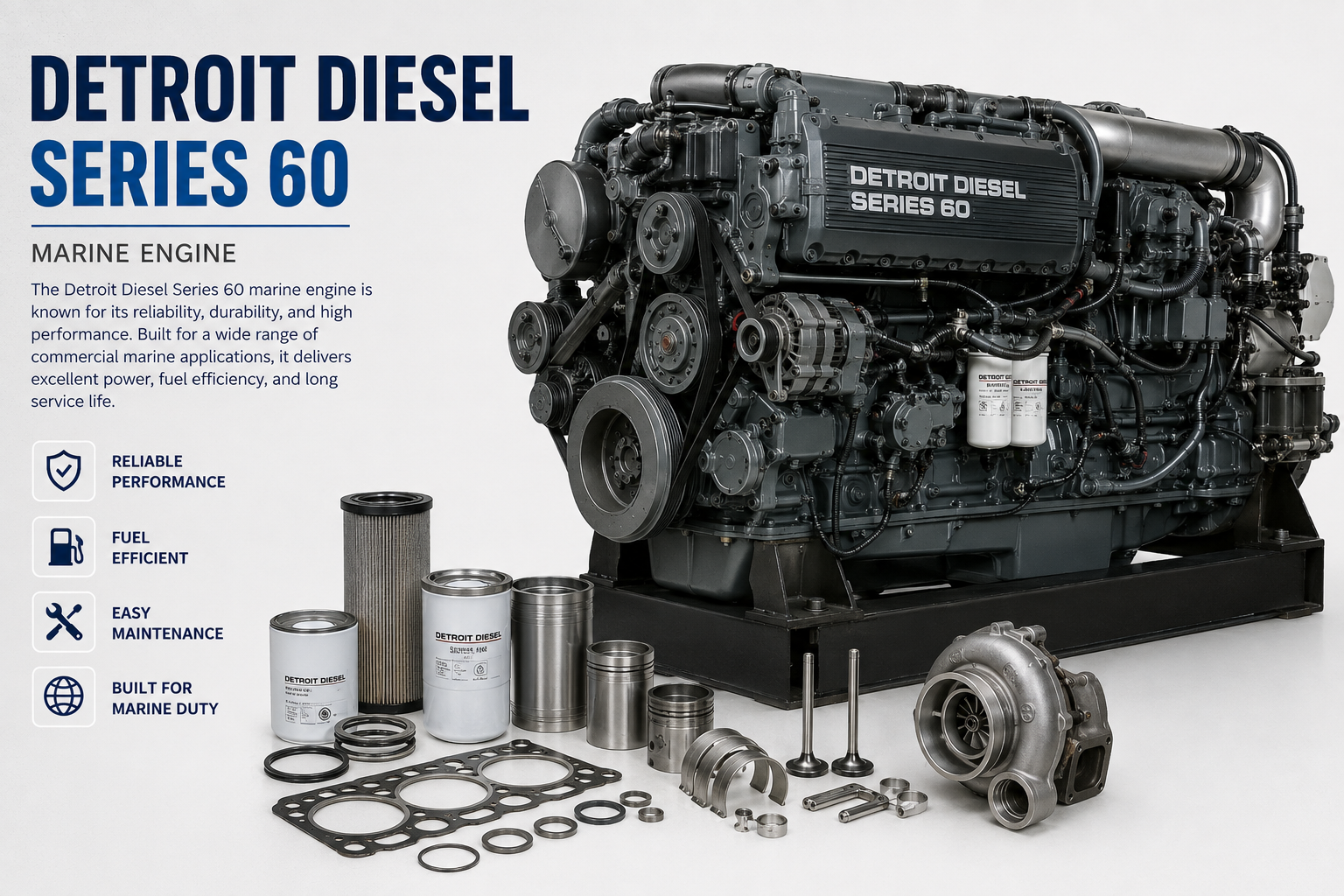
It is an inline six-cylinder, four-stroke diesel engine with electronic engine management, an overhead camshaft, turbocharging and replaceable cylinder liners.
For marine operators, understanding those differences matters because the Series 60 requires a different approach to troubleshooting, maintenance and spare-parts identification.
So, what should an engineer know before servicing one?
Let’s go through it.
What Is a Detroit Diesel Series 60?
The Detroit Diesel Series 60 is a heavy-duty diesel engine family built around a straight-six-cylinder configuration.
Depending on the engine version, the Series 60 family includes:
- 11.1L
- 12.7L
- 14.0L
Marine configurations are particularly associated with the 12.7L and 14L Series 60 engines.
The engine combines several important technologies:
- Four-stroke operation
- Inline-six configuration
- Overhead camshaft
- Turbocharging
- Charge-air cooling
- Replaceable wet cylinder liners
- Electronic fuel control
- Detroit Diesel Electronic Control, or DDEC
That combination makes the Series 60 very different from Detroit Diesel's older mechanically controlled two-cycle engines.
Is the Detroit Diesel Series 60 a Two-Stroke Engine?
No.
This is probably the most important misconception to clear up.
The Series 60 is a four-stroke engine.
Its combustion cycle follows:
Intake → Compression → Power → Exhaust
Older Detroit Diesel engines such as the 71 Series and 92 Series became famous for their two-stroke design.
The Series 60 belongs to a later generation of Detroit Diesel technology.
That means the valve train, fuel system, electronic controls and diagnostic approach are very different.
Why Does the Series 60 Use an Inline-Six Configuration?
An inline-six places all six cylinders in one straight row.
This arrangement provides a naturally balanced layout while allowing the crankshaft to be supported along its length.
The Series 60 uses seven main bearings.
These main bearings support the crankshaft while allowing it to rotate on a thin pressurized film of lubricating oil.
This is why lubrication condition is so important.
If oil pressure drops or contamination reaches the bearings, the problem can quickly move from a small maintenance issue to major crankshaft damage.
What Are the Main Detroit Diesel Series 60 Engine Sizes?
Three displacement versions are commonly associated with the family.
Series 60 11.1L
The 11.1L uses approximately:
- 130 mm bore
- 139 mm stroke
- 11.1-liter displacement
Series 60 12.7L
The 12.7L keeps the 130 mm bore but uses a longer:
- 160 mm stroke
This increases displacement to approximately 12.7 liters.
Series 60 14L
The 14L increases both bore and stroke to approximately:
- 133 mm bore
- 168 mm stroke
- 14.0-liter displacement
This is why identifying an engine simply as a "Detroit Series 60" is not enough when ordering internal components.
Why Is the Engine Serial Number So Important?
Imagine calling a spare-parts supplier and saying:
"I need a piston for a Detroit Series 60."
There is still important information missing.
Which displacement?
Which serial-number range?
Which engine rating?
Which piston specification?
The same applies to:
- Injectors
- Cylinder liners
- Bearings
- Turbochargers
- Pumps
- Electronic components
- Gaskets
- Overhaul kits
Whenever possible, record:
- Engine model
- Complete engine serial number
- Engine displacement
- Rated horsepower
- Rated RPM
- Existing part number
- DDEC generation
- Vessel application
A photograph of the engine identification information can also help.
What Is DDEC and Why Does It Matter?
DDEC stands for Detroit Diesel Electronic Control.
This electronic system was one of the major differences between the Series 60 and earlier mechanically controlled Detroit engines.
Different Series 60 engines can use different generations of DDEC.
The electronic control system receives information from sensors throughout the engine and uses that information to manage fuel delivery and engine operation.
Depending on configuration, the system may monitor information such as:
- Engine speed
- Coolant temperature
- Oil pressure
- Throttle demand
- Engine load
- Intake conditions
- Engine position
- Protection parameters
For marine engineers, this means a Series 60 problem should not automatically be treated as a purely mechanical fault.
Can an Electronic Fault Look Like a Mechanical Problem?
Yes.
Suppose the engine develops:
- Rough running
- Loss of power
- Uneven cylinder performance
- Difficult starting
The first suspicion may be a bad injector.
But the actual problem could also involve:
- Wiring
- Sensor failure
- Electrical connection
- Injector circuit
- DDEC control
- Fuel supply
- Valve adjustment
- Compression
This is why good diagnostics matter.
Replacing components without confirming the cause can become expensive very quickly.
How Does the Series 60 Fuel Injection System Work?
The Series 60 uses electronically controlled unit injection.
The fuel system has to supply clean fuel to the injectors while the electronic control system manages injection according to operating conditions.
Important components can include:
- Fuel pump
- Fuel filters
- Unit injectors
- Fuel lines
- Injector seals
- Wiring
- Electronic control module
A healthy injector needs more than just good internal components.
It also depends on:
Clean fuel + correct fuel supply + good wiring + proper mechanical adjustment + correct electronic control.
What Symptoms Can a Faulty Injector Cause?
Possible symptoms include:
- Rough idle
- Smoke
- Reduced power
- High fuel consumption
- Difficult starting
- Uneven exhaust temperatures
- Cylinder misfire
But those symptoms are not exclusive to injectors.
A compression problem or valve-train issue can produce similar behavior.
Before replacing an injector, confirm the surrounding mechanical and electronic systems.
Why Does the Series 60 Need a Turbocharger?
The turbocharger uses exhaust energy to force additional air into the engine.
More air allows the engine to burn fuel efficiently and produce greater output.
The process is simple in principle:
Exhaust gas spins turbine → turbine drives compressor → compressor increases intake-air pressure.
But turbocharger performance depends on more than the turbo itself.
Problems can also come from:
- Air intake restrictions
- Charge-air leaks
- Exhaust leaks
- Dirty charge-air cooler
- Lubrication problems
- Damaged hoses or clamps
What Happens When Turbocharger Performance Drops?
Common symptoms can include:
- Black smoke
- Reduced power
- Slow acceleration
- High exhaust temperature
- Lower boost
- Increased fuel consumption
However, avoid immediately replacing the turbocharger.
Check the complete intake and exhaust system first.
Why Is the Charge-Air Cooler Important?
Compressed air becomes hot.
Hot air is less dense than cooler air.
The charge-air cooler lowers the temperature of compressed intake air before it enters the cylinders.
This supports:
- Better combustion
- Improved air density
- Controlled exhaust temperature
- Efficient engine output
If the charge-air cooler becomes contaminated or restricted, the engine may still run—but not as efficiently as it should.
How Does a Marine Series 60 Stay Cool?
A marine diesel engine has to transfer a large amount of heat away from the engine.
Marine installations generally use a closed engine-coolant circuit together with seawater as the final cooling medium.
The system can include:
- Freshwater circulation pump
- Seawater pump
- Heat exchanger
- Thermostats
- Oil cooler
- Charge-air cooler
- Hoses
- Sensors
- Expansion tank
The exact arrangement depends on the vessel installation.
What Happens When Seawater Flow Starts to Drop?
This is a common marine maintenance issue.
Reduced seawater flow means the cooling system cannot reject heat as efficiently.
Possible causes include:
- Blocked sea strainer
- Damaged pump impeller
- Worn seawater pump
- Restricted hose
- Fouled heat exchanger
- Marine growth
- Scale
- Debris
The first sign may simply be that the engine begins running slightly warmer than normal.
That is why engineers should watch trends, not only alarms.
Why Are Operating Trends So Useful?
Imagine your engine normally runs at a stable temperature under a known load.
Now it begins running several degrees hotter.
No alarm.
No shutdown.
But something has changed.
That change may be the first sign of:
- Restricted cooling
- Higher engine load
- Charge-air contamination
- Thermostat deterioration
- Pump wear
The same principle applies to:
- Oil pressure
- Fuel consumption
- Exhaust temperature
- Boost
- Smoke
- Oil consumption
- Coolant consumption
A gradual change can tell you a lot before a serious failure occurs.
What Does the Lubricating Oil System Protect?
Almost every heavily loaded moving component depends on engine oil.
That includes:
- Crankshaft main bearings
- Connecting rod bearings
- Camshaft
- Valve train
- Turbocharger
The lubrication system includes components such as:
- Oil pump
- Oil filter
- Oil cooler
- Pressure-control components
- Oil galleries
- Oil pan
- Sensors
Good lubrication is not simply about having oil inside the engine.
The oil must be:
Correct specification, clean, properly cooled and supplied at adequate pressure.
What Can Cause Low Oil Pressure?
Possible causes include:
- Low oil level
- Incorrect oil viscosity
- Oil dilution
- Worn main bearings
- Worn connecting rod bearings
- Oil pump deterioration
- Pressure-regulating problems
- Excessive internal clearances
- Filter problems
- Faulty pressure sensor
This is another good example of why diagnosis matters.
A low reading may represent an actual lubrication problem—or an instrumentation problem.
Confirm which one before dismantling the engine.
What Should You Know About Series 60 Cylinder Liners?
The Series 60 uses replaceable wet cylinder liners.
This makes the engine rebuildable without replacing the entire cylinder block when the cylinder running surfaces become worn.
A typical cylinder repair may involve:
- Cylinder liner
- Piston
- Piston rings
- Piston pin
- Liner seals
- Connecting rod bearing
- Related gaskets
During overhaul, all components should be inspected together.
Replacing piston rings without checking liner condition, for example, may not solve excessive blow-by or oil consumption.
What Are the Signs of Cylinder Wear?
Possible indicators include:
- High blow-by
- Increased oil consumption
- Low compression
- Blue smoke
- Loss of power
- Difficult starting
Again, symptoms should be confirmed with proper inspection and measurements.
What's Inside the Cylinder Head?
The cylinder-head assembly contains important components involved in combustion, airflow and fuel delivery.
These can include:
- Intake valves
- Exhaust valves
- Valve guides
- Valve seats
- Valve springs
- Camshaft
- Rocker components
- Injectors
- Cylinder-head gasket
Because coolant, lubrication and combustion pressure all operate close to one another in this area, good sealing is essential.
When Should a Series 60 Cylinder Head Be Inspected?
Reasons may include:
- Low compression
- Valve damage
- Overheating
- Coolant leakage
- Combustion leakage
- Abnormal cylinder temperatures
- Major engine overhaul
A proper cylinder-head inspection may involve checking:
- Cracks
- Surface flatness
- Valve seats
- Valve guides
- Valve condition
- Injector locations
- Sealing surfaces
What Are Common Series 60 Overhaul Parts?
Depending on the engine condition, an overhaul may involve:
- Pistons
- Piston rings
- Cylinder liners
- Main bearings
- Connecting rod bearings
- Thrust bearings
- Cylinder-head gasket
- Complete gasket set
- Injectors
- Oil pump
- Water pump
- Cylinder-head components
- Turbocharger
- Seals
- O-rings
But a rebuild should not simply become:
Replace everything because it is in the kit.
Inspection and measurement should determine what the engine actually needs.
When Does a Detroit Diesel Series 60 Need an Overhaul?
There is no single operating-hour number that applies to every engine.
Engine life depends heavily on:
- Duty cycle
- Engine rating
- Load
- Maintenance
- Fuel quality
- Oil quality
- Cooling-system condition
- Previous repairs
- Operating environment
Warning signs that deserve investigation can include:
- Increased blow-by
- High oil consumption
- Reduced compression
- Persistent smoke
- Low oil pressure
- Loss of performance
- Coolant contamination
- Repeated overheating
- Internal mechanical noise
One symptom alone doesn't automatically mean a complete overhaul is required.
Diagnose first.
OEM, Aftermarket or Remanufactured Series 60 Parts?
For an older marine engine, there may be several ways to complete a repair.
OEM and Genuine Parts
These are useful when original specification and traceability are priorities.
Aftermarket Parts
Good-quality aftermarket parts can be a practical option for mature engines such as the Series 60.
Quality and correct application remain important.
Remanufactured Components
Remanufacturing can be particularly useful for higher-value parts such as:
- Injectors
- Cylinder heads
- Turbochargers
- Pumps
- Electronic components
The right choice depends on the component, engine condition, vessel requirements and availability.
Are Truck and Marine Series 60 Parts Always Interchangeable?
No.
This is important because the Series 60 is widely known from road applications.
Marine engines can have different:
- Seawater pumps
- Heat exchangers
- Cooling connections
- Charge-air cooling
- Exhaust equipment
- Turbochargers
- Electrical arrangements
- Flywheel configurations
- Mounting components
Some base-engine parts may be shared, but compatibility should always be verified.
What Should You Send When Ordering Series 60 Parts?
Try to provide:
- Engine model
- Engine serial number
- 11.1L, 12.7L or 14L
- Rated power
- Rated RPM
- Existing part number
- Component description
- Quantity
- Clear photographs
- Vessel location
For older engines, even casting numbers or photos of connections can help identify a component.
Which Series 60 Parts Are Commonly Requested?
Common requirements include:
- Fuel injectors
- Cylinder heads
- Cylinder-head gaskets
- Pistons
- Piston rings
- Cylinder liners
- Connecting rods
- Main bearings
- Connecting rod bearings
- Crankshafts
- Camshafts
- Turbochargers
- Water pumps
- Oil pumps
- Heat exchangers
- Oil coolers
- Sensors
- Electronic control components
- Gasket sets
- Overhaul parts
When possible, connect these terms internally to the relevant product categories on your website.
Is the Detroit Diesel Series 60 Still Worth Maintaining?
For many vessels, yes.
The decision depends on:
- Engine condition
- Parts availability
- Vessel value
- Planned operating life
- Repair cost
- Repower cost
- Installation changes required for replacement
A well-maintained existing engine may still make economic sense compared with a complete repower.
But the decision should be based on the condition of the engine and vessel, not sentiment.
Final Thoughts
The Detroit Diesel Series 60 marine engine combines traditional heavy-duty diesel construction with electronic engine control.
That combination means successful maintenance requires understanding both sides of the engine.
You need to pay attention to:
Mechanical condition.
But also:
Electronic information.
You need to check:
Fuel delivery.
But also:
Airflow and charge-air cooling.
And when temperatures begin changing, you need to think beyond the thermostat and look at the entire marine cooling circuit.
For spare-parts identification, the best starting point remains simple:
Engine serial number + engine model + part number + clear photographs.
That small amount of information can prevent a large number of ordering mistakes.
Frequently Asked QuestionsIs the Detroit Diesel Series 60 four-stroke?
Yes. The Series 60 is an inline six-cylinder four-stroke diesel engine.
What are the main Series 60 sizes?
The main displacement families are 11.1L, 12.7L and 14.0L.
Does a Series 60 have DDEC?
Yes. Series 60 engines use Detroit Diesel Electronic Control technology, although the exact DDEC generation varies by engine.
Does the Series 60 use cylinder liners?
Yes. It uses replaceable wet cylinder liners.
How many main bearings does a Series 60 have?
The crankshaft is supported by seven main bearings.
Can Series 60 engines be rebuilt?
Yes. Pistons, liners, bearings, cylinder-head components, gaskets and other overhaul parts can be replaced depending on engine condition.
Are Series 60 truck parts the same as marine parts?
Not necessarily. Marine installations may use different cooling, exhaust, turbocharger, electrical and accessory arrangements.
What information should I provide when ordering parts?
Provide the engine serial number, model number, displacement, existing part number, component description and photos where possible.
Related Products
Explore related Detroit Diesel Series 60 components including:
- Injectors
- Cylinder heads
- Pistons and liners
- Bearings
- Turbochargers
- Water pumps
- Oil pumps
- Cooling components
- Gaskets and seals
- Overhaul parts
Related Engine Pages
You may also be interested in:
- Detroit Diesel 53 Series
- Detroit Diesel 71 Series
- Detroit Diesel 92 Series
- Detroit Diesel 149 Series
Browse Our Complete Catalog
Browse our complete marine engine spare-parts catalog for Detroit Diesel and other major marine diesel engine manufacturers.
Need Help Identifying a Detroit Diesel Series 60 Part?
If you are working on a Series 60 and are unsure which replacement component is required, send us the available engine and part information.
Email: request@alfamarinespareparts.com
Website: www.alfamarinespareparts.com
Please include the engine model, serial number, part number, quantity and clear photographs whenever possible.