What Is the Detroit Diesel Series 149 Marine Engine?
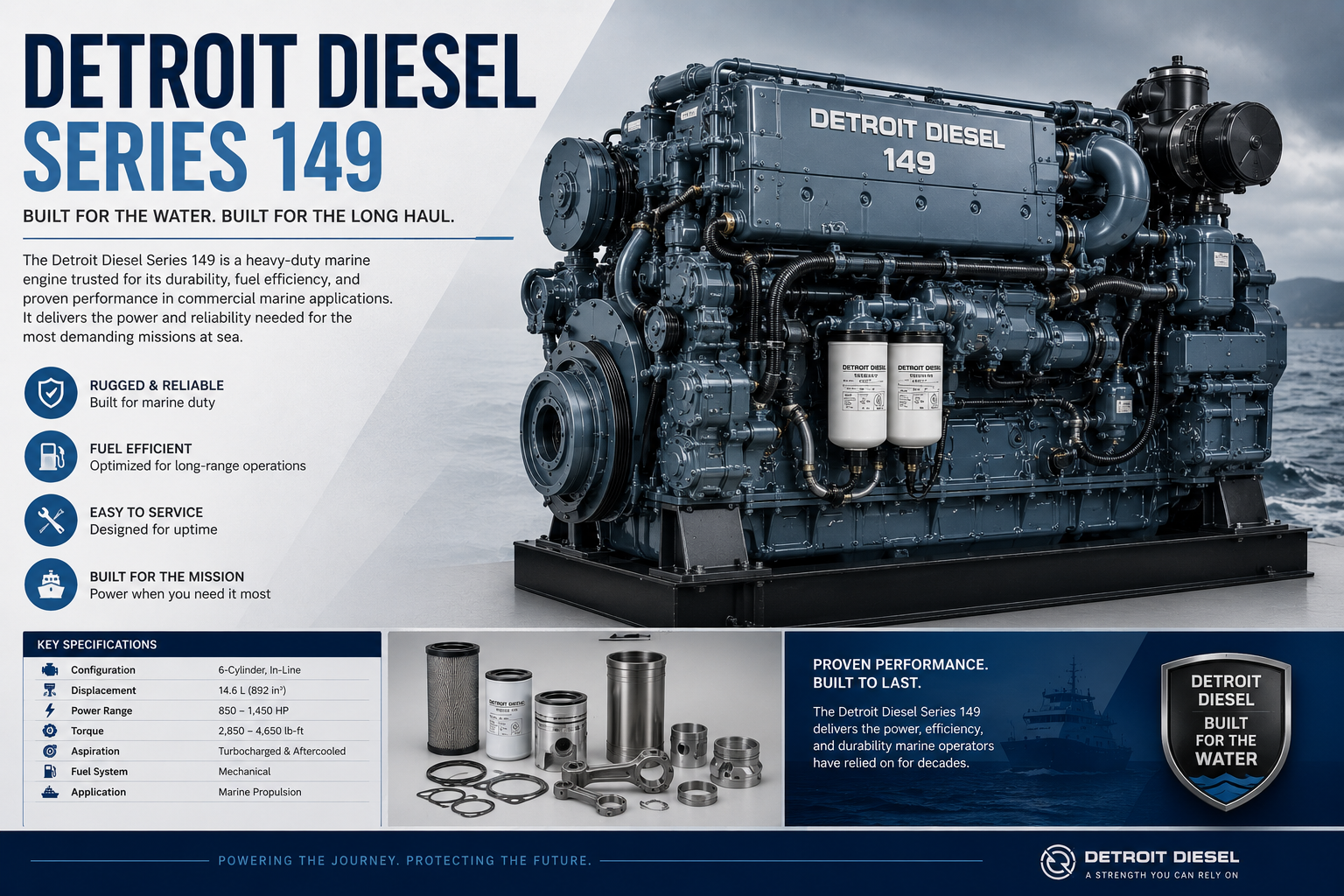
The Detroit Diesel Series 149 is a large-displacement, heavy-duty two-stroke diesel engine family developed for applications requiring substantial power and continuous-duty performance.
The “149” designation refers to approximately 149 cubic inches of displacement per cylinder. This places the Series 149 among Detroit Diesel's larger traditional two-stroke engine families.
Series 149 engines were produced in several configurations, including well-known V-engine arrangements, and were used in demanding marine, industrial, power-generation and other heavy-duty applications.
In marine service, Series 149 engines have been used in applications such as:
- Commercial vessels
- Tugboats
- Workboats
- Offshore vessels
- Fishing vessels
- Marine propulsion
- Auxiliary power
- Marine generator installations
- Government and military craft
At Alfa Marine Spare Parts, we supply OEM, genuine, aftermarket and remanufactured Detroit Diesel Series 149 marine engine spare parts for routine maintenance, repairs and complete engine overhaul requirements.
Detroit Diesel Series 149 Technical OverviewSpecificationDetailsManufacturerDetroit DieselEngine FamilySeries 149Engine CycleTwo-stroke dieselCylinder ArrangementV configuration, depending on modelDisplacement DesignationApprox. 149 cu in per cylinderFuel SystemUnit injectionAir SystemBlower-assisted scavengingCoolingLiquid-cooledAspirationConfiguration dependent; turbocharged versions existTypical Marine UsePropulsion, auxiliary and generator applications
Exact specifications, ratings and equipment vary according to the individual Series 149 engine model and marine configuration.
Detroit Diesel Series 149 Engine Models
The Series 149 family includes large V-type engines such as:
- Detroit Diesel 8V149
- Detroit Diesel 12V149
- Detroit Diesel 16V149
Different versions and ratings were produced for specific operating requirements.
Marine installations can also differ in turbocharging, cooling equipment, exhaust arrangements and auxiliary equipment. The engine model, serial number and existing component number are therefore important when identifying replacement parts.
What Does “149” Mean?
The number 149 refers to approximately 149 cubic inches of displacement for each cylinder.
It does not represent the engine's total displacement.
For example, increasing the number of cylinders produces a much larger total displacement while retaining the Series 149 basic cylinder displacement concept.
This large displacement per cylinder contributes to the substantial power capability associated with the Series 149 family.
Is the Detroit Diesel Series 149 a Two-Stroke Engine?
Yes.
The traditional Detroit Diesel Series 149 is a two-stroke diesel engine.
Its operating principle shares important characteristics with other classic Detroit Diesel two-stroke families, including:
- Blower-assisted scavenging
- Cylinder-liner air ports
- Exhaust valves in the cylinder head
- Unit fuel injectors
- One power cycle per crankshaft revolution
This architecture is fundamentally different from the later four-stroke Detroit Diesel Series 60.
How Does the Series 149 Two-Stroke Cycle Work?
The Series 149 requires a continuous supply of fresh combustion air.
As the piston approaches the lower portion of its stroke, ports in the cylinder liner become exposed. Pressurized air enters through these ports and helps push combustion gases toward the exhaust valves.
This process is called scavenging.
The operating sequence involves:
- Combustion forces the piston downward.
- Exhaust valves begin releasing combustion gases.
- Cylinder-liner air ports become exposed.
- Pressurized scavenging air enters the cylinder.
- Remaining exhaust gases are displaced.
- The piston moves upward and closes the liner ports.
- Air is compressed.
- Fuel is injected near the end of compression.
- Combustion begins the next power stroke.
This process repeats with every crankshaft revolution.
Why Is the Blower Important?
The blower is a fundamental part of the Detroit Diesel two-stroke operating system.
It supplies the airflow required to scavenge the cylinders and provide fresh combustion air.
Blower-related components can include:
- Blower Assemblies
- Blower Rotors
- Blower Bearings
- Blower Seals
- Blower Drive Components
- Blower Gaskets
- Airbox Components
- Associated Hardware
Reduced airflow can negatively affect combustion and overall engine performance.
Turbocharger System
Many heavy-duty Series 149 configurations use turbocharging in addition to the scavenging system.
The turbocharger uses exhaust energy to increase intake-air pressure and support the substantial airflow requirements of the engine.
Turbocharger components can include:
- Complete Turbochargers
- Turbocharger Cartridges
- Compressor Components
- Turbine Components
- Bearings
- Seals
- Oil Supply Lines
- Oil Drain Components
- Mounting Hardware
- Turbocharger Gaskets
Air and exhaust-system condition are important for maintaining proper turbocharger performance.
Detroit Diesel Series 149 Fuel Injection System
The Series 149 uses unit fuel injection, a defining feature of traditional Detroit Diesel engines.
Instead of relying on a conventional high-pressure injection pump and separate high-pressure lines for each cylinder, individual unit injectors provide fuel metering and high-pressure injection at each cylinder.
Fuel-system components can include:
- Unit Injectors
- Remanufactured Injectors
- Fuel Pumps
- Fuel Filters
- Fuel Lines
- Fuel Manifolds
- Injector Seals
- Injector Hardware
- Fuel-System Gaskets
- Governor and Control Components, depending on configuration
Correct injector specification is important because injector arrangements can vary with engine model and rating.
Cylinder Heads
The cylinder heads contain important combustion and valve-train components.
Series 149 cylinder-head parts can include:
- Complete Cylinder Heads
- Remanufactured Cylinder Heads
- Exhaust Valves
- Valve Guides
- Valve Seats
- Valve Springs
- Rocker Components
- Injector Components
- Cylinder Head Gaskets
- Cylinder Head Seals
Because fresh intake air enters through the cylinder-liner ports, the cylinder head primarily handles exhaust-valve and injector functions rather than using a conventional four-stroke intake-valve arrangement.
Cylinder Liners
The cylinder liners are especially important on a Detroit Diesel two-stroke engine.
They provide the piston running surface while incorporating the air ports required for scavenging.
Available components can include:
- Cylinder Liners
- Liner Seals
- Pistons
- Piston Rings
- Piston Pins
- Connecting Rod Components
Wear affecting the liners or piston assemblies can influence compression, oil consumption, scavenging and combustion performance.
Pistons and Piston Rings
Series 149 pistons operate under substantial mechanical and thermal loading.
Replacement components may include:
- Pistons
- Piston Rings
- Piston Pins
- Retaining Components
- Connecting Rods
- Connecting Rod Bearings
Piston, ring and liner condition should be evaluated together during major engine overhaul work.
Crankshaft and Bearings
The crankshaft converts combustion force into rotational output for the vessel's propulsion system or driven equipment.
Major lower-engine components include:
- Crankshaft
- Main Bearings
- Connecting Rod Bearings
- Thrust Components
- Crankshaft Seals
- Vibration Damper Components
Correct lubrication and bearing clearances are critical for protecting these heavily loaded components.
Camshaft and Valve Train
The camshaft and valve train coordinate exhaust-valve and injector operation.
Components can include:
- Camshafts
- Camshaft Bearings
- Rocker Components
- Injector Rocker Components
- Exhaust Valve Components
- Valve Springs
- Followers
- Associated Hardware
Correct adjustment and timing are essential for dependable two-stroke engine operation.
Detroit Diesel Series 149 Cooling System
The Series 149 is a liquid-cooled engine.
Engine coolant circulates through critical areas of the engine to remove combustion heat.
Typical engine-side components can include:
- Engine Water Pumps
- Thermostats
- Coolant Pipes
- Coolant Hoses
- Temperature Components
- Water Pump Seals
- Cooling-System Gaskets
Marine installations may use additional raw-water equipment to reject heat to seawater.
Marine Cooling System
Depending on the vessel installation, marine cooling components can include:
- Heat Exchangers
- Seawater Pumps
- Raw-Water Pump Components
- Impellers
- Pump Shafts
- Bearings
- Mechanical Seals
- Raw-Water Hoses
- Cooling-System Fittings
Marine cooling arrangements can differ between installations, so component identification should be based on the actual engine and vessel configuration.
Lubrication System
The lubrication system protects the Series 149's heavily loaded internal components.
Important components include:
- Engine Oil Pumps
- Oil Filters
- Oil Coolers
- Oil Pressure Components
- Oil Pan Components
- Oil Seals
- Lubrication-System Gaskets
Lubricating oil protects components such as the crankshaft, bearings, camshaft, valve train and turbocharger assemblies.
Detroit Diesel Series 149 Overhaul Parts
The rebuildable construction of the Series 149 allows major engine components to be serviced during overhaul.
Typical overhaul requirements can include:
- Cylinder Liners
- Pistons
- Piston Rings
- Piston Pins
- Main Bearings
- Connecting Rod Bearings
- Thrust Components
- Cylinder Head Components
- Unit Injectors
- Blower Components
- Crankshaft Seals
- Complete Gasket Sets
- Complete Seal Kits
The final overhaul parts requirement depends on the engine model and the condition of individual components found during inspection.
Where Are Detroit Diesel Series 149 Marine Engines Used?
Series 149 engines have been associated with demanding applications requiring substantial diesel power, including:
- Tugboats
- Commercial Workboats
- Offshore Support Vessels
- Fishing Vessels
- Marine Generator Sets
- Commercial Ships
- Government Vessels
- Military Marine Applications
- Heavy Auxiliary Applications
- Industrial Marine Equipment
Identifying Detroit Diesel Series 149 Spare Parts
Correct identification is particularly important for an older heavy-duty engine family such as the Series 149.
Useful information includes:
- Engine Model
- Engine Serial Number
- Existing Part Number
- Component Description
- Quantity Required
- Marine Configuration
- Clear Component Photographs
- Delivery Destination
For marine-specific equipment such as heat exchangers, seawater pumps and exhaust components, details of the existing installation can also be important.
Browse Our Complete Catalog
Alfa Marine Spare Parts supplies marine engine spare parts for:
- Detroit Diesel
- MTU
- Caterpillar
- Cummins
- MAN
- Wärtsilä
- DEUTZ
- Volvo Penta
- Scania
- Perkins
- John Deere
- Mitsubishi
- Yanmar
- Doosan
Website: www.alfamarinespareparts.com
Our catalog covers components for marine propulsion engines, auxiliary engines, generator sets, fishing vessels, tugboats, workboats, offshore vessels, commercial fleets and other marine applications worldwide.