Shipyards, Boatyards, Marinas & Dry Docks Explained
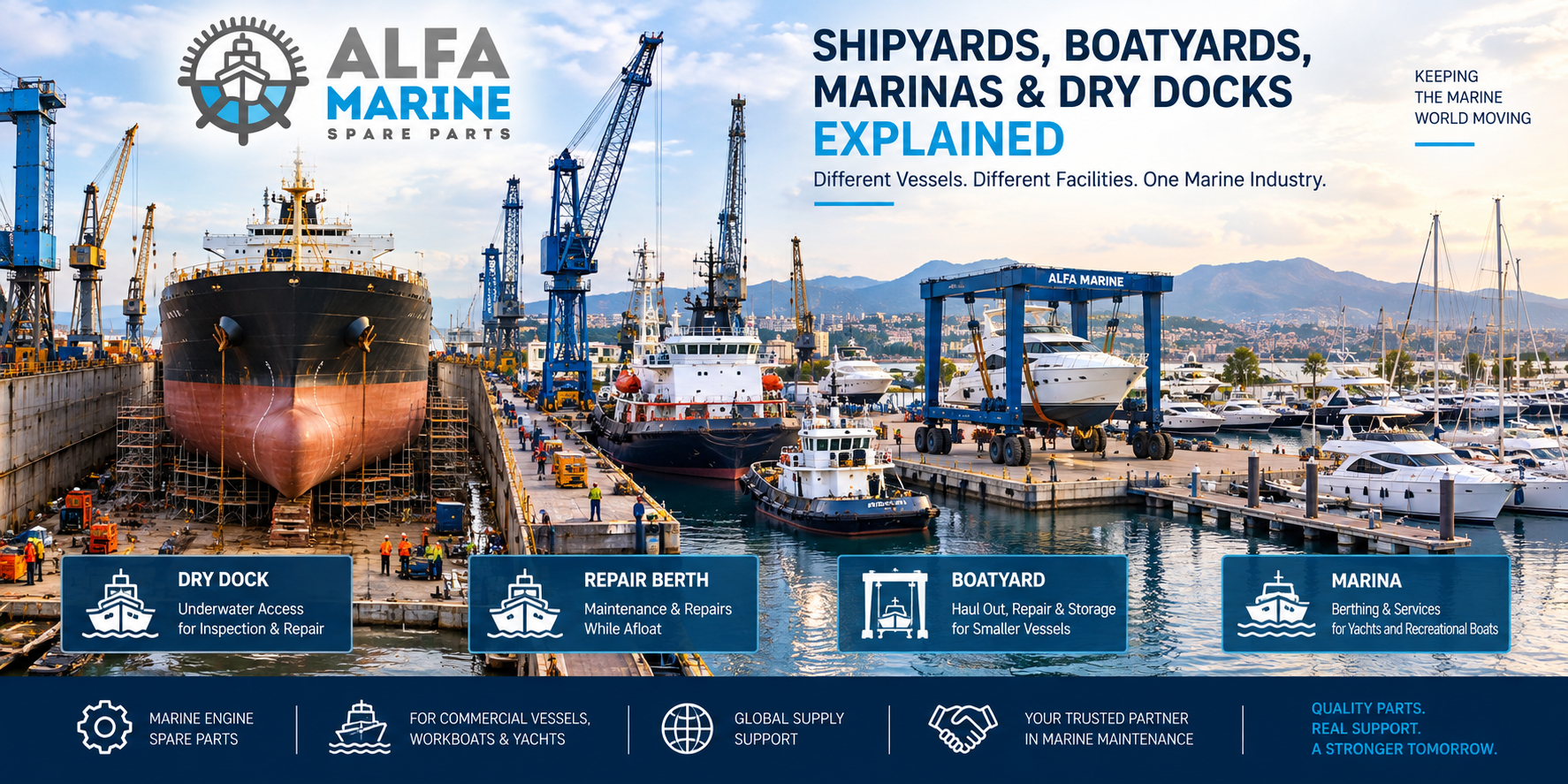
A yacht returns to the marina with an engine problem.
A tugboat moves alongside a repair berth for planned maintenance.
Across the harbour, a much larger commercial ship slowly enters a dry dock. Once the dock is closed and the water is removed, areas of the ship that normally remain below the waterline become accessible for inspection and repair.
All three vessels need attention, but they are not necessarily going to the same type of facility.
Terms such as shipyard, boatyard, marina, repair yard, berth and dry dock are sometimes used as though they mean the same thing.
They don't.
Some are places where vessels remain afloat. Others are industrial facilities where ships are built or repaired. And some exist specifically to provide access to areas of a vessel that are normally underwater.
Here is how they differ and what actually happens when a vessel arrives for maintenance or repair.
What Is a Shipyard?
A shipyard is an industrial marine facility where ships and other vessels can be built, repaired, maintained or converted.
Not every shipyard performs the same work.
Some yards concentrate on constructing new vessels. Others specialize in repairing ships already in service. Larger facilities may handle both.
Walk through a major shipyard and you may find repair berths, workshops, cranes, warehouses, fabrication areas and dry-docking facilities within the same site.
Imagine a commercial vessel arriving for scheduled maintenance.
The ship may initially remain afloat alongside a repair berth while technicians work onboard.
If the maintenance also requires access below the waterline, the vessel may later be moved into a dry dock.
That gives us one of the most important distinctions:
The shipyard is the overall facility. A dry dock is one particular facility that a shipyard may have.
What Is a Ship Repair Yard?
A ship repair yard concentrates primarily on maintaining and repairing vessels already in service.
A vessel might arrive for planned maintenance, machinery repairs, inspections, steel work, painting or a larger conversion project.
And the ship doesn't always need to leave the water.
Suppose a vessel requires work on its main engine, generator, turbocharger or cooling system. Technicians may be able to complete the job while the ship remains afloat at a repair berth.
Now imagine the same vessel also needs its propeller, rudder and underwater hull inspected.
That changes the situation.
Those areas are normally below the waterline, so dry-docking may become part of the repair schedule.
What Is a Boatyard?
A boatyard generally works with smaller vessels than a major commercial shipyard.
This is where you are more likely to find motor yachts, sailing yachts, recreational boats, fishing boats and smaller commercial craft.
A boatyard may carry out engine repairs, hull work, antifouling, painting and general maintenance. It may also provide storage for vessels ashore.
The biggest difference is often how vessels are handled.
Instead of putting a yacht into a large dry dock designed for commercial ships, a boatyard may use a marine travel lift, crane, trailer or slipway to bring it ashore.
Once the vessel is safely supported on land, technicians can work around the hull and underwater equipment.
What Is a Marina?
A marina has a different primary purpose.
It provides berthing and services mainly for yachts and recreational boats.
Walk through a marina and you may see rows of motor yachts and sailing boats secured to pontoons, often connected to shore power and freshwater.
Some marinas also have fuel facilities, workshops, chandlers and haul-out areas.
Others primarily provide berthing.
So when somebody tells you:
“The yacht is at the marina.”
that doesn't necessarily mean the yacht is being repaired or has been taken out of the water.
It may simply be sitting at its berth.
A marina can have repair facilities, but a marina and a boatyard are not automatically the same thing.
Port, Harbour and Marina: What's the Difference?
These terms can also be confusing.
A harbour is generally a sheltered area where vessels can anchor or berth.
A port is associated with marine transportation and vessel operations and may contain cargo terminals, passenger facilities, commercial berths and other infrastructure.
A marina is more specifically associated with yachts and recreational craft.
One large port can therefore contain several completely different marine environments.
A container ship may be working at one terminal.
A tanker may be berthed somewhere else.
Tugboats may be waiting for their next job.
A ship repair facility may be operating nearby.
And in another part of the harbour, yachts may be sitting in a marina.
What Is a Berth?
A berth is a designated position where a vessel can be secured while afloat.
For a yacht, that might be its normal place in a marina.
For a commercial vessel, the berth could be alongside a cargo terminal, passenger terminal or repair facility.
A ship undergoing maintenance may remain at a repair berth, allowing technicians, cranes, tools and spare parts to reach the vessel while it stays afloat.
Being at a repair berth does not mean the vessel is in dry dock.
The vessel is still floating.
What Is a Dry Dock?
A ship spends most of its working life with a large part of its hull underwater.
That means areas such as the propeller, rudder, underwater hull, sea chests and underwater valves and openings cannot normally be accessed in the same way as machinery inside the engine room.
A dry dock changes that.
Imagine a commercial ship slowly entering a large dock filled with water.
Before the ship arrives, supporting blocks have been positioned according to the vessel and docking arrangement.
The vessel is carefully guided into position.
Once everything is correctly aligned, the dock entrance can be closed and the water removed.
As the water level falls, the vessel gradually settles onto the prepared supporting blocks.
Eventually, a ship that normally floats in the sea is sitting dry inside the dock.
Shipyard teams can now access areas of the hull and underwater equipment that would normally be submerged.
This is the fundamental purpose of a dry dock: providing dry access for construction, inspection, maintenance and repair.
What Happens to a Ship in Dry Dock?
Once the vessel is dry, inspection and maintenance can begin.
The underwater hull can be examined for damage, fouling and coating condition.
The propeller and rudder become accessible.
Sea chests, underwater valves and other underwater fittings can be inspected.
Depending on the vessel and planned work, attention may also be given to shafting, seals, thrusters and other propulsion-related equipment.
Hull cleaning, surface preparation, coating and anode work may also form part of a docking period.
The exact work scope varies from vessel to vessel. Not every ship receives every one of these operations during every docking.
But not everything happening during a dry-docking period is underneath the ship.
While one team works on the hull, another may be inside the engine room.
A seawater pump could be opened for inspection.
Cooling equipment may be serviced.
Main-engine maintenance could be underway.
A generator may be undergoing repair at the same time.
A shipyard period can therefore involve many different jobs happening across the vessel simultaneously.
What Is a Graving Dock?
A graving dock is a fixed basin-type dry dock constructed on shore, with an entrance that can be closed so the water can be pumped or drained out.
The vessel enters while there is sufficient water in the dock.
Once the ship is correctly positioned, the entrance is closed and the water is removed.
As the water level falls, the vessel settles onto prepared supporting blocks and is secured as required for stability.
The ship then remains dry while inspection, maintenance and repair work are carried out.
When the work is finished, the process is reversed.
Water is allowed back into the dock.
As the water level rises, the vessel becomes buoyant again.
Once it is safely floating and ready to leave, the entrance can be opened and the vessel moved out.
Some graving docks are extremely large because they are designed to accommodate major commercial vessels.
What Is a Floating Dry Dock?
A floating dry dock achieves a similar result in a different way.
Instead of being a fixed basin constructed on shore, the dock itself floats.
Ballast tanks are flooded so the dock lowers sufficiently into the water for the vessel to enter.
The ship is carefully positioned over the supporting arrangement.
Water is then pumped from the ballast tanks.
As the floating dock rises, the vessel is lifted with it until its underwater hull is clear of the surrounding water and the vessel is properly supported.
The ship hasn't been hauled onto land.
The floating dock has raised the ship out of the water.
This allows shipyard teams to reach the underwater hull and equipment while the floating dock itself remains afloat.
How Are Yachts and Smaller Boats Hauled Out?
A yacht doesn't normally require the same docking arrangement as a large tanker or container ship.
Many boatyards and suitably equipped marinas use a marine travel lift.
The yacht enters a designated lifting area.
Heavy lifting slings are positioned beneath and around the hull at suitable lifting locations. The travel lift then raises the vessel clear of the water.
The lift can move the yacht into the yard, where it is properly supported ashore.
Now technicians can reach the hull, propellers, shafts, rudders and other areas that were underwater.
For the yacht owner, the vessel has been hauled out.
For the boatyard, the maintenance work may only be beginning.
What Is a Slipway?
A slipway is another way of moving vessels between land and water.
It is a sloping structure extending into the water that can be used for launching or recovering vessels.
Depending on the facility and vessel, trailers, cradles or other hauling arrangements may be used.
Slipways are commonly associated with smaller craft, although larger industrial slipway systems also exist.
The equipment may be different from a travel lift or dry dock, but the purpose is similar: moving the vessel safely between the water and a position where inspection, maintenance or repair can be carried out.
Does an Engine Repair Mean the Ship Must Go Into Dry Dock?
No.
This is an important distinction.
Imagine a tugboat that needs a seawater pump replaced.
The vessel may be able to remain alongside while the work is completed.
The same could apply to fuel injectors, a turbocharger, generator or many other engine-room repairs.
Work above the waterline and inside a vessel can often be performed while the vessel remains afloat. Dry-docking becomes particularly relevant when work requires access to normally submerged areas or when engine maintenance forms part of a larger scheduled docking period.
So engine-room maintenance and dry-dock work are not the same thing, even though both may happen during the same shipyard visit.
Shipyard, Boatyard, Marina or Dry Dock?
| FacilityWhat It Is Mainly Used For | |
| Shipyard | Building, repairing, maintaining or converting ships and vessels |
| Ship repair yard | Repairing and maintaining vessels already in service |
| Boatyard | Repair, haul-out and storage of smaller vessels and yachts |
| Marina | Berthing and services mainly for yachts and recreational boats |
| Berth | A designated position where a vessel is secured while afloat |
| Dry dock | Providing dry access to areas of a vessel normally below the waterline |
| Graving dock | A fixed basin-type dry dock constructed on shore |
| Floating dry dock | A floating structure that raises and supports a vessel clear of the water |
| Travel lift | Mobile lifting equipment commonly used to haul boats and yachts ashore |
| Slipway | A sloping structure used for launching or recovering vessels |
A Shipyard Repair Rarely Starts With the Complete Story
Imagine a commercial vessel arriving for a planned yard period.
The technical department already has a maintenance schedule and a spare-parts list.
Then the engineers start opening machinery.
A pump expected to need seals also has a worn shaft.
An inspection reveals that additional gaskets are required.
Another piece of machinery needs more work than expected.
The parts list starts growing.
This is normal in marine repair.
The condition of every internal part cannot always be known before equipment is dismantled and inspected.
When a vessel is working against a limited shipyard schedule, identifying the required spare parts correctly becomes particularly important.
An enquiry saying:
“We need a pump for the ship.”
doesn't provide enough information.
The part number, part description, quantity, exact engine model and Engine Serial Number or nameplate details provide a much stronger starting point for identification.
Request Marine Engine Parts for Shipyard Repairs
Alfa Marine Spare Parts supplies marine engine spare parts for shipyards, ship repair companies, boatyards, marine service companies, yachts, workboats and commercial vessels.
If your vessel is preparing for planned maintenance, repair or dry-docking, you can submit a complete multi-item parts list for quotation.
Include the part numbers where available, part descriptions, quantities, complete engine model and Engine Serial Number/nameplate details.
When a part number isn't available, clear photos of the engine nameplate and existing part can also help with identification.
Frequently Asked Questions
Is a dry dock the same as a shipyard?
No. A shipyard is the larger industrial facility where vessels may be built, repaired, maintained or converted. A dry dock is a particular facility used to provide dry access to areas of a vessel that are normally underwater.
Does a ship need to enter dry dock for engine repairs?
Not necessarily. Many engine, generator, pump and auxiliary machinery repairs can be completed while the vessel remains afloat. Dry-docking becomes particularly relevant when underwater areas also need inspection, maintenance or repair.
Where are yachts taken out of the water for maintenance?
Many yachts are hauled out at boatyards or suitably equipped marinas using marine travel lifts, cranes or other suitable lifting systems. The method depends on the vessel's size, weight, design and the facilities available.
Independent Supplier Notice
Alfa Marine Spare Parts is an independent marine spare-parts supplier and is not an official or authorized dealer, representative or partner of the manufacturers whose names may appear on this website. Manufacturer names, trademarks, engine models and part numbers are used only for identification and cross-reference purposes.