Types of Boats, Yachts & Commercial Ships Explained
Stand in a busy seaport for a few minutes and you may see completely different vessels using the same stretch of water.
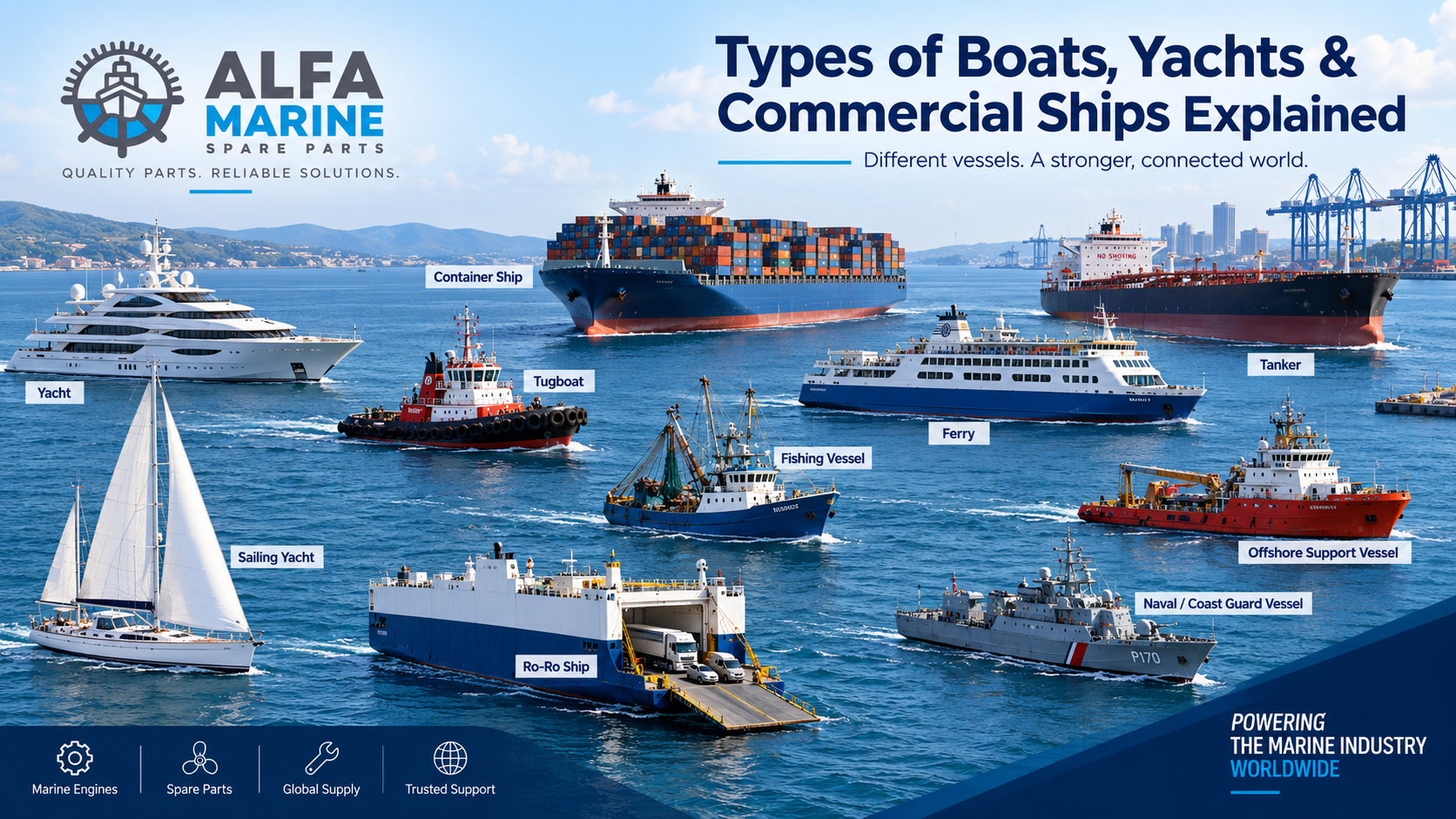
A motor yacht enters the marina. A tugboat pushes against the side of a much larger container ship. A pilot boat heads offshore to meet an arriving vessel. A ferry is loading cars while a fishing vessel prepares to leave port.
They all travel on water, but we don't describe them in the same way.
One is called a boat, another a yacht, another a workboat, and another a ship.
So what actually makes them different?
There isn't one simple size at which a boat suddenly becomes a ship. Marine terminology also depends on the vessel's purpose, design, operation and the type of work it performs.
Let's look at the main vessel types you will encounter at sea.
First, What Is a Vessel?
Vessel is the useful general term.
It can describe many kinds of watercraft without immediately specifying exactly what they do.
That is why the marine industry commonly uses terms such as commercial vessel, fishing vessel, passenger vessel, offshore vessel and research vessel.
A yacht is a vessel.
A tugboat is a vessel.
A container ship is a vessel.
Once you know what the vessel is designed to do, you can describe it more specifically.
What Is the Difference Between a Boat and a Ship?
People often explain this by saying:
“A boat is small and a ship is big.”
There is some truth in that, but it isn't a complete rule.
A small recreational craft is clearly a boat. A large ocean-going container carrier is clearly a ship.
Between those two extremes, terminology becomes less exact.
Size matters, but so do construction, purpose, crew, operating area and normal industry usage.
A tugboat, for example, may be extremely powerful and perform serious commercial work, yet we still call it a boat.
A large fishing vessel may be called a fishing boat in everyday conversation and a fishing vessel or fishing ship in other contexts.
So there isn't one universal length that separates every boat from every ship in normal marine language.
Recreational Boats
A recreational boat is primarily used for private leisure rather than commercial work or transportation.
This group includes many different designs, from small motorboats and center-console boats to cabin cruisers and larger pleasure craft.
Propulsion can come from outboard engines, sterndrives or inboard marine engines.
How the boat is used matters just as much as its size. A privately operated boat that runs mainly on weekends can have a completely different operating life from a similarly sized commercial boat working every day.
What Makes a Boat a Yacht?
A yacht is generally associated with recreational or leisure use.
Yachts range from relatively small sailing and motor yachts to very large luxury vessels.
A motor yacht may use one or more inboard diesel engines with marine transmissions, shafts, pods, waterjets or other propulsion arrangements.
Larger yachts can have surprisingly substantial engine rooms, with multiple generators, cooling systems, pumps, stabilizers, hydraulics and other auxiliary machinery.
A yacht may look very different from a commercial ship from the outside, but there is still serious marine machinery operating below deck.
Sailing Yachts
A sailing yacht primarily uses sails for propulsion, but most cruising sailing yachts also have an auxiliary engine.
That engine becomes particularly important when entering or leaving a marina, maneuvering in restricted waters or operating when sailing isn't practical.
Larger sailing yachts can also carry sophisticated generators, pumps, hydraulic systems and other equipment.
So describing a vessel as a sailing yacht doesn't tell you which engine or parts are installed onboard.
Superyachts and Large Motor Yachts
As yachts become larger, their machinery becomes increasingly complex.
A large motor yacht may have twin main engines, several generator sets, substantial cooling systems, stabilizers, hydraulic equipment and extensive electrical and hotel services.
The term superyacht is widely used for large luxury yachts, although exact size definitions can vary within the industry.
What separates them from cargo or working ships is primarily their purpose: they are built around yachting, accommodation and leisure rather than transporting commercial cargo.
What Is a Workboat?
A workboat is built to perform a job.
Instead of being designed mainly for leisure, the vessel may support ports, shipyards, offshore installations, construction projects, towing, marine maintenance or crew transfers.
Workboats come in many sizes because the job determines the design.
A small harbour workboat and a powerful offshore vessel may look completely different, but both exist because somebody needs work performed on the water.
Tugboats
Tugboats are a perfect example of why vessel size doesn't tell the whole story.
A tug may look tiny next to the container ship or tanker it is assisting, but it is built to produce substantial thrust.
Imagine a large ship approaching a busy harbour.
Its own propulsion can move it across an ocean, but maneuvering such a large vessel close to a berth can require additional control.
Tugboats can push, pull, tow and assist ships during berthing and unberthing, as well as perform other towing operations.
Their engines and propulsion systems are therefore designed around demanding working conditions rather than simply cruising from one place to another.
Pilot Boats and Crew Boats
A pilot boat transports maritime pilots between shore and ships.
When a commercial ship approaches or leaves a port, a pilot may board to assist with local navigation. The pilot boat must safely transfer that person to or from the larger vessel, often in open water.
A crew boat has a different purpose. It carries personnel and sometimes equipment between shore and offshore locations such as platforms, wind farms or marine construction projects.
Both can be relatively small vessels, but their commercial operating schedules may be intensive.
Fishing Vessels
The term fishing vessel covers everything from small coastal boats to large ocean-going ships.
Commercial types include trawlers, longliners and purse seiners, among others.
Their design depends heavily on the fishing method.
A fishing vessel may need much more than propulsion. Winches, hydraulics, refrigeration, generators, pumps and processing equipment can all form part of the operation.
This makes a commercial fishing vessel a working platform as well as a means of transportation.
Ferries
A ferry transports passengers, vehicles or both between locations.
Some ferries make short crossings between nearby ports or islands. Others operate much longer routes.
Their designs also vary.
A fast passenger ferry may be built around speed, while a large vehicle ferry may have several decks for cars, trucks and passengers.
Many ferries repeat the same operating cycle throughout the day: departure, passage, maneuvering, berthing, loading and then departure again.
Offshore Support Vessels
Offshore operations require vessels built for very specific jobs.
A Platform Supply Vessel (PSV) may transport supplies and equipment to offshore installations.
An Anchor Handling Tug Supply vessel (AHTS) can perform anchor handling, towing and supply work.
Other offshore vessels may support subsea operations, construction, wind farms or specialist marine projects.
These vessels often combine propulsion with significant deck machinery and auxiliary power because the job continues even after they arrive at the offshore location.
Cargo Ships Are Not All the Same
The term cargo ship sounds simple, but what the ship carries determines much of its design.
A ship carrying containers needs a completely different cargo arrangement from one carrying grain, crude oil or vehicles.
This gives us several major commercial ship types.
Container Ships
Container ships carry standardized shipping containers.
They range from smaller feeder vessels connecting regional ports to enormous ocean-going ships operating international routes.
Their most recognizable feature is the large number of containers stacked in dedicated positions on and below deck.
Bulk Carriers
Bulk carriers transport unpackaged dry cargo such as grain, coal and ore.
Instead of carrying individual containers, the cargo is loaded into large holds.
Their deck layout, cargo handling and operating requirements therefore differ substantially from those of container ships.
Tankers
Tankers transport liquid cargo in dedicated tanks.
This group includes crude oil tankers, product tankers and chemical tankers.
Cargo pumps, piping and valves are an essential part of their operation because the liquid must be loaded, contained and discharged safely.
Gas Carriers
Gas carriers are designed for cargoes such as LNG and LPG.
Their cargo-containment and handling arrangements are highly specialized because the products are transported under controlled temperature and/or pressure conditions depending on the cargo and vessel design.
Ro-Ro Ships
Ro-Ro means roll-on/roll-off.
Instead of lifting every piece of cargo onboard, wheeled cargo can be driven onto and off the ship using ramps.
Cars, trucks, trailers and heavy machinery are common examples.
Some passenger ferries are also Ro-Ro vessels because they carry both people and vehicles.
General Cargo and Multipurpose Ships
Not every cargo fits neatly into the categories above.
General cargo and multipurpose ships can carry machinery, steel products, packaged goods, project cargo and other loads.
Some have their own cranes, allowing them to handle cargo in ports where shore-based lifting equipment may be limited.
Heavy-Lift and Project Cargo Vessels
What happens when the cargo is an enormous piece of industrial machinery rather than a container?
That is where heavy-lift and project cargo vessels come in.
They are designed to transport unusually large or heavy loads, sometimes using powerful onboard cranes or specialized loading arrangements.
Passenger and Cruise Ships
Passenger ships are designed primarily around transporting people.
A cruise ship takes this much further.
Modern cruise ships need propulsion, but they also need enormous amounts of power for accommodation, kitchens, refrigeration, air conditioning, lighting, freshwater production and other hotel services.
In engineering terms, a cruise ship isn't simply a vessel that carries passengers. It is also a large floating facility that must keep many systems operating at the same time.
Research, Survey and Dredging Vessels
Some vessels go to sea specifically to perform specialist work.
Research and survey vessels may carry laboratories, sonar systems, subsea equipment or remotely operated vehicles.
A dredger has a very different job. It removes sand, mud or other material from the seabed to maintain harbours and shipping channels, support construction or carry out land-reclamation work.
These vessels are good examples of how a vessel's mission can shape almost everything about its machinery and layout.
Naval, Coast Guard and Government Vessels
Governments and maritime authorities also operate specialized vessels.
These include patrol boats, rescue craft, coast guard vessels, naval ships, survey vessels and support ships.
Their designs depend on their missions, which can range from search and rescue to patrol, surveillance, transport and naval operations.
The Main Vessel Types at a Glance
| Vessel TypeMain Purpose | |
| Recreational boat | Private leisure and boating |
| Motor yacht | Leisure and yachting |
| Sailing yacht | Sail propulsion with auxiliary engine |
| Superyacht | Large luxury yachting |
| Workboat | Commercial marine work |
| Tugboat | Towing, pushing and ship assistance |
| Pilot boat | Transporting maritime pilots |
| Crew boat | Offshore personnel transport |
| Fishing vessel | Commercial fishing |
| Ferry | Passenger and/or vehicle transport |
| Offshore support vessel | Offshore supply and marine operations |
| Container ship | Containerized cargo |
| Bulk carrier | Dry bulk cargo |
| Tanker | Liquid cargo |
| Gas carrier | LNG, LPG and related cargoes |
| Ro-Ro ship | Wheeled cargo |
| General cargo ship | Mixed conventional cargo |
| Heavy-lift vessel | Oversized and heavy project cargo |
| Cruise ship | Passenger cruising |
| Research vessel | Scientific and survey work |
| Dredger | Seabed excavation and dredging |
| Patrol/government vessel | Government and maritime operations |
Why Vessel Type Matters When Ordering Marine Parts
Knowing that a vessel is a tugboat, yacht, ferry or fishing vessel provides useful context, but it usually isn't enough to identify the correct engine part.
Two similar tugboats can have completely different engines.
Two yachts of approximately the same size can use different propulsion systems.
A vessel may also have been repowered during its working life, meaning the engine onboard today isn't necessarily the one installed when the vessel was built.
So an enquiry saying:
“I need a seawater pump for my tugboat.”
still leaves an important question:
Which engine?
For accurate parts identification, provide the part number, part description, quantity, complete engine model and Engine Serial Number or nameplate details.
The vessel tells us where the part is working.
The engine information helps identify which part you actually need.
Request a Marine Engine Parts Quote
Alfa Marine Spare Parts supplies marine engine spare parts for yachts, workboats, tugboats, fishing vessels, ferries, offshore vessels, commercial ships and other marine applications.
For an accurate quotation, send the part number, part description, quantity, complete engine model and Engine Serial Number/nameplate details.
A clear photo of the engine nameplate or existing part can also help when additional identification is required.
Frequently Asked Questions
Is there an exact size where a boat becomes a ship?
Not in ordinary marine terminology. Size plays an important role, but purpose, construction and normal industry usage also affect whether a vessel is commonly described as a boat or ship.
Is a yacht also considered a vessel?
Yes. Vessel is a broad term that can include yachts, boats and ships. Calling something a yacht gives more information about its purpose and type of operation.
Why do you need the engine model if I already know the vessel type?
Because the same type of vessel can use many different engines and propulsion systems. The exact engine model, serial number and part number are much more useful for identifying the correct marine engine spare parts.
Independent Supplier Notice
Alfa Marine Spare Parts is an independent marine spare-parts supplier and is not an official or authorized dealer, representative or partner of the manufacturers whose names may appear on this website. Manufacturer names, trademarks, engine models and part numbers are used only for identification and cross-reference purposes.