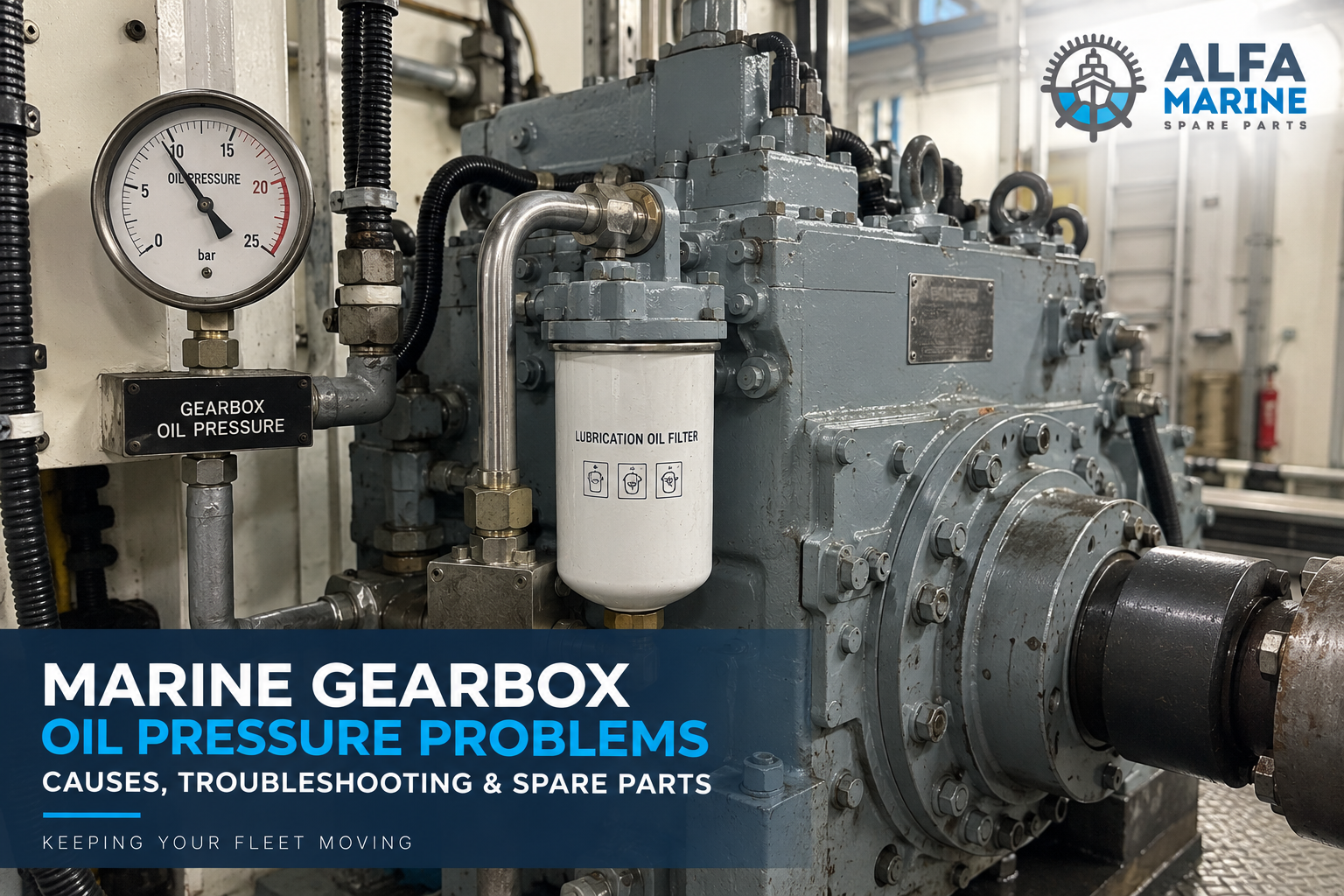
Marine Gearbox Oil Pressure Problems: Causes, Troubleshooting & Spare Parts
A marine gearbox can operate normally for thousands of hours, but when oil pressure begins to drop, fluctuate or disappear, the problem deserves immediate attention.
Low gearbox oil pressure can affect much more than lubrication. Depending on the transmission design, the same oil system may lubricate gears and bearings, remove heat and provide hydraulic pressure for clutch engagement. A pressure problem can therefore develop into delayed engagement, clutch slipping, overheating, accelerated wear or loss of propulsion.
The difficult part is identifying the actual cause.
A low-pressure alarm does not automatically mean the oil pump has failed. The problem could be as simple as low oil level or a restricted filter, or it could involve internal leakage, worn bearings, a pressure-control valve or the clutch hydraulic circuit.
This guide explains the most common causes of marine gearbox oil pressure problems, what engineers should inspect and which marine gearbox spare parts may be required after the fault has been properly identified.
Alfa Marine Spare Parts supports shipowners, shipyards, yacht engineers, marine repair companies and technical purchasing departments sourcing marine gearbox spare parts for maintenance, repair and overhaul worldwide.
Quick Answer: What Causes Low Marine Gearbox Oil Pressure?
Common causes include:
- Low gearbox oil level
- Incorrect oil specification
- Contaminated oil
- Restricted oil filter or strainer
- Worn gearbox oil pump
- Damaged pump drive
- Pressure-control valve problems
- Internal hydraulic leakage
- Worn bearings or bushings
- Damaged seals
- Excessive gearbox temperature
- Restricted pump suction
- Faulty pressure sensor or switch
- Wiring or monitoring-system faults
Do not replace the gearbox oil pump solely because the dashboard or gearbox display shows low pressure.
The pressure reading should be verified and the complete lubrication and hydraulic system inspected according to the gearbox manufacturer's service procedures.
Marine Gearbox Oil Pressure Troubleshooting Checklist
When gearbox oil pressure is low or unstable, start with basic checks before assuming that the gearbox requires major repair.
1. Check the Gearbox Oil Level
Confirm that the gearbox contains the correct amount of oil according to the manufacturer's procedure.
Look for leakage around:
- Input shaft
- Output shaft
- Seals
- Hoses
- Fittings
- Oil filter
- Oil pump
- Oil cooler
- Inspection covers
If the oil level is low, simply adding more oil is not enough.
Determine why the oil level dropped.
2. Inspect the Oil Condition
Check the appearance and condition of the oil.
Look for:
- Milky appearance
- Water contamination
- Metallic particles
- Unusual discoloration
- Burnt odor
- Excessive debris
Contaminated gearbox oil can provide valuable information about what may be happening internally.
3. Check Gearbox Temperature
Compare the operating temperature with the normal range specified for the installed gearbox.
Excessive temperature reduces oil viscosity and can make an existing pressure problem more noticeable.
A gearbox that maintains pressure when cold but loses pressure as it warms up deserves further investigation.
4. Inspect the Oil Filter or Strainer
A restricted filter or suction strainer can interfere with normal oil circulation.
Where appropriate, inspect the removed filter for:
- Metallic particles
- Bearing material
- Clutch material
- Unusual debris
- Heavy contamination
Do not treat a badly contaminated filter simply as a filter problem. The material inside it may indicate wear elsewhere in the transmission.
5. Verify the Oil-Pressure Reading
Before dismantling the gearbox or replacing expensive parts, confirm that the indicated pressure is accurate.
Possible monitoring faults include:
- Pressure sensor
- Pressure switch
- Wiring
- Electrical connector
- Gauge
- Display
- Alarm circuit
Where permitted by the gearbox manufacturer, actual pressure can be checked using appropriate test equipment.
6. Inspect the Oil Pump and Suction Side
If pressure remains low, the gearbox oil pump and its supply should be investigated.
Possible problems include:
- Pump wear
- Excessive internal clearance
- Damaged pump gears
- Pump-drive failure
- Shaft wear
- Damaged seals
- Restricted suction passage
- Air entering the suction side
7. Check Pressure-Control Valves
Pressure-regulating and control valves can influence gearbox oil and hydraulic pressure.
A valve that is worn, sticking or contaminated may prevent the system from maintaining the required pressure.
8. Investigate Internal Leakage
Not every gearbox oil leak is visible externally.
Pressure can also escape internally through worn:
- Seals
- Bushings
- Bearings
- Hydraulic passages
- Clutch circuits
- Valves
- Pump clearances
Internal leakage can make diagnosis more difficult because there may be no obvious oil underneath the gearbox.
Why Oil Pressure Is Important in a Marine Gearbox
Gearbox oil performs several jobs simultaneously.
Its primary purpose is lubrication. A protective oil film reduces direct contact between heavily loaded surfaces inside the transmission.
Oil also carries heat away from gears and bearings.
In many hydraulically operated marine transmissions, oil pressure is also used to engage the gearbox clutch.
Loss of pressure can therefore potentially affect:
- Gear lubrication
- Bearing lubrication
- Clutch engagement
- Heat removal
- Hydraulic control
- Transmission reliability
This is why an oil-pressure problem should be treated as a gearbox system problem, not automatically as an oil-pump problem.
Low Marine Gearbox Oil Level
Low oil level is one of the simplest possibilities to investigate.
If the oil pump cannot receive a consistent supply, pressure may become unstable.
Possible reasons for oil loss include:
- Shaft-seal leakage
- Damaged hoses
- Loose fittings
- Oil-cooler leakage
- Cover or gasket leakage
- Incorrect filling
- Oil loss during maintenance
The source of significant oil loss should be identified before the gearbox returns to normal service.
Incorrect Marine Gearbox Oil
Marine transmissions do not all use the same lubricant.
Oil viscosity and specification can affect:
- Lubrication
- Hydraulic pressure
- Clutch operation
- Heat transfer
- Seal performance
- Gearbox efficiency
Using an oil because it worked in another marine gearbox is not sufficient.
The lubricant should meet the requirements specified for the exact gearbox model and operating application.
Clogged Marine Gearbox Oil Filter
Oil filters protect the gearbox by capturing contamination circulating through the lubrication system.
Over time, a filter can become restricted.
A severely contaminated filter can reduce oil flow, but the contamination itself may also be evidence of another problem.
For example, unusual metallic material can originate from gears, bearings, shafts or other internal wear surfaces.
When abnormal debris is discovered, identifying its source is more important than simply installing another filter.
Marine Gearbox Oil Pump Problems
The marine gearbox oil pump is naturally one of the first parts considered when oil pressure is low.
A worn or damaged pump may be unable to maintain adequate pressure.
Possible oil-pump problems include:
- Worn pumping surfaces
- Excessive clearance
- Damaged gears
- Worn shaft
- Damaged drive
- Seal failure
- Suction restriction
- Air leakage
However, replacing the pump without testing the rest of the system can be expensive and ineffective.
A perfectly serviceable pump cannot maintain pressure if excessive oil is escaping elsewhere in the system.
Marine Gearbox Pressure-Control Valve Problems
Pressure-control valves regulate oil within the gearbox hydraulic or lubrication system.
Contamination, wear or sticking can prevent a valve from regulating pressure correctly.
Small hydraulic passages can be particularly sensitive to contamination.
This is another reason why gearbox oil cleanliness and filtration are important.
Internal Gearbox Oil Leakage
An external leak leaves evidence.
Internal leakage may not.
Depending on the transmission design, excessive clearance or damaged sealing surfaces can allow oil pressure to escape internally.
Possible areas include:
- Clutch circuits
- Hydraulic passages
- Seals
- Bushings
- Bearings
- Valves
- Oil pump
When pressure remains low despite correct oil level, temperature and filtration, internal leakage becomes one of the areas that may require further investigation.
Low Gearbox Oil Pressure and Delayed Engagement
One of the most noticeable gearbox complaints is delayed ahead or astern engagement.
The engine may be operating normally, but after the control is moved into gear there is an unusual delay before propulsion engages.
On hydraulically operated transmissions, possible areas to investigate include:
- Gearbox oil level
- Hydraulic pressure
- Oil condition
- Oil filter
- Oil pump
- Pressure-control valve
- Clutch seals
- Clutch plates
- Hydraulic passages
- Gearbox control system
Delayed engagement does not automatically mean the clutch plates need replacement.
The clutch needs adequate hydraulic pressure to operate correctly.
Why Gearbox Oil Pressure Can Drop When Hot
This is an important diagnostic clue.
A gearbox may show acceptable oil pressure immediately after startup but gradually lose pressure as it reaches operating temperature.
Oil becomes less viscous as temperature increases.
If internal clearances have increased because of wear, leakage can become more noticeable when the oil becomes hotter and thinner.
Possible areas to investigate include:
- Oil pump wear
- Excessive bearing clearance
- Internal hydraulic leakage
- Pressure-control valve condition
- Incorrect oil viscosity
- Excessive gearbox temperature
The difference between cold and fully warmed operating pressure can therefore provide useful diagnostic information.
High Marine Gearbox Oil Temperature
Low pressure and excessive temperature can sometimes appear together.
Possible causes of high gearbox oil temperature include:
- Low oil level
- Incorrect lubricant
- Restricted oil circulation
- Dirty oil filter
- Oil-cooler problems
- Insufficient cooling-water flow
- Clutch slipping
- Bearing problems
- Internal friction
- Excessive load
Temperature that gradually increases above the gearbox's normal operating range should be investigated.
Marine Gearbox Oil Cooler Problems
The gearbox oil cooler removes heat from the lubricating oil.
Depending on the vessel, cooling can involve seawater, freshwater or another cooling circuit.
Potential problems include:
- Restricted cooling-water flow
- Fouled cooler surfaces
- Scale
- Corrosion
- Blocked passages
- Damaged cooler tubes
- Oil-side contamination
- Internal leakage
A cooler failure can also create another serious problem: water contamination of the gearbox oil.
Water in Marine Gearbox Oil
Milky or cloudy gearbox oil can indicate water contamination.
Possible sources include:
- Leaking oil cooler
- Condensation
- Damaged seals
- Water entering during maintenance
- Environmental contamination
Water can reduce lubrication quality and contribute to corrosion and bearing damage.
Changing the oil without identifying where the water entered may only provide a temporary solution.
Metal Particles in Marine Gearbox Oil
Metallic contamination deserves attention.
Potential sources can include:
- Bearings
- Gears
- Pinions
- Shafts
- Bushings
- Clutch-related wear
- Other internal surfaces
The quantity, type and appearance of the material should be considered together with operating symptoms.
Significant metallic contamination may indicate that further internal inspection is required before continued operation.
Marine Gearbox Bearings and Oil Pressure
Bearing condition and gearbox lubrication are closely connected.
Bearings depend on adequate lubrication, while excessive internal clearance can also influence gearbox behavior.
Possible signs of bearing trouble include:
- Increasing vibration
- Abnormal noise
- Rising temperature
- Metallic contamination
- Shaft movement
- Unusual wear patterns
Replacing a damaged bearing without determining why it failed can lead to another failure.
Gearbox Shaft Seals and Oil Leakage
Oil around the input or output shaft often directs attention toward the shaft seal.
But the seal itself may not be the complete problem.
Technicians should also inspect:
- Shaft sealing surface
- Shaft wear
- Bearing condition
- Shaft movement
- Alignment
A damaged shaft surface can quickly damage a newly installed seal.
Low Oil Pressure, High Temperature or Delayed Engagement?
Different symptoms can help determine where troubleshooting should begin.
| SymptomAreas to Check | |
| Low oil pressure | Oil level, filter, pump, pressure valve, internal leakage |
| Pressure drops when hot | Oil viscosity, pump wear, internal clearances, temperature |
| Delayed engagement | Hydraulic pressure, clutch circuit, valves, seals, clutch plates |
| High oil temperature | Oil level, cooler, water flow, clutch slip, bearings |
| Milky gearbox oil | Water contamination, oil cooler, seals |
| Metal in oil/filter | Bearings, gears, shafts, bushings, clutch wear |
| Oil leaking at shaft | Shaft seal, shaft surface, bearings, shaft movement |
| Pressure alarm with normal operation | Sensor, switch, wiring, gauge, actual pressure |
This table is a troubleshooting starting point only. The gearbox manufacturer's service procedures and operating limits should always be followed.
Marine Gearbox Spare Parts for Repair and Overhaul
Once the fault has been correctly identified, the repair may require:
- Gearbox oil pumps
- Oil filters
- Pressure-control valves
- Oil coolers
- Bearings
- Thrust bearings
- Shaft seals
- O-rings
- Gaskets
- Clutch plates
- Clutch seals
- Gears
- Pinions
- Shafts
- Pressure sensors
- Temperature sensors
- Speed sensors
- Couplings
- Overhaul parts
Correct identification is particularly important for internal gearbox parts.
Two transmissions from the same manufacturer may use different parts because of gearbox model, ratio, production version or configuration.
REINTJES, RENK, Twin Disc and ZF Marine Gearbox Parts
Alfa Marine Spare Parts supports marine gearbox and transmission parts inquiries for established marine applications, including:
- REINTJES
- RENK
- Twin Disc
- ZF
- Volvo Penta
- Other marine transmission systems
Parts availability depends on the exact gearbox and required item.
For accurate sourcing, provide the gearbox identification rather than only the vessel's engine model.
How to Identify the Correct Marine Gearbox Spare Parts
For a marine gearbox parts inquiry, provide:
- Gearbox manufacturer
- Gearbox model
- Complete serial number
- Reduction ratio
- Existing part number
- Required quantity
- Engine make and model
- Vessel type
- Delivery destination
A clear photograph of the gearbox nameplate and existing part can be especially useful when the part number is difficult to identify.
For larger repairs, send the complete overhaul parts list so related requirements can be identified together.
Repair the Cause, Not Only the Failed Part
This is one of the most important principles in marine gearbox maintenance.
A damaged bearing may be the result of inadequate lubrication.
A leaking shaft seal may be caused by shaft wear or excessive movement.
A damaged clutch may have been operating with insufficient hydraulic pressure.
High gearbox temperature may originate from a restricted oil cooler.
Low pressure may be caused by internal leakage rather than the oil pump.
Replacing the visibly damaged part without finding the reason for the failure can lead to the same problem returning after the gearbox goes back into service.
Marine Gearbox Spare Parts for Commercial Vessels and Yachts
Alfa Marine Spare Parts supports shipowners, shipyards, marine engineers, yacht engineers, repair companies, vessel managers, fleet operators and technical purchasing departments sourcing marine gearbox spare parts.
Requirements can range from individual oil pumps, seals and filters to larger gearbox overhaul parts packages.
Parts can be sourced for marine applications including:
- Commercial vessels
- Yachts
- Tugboats
- Fishing vessels
- Ferries
- Workboats
- Offshore vessels
- Dredgers
- Patrol vessels
- Other marine propulsion applications
Worldwide shipping is available according to parts availability and destination.
Alfa Marine Spare Parts is an independent marine spare parts supplier and is not an authorized dealer for the brands referenced in this article.
Frequently Asked Questions
What causes low oil pressure in a marine gearbox?
Possible causes include low oil level, incorrect or contaminated oil, a restricted filter, oil-pump wear, pressure-control valve problems, internal leakage or excessive operating temperature. The complete lubrication and hydraulic system should be inspected before replacement parts are selected.
Can low marine gearbox oil pressure cause delayed engagement?
Yes. On gearboxes that use hydraulic pressure for clutch operation, inadequate pressure can contribute to delayed or poor engagement. The oil level, filter, pump, valves, seals, hydraulic circuit and clutch should be considered during diagnosis.
What information is needed to order marine gearbox spare parts?
Provide the gearbox manufacturer, model, serial number, reduction ratio, existing part number and required quantity. Engine information, vessel details and photographs of the gearbox nameplate can also help with correct identification.
Request a Quote for Marine Gearbox Spare Parts
Looking for marine gearbox oil pumps, filters, bearings, seals, clutch parts, gears, shafts or overhaul parts?
Send us your gearbox manufacturer, model, serial number, reduction ratio, existing part numbers, required quantities and delivery destination.
REQUEST A QUOTE
Worldwide Shipping | Marine Gearbox Spare Parts Sourcing