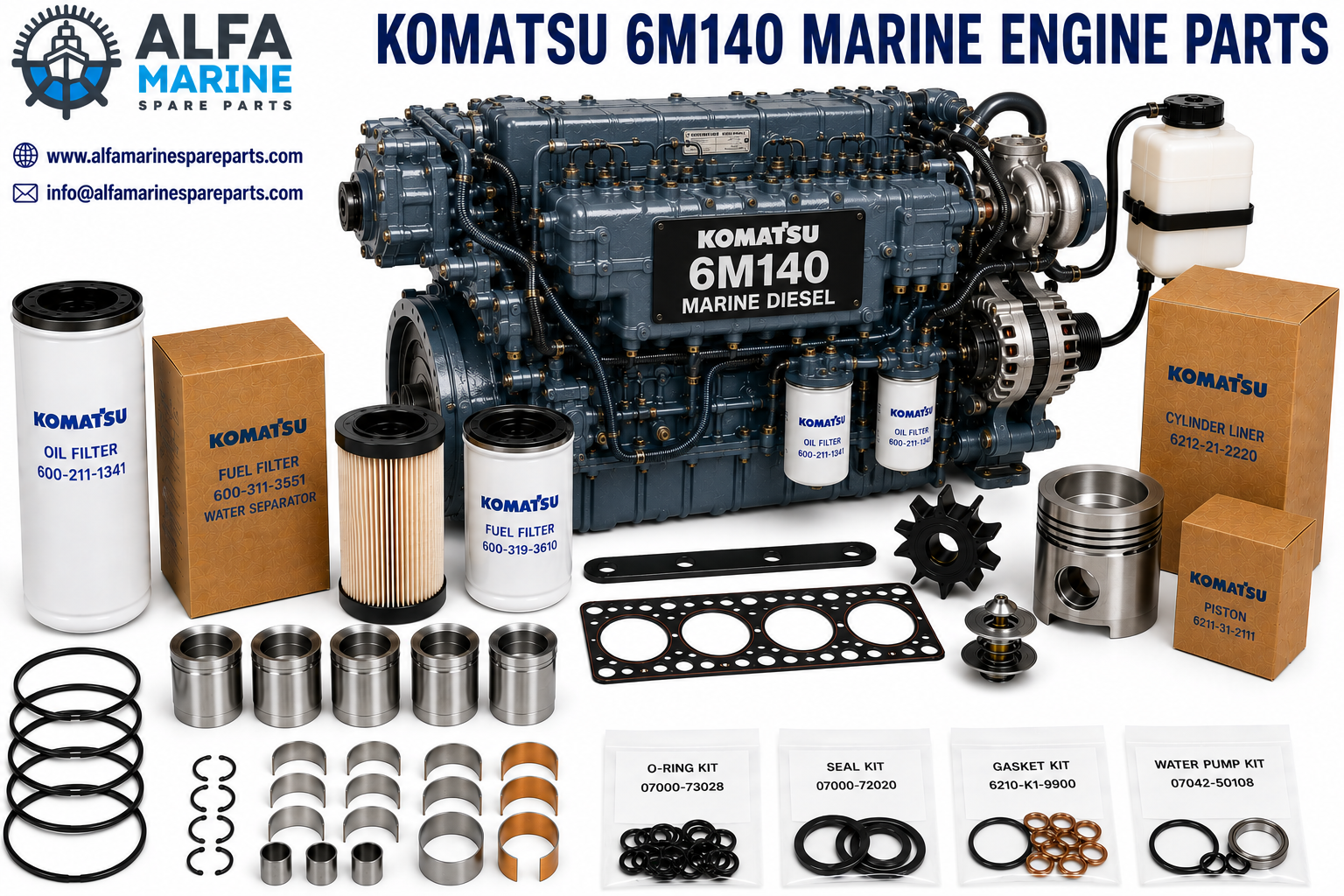
Komatsu 6M140 Marine Engine Parts
The Komatsu 6M140 Marine Engine is a heavy-duty inline six-cylinder marine diesel engine developed for commercial propulsion applications where dependable performance, high engine loading and long operating periods are important.
Marine versions include configurations such as the Komatsu 6M140A-5 and higher-output Komatsu 6M140AP-5.
These engines use a 15.2-litre six-cylinder configuration with direct fuel injection, turbocharging and intercooling.
Komatsu 6M140 marine engines can be encountered in commercial fishing vessels, workboats, utility craft, passenger vessels and other commercial marine applications.
As operating hours accumulate, spare-parts requirements can range from routine filters, gaskets and seals to fuel injection equipment, turbocharger components, intercooler parts, cooling-system components, cylinder heads, pistons, bearings, crankshaft components and major overhaul parts.
Alfa Marine Spare Parts supports Komatsu 6M140 Marine Engine Parts requirements for:
- Planned Maintenance
- Commercial Vessel Repairs
- Fishing Vessel Maintenance
- Workboat Repairs
- Engine-Room Repairs
- Fuel-System Repairs
- Turbocharger Repairs
- Intercooler Repairs
- Cooling-System Repairs
- Lubrication-System Repairs
- Cylinder Head Repairs
- Internal Engine Repairs
- Major Engine Overhauls
- Spare Parts Planning
Depending on the component and availability, supply options can include:
- Genuine Komatsu Parts
- OEM-Quality Components
- Selected Aftermarket Parts
- Remanufactured Components
- Maintenance Parts
- Repair Components
- Overhaul Parts
What Are the Technical Specifications of the Komatsu 6M140?
Two documented marine configurations are the Komatsu 6M140A-5 and Komatsu 6M140AP-5.
SpecificationKomatsu 6M140A-5Komatsu 6M140AP-5ManufacturerKomatsuKomatsuEngine Family6M1406M140ApplicationMarine PropulsionMarine PropulsionConfigurationInline 6-CylinderInline 6-CylinderCycleFour-Stroke DieselFour-Stroke DieselDisplacementApprox. 15.2 LApprox. 15.2 LBore × Stroke140 × 165 mm140 × 165 mmAspirationTurbocharged with IntercoolerTurbocharged with IntercoolerCombustion SystemDirect InjectionDirect InjectionMaximum OutputApprox. 566 kW / 770 PSApprox. 625 kW / 850 PSMaximum SpeedApprox. 2,100 rpmApprox. 2,200 rpmRated OutputApprox. 515 kW / 700 PSApprox. 569 kW / 774 PSRated SpeedApprox. 2,035 rpmApprox. 2,132 rpmApprox. Dry Weight2,340 kg2,340 kgApprox. Dimensions2,298 × 1,060 × 1,283 mm2,298 × 1,060 × 1,283 mmIntake SystemTurbo + IntercoolerTurbo + IntercoolerTypical ApplicationCommercial Marine PropulsionHigher-Output Marine Propulsion
Exact specifications can vary according to engine version, production period, rating and vessel installation.
For replacement parts, always confirm the exact Komatsu 6M140 model, engine serial number, build information and identification from the currently installed component.
What Does Komatsu 6M140 Mean?
The Komatsu 6M140 belongs to Komatsu's six-cylinder 140 mm bore marine engine family.
The documented configuration uses:
- Six Cylinders
- Inline Cylinder Arrangement
- 140 mm Bore
- 165 mm Stroke
- Approximately 15.2-Litre Displacement
- Four-Stroke Diesel Cycle
- Direct Fuel Injection
- Turbocharging
- Intercooling
The combination provides substantial displacement from a relatively compact inline-six marine engine.
Is the Komatsu 6M140 an Inline Six-Cylinder Engine?
Yes.
The Komatsu 6M140 uses an inline six-cylinder configuration.
This arrangement provides a relatively narrow engine package compared with a V-engine and can make the 6M140 suitable for commercial vessels where engine-room space and service access are important considerations.
Is the Komatsu 6M140 Turbocharged?
Yes.
Documented marine configurations including the 6M140A-5 and 6M140AP-5 are turbocharged and intercooled.
The turbocharger compresses intake air before it enters the engine.
The intercooler reduces the temperature of this compressed air before combustion.
These systems influence:
- Engine Power
- Combustion Air Supply
- Intake-Air Temperature
- Exhaust Temperature
- Fuel Consumption
- Engine Loading
- Overall Performance
Turbocharger and intercooler condition should therefore be considered when investigating reduced engine power.
What Is the Difference Between the Komatsu 6M140A-5 and 6M140AP-5?
Both engines share the same basic:
- Six-Cylinder Configuration
- 15.2-Litre Displacement
- 140 × 165 mm Bore and Stroke
- Turbocharged Intake
- Intercooler
- Direct Injection Arrangement
The 6M140AP-5 uses a higher marine output rating.
The 6M140A-5 has a documented maximum output of approximately 566 kW / 770 PS, while the 6M140AP-5 reaches approximately 625 kW / 850 PS.
This makes exact model identification important when sourcing engine and supporting-system components.
Are All Komatsu 6M140 Marine Engines the Same?
No.
Differences can exist according to:
- Exact Engine Variant
- Production Period
- Marine Rating
- Fuel Injection Equipment
- Turbocharger Configuration
- Intercooler Arrangement
- Cooling System
- Lubrication System
- Electrical Equipment
- Exhaust Arrangement
- Previous Repairs
- Previous Overhauls
Ordering major components simply by saying Komatsu 6M140 may therefore not provide enough information.
Why Is the Komatsu 6M140 Serial Number Important?
Commercial marine engines can remain in operation through multiple maintenance and overhaul cycles.
During that time, components may have been:
- Rebuilt
- Reconditioned
- Exchanged
- Replaced
- Superseded
- Updated
- Modified During Previous Repairs
This can be particularly relevant for:
- Fuel Injection Pumps
- Fuel Injectors
- Turbochargers
- Cooling-Water Pumps
- Intercoolers
- Heat Exchangers
- Oil Coolers
- Cylinder Heads
- Starter Motors
- Alternators
- Electrical Components
For accurate parts identification, use the engine serial number together with identification from the currently installed component whenever possible.
Komatsu 6M140 Routine Maintenance Parts
Common maintenance requirements can include:
- Engine Oil Filters
- Fuel Filters
- Fuel-Water Separator Elements
- Air Filter Components
- Drive Belts
- Thermostats
- Gaskets
- O-Rings
- Seals
- Cooling-System Components
- Lubrication-System Components
- Service Kits
Maintenance should be based on the applicable engine requirements together with vessel duty, engine loading and service history.
What Can Affect Komatsu 6M140 Component Life?
Engine operating hours alone do not determine component condition.
Factors can include:
- Continuous High-Load Operation
- Annual Operating Hours
- Frequent Load Changes
- Fuel Quality
- Lubricating Oil Condition
- Cooling-System Condition
- Air-Intake Condition
- Exhaust Temperature
- Engine-Room Temperature
- Maintenance History
- Previous Overhauls
- Long Periods of Inactivity
- Vessel Operating Profile
Commercial fishing and workboat engines operating long hours can therefore have different maintenance priorities from intermittently used engines.
Komatsu 6M140 Fuel-System Parts
Potential requirements can include:
- Fuel Injection Pump
- Fuel Injection Pump Components
- Fuel Injectors
- Injector Nozzles
- Fuel Transfer Pump
- Primary Fuel Filters
- Secondary Fuel Filters
- Fuel-Water Separator Components
- High-Pressure Fuel Pipes
- Fuel Supply Pipes
- Fuel Return Components
- Fuel Connections
- Gaskets
- Seals
- O-Rings
Komatsu 6M140 Fuel Injection Pump
Potential requirements can include:
- Complete Fuel Injection Pump
- Reconditioned Fuel Injection Pump
- Injection Pump Components
- Pump Seals
- Pump Gaskets
- Fuel Connections
- Associated Fuel-System Components
Why Should the Existing Komatsu 6M140 Injection Pump Be Identified?
A fuel injection pump may have been rebuilt or exchanged during previous engine maintenance.
Useful identification information can include:
- Exact Engine Variant
- Engine Serial Number
- Engine Build Information
- Existing Komatsu Part Number
- Injection Pump Manufacturer
- Pump Type
- Pump Identification Number
- Identification Plate
- Clear Photographs
This helps reduce the risk of selecting fuel equipment based only on the general 6M140 engine designation.
Komatsu 6M140 Fuel Injectors
Potential requirements can include:
- Complete Fuel Injectors
- Injector Nozzles
- Injector Sealing Components
- High-Pressure Fuel Pipes
- Fuel Return Components
- Associated Hardware
What Are Possible Signs of a Komatsu 6M140 Injector Problem?
Possible symptoms can include:
- Difficult Starting
- Rough Engine Operation
- Uneven Cylinder Performance
- Increased Exhaust Smoke
- Abnormal Cylinder Exhaust Temperature
- Reduced Engine Power
- Increased Fuel Consumption
- Abnormal Combustion Noise
These symptoms do not automatically confirm injector failure.
Fuel supply, injection-pump condition, injection timing, compression, valve condition and airflow should also be investigated.
Why Is Cylinder-to-Cylinder Comparison Useful on a Komatsu 6M140?
Comparing the six cylinders can provide useful diagnostic information.
Engineers may compare:
- Exhaust Temperature
- Combustion Behaviour
- Injector Performance
- Compression
- Valve Condition
- Fuel Delivery
- Exhaust Smoke
- Cylinder Contribution
A cylinder operating noticeably differently from the other five may justify further investigation.
Komatsu 6M140 Fuel Filter Parts
Potential requirements can include:
- Primary Fuel Filters
- Secondary Fuel Filters
- Fuel Filter Elements
- Fuel-Water Separator Components
- Filter Housings
- Filter Seals
- O-Rings
- Drain Components
Why Is Fuel Cleanliness Important on the Komatsu 6M140?
Fuel contamination can damage precision injection components.
Possible contaminants can include:
- Water
- Sediment
- Tank Debris
- Rust
- Corrosion Products
- Microbial Contamination
Poor fuel condition can contribute to:
- Injector Wear
- Injection-Pump Wear
- Poor Combustion
- Difficult Starting
- Unstable Engine Operation
- Reduced Engine Power
- Increased Exhaust Smoke
Komatsu 6M140 Turbocharger Parts
Potential requirements can include:
- Complete Turbocharger
- Turbocharger Cartridge
- Compressor Components
- Turbine Components
- Bearings
- Seals
- Oil Supply Components
- Oil Drain Components
- Intake Connections
- Exhaust Connections
- Turbocharger Gaskets
- Mounting Hardware
What Are Possible Signs of a Komatsu 6M140 Turbocharger Problem?
Possible symptoms can include:
- Reduced Engine Power
- Poor Acceleration
- Reduced Boost
- Increased Exhaust Smoke
- Abnormal Turbocharger Noise
- Oil Leakage
- Increased Oil Consumption
- High Exhaust Temperature
These symptoms should be properly diagnosed before automatically replacing the turbocharger.
What Can Cause a Komatsu 6M140 Turbocharger to Fail?
Possible contributing factors can include:
- Restricted Lubricating-Oil Supply
- Poor Oil Drainage
- Contaminated Lubricating Oil
- Restricted Air Intake
- Foreign-Object Damage
- Exhaust Restriction
- Excessive Exhaust Temperature
- Prolonged Abnormal Operation
Installing another turbocharger without correcting the original cause can result in repeated failure.
Does Black Smoke Mean the Komatsu 6M140 Turbocharger Has Failed?
Not necessarily.
Black smoke can also be associated with:
- Restricted Air Filters
- Injector Problems
- Fuel Injection Problems
- Excessive Fuel Delivery
- Low Compression
- Charge-Air Leakage
- Intercooler Problems
- High Engine Load
- Propeller Overloading
- Hull Fouling
- Exhaust Restriction
The complete engine and propulsion system should therefore be considered.
Komatsu 6M140 Air Intake Parts
Potential requirements can include:
- Air Cleaner Components
- Air Filter Components
- Intake Pipes
- Intake Hoses
- Turbocharger Connections
- Charge-Air Pipes
- Intake Manifold Components
- Clamps
- Gaskets
- Seals
Komatsu 6M140 Intercooler Parts
Potential requirements can include:
- Complete Intercooler
- Charge-Air Cooler Core
- Intercooler Housing
- End Covers
- Air Connections
- Cooling Connections
- Gaskets
- O-Rings
- Seals
Why Is the Komatsu 6M140 Intercooler Important?
The intercooler reduces the temperature of compressed intake air after turbocharging.
Poor charge-air cooling can contribute to:
- Higher Intake-Air Temperature
- Reduced Air Density
- Reduced Engine Performance
- Increased Exhaust Temperature
- Increased Thermal Load
- Poorer Combustion Conditions
Both the air side and cooling side should be considered during inspection.
What Can Restrict a Komatsu 6M140 Intercooler?
Possible causes can include:
- Oil Contamination
- Dirt
- Deposits
- Corrosion
- Scale
- Restricted Cooling Flow
- Internal Passage Problems
An intercooler problem can reduce performance even when the turbocharger itself is functioning correctly.
Komatsu 6M140 Cooling-System Parts
Potential requirements can include:
- Cooling-Water Pumps
- Seawater Pumps Where Installed
- Heat Exchanger Components
- Intercooler Components
- Oil Coolers
- Thermostats
- Cooling Pipes
- Cooling Hoses
- Temperature Components
- Gaskets
- O-Rings
- Seals
Komatsu 6M140 Cooling-Water Pump
Potential requirements can include:
- Complete Cooling-Water Pump
- Pump Housing
- Pump Shaft
- Bearings
- Mechanical Seals
- Impeller Components
- Gaskets
- O-Rings
What Can Reduce Komatsu 6M140 Cooling-Water Pump Performance?
Possible causes can include:
- Internal Wear
- Bearing Wear
- Seal Damage
- Impeller Damage
- Cavitation
- Corrosion
- Restricted Flow
- Cooling-System Contamination
The pump should be considered together with the complete cooling circuit.
Komatsu 6M140 Heat Exchanger Parts
Potential requirements can include:
- Complete Heat Exchanger
- Heat Exchanger Core
- Tube Bundle
- Housing
- End Covers
- Cooling Connections
- Gaskets
- O-Rings
- Seals
What Can Restrict a Komatsu 6M140 Heat Exchanger?
Possible causes can include:
- Scale
- Salt Deposits
- Sediment
- Marine Growth
- Internal Corrosion
- Debris
- Cooling-System Contamination
Internal flow can become restricted even when the cooler appears satisfactory externally.
Why Can a Komatsu 6M140 Overheat Under Load?
At lower load, the engine produces less heat.
When propulsion load increases, the cooling system must reject considerably more heat.
A partially restricted cooling system may therefore perform normally at low load but become inadequate at higher engine output.
Areas to investigate can include:
- Cooling-Water Pump
- Seawater Circuit
- Heat Exchanger
- Intercooler
- Oil Cooler
- Thermostats
- Cooling Pipes
- Cooling Hoses
- Coolant Condition
- Seawater Flow
- Exhaust Cooling Components
Komatsu 6M140 Lubrication-System Parts
Potential requirements can include:
- Engine Oil Filters
- Oil Filter Elements
- Oil Pump Components
- Oil Cooler
- Oil Cooler Core
- Oil Pressure Components
- Oil Pipes
- Oil Lines
- Oil Pan Components
- Front Crankshaft Seal
- Rear Crankshaft Seal
- Gaskets
- O-Rings
Why Is Lubrication Critical on the Komatsu 6M140?
Lubricating oil protects important engine components including:
- Crankshaft Journals
- Main Bearings
- Connecting Rod Bearings
- Pistons
- Camshaft Components
- Valve-Train Components
- Turbocharger
Poor lubrication can therefore affect multiple major engine assemblies simultaneously.
What Can Low Oil Pressure Mean on a Komatsu 6M140?
Possible causes can include:
- Incorrect Oil Level
- Incorrect Oil Grade
- Deteriorated Lubricating Oil
- Restricted Oil Filters
- Oil Pump Wear
- Excessive Bearing Clearance
- Internal Engine Wear
- Oil Pressure Sensor Problems
- Instrumentation Problems
Low oil pressure should be investigated systematically.
Komatsu 6M140 Oil Cooler Parts
Potential requirements can include:
- Complete Oil Cooler
- Oil Cooler Core
- Oil Cooler Housing
- Oil Connections
- Cooling Connections
- Gaskets
- O-Rings
- Seals
Komatsu 6M140 Cylinder Head Parts
Potential requirements can include:
- Complete Cylinder Heads
- Intake Valves
- Exhaust Valves
- Valve Guides
- Valve Seats
- Valve Springs
- Rocker Components
- Valve-Train Components
- Cylinder Head Gaskets
- Valve Cover Gaskets
- Injector Sealing Components
When Should a Komatsu 6M140 Cylinder Head Be Inspected?
Inspection may become necessary following:
- Engine Overheating
- Coolant Loss
- Cylinder Head Gasket Failure
- Low Compression
- Valve Damage
- Abnormal Combustion
- Abnormal Cylinder Exhaust Temperature
- Major Engine Overhaul
Rebuild or Replace a Komatsu 6M140 Cylinder Head?
The decision should be based on inspection and measurements.
Important areas can include:
- Cracking
- Corrosion
- Flatness
- Valve Condition
- Valve-Seat Condition
- Valve-Guide Wear
- Sealing Surfaces
- Previous Machining
- Thermal Damage
A serviceable cylinder head may be suitable for rebuilding.
Severe structural damage or dimensional problems may make replacement more appropriate.
Komatsu 6M140 Pistons and Piston Rings
Potential requirements can include:
- Pistons
- Piston Ring Sets
- Piston Pins
- Piston Pin Bushings
- Retaining Components
What Can Worn Komatsu 6M140 Piston Rings Cause?
Possible symptoms can include:
- Excessive Blow-By
- Increased Oil Consumption
- Reduced Compression
- Difficult Starting
- Increased Exhaust Smoke
- Reduced Engine Power
Piston, ring and cylinder condition should be evaluated together.
Why Should Pistons and Cylinders Be Measured During Overhaul?
Measurements can establish:
- Cylinder Wear
- Bore Condition
- Piston Condition
- Piston-to-Bore Clearance
- Ring-Groove Condition
- Whether Components Can Be Reused
- Which Replacement Components Are Required
Installing new piston rings cannot compensate for excessive cylinder or piston wear.
Komatsu 6M140 Connecting Rod Parts
Potential requirements can include:
- Connecting Rods
- Connecting Rod Bearings
- Small-End Bushings
- Connecting Rod Bolts
- Associated Hardware
Connecting rods should be inspected carefully following:
- Bearing Failure
- Lubrication Failure
- Piston Damage
- Abnormal Combustion
- Other Major Internal Damage
Komatsu 6M140 Main and Connecting Rod Bearings
Potential requirements can include:
- Main Bearing Sets
- Connecting Rod Bearing Sets
- Big-End Bearings
- Thrust Bearings
- Thrust Components
Why Should Komatsu 6M140 Bearing Dimensions Be Confirmed?
Previous overhaul work may have involved crankshaft repair or machining.
A crankshaft may have been:
- Polished
- Repaired
- Reground
- Replaced
Actual crankshaft dimensions should therefore guide final bearing selection.
Komatsu 6M140 Crankshaft Parts
Potential requirements can include:
- Complete Crankshaft
- Main Bearings
- Connecting Rod Bearings
- Thrust Components
- Crankshaft Gear Components
- Front Crankshaft Seal
- Rear Crankshaft Seal
What Should Be Checked on a Komatsu 6M140 Crankshaft?
During overhaul, inspection can include:
- Main Journal Diameter
- Connecting Rod Journal Diameter
- Journal Surface Condition
- Scoring
- Taper
- Out-of-Round Condition
- Heat Damage
- Previous Machining
- General Crankshaft Condition
Komatsu 6M140 Camshaft and Timing Components
Potential requirements can include:
- Camshaft Components
- Camshaft Bearings
- Timing Gears
- Gear-Train Components
- Timing Covers
- Timing Cover Gaskets
- Valve-Train Components
Komatsu 6M140 Gaskets and Seals
Potential requirements can include:
- Cylinder Head Gaskets
- Valve Cover Gaskets
- Intake Gaskets
- Exhaust Gaskets
- Turbocharger Gaskets
- Intercooler Gaskets
- Cooling-System Gaskets
- Oil Cooler Gaskets
- Injector Seals
- Front Crankshaft Seal
- Rear Crankshaft Seal
- O-Rings
- Upper Gasket Sets
- Lower Gasket Sets
- Complete Engine Gasket Sets
- Engine Seal Kits
Are All Komatsu 6M140 Gasket Sets the Same?
Not necessarily.
The correct gasket package can depend on:
- Exact Engine Variant
- Engine Serial Number
- Engine Build Information
- Installed Components
- Production Changes
- Previous Modifications
The exact engine configuration should therefore be confirmed before ordering.
Komatsu 6M140 Starter Motor Parts
Potential requirements can include:
- Complete Starter Motors
- Starter Solenoids
- Relays
- Electrical Connections
- Associated Hardware
Does Slow Cranking Automatically Mean Starter Failure?
No.
Possible causes can include:
- Weak Batteries
- Corroded Battery Connections
- Damaged Battery Cables
- Poor Ground Connections
- Excessive Electrical Resistance
- Relay Problems
- Control-Circuit Problems
The complete starting system should be checked before replacing the starter motor.
Komatsu 6M140 Alternator Parts
Potential requirements can include:
- Complete Alternators
- Alternator Components
- Drive Belts
- Pulleys
- Belt-Tensioning Components
- Electrical Connections
Komatsu 6M140 Electrical Components
Depending on the exact installation, potential requirements can include:
- Temperature Senders
- Oil Pressure Senders
- Speed Sensors
- Switches
- Relays
- Wiring Components
- Electrical Connectors
- Alarm Components
- Shutdown Components
- Starter Components
- Alternator Components
Komatsu 6M140 Exhaust-System Parts
Potential requirements can include:
- Exhaust Manifold Components
- Turbocharger Exhaust Connections
- Exhaust Pipes
- Expansion Connections
- Exhaust Gaskets
- Seals
- Clamps
- Associated Hardware
Why Is Exhaust Restriction Important?
Exhaust restriction can contribute to:
- Reduced Engine Power
- Increased Exhaust Temperature
- Increased Exhaust Smoke
- Poor Turbocharger Performance
- Poor Engine Response
The exhaust system should therefore be considered during performance troubleshooting.
Komatsu 6M140 Engine Overhaul Parts
Depending on inspection findings, overhaul requirements can include:
- Pistons
- Piston Rings
- Piston Pins
- Main Bearings
- Connecting Rod Bearings
- Connecting Rods
- Small-End Bushings
- Thrust Components
- Cylinder Head Components
- Intake Valves
- Exhaust Valves
- Crankshaft Seals
- Complete Gasket Sets
- Seal Kits
- Fuel-System Components
- Turbocharger Components
- Cooling-System Components
- Lubrication-System Components
More extensive repairs may require:
- Complete Cylinder Heads
- Crankshaft
- Camshaft Components
- Fuel Injectors
- Fuel Injection Pump
- Turbocharger
- Cooling-Water Pump
- Heat Exchanger Components
- Intercooler Components
- Oil Cooler
- Starter Motors
- Alternators
Is There One Standard Komatsu 6M140 Overhaul Kit?
Not necessarily.
The correct overhaul package should be determined from:
- Exact Engine Variant
- Engine Serial Number
- Engine Build Information
- Operating Hours
- Maintenance History
- Previous Overhauls
- Cylinder Measurements
- Piston Condition
- Crankshaft Dimensions
- Bearing Condition
- Cylinder Head Condition
- Fuel Injection Equipment
- Turbocharger Condition
- Cooling-System Condition
Why Should Inspection Come Before Ordering a Komatsu 6M140 Overhaul Kit?
Previous overhaul work may have changed the engine from its original condition.
Previous machining or component replacement can affect:
- Crankshaft Dimensions
- Bearing Requirements
- Cylinder Condition
- Piston Requirements
- Cylinder Head Condition
- Fuel Injection Equipment
- Turbocharger Configuration
A practical approach is:
Identify the engine → inspect the components → measure where necessary → confirm part numbers → order.
Genuine Komatsu 6M140 Marine Engine Parts
Depending on availability, genuine components can support selected:
- Planned Maintenance
- Fuel-System Repairs
- Turbocharger Repairs
- Cooling-System Repairs
- Cylinder Head Repairs
- Internal Engine Repairs
- Major Engine Overhauls
OEM-Quality Komatsu 6M140 Parts
Where the original component manufacturer and correct technical specification can be established, OEM-quality sourcing may be possible for:
- Fuel Injection Components
- Turbocharger Components
- Pumps
- Bearings
- Filters
- Cooling Components
- Starter Motors
- Alternators
- Other Engine Components
Aftermarket Komatsu 6M140 Parts
Selected aftermarket alternatives may be available for:
- Filters
- Gaskets
- Seals
- Bearings
- Pistons
- Piston Rings
- Cooling-System Components
- Maintenance Components
- Selected Internal Engine Parts
Compatibility should always be confirmed against the exact Komatsu 6M140 configuration.
Remanufactured Komatsu 6M140 Components
Depending on availability, professionally remanufactured options may include:
- Fuel Injectors
- Fuel Injection Pumps
- Turbochargers
- Cylinder Heads
- Starter Motors
- Alternators
- Selected Pumps
- Other Rebuildable Components
What Vessels Use Komatsu 6M140 Marine Engines?
Komatsu 6M140 marine engines can support applications including:
- Commercial Fishing Vessels
- Workboats
- Utility Vessels
- Passenger Craft
- Service Vessels
- Coastal Commercial Vessels
- Other Commercial Marine Craft
Actual vessel application depends on engine rating, marine gear, propulsion arrangement and vessel design.
What Information Should I Provide for Komatsu 6M140 Parts?
For accurate Komatsu 6M140 Marine Engine Parts identification, provide:
- Exact Engine Variant – 6M140A-5, 6M140AP-5 or Other Version
- Engine Serial Number
- Engine Build Information
- Existing Komatsu Part Number
- Component Manufacturer Number
- Fuel Injection Pump Identification Where Relevant
- Injector Identification Where Relevant
- Turbocharger Identification Where Relevant
- Cooling-Water Pump Identification Where Relevant
- Part Description
- Quantity Required
- Clear Photographs
- Vessel Application
- Marine Gear Information Where Relevant
- Delivery Country or Nearest Port
For major components, photographs showing the engine identification plate and the actual component being replaced can be particularly useful.