Perkins Sabre M130C / M135 / M300Ti Raw-Water Pump PW10000 Guide
The raw-water pump is an important part of the cooling system on a Perkins Sabre M130C, M135 or M300Ti marine engine.
When replacing a seawater pump, however, matching the engine model and finding a pump that looks similar is not enough.
The pump covered in this guide is:
Engine: Perkins Sabre M130C / M135 / M300Ti
Component: Complete Raw-Water / Seawater Pump
Part Reference: PW10000
Part number PW10000 is documented as a complete raw-water / seawater pump reference associated with selected Perkins Sabre applications.
However, PW10000 should not automatically be treated as universal for every M130C, M135 or M300Ti installation.
Before ordering, verify:
Exact engine model + engine serial number + existing pump number + installed pump configuration
Perkins Sabre PW10000 Raw-Water Pump
The pump covered in this guide is:
| EngineComponentPart Reference | ||
| Perkins Sabre M130C / M135 / M300Ti | Complete Raw-Water / Seawater Pump | PW10000 |
The raw-water pump supplies seawater to the marine side of the cooling system.
Correct pump identification is important because seemingly similar pumps can differ in their drive arrangement, rotation, mounting or connection orientation.
This means:
Similar appearance does not prove compatibility.
Before installing a replacement PW10000, compare it carefully with the removed pump and verify the application against the exact engine.
What Does the Raw-Water Pump Do?
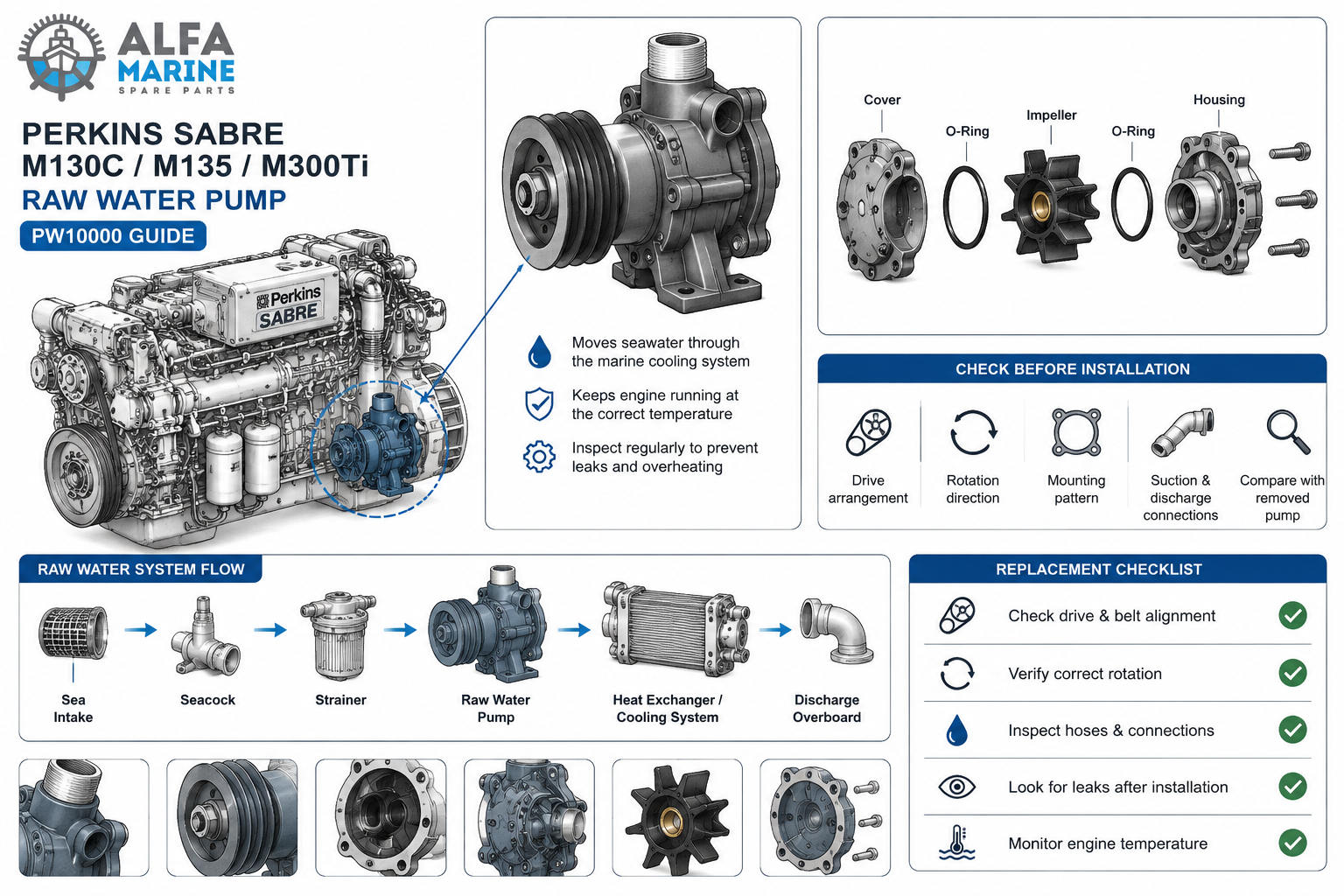
The raw-water pump moves seawater through the marine cooling circuit.
A simplified seawater path can be represented as:
Sea intake → seacock → raw-water strainer → seawater pump → cooling components / heat exchanger → discharge
The exact routing depends on the vessel and engine installation.
The seawater circuit removes heat through the marine cooling system. If seawater flow becomes restricted or inadequate, cooling performance can deteriorate.
This can become particularly noticeable as engine load increases.
Raw-Water Pump vs Engine Coolant Pump
The raw-water pump should not be confused with the engine's fresh-water coolant circulation pump.
They perform different functions.
Raw-Water / Seawater Pump
Moves seawater through the marine side of the cooling system.
Fresh-Water / Coolant Pump
Circulates engine coolant through the engine's closed cooling circuit.
When requesting a replacement, simply asking for a:
“Perkins Sabre water pump”
may therefore not provide enough information.
Specify whether you require the raw-water / seawater pump or the engine coolant circulation pump.
Similar Appearance Does Not Prove Pump Compatibility
This is particularly important with marine engines that have been in service for many years.
Two pumps can appear almost identical while having important technical differences.
Before installing a replacement, compare:
- Drive arrangement
- Pump rotation
- Mounting pattern
- Suction connection
- Discharge connection
- Hose orientation
- Pump body configuration
- Identification numbers
A pump that physically bolts onto the engine is not automatically the correct pump.
Physical fit does not establish technical compatibility.
Check the Pump Drive
The drive arrangement deserves careful attention when replacing a raw-water pump.
Compare the drive side of the removed pump with the proposed replacement.
Check for differences involving:
- Drive configuration
- Shaft arrangement
- Gear engagement
- Mounting depth
- Pump position
Do not force a replacement pump into position simply because the mounting points appear to align.
If anything differs from the removed unit, confirm the pump application before installation.
Pump Rotation Matters
Correct pump rotation is essential for proper seawater circulation.
When replacing PW10000, verify the required rotation against the existing installation and technical information applicable to the exact engine.
Do not assume that two visually similar pumps operate in the same direction.
A pump with an incorrect configuration may not provide the expected seawater flow.
For this reason:
Drive arrangement + rotation should always be checked before installation.
Compare Hose Connections and Orientation
Hose orientation is another useful identification check.
Before removing the existing pump, note the position of the:
- Suction connection
- Discharge connection
- Hose routing
- Connection angles
- Nearby components
Taking photographs before disassembly can be extremely useful.
When the replacement pump arrives, compare the connections before installation.
If the hose ports are positioned differently, do not immediately modify the vessel's plumbing.
First confirm whether the replacement pump is correct for the engine.
Inspect the Raw-Water System When Changing the Pump
Replacing a raw-water pump provides a good opportunity to inspect the surrounding seawater circuit.
Check the:
- Seacock
- Sea intake
- Raw-water strainer
- Suction hose
- Hose clamps
- Pump connections
- Downstream hoses
- Heat exchanger
- Other seawater-fed coolers
- Discharge path
A new pump cannot correct a blocked seawater intake or restricted heat exchanger.
If the previous pump was damaged because of poor seawater supply, replacing the pump without correcting the underlying cause may lead to another failure.
Check the Raw-Water Strainer
The seawater pump depends on an unrestricted supply of water.
Inspect the strainer for:
- Marine growth
- Weed
- Shell fragments
- Sediment
- Plastic
- Other debris
A partially restricted strainer may still allow enough seawater through when the engine is operating at low load.
As engine load increases, however, cooling demand also increases.
The restriction can then become much more noticeable.
This is why cooling-system problems sometimes appear only when the vessel is operating under propulsion load.
Normal at Idle but Hotter Under Load?
An engine that maintains normal temperature at idle but runs hotter under load deserves investigation.
At idle, the engine produces relatively little heat.
Even a partially restricted raw-water circuit may still provide enough cooling.
Under sustained load, the engine produces more heat and requires greater cooling capacity.
A restriction involving the:
Sea intake → strainer → suction hose → raw-water pump → heat exchanger → discharge
may therefore become more noticeable.
This means:
Normal temperature at idle does not prove that seawater flow is adequate under load.
Don't Automatically Blame PW10000 for Overheating
If a Perkins Sabre engine begins running hotter than normal, the raw-water pump is one component worth inspecting.
But overheating does not automatically mean PW10000 has failed.
Possible causes can include:
- Restricted sea intake
- Closed or partially closed seacock
- Blocked raw-water strainer
- Suction-hose problems
- Raw-water pump deterioration
- Restricted heat exchanger
- Restricted cooler
- Downstream seawater restriction
- Problems in the closed coolant circuit
- Abnormal engine load
Diagnose the complete cooling system before replacing the pump.
Inspect the Removed Pump
The old pump can provide useful evidence.
Before disposing of it, inspect its condition.
Look for:
- Internal wear
- Impeller deterioration
- Shaft problems
- Bearing deterioration
- Seal leakage
- Corrosion
- Drive damage
- Abnormal internal contact
Understanding why the original pump failed can help protect the replacement.
For example, evidence of inadequate seawater supply may indicate that the root cause exists somewhere upstream of the pump.
Missing Impeller Material Deserves Attention
If inspection reveals damaged or missing impeller material, do not simply install a replacement pump and forget about the missing pieces.
As a general marine cooling-system diagnostic practice, consider whether fragments may have travelled downstream.
Possible locations requiring inspection can include:
- Pump outlet
- Hoses
- Cooler connections
- Heat exchanger
- Other downstream restrictions
Missing material can potentially contribute to reduced seawater flow.
The exact inspection procedure should follow the technical information applicable to the engine and cooling-system installation.
Check for Leaks After Installation
Once the replacement pump has been installed and the engine is operating normally, inspect the areas disturbed during maintenance.
Look for:
- Seawater leakage
- Hose leakage
- Loose clamps
- Leakage around pump connections
- Abnormal pump noise
- Abnormal vibration
Also monitor engine temperature during subsequent operation.
The objective is not simply to install the pump.
It is to confirm that the complete cooling system is operating correctly afterward.
Why PW10000 Should Not Be Treated as Universal
Perkins Sabre engines have been installed in many different vessels and may have undergone repairs or modifications during their operating lives.
Pump identification can depend on:
- Exact engine model
- Engine serial number
- Engine build
- Marine configuration
- Existing pump
- Installed cooling arrangement
- Previous repairs or modifications
For this reason:
PW10000 should not automatically be assumed to fit every Perkins Sabre M130C, M135 or M300Ti installation.
Correct identification should always come before ordering.
Ordering Perkins Sabre Raw-Water Pump PW10000
The component covered in this guide is:
Engine: Perkins Sabre M130C / M135 / M300Ti
Component: Complete Raw-Water / Seawater Pump
Part Reference: PW10000
When requesting a replacement pump, provide:
Exact engine model + engine serial number + existing pump number + pump identification
For older installations, it can also help to provide:
- Engine data-plate photograph
- Existing pump photographs
- Pump identification or casting numbers
- Drive-side photograph
- Suction and discharge connection photographs
- Vessel application
This information can help establish the correct replacement before ordering.
For Perkins marine pumps and engine components, contact Alfa Marine Spare Parts.
Email: request@alfamarinespareparts.com
Request a Quote
Frequently Asked Questions
What is Perkins Sabre part number PW10000?
PW10000 is a documented complete raw-water / seawater pump reference associated with selected Perkins Sabre M130C, M135 and M300Ti applications.
Is PW10000 a complete seawater pump?
Yes. PW10000 is referenced as a complete raw-water / seawater pump, rather than simply an impeller or service component.
Does PW10000 fit every M130C, M135 or M300Ti?
No. It should not automatically be treated as universal. Verify the exact engine model, serial number and installed pump before ordering.
Is the raw-water pump the same as the coolant pump?
No. The raw-water pump moves seawater through the marine cooling circuit. The engine coolant pump circulates coolant through the closed fresh-water circuit.
Why should I compare pump rotation?
Correct rotation is important for proper pump operation. Do not assume that two visually similar pumps have the same operating configuration.
Why does hose orientation matter?
Different pump configurations can have different suction and discharge arrangements. Hose orientation can therefore provide an important identification clue.
Can a blocked seawater strainer cause overheating?
A restricted strainer can reduce seawater supply and cooling capacity, particularly as engine load increases.
Does overheating mean PW10000 has failed?
Not necessarily. Intake restriction, strainer blockage, hose problems, heat-exchanger restriction and other cooling-system problems can create similar symptoms.
What information should I provide when ordering PW10000?
Provide the exact engine model, engine serial number, existing pump number and pump identification, preferably with photographs.
Conclusion
When replacing the raw-water pump on a Perkins Sabre M130C, M135 or M300Ti, do not rely on appearance alone.
For selected applications, PW10000 is a documented complete raw-water / seawater pump reference.
Before installation, compare:
Drive → rotation → mounting → hose connections → pump identification
Also inspect the surrounding seawater circuit to determine whether a restriction or other cooling-system problem contributed to the original pump failure.
Most importantly, verify the exact engine and installed pump before ordering.
A useful engine-room principle is:
A pump that looks the same is not necessarily the same pump.
For Perkins Sabre pumps and other marine-engine components, contact Alfa Marine Spare Parts.
Email: request@alfamarinespareparts.com