
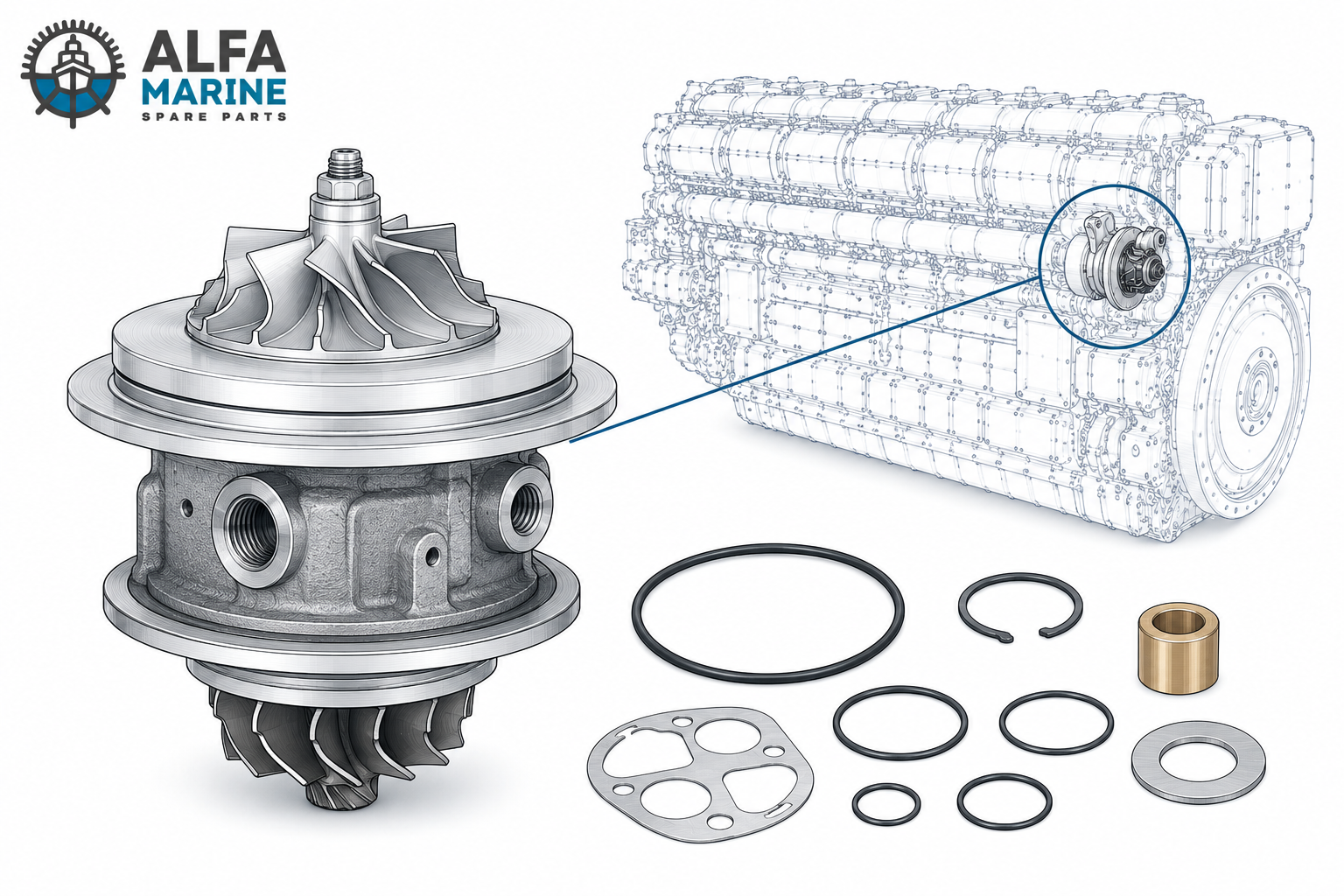
MTU Turbocharger Cartridge: Replacement & Identification Guide
An MTU turbocharger cartridge can be an important replacement component when repairing an applicable turbocharger used on an MTU engine.
The cartridge is sometimes referred to in the parts market as a:
Turbocharger cartridge
Turbo cartridge
Turbo core
CHRA
or:
Center housing rotating assembly
However, a cartridge should not be selected simply because it is advertised for an MTU Series 2000 or MTU Series 4000 engine.
MTU engines exist in many configurations, and turbocharging systems can differ according to the exact engine model and application.
For accurate identification, start with:
Complete MTU engine model + engine serial number + complete turbocharger identification + existing turbocharger or cartridge part number
Alfa Marine Spare Parts is an independent marine engine parts supplier. Depending on the individual requirement and availability, we supply and source turbochargers, turbocharger cartridges and related engine components for applicable MTU engines.
From our European operations in the Netherlands and Spain, we support international customers requiring parts for maintenance, repair and overhaul projects.
Browse Marine Spare Parts or Request a Quote.
What Is an MTU Turbocharger Cartridge?
The term turbocharger cartridge generally refers to the central rotating assembly of a turbocharger.
Depending on the turbocharger design and supplier terminology, a cartridge or CHRA can incorporate applicable central components associated with:
- Turbocharger shaft
- Compressor wheel
- Turbine wheel/shaft assembly
- Bearing system
- Center housing
- Sealing components
- Other internal components
The exact construction depends on the turbocharger.
Do not assume that every cartridge supplied for an MTU application contains exactly the same components.
Always confirm the scope of supply before ordering.
Turbocharger Cartridge vs Complete Turbocharger
A turbocharger cartridge is not necessarily the same as a complete turbocharger.
A complete turbocharger can include the applicable:
- Compressor housing
- Turbine housing
- Center section
- Rotating assembly
- Other application-specific components
A cartridge normally represents only part of the complete turbocharger assembly.
This distinction is important when deciding whether the existing turbocharger can be repaired using a cartridge or whether a complete replacement turbocharger is required.
CHRA, Turbo Core & Cartridge Terminology
Parts suppliers can use different terminology.
Common searches include:
MTU turbocharger cartridge
MTU turbo cartridge
MTU turbo core
MTU CHRA
MTU turbocharger core assembly
These terms can help during parts research, but terminology alone does not confirm compatibility.
The turbocharger must still be identified correctly.
Start With the Complete MTU Engine Model
A search for:
MTU turbocharger cartridge
is very broad.
Even:
MTU Series 4000 turbo cartridge
may not provide enough information.
A better search uses:
Exact MTU engine model + turbocharger number + cartridge
For example:
MTU 16V 2000 + turbocharger number + cartridge
or:
MTU 16V 4000 + turbocharger number + CHRA
Use the complete engine designation whenever possible.
Why the Engine Serial Number Matters
The engine serial number provides additional identification information when sourcing turbocharger components.
MTU engine families can contain different models, ratings and configurations.
For a strong turbocharger enquiry, provide:
Complete engine model + engine serial number + turbocharger identification
However, do not rely solely on the engine serial number when the turbocharger itself carries readable identification.
The turbocharger number is particularly important when identifying internal repair components.
Identify the Existing Turbocharger
Before removing or dismantling the turbocharger, inspect it carefully for identification.
Record applicable:
- MTU part number
- Turbocharger manufacturer
- Turbocharger model
- Turbocharger serial number
- Assembly number
- Identification plate information
- Numbers cast, stamped or engraved on the unit
- Existing cartridge reference if known
Take clear photographs before cleaning or disassembly.
Do not intentionally remove prefixes, suffixes, letters or leading zeros from a reference.
Photograph the Turbocharger Data Plate
The turbocharger identification plate can be one of the most useful sources of information.
Take a clear photograph showing the complete plate.
Also photograph:
- Complete turbocharger
- Compressor housing
- Turbine side
- Oil connections
- Cooling connections where applicable
- Mounting arrangement
- Engine data plate
Several photographs are better than one close-up.
MTU Series 2000 Turbocharger Cartridges
MTU Series 2000 includes numerous engine models and configurations.
Turbocharging arrangements can differ within the family.
Do not search only:
MTU Series 2000 turbo cartridge
Instead use:
Exact Series 2000 engine model + turbocharger identification + cartridge
The turbocharger identification should be verified before selecting a cartridge.
A cartridge associated with one Series 2000 application should not automatically be assumed suitable for another.
MTU Series 4000 Turbocharger Cartridges
The same principle applies to MTU Series 4000 engines.
Series 4000 contains multiple engine models, ratings and turbocharging configurations.
Therefore:
MTU Series 4000 turbocharger cartridge
is a useful search term, but it is not enough by itself to establish the correct replacement component.
Use:
Complete Series 4000 model + engine serial number + turbocharger identification
before confirming the cartridge.
Turbocharger Configuration Matters
MTU turbocharging systems are engineered according to the requirements of the individual engine application.
Different MTU engines can use different turbocharging arrangements.
Depending on the exact engine configuration, the system may use:
- One turbocharger
- Multiple turbochargers
- Sequential turbocharging
- Other application-specific turbocharging arrangements
Do not assume that all turbochargers installed on MTU engines use the same cartridge.
Multiple Turbochargers on One Engine
Some MTU engine configurations use more than one turbocharger.
If an engine has multiple turbochargers, record the identification of the turbocharger being repaired.
Where appropriate, record the identification of all installed turbochargers.
Do not assume that every turbocharger position automatically uses an identical component without verification.
MTU Turbocharger Cartridge Part Number
If the existing cartridge has a readable part number, record it exactly.
A useful search structure is:
MTU + engine model + turbocharger number + cartridge part number
If the cartridge itself has no readable number, use the complete turbocharger identification.
Do not guess missing characters.
Old MTU Turbocharger Part Numbers
Older turbochargers may carry references different from numbers found in current parts searches.
Keep all original numbers.
They can help with:
- Turbocharger identification
- Cartridge searches
- Historical parts research
- Supersession checks
- Cross-reference enquiries
An old number can remain valuable even if a newer reference exists.
Superseded Turbocharger & Cartridge Numbers
Component references can change over time.
You may encounter:
Old turbocharger number → newer turbocharger number
or:
Old cartridge number → proposed replacement cartridge
This can provide a useful parts lead.
However:
Supersession should be verified for the individual turbocharger application.
Provide:
Old number + proposed replacement number + engine model + engine serial number + turbocharger identification
before ordering.
MTU Turbocharger Cartridge Cross Reference
Cross-reference databases can connect an MTU or turbocharger reference with another cartridge number.
This can be useful during sourcing.
However:
Cross reference does not automatically mean confirmed interchangeability.
The proposed cartridge should be verified against the complete turbocharger identification and engine application.
Similar-Looking Cartridges Can Be Different
Turbocharger cartridges can look very similar externally.
That does not mean they are interchangeable.
Differences can involve applicable:
- Compressor wheel design
- Turbine wheel design
- Shaft dimensions
- Bearing arrangement
- Center housing
- Sealing arrangement
- Oil passages
- Cooling arrangement
- Rotating assembly specification
- Turbocharger application
Do not select a cartridge by photographs alone when reliable identification is available.
Do Not Identify a Cartridge by Wheel Diameter Alone
Dimensions can provide supporting information during identification, but they should not replace the complete turbocharger reference.
Two cartridges with similar wheel dimensions may still have different:
- Wheel geometry
- Shaft specifications
- Bearing systems
- Balancing requirements
- Housings
- Applications
Use measurements as supporting information, not as the primary confirmation of compatibility.
Why Turbocharger Balancing Matters
A turbocharger rotating assembly operates at very high rotational speed.
Correct assembly condition and balancing are therefore critical.
A replacement cartridge should be suitable for the exact turbocharger application and supplied in an appropriate condition.
Do not treat turbocharger internal repair as equivalent to replacing a low-speed mechanical component.
New Turbocharger Cartridge
A new cartridge may be available for certain MTU turbocharger applications.
Before ordering, verify:
- Engine model
- Engine serial number
- Complete turbocharger number
- Cartridge part number
- Manufacturer
- Supply condition
- Required quantity
Do not assume that new automatically means OEM.
If OEM is required, state this clearly.
Reconditioned Turbocharger Cartridge
Reconditioned or remanufactured turbocharger components may be available depending on the application.
The term reconditioned can describe different scopes of work.
Before purchasing, establish applicable:
- Component identity
- Repair scope
- Parts replaced
- Inspection performed
- Balancing/testing status
- Warranty
- Supply condition
Do not assume that every reconditioned cartridge has undergone the same process.
Cartridge Replacement vs Complete Turbocharger Replacement
A cartridge replacement may be appropriate when the remaining turbocharger components are serviceable and the correct cartridge is available.
However, installing a new cartridge cannot correct every turbocharger problem.
A complete turbocharger may need to be considered when inspection identifies significant damage to applicable:
- Compressor housing
- Turbine housing
- Mounting surfaces
- Oil connections
- Cooling connections
- Other external components
The repair decision should be based on the condition of the complete turbocharger.
Inspect the Compressor Housing
Before installing a replacement cartridge, inspect the compressor housing as applicable.
Look for:
- Contact marks
- Cracking
- Corrosion
- Foreign-object damage
- Excessive contamination
- Damaged mounting surfaces
- Other physical damage
A new cartridge should not be installed blindly into a damaged housing.
Inspect the Turbine Housing
The turbine side should also be inspected.
Depending on the turbocharger condition, look for applicable:
- Cracking
- Erosion
- Heavy deposits
- Foreign-object damage
- Contact marks
- Damaged mounting surfaces
- Other deterioration
The housing must be suitable for continued service if it will be reused.
Check the Turbocharger Oil Supply
A replacement cartridge will not correct a lubrication problem.
Before returning the turbocharger to service, investigate the applicable oil supply and drain arrangement.
Depending on the engine and turbocharger, check applicable:
- Oil supply condition
- Oil feed connections
- Oil drain
- Restrictions
- Contamination
- Leakage
- Installation condition
Follow the applicable MTU and turbocharger service procedures.
A New Cartridge Cannot Fix a Restricted Oil Supply
This is an important point.
A new turbocharger cartridge cannot overcome an inadequate or restricted oil supply.
If lubrication contributed to the original turbocharger failure, installing another cartridge without correcting the cause can lead to another failure.
The root cause should be established before the engine returns to normal operation.
Check the Air Intake System
Turbocharger problems can also be influenced by the condition of the air-intake system.
Depending on the engine installation, inspect applicable:
- Air filters
- Intake restrictions
- Air ducting
- Connections
- Contamination
- Foreign-object entry
- Leaks
Do not assume that every boost problem originates inside the turbocharger.
Check the Exhaust System
The exhaust side can also influence turbocharger performance.
Depending on the installation, investigate applicable:
- Exhaust restrictions
- Leakage
- Exhaust manifold condition
- Connections
- Heavy deposits
- Other exhaust-system problems
The exact inspection depends on the engine and turbocharging configuration.
Low Boost Does Not Automatically Mean Cartridge Failure
This is one of the most important diagnostic points.
Low boost does not automatically mean the turbocharger cartridge has failed.
Low boost can potentially be associated with several conditions, including applicable:
- Air-intake restriction
- Charge-air leakage
- Exhaust leakage
- Exhaust restriction
- Fuel-system problems
- Engine-load problems
- Turbocharger condition
- Other engine faults
Diagnose the complete system before ordering a cartridge solely because boost pressure is low.
Black Smoke Does Not Automatically Mean Turbo Failure
Black exhaust smoke can occur when combustion receives insufficient air for the amount of fuel being supplied, but turbocharger failure is only one possible cause.
Depending on the engine, investigate applicable:
- Air intake
- Charge-air system
- Turbocharging system
- Fuel system
- Injectors
- Exhaust system
- Engine load
- Other combustion-related conditions
Do not replace the cartridge based on smoke alone.
Blue Smoke & Turbocharger Investigation
Blue or blue-grey exhaust smoke can justify investigating oil entering the combustion or air system.
However, turbocharger condition is only one possible area.
Other engine conditions can also contribute to oil consumption or blue smoke.
Diagnosis should establish the actual source before parts are replaced.
Oil in the Compressor Side
Oil found in the air system should be investigated carefully.
Do not automatically conclude that visible oil proves the cartridge has failed.
Depending on the engine and installation, consider the complete crankcase ventilation, intake, turbocharger and engine operating condition.
The amount and location of oil are important diagnostic information.
Excessive Turbocharger Noise
Abnormal turbocharger noise can indicate a condition requiring immediate investigation.
Possible areas can include:
- Rotating-component contact
- Bearing condition
- Foreign-object damage
- Air leakage
- Exhaust leakage
- Other mechanical problems
Do not continue operating a turbocharger with severe abnormal noise without determining the cause.
Turbocharger Shaft Play
Shaft movement is often checked during turbocharger inspection.
However, acceptable movement depends on the individual turbocharger design and service specification.
Do not publish or use a universal shaft-play limit for all MTU turbochargers.
Use the applicable technical information for the specific turbocharger.
Compressor Wheel Damage
Inspect the compressor wheel where appropriate.
Possible damage can include:
- Bent blades
- Chipped blades
- Foreign-object impact
- Contact marks
- Erosion
- Heavy contamination
Damage to the rotating assembly requires appropriate evaluation before the turbocharger returns to service.
Turbine Wheel Damage
The turbine wheel should also be evaluated where applicable.
Inspect for:
- Blade damage
- Contact
- Heavy deposits
- Erosion
- Cracking
- Other deterioration
A damaged rotating assembly should not be returned to service simply because the turbocharger can still rotate.
Foreign-Object Damage
Foreign material entering either side of a turbocharger can damage the rotating components.
If foreign-object damage is found, investigate where the material came from.
Installing a new cartridge without correcting the source of foreign material can result in repeat damage.
Find the Root Cause Before Installing a New Cartridge
When a turbocharger cartridge has failed, determine why.
Potential areas for investigation can include:
- Lubrication
- Oil contamination
- Air-intake restriction
- Foreign-object entry
- Exhaust conditions
- Charge-air system
- Installation
- Engine operating condition
- Other mechanical problems
Replacing the damaged cartridge without correcting the root cause can lead to repeat failure.
Do Not Guess Turbocharger Installation Specifications
Turbocharger installation can involve application-specific procedures and values.
Do not guess:
- Fastener torque
- Oil-line requirements
- Clearances
- Orientation requirements
- Balancing specifications
- Assembly procedures
Use the applicable service information for the exact engine and turbocharger.
Priming & Lubrication After Installation
Correct lubrication during installation and initial operation is important for turbocharger service.
Follow the applicable MTU and turbocharger installation procedures for the exact unit.
Do not rely on generic internet procedures when manufacturer-specific information is available.
Check Charge-Air Connections After Installation
After turbocharger work, inspect the applicable charge-air connections.
Depending on the engine configuration, check:
- Hoses
- Pipes
- Clamps
- Seals
- Connections
- Charge-air coolers
- Other intake components
A charge-air leak can cause poor performance even when the turbocharger itself is serviceable.
Verify Operation After Turbocharger Repair
After installation, verify engine operation according to the applicable procedure.
Depending on the engine and installation, checks can include:
- Oil leakage
- Coolant leakage where applicable
- Air leakage
- Exhaust leakage
- Abnormal noise
- Engine response
- Boost behavior
- Exhaust smoke
- Operating temperatures
- Diagnostic information
Do not place the engine under significant load until the repair has been appropriately checked.
Build an MTU Turbocharger Cartridge Parts List
For planned repair or overhaul work, organize the requirement before ordering.
| ItemExisting Part NumberDescriptionQuantityCondition | ||||
| 1 | Existing reference | Turbocharger cartridge / CHRA | Required qty. | OEM / specified |
| 2 | Existing reference | Turbocharger gasket/seal | Required qty. | New |
| 3 | Existing reference | Turbocharger component | Required qty. | Specified |
| 4 | Existing reference | Related installation part | Required qty. | New |
At the top, record:
Engine model:
Engine serial number:
Turbocharger manufacturer:
Turbocharger model:
Turbocharger part number:
Cartridge number if known:
Delivery destination:
Required date:
Do not guess missing references.
No Turbocharger Number? Send Photographs
If the turbocharger identification cannot be read, send photographs showing:
- Complete turbocharger
- Identification plate
- Stamped numbers
- Engraved references
- Compressor housing
- Turbine housing
- Oil connections
- Cooling connections where applicable
- Mounting arrangement
- Engine data plate
Historical invoices and previous overhaul records can also provide useful identification.
Common MTU Turbocharger Cartridge Search Mistakes
Searching Only “MTU Turbo Cartridge”
This is too broad.
Ordering by Engine Series Only
Series 2000 or Series 4000 alone may not identify the correct turbocharger.
Identifying the Cartridge by Appearance
Similar-looking cartridges can have different specifications.
Assuming Every Turbo on a Multi-Turbo Engine Is Identical
Verify each applicable turbocharger position and reference.
Using a Cross Reference Without Verification
Cross-reference information is a search lead, not automatic proof of interchangeability.
Assuming Low Boost Means Cartridge Failure
Diagnose the complete air, exhaust, fuel and engine systems.
Ignoring the Cause of the Original Failure
A new cartridge can fail again if the root cause remains.
Assuming New Means OEM
Specify OEM if required.
Better MTU Turbocharger Cartridge Search Process
Use this sequence:
1. Identify the complete MTU engine model
2. Record the engine serial number
3. Identify the turbocharger manufacturer
4. Record the complete turbocharger model and part number
5. Photograph the turbocharger identification plate
6. Record the existing cartridge number if available
7. Establish the reason for repair
8. Inspect the reusable turbocharger housings
9. Investigate the root cause of any failure
10. Verify the proposed cartridge against the complete turbocharger
11. Follow the applicable installation procedure
12. Check the air, exhaust and lubrication systems
13. Verify engine operation after repair
This is more reliable than purchasing a cartridge solely from a broad engine-family description.
MTU Turbocharger Cartridges for Planned Overhauls
For planned engine maintenance or overhaul projects, identify turbocharger requirements before dismantling the engine.
Record:
Engine model + engine serial number + turbocharger manufacturer + turbocharger number + cartridge reference
If the engine uses multiple turbochargers, document each applicable unit.
This makes quotation, sourcing and onboard inventory management easier.
MTU Turbocharger Parts Supply From Europe
Alfa Marine Spare Parts supports international customers from European operations in the Netherlands and Spain.
Customers include:
- Chief engineers
- Yacht managers
- Shipyards
- Marine repair companies
- Commercial vessel operators
- Engine rebuilders
- Purchasing departments
- Marine service companies
Depending on the individual requirement and availability, we can supply and source applicable MTU turbocharger cartridges, complete turbochargers and related turbocharger components for customers worldwide.
Request an MTU Turbocharger Cartridge
Looking for an MTU turbocharger cartridge, turbo core, CHRA or complete turbocharger?
Send:
Complete MTU engine model + engine serial number + turbocharger manufacturer + turbocharger model/part number + cartridge number if known + quantity + delivery destination
If the identification is unreadable, include clear photographs of:
Complete turbocharger + identification plate + compressor housing + turbine housing + connections + engine data plate
📧 request@alfamarinespareparts.com
Request a Quote
Browse Marine Spare Parts
Frequently Asked Questions
What is an MTU turbocharger cartridge?
A turbocharger cartridge generally refers to the turbocharger's central rotating assembly, often called a CHRA or turbo core. The exact components included depend on the turbocharger design and supplier.
Is a turbocharger cartridge the same as a complete turbo?
No. A cartridge generally represents the central assembly, while a complete turbocharger also includes applicable compressor and turbine housings and other components.
How do I identify the correct MTU turbocharger cartridge?
Start with the complete MTU engine model, engine serial number and complete turbocharger identification. The turbocharger manufacturer, model and part number are particularly important.
Can I order a cartridge using only the MTU engine model?
The engine model is useful, but the complete turbocharger identification should be provided whenever possible.
Are all MTU Series 2000 turbo cartridges the same?
No universal interchangeability should be assumed. Series 2000 engines exist in different configurations and turbocharging arrangements.
Are all MTU Series 4000 turbo cartridges interchangeable?
No. Identify the exact engine and turbocharger before selecting a cartridge.
Does low boost mean the turbocharger cartridge has failed?
Not necessarily. Low boost can have several causes involving the air, charge-air, exhaust, fuel, engine-load or turbocharging systems.
Can a new cartridge fix a damaged turbocharger housing?
Not necessarily. Compressor and turbine housings should be inspected before they are reused.
Why should the turbocharger oil supply be checked?
A lubrication problem can contribute to turbocharger damage. Installing a new cartridge without correcting the underlying lubrication issue can result in repeat failure.
Can I identify a turbo cartridge from photographs?
Photographs can provide useful supporting information, especially when the turbocharger identification plate and existing references are visible. They should not replace reliable part-number verification when that information is available.
Can an old MTU turbocharger number have a newer replacement?
Turbocharger or component references can change or be superseded. Keep both the old and proposed replacement numbers and verify their relationship for the individual application.
Can I use an aftermarket turbocharger cartridge?
Where alternatives are acceptable, the proposed cartridge should still be verified against the exact turbocharger and engine application. Specify OEM required if OEM components are mandatory.
Do you supply MTU turbocharger cartridges internationally?
Alfa Marine Spare Parts supports international customers from European operations in the Netherlands and Spain.
Independent Supplier Notice
Alfa Marine Spare Parts is an independent supplier and is not an official or authorized dealer of MTU or Rolls-Royce Power Systems. Brand names, trademarks, part numbers and model designations are used for identification and compatibility reference purposes only.