
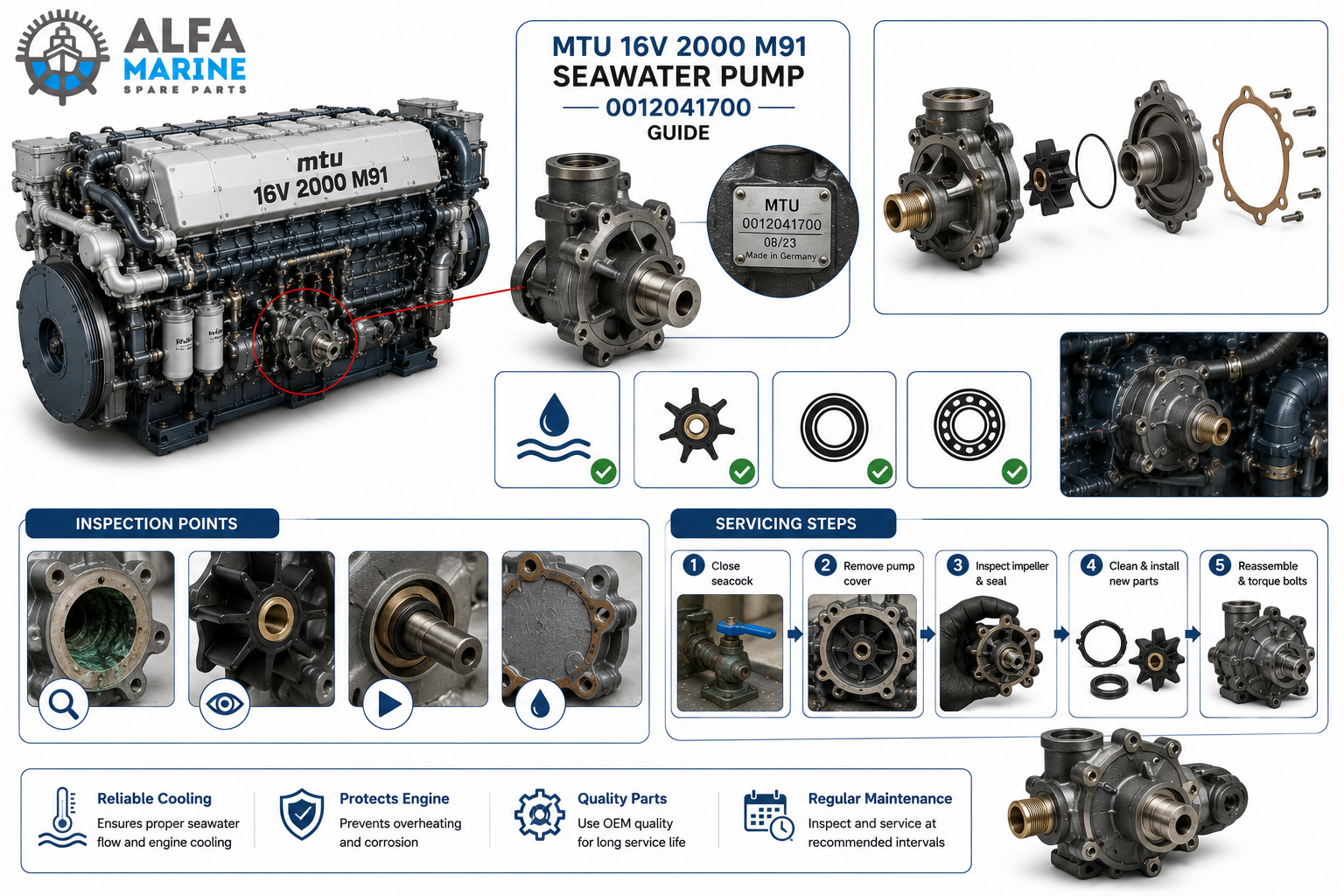
MTU 16V 2000 M91 Seawater Pump 0012041700 Guide
A gradual increase in coolant temperature on an MTU 16V 2000 M91 marine engine deserves attention—even when the engine has not triggered a temperature alarm.
Marine engineers often know the normal operating behavior of an engine extremely well. If the engine normally maintains a consistent temperature at a particular RPM and load but begins operating progressively warmer under similar conditions, that change can provide an early indication that cooling-system performance has changed.
One component worth considering is the seawater pump.
For certain MTU 16V 2000 M91 configurations, the documented seawater-pump reference is:
Engine: MTU 16V 2000 M91
Component: Seawater Pump
Part Reference: 0012041700
This pump should not be treated as universal for every MTU 16V 2000 M91. Engine serial number, build configuration and identification on the existing pump should be verified before ordering.
For related components, visit MTU Series 2000 Marine Engine Parts.
MTU 16V 2000 M91 Seawater Pump Part Number
The seawater-pump reference covered in this guide is:
| EngineComponentPart Reference | ||
| MTU 16V 2000 M91 | Seawater Pump | 0012041700 |
Parts information documents 0012041700 as the seawater-pump BOM on a documented MTU 16V 2000 M91 configuration.
That distinction is important.
The Series 2000 family has been produced in multiple versions, and component selection can depend on the exact engine specification.
Before ordering, verify:
Complete engine model + engine serial number + existing pump number + pump identification
Photographs of the pump identification and engine data plate can also assist with identification.
What Does the MTU M91 Seawater Pump Do?
The seawater pump moves raw seawater through the marine side of the cooling system.
A simplified seawater path can look like:
Sea intake → seacock → sea strainer → seawater pump → coolers / heat exchanger → discharge
The exact arrangement depends on the vessel installation.
The seawater circuit helps remove heat from the engine's cooling systems.
This is why reduced seawater flow may become particularly noticeable when engine load increases.
At low load, the cooling system may still have enough capacity to maintain normal temperature.
At higher load, the engine produces considerably more heat. A developing restriction or reduction in seawater flow can therefore become more noticeable during sustained propulsion load.
Track Coolant Temperature Over Time
One of the most useful engine-room practices is to understand what is normal for your engine.
A single temperature reading provides limited information.
A temperature trend can tell you much more.
Suppose the MTU 16V 2000 M91 historically operates at a consistent coolant temperature at the same cruising RPM and similar load.
Over time, the engineer notices:
Normal historical temperature → slightly warmer → consistently warmer → temperature begins increasing under sustained load
That trend deserves investigation.
It does not automatically prove that seawater pump 0012041700 is failing.
But it does indicate that something affecting cooling performance may have changed.
Same Load, Different Temperature? Pay Attention
For meaningful comparison, operating conditions matter.
Try to compare engine temperature under reasonably similar conditions:
- Similar RPM
- Similar engine load
- Similar vessel speed
- Similar seawater conditions
- Similar vessel loading
- Similar ambient conditions
This helps separate a genuine cooling-system trend from normal operating variation.
The most useful question is:
Is the engine behaving differently under conditions where it previously behaved normally?
If the answer is yes, the change deserves investigation.
A Seawater Pump Can Lose Performance Before an Alarm
Cooling-system problems do not always begin with an immediate overheating alarm.
Performance can deteriorate gradually.
Depending on the cause, reduced seawater flow can be associated with:
- Pump wear
- Impeller deterioration
- Internal pump damage
- Seal or shaft problems
- Restricted seawater intake
- Dirty sea strainer
- Restricted hoses
- Cooler or heat-exchanger fouling
- Debris in the seawater circuit
The engine may initially remain within its acceptable operating range.
But an engineer familiar with the vessel may notice that temperature is no longer behaving exactly as it did previously.
This is why trend monitoring can provide useful warning before an alarm threshold is reached.
Don't Automatically Blame Pump 0012041700
A rising coolant temperature does not automatically mean the seawater pump needs replacement.
The pump is only one component in the seawater circuit.
If cooling performance changes, inspect the complete path.
1. Seawater Intake
Confirm that the intake is unobstructed and the seacock is correctly positioned.
2. Sea Strainer
Inspect for marine growth, weeds, shells, sediment or other debris.
3. Suction-Side Hoses
Check for restriction, deterioration, collapse or possible air entry.
4. Seawater Pump
Inspect pump condition according to the applicable MTU technical procedure.
5. Downstream Hoses
Look for restriction, deterioration or abnormal condition.
6. Heat Exchangers and Coolers
Consider fouling or restriction within the seawater side.
7. Continue Cooling-System Diagnosis
If seawater flow appears normal, continue investigating the remaining cooling system according to the applicable engine documentation.
This avoids replacing an expensive seawater pump when the actual restriction is elsewhere.
MTU 16V 2000 M91 Normal at Idle but Hotter Under Load
This is an important diagnostic pattern.
Imagine the engine operating at the dock with normal temperature.
The vessel then gets underway and engine load increases.
After sustained operation, coolant temperature gradually climbs above its historical normal value.
At idle, the engine produces relatively little heat.
Even a partially restricted seawater system may still provide sufficient cooling capacity.
Under load, cooling demand increases considerably.
A restriction that was barely noticeable at idle can therefore become important during sustained operation.
This means:
Normal temperature at idle does not prove that seawater flow is adequate under propulsion load.
If temperature consistently rises only as load increases, investigate the cooling system under the conditions where the symptom actually occurs.
Twin MTU M91 Engines Can Provide a Useful Comparison
Twin-engine installations provide an additional diagnostic reference.
If both engines are operating at approximately the same RPM and similar load, their operating data can be compared.
For example:
Port MTU 16V 2000 M91 → normal historical temperature
Starboard MTU 16V 2000 M91 → consistently warmer
That difference does not identify the failed component by itself.
But it provides useful evidence.
Compare:
- Coolant temperature
- Engine load
- Seawater strainers
- Seawater flow
- Pump condition
- Coolers
- Heat exchangers
- Oil temperature
- Charge-air temperature
If one engine's behavior changes while the other remains stable under comparable conditions, investigate why.
Inspect Seawater Pump 0012041700 as a Complete Assembly
Parts information for documented 0012041700 configurations shows that the seawater pump contains several serviceable internal components.
Examples include:
| ComponentPart Reference | |
| Pump shaft | 8692040121 |
| Impeller | 8692010025 |
| Rotary seal | 8692010024 |
| Cylindrical roller bearing | 8699810032 |
| Angular-contact ball bearing | 8699810033 |
| Oil seal | 0089978047 |
| Sealing ring | 8699970245 |
| Gear | 8692010026 |
| Mounting O-ring | 700429118000 |
These numbers should not be ordered solely from this article.
Always verify the actual pump configuration and engine serial number before ordering internal components.
Does a Leaking Seawater Pump Need Complete Replacement?
Not necessarily.
The correct repair depends on what inspection reveals.
Possible areas of deterioration include:
- Rotary seal
- Bearings
- Pump shaft
- Impeller
- Internal housing
- Gear
- Sealing components
- Corroded or worn surfaces
If the major pump components remain serviceable, overhaul may be possible depending on the pump's condition and applicable repair specifications.
If damage is extensive, complete pump replacement may be more appropriate.
The decision should be based on inspection rather than automatically assuming that every leaking pump needs complete replacement.
If the Seal Is Leaking, Inspect More Than the Seal
Replacing a leaking seal without checking the components around it can result in another leak.
If seawater pump 0012041700 shows leakage, consider:
Seal → shaft → bearings → housing → internal pump components
A worn shaft can affect a replacement seal.
Bearing deterioration can allow unwanted shaft movement.
Corrosion or wear can damage sealing surfaces.
The visible leak may therefore be a symptom of a larger pump-condition problem.
Check Impeller 8692010025
Parts information for documented 0012041700 pump configurations identifies 8692010025 as the impeller.
If the pump is opened for inspection, evaluate the impeller according to the applicable technical procedure.
Look for abnormal:
- Wear
- Damage
- Missing material
- Surface deterioration
- Evidence of contact
- Corrosion or erosion
If impeller material is missing, consider whether debris may have travelled downstream.
As a general marine cooling-system diagnostic practice, missing material should be accounted for because debris can potentially contribute to downstream restriction.
Rising Temperature Doesn't Always Mean Reduced Seawater Flow
Temperature trends are useful, but they must be interpreted correctly.
A gradual increase in coolant temperature can have causes beyond the seawater pump.
Possible areas include:
- Reduced seawater flow
- Heat-exchanger fouling
- Cooler restriction
- Coolant-side problems
- Thermostat-related problems
- Abnormal engine load
- Sensor or instrumentation issues
- Higher seawater temperature
- Different vessel operating conditions
This is why a temperature trend should be treated as a reason to investigate, not proof that pump 0012041700 has failed.
Good diagnosis asks:
What changed?
Then follows the evidence.
Record MTU M91 Operating Data
Operating records can make gradual changes much easier to identify.
Useful information can include:
| Operating DataWhy It Helps | |
| Engine hours | Establishes maintenance history |
| RPM | Provides operating reference |
| Engine load | Makes temperature comparisons meaningful |
| Coolant temperature | Shows cooling trends |
| Oil temperature | Provides another heat-load indicator |
| Charge-air temperature | Helps compare operating conditions |
| Seawater temperature | Provides environmental context |
| Maintenance performed | Connects changes with service events |
The objective is not to react to every minor fluctuation.
Instead, look for consistent changes from the engine's established normal behavior.
Why 0012041700 Is Not Universal for Every M91
This is especially important when ordering replacement parts.
The fact that 0012041700 is documented on an MTU 16V 2000 M91 does not mean every 16V 2000 M91 uses that exact pump.
Component selection can vary with:
- Engine serial number
- Build specification
- Production configuration
- Marine application
- Cooling-system arrangement
- Previous repairs or modifications
A request stating only:
“MTU 16V 2000 M91 seawater pump”
may therefore not contain enough information for confident identification.
A better request is:
Engine: MTU 16V 2000 M91
Engine serial number: __________
Existing pump number: 0012041700
Pump identification: __________
Quantity: __________
Photographs: Attached
Ordering MTU 16V 2000 M91 Seawater Pump 0012041700
The component covered in this guide is:
Engine: MTU 16V 2000 M91
Component: Seawater Pump
Part Reference: 0012041700
When requesting this or other MTU Series 2000 Marine Engine Parts, provide:
Complete engine designation + engine serial number + existing pump number + pump identification
Photographs of the existing pump and engine data plate can further assist identification.
Alfa Marine Spare Parts can assist with MTU Series 2000 cooling-system components, complete seawater pumps and applicable pump components, subject to correct identification and availability.
Email: request@alfamarinespareparts.com
Request a Quote
Frequently Asked Questions
What is MTU part number 0012041700?
0012041700 is documented as a seawater pump used on certain MTU Series 2000 configurations, including a documented MTU 16V 2000 M91 application.
Does every MTU 16V 2000 M91 use pump 0012041700?
No. The pump should not be treated as universal. Verify the complete engine designation, engine serial number and existing pump identification.
Can reduced seawater-pump performance cause higher coolant temperature?
Reduced seawater-pump performance can contribute to lower seawater flow and reduced cooling capacity. However, a temperature increase can have several possible causes and should be diagnosed systematically.
Can the seawater pump still operate when worn?
Yes. A worn pump may continue producing flow while no longer providing the same performance under higher cooling demand.
Why does my MTU M91 run normally at idle but hotter under load?
Higher engine load creates greater cooling demand. A partially restricted seawater circuit or another cooling-system problem may therefore become more noticeable during sustained operation.
Is 8692010025 an impeller for pump 0012041700?
8692010025 is documented as the impeller in the 0012041700 pump configuration referenced in the parts information. Verify the actual pump before ordering.
Should I replace the complete pump if it leaks?
Not automatically. The shaft, seals, bearings, impeller, housing and other relevant components should be inspected to determine whether repair, overhaul or complete replacement is appropriate.
What information should I provide when ordering an MTU M91 seawater pump?
Provide the complete engine model, engine serial number, existing pump part number and pump identification, preferably with photographs.
Conclusion
A gradual increase in coolant temperature on an MTU 16V 2000 M91 can provide useful information before an overheating alarm occurs.
If the engine begins running consistently warmer at the same RPM and comparable load, don't ignore the change.
Investigate the complete cooling path:
Seawater intake → strainer → hoses → seawater pump → coolers / heat exchanger → discharge
For certain MTU 16V 2000 M91 configurations, 0012041700 is a documented seawater-pump reference, but it should never be assumed to fit every M91.
Verify the engine serial number and existing pump identification before ordering.
A useful engine-room principle is:
Know the normal temperature. Watch the trend. Investigate the change before it becomes an alarm.
For seawater pumps and other MTU Series 2000 Marine Engine Parts, contact Alfa Marine Spare Parts.
Email: request@alfamarinespareparts.com