
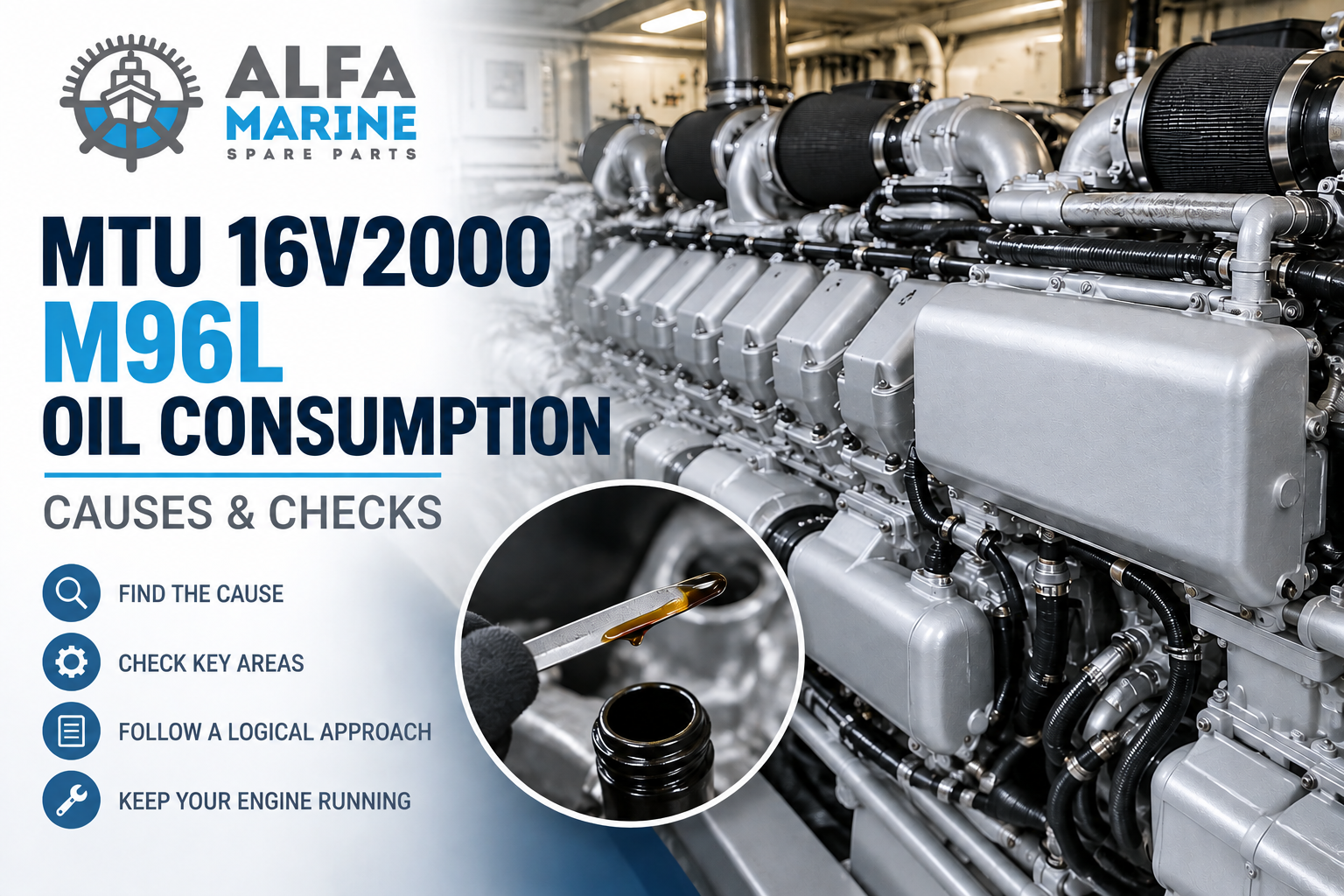

MTU 16V2000 M96L Oil Consumption: Causes & Checks
You check the oil level before departure and everything looks normal. After several trips, however, the MTU 16V2000 M96L needs topping up again.
There may be no alarm. The engine may still start normally, reach its expected RPM and perform well underway. You may not even see an obvious oil leak in the engine room.
So where is the oil going?
The MTU 16V2000 M96L is a 35.7-litre V16 marine engine rated at 1,939 kW / 2,600 bhp at 2,450 rpm. If lubricating-oil consumption starts to increase, it should be investigated properly rather than blamed immediately on piston rings, cylinder liners or turbochargers.
Oil may be leaking externally, passing through the crankcase ventilation system, associated with a turbocharger or lubrication-system problem, or being consumed internally.
The important thing is to establish how much oil is actually being lost and where it is going before deciding which parts need attention.
For engine and parts information, see the MTU 16V2000 M96L Marine Engine Parts page.
First Confirm That Oil Consumption Has Really Increased
Before looking for a fault, stop estimating.
Saying that an engine “seems to be using more oil lately” does not provide enough information to diagnose the problem.
Record the amount of make-up oil added and the operating hours between top-ups.
If you add two litres after 25 operating hours, write it down. Repeat the measurement during the next operating period.
After several readings, you will have a much clearer picture of whether the consumption is stable, gradually increasing or perhaps only appeared unusual because the oil level was being checked under different conditions.
On a twin-engine yacht, this becomes particularly useful. If both engines have accumulated approximately the same operating hours but one consistently requires more make-up oil, that difference deserves investigation.
Check the Oil Level the Same Way Every Time
Before assuming the M96L has a mechanical problem, make sure the oil-level readings themselves are reliable.
Checking the oil shortly after shutdown one day and after the engine has been standing for a much longer period the next time can produce readings taken under different conditions.
Vessel attitude can also influence what you see on the dipstick.
Follow the correct oil-level checking procedure for the installation and try to make each measurement under repeatable conditions.
The objective is simple: make sure the falling oil level is real before trying to diagnose why it is falling.
Avoid automatically overfilling the engine simply because you want the dipstick to remain at its highest mark.
Look for External Oil Leaks First
Before discussing pistons, liners or turbochargers, inspect the outside of the engine carefully.
Pay particular attention to oil-filter and filter-housing areas, lubrication-system pipes and connections, oil-cooler connections, seals and gaskets, sump and drain areas, turbocharger oil lines and anything that has recently been disturbed during maintenance.
An oil leak does not always leave a large puddle underneath the engine.
Oil can travel along a housing, pipe or bracket before dripping somewhere completely different. Some leaks also become much more noticeable when the engine is hot and operating.
If an area is already covered with old oil residue, clean it first. Operate the engine and inspect it again.
Fresh oil is considerably easier to trace.
Ask One Important Question: When Did It Start?
This simple question can prevent a lot of unnecessary troubleshooting.
Was oil consumption normal before the last service?
Was a different lubricating oil introduced?
Was turbocharger work carried out?
Were cylinder heads serviced?
Was anything changed around the crankcase ventilation system?
Did the problem begin after an oil and filter service?
Did the behaviour change after a particular passage or operating period?
If the engine was stable for hundreds of hours and oil consumption changed immediately after maintenance, inspect what changed before assuming that an unrelated internal failure occurred at exactly the same time.
The timing does not prove the cause, but it gives you a logical starting point.
Check the Crankcase Breather and Oil Separator System
The crankcase ventilation system should be considered when oil consumption changes.
Some combustion gases naturally pass the piston rings and enter the crankcase while the engine is operating. The ventilation system manages these gases and the oil mist carried with them.
If something changes in this system, oil carryover can change as well.
Look for unusual oil mist, changes in crankcase behaviour, restrictions or anything in the breather and oil-separator arrangement that has recently been serviced or disturbed.
Do not diagnose piston-ring wear simply because crankcase vapour is visible.
A diesel engine naturally produces some blow-by.
The more useful question is:
Has the crankcase behaviour changed compared with what is normal for this particular engine?
What Can Blow-By Tell You?
Blow-by becomes much more useful when you have something to compare it with.
If crankcase behaviour has remained stable for a long period and then changes at approximately the same time that oil consumption increases, the combination deserves closer investigation.
If historical measurements are available, compare them.
On a twin-M96L installation, comparison between port and starboard engines can also provide useful information when both engines are operating under broadly comparable conditions.
But avoid jumping directly from:
“There is crankcase vapour.”
to:
“The piston rings are worn.”
That conclusion requires additional evidence.
Could the Turbocharger Be Involved?
Yes, but increased oil consumption alone is not enough reason to replace a turbocharger.
The M96L uses a high-output turbocharged arrangement, so turbocharger-related oil paths are reasonable areas to investigate when other evidence points in that direction.
Look for abnormal oil accumulation in the relevant intake or charge-air areas. Inspect the oil supply and return connections where appropriate. The exhaust side may also require investigation when other symptoms suggest oil could be passing through that route.
The important word is abnormal.
A light oil film and enough oil to explain significant engine-oil consumption are not the same thing.
If oil is found, the next question should be:
Where did this oil come from?
Do not condemn the turbocharger simply because oil is present nearby.
Check the Turbocharger Oil Supply and Return Area
A turbocharger depends on a reliable lubricating-oil supply and an effective oil return path.
If the investigation points toward the turbocharger area, inspect the associated oil lines and connections for leakage and follow the appropriate MTU service procedure for the specific engine configuration.
An oil-related problem around a turbocharger does not automatically mean the complete turbocharger has failed.
Find the actual cause before replacing an expensive assembly.
Does Your M96L Have an Oil Replenishment System?
Some M96L installations can be equipped with an optional oil replenishment and oil-level regulating system.
If this equipment is fitted, do not monitor only the dipstick. Also consider how much make-up oil the system is supplying.
An automatic replenishment arrangement can maintain the engine oil level while oil is still being consumed or lost.
A reasonably stable dipstick reading therefore does not necessarily mean that no make-up oil is being used.
The engineer needs to understand the configuration actually installed on the vessel.
This is another reason why the complete engine model and engine serial number are important when investigating an M96L.
Do Not Ignore the Engine Oil Cooler
The oil cooler forms part of the lubrication system and should be considered when the evidence points in that direction.
That does not mean every M96L with increased oil consumption has an oil-cooler problem.
It means the cooler should not be forgotten during a wider oil-loss investigation, particularly when other signs suggest leakage or contamination.
Inspect it because the symptoms point you there, not simply because the part exists on the engine.
What About the Engine Oil Pump?
The engine oil pump is critical to lubrication-system operation, but an oil-pump problem and an oil-consumption problem are not automatically the same thing.
Do not replace an oil pump simply because the engine is using more oil.
Oil pressure, alarms, lubrication-system behaviour and other diagnostic findings should support an investigation in that direction.
This distinction matters. Otherwise, an oil-consumption investigation can quickly become an inaccurate list of expensive parts to replace.
Could the Pistons, Rings or Cylinder Liners Be Worn?
Yes. Internal cylinder condition is one possible cause of increased lubricating-oil consumption.
If piston-ring or liner condition deteriorates, more oil may reach the combustion chamber.
However:
Oil consumption can be caused by ring or liner wear.
does not mean:
Oil consumption proves the rings or liners are worn.
Before moving toward internal engine work, look for supporting evidence.
Has oil consumption been increasing gradually?
Has crankcase behaviour changed?
Are oil-analysis trends changing?
Is unusual debris appearing in the used oil filter?
Are cylinder-condition checks pointing in the same direction?
The more independent observations that agree, the stronger the case becomes for deeper mechanical inspection.
Blue Smoke Is a Clue, Not a Diagnosis
Blue or blue-grey exhaust smoke can be consistent with lubricating oil entering the combustion process, but smoke colour alone does not identify the source.
Pay attention to when it occurs.
Does it appear only at startup? After extended idling? During acceleration? At normal cruising load? Continuously?
On a twin-engine yacht, does one engine produce visible smoke while the other remains clear?
Those observations are more useful than simply recording “engine smoking blue.”
Blue smoke may support an oil-consumption investigation, but by itself it cannot tell you whether the source is turbocharger-related, cylinder condition or another oil path.
Twin M96Ls Give You a Useful Diagnostic Advantage
If the yacht has two MTU 16V2000 M96Ls, the other engine can provide a useful reference.
Suppose both engines have operated for 60 hours.
Port engine: minimal make-up oil.
Starboard engine: repeatedly requires additional oil.
That does not identify the fault, but it immediately gives you something useful to investigate.
Compare external leakage, exhaust behaviour, crankcase behaviour, oil in the relevant intake or charge-air areas, oil-analysis trends, recent maintenance and make-up oil supplied by any replenishment system.
This port-versus-starboard comparison can also be useful for performance problems. See our MTU 16V2000 M96L One Engine Low RPM: Causes & Diagnosis.
Oil Analysis Can Add Another Piece of Evidence
Used-oil analysis can be valuable, particularly when historical results are available for the same engine.
The key is the trend.
Depending on the laboratory and analysis program, results may include wear metals, viscosity, fuel dilution, water, soot and other indicators.
A single unusual value does not automatically identify a failed engine part.
Suppose oil consumption has gradually increased while one or more oil-analysis indicators also begin moving away from the engine's established historical trend.
That combination deserves attention.
Oil analysis is evidence. It is not a substitute for inspecting and testing the engine.
Inspect the Used Oil Filter if Internal Wear Is Suspected
If the evidence begins pointing toward internal wear, inspection of the used oil filter can provide another piece of information.
Look for abnormal debris and consider whether the findings support what the other evidence is telling you.
If significant metallic material is found, further identification may be appropriate.
What you want is a consistent diagnostic picture.
Oil consumption is increasing. Crankcase behaviour has changed. Oil-analysis trends have changed. Abnormal material is appearing in the filter.
When several observations begin pointing in the same direction, there is much more justification for investigating the engine internally than when the only symptom was a falling dipstick level.
Sudden and Gradual Oil Consumption Tell Different Stories
How quickly the change appeared matters.
If an M96L has been stable for hundreds of hours and suddenly begins requiring substantially more make-up oil, ask what changed recently.
Look for a new external leak. Review recent maintenance. Inspect the crankcase breather system. Investigate turbocharger-related oil paths when appropriate. Check whether an optional oil-replenishment system is masking the actual consumption rate. Observe the exhaust.
A sudden change gives you a useful timeline.
A slow increase over a much longer operating period deserves a different approach.
Now compare long-term oil consumption with engine hours, crankcase behaviour, oil-analysis history, filter findings and previous maintenance.
You are looking for a developing trend rather than one isolated event.
Do Not Confuse Oil Consumption With Fuel Consumption
These are completely different problems.
Fuel consumption is influenced by engine load, RPM, vessel speed, hull condition, propeller loading and operating profile.
We cover that separately in our MTU 16V2000 M96L Fuel Consumption & Cruising Guide.
This article is concerned with lubricating oil disappearing from the engine.
The central diagnostic question is:
Is the oil leaking externally, passing through another engine system or being consumed internally?
Keeping that distinction clear prevents unnecessary troubleshooting.
When Should You Consider Internal Engine Inspection?
When the evidence points there.
If abnormal oil consumption has been confirmed, obvious external leakage has been investigated, the applicable crankcase ventilation system has been checked, turbocharger-related oil paths have been considered and the optional replenishment system has been checked where fitted, further testing may be justified.
If those findings then point toward cylinder condition or another internal area, proceed using the applicable MTU service procedure for the specific engine.
That is a much stronger basis for opening an engine than simply saying:
“It uses oil, so replace the rings.”
Oil consumption is a symptom.
The repair should follow the diagnosis.
A Practical M96L Oil-Consumption Investigation
Imagine the captain reports:
“Starboard is taking oil again. Port isn't.”
The investigation should begin with evidence, not parts.
Confirm that both oil levels are being checked correctly. Record make-up oil against operating hours. Inspect for external leaks. Ask when the difference began and review recent maintenance.
Then check the breather and oil-separator arrangement. Look for abnormal oil in the relevant intake or charge-air path where appropriate. Inspect the turbocharger lubrication area if the evidence points there.
Review oil-analysis trends. Inspect the used oil filter if internal wear is suspected. Compare crankcase behaviour or historical blow-by information if available.
Only then should the investigation move deeper into the engine.
That is how:
“Starboard keeps using oil.”
becomes:
“We know where the oil is going and what needs to be repaired.”
MTU 16V2000 M96L Engine Parts
Once the fault has been identified, Alfa Marine Spare Parts can assist with parts for the M96L and the wider Series 2000 marine engine family.
See the MTU 16V2000 M96L Marine Engine Parts page or browse MTU Series 2000 Marine Engine Parts.
Depending on the confirmed repair, requirements may include lubrication-system parts, seals and gaskets, crankcase breather parts, turbocharger-related parts, cylinder-head parts, pistons, piston rings, cylinder liners, bearings, filters or overhaul parts.
Do not treat this as a replacement list simply because the engine is consuming oil.
Diagnose the problem first. Identify the repair second. Confirm the correct parts third.
For accurate identification, provide the complete MTU 16V2000 M96L engine designation, engine serial number, existing part number where available, part description and required quantity.
Frequently Asked Questions
Why is my MTU 16V2000 M96L using more engine oil?
There is no single cause. First confirm the actual consumption and check for external leaks. Depending on the evidence, the investigation may then include the crankcase breather and oil-separator system, turbocharger-related oil paths, the optional oil-replenishment system where fitted and possible internal engine condition.
Does increased oil consumption mean my M96L needs new pistons or cylinder liners?
No. Increased oil consumption alone does not prove that the pistons, rings or liners are responsible. Internal work should follow appropriate inspection, oil-analysis trends, crankcase observations and mechanical testing.
My yacht has two M96Ls. Should both engines use exactly the same amount of oil?
Not necessarily. However, a persistent or growing difference between two engines operating under broadly similar conditions is useful diagnostic information. Record make-up oil against operating hours separately and compare the engines before deciding what is causing the difference.
Request MTU 16V2000 M96L Parts
Once the required repair has been identified, send Alfa Marine Spare Parts the engine model, engine serial number, part number if known, part description, quantity and delivery destination.
For an overhaul or larger repair, a complete parts list can be submitted in one enquiry.
 ENGINE PARTS