Why Does My Komatsu Marine Diesel Engine Oil Smell Like Diesel?
When engine oil in a Komatsu marine diesel engine begins to smell strongly of diesel fuel, it should not be dismissed as a normal characteristic of an older engine.
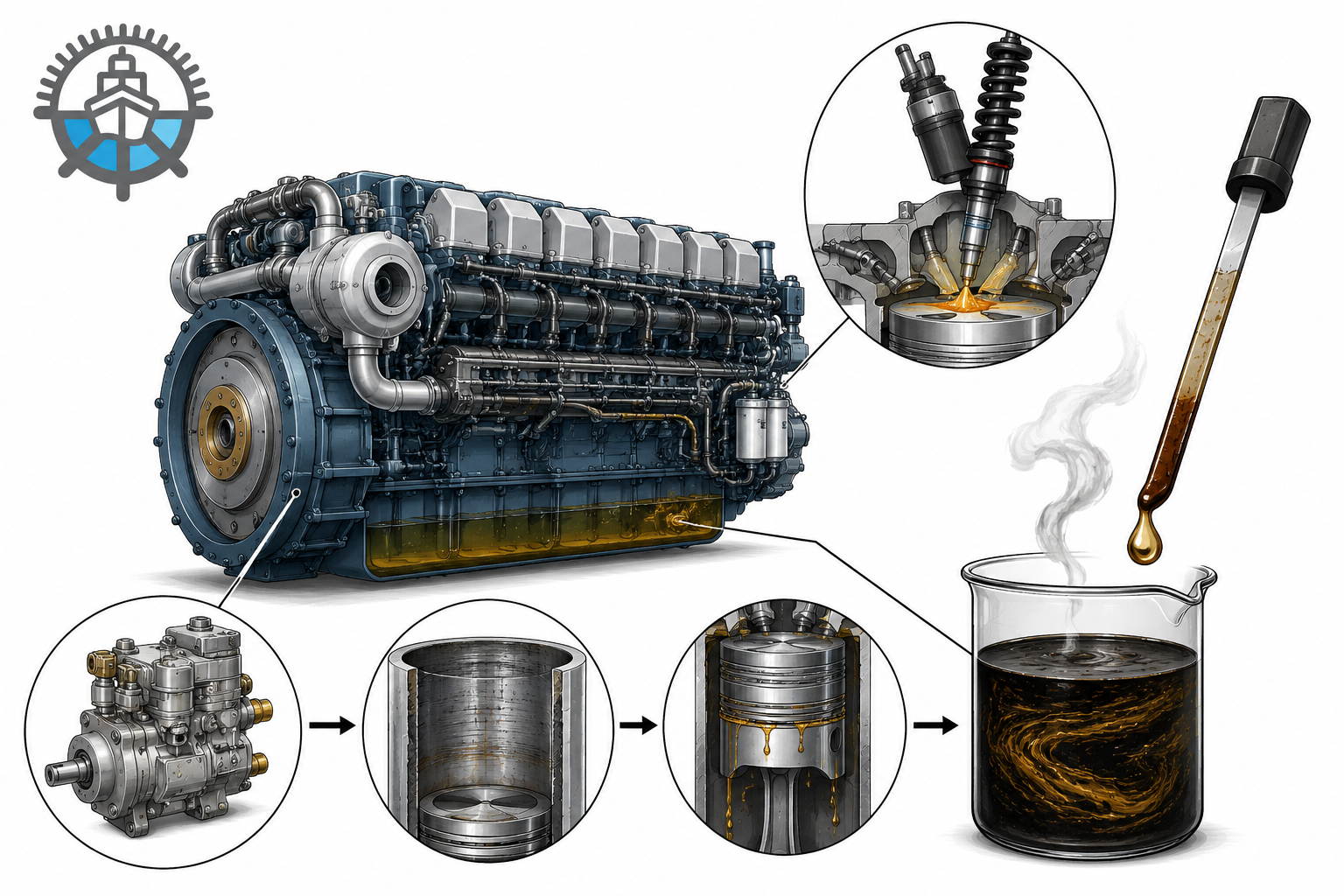
A diesel smell can indicate fuel dilution—diesel fuel entering the lubrication system and mixing with the engine oil.
Sometimes the first indication is the smell on the dipstick. In other cases, the engineer notices something more important:
The engine oil level is gradually rising even though no oil has been added.
Fuel-diluted oil can lose viscosity and lubrication performance. If the contamination becomes significant, lubrication of bearings, crankshaft journals, cylinder liners, piston rings, camshaft components and other heavily loaded surfaces can be affected.
The important diagnostic question is therefore not simply:
“Why does my Komatsu engine oil smell like diesel?”
It is:
“Where is the diesel entering the lubrication system?”
What Is Fuel Dilution in a Komatsu Marine Diesel Engine?
Fuel dilution occurs when diesel fuel enters the crankcase and mixes with the lubricating oil.
Engine oil is designed to maintain a protective lubricating film between moving components. Diesel fuel does not provide the same lubrication characteristics.
As the concentration of fuel in the oil increases, the lubricant can become progressively thinner.
Possible warning signs include:
- Strong diesel smell from the engine oil
- Engine oil level gradually increasing
- Oil appearing unusually thin
- Reduced oil pressure, particularly when hot
- Rough or uneven engine operation
- Increased exhaust smoke
- Hard starting
- Abnormal fuel consumption
- Changes in cylinder exhaust temperatures
A diesel smell alone does not identify the failed component.
The fuel system, combustion process, cylinder condition, lubrication system and engine operating temperature may all need to be considered.
What Causes Diesel Fuel to Enter Komatsu Engine Oil?
Several different faults or operating conditions can contribute to fuel dilution.
Common areas to investigate include:
- Leaking fuel injectors
- Poor injector spray pattern
- Excessive fuel delivery
- Fuel injection pump problems
- Fuel supply-pump seal leakage on applicable systems
- Incomplete combustion
- Worn piston rings
- Excessive cylinder-liner wear
- Poor compression
- Low engine operating temperature
- Extended low-load operation
More than one condition can sometimes be present at the same time.
For example, a worn injector combined with reduced cylinder compression can increase the possibility of incomplete combustion and unburned fuel reaching the cylinder wall.
Start With the Komatsu Fuel Injectors
The fuel injection system is one of the first areas worth investigating when diesel contamination of the engine oil is suspected.
A correctly functioning diesel injector must deliver the required quantity of fuel with the appropriate timing, pressure and atomization for the particular injection system.
As injector components wear, become contaminated or develop internal problems, the injector may begin to:
- Dribble fuel
- Leak after injection
- Deliver excessive fuel
- Produce an incorrect spray pattern
- Atomize fuel poorly
- Contribute to incomplete combustion
Instead of burning properly, some fuel can reach the cylinder wall.
The lubricating oil film on the liner can then become contaminated, while some unburned diesel may migrate past the piston rings and eventually reach the crankcase.
This process is often associated with cylinder wash-down and fuel dilution.
What Other Symptoms Can a Faulty Injector Cause?
An injector problem may produce symptoms beyond contaminated engine oil.
Depending on the type and severity of the fault, an engineer may notice:
- White or grey exhaust smoke
- Black smoke under certain operating conditions
- Rough running
- Uneven cylinder operation
- Difficult starting
- Abnormal combustion noise
- Increased fuel consumption
- Reduced engine performance
- Different exhaust temperatures between cylinders
These symptoms can help guide diagnosis, but none of them individually proves that an injector has failed.
Compression problems, incorrect fuel delivery, air-supply problems and other mechanical conditions can produce similar symptoms.
Testing is therefore preferable to replacing components based solely on one observation.
Komatsu S6D125 Marine Engine Example
A useful engine family for understanding why correct fuel-system identification matters is the Komatsu S6D125 Marine Engine.
The S6D125 belongs to Komatsu's 125-series diesel engine family. Related configurations include the Komatsu SA6D125 Marine Engine and Komatsu SAA6D125 Marine Engine.
Although these engines belong to the same broader family, their configurations should not automatically be treated as identical.
| Komatsu EngineGeneral ConfigurationEngine Parts Page | ||
| S6D125 | Inline 6, naturally aspirated | Komatsu S6D125 Parts |
| SA6D125 | Inline 6, turbocharged | Komatsu SA6D125 Parts |
| SAA6D125 | Inline 6, turbocharged with charge-air cooling | Komatsu SAA6D125 Parts |
This distinction matters when ordering injectors, injection equipment, pumps, turbocharger components and other engine parts.
Komatsu S6D125 Injector Part Numbers
Different S6D125 versions can use different fuel-injection components.
Examples of Komatsu fuel-injector references associated with this engine family include:
| Komatsu Part NumberComponentEngine Reference | ||
| R6151-11-3101 | Fuel Injector Nozzle | S6D125-1 |
| R6151-13-3200 | Fuel Injector Nozzle | S6D125-1 |
| R6151-12-3100 | Fuel Injector Nozzle | S6D125-2 |
| 6151-12-3100 | Injector Assembly | Exact application must be verified |
These examples demonstrate an important point:
S6D125 Does Not Automatically Mean One Injector
Even within the same Komatsu engine family, different versions can use different fuel-injection equipment.
The complete engine designation, serial number and existing injector identification should therefore be checked before ordering.
Part numbers should not automatically be considered interchangeable simply because they appear within the same engine family.
Could the Komatsu Fuel Pump Be Leaking Diesel Into the Oil?
Yes, depending on the particular engine and fuel-system design.
The fuel supply pump or injection pump should also be considered when investigating fuel contamination.
A failed seal or internal pump problem on an applicable system may provide a more direct path for diesel fuel to reach the engine lubrication system.
This type of fault can sometimes produce a different symptom pattern from a combustion-related injector problem.
For example:
Injector or combustion problem:
Fuel dilution may occur together with rough running, smoke, abnormal combustion or differences between cylinders.
Pump or pump-seal problem:
The engine oil level may increase without an equally obvious combustion problem.
This is only a diagnostic distinction—not proof of which component has failed.
The exact fuel-pump configuration must be identified for the particular Komatsu engine before parts are selected.
Don't Ignore the Piston Rings and Cylinder Liners
Finding diesel in the oil does not automatically mean that an injector or fuel pump has failed.
Cylinder condition also matters.
The piston rings help control the separation between the combustion chamber and crankcase.
Excessive wear or damage can increase the amount of fuel and combustion products passing into the crankcase.
Possible contributing conditions include:
- Worn piston rings
- Broken or damaged rings
- Excessive cylinder-liner wear
- Poor cylinder compression
- Cylinder glazing
- Incomplete combustion
- Excessive blow-by
Fuel dilution can therefore sometimes result from several conditions working together.
For example:
Poor injector atomization + worn piston rings + low cylinder compression
can create a much greater fuel-dilution problem than one minor fault by itself.
Why Cylinder Wash-Down Matters
Cylinder wash-down occurs when excessive or poorly atomized fuel reaches the cylinder wall and disrupts the lubricating oil film.
The cylinder liner and piston rings rely on controlled lubrication.
If excessive diesel continually washes the oil film from the liner, lubrication conditions can deteriorate.
Over time, this may contribute to increased wear of:
- Cylinder liners
- Piston rings
- Pistons
- Bearings and other components if diluted oil circulates through the engine
This is one reason significant fuel dilution should not be treated simply as an oil-change problem.
The source of the excess fuel needs to be identified.
Engine Temperature Can Contribute to Fuel Dilution
A marine diesel engine that operates for extended periods below its intended operating temperature can experience poorer combustion conditions.
This can become relevant when an engine:
- Runs for short periods
- Frequently starts and stops
- Operates extensively at very low load
- Does not reach normal operating temperature
- Has a thermostat problem
- Has another cooling-system issue affecting temperature regulation
Incomplete combustion can increase the possibility of unburned fuel reaching the cylinder walls.
This is why a complaint involving diesel in the engine oil may require investigation of both the fuel system and cooling system.
A thermostat or cooling-system fault does not directly mean that diesel will enter the oil, but abnormal operating temperature can contribute to combustion conditions that increase fuel dilution.
What About Turbocharger Problems?
Turbocharger problems are not normally the first explanation for diesel fuel directly entering the crankcase.
However, on turbocharged Komatsu engines such as applicable SA6D125 and SAA6D125 configurations, air-supply and turbocharger problems can affect combustion.
Insufficient air under load can contribute to:
- Black smoke
- Poor combustion
- Reduced power
- Increased exhaust temperatures
- Abnormal fuel consumption
This can complicate diagnosis when a fuel-system problem is also present.
Turbocharger condition should therefore be evaluated when the complete symptom pattern indicates an air-supply or boost problem, rather than assuming the turbocharger itself is directly putting diesel into the engine oil.
How to Diagnose Komatsu Marine Engine Fuel Dilution
The goal is first to establish whether fuel dilution is actually occurring and then identify its source.
1. Monitor the Engine Oil Level
Do not rely on a single dipstick reading.
Check and record the oil level under consistent conditions.
If the level continues increasing even though no lubricating oil has been added, contamination should be investigated.
A rising oil level can be an important clue when combined with a strong diesel smell.
2. Inspect the Oil Condition
Check whether the lubricant:
- Smells strongly of diesel
- Appears unusually thin
- Has changed noticeably from its normal condition
Smell can provide a warning, but it is not a precise measurement.
Where necessary, laboratory oil analysis can provide much stronger evidence and help quantify fuel contamination.
3. Test the Fuel Injectors
Depending on the particular Komatsu injection system, injector diagnosis may include:
- Injector leakage testing
- Spray-pattern inspection
- Opening-pressure testing on applicable mechanical systems
- Injector return or leak-off testing
- Cylinder contribution testing
- Fuel-delivery comparison
- Inspection for nozzle problems
Do not automatically replace the entire injector set simply because the oil smells like diesel.
Establish the fault first.
4. Inspect the Fuel Pump
Determine whether the particular Komatsu fuel-system design provides a possible leakage path between the fuel equipment and engine lubrication system.
Inspect the pump, seals and related components using the appropriate procedure for the exact engine configuration.
5. Compare Cylinder Performance
Cylinder-to-cylinder comparison can provide valuable diagnostic information.
Look for differences in:
- Exhaust temperature
- Exhaust smoke
- Combustion sound
- Compression
- Injector performance
- Cylinder contribution
One cylinder behaving differently from the others can help narrow the investigation.
6. Check Compression and Blow-By
If injector testing does not explain the contamination, cylinder condition becomes increasingly important.
Compression and blow-by evaluation can help identify problems involving:
- Piston rings
- Cylinder liners
- Valve sealing
- General cylinder condition
Fuel-system diagnosis and mechanical engine diagnosis should therefore not always be treated separately.
7. Check Engine Operating Temperature
Confirm that the engine reaches and maintains its expected operating temperature.
If the engine consistently operates cold, investigate:
- Thermostat condition
- Cooling-system operation
- Temperature instrumentation
- Actual operating load
Correct operating temperature supports efficient combustion.
Injector, Fuel Pump or Engine Wear?
The complete symptom pattern is more useful than one symptom alone.
| ObservationArea Worth Investigating | |
| Oil smells strongly of diesel | Confirm possible fuel dilution |
| Oil level steadily rising | Fuel entering lubrication system |
| Rough running + fuel dilution | Injector / combustion condition |
| White or grey smoke | Injector / incomplete combustion / compression |
| Black smoke under load | Fuel delivery / air supply / turbocharger |
| One abnormal cylinder | Injector / compression / cylinder condition |
| Oil rises without obvious cylinder symptoms | Fuel pump / pump seal where applicable |
| Engine consistently operates cold | Thermostat / cooling system |
| High blow-by + fuel dilution | Piston rings / cylinder liners |
| Abnormal fuel consumption | Injection and combustion system |
| Low hot oil pressure | Check oil condition and lubrication system |
This table should be treated as a diagnostic direction rather than confirmation of a failed component.
Several different faults can produce similar symptoms.
Why Changing the Engine Oil Alone Is Not Enough
Changing contaminated oil may be necessary, but it does not eliminate the source of the contamination.
Consider a leaking injector.
The contaminated oil is drained.
Fresh engine oil is installed.
The engine returns to service.
The injector continues delivering excessive fuel.
Fuel begins contaminating the fresh oil again.
The original fault remains.
The correct approach is therefore to identify the source of the excessive fuel entry, repair the underlying problem and address the contaminated lubricant according to the applicable engine service requirements.
Correct Komatsu Marine Engine Part Identification
Komatsu diesel engines exist in numerous models, versions, specifications and applications.
An injector, injection pump, thermostat, turbocharger or other replacement component should therefore not be selected from the engine-family name alone.
For engines such as the S6D125 family, identification should include:
Engine model + engine version + Engine Serial Number + engine specification + existing part number + application
For example, identify whether the engine is:
When requesting replacement parts, provide:
- Complete Komatsu engine model
- Engine version
- Engine Serial Number
- Existing injector part number
- Existing fuel-pump number when applicable
- Quantity required
- Marine propulsion or auxiliary application
- Delivery destination
Exact compatibility should be verified before ordering.
Komatsu Marine Diesel Engine Parts
Alfa Marine Spare Parts supplies replacement components for selected Komatsu marine diesel engine applications.
Products can include:
- Fuel injectors
- Injector nozzles
- Fuel injection components
- Fuel pumps
- Gaskets and seals
- Water pumps
- Thermostats
- Cooling-system components
- Turbocharger components for applicable turbocharged engines
- Pistons
- Piston rings
- Cylinder liners
- Bearings
- Gasket and overhaul kits
- Other marine diesel engine components
For S6D125 fuel-system enquiries, part-number references may include:
R6151-11-3101 | R6151-13-3200 | R6151-12-3100 | 6151-12-3100
These numbers are application-specific. Compatibility should always be confirmed against the individual engine.
Browse Komatsu Marine Engine Parts for additional Komatsu engine types and replacement components.
Request Komatsu Marine Engine Parts
If your Komatsu marine diesel engine oil smells like diesel, identifying the source of the fuel dilution is more important than replacing components based on symptoms alone.
For Komatsu fuel injectors, injection components, fuel pumps, cooling-system parts, turbocharger components and overhaul parts, send the complete engine identification and existing component number whenever available.
For parts enquiries, provide:
Engine model + Engine Serial Number + existing part number + quantity + delivery destination
Email: request@alfamarinespareparts.com
Request a Quote
Alfa Marine Spare Parts
Frequently Asked Questions
Why does my Komatsu marine diesel engine oil smell like diesel?
A strong diesel smell can indicate fuel dilution. Possible causes include leaking or poorly atomizing injectors, fuel-pump or pump-seal problems on applicable systems, incomplete combustion, cylinder wear and unsuitable operating temperature.
Can a bad Komatsu injector put diesel into the engine oil?
Yes. An injector that leaks, dribbles, over-fuels or atomizes poorly can leave unburned fuel on the cylinder wall. Some fuel can then migrate past the piston rings and contaminate the crankcase oil.
Why is my Komatsu engine oil level increasing?
If no lubricating oil has been added, a rising oil level can indicate contamination. Fuel dilution should be investigated, while other possible contaminants such as coolant should also be considered where appropriate.
What injector does a Komatsu S6D125 use?
It depends on the exact S6D125 version and configuration. Documented references include R6151-11-3101 and R6151-13-3200 for S6D125-1 applications and R6151-12-3100 for S6D125-2 applications. Always verify against the engine identification before ordering.
Are S6D125, SA6D125 and SAA6D125 injectors all the same?
They should not automatically be considered the same. These engines belong to the same broader family but have different configurations and can use different fuel-system components. Verify the engine model, version, serial number and existing component number.
Can a fuel pump cause diesel to enter the engine oil?
On applicable engine and fuel-system designs, a pump or pump-seal problem can potentially create a path for fuel to reach the lubrication system. The exact design must be checked before diagnosing the pump as the source.
Can worn piston rings cause fuel dilution?
Worn or damaged piston rings can increase the amount of unburned fuel and combustion products reaching the crankcase, particularly when combined with poor combustion or injector problems.
Can running a Komatsu marine diesel too cold cause fuel dilution?
Low operating temperature can contribute to incomplete combustion. If an engine consistently runs too cold, thermostat condition, cooling-system operation and operating load should be investigated.
Should I replace all injectors if the engine oil smells like diesel?
Not automatically. Confirm fuel dilution and determine its source first. Injector testing, fuel-pump inspection, cylinder comparison, compression testing and evaluation of engine operating temperature may be required.
How do I identify the correct Komatsu marine injector?
Provide the complete engine model, engine version, Engine Serial Number and existing injector part number. Fuel equipment can vary within the same Komatsu engine family.