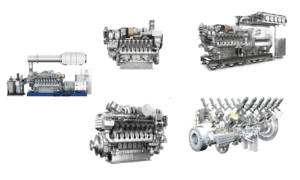
The introduction of the first marine module in the MTU Series 4000 engines category was in 1996. Ever since, these diesel engines featuring common rail direct injection technology have never lost their popularity in the marine industry. These engines have a decent track record of selling 58,000 modules, serving over 345,000,000 operational hours.
In this blog post, we highlight the versatility, style, and reliability of adopting MTU Series 4000 in diverse marine applications. We have also presented a suite of case studies for interested buyers looking to upgrade to the Series 4000 M05 – the most advanced marine engine in the series.
MTU Series 4000 Marine Engines – An Overview
MTU Series 4000 has several diesel-powered marine propulsion engines and gensets for various vessel powering needs. While gensets primarily comprise a 12 V-shaped cylinder arrangement, the propulsion modules are available in 8, 12, 16, and 20 V-shaped cylinders. Series 4000 M05 engines are highly recommended for shipowners considering top-level retrofits. This commercial marine propulsion diesel engine boasts the powerful IRONMEN lineage. M05 is available in three configurations to meet diverse applications.
- 12V 4000 M05: 1,119–1,932 kW (~1,500–2,591 bhp)
- 16V 4000 M05: ~2,300–3,200 kW (~2,467–3,454 bhp)
- 20V 4000 M05: ~3,084 kW (Up to ~4,291 bhp)
These engines are ideal for small to mid-sized vessels within 2,012 hp and 4,291 hp (~1,500–3,200 kW range). The compact design offers enhanced fuel efficiency and installation in small engine rooms. Vessel owners can expect an extended lifecycle with wear-resistant alloy piston rings. Reduce your emission footprint with advanced fuel filters and easily accessible air filters.
Simple integration of the MTU DPF redundant raises possibilities of reducing the volume of particulates within the engine. The Series 4000 M05 marine engine with SCR emission reduction system makes these engines compliant with the IMO III and EPA Tier 4 international maritime emission standards.
MTU Series 4000 Engines – Supported Marine Applications
From commercial to pleasure crafts to heavy-duty defense naval applications, MTU Series 4000 engines have served diverse vessel powering roles. With extended haul performance, high-end power output, and enhanced fuel efficiency, vessel owners can significantly cut down the operation and maintenance costs. Herein is a breakdown of supported applications across various marine segments and case studies of successful engine performance:
1. Commercial Shipping & Cargo Vessels
Vessel Types
Coastal freighters, container vessels, bulk carriers, tugboats, and towboats
Application and Case Studies
Sause Bros., the premium provider of West Coast marine services, upgraded their tug and barge fleet to high-speed 12V and 16V MTU Series 4000 engines. The switch from traditional medium-speed modules to revolutionary MTU marine engines now fetches 30-47% fuel savings, fewer overhauls, and low maintenance costs.
Southern Towing Company’s success is another example in the commercial shipping category. The famous American inland tank barge operator now has 8V and 12V MTU Series 4000 Ironmen marine engines in their six inland waterway towboats. The retrofit project also includes engine integration with state-of-the-art Z-drive steering, enhanced fuel efficiency, compliance with stringent emission standards, improved maneuverability, and extended uptime on long-distance inland voyages.
2. Ferries & Passenger Vessels
Vessel Types
Fast ferries, RoPax vessels, sightseeing boats
Application and Case Studies
The upgrade to MTU Series 4000 8V M60 propulsion engines in two modernized ferries in North Carolina is a brilliant example of success in the passenger boats category. Apart from low-noise operations, these engines work well with higher loads, delivering seamless performance, improved fuel economy, and frictionless operations on large vessels.
MTU 16V engine from the Series 4000 with SCR integration on the WETA Pyxis ferry in San Francisco Bay helps in 75% NOx emissions to comply with the stringent IMO II regulations. Furthermore, the combined technology produces 65% less particulate matter than that required to pass the EPA Tier 3 standards.
Willem Barentz, a Dutch ferry boat, operates on two 16V Series 4000 gas marine engines, offering 3000 kW power output. The gas engines facilitate clean combustion cycles, zero sulfur oxides, and almost no particulates. These cutting-edge features help the boat comply with the IMO III rules when navigating the sensitive zones in the Wadden Sea without using exhaust gas aftertreatment.
3. Offshore, Gensets & Workboats
Vessel Types
Offshore supply vessels (OSVs), tugboats, crew transfer vessels, dredgers
Application and Case Studies
The Series 4000 8-cylinder (Iron Men) is a workboat variant module. These engines feature low fuel consumption optimization and offer customization for gensets and diesel-mechanical systems. With a far-reaching up to 34,000 hours of extended overhaul interval, the models are widely in use in several ocean tugs, heavy-duty inland vessels, and fireboats.
MTU is actively manufacturing marine gensets in the Series 4000 segment with superior Tier 3 standards. The configuration in 8, 12, and 16 cylinders includes 750–2,680 bhp (560–2,000 kW) output power for both diesel-electric and diesel-mechanical main propulsion engines.
4. Naval, Government, & Defence Vessels
Vessel Types
Patrol boats, corvettes, frigates, landing crafts
Application and Case Studies
To meet the rising demand for MTU engines in India, the Garden Reach Shipbuilders & Engineers (GRSE) partnered with Rolls-Royce in 2024. The manufacturing giants signed an individual license agreement to acquire the production rights of Series 4000 engines for government naval vessels. These IMO Tier II engines are under production for installation in defence interceptor and patrol boats. The new modules are currently in deployment on Car Nicobar-class ships.
Miecznik frigates in Poland use four Series 4000 on-board generators with a 12V configuration. These generators continuously run to support the electricity supply requirements throughout these giant combatant warships.
5. Polar & Remote
Vessel Types
Research & expedition vessels
Application and Case Studies
Sikuliaq, a uniquely designed U.S. research vessel for operations in Arctic region employs four MTU Ironmen engines in the 4000 Series for its electric propulsion system and power genset. The engines feature advanced noise dampers for silent operation in sensitive research zones. Furthermore, low fuel economy and reliability make the engines suitable for adapting to diverse temperature conditions.
Final Thoughts,
The MTU Series 4000 engines boast versatility and adaptability to diverse marine applications across different vessel types. From passenger ferries to giant cargo ships to complex naval defense warships, these engines have emerged as the trusted source of diverse vessel powering needs. With IMO Tier III and EPA Tier 4 compliance, these engines are ideal for watercraft cruising strict and sensitive routes.