Yamaha High-Horsepower Marine Engines: What Is the Difference, and Which One Fits Which Boat?
When somebody says:
“I have a Yamaha marine engine.”
that can mean almost anything.
Yamaha makes very small outboards, but at the other end of the range it also produces large offshore engines such as:
- F200
- F225
- F250
- F300
- F350
- F400
- F425
- F450 XTO Offshore
For this guide, we are focusing on the larger Yamaha marine outboard engines used on offshore boats, sportfishing vessels, center consoles, patrol craft, tenders and other high-performance marine applications.
Yamaha’s current four-stroke range extends up to 450 hp, with the larger engine families built around inline-four, V6 and V8 architectures.
The important thing to understand is that a Yamaha F200 and an F450 may both be outboards, but they belong to very different installation classes.
So the useful question is not:
“Which Yamaha is best?”
It is:
“Which Yamaha engine is best for the boat, hull, load and operating profile?”
Understanding the Larger Yamaha Marine Engine Families
A simple way to understand the high-horsepower Yamaha range is:
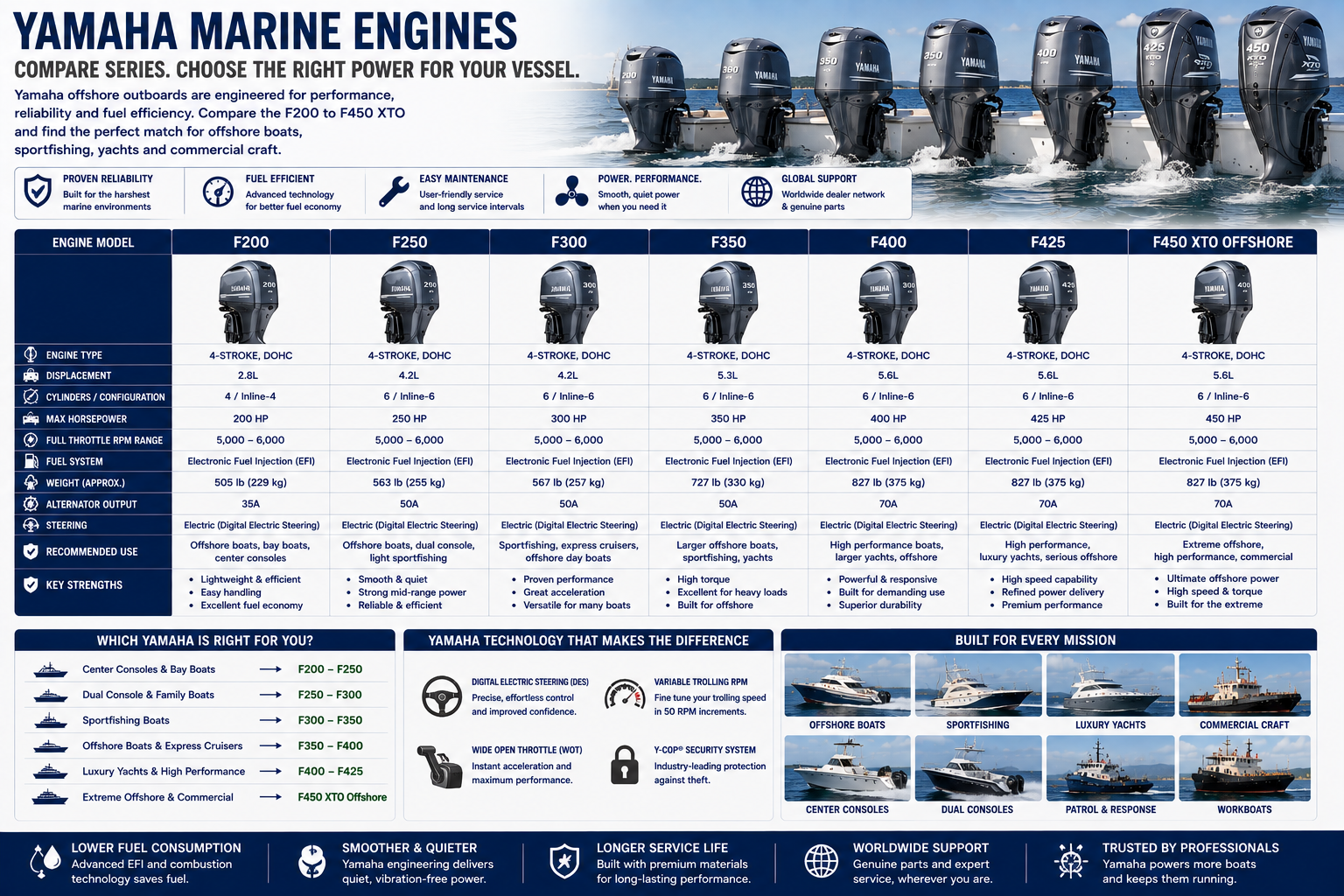
| Yamaha Engine ClassBasic ArchitectureGeneral CharacterTypical Boat | |||
| F200 | Inline 4 or V6 depending model/market | Entry into larger offshore power | Smaller center consoles, cruisers, workboats |
| F225 / F250 | V6 families | Strong offshore all-rounders | Fishing boats, patrol, recreational craft |
| F300 | 4.2L V6 | High-output offshore engine | Larger center consoles, sportfishing, commercial craft |
| F350 | 4.3L V6 | New high-output V6 | Heavy offshore boats and multi-engine installations |
| F400 | 5.6L V8 XTO | Heavy offshore power | Large center consoles, yachts, commercial craft |
| F425 | 5.6L V8 XTO | High-output offshore V8 | Large offshore and sportfishing vessels |
| F450 | 5.6L V8 XTO | Top high-horsepower V8 | Large offshore boats and multi-engine installations |
Yamaha's current global four-stroke range groups the high-power engines into a 5.6-liter V8 450–400 hp family, a 4.3-liter V6 350 hp family, a 4.2-liter V6 300–200 hp family, and other lower-power platforms below them.
Yamaha F200: Where Bigger Outboard Power Starts Getting Serious
The F200 is one of the most recognizable Yamaha outboards.
Depending on generation and market, Yamaha has offered 200-hp engines in different architectures. One major modern platform is the lightweight 2.8-liter inline-four F200, while Yamaha also has larger V6 families covering the 200–300 hp class.
Which Boats Suit an F200?
Think:
- Center consoles
- Small sportfishing boats
- Walkarounds
- Cabin cruisers
- Commercial utility boats
- Patrol boats
- RIBs
For many boats, 200 hp is already substantial.
A single F200 may be enough for a moderate-size vessel.
A twin-F200 installation gives:
400 hp total.
That makes the F200 class particularly flexible.
F200 Personality
The Versatile Starting Point
Enough power for serious boating while remaining much smaller and lighter than the big V8 offshore engines.
Single vs. Twin Yamaha F200
This is one of the first major decisions with larger outboards.
Single F200
Potential advantages include:
- Lower purchase cost
- Less weight
- Lower maintenance count
- Simpler fuel and control installation
Twin F200
Potential advantages include:
- 400 hp total
- Propulsion redundancy
- Better maneuverability
- More thrust for heavier boats
But now maintenance doubles.
Instead of one:
- Water pump
- Gearcase
- Fuel system
- Propeller
- Engine oil system
you have two.
That matters over the life of the boat.
Yamaha F225 and F250: The Offshore Middleweights
The 225 and 250 hp classes have long been extremely important in Yamaha's offshore range.
They are commonly encountered on:
- Fishing boats
- Center consoles
- Offshore cruisers
- Patrol vessels
- Commercial craft
- Twin-engine installations
For many boat owners, 250 hp represents a very useful balance between:
power + weight + fuel consumption + installation size.
A twin-F250 boat has roughly:
500 hp total.
A triple installation provides approximately:
750 hp total.
At that point, even a relatively modest individual engine becomes part of a serious propulsion system.
Why Multiple Outboards Changed Large-Boat Design
Years ago, a large boat often meant:
big inboard diesel engines.
Today, large offshore boats may instead use:
two, three, four or even more large outboards.
This changes the engine room completely.
There may be no traditional engine room at all.
Instead, the propulsion package sits outside the hull.
Potential advantages include:
- More interior space
- Easier engine replacement
- Excellent shallow-water capability when tilted
- High power-to-weight
- Multiple-engine redundancy
The tradeoff is the number of engines that must be maintained.
Yamaha F300: One of the Most Important Offshore V6 Engines
The F300 belongs to Yamaha's large 4.2-liter V6 family.
Yamaha's current global range groups the 200–300 hp high-power outboards around this 4.2-liter V6 architecture.
The F300 is particularly common in offshore boating because it provides substantial output without requiring the much larger V8 XTO platform.
Where Does an F300 Fit?
Think:
- Offshore center consoles
- Sportfishing boats
- Large RIBs
- Patrol craft
- Commercial utility vessels
- Cabin boats
- Larger recreational boats
A single F300 already gives strong performance.
Twin F300s give:
600 hp.
Triple F300s:
900 hp.
Quad F300s:
1,200 hp.
This shows why modern outboard boats can reach power levels that were once associated mainly with large inboard installations.
F250 vs. F300: Which Makes More Sense?
Yamaha F250
More moderate output.
Often well suited to boats where weight, fuel economy and total cost matter.
Yamaha F300
More power from the larger offshore V6 class.
Better suited where hull weight, passenger load or performance requirements justify additional output.
The correct answer is not always the F300.
If the boat performs correctly with 250 hp, adding horsepower may simply add:
- Cost
- Fuel use
- Weight
- Propeller-load changes
Boat design comes first.
Yamaha F350: The New 4.3-Liter V6
The current Yamaha F350 is particularly interesting because Yamaha redesigned the V6 platform to deliver 350 hp without moving to the much larger 5.6-liter V8.
Yamaha describes the F350 as a 4.3-liter, 60-degree V6 with 24 valves and DOHC, using larger intake and exhaust valves plus updated components derived in part from its XTO technology.
This gives Yamaha a useful step between:
F300 V6
and
F400/F450 V8.
F350 Personality
The High-Output V6
For boat owners who need more than 300 hp but don't necessarily need the size and weight of the XTO V8.
Why the F350 Matters
The F350 solves a common boat-design problem.
Suppose a vessel needs:
700 hp total.
You could use:
2 × 350 hp
instead of:
3 × lower-powered engines
depending on hull design and transom rating.
Fewer engines can mean fewer:
- Gearcases
- Oil changes
- Water pumps
- Propellers
- Fuel connections
- Engine control systems
But each individual engine becomes more critical.
Yamaha XTO Offshore: Moving Into V8 Territory
The XTO Offshore is where Yamaha moves from large V6 outboards into a completely different engine class.
The current XTO F400 and F450 use a:
5,559 cc
60-degree V8
32-valve DOHC
four-stroke
direct-injection
architecture.
This is a 5.6-liter outboard.
That statement alone shows how far outboard technology has developed.
Yamaha F400 XTO Offshore
The F400A XTO produces approximately 294.2 kW / 400 PS at 5,500 rpm.
Yamaha lists dry weight at approximately 447–468 kg depending on configuration, with Digital Electronic Control and direct fuel injection.
Which Boats Suit an F400?
Think:
- Large center consoles
- Offshore sportfishing boats
- Yacht tenders
- Patrol vessels
- Large recreational boats
- Commercial high-speed craft
- Multi-engine installations
The F400 is not meant for a small runabout.
It belongs on boats designed structurally and hydrodynamically for substantial outboard power.
Yamaha F425 XTO Offshore
The F425 helped establish Yamaha's modern high-horsepower V8 generation.
Yamaha identifies the F425A as a 5,559 cc V8 producing 425 hp, and notes that it was the first four-stroke outboard to use gasoline direct injection directly into the combustion chamber.
It also introduced integrated electric steering as part of Yamaha's high-power offshore approach.
Why Was the F425 Important?
Because it showed that very large offshore boats could use an outboard package with:
- V8 displacement
- Direct injection
- Integrated steering
- Electronic controls
- Major reverse thrust
- Multi-engine capability
That blurred the traditional boundary between outboard-powered boats and large inboard yachts.
Yamaha F450 XTO Offshore: The Big One
The F450A currently sits at the top of Yamaha's global four-stroke outboard range.
Yamaha specifies:
450 PS / 331 kW
5.6-liter V8
32 valves
DOHC
Direct fuel injection
5,500 rpm rated maximum output
with dry weight around 447–468 kg, depending on shaft configuration.
This is a serious piece of marine machinery.
F450 Personality
The Offshore Heavyweight
V8 displacement, direct injection and 450 hp designed for boats where one large outboard is only part of a much larger propulsion package.
What Happens When You Install Two F450s?
Twin F450s provide:
900 hp total.
That is already more than many traditional diesel-powered boats ever had.
Now consider:
Triple F450
1,350 hp total
Quad F450
1,800 hp total
This is why large center consoles, offshore sportfishing boats and fast luxury craft can now rely entirely on outboard propulsion.
F300 vs. F350 vs. F450
This is one of the most useful comparisons for larger Yamaha engines.
Yamaha F300
4.2-liter V6 family
Good all-round offshore power.
Excellent for twin and triple installations.
Yamaha F350
4.3-liter V6
Higher power without jumping immediately to the V8 XTO.
Useful where power-to-weight matters.
Yamaha F450 XTO
5.6-liter V8
Heavy offshore power.
Best suited to very large boats, high loads and demanding multi-engine installations.
The F450 is not automatically superior.
It is simply a much bigger tool.
Why the XTO Uses Direct Fuel Injection
Yamaha's 5.6-liter V8 XTO uses direct fuel injection, spraying fuel directly into the combustion chamber at high pressure. Yamaha says this improves fuel atomization, combustion effectiveness, power and efficiency.
This is different from a more traditional port-fuel-injection arrangement.
But it also raises the importance of:
- Clean fuel
- Correct filtration
- High-pressure fuel-system condition
- Proper injector operation
High-performance fuel systems do not tolerate contamination well.
The XTO's Cylinder Technology Is Different Too
Yamaha uses what it calls Plasma Fusion Sleeve technology on its 4.2- and 5.6-liter powerheads.
Instead of conventional steel cylinder liners, the cylinder surface uses a plasma-fused coating that Yamaha says is harder and lighter than conventional steel liners while helping increase displacement without increasing the basic powerhead size.
This illustrates an important difference between a modern high-horsepower outboard and many traditional rebuildable marine diesels.
You should not assume every cylinder block is serviced in the same way.
Yamaha Outboards vs. Large Inboard Diesels
This comparison is useful.
Large Outboard Installation
Advantages can include:
- Engines mounted outside hull
- Easier whole-engine replacement
- More interior volume
- Excellent maneuverability
- Multiple-engine redundancy
- High power-to-weight
Inboard Diesel Installation
Potential advantages include:
- Large displacement
- Heavy continuous-duty capability
- Lower-speed torque
- Different fuel-economy characteristics
- Traditional shaft propulsion
Neither system is automatically better.
A 40-foot offshore center console and a 40-foot commercial trawler may be similar in length but require completely different propulsion philosophies.
Which Yamaha Is Best for an Offshore Fishing Boat?
For offshore fishing, relevant engines often start around:
F200 / F250
and move through:
F300
F350
F400
F450
depending on boat size.
For a medium offshore center console:
twin F250 or F300
may make sense.
For a larger heavy center console:
triple or quad F300/F350
may be appropriate.
For very large high-performance offshore boats:
F400 or F450 XTO installations
become especially relevant.
The hull builder's maximum horsepower and transom-weight limits should always determine what is acceptable.
Which Yamaha Is Best for a Sportfishing Boat?
Sportfishing boats often prioritize:
- Offshore reliability
- Cruise speed
- Fast acceleration
- Ability to carry fuel and equipment
- Low-speed maneuverability
- Redundancy
The likely high-power families include:
- F250
- F300
- F350
- F400
- F450
Multi-engine installations provide redundancy, which matters far offshore.
But redundancy also multiplies maintenance.
Four engines means four sets of:
- Spark plugs
- Water pumps
- Gear oil
- Engine oil
- Fuel components
- Anodes
- Propellers
That annual service budget matters.
Which Yamaha Is Best for a Large RIB?
Large rigid inflatable boats often benefit from high power-to-weight and responsive acceleration.
Depending on boat size:
- F200
- F250
- F300
- F350
can fit naturally.
Military, rescue and patrol-oriented RIBs may have different rating and redundancy requirements from recreational boats.
The correct choice depends on hull certification and commercial duty.
Which Yamaha Is Best for a Patrol Boat?
A patrol boat may need:
- Fast acceleration
- High top speed
- Rapid maneuvering
- Multiple-engine redundancy
- Reliable electronic controls
Higher-power Yamaha V6 and V8 outboards can be attractive for this reason.
Possible configurations include:
twin F300/F350
or
multiple XTO V8 engines
depending on vessel size.
But a patrol craft operating several thousand hours annually should be evaluated differently from a weekend recreational boat.
Duty cycle still matters.
Yamaha High-Horsepower Engines for Yacht Tenders
Large yacht tenders are another interesting application.
A tender may need:
- Compact propulsion
- High acceleration
- Low-speed control
- Easy service access
- Ability to tilt engines clear of the water
Depending on tender size, Yamaha engines from:
F200 through F450
can become relevant.
For very large tenders, twin large outboards can provide significant performance without sacrificing as much interior space to an inboard engine room.
Why Digital Steering Matters on Big Outboards
Once you put three or four 400+ hp engines on a transom, steering is no longer a small detail.
Yamaha's XTO architecture introduced integrated electronic steering, reducing reliance on conventional external steering hardware.
That can simplify installation and improve integration with modern helm systems.
It also makes electronics an increasingly important part of propulsion maintenance.
Yamaha Helm Master EX
Yamaha's Helm Master EX integrates boat control functions such as:
- Steering
- Joystick control
- Autopilot
- Multi-engine control
Yamaha says the system supports configurations ranging from single-engine to multi-engine applications, with particularly strong integration for twin, triple and quad installations.
This is especially important on large outboard-powered boats.
A 1,200-hp quad-outboard installation is not just four engines.
It is a complete:
engine + steering + control + navigation-integration system.
Why Joystick Control Matters
Imagine docking a 45-foot center console with three large outboards in crosswind.
Traditional throttle-and-wheel control requires skill.
Joystick systems can coordinate:
- Engine direction
- Engine rpm
- Steering angle
to move the vessel:
- Sideways
- Diagonally
- Rotationally
This can make large outboard boats much easier to maneuver.
But again, the electronics become part of the maintenance picture.
Water Pumps Matter Just as Much on a 450-hp Outboard
A sophisticated V8 is still dependent on cooling water.
The outboard relies on seawater flow through the cooling system.
If water flow drops because of:
- Impeller damage
- Intake restriction
- Debris
- Scale
- Corrosion
engine temperature can rise.
High-horsepower engines generate a lot of heat.
Cooling-system maintenance therefore remains fundamental.
Why Gearcase Maintenance Becomes Critical
An outboard does not use a traditional inboard marine gearbox.
The transmission and propeller gearing are contained in the lower unit.
That means high-horsepower engines put enormous load through:
- Gear set
- Propeller shaft
- Bearings
- Seals
- Lubricant
A 450-hp engine produces serious torque.
Gearcase oil condition can tell you a lot.
Watch for:
- Water contamination
- Metallic debris
- Burnt oil
- Seal leakage
Never treat the lower unit as secondary to the powerhead.
Propellers Matter More as Horsepower Increases
Large Yamaha engines need the correct propeller setup.
Yamaha even developed dedicated XTO EC propellers for the F400 and F450 to improve grip where the immense torque of the 5.6-liter V8 can contribute to propeller ventilation.
Propeller selection affects:
- Acceleration
- Maximum rpm
- Fuel economy
- Engine load
- Cavitation/ventilation
- Top speed
A wrong propeller can overload a perfectly healthy engine.
Why Maximum RPM Matters
A boat engine needs to reach the manufacturer's specified full-throttle rpm range under proper loading.
If it cannot, possible causes can include:
- Too much propeller pitch
- Excess vessel weight
- Fouled hull
- Engine problem
- Fuel-system restriction
- Poor airflow
Running continuously overloaded can create:
- Higher cylinder pressure
- Higher temperature
- Poor fuel economy
- Reduced engine life
Propeller setup is therefore part of engine health.
Quick Yamaha High-Horsepower Comparison
| Yamaha ClassArchitectureApprox. PowerTypical Application | |||
| F200 | Inline 4 / V6 family depending version | 200 hp | Center consoles, cruisers, commercial craft |
| F250 | V6 class | 250 hp | Offshore fishing, patrol, twin/triple installations |
| F300 | 4.2L V6 | 300 hp | Large center consoles, sportfishing |
| F350 | 4.3L V6 | 350 hp | Heavy offshore and performance boats |
| F400 XTO | 5.6L V8 | 400 hp | Large offshore boats, yachts |
| F425 XTO | 5.6L V8 | 425 hp | Heavy offshore and large multi-engine boats |
| F450 XTO | 5.6L V8 | 450 hp | Large high-performance offshore vessels |
The current high-horsepower architecture and specifications are based on Yamaha's global outboard range.
Yamaha High-Horsepower Engine “Personalities”
F200 — The Versatile One
Serious power without moving into the biggest offshore classes.
F250 — The Offshore All-Rounder
Strong enough for many twin and triple installations without going extreme.
F300 — The Popular Big V6
A natural choice for serious offshore center consoles and sportfishing boats.
F350 — The High-Output V6
More power from a 4.3-liter V6, sitting neatly between the F300 and XTO V8.
F400 XTO — The Big V8
Five-point-six liters and 400 hp for large boats.
F425 XTO — The Technology Pioneer
A 5.6-liter V8 that helped introduce direct injection and integrated electric steering to this class of four-stroke outboard.
F450 XTO — The Offshore Heavyweight
Yamaha's current 450-hp 5.6-liter V8 designed for serious offshore installations.
Common Yamaha High-Horsepower Marine Spare Parts
Depending on engine model and generation, maintenance requirements can include:
- Engine oil filters
- Fuel filters
- Fuel-water separators
- Spark plugs
- Fuel injectors
- High-pressure fuel-system components
- Fuel pumps
- Thermostats
- Water pumps
- Water-pump impellers
- Anodes
- Engine oil pumps
- Sensors
- Starter motors
- Alternator/charging components
- Ignition coils
- ECU components
- Wiring harnesses
- Gaskets
- O-rings
- Oil seals
- Propeller shafts
- Lower-unit seals
- Gearcase components
- Propellers
- Steering components
- Trim-and-tilt components
For XTO engines, the high-pressure direct-injection system and integrated steering/control systems make exact engine identification especially important.
Why Exact Yamaha Engine Identification Matters
A customer might say:
“I need a Yamaha F300 water pump.”
That is a useful beginning.
But you still need:
- Exact F300 model
- Model year or production code
- Serial number
- Shaft length
- Rotation where applicable
- Existing part number
And with an XTO installation, you may also need to know whether you are dealing with:
F400A
FL400A
F450A
or
FL450A.
Yamaha lists right- and left-hand engine configurations for applicable high-power models, which is another reason the complete model matters.
A Good Yamaha Parts Inquiry
Manufacturer: Yamaha
Engine Model: F450A / FL450A
Serial Number: __________
Year: __________
Shaft Length: __________
Current Part Number: __________
Quantity: __________
Photos: Recommended
For a multi-engine boat, also state:
port / center / starboard engine position
where relevant.
Don't Forget Engine Position on Triple and Quad Installations
Suppose a boat has four XTO engines.
A part request may involve:
- Port outer
- Port inner
- Starboard inner
- Starboard outer
Some components may be common.
Others can differ according to rotation, rigging or installation.
So instead of writing:
“Need F450 propeller.”
write:
“Need propeller for starboard outer F450A, serial number _____.”
That is much safer.
Common Maintenance Areas on Large Yamaha Outboards
For high-horsepower engines, pay particular attention to:
Fuel system
Clean fuel is critical.
Cooling system
Water-pump condition and cooling passages matter.
Gearcase
Check oil and seals.
Propeller
Inspect for damage and correct loading.
Anodes
Protect against corrosion.
Electrical system
Modern engines depend heavily on sensors and control modules.
Steering and controls
Particularly important on XTO and Helm Master-equipped boats.
Buying a Used Yamaha F300, F350 or XTO: What Should You Check?
Before buying a used high-horsepower outboard, ask for:
- Complete engine model
- Serial number
- Engine hours
- ECU engine-hour report if available
- Service history
- Compression/leak-down information where appropriate
- Cold-start video
- Running video
- Fault-code history
- Overheat history
- Water-pump service history
- Gearcase oil history
- Propeller condition
- Corrosion inspection
- Lower-unit condition
- Fuel-system history
- Steering/control condition
- Reason for removal
For a multi-engine installation, compare the engines against each other.
If one has very different hours, temperatures or service history, ask why.
Marine Engineer Tip
Don't choose a large Yamaha only by horsepower.
Check:
Boat manufacturer's maximum power
Maximum transom weight
Single, twin, triple or quad installation
Hull type
Boat displacement
Fuel capacity
Propeller selection
Expected operating hours
Commercial or recreational duty
Steering/control system
Service access
The best engine is the one correctly matched to the hull.
Frequently Asked Questions
What Are Yamaha's Largest Current Outboard Engines?
Yamaha's current global four-stroke range extends to 450 hp, with the F450 and F400 using a 5.6-liter V8 XTO platform.
Is the Yamaha F450 a V8?
Yes. The F450A uses a 5,559 cc, 60-degree V8 with 32 valves and DOHC.
How Much Power Does the F450 Produce?
Yamaha specifies approximately 331 kW / 450 PS at 5,500 rpm.
Is the Yamaha F400 Also a V8?
Yes. The F400A uses the same 5.6-liter V8 architecture and produces approximately 294.2 kW / 400 PS at 5,500 rpm.
What Is the Yamaha F350?
The current F350B is a 4.3-liter, 60-degree V6 producing 350 hp. Yamaha developed it as a lighter high-output option below the XTO V8 family.
Is the F300 a V6?
The modern high-power F300 belongs to Yamaha's 4.2-liter V6 300–200 hp family.
What Is Yamaha XTO Offshore?
XTO Offshore is Yamaha's large high-horsepower V8 outboard platform. Current versions include the F400 and F450, using 5.6-liter V8 powerheads, direct injection and integrated digital systems.
Does the XTO Use Direct Fuel Injection?
Yes. Yamaha's 5.6-liter XTO V8 uses high-pressure direct injection into the combustion chamber.
Can Yamaha Large Outboards Be Used in Quad Installations?
Yes. Yamaha supports integrated multi-engine control, and Helm Master EX is designed for twin, triple and quad-engine applications as well as other supported configurations.
What Is Helm Master EX?
Helm Master EX is Yamaha's integrated boat-control system combining functions such as electronic steering, joystick maneuvering, multi-engine control and autopilot.
Are F400 and F450 Propellers Special?
Yamaha offers XTO-specific propellers, including designs intended to handle the substantial torque and reduce ventilation in demanding applications.
Yamaha High-Horsepower Marine Spare Parts
Alfa Marine Spare Parts can assist with spare-parts inquiries for larger Yamaha marine outboards including:
- Yamaha F200
- Yamaha F225
- Yamaha F250
- Yamaha F300
- Yamaha F350
- Yamaha F400 XTO Offshore
- Yamaha F425 XTO Offshore
- Yamaha F450 XTO Offshore
- Selected Yamaha high-horsepower commercial and offshore outboards
Depending on exact engine and availability, requirements may include genuine, OEM, aftermarket, remanufactured or reconditioned components where applicable.
Common Yamaha Parts We Can Help Identify
Parts requirements can include:
- Oil filters
- Fuel filters
- Water separators
- Fuel pumps
- Fuel injectors
- High-pressure fuel components
- Ignition coils
- Spark plugs
- Thermostats
- Water pumps
- Impellers
- Anodes
- Sensors
- ECU components
- Starters
- Charging-system parts
- Trim-and-tilt components
- Steering components
- Gaskets
- O-rings
- Oil seals
- Lower-unit components
- Propeller shafts
- Gearcase seals
- Propellers
Related Yamaha Marine Engine Pages
- Yamaha F200 Marine Engine Spare Parts
- Yamaha F225 Marine Engine Spare Parts
- Yamaha F250 Marine Engine Spare Parts
- Yamaha F300 Marine Engine Spare Parts
- Yamaha F350 Marine Engine Spare Parts
- Yamaha F400 XTO Offshore Spare Parts
- Yamaha F425 XTO Offshore Spare Parts
- Yamaha F450 XTO Offshore Spare Parts
Why Choose Alfa Marine Spare Parts?
Yamaha high-horsepower outboards are a good example of why the complete engine model matters.
A customer might write:
“Need Yamaha 450 parts.”
We still need to know:
F450A or another configuration?
What is the serial number?
What shaft length?
Which engine position on a multi-engine boat?
What is the existing part number?
Alfa Marine Spare Parts assists yacht engineers, boatyards, marine service companies, fishing-vessel operators, patrol-boat operators and other marine customers with Yamaha high-horsepower outboard spare-parts inquiries.
The objective is simple:
identify the exact engine first, then identify the correct component.
Worldwide Yamaha Marine Spare Parts Supply
Alfa Marine Spare Parts supports:
- Boatyards
- Yacht repair companies
- Marine workshops
- Marine engineers
- Yacht managers
- Sportfishing operators
- Offshore fishing boats
- Patrol craft
- Large RIB operators
- Commercial utility vessels
- Yacht tenders
- Marine service companies
- Marine equipment distributors
For an inquiry, provide:
Yamaha engine model + serial number + year + shaft length + current part number + quantity + photographs where available.
Contact Alfa Marine Spare Parts
Email: request@alfamarinespareparts.com
Website:
https://alfamarinespareparts.com
Marine Spare Parts Catalog:
https://alfamarinespareparts.com/spareparts
One Final Thought
The larger Yamaha marine engine range becomes much easier to understand when you think in terms of boat size and power density.
The F200 and F250 are versatile offshore engines that can work alone or as part of twin and triple installations.
The F300 moves into the popular 4.2-liter V6 offshore class.
The newer F350 increases output through a 4.3-liter V6 while staying below the size of Yamaha's V8 XTO platform.
Then the philosophy changes.
The F400 and F450 XTO Offshore use a 5.6-liter V8, direct fuel injection and sophisticated electronic systems designed for large, heavy offshore boats.
And once you begin installing two, three or four of these engines, the boat is no longer powered by “an outboard.”
It has a complete high-horsepower propulsion system.
So when somebody asks:
“Which big Yamaha marine engine is best?”
the useful answer is:
What boat, what transom, what total horsepower, and how many engines?
Because the right Yamaha for a 28-foot fishing boat and the right Yamaha for a 50-foot quad-outboard offshore boat are completely different propulsion decisions.