
Why Is My Doosan L126TI Marine Hard to Start When Hot?
A Doosan L126TI marine engine that starts normally when cold but becomes difficult to restart when hot gives the engineer an important diagnostic clue.
When an L126TI starts reliably after cooling down but requires excessive cranking at operating temperature, the investigation should concentrate on what changes as the engine and its components become hot.
Important areas include:
- Hot cranking speed
- Starter and electrical connections
- Fuel supply
- Fuel feed pump
- Injection pump
- Injectors and nozzles
- Injection timing
- Compression
- Valve sealing and clearance
- General engine wear
The important question is not simply:
“Why is my Doosan difficult to start?”
It is:
“What changes after the L126TI reaches operating temperature?”
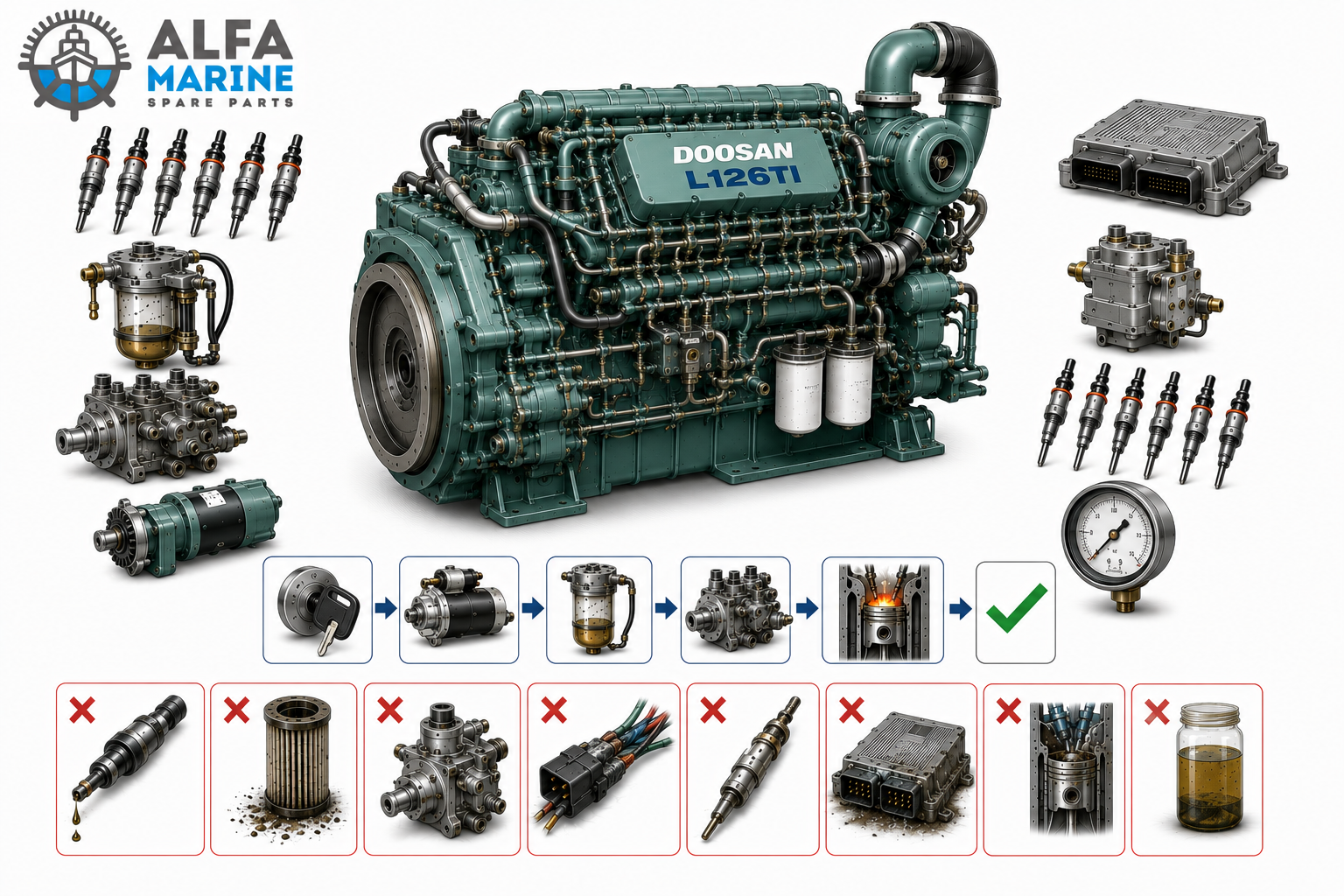
Doosan L126TI Marine Engine Doosan L126 Marine Engine Spare Parts | Alfa Marine Spare Parts
The Doosan L126TI marine family includes the L126TIH and L126TIM.
It is an inline six-cylinder, four-stroke, direct-injection marine diesel with turbocharging, intercooling and indirect seawater cooling through a heat exchanger.
| SpecificationDoosan L126TI | |
| Engine configuration | Inline 6 |
| Cycle | Four-stroke |
| Injection | Direct injection |
| Displacement | 11,051 cc |
| Bore × stroke | 123 × 155 mm |
| Compression ratio | 17:1 |
| Firing order | 1-5-3-6-2-4 |
| Cold valve clearance | 0.3 mm intake / 0.3 mm exhaust |
| Compression pressure | Approx. 28 kg/cm² at 200 rpm, initial condition |
| Injection timing | 14° ±1° BTDC |
| Nozzle opening pressure | 1st: 160 / 2nd: 220 kg/cm² |
| Starting system | Electric |
| Starter specification | 24 V / 6.0 kW |
| Cooling | Indirect seawater cooling with heat exchanger |
The L126TIH is documented at 360 PS / 265 kW at 2,000 rpm, while the L126TIM is documented at 400 PS / 294 kW at 2,100 rpm.
Exact component application should still be confirmed from the engine serial number and installed component.
Why Can an L126TI Become Hard to Start When Hot?
Heat changes several conditions inside a diesel engine.
As temperature increases:
- Electrical resistance can change
- Starter performance can deteriorate
- Fuel viscosity decreases
- Injection-pump internal leakage can become more significant
- Injector behavior can change
- Mechanical clearances change
- Marginal compression problems may become more noticeable
This makes a hot-only starting problem diagnostically different from an engine that is difficult to start under all conditions.
A useful pattern is:
Cold engine → starts normally
Fully warm engine → extended cranking
Engine cools → normal starting returns
When that pattern repeats consistently, investigate temperature-dependent faults first.
Start With Hot Cranking Speed
Do not dismantle the injection system before comparing cold and hot cranking performance.
The documented L126TI starting system uses a:
24 V / 6.0 kW starter
Check:
- Battery condition
- Battery voltage
- Voltage during cranking
- Starter condition
- Solenoid condition
- Battery cables
- Ground connections
- Connection resistance
- Actual hot cranking speed
A starter can operate satisfactorily when cold but perform poorly after heat soak.
If hot cranking speed is significantly lower than cold cranking speed, investigate the starting circuit first.
Why Cranking Speed Matters
A diesel engine relies on compression to produce sufficient cylinder temperature for ignition.
If the starter cannot rotate the engine fast enough, combustion conditions during starting can deteriorate.
This can produce:
Normal cold start → slow hot cranking → difficult hot restart
which can easily be mistaken for an injection-pump or injector problem.
Measure voltage and cranking performance rather than judging the starter only by sound.
Check the Fuel Supply
If hot cranking performance is satisfactory, move to the fuel system.
The L126TI uses mechanical direct injection.
Check:
- Fuel filters
- Fuel supply
- Fuel hoses and pipes
- Air intrusion
- Fuel feed pump
- Injection pump
- Injectors/nozzles
- Fuel control
- Fuel quality
Compare fuel-system behavior when the engine is cold with its behavior immediately after shutdown at operating temperature.
Can Air in the Fuel System Cause Difficult Starting?
Yes.
Air entering the fuel system can contribute to:
- Extended cranking
- Irregular starting
- Loss of prime
- Engine starting and stopping
- Rough operation immediately after starting
Inspect:
- Fuel hoses
- Pipe connections
- Filter housings
- Seals
- Feed-pump connections
- Return connections
- Recently disturbed components
A fuel system can draw air without necessarily producing a large visible external diesel leak.
Doosan L126TI Fuel Feed Pump
Detailed L126TIH/L126TIM injection-system documentation identifies:
105207-1400 — Fuel Feed Pump
The feed pump supplies fuel to the injection system.
If feed-pump performance deteriorates, possible symptoms can include:
- Extended cranking
- Difficult starting
- Poor fuel supply
- Loss of prime
- Irregular starting
- Engine starting and then stopping
Before condemning the much more expensive injection pump, establish that fuel is reaching it correctly.
Fuel-filter restriction and air intrusion can produce similar symptoms.
Doosan L126TI Fuel Injection Pump
One of the most important verified references for this troubleshooting problem is:
65.11101-7313A — Fuel Injection Pump
The associated Zexel reference documented for L126TIH/L126TIM is:
106675-4651
Detailed service information identifies the pump as a PE6P-type mechanical injection pump.
It also identifies:
65.11125-0010 — Injection Pump Plunger
These references are directly relevant when investigating an L126TI that cranks normally when hot but develops inadequate or abnormal fuel delivery.
Can the Injection Pump Cause Hot-Starting Problems?
Yes.
A worn mechanical injection pump can behave differently as temperature changes.
When fuel becomes warmer and less viscous, internal leakage through worn pump components may become more significant.
Injection-pump condition becomes particularly interesting when the engine:
- Starts well cold
- Cranks normally hot
- Has adequate fuel supply
- Has no obvious air intrusion
- Becomes progressively harder to restart as temperature increases
- Starts normally again after cooling
This symptom pattern does not prove that the injection pump is defective.
The fuel feed system, injectors, timing and compression still need to be considered.
65.11101-7313A / 106675-4651 Injection Pump
For the L126TIH/L126TIM, documented injection-pump references include:
Doosan P/N: 65.11101-7313A
Zexel P/N: 106675-4651
Pump type: PE6P
Plunger P/N: 65.11125-0010
Fuel feed pump: 105207-1400
When replacing or rebuilding the pump, verify:
Engine model + serial number + existing Doosan number + Zexel number
The identification plate on the existing injection pump is particularly useful.
Can L126TI Injectors Cause Hard Hot Starting?
Yes.
Injector condition can affect starting quality and combustion.
A worn injector or nozzle can contribute to:
- Poor atomization
- Fuel dribbling
- Incorrect opening behavior
- Difficult starting
- Rough running immediately after starting
- White or grey exhaust
- Uneven cylinder operation
- Increased fuel consumption
The L126TI uses two-stage nozzle-opening characteristics.
The documented engine specification is approximately:
First stage: 160 kg/cm²
Second stage: 220 kg/cm²
This is why injector testing should evaluate more than whether fuel simply comes through the nozzle.
Doosan L126TI Injector and Nozzle References
Detailed L126TIH/L126TIM service information provides several useful references.
Engine-Standard Nozzle & Holder
105030-4711 — Nozzle & Holder Assembly
This is the important engine-standard reference in the service information.
Injection Nozzle
105101-7961 — Injection Nozzle
The documented nozzle specification identifies a five-hole nozzle configuration in the injection-system calibration information.
Injection-Pump Test Nozzle & Holder
105780-8140 — Nozzle & Holder Assembly
This number needs an important qualification.
105780-8140 is documented as the nozzle-and-holder assembly used under injection-pump test/calibration conditions.
It should therefore not be advertised as the normal L126TI engine injector simply because it appears in the injection-pump specifications.
For engine parts identification, 105030-4711 is the more relevant nozzle-and-holder reference from this documentation.
Watch the Exhaust During Hot Cranking
Exhaust appearance can provide useful diagnostic direction.
Little or No Smoke
This can direct attention toward insufficient fuel delivery.
Investigate:
- Fuel supply
- Fuel feed pump
- Injection pump
- Fuel control
- Injector operation
White or Pale Smoke
Fuel may be reaching the cylinders but failing to ignite properly.
Investigate:
- Cranking speed
- Injector atomization
- Injection timing
- Compression
- Valve sealing
- Cylinder condition
Smoke color provides direction but does not identify a failed component by itself.
Could Low Compression Cause Hard Hot Starting?
Yes.
The L126TI has a documented compression ratio of:
17:1
The published initial compression-pressure reference is approximately:
28 kg/cm² at 200 rpm
Compression can deteriorate because of:
- Piston-ring wear
- Cylinder-liner wear
- Valve leakage
- Valve-seat problems
- Incorrect valve clearance
- Cylinder-head problems
- Internal mechanical wear
If cranking speed and fuel delivery are correct but the engine remains difficult to restart, compression testing becomes more important.
Compression-Related Parts
Compression itself does not have a replacement part number.
When compression is below specification, investigate the mechanical components responsible for cylinder sealing:
- Pistons
- Piston rings
- Cylinder liners
- Intake valves
- Exhaust valves
- Valve seats
- Cylinder-head components
- Cylinder-head gasket
These components should be ordered using the exact L126TI engine identification rather than assuming that all related Doosan 126-series engines use identical parts.
Check Valve Clearance
The documented cold valve-clearance specification for the L126TI is:
Intake: 0.3 mm
Exhaust: 0.3 mm
Incorrect valve clearance or poor valve sealing can influence effective compression.
However, valve adjustment should follow the correct service procedure.
Do not adjust the valves simply because the engine is difficult to restart when hot.
First determine whether the symptom points toward a mechanical problem.
Does Injection Timing Matter?
Yes.
The Doosan marine specification for the L126TI gives:
14° ±1° BTDC
Correct injection timing is important for starting and combustion.
Timing deserves particular attention after:
- Injection-pump removal
- Injection-pump replacement
- Injection-system repair
- Timing work
- Major engine repair
- Previous incorrect adjustment
Detailed pump calibration documentation can contain different test/calibration references, so the installed-engine service procedure should be followed when setting engine injection timing.
What if the Engine Starts Better After Cooling?
This is a particularly useful diagnostic clue.
If the pattern is:
Cold → starts normally
Hot → difficult to restart
Cool again → starts normally
concentrate on temperature-sensitive conditions.
These include:
- Starter performance
- Electrical resistance
- Fuel viscosity
- Injection-pump internal leakage
- Injector behavior
- Mechanical clearances
- Compression
Record how long the engine must cool before normal starting returns.
This can help reproduce the fault during diagnosis.
What if the Engine Cranks Normally When Hot?
If measured hot cranking performance is normal, shift the diagnostic emphasis toward:
Fuel feed → injection pump → injectors → injection timing → compression
This is where the verified fuel-system references become useful:
| ComponentPart Number / Reference | |
| Fuel Injection Pump | 65.11101-7313A |
| Zexel Pump Reference | 106675-4651 |
| Injection Pump Plunger | 65.11125-0010 |
| Fuel Feed Pump | 105207-1400 |
| Engine Nozzle & Holder | 105030-4711 |
| Injection Nozzle | 105101-7961 |
| Pump Calibration Nozzle & Holder | 105780-8140 |
These references should still be compared with the existing components before ordering.
What if It Cranks Slowly Only When Hot?
Then investigate the starting system before dismantling the injection equipment.
Check:
- 24 V starting supply
- Starter motor
- Solenoid
- Batteries
- Battery cables
- Grounds
- Voltage drop
- Connection resistance
The documented starter specification is:
24 V / 6.0 kW
A specific replacement starter part number should be verified against the installed engine before ordering.
What if the Problem Started After Injection-Pump Work?
Begin with the work that was performed.
Verify:
- Correct injection pump
- Pump identification
- Injection timing
- Fuel-system priming
- Fuel-line connections
- Fuel leakage
- Air intrusion
- Components disturbed during repair
If the installed pump carries:
65.11101-7313A
or Zexel:
106675-4651
record both references when requesting replacement or repair components.
What if the Problem Started After Injector Work?
Check:
- Correct nozzle/holder identification
- Nozzle condition
- Injector installation
- Opening pressure
- Fuel-line installation
- Air intrusion
- Components disturbed during repair
Remember the distinction:
105030-4711 — engine-standard nozzle & holder reference
105780-8140 — injection-pump calibration/test nozzle & holder reference
They should not automatically be treated as the same application.
Hot Starting: Starter, Fuel System or Compression?
| SymptomArea Worth Investigating | |
| Slow cranking only hot | Starter / batteries / cables / grounds |
| Normal cranking + little smoke | Fuel feed / injection pump |
| Normal cranking + white smoke | Injectors / timing / compression |
| Starts again after cooling | Temperature-dependent fault |
| Rough immediately after starting | Injectors / individual cylinders |
| Progressive hard starting | Injection system / mechanical wear |
| Problem after pump work | Timing / installation / priming |
| One cylinder abnormal | Injector / valve / compression |
| Hard starting cold and hot | Broaden complete diagnosis |
These are diagnostic directions rather than proof of a specific component failure.
Practical Doosan L126TI Hot-Start Check
A logical diagnostic sequence is:
- Confirm L126TIH or L126TIM.
- Record the engine serial number.
- Record the existing injection-pump number.
- Record injector/nozzle identification where available.
- Determine whether cold starting is normal.
- Bring the engine to normal operating temperature.
- Compare cold and hot cranking performance.
- Measure battery voltage during hot cranking.
- Check cables and grounds.
- Verify fuel supply.
- Inspect fuel filters.
- Check for air intrusion.
- Evaluate the 105207-1400 fuel feed pump where applicable.
- Observe exhaust during hot cranking.
- Evaluate the 65.11101-7313A / 106675-4651 injection pump where fitted.
- Test injector/nozzle condition.
- Verify injection timing when appropriate.
- Compare all six cylinders.
- Check valve condition and clearance when indicated.
- Evaluate compression.
- Identify the actual fault before ordering major components.
The objective is:
Cranking speed → fuel supply → feed pump → injection pump → injectors → compression → combustion
Why Exact L126TI Part Identification Matters
A request for:
“Doosan L126TI injection pump”
is better than no engine information, but it is still not ideal.
Provide:
- L126TIH or L126TIM
- Engine serial number
- Existing Doosan part number
- Zexel/manufacturer number where applicable
- Injector/nozzle number
- Clear photographs
- Vessel application
For example:
L126TIH + serial number + 65.11101-7313A + 106675-4651
provides much stronger identification than simply requesting:
“L126TI fuel pump.”
Doosan L126TI Hot-Starting Parts Reference
The strongest relevant references for this troubleshooting problem are:
65.11101-7313A — Fuel Injection Pump
106675-4651 — Zexel Injection Pump Reference
65.11125-0010 — Injection Pump Plunger
105207-1400 — Fuel Feed Pump
105030-4711 — Engine-Standard Nozzle & Holder Assembly
105101-7961 — Injection Nozzle
105780-8140 — Injection-Pump Calibration/Test Nozzle & Holder
24 V / 6.0 kW — Starter Motor Specification
The exact component should always be compared with the installed part before ordering.
Doosan L126TI Marine Engine Parts
Doosan L126 Marine Engine Spare Parts | Alfa Marine Spare Parts
Alfa Marine Spare Parts supplies and sources replacement components for Doosan marine diesel engines.
L126TI enquiries can include:
- Fuel injection pumps
- Injection-pump components
- Fuel feed pumps
- Fuel injectors
- Injector nozzles
- Starter motors
- Turbochargers
- Cylinder heads
- Valves
- Pistons
- Piston rings
- Cylinder liners
- Bearings
- Water pumps
- Cooling-system components
- Gaskets and seals
- Overhaul components
Exact application should be confirmed using the engine serial number and existing component identification.
Request Doosan L126TI Marine Parts
If your Doosan L126TI marine engine becomes difficult to start when hot, avoid immediately replacing the complete injection system.
First establish whether the problem is related to:
Hot cranking → fuel supply → feed pump → injection pump → injectors → timing → compression
For accurate parts identification, provide:
Engine model + serial number + existing part number + manufacturer reference + clear photographs
Email: request@alfamarinespareparts.com
Request a Quote
Alfa Marine Spare Parts
Frequently Asked Questions
Why does my Doosan L126TI start cold but become difficult to start hot?
A temperature-dependent problem can involve hot cranking speed, starter performance, fuel feed, injection-pump condition, injector performance or compression.
What is the L126TI injection-pump part number?
For L126TIH/L126TIM service documentation, the injection pump is identified as 65.11101-7313A, with associated Zexel reference 106675-4651. Verify the installed pump before ordering.
What is the L126TI fuel feed pump reference?
The detailed L126TIH/L126TIM injection-system specification identifies 105207-1400 as the fuel feed pump.
What is the L126TI nozzle-and-holder reference?
The service information identifies 105030-4711 as the engine-standard nozzle-and-holder reference.
What is 105780-8140?
105780-8140 appears as the nozzle-and-holder assembly used for injection-pump test/calibration conditions. It should not automatically be advertised as the standard engine injector.
Can the injection pump cause difficult hot starting?
Yes. Internal pump wear can become more noticeable as operating temperature increases and fuel viscosity decreases. Testing is preferable to replacing the pump based solely on the symptom.
Can L126TI injectors cause hot-start problems?
Yes. Poor atomization, leakage or incorrect opening characteristics can contribute to difficult starting.
What is the L126TI compression ratio?
The Doosan marine specification gives 17:1.
What is the initial L126TI compression-pressure reference?
Published Doosan specifications give approximately 28 kg/cm² at 200 rpm under initial-condition reference conditions.
What is the L126TI starter specification?
The documented starter capacity is 24 V / 6.0 kW.
What is the L126TI firing order?
1-5-3-6-2-4.
What information should I provide when ordering L126TI parts?
Provide the complete engine model, engine serial number, existing Doosan part number, component manufacturer reference where available and clear photographs.