Fuel Filter for Doosan L126TI Marine Engine: Filtration, Water Contamination, Replacement & Part Numbers
The fuel filter on a Doosan L126TI marine engine is a relatively small component protecting a much more expensive fuel-injection system.
That makes it easy to underestimate.
A fuel filter can cost only a fraction of what an injection pump or injector repair costs, but once contaminated fuel passes through the filtration system, the consequences can become much more serious.
The Doosan L126TI is a 6-cylinder, 4-stroke, direct-injection, water-cooled marine diesel with a wet turbocharger and intercooler. Published L126TI specifications list approximately 11.05 liters displacement, with ratings including 360 PS at 2,000 rpm and 400 PS at 2,100 rpm depending on configuration.
For this engine, the useful question is not simply:
“When should I change the fuel filter?”
It is:
“What is the filter telling me about the fuel system?”
A filter that suddenly blocks much faster than before may be warning you about a contaminated tank.
Water appearing repeatedly in the separator may indicate an upstream fuel-storage problem.
And an engine that runs perfectly at idle but loses power under load may simply not be receiving enough fuel through a restricted filter.
1. Doosan L126TI Marine Engine
This article focuses specifically on the:
Doosan L126TI Marine Engine
Basic engine characteristics include:
Configuration: Inline 6-cylinder
Cycle: 4-stroke diesel
Fuel system: Direct injection
Cooling: Water-cooled
Aspiration: Turbocharged and intercooled
Displacement: Approximately 11,051 cc
Typical published ratings: 360 PS / 265 kW at 2,000 rpm and 400 PS / 294 kW at 2,100 rpm
The engine uses a mechanical injection-pump arrangement in the documented L126TI specification.
That fuel system still depends heavily on clean diesel with minimal water and particulate contamination.
2. What Does the Fuel Filter Do?
The fuel filter sits between the fuel supply and the engine's precision fuel-injection components.
Its job is to remove contaminants such as:
- Dirt
- Rust
- Tank sediment
- Fine particles
- Other debris
Depending on the vessel arrangement, the fuel system may also include a primary fuel-water separator before the engine-mounted final filter.
A simplified fuel path can look like:
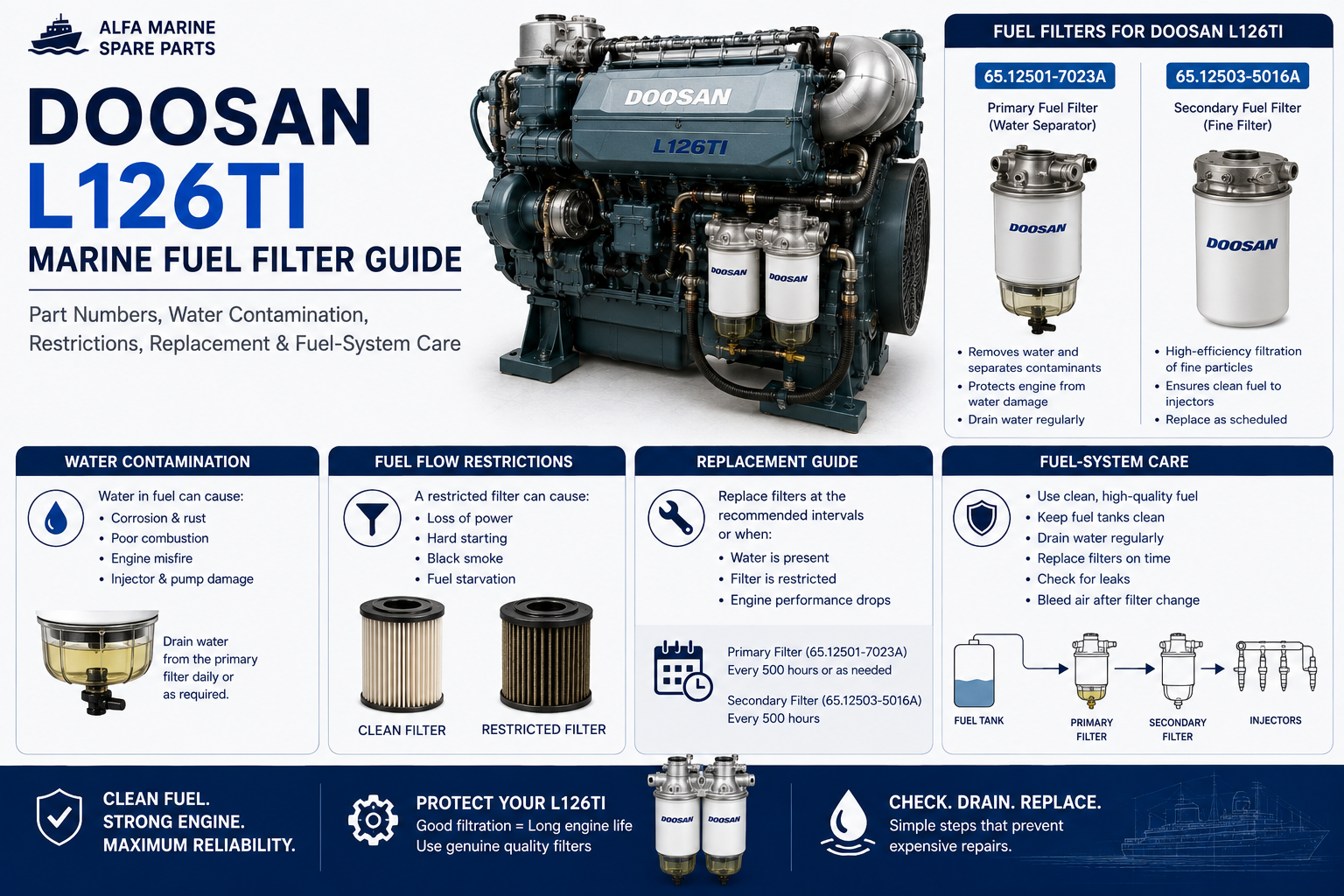
Fuel tank → primary separator → feed system → engine fuel filter → injection pump → injectors
The exact installation can vary.
3. Why Fuel Filtration Matters on the L126TI
Injection equipment works with precisely controlled clearances.
Contaminants can contribute to:
- Injector wear
- Injection-pump wear
- Poor spray pattern
- Unstable engine operation
- Reduced power
- Difficult starting
- Higher fuel consumption
This is why the filter should not be viewed simply as a scheduled service item.
It is a protective barrier between the fuel tank and expensive engine components.
4. Doosan L126TI Fuel Filter Part Numbers
The L126TI parts catalogue identifies a complete fuel-filter assembly and individual fuel-filter components.
Documented numbers include:
| Doosan Part NumberDescription | |
| 65.12501-7023A | Fuel Filter Assembly |
| 65.12504-5013B | Fuel Filter Head |
| 65.12503-5016A | Fuel Filter / Filter Element Component |
The parts catalogue covering Doosan MD196T, MD196TI, L126TI, L126TIM, AD196T, AD196TI and AD126TI lists 65.12501-7023A as the fuel-filter assembly, with 65.12504-5013B identified as the fuel-filter head and 65.12503-5016A among the filter assembly components.
The complete assembly number 65.12501-7023A also appears in L126TI-related spare-parts listings.
5. What Is Doosan Part Number 65.12501-7023A?
65.12501-7023A is a documented fuel filter assembly used in the L126TI family parts catalogue.
That means this number refers to more than just a disposable filter cartridge.
When someone asks for:
“Doosan L126TI fuel filter”
it is therefore important to determine whether they need:
- Complete fuel-filter assembly
- Fuel-filter head
- Replaceable filter element
- Seals
- Fuel pipes or fittings
These are different requirements.
6. What Is Part Number 65.12504-5013B?
The same parts catalogue identifies:
65.12504-5013B — Head; Fuel Filter.
The filter head supports the filter assembly and fuel connections.
A leaking or damaged filter head can create symptoms that appear to be a filter-element problem.
Inspect for:
- Cracks
- Damaged threads
- Fuel leakage
- Corrosion
- Poor sealing surfaces
Replacing the filter cartridge will not repair a damaged filter head.
7. What Is Part Number 65.12503-5016A?
The L126TI fuel-filter assembly information also identifies 65.12503-5016A as part of the fuel-filter arrangement.
The closely related 65.12503-5016 number is also sold and identified independently as a Doosan engine fuel filter.
Because suffixes and revisions can matter, the exact number on the existing filter should be checked before ordering.
For example:
65.12503-5016
and:
65.12503-5016A
should not automatically be treated as identical without parts verification.
8. Why the Engine Serial Number Still Matters
Even when you have a useful part number, engine identification remains important.
The L126TI family has existed in different configurations and applications.
Before ordering, provide:
Engine: Doosan L126TI
Engine Serial Number: __________
Existing Fuel Filter Number: __________
Fuel Filter Assembly Number: __________
Quantity: __________
The original component number is often the strongest starting point.
9. Fuel Filter vs. Fuel-Water Separator
These terms are often used interchangeably, but they are not always the same component.
Fuel Filter
Primarily removes fine contaminants from the diesel fuel.
Fuel-Water Separator
Designed to help separate water and heavier contamination before the fuel reaches the engine's final filtration system.
Many marine installations use both.
The primary separator protects the engine-mounted final filter.
10. Why Water in Diesel Fuel Is Such a Problem
Water can enter marine fuel through:
- Tank condensation
- Contaminated fuel supply
- Damaged filler caps
- Vent-system problems
- Long storage periods
- Poor tank maintenance
Water can contribute to:
- Corrosion
- Injector damage
- Injection-pump damage
- Microbial contamination
- Filter blockage
A marine fuel system naturally faces more moisture exposure than many land-based installations.
11. Check the Fuel-Water Separator Regularly
If the vessel has a transparent bowl or drainable separator, inspect it during engine-room rounds.
Look for:
- Water
- Sediment
- Rust
- Dark sludge
If water appears repeatedly, do not simply keep draining it forever.
Ask:
“Why is there so much water in this fuel system?”
The real problem may be inside the fuel tank.
12. Situation: L126TI Runs Fine at Idle but Loses Power Under Load
This is a classic symptom of restricted fuel flow.
At idle, the engine requires relatively little fuel.
When the vessel accelerates, demand increases sharply.
A partially blocked fuel filter may still provide enough fuel for idle but not enough for full engine load.
Possible symptoms include:
- Reduced RPM
- Slow acceleration
- Loss of power
- Engine surging
- Engine stopping under heavy load
Before replacing expensive injection components, inspect the basic fuel supply.
13. Situation: Engine Will Not Reach Normal RPM
Possible causes include:
- Dirty fuel filter
- Primary separator restriction
- Blocked tank pickup
- Air entering the fuel system
- Feed-pump issue
- Injection-pump problem
- Air-system restriction
- Excessive propeller load
Do not automatically blame the turbocharger or injectors.
Start with the simple checks.
14. Situation: Fuel Filter Keeps Blocking Quickly
Suppose a new filter normally lasts a reasonable service period.
Suddenly it becomes restricted repeatedly.
That tells you something.
Possible causes include:
- Dirty tank
- Microbial growth
- Rust
- Sediment
- Contaminated fuel delivery
Changing filters repeatedly may keep the engine operating temporarily.
But the tank may be the actual problem.
15. What Does a Dirty Fuel Filter Look Like?
A removed filter may contain:
- Dark sediment
- Rust particles
- Sludge
- Water-related contamination
- Fine dirt
Do not immediately throw the old filter away.
Inspect it.
The filter may provide a useful sample of what is inside the vessel's fuel tank.
16. Black Sludge in the Fuel System
Dark or sticky contamination can be associated with degraded fuel or microbial contamination.
Possible effects include:
- Frequent filter blockage
- Tank deposits
- Fuel-line restriction
If filters repeatedly become coated in abnormal material, investigate the complete fuel-storage system rather than only changing the engine filter.
17. Rust in the Filter
Rust particles can indicate corrosion somewhere in the fuel-storage or supply system.
Possible sources include:
- Fuel tank
- Steel fuel piping
- Fittings
A new filter protects the injection system from the particles.
But it does not stop the corrosion producing them.
18. Air Entering the Fuel System
A filter change can sometimes introduce air into the fuel circuit.
Possible symptoms after service include:
- Difficult starting
- Uneven running
- Engine stops shortly after starting
- Unstable RPM
If the engine ran normally before the filter change and badly afterward, inspect the work that was just performed.
Check:
- Filter sealing
- O-rings
- Connections
- Bleeding/priming
Timing is often a powerful troubleshooting clue.
19. Do Not Install Two Seals Accidentally
When changing a spin-on or cartridge-type filter arrangement, make sure the old sealing ring is removed if the design requires it.
A common servicing problem on filters generally is:
old gasket remains installed + new filter receives another gasket.
That can cause:
- Fuel leakage
- Air ingress
- Poor sealing
Always inspect the filter mounting surface.
20. Cleanliness During Filter Replacement
Before removing the filter, clean around the filter head.
Why?
Because dirt around the housing can fall directly into an open fuel connection.
The whole purpose of the filter is to keep contamination out of the injection system.
Do not introduce contamination during the filter change itself.
21. Fill or Prime the Filter Correctly
After filter replacement, the fuel system needs to be returned to service using the correct priming and bleeding procedure.
Avoid improvised methods that introduce dirty fuel downstream of the filter.
The clean side of the filtration system should remain clean.
22. Fuel Leakage Around the Filter
If diesel appears around the filter assembly after service, inspect immediately.
Possible causes include:
- Loose filter
- Damaged seal
- Incorrect filter
- Damaged filter head
- Loose fuel connection
- Incorrect gasket placement
A fuel leak is both a reliability problem and an engine-room safety concern.
23. Check Fuel Pipes and Hollow Screws
The documented L126TI fuel-system parts listing includes fuel pipes, hollow screws and sealing rings around the fuel-filter arrangement.
These small parts matter.
A leaking sealing ring can allow:
- Fuel leakage
- Air ingress
That can create symptoms resembling a blocked filter or injection problem.
24. Don't Overtighten the Filter
More torque does not automatically create a better seal.
Excessive tightening can:
- Damage the seal
- Damage threads
- Make later removal difficult
- Damage the filter head
Install the filter using the correct servicing procedure.
25. Fuel Filter Condition and Injector Life
Injectors depend on clean fuel.
Contamination reaching the injectors can contribute to:
- Poor atomization
- Uneven cylinder combustion
- Smoke
- Increased fuel consumption
- High exhaust temperature
- Reduced power
Maintaining filtration is therefore part of protecting the injectors.
26. Fuel Filter Condition and Injection Pump Life
The L126TI specification lists a mechanical variable-speed injection-pump governor arrangement.
Mechanical injection equipment is robust, but that does not make it immune to contamination.
Water and dirt can still damage precision internal surfaces.
Good filtration remains important.
27. Fuel Filter and Black Smoke
A blocked fuel filter normally restricts fuel rather than creating excessive fuel delivery.
So black smoke should not automatically be blamed on the filter.
Black smoke can involve:
- Air restriction
- Turbocharger performance
- Injector condition
- Engine overload
However, severe fuel-delivery irregularities can still affect engine behavior.
Use smoke together with other symptoms.
28. Fuel Filter and White Smoke
White smoke can be associated with incomplete combustion under certain conditions.
If filter replacement is followed immediately by:
- Hard starting
- Rough operation
- White smoke
check whether air entered the fuel system.
Do not immediately assume internal engine damage.
29. Hard Starting After the Vessel Has Been Sitting
Fuel may drain back or air may enter the system through a leak.
Possible areas include:
- Filter seals
- Fuel hoses
- Connections
- Check valves depending on the system
- Feed system
If starting improves after priming, investigate why fuel pressure or prime is being lost.
30. Filter Replacement Interval
The correct fuel-filter service interval should be based on the maintenance requirements for the specific L126TI engine and vessel.
But operating conditions also matter.
A vessel taking clean fuel from well-maintained tanks has a different environment from one with:
- Old tanks
- Heavy sediment
- Frequent water contamination
A filter that becomes restricted before its scheduled service interval should be changed and the cause investigated.
31. Don't Stretch Filter Life to Save a Small Amount
A fuel filter is inexpensive compared with:
- Injection pump repair
- Injector replacement
- Vessel downtime
Running a filter far beyond its useful life to save a small service cost does not make much economic sense on a commercial marine engine.
32. Carry Spare Fuel Filters Onboard
For a commercial vessel or long voyage, carrying spare filters can be valuable.
Contaminated fuel can suddenly block filters much faster than expected.
Useful onboard spares may include:
- Final fuel filter
- Primary separator element
- Sealing rings
- Relevant O-rings
The correct onboard stock depends on the actual vessel fuel system.
33. Twin Doosan Engines Can Help Identify Fuel Problems
Suppose a vessel has twin L126TI engines supplied from similar fuel tanks.
One engine:
reaches normal RPM.
The other:
loses power under load.
Compare:
- Fuel filters
- Separators
- Fuel pressure/supply
- Tank selection
- Fuel hoses
One engine becomes a useful reference for the other.
34. Doosan L126TI Fuel Filter Part Number Summary
For quick reference:
65.12501-7023A — Fuel Filter Assembly
65.12504-5013B — Fuel Filter Head
65.12503-5016A — Fuel Filter Component / Element in the documented assembly
These are documented in an L126TI-family parts catalogue.
Because part revisions and engine configurations can differ, verify the number against the existing filter and engine serial number before ordering.
35. Other Doosan Fuel Filter Numbers
Doosan uses many different fuel-filter numbers across its broader engine range.
For example, 65.12503-5033A is documented as a Doosan fuel-filter cartridge but is associated with other Doosan diesel applications such as DL08, not automatically with the L126TI.
This is exactly why a generic search for:
“Doosan fuel filter”
can lead to the wrong part.
Use the engine model and existing filter number.
36. Do Not Assume Similar Doosan Numbers Are Interchangeable
You may encounter numbers such as:
- 65.12503-5016
- 65.12503-5011
- 65.12503-5033A
- 65.12503-5011E
They may all be associated with Doosan fuel filtration in different applications, but that does not make them interchangeable.
For example, 65.12503-5011E is identified as a Doosan fuel-water separator in other applications.
Always confirm the exact engine.
37. Complete Fuel Filter Assembly or Element?
When requesting parts, state clearly what you need.
Complete Assembly
May include:
- Filter head
- Filter element
- Connections
- Related mounting parts
Replacement Filter
Normally only replaces the consumable filtration component.
Repair Components
May include:
- Seals
- Fittings
- Filter head
- Pipes
This distinction can avoid unnecessary expense.
38. When Should the Filter Head Be Replaced?
The filter head may require replacement if it has:
- Cracks
- Damaged threads
- Severe corrosion
- Damaged sealing surfaces
Do not replace a complete assembly if only the filter cartridge is due for routine service.
But do not keep installing new filters onto a damaged head either.
39. Fuel-System Inspection Checklist
During routine engine-room checks:
☐ Inspect fuel filter for leaks
☐ Check primary water separator
☐ Drain water when required
☐ Inspect fuel hoses
☐ Look for loose connections
☐ Check for air ingress
☐ Record repeated filter restrictions
☐ Inspect removed filters for contamination
☐ Keep spare filters onboard
A few minutes of inspection can protect much more expensive fuel-system components.
40. What Information Should You Send When Ordering?
Instead of:
“Need Doosan marine fuel filter.”
send:
Manufacturer: Doosan
Engine: L126TI
Engine Serial Number: __________
Existing Filter Part Number: __________
Complete Assembly Required: Yes / No
Quantity: __________
Photographs: Attached
Delivery Location: __________
If your existing filter shows 65.12503-5016A or the assembly shows 65.12501-7023A, include that information.
41. Frequently Asked Questions
Which Doosan Marine Engine Is This Guide About?
This guide focuses on the Doosan L126TI marine engine.
What Is the Doosan L126TI Fuel Filter Assembly Number?
A documented L126TI-family parts catalogue identifies 65.12501-7023A as the fuel-filter assembly.
What Is Doosan 65.12504-5013B?
It is identified in the same catalogue as the fuel-filter head.
What Is Doosan 65.12503-5016A?
It appears as part of the documented L126TI fuel-filter assembly and is associated with the fuel-filter element/component.
Why Does My L126TI Lose Power at High RPM?
Possible causes include restricted fuel filters, tank pickup restriction, air in the fuel system, injection problems, air-system problems or excessive engine load.
Why Does My New Fuel Filter Block So Quickly?
The fuel tank may contain water, rust, sludge or other contamination.
Should I Keep Changing Filters if They Keep Blocking?
Change the restricted filter as necessary to protect the engine, but investigate the source of the contamination.
Can Air Enter the Fuel System During Filter Replacement?
Yes. Incorrect sealing or incomplete priming can cause difficult starting or unstable engine operation after service.
Can I Use Any Doosan Fuel Filter With a Similar Part Number?
No. Verify the exact filter against the engine model, serial number and existing part number.
Doosan L126TI Fuel-System & Engine Spare Parts
Alfa Marine Spare Parts can assist with inquiries for:
- Fuel filters
- Fuel-filter assemblies
- Fuel-filter heads
- Fuel-water separator components
- Fuel pipes
- Sealing rings
- Injectors
- Injection pumps
- Feed pumps
- Turbochargers
- Oil filters
- Air filters
- Seawater pumps
- Freshwater pumps
- Heat exchangers
- Cylinder heads
- Pistons
- Cylinder liners
- Bearings
- Gaskets
- Overhaul components
Correct identification should always be based on the engine model, serial number and existing component number.
Browse Our Complete Catalog
Marine engine brands:
https://alfamarinespareparts.com/our-brand
Marine spare parts:
https://alfamarinespareparts.com/spareparts
Contact Alfa Marine Spare Parts
For Doosan L126TI fuel filters, fuel-system parts and marine engine spare parts:
Email: request@alfamarinespareparts.com
For faster identification, provide:
Doosan L126TI serial number + existing fuel-filter part number + quantity + photographs + delivery location.
Final Word
A Doosan L126TI fuel filter is a simple component with a very important job.
It stands between whatever is inside the vessel's fuel tank and the engine's injection equipment.
That means the filter can also tell you a story.
If it lasts normally for a long period and suddenly begins blocking every few days, something upstream has changed.
If water keeps appearing in the separator, the problem may be the tank—not the filter.
If the L126TI runs perfectly at idle but loses power when load increases, fuel restriction deserves investigation.
And if the engine runs badly immediately after filter replacement, ask whether air entered the fuel system before blaming the injectors.
For parts identification, numbers such as 65.12501-7023A, 65.12504-5013B and 65.12503-5016A provide useful starting points for documented L126TI fuel-filter components.
But the safest ordering method remains:
Doosan L126TI + engine serial number + existing filter number + photographs.
A fuel filter is inexpensive.
The injection equipment it protects is not.