DEUTZ F4L912 Marine Engine Overhaul Gasket Set Explained
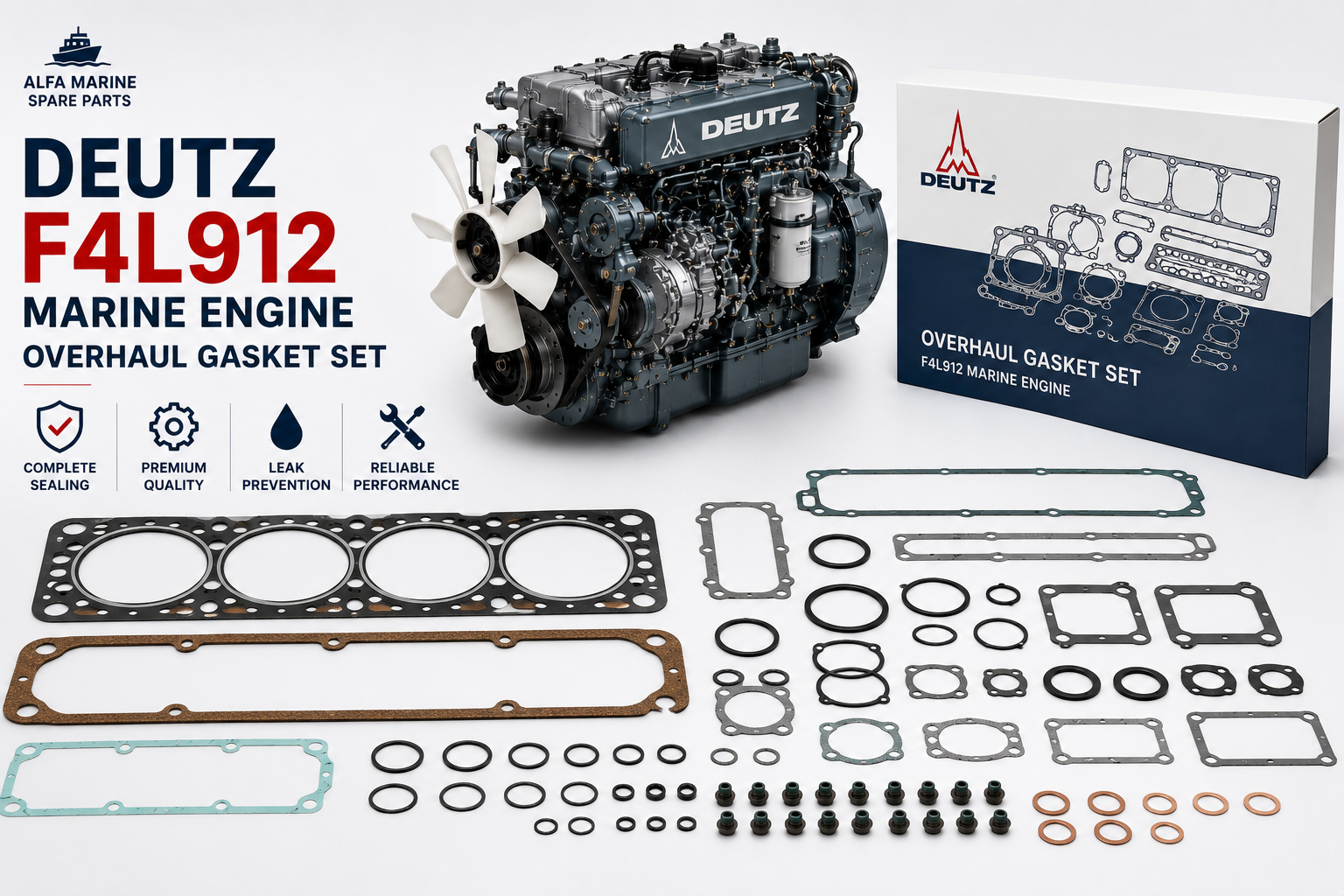
An overhaul gasket set for the DEUTZ F4L912 marine engine is not simply a box of seals.
It is a collection of sealing components used when the engine is opened for major repair, top-end work, cylinder repair, or a more complete overhaul.
The DEUTZ F4L912 is a 4-cylinder, naturally aspirated, air-cooled diesel engine with direct injection. DEUTZ documentation identifies the F4L912 as part of the 912 family, using an integrated air-cooling system rather than a conventional liquid-coolant circuit.
That air-cooled construction changes the way an overhaul gasket set should be understood.
There is no conventional liquid-cooled cylinder-head gasket arrangement like you would expect on many modern marine diesels. Instead, sealing is concentrated around areas such as the cylinder heads, rocker covers, crankcase, oil system, intake, exhaust, injection equipment and other engine joints.
1. What Is a DEUTZ F4L912 Overhaul Gasket Set?
An overhaul gasket set is designed to provide many of the seals and gaskets normally required when rebuilding a substantial part of the engine.
Depending on the supplier and kit specification, the set may include components for areas such as:
- Cylinder-head sealing
- Rocker or valve-cover sealing
- Intake manifold
- Exhaust manifold
- Oil sump
- Crankcase covers
- Oil system
- Fuel/injection related sealing
- Pushrod or valve-train areas
- Front and rear engine covers
- Various O-rings and sealing washers
The exact contents vary.
That is important.
Two boxes both advertised as:
“F4L912 overhaul gasket set”
may not contain exactly the same parts.
2. Why the F4L912 Is Different From a Water-Cooled Marine Engine
The F4L912 is air-cooled.
DEUTZ describes the 912 family as using an integrated axial-flow blower for cooling, and the engine architecture includes individual cylinder arrangements and separate cylinder heads.
That means you will not find the same type of coolant-related gasket package used on many liquid-cooled engines.
There is no conventional:
water jacket → head gasket → coolant passage
arrangement throughout the engine like you might see on a typical water-cooled marine diesel.
Instead, cooling depends heavily on:
- Cooling fins
- Cooling-air passages
- Fan/blower system
- Correct airflow around the cylinders and heads
This makes cleanliness around the cooling fins very important during overhaul.
3. Individual Cylinder Heads
One of the characteristic features of the 912 family is the use of individual cylinder heads.
On an F4L912, each of the four cylinders has its own cylinder-head arrangement rather than one long common head covering all cylinders.
This offers an important maintenance advantage.
If one cylinder has a problem involving:
- Valve seat
- Valve guide
- Cylinder head
- Compression
- Combustion
that position can be inspected individually.
During overhaul, the sealing components associated with each head should be carefully identified and renewed where required.
4. What Does the Cylinder-Head Sealing Area Do?
The cylinder head must seal the combustion chamber properly.
This sealing area experiences:
- Combustion pressure
- High temperature
- Repeated thermal cycles
A poor seal can contribute to:
- Compression loss
- Combustion leakage
- Difficult starting
- Power loss
- Soot around the head/cylinder interface
On an air-cooled DEUTZ engine, visible combustion leakage around a cylinder position can be an important diagnostic clue.
5. Do Not Assume a Traditional Head Gasket Is Included
This is one of the most important points when ordering an F4L912 gasket set.
Because of the engine's individual-cylinder, air-cooled construction, sealing arrangements differ from the large composite cylinder-head gasket commonly seen on many water-cooled automotive or marine engines.
Do not order a kit based only on:
“4-cylinder diesel head gasket set.”
The gasket set must match the actual F4L912 engine architecture.
6. Rocker Cover / Valve Cover Gaskets
The rocker-cover area protects the valve train.
The sealing components here help prevent engine oil from escaping around the cover.
A leaking rocker-cover gasket may create:
- Oil on the cylinder head
- Dirt accumulation
- Oil smell
- Oil running toward hot engine surfaces
Older 912 engines often become dirty over time because small oil leaks are allowed to continue.
During overhaul, renewing these seals helps make future inspection easier.
7. Why Small Oil Leaks Matter on an Air-Cooled Engine
On an air-cooled engine, clean external surfaces matter more than many operators realize.
Oil and dirt can accumulate around:
- Cooling fins
- Cylinder areas
- Cylinder heads
This can interfere with cooling airflow.
So a leaking gasket can create two problems:
oil loss
and:
reduced cooling efficiency because dirt sticks to the oily surfaces.
8. Intake Manifold Gaskets
The intake system delivers combustion air to the cylinders.
Intake manifold gaskets help prevent air leakage between intake components and the cylinder-head area.
A leaking intake connection can contribute to:
- Unmetered or poorly distributed air
- Dust ingestion depending on leak location
- Reduced engine performance
- Uneven cylinder behavior
During overhaul, inspect both the gasket and the mating surfaces.
A new gasket cannot seal a badly damaged flange.
9. Exhaust Manifold Gaskets
The exhaust manifold collects exhaust gases from the four cylinders.
Exhaust gaskets operate under high temperature.
Common failure signs can include:
- Black soot
- Exhaust smell
- Ticking sound
- Hot gas leakage
- Burn marks around the joint
If soot is visible around one exhaust port, inspect the gasket and flange condition.
Do not simply tighten the manifold harder without understanding why the joint is leaking.
10. Why Exhaust Leaks Matter on an F4L912
The F4L912 is naturally aspirated, so an exhaust leak does not reduce turbocharger energy in the way it would on a turbocharged BF engine.
But it can still cause:
- Increased engine-room heat
- Exhaust fumes
- Noise
- Damage to nearby components
A good overhaul should therefore include careful inspection of exhaust sealing surfaces.
11. Oil Sump Gasket
The oil sump holds the engine's lubricating oil.
The sump gasket seals the joint between the oil pan and crankcase.
Possible signs of failure include:
- Oil drops under the engine
- Wet sump flange
- Persistent oil loss
- Dirt sticking around the joint
During overhaul, the sump is often removed for cleaning and internal inspection.
A new sump gasket is therefore commonly part of the sealing work.
12. Why the Oil Sump Should Be Cleaned During Overhaul
When the sump is removed, inspect what has collected inside.
Look for:
- Sludge
- Metallic particles
- Carbon
- Unusual debris
The sump can provide valuable evidence of internal engine condition.
Do not immediately wash everything away before inspecting it.
13. Front Cover and Timing-Area Gaskets
The front of the engine contains important drive and timing-related components.
Depending on the overhaul scope, gasket sets may include sealing components for front covers and related housings.
Look for previous signs of:
- Oil leakage
- Damaged sealing surfaces
- Incorrect sealant use
Older engines are sometimes repaired repeatedly with excessive sealing compound.
That can make the next overhaul more difficult.
14. Rear Engine Sealing
Rear sealing components around the crankshaft/flywheel area may also require attention during a complete overhaul.
A rear oil leak can sometimes appear as:
- Oil inside the bellhousing area
- Oil near the flywheel
- Oil dripping between engine and gearbox
If the engine is already removed or substantially dismantled, this is the best time to inspect hard-to-access seals.
15. Crankshaft Seals
Front and rear crankshaft seals help control oil leakage where the crankshaft exits the crankcase.
These are not always included in every generic gasket set.
This is why it is important to ask whether the kit includes:
- Front crankshaft seal
- Rear crankshaft seal
or whether these must be ordered separately.
16. O-Rings
O-rings are small but important.
Depending on engine configuration and repair scope, they may be used around:
- Oil passages
- Fuel-system connections
- Covers
- Injection-related components
- Other engine joints
A missing O-ring can stop an overhaul even when all the large components are already installed.
17. Sealing Washers
Copper or other sealing washers may be used around:
- Fuel connections
- Oil fittings
- Injection components
- Drain plugs
Do not assume every washer can be reused.
A sealing washer that has already been crushed or damaged may not reseal correctly.
18. Injection-System Sealing Components
The F4L912 uses mechanical direct injection. DEUTZ identifies direct injection as one of the defining features of the 912 family.
During overhaul, fuel-system work may involve sealing around:
- Injectors
- Injection lines
- Injection pump connections
Cleanliness is critical.
Do not allow dirt into fuel-system components while replacing seals.
19. Injector Sealing
An injector must seal correctly in its installation position.
Poor sealing can contribute to:
- Combustion leakage
- Carbon buildup
- Difficult injector removal later
- Abnormal cylinder operation
When injectors are removed during overhaul, inspect the seating area before reinstalling them.
20. Valve-Cover and Valve-Train Sealing
The valve train includes components such as:
- Rocker arms
- Pushrods
- Valves
- Valve springs
Oil must remain where it belongs while dirt remains outside the engine.
Good sealing around covers and access points helps protect these components.
21. Pushrod-Tube or Related Sealing Areas
Depending on the exact engine arrangement, the F4L912 may have sealing components associated with valve-actuation passages and cylinder/head assemblies.
These areas should be inspected carefully during disassembly.
Oil leakage around these positions can be mistaken for:
- Head leakage
- Rocker-cover leakage
- Crankcase leakage
Clean the engine before diagnosing the exact source.
22. Why You Should Photograph the Engine Before Disassembly
Before removing all the old gaskets, take photographs.
Record:
- Where each seal was fitted
- Which side faced the component
- Any sealant used
- Leakage patterns
This can help during assembly.
It can also provide useful evidence.
For example:
one cylinder position has much more oil leakage than the other three.
That deserves attention.
23. Do Not Throw Away Every Old Gasket Immediately
Old gaskets can help identify:
- Incorrect installation
- Burned areas
- Poor clamping
- Corrosion
- Leakage path
Compare the old gasket to the replacement before discarding it.
This is particularly useful when working on an older engine where previous repairs may have used incorrect parts.
24. Complete Overhaul Set vs. Top Gasket Set
These terms are often confused.
Top Gasket Set
Normally concentrates on upper-engine components such as:
- Cylinder-head area
- Valve covers
- Intake
- Exhaust
- Injector-related seals
Full / Overhaul Gasket Set
May additionally include:
- Oil sump gasket
- Front-cover seals
- Rear-cover seals
- Crankshaft-related sealing
- Additional O-rings and washers
The exact contents still depend on the supplier.
Always ask for a contents list.
25. What Should Be in an F4L912 Overhaul Gasket Set?
A practical full kit may include some combination of:
- Cylinder/head sealing components
- Rocker-cover gaskets
- Intake-manifold gaskets
- Exhaust-manifold gaskets
- Oil-pan gasket
- Front-cover gaskets
- Rear-cover gaskets
- Injector seals
- Oil-system seals
- O-rings
- Sealing washers
- Various small gaskets
But do not publish or order based on the assumption that every kit includes every item.
Confirm the actual kit.
26. Why Kit Quality Matters
A complete engine rebuild can involve substantial:
- Labor
- Machining
- Parts
- Downtime
Using poor-quality gaskets can lead to:
- Oil leaks
- Air leaks
- Exhaust leaks
- Repeat dismantling
The cost of reopening the engine is often far greater than the difference between a poor and good sealing set.
27. Gasket Material Matters
Different engine locations require different sealing materials.
A gasket near the exhaust manifold faces very different conditions from an oil-pan gasket.
The gasket may need resistance to:
- Heat
- Oil
- Fuel
- Compression
- Vibration
Do not replace a purpose-designed gasket with random sheet material simply because it can be cut into the same shape.
28. Mating Surfaces Must Be Clean
A new gasket cannot compensate for a dirty or damaged sealing surface.
Before assembly:
- Remove old gasket material
- Remove corrosion
- Clean oil from appropriate surfaces
- Inspect for scratches
- Check for distortion
Avoid damaging aluminium cylinder-head surfaces during cleaning.
29. The F4L912 Uses Individual Aluminium Cylinder Heads
DEUTZ technical information for the 912 family identifies aluminium individual cylinder heads, with overhead valves and one intake and one exhaust valve per cylinder.
This makes careful handling particularly important.
Do not aggressively scrape sealing surfaces with tools that can gouge the aluminium.
A damaged sealing face can create a leak even with a brand-new gasket or sealing ring.
30. Inspect the Cylinder Heads During Overhaul
Once the engine is open, inspect each cylinder head for:
- Cracking
- Valve-seat condition
- Valve-guide wear
- Combustion leakage
- Damaged sealing surfaces
- Cooling-fin blockage
Because there are four separate heads, compare them.
If three look normal and one looks very different, investigate why.
31. Valve Inspection
The F4L912 uses overhead valves with an intake and exhaust valve for each cylinder.
Inspect:
- Valve faces
- Valve seats
- Valve stems
- Guides
- Springs
A gasket overhaul should not distract attention from mechanical wear in the components being resealed.
32. Clean the Cooling Fins
Because the engine is air-cooled, cooling fins are critical.
During overhaul, clean:
- Cylinder fins
- Cylinder-head fins
- Air passages
- Fan/blower path
Oil, dust and debris can reduce cooling effectiveness.
This is one of the most important differences between overhauling an F4L912 and a conventional water-cooled diesel.
33. Inspect the Cooling Blower
DEUTZ's 912 design uses an integrated axial-flow blower for cooling. (deutz.com)
Inspect:
- Fan/blower condition
- Drive
- Air guides
- Covers
- Cooling passages
A perfectly rebuilt engine can still overheat if cooling airflow is restricted.
34. Do Not Block Cooling Air With Incorrect Sealing Material
Excessive sealant can squeeze outward and potentially create problems.
Use sealant only where specified and in the correct amount.
More sealant does not necessarily mean a better seal.
On an air-cooled engine, keeping cooling and oil passages clean is especially important.
35. Check Engine Oil During the Overhaul
Before discarding the old oil, inspect it for:
- Fuel smell
- Metallic material
- Sludge
- Excessive contamination
The oil can provide information about:
- Bearing condition
- Fuel dilution
- Maintenance history
DEUTZ emphasizes the importance of proper engine oil for wear protection and engine reliability.
36. Oil Filter Inspection
If the overhaul was triggered by:
- Low oil pressure
- Knocking
- Metal in the oil
inspect the filter carefully.
A gasket set will stop leaks.
It will not repair:
- Worn bearings
- Damaged crankshaft journals
- Failed oil pump
Do not confuse sealing work with mechanical overhaul work.
37. When Is a Gasket Set Not Enough?
An overhaul gasket set is only part of an engine rebuild.
You may also need:
- Pistons
- Piston rings
- Cylinder components
- Main bearings
- Connecting-rod bearings
- Valves
- Valve guides
- Injectors
- Oil pump
- Fuel-system parts
DEUTZ itself lists major engine components such as pistons, liners, valves, crankshafts, connecting rods, oil pumps, injection components and cylinder heads as key spare-part categories.
38. Situation: The Engine Has Low Compression
Do not assume a gasket set will solve the problem.
Low compression can involve:
- Valve leakage
- Piston-ring wear
- Cylinder wear
- Head sealing
- Piston damage
The engine should be measured and inspected.
A new gasket cannot compensate for a worn cylinder.
39. Situation: The Engine Leaks Oil Everywhere
A complete gasket set may help if old seals have deteriorated.
But first confirm the crankcase ventilation system is functioning correctly.
Excessive crankcase pressure can force oil through otherwise serviceable seals.
If you renew every gasket without correcting excessive blow-by or ventilation problems, leaks can return.
40. Situation: One Cylinder Head Has Black Leakage Marks
Black combustion staining around one cylinder/head position may indicate sealing issues.
Before installing new components, inspect:
- Head sealing surface
- Cylinder sealing area
- Head condition
- Fasteners
- Correct assembly
Do not simply fit a new seal onto a damaged surface.
41. Situation: Exhaust Gaskets Keep Failing
Repeated exhaust-gasket failure may indicate:
- Warped manifold
- Damaged flange
- Loose fasteners
- Incorrect gasket
- Excessive vibration
Replacing the gasket repeatedly only addresses the symptom.
42. Situation: New Sump Gasket Still Leaks
Possible causes include:
- Damaged flange
- Bent oil pan
- Incorrect tightening
- Dirty sealing surfaces
- Incorrect gasket
- Excess crankcase pressure
Again, a gasket is only one part of the sealing system.
43. Correct Tightening Matters
Fasteners should be tightened using the correct procedure and values for the specific engine.
Overtightening can:
- Damage gaskets
- Distort covers
- Damage threads
Undertightening can allow leaks.
Do not use:
“as tight as possible”
as an assembly specification.
44. Why Engine Serial Number Matters
The F4L912 has existed across many years and applications.
There can be differences involving:
- Engine build
- Peripheral equipment
- Covers
- Injection components
- Sealing arrangements
When ordering a gasket set, provide:
engine model + engine serial number + existing kit/part number where available.
45. Marine Conversion Matters Too
The F4L912 was used broadly in industrial and stationary applications, and marine examples may involve marinization or vessel-specific peripheral equipment.
Therefore, the base engine may be F4L912 while components around it differ.
Marine-specific additions may affect:
- Exhaust
- Mounting
- Gearbox connection
- Electrical equipment
- Fuel arrangements
Always identify whether you need:
base-engine gaskets
or:
gaskets for a marine-specific peripheral component.
46. Overhaul Gasket Kit Identification
For an accurate request, use something like:
Manufacturer: DEUTZ
Engine: F4L912
Engine Serial Number: __________
Application: Marine propulsion / generator / marinized industrial
Kit Required: Full overhaul gasket set
Existing Kit Number: __________
Additional Seals Required: Front / Rear crankshaft seals
Quantity: __________
Photos: Attached
This is far better than:
“Need 912 gasket set.”
47. Common F4L912 Overhaul Parts
Alongside the gasket set, a major repair may involve:
- Cylinder heads
- Intake valves
- Exhaust valves
- Valve guides
- Valve springs
- Pistons
- Piston rings
- Cylinder components
- Connecting rods
- Main bearings
- Connecting-rod bearings
- Crankshaft seals
- Oil pump
- Oil filters
- Fuel filters
- Injection components
- Starter motor
- Alternator
The actual parts requirement depends on engine condition.
48. Gasket Set Checklist Before Assembly
Before rebuilding the engine, verify:
☐ Correct F4L912 kit
☐ Engine serial number checked
☐ Cylinder/head sealing parts included
☐ Rocker-cover gaskets included
☐ Intake gaskets included
☐ Exhaust gaskets included
☐ Sump gasket included
☐ Required O-rings included
☐ Injector seals included where required
☐ Front crankshaft seal available
☐ Rear crankshaft seal available
☐ Required sealing washers available
☐ Mating surfaces inspected
☐ Cooling fins cleaned
☐ Cooling blower inspected
This prevents a small missing seal from stopping the entire overhaul.
49. Frequently Asked Questions
What Is an F4L912 Overhaul Gasket Set?
It is a collection of gaskets, seals, O-rings and related sealing components used during major engine repair or overhaul.
Is the DEUTZ F4L912 Water-Cooled?
No. The F4L912 belongs to the DEUTZ 912 air-cooled engine family and uses an integrated air-cooling arrangement.
How Many Cylinders Does the F4L912 Have?
It is a four-cylinder inline diesel engine.
Is the F4L912 Turbocharged?
The standard F4L912 is naturally aspirated. The 912 family includes different naturally aspirated configurations; turbocharged DEUTZ versions are typically identified differently.
Does Every F4L912 Gasket Set Contain the Same Parts?
No. Kit contents can vary between suppliers and versions.
Are Crankshaft Seals Always Included?
Not necessarily. Confirm whether front and rear crankshaft seals are included or need to be ordered separately.
Should I Replace All Old Gaskets During an Overhaul?
Sealing components disturbed during overhaul should be handled according to the correct service procedure. Reusing questionable old seals can create leaks after assembly.
Can a Gasket Set Fix Low Compression?
Only if the compression loss is actually caused by a sealing problem addressed by the kit. Worn valves, rings or cylinders require mechanical repair.
Why Do I Need the Engine Serial Number?
It helps confirm the exact engine build and correct gasket-set specification.
DEUTZ F4L912 Marine Engine Spare Parts
Alfa Marine Spare Parts can assist with inquiries for DEUTZ F4L912 overhaul and maintenance parts, including:
- Full overhaul gasket sets
- Top gasket sets
- Rocker-cover gaskets
- Intake gaskets
- Exhaust gaskets
- Oil-pan gaskets
- O-rings
- Crankshaft seals
- Cylinder-head components
- Intake valves
- Exhaust valves
- Valve guides
- Pistons
- Piston rings
- Bearings
- Connecting rods
- Oil pumps
- Fuel-system components
- Injectors
- Oil filters
- Fuel filters
- Starter motors
- Alternators
Browse Our Complete Catalog
Marine engine brands:
https://alfamarinespareparts.com/our-brand
Marine spare parts:
https://alfamarinespareparts.com/spareparts
Contact Alfa Marine Spare Parts
For DEUTZ F4L912 overhaul gasket sets and marine engine spare parts:
Email: request@alfamarinespareparts.com
For faster parts identification, provide:
DEUTZ F4L912 engine serial number + existing gasket/kit number where available + required repair scope + quantity + photographs + delivery location.
Final Word
An overhaul gasket set for a DEUTZ F4L912 marine engine may look like a collection of relatively inexpensive parts.
But these small components determine whether:
oil stays inside the engine,
air enters where it should,
exhaust gas stays inside the exhaust system,
and:
combustion pressure remains properly sealed.
The F4L912 also has one characteristic that should always remain in mind during overhaul:
it is air-cooled.
That means oil leakage can create more than a dirty engine.
Oil attracts dirt.
Dirt can build up around the cylinder and head cooling fins.
And restricted cooling airflow can gradually increase engine temperature.
So a good F4L912 overhaul does not end with replacing the gaskets.
Clean the cooling fins.
Inspect the individual cylinder heads.
Check the valves.
Inspect the oil.
Look at the old filters.
Check the crankcase ventilation.
And find out why each old gasket failed.
The best overhaul gasket set is not simply the set with the most pieces.
It is the correct set for the exact F4L912 engine, containing the seals needed for the actual repair being performed.