Perkins 4.108 Marine Engine Parts
Perkins 4.108 Marine Engine Parts
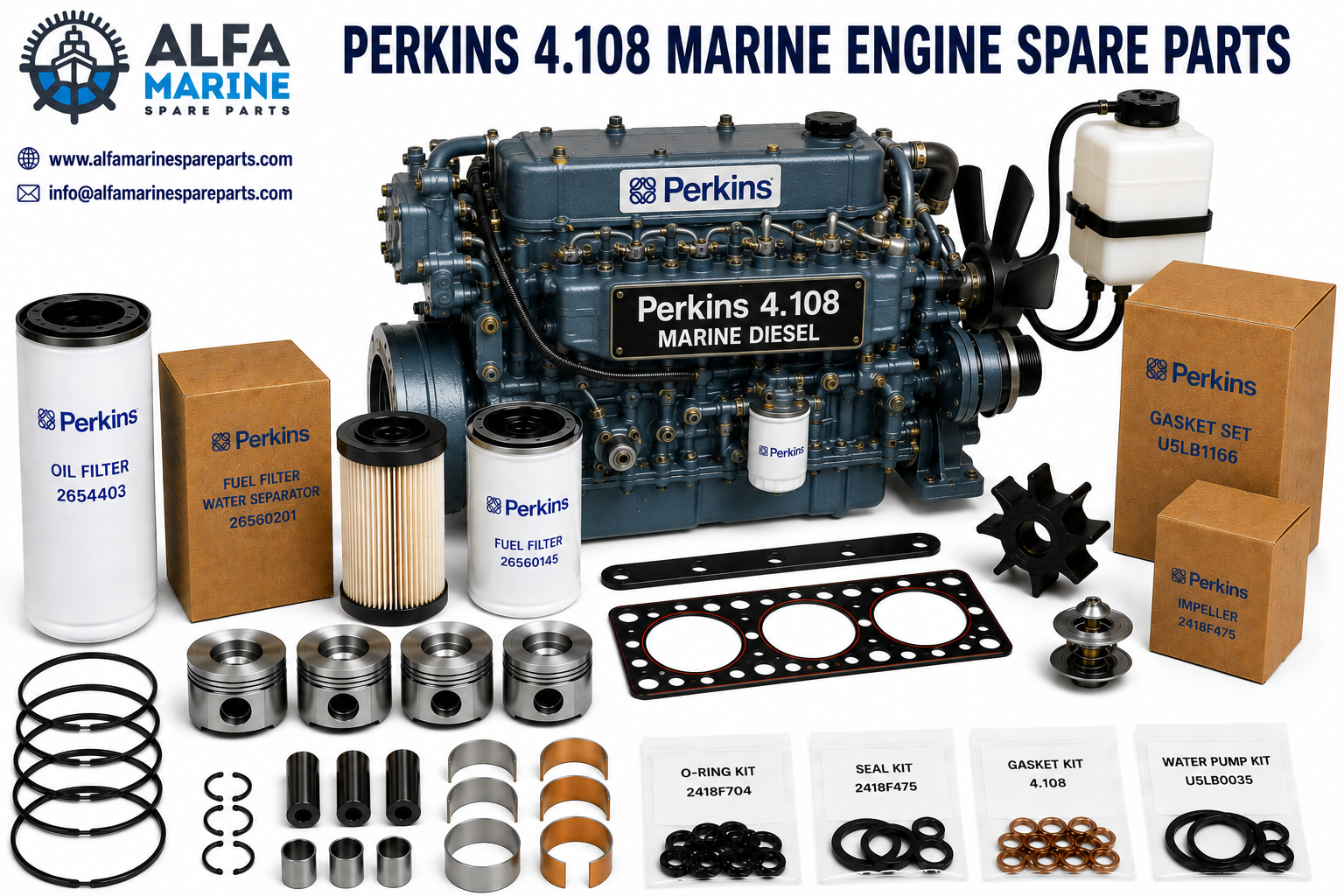
Perkins 4.108 Marine Engine Spare Parts
The Perkins 4.108 Marine Engine is one of the best-known compact Perkins diesel engines used in marine propulsion. Perkins identifies the 4.108 as a four-cylinder engine with approximately 1.8 litres displacement, and the engine family has a long history in marine applications.
The 4.108 can still be found in sailing yachts, motor yachts, fishing boats, classic vessels and older commercial craft. Because many engines have accumulated decades of service, parts requirements can range from routine filters and raw-water pump components to fuel-injection equipment, cylinder heads, pistons, bearings and complete overhaul components.
Alfa Marine Spare Parts supports Perkins 4.108 Marine Engine Spare Parts requirements for:
- Planned Maintenance
- Yacht Maintenance and Refit
- Commercial Vessel Repairs
- Engine-Room Repairs
- Fuel-System Repairs
- Cooling-System Repairs
- Cylinder Head Repairs
- Internal Engine Repairs
- Major Engine Overhauls
- Classic Vessel Restoration
- Spare Parts Planning
Depending on component and availability, supply options can include:
- Genuine Perkins Parts
- OEM-Quality Components
- Selected Aftermarket Parts
- Remanufactured Components
- Maintenance Components
- Repair Parts
- Overhaul Parts
What Are the Technical Specifications of the Perkins 4.108?
The Perkins 4.108 is an established compact four-cylinder diesel engine family. Perkins currently identifies the family as a 1.8-litre, four-cylinder engine and continues to list 4.108-series replacement components in its parts catalog.
SpecificationPerkins 4.108ManufacturerPerkinsEngine Family4.108ApplicationMarine Propulsion / Other Diesel ApplicationsConfigurationInline 4-CylinderCycleFour-Stroke DieselFuelDieselDisplacementApprox. 1.8 Litres / 108 cu inFuel SystemMechanical Diesel InjectionMarine CoolingCommonly Freshwater / Heat-Exchanger ArrangementTypical ApplicationsSailing Yachts, Motor Yachts & Small Marine Craft
Exact marine power ratings, cooling arrangements, fuel equipment and installed accessories can vary by build and vessel installation.
For this reason, the engine serial number should always be used when confirming replacement components. Perkins states that the serial number is the only reliable way to identify the exact engine specification and compatible replacement parts.
What Does Perkins 4.108 Mean?
The designation refers to two basic engine characteristics:
4 — Four cylinders.
108 — Approximately 108 cubic inches of displacement.
That corresponds to approximately 1.8 litres.
Are All Perkins 4.108 Marine Engines the Same?
No.
This is particularly important when sourcing spare parts.
Individual engines can differ according to:
- Production Period
- Engine Build
- Marine Conversion
- Cooling Arrangement
- Fuel Injection Equipment
- Raw-Water Pump
- Exhaust Arrangement
- Electrical Equipment
- Previous Repairs
- Previous Overhauls
Perkins' own parts guidance emphasizes checking the exact engine serial number rather than assuming compatibility from the model family alone.
Why Is the Perkins 4.108 Serial Number Important?
Many 4.108 engines have undergone years of maintenance, repairs and vessel modifications.
Components may have been:
- Rebuilt
- Reconditioned
- Exchanged
- Replaced
- Superseded
- Modified
- Updated
This can be particularly important when identifying:
- Fuel Injectors
- Fuel Injection Equipment
- Raw-Water Pumps
- Freshwater Pumps
- Starter Motors
- Alternators
- Electrical Components
- Cooling Components
Perkins continues to list individual 4.108-series parts, but its catalog repeatedly advises checking the exact engine serial number for compatibility.
Perkins 4.108 Routine Maintenance Parts
Common maintenance requirements can include:
- Engine Oil Filters
- Fuel Filters
- Fuel-Water Separator Elements
- Air Filter Components
- Raw-Water Pump Impellers
- Drive Belts
- Thermostats
- Gaskets
- O-Rings
- Seals
- Cooling-System Components
- Service Kits
Does an Older Perkins 4.108 Need Special Attention?
Older engines often require attention beyond basic oil and filter changes.
Important areas can include:
- Cooling-System Corrosion
- Raw-Water Pump Condition
- Heat Exchanger Condition
- Fuel-System Cleanliness
- Fuel Injection Equipment
- Lubricating-Oil Pressure
- Oil Leakage
- Coolant Leakage
- Exhaust-System Condition
- Electrical Connections
- Hoses
- Seals
- Gaskets
- Engine Mounts
Perkins also emphasizes the importance of proper lubrication and cooling-system maintenance for engine life.
Perkins 4.108 Fuel-System Parts
Potential requirements can include:
- Fuel Injectors
- Injector Nozzles
- Fuel Injection Pump
- Injection Pump Components
- Fuel Lift Pump
- Primary Fuel Filters
- Secondary Fuel Filters
- Fuel-Water Separator Components
- Injector Pipes
- Fuel Supply Pipes
- Fuel Return Components
- Fuel Connections
- Seals
- Gaskets
- O-Rings
Perkins 4.108 Fuel Injectors
Potential requirements can include:
- Complete Fuel Injectors
- Injector Nozzles
- Injector Sealing Components
- Injector Pipes
- Fuel Return Components
- Associated Hardware
What Are Possible Signs of Perkins 4.108 Injector Problems?
Possible symptoms can include:
- Difficult Starting
- Rough Running
- Uneven Cylinder Operation
- Excessive Exhaust Smoke
- Reduced Engine Power
- Increased Fuel Consumption
- Abnormal Combustion Noise
These symptoms do not automatically confirm injector failure.
Fuel quality, fuel delivery, injection-pump condition, compression and air supply should also be investigated.
Perkins 4.108 Fuel Injection Pump Parts
Potential requirements can include:
- Complete Fuel Injection Pump
- Reconditioned Fuel Injection Pump
- Injection Pump Components
- Pump Seals
- Pump Gaskets
- Fuel Connections
- Associated Fuel-System Parts
Why Should the Existing Injection Pump Be Identified?
A 4.108 that has been operating for decades may no longer have its original injection pump.
The pump may previously have been:
- Rebuilt
- Reconditioned
- Exchanged
- Replaced
- Superseded
Useful identification information can include:
- Engine Serial Number
- Pump Manufacturer
- Pump Model
- Pump Identification Number
- Existing Perkins Part Number
- Clear Photographs
Perkins 4.108 Fuel Lift Pump Parts
Potential requirements can include:
- Complete Fuel Lift Pump
- Pump Components
- Pump Gaskets
- Seals
- Fuel Connections
- Associated Fuel Lines
Can a Weak Lift Pump Cause Starting Problems?
Yes.
Insufficient fuel supply can contribute to:
- Extended Cranking
- Difficult Starting
- Unstable Idle
- Reduced Engine Power
- Engine Stalling
Fuel filters, air leaks and injection equipment should also be checked before the lift pump is automatically blamed.
Perkins 4.108 Fuel Filter Parts
Potential requirements can include:
- Primary Fuel Filters
- Secondary Fuel Filters
- Fuel Filter Elements
- Fuel-Water Separators
- Filter Housings
- Filter Seals
- O-Rings
- Drain Components
Why Is Clean Fuel Important on an Older Perkins 4.108?
Older marine fuel tanks can accumulate:
- Water
- Sediment
- Rust
- Tank Debris
- Microbial Contamination
Contaminated fuel can contribute to:
- Injector Wear
- Injection-Pump Wear
- Difficult Starting
- Poor Combustion
- Unstable Engine Operation
- Reduced Power
Perkins 4.108 Air Intake Parts
Potential requirements can include:
- Air Cleaner Components
- Air Filter Components
- Intake Hoses
- Intake Pipes
- Intake Manifold Components
- Clamps
- Gaskets
- Seals
Perkins still lists air-filter components associated with the 4.108 family in its current parts catalog.
Can Restricted Airflow Cause Black Smoke?
Yes.
Restricted airflow can contribute to:
- Black Exhaust Smoke
- Reduced Engine Power
- Poor Acceleration
- Increased Fuel Consumption
- Increased Exhaust Temperature
Fuel-injection condition and engine loading should also be considered during diagnosis.
Perkins 4.108 Raw-Water Cooling System Parts
Marine 4.108 installations commonly use a freshwater-cooled engine circuit with a seawater side for heat removal.
Potential requirements can include:
- Complete Raw-Water Pump
- Seawater Pump
- Flexible Impeller
- Pump Cover
- Pump Shaft
- Bearings
- Mechanical Seals
- Cooling Hoses
- Seawater Pipes
- Connections
- Gaskets
- O-Rings
Why Is the Perkins 4.108 Raw-Water Pump Important?
The raw-water pump maintains seawater circulation through the marine cooling system.
Reduced flow can contribute to:
- Engine Overheating
- Rising Coolant Temperature
- High Exhaust Temperature
- Reduced Heat Exchanger Performance
- Wet-Exhaust Cooling Problems
What Should Be Checked When 4.108 Seawater Flow Drops?
Areas to investigate can include:
- Seacock
- Raw-Water Intake
- Sea Strainer
- Intake Hose
- Raw-Water Pump
- Flexible Impeller
- Pump Cover
- Cooling Hoses
- Heat Exchanger
- Exhaust Cooling Circuit
- Downstream Cooling Passages
Perkins 4.108 Raw-Water Pump Impeller
The flexible impeller is an important routine-service component.
If an impeller has broken blades, fragments can potentially travel into:
- Cooling Hoses
- Pipe Connections
- Heat Exchanger Passages
- Other Cooling Components
Installing a new impeller may not completely restore seawater flow if old pieces remain trapped downstream.
Perkins 4.108 Freshwater Pump Parts
Potential requirements can include:
- Complete Freshwater Pump
- Coolant Circulation Pump
- Pump Housing
- Pump Shaft
- Bearings
- Seals
- Gaskets
- O-Rings
Perkins 4.108 Heat Exchanger Parts
Potential requirements can include:
- Complete Heat Exchanger
- Heat Exchanger Core
- Tube Bundle
- Housing
- End Covers
- End-Cap Seals
- Raw-Water Connections
- Coolant Connections
- Gaskets
- O-Rings
- Seals
What Can Restrict a Perkins 4.108 Heat Exchanger?
Possible causes can include:
- Salt Deposits
- Scale
- Marine Growth
- Sediment
- Corrosion
- Broken Impeller Pieces
- Other Debris
Cooling-system condition is especially important on older marine engines, and Perkins describes the cooling system as essential in preventing overheating and engine breakdown.
Why Can a Perkins 4.108 Overheat Under Load?
At idle, the engine produces less heat.
When propulsion load increases, the cooling system has to remove more heat. A partially restricted cooling system may therefore appear acceptable at idle but become inadequate under load.
Areas to investigate can include:
- Seacock
- Sea Strainer
- Raw-Water Intake
- Raw-Water Pump
- Impeller
- Cooling Hoses
- Heat Exchanger
- Thermostat
- Freshwater Pump
- Coolant Level
- Coolant Condition
- Exhaust Cooling Circuit
Perkins 4.108 Thermostat Parts
Potential requirements can include:
- Thermostats
- Thermostat Housing
- Thermostat Gaskets
- O-Rings
- Seals
- Associated Hardware
Perkins 4.108 Lubrication-System Parts
Potential requirements can include:
- Engine Oil Filters
- Oil Filter Elements
- Oil Pump Components
- Oil Cooler
- Oil Cooler Components
- Oil Pressure Components
- Oil Pipes
- Oil Lines
- Oil Pan Components
- Gaskets
- O-Rings
- Crankshaft Seals
What Can Low Oil Pressure Mean on a Perkins 4.108?
Possible causes can include:
- Incorrect Oil Level
- Incorrect Oil Grade
- Deteriorated Oil
- Restricted Oil Filter
- Oil Pump Wear
- Excessive Bearing Clearance
- Internal Engine Wear
- Oil Pressure Sender Problems
- Instrumentation Problems
Perkins notes that lower-quality oil can increase wear and shorten engine life, so oil quality and condition should also be considered during maintenance.
Perkins 4.108 Oil Cooler Parts
Depending on the installation, potential requirements can include:
- Complete Oil Cooler
- Oil Cooler Core
- Oil Cooler Housing
- Oil Connections
- Cooling Connections
- Gaskets
- O-Rings
- Seals
Perkins 4.108 Cylinder Head Parts
Potential requirements can include:
- Complete Cylinder Head
- Intake Valves
- Exhaust Valves
- Valve Guides
- Valve Seats
- Valve Springs
- Rocker Components
- Valve-Train Components
- Cylinder Head Gasket
- Valve Cover Gaskets
- Injector Sealing Components
When Should a Perkins 4.108 Cylinder Head Be Inspected?
Inspection may become necessary following:
- Severe Overheating
- Head-Gasket Failure
- Coolant Loss
- Low Compression
- Valve Damage
- Coolant Leakage
- Abnormal Combustion
- Major Engine Overhaul
Should an Older Perkins 4.108 Cylinder Head Automatically Be Replaced?
No.
The decision should be based on inspection and measurements.
Important areas include:
- Cracking
- Corrosion
- Flatness
- Valve Condition
- Valve-Seat Condition
- Valve-Guide Wear
- Sealing Surfaces
- Previous Machining
- Overheating Damage
A serviceable cylinder head may still be suitable for rebuilding.
Perkins 4.108 Pistons and Piston Rings
Potential requirements can include:
- Pistons
- Piston Ring Sets
- Piston Pins
- Piston Pin Bushings
- Retaining Components
What Can Worn Perkins 4.108 Piston Rings Cause?
Possible symptoms include:
- Excessive Blow-By
- Increased Oil Consumption
- Reduced Compression
- Difficult Starting
- Exhaust Smoke
- Reduced Engine Power
Piston, ring and cylinder condition should be evaluated together.
Perkins 4.108 Connecting Rod Parts
Potential requirements can include:
- Connecting Rods
- Connecting Rod Bearings
- Small-End Bushings
- Connecting Rod Bolts
- Associated Hardware
Perkins 4.108 Main and Connecting Rod Bearings
Potential requirements can include:
- Main Bearing Sets
- Connecting Rod Bearing Sets
- Big-End Bearings
- Thrust Bearings
- Thrust Washers
Why Should Bearing Size Be Checked Carefully?
An older engine may have undergone previous crankshaft machining.
The crankshaft may have been:
- Polished
- Reground
- Repaired
- Replaced
Bearings should therefore be selected based on the crankshaft's actual dimensions rather than engine model alone.
Perkins 4.108 Crankshaft Parts
Potential requirements can include:
- Complete Crankshaft
- Main Bearings
- Connecting Rod Bearings
- Thrust Components
- Crankshaft Gear Components
- Front Crankshaft Seal
- Rear Crankshaft Seal
What Should Be Checked on a Perkins 4.108 Crankshaft During Overhaul?
Inspection can include:
- Main Journal Diameter
- Connecting Rod Journal Diameter
- Journal Surface Condition
- Scoring
- Taper
- Out-of-Round Condition
- Heat Damage
- Previous Grinding
- General Crankshaft Condition
Perkins 4.108 Camshaft and Timing Parts
Potential requirements can include:
- Camshaft
- Camshaft Bearings
- Timing Gears
- Gear-Train Components
- Timing Covers
- Timing Cover Gaskets
- Valve-Train Components
Perkins 4.108 Gaskets and Seals
Potential requirements can include:
- Cylinder Head Gasket
- Valve Cover Gaskets
- Intake Gaskets
- Exhaust Gaskets
- Raw-Water Pump Gaskets
- Freshwater Pump Gaskets
- Heat Exchanger Gaskets
- Oil Cooler Gaskets
- Injector Seals
- Front Crankshaft Seal
- Rear Crankshaft Seal
- O-Rings
- Upper Gasket Sets
- Lower Gasket Sets
- Complete Engine Gasket Sets
- Engine Seal Kits
Are All Perkins 4.108 Gasket Sets the Same?
No.
The 4.108 family covers engines from different production periods and installations.
A gasket set should be matched using the exact engine serial number and build information.
Perkins 4.108 Starter Motor Parts
Potential requirements can include:
- Complete Starter Motor
- Starter Solenoid
- Relays
- Electrical Connections
- Associated Hardware
Perkins currently lists starter-motor components specifically associated with the 4.108 Series, while advising users to verify the exact engine serial number.
Does Slow Cranking Always Mean Starter Failure?
No.
Possible causes can include:
- Weak Batteries
- Corroded Battery Terminals
- Damaged Battery Cables
- Poor Ground Connections
- Excessive Electrical Resistance
- Relay Problems
- Control-Wiring Problems
Marine corrosion can create substantial electrical resistance in older installations.
Perkins 4.108 Alternator Parts
Potential requirements can include:
- Complete Alternator
- Alternator Components
- Drive Belts
- Pulleys
- Belt-Tensioning Components
- Electrical Connections
On older vessels, the currently installed alternator should be identified because charging-system components may have been changed during previous refits.
Perkins 4.108 Exhaust-System Parts
Depending on the marine installation, potential requirements can include:
- Exhaust Manifold Components
- Exhaust Elbows
- Mixing Elbows
- Exhaust Connections
- Exhaust Gaskets
- Seals
- Clamps
- Associated Hardware
Why Should an Older 4.108 Exhaust Elbow Be Inspected?
In a wet-exhaust installation, hot exhaust gases and seawater operate close together.
Internal corrosion and deposits can contribute to:
- Restricted Exhaust Flow
- Reduced Engine Power
- Increased Exhaust Temperature
- Increased Exhaust Smoke
- Poor Engine Response
The internal condition may be considerably worse than the outside appearance suggests.
Perkins 4.108 Engine Overhaul Parts
Depending on inspection findings, overhaul requirements can include:
- Pistons
- Piston Rings
- Piston Pins
- Main Bearings
- Connecting Rod Bearings
- Connecting Rods
- Small-End Bushings
- Thrust Components
- Cylinder Head Components
- Intake Valves
- Exhaust Valves
- Crankshaft Seals
- Complete Gasket Sets
- Seal Kits
- Fuel-System Components
- Cooling-System Components
- Lubrication-System Components
More extensive repairs may require:
- Complete Cylinder Head
- Crankshaft
- Camshaft Components
- Fuel Injectors
- Fuel Injection Pump
- Raw-Water Pump
- Freshwater Pump
- Heat Exchanger
- Oil Cooler
- Starter Motor
- Alternator
Is There One Standard Perkins 4.108 Overhaul Kit?
Not necessarily.
The correct overhaul package depends on:
- Exact Engine Version
- Engine Serial Number
- Engine Build Information
- Operating Hours
- Maintenance History
- Previous Overhauls
- Cylinder Measurements
- Piston Condition
- Crankshaft Dimensions
- Bearing Sizes
- Cylinder Head Condition
- Fuel-System Condition
- Cooling-System Condition
Why Should Inspection Come Before Ordering a 4.108 Overhaul Kit?
Many 4.108 engines have undergone previous internal repairs.
For example, if the crankshaft was reground during an earlier overhaul, standard-size bearings may no longer be correct.
A better process is:
Identify the engine → inspect the components → measure where necessary → order the correct parts.
What Information Should I Provide for Perkins 4.108 Parts?
For accurate Perkins 4.108 Marine Engine Spare Parts identification, provide:
- Exact Perkins 4.108 Version
- Engine Serial Number
- Engine Build Information
- Existing Perkins Part Number, if available
- Component Manufacturer Number
- Fuel Injection Pump Identification Where Relevant
- Raw-Water Pump Identification Where Relevant
- Part Description
- Quantity Required
- Clear Photographs
- Vessel Application
- Marine Gear Information Where Relevant
- Delivery Country or Nearest Port
Perkins specifically states that the engine serial number should be used to confirm the exact engine specification and compatible replacement parts.
For older 4.108 marine installations, photographs of the engine identification plate and actual component being replaced can be especially valuable.
Parts Catalogue
Perkins 4.108 Marine Engine Components and Spare Parts
The Perkins 4.108 Marine Engine has been used for many years in sailing yachts, motor yachts, fishing boats and other marine applications. Because a large number of these engines are now older installations, correct component identification is especially important when sourcing replacement parts.
Alfa Marine Spare Parts supports requirements ranging from routine service components to fuel-system, cooling-system, cylinder-head and major overhaul parts.
Perkins 4.108 Routine Maintenance Parts
Common maintenance requirements can include:
- Engine Oil Filters
- Fuel Filters
- Fuel-Water Separator Elements
- Air Cleaner Components
- Raw-Water Pump Impellers
- Drive Belts
- Thermostats
- Gaskets
- O-Rings
- Seals
- Cooling-System Components
- Service Kits
Maintenance planning should consider engine hours, age, service history and actual vessel operating conditions.
What Can Affect Perkins 4.108 Component Life?
Two Perkins 4.108 engines of similar age may have very different mechanical conditions.
Factors can include:
- Total Operating Hours
- Engine Loading
- Operating Speed
- Fuel Quality
- Lubricating Oil Condition
- Cooling-System Maintenance
- Saltwater Exposure
- Engine-Room Temperature
- Long Periods of Inactivity
- Previous Overhauls
- Previous Component Replacement
- Vessel Operating Conditions
For older engines, maintenance history can be just as important as total engine hours.
Perkins 4.108 Fuel Injection System
Potential requirements can include:
- Fuel Injectors
- Injector Nozzles
- Fuel Injection Pump
- Injection Pump Components
- Fuel Lift Pump
- Primary Fuel Filters
- Secondary Fuel Filters
- Fuel-Water Separator Components
- Injector Pipes
- Fuel Supply Components
- Fuel Return Components
- Fuel Connections
- Seals
- Gaskets
- O-Rings
Why Should Perkins 4.108 Fuel Equipment Be Identified Carefully?
An older 4.108 may no longer have every fuel-system component originally fitted to the engine.
Components may have previously been:
- Rebuilt
- Reconditioned
- Exchanged
- Replaced
- Superseded
Useful identification information includes:
- Engine Serial Number
- Engine Build Information
- Fuel Injection Pump Manufacturer
- Injection Pump Identification Number
- Existing Perkins Part Number
- Injector Identification
- Clear Photographs
Perkins 4.108 Fuel Injection Pump
The mechanical fuel injection pump is one of the key components in the 4.108 fuel system.
Potential requirements can include:
- Complete Fuel Injection Pump
- Reconditioned Fuel Injection Pump
- Injection Pump Components
- Pump Seals
- Pump Gaskets
- Fuel Connections
- Related Fuel-System Components
Why Should the Injection Pump Identification Plate Be Checked?
The pump currently fitted to an older engine may not be the original unit.
The identification plate can help establish:
- Pump Manufacturer
- Pump Type
- Pump Number
- Pump Specification
- Existing Configuration
This is particularly useful when the vessel's maintenance history is incomplete.
Perkins 4.108 Fuel Injectors
Potential requirements can include:
- Complete Fuel Injectors
- Injector Nozzles
- Injector Sealing Components
- Injector Pipes
- Fuel Return Components
- Associated Hardware
What Can Cause a Perkins 4.108 to Smoke?
Exhaust smoke can have several possible causes.
Depending on smoke colour and operating conditions, areas to investigate can include:
- Fuel Injectors
- Fuel Injection Pump
- Fuel Quality
- Restricted Air Intake
- Low Compression
- Piston Ring Wear
- Valve Condition
- Engine Temperature
- Engine Loading
- Exhaust Restriction
Replacing injectors without checking the rest of the engine may not solve the real problem.
Perkins 4.108 Fuel Lift Pump
Potential requirements can include:
- Complete Fuel Lift Pump
- Pump Components
- Pump Gaskets
- Seals
- Fuel Connections
- Associated Fuel Lines
Can a Weak Fuel Lift Pump Cause Difficult Starting?
Yes.
Insufficient fuel delivery can contribute to:
- Extended Cranking
- Difficult Starting
- Unstable Idle
- Reduced Engine Power
- Engine Stalling
However, blocked fuel filters, air leaks and injection-system problems should also be checked.
Perkins 4.108 Fuel Filter Components
Potential requirements can include:
- Primary Fuel Filters
- Secondary Fuel Filters
- Fuel Filter Elements
- Fuel-Water Separator Components
- Filter Housings
- Filter Seals
- O-Rings
- Drain Components
Why Is Clean Fuel Important on an Older Perkins 4.108?
Older marine fuel tanks can accumulate:
- Water
- Sediment
- Rust
- Tank Debris
- Microbial Contamination
Contaminated fuel can contribute to injector wear, injection-pump problems, difficult starting and unstable engine operation.
Perkins 4.108 Air Intake System
Potential requirements can include:
- Air Cleaner Components
- Air Filter Components
- Intake Hoses
- Intake Pipes
- Intake Manifold Components
- Clamps
- Gaskets
- Seals
Can Restricted Airflow Reduce 4.108 Performance?
Yes.
Restricted airflow can contribute to:
- Black Exhaust Smoke
- Reduced Engine Power
- Poor Acceleration
- Increased Fuel Consumption
- Higher Exhaust Temperature
Fuel-system condition and engine loading should also be considered.
Perkins 4.108 Raw-Water Cooling System
For marine installations using a heat exchanger and seawater circuit, potential requirements can include:
- Complete Raw-Water Pump
- Seawater Pump
- Flexible Impeller
- Pump Cover
- Pump Shaft
- Bearings
- Mechanical Seals
- Wear Components
- Cooling Hoses
- Seawater Pipes
- Gaskets
- O-Rings
Why Is Perkins 4.108 Seawater Flow Important?
The raw-water circuit helps transfer heat away from the engine's closed cooling system.
Reduced seawater flow can contribute to:
- Engine Overheating
- Rising Coolant Temperature
- High Exhaust Temperature
- Reduced Heat Exchanger Performance
- Wet-Exhaust Cooling Problems
What Should Be Checked When 4.108 Seawater Flow Is Low?
A practical inspection can include:
- Seacock
- Raw-Water Intake
- Sea Strainer
- Intake Hose
- Raw-Water Pump
- Flexible Impeller
- Pump Cover
- Cooling Hoses
- Heat Exchanger
- Exhaust Cooling Components
- Downstream Cooling Passages
This helps avoid replacing a serviceable pump when the actual restriction is elsewhere.
Perkins 4.108 Raw-Water Pump Impeller
The flexible impeller is a small component but can have a major effect on cooling performance.
If blades are missing, fragments can potentially become trapped inside:
- Cooling Hoses
- Pipe Connections
- Heat Exchanger Passages
- Other Cooling Components
A new impeller may not restore full cooling performance if pieces of the old impeller remain downstream.
Perkins 4.108 Freshwater Cooling System
Potential requirements can include:
- Freshwater Pump
- Coolant Circulation Pump
- Thermostats
- Thermostat Housing
- Coolant Pipes
- Cooling Hoses
- Temperature Components
- Gaskets
- O-Rings
- Seals
Why Should Both Perkins 4.108 Cooling Circuits Be Checked?
Marine engine cooling depends on both the raw-water and closed freshwater circuits.
Possible overheating causes can include:
- Restricted Seawater Intake
- Blocked Sea Strainer
- Damaged Impeller
- Worn Raw-Water Pump
- Restricted Heat Exchanger
- Faulty Thermostat
- Freshwater Pump Problems
- Low Coolant Level
- Deteriorated Coolant
- Restricted Cooling Hoses
The complete cooling system should therefore be investigated.
Perkins 4.108 Heat Exchanger Components
Potential requirements can include:
- Complete Heat Exchanger
- Heat Exchanger Core
- Tube Bundle
- Housing
- End Covers
- End-Cap Seals
- Raw-Water Connections
- Coolant Connections
- Gaskets
- O-Rings
- Seals
Why Is Heat Exchanger Condition Important on an Older 4.108?
Internal cooling passages can become affected by:
- Salt Deposits
- Scale
- Sediment
- Marine Growth
- Corrosion
- Broken Impeller Pieces
- Other Debris
The outside of the heat exchanger may look acceptable even while internal water flow is restricted.
Why Can a Perkins 4.108 Run Normally at Idle but Overheat Under Load?
At idle, the engine produces much less heat.
As propulsion load increases, the cooling system must remove substantially more heat. A partial restriction can therefore become noticeable only when the engine is working harder.
Areas to investigate can include:
- Raw-Water Intake
- Sea Strainer
- Raw-Water Pump
- Impeller
- Heat Exchanger
- Thermostat
- Freshwater Pump
- Cooling Hoses
- Coolant Condition
- Exhaust Cooling Circuit
Perkins 4.108 Thermostat Components
Potential requirements can include:
- Thermostats
- Thermostat Housing
- Thermostat Gaskets
- O-Rings
- Seals
- Associated Hardware
Perkins 4.108 Lubrication System
Potential requirements can include:
- Engine Oil Filters
- Oil Filter Elements
- Oil Pump Components
- Oil Cooler
- Oil Cooler Core
- Oil Pressure Components
- Oil Pipes
- Oil Lines
- Oil Pan Components
- Gaskets
- O-Rings
- Crankshaft Seals
What Can Low Oil Pressure Mean on a Perkins 4.108?
Possible causes can include:
- Incorrect Oil Level
- Incorrect Oil Grade
- Deteriorated Oil
- Restricted Oil Filter
- Oil Pump Wear
- Excessive Bearing Clearances
- Internal Engine Wear
- Oil Pressure Sender Problems
- Instrumentation Problems
Low oil pressure should therefore be investigated systematically.
Perkins 4.108 Oil Cooler Components
Depending on the exact marine installation, potential requirements can include:
- Complete Oil Cooler
- Oil Cooler Core
- Oil Cooler Housing
- Oil Connections
- Cooling Connections
- Gaskets
- O-Rings
- Seals
Perkins 4.108 Cylinder Head Components
Potential requirements can include:
- Complete Cylinder Head
- Intake Valves
- Exhaust Valves
- Valve Guides
- Valve Seats
- Valve Springs
- Rocker Components
- Valve-Train Components
- Cylinder Head Gasket
- Valve Cover Gaskets
- Injector Sealing Components
What Should Be Checked When Rebuilding a Perkins 4.108 Cylinder Head?
Inspection can include:
- Cracking
- Corrosion
- Cylinder-Head Flatness
- Valve Condition
- Valve-Seat Condition
- Valve-Guide Wear
- Valve Springs
- Sealing Surfaces
- Previous Machining
- Overheating Damage
A cylinder head should be evaluated before deciding whether rebuilding or replacement is more appropriate.
Perkins 4.108 Pistons and Piston Rings
Potential requirements can include:
- Pistons
- Piston Ring Sets
- Piston Pins
- Piston Pin Bushings
- Retaining Components
Why Should Pistons and Cylinders Be Measured During Overhaul?
An older engine may have considerable wear or previous machining.
Measurements can help establish:
- Cylinder Wear
- Bore Condition
- Piston Condition
- Piston-to-Bore Clearance
- Whether Existing Components Can Be Reused
- Which Replacement Components Are Appropriate
Simply fitting new piston rings into badly worn cylinders may not restore expected compression or oil control.
Perkins 4.108 Connecting Rod Components
Potential requirements can include:
- Connecting Rods
- Connecting Rod Bearings
- Small-End Bushings
- Connecting Rod Bolts
- Associated Hardware
Connecting rods should be inspected carefully after bearing failure, lubrication problems or major internal engine damage.
Perkins 4.108 Main Bearings
Potential requirements can include:
- Main Bearing Sets
- Thrust Bearings
- Thrust Washers
- Associated Bearing Components
Perkins 4.108 Connecting Rod Bearings
Potential requirements can include:
- Connecting Rod Bearing Sets
- Big-End Bearings
- Associated Components
Why Should Bearing Size Be Confirmed Before Ordering?
A crankshaft may have been machined during a previous overhaul.
It may have been:
- Polished
- Reground
- Repaired
- Replaced
This means the engine may no longer require standard-size bearings.
A practical approach is:
Identify the engine → inspect the crankshaft → measure the journals → select the correct bearing size.
Perkins 4.108 Crankshaft
Potential requirements can include:
- Complete Crankshaft
- Main Bearings
- Connecting Rod Bearings
- Thrust Components
- Crankshaft Gear Components
- Front Crankshaft Seal
- Rear Crankshaft Seal
What Should Be Inspected on a Perkins 4.108 Crankshaft?
During overhaul, inspection can include:
- Main Journal Diameter
- Connecting Rod Journal Diameter
- Journal Surface Condition
- Scoring
- Taper
- Out-of-Round Condition
- Heat Damage
- Previous Grinding
- General Crankshaft Condition
Perkins 4.108 Camshaft and Timing Components
Potential requirements can include:
- Camshaft
- Camshaft Bearings
- Timing Gears
- Gear-Train Components
- Timing Covers
- Timing Cover Gaskets
- Valve-Train Components
Perkins 4.108 Gasket and Seal Sets
Potential requirements can include:
- Cylinder Head Gasket
- Valve Cover Gaskets
- Intake Gaskets
- Exhaust Gaskets
- Raw-Water Pump Gaskets
- Freshwater Pump Gaskets
- Heat Exchanger Gaskets
- Oil Cooler Gaskets
- Injector Seals
- Front Crankshaft Seal
- Rear Crankshaft Seal
- O-Rings
- Upper Gasket Sets
- Lower Gasket Sets
- Complete Engine Gasket Sets
- Engine Seal Kits
Why Should a Perkins 4.108 Gasket Set Be Matched to the Exact Engine?
Different production periods and marine arrangements may use different components.
A gasket set should therefore be matched against:
- Engine Serial Number
- Engine Build Information
- Exact Engine Version
- Existing Components
Perkins 4.108 Starter Motor
Potential requirements can include:
- Complete Starter Motor
- Starter Solenoid
- Relays
- Electrical Connections
- Associated Hardware
Why Can an Older Perkins 4.108 Crank Slowly?
Possible causes can include:
- Weak Batteries
- Corroded Battery Terminals
- Damaged Battery Cables
- Poor Ground Connections
- Excessive Electrical Resistance
- Relay Problems
- Control-Circuit Problems
Marine electrical connections can develop significant resistance through corrosion.
Perkins 4.108 Alternator
Potential requirements can include:
- Complete Alternator
- Alternator Components
- Drive Belts
- Pulleys
- Belt-Tensioning Components
- Electrical Connections
On an older vessel, the currently installed alternator should be identified because charging-system components may have changed during previous refits.
Perkins 4.108 Exhaust-System Components
Depending on the installation, potential requirements can include:
- Exhaust Manifold Components
- Exhaust Elbows
- Mixing Elbows
- Exhaust Connections
- Exhaust Gaskets
- Seals
- Clamps
- Associated Hardware
Why Should a Perkins 4.108 Mixing Elbow Be Inspected?
In a wet-exhaust installation, hot exhaust gases and seawater operate close together.
Over time, internal corrosion and deposits can restrict exhaust flow.
Possible effects can include:
- Reduced Engine Performance
- Increased Exhaust Temperature
- Increased Exhaust Smoke
- Poor Engine Response
The internal condition can be significantly worse than the external appearance suggests.
Perkins 4.108 Engine Overhaul Components
Depending on inspection findings, a major overhaul can require:
- Pistons
- Piston Rings
- Piston Pins
- Main Bearings
- Connecting Rod Bearings
- Connecting Rods
- Small-End Bushings
- Thrust Components
- Cylinder Head Components
- Intake Valves
- Exhaust Valves
- Crankshaft Seals
- Complete Gasket Sets
- Seal Kits
- Fuel-System Components
- Cooling-System Components
- Lubrication-System Components
More extensive repairs may require:
- Complete Cylinder Head
- Crankshaft
- Camshaft Components
- Fuel Injectors
- Fuel Injection Pump
- Raw-Water Pump
- Freshwater Pump
- Heat Exchanger
- Oil Cooler
- Starter Motor
- Alternator
Why Should a Perkins 4.108 Overhaul Begin With Inspection?
Many 4.108 engines have long and sometimes incomplete maintenance histories.
Before ordering a major overhaul package, technicians should establish:
- Exact Engine Version
- Engine Serial Number
- Cylinder Condition
- Piston Condition
- Crankshaft Dimensions
- Bearing Sizes
- Connecting Rod Condition
- Cylinder Head Condition
- Fuel-System Condition
- Cooling-System Condition
This reduces the risk of ordering incorrect components.
Genuine Perkins 4.108 Marine Engine Parts
Depending on availability, genuine components may be available for selected maintenance and repair requirements.
Because the 4.108 is an established older engine family, genuine availability may differ from one component category to another.
OEM-Quality Perkins 4.108 Parts
Where the original equipment manufacturer and technical specification can be established, OEM-quality sourcing may be possible for selected:
- Fuel-System Components
- Pumps
- Bearings
- Filters
- Cooling Components
- Starter Motors
- Alternators
- Other Engine Components
Aftermarket Perkins 4.108 Parts
Selected aftermarket parts can remain important for supporting older 4.108 engines.
Depending on specification and availability, these may include:
- Filters
- Gaskets
- Seals
- Bearings
- Pistons
- Piston Rings
- Cooling-System Components
- Maintenance Components
- Selected Internal Engine Parts
Compatibility should always be confirmed before installation.
Remanufactured Perkins 4.108 Components
Depending on availability, professionally remanufactured options may include:
- Fuel Injectors
- Fuel Injection Pumps
- Cylinder Heads
- Starter Motors
- Alternators
- Selected Pumps
- Other Rebuildable Assemblies
Perkins 4.108 Parts for Sailing Yachts and Motor Yachts
The long history of the 4.108 means it can still be found in:
- Sailing Yachts
- Motor Yachts
- Cruising Boats
- Classic Yachts
- Yacht Refit Projects
- Vessel Restoration Projects
- Repowered Older Vessels
Perkins 4.108 Parts for Commercial Marine Applications
The engine can also be encountered in:
- Fishing Boats
- Workboats
- Utility Craft
- Service Boats
- Coastal Craft
- Older Commercial Vessels
Who Do We Supply?
Alfa Marine Spare Parts supports Perkins 4.108 Marine Engine Spare Parts requirements for:
- Shipyards
- Ship Repairers
- Marine Engineers
- Chief Engineers
- Technical Superintendents
- Fleet Operators
- Marine Service Companies
- Commercial Fishing Companies
- Offshore Operators
- Government Fleets
- Maritime Contractors
- Boat Builders
- Marine Equipment Distributors
- Marinas
- Yacht Service Companies
- Yacht Owners
- Commercial Vessel Operators
Worldwide Perkins 4.108 Marine Spare Parts Supply
Alfa Marine Spare Parts supports requirements across international marine markets, including:
- Spain
- Italy
- Monaco
- France
- Netherlands
- Belgium
- Germany
- Greece
- United Kingdom
- Miami and Florida
- Texas
- Toronto and Canada
- Dubai and UAE
- Nigeria
- Caribbean
- South America
- Other Major International Seaports
What Information Helps Identify the Correct Perkins 4.108 Part?
For accurate parts identification, provide:
- Exact Perkins 4.108 Version
- Engine Serial Number
- Engine Build Information
- Existing Perkins Part Number
- Component Manufacturer Number
- Fuel Injection Pump Identification Where Relevant
- Raw-Water Pump Identification Where Relevant
- Part Description
- Quantity Required
- Clear Photographs
- Vessel Application
- Marine Gear Information Where Relevant
- Delivery Destination
For older 4.108 engines, photographs showing identification plates, casting numbers, component markings, mounting arrangements and connections can significantly improve parts identification.
Browse Perkins and Other Marine Engine Brands
Browse Alfa Marine Spare Parts Engine Brands
Browse Marine Engine Spare Parts
Browse Catalogue
Why Choose Alfa Marine Spare Parts for Perkins 4.108 Marine Engine Spare Parts?
The Perkins 4.108 Marine Engine remains in service in sailing yachts, motor yachts, fishing boats, classic vessels and older commercial craft around the world. Because many of these engines have been operating for decades, accurate identification is especially important when sourcing replacement components.
Alfa Marine Spare Parts supports Perkins 4.108 Marine Engine Spare Parts requirements for:
- Planned Maintenance
- Yacht Refits
- Commercial Vessel Repairs
- Engine-Room Repairs
- Fuel-System Repairs
- Cooling-System Repairs
- Cylinder Head Repairs
- Internal Engine Repairs
- Major Engine Overhauls
- Restoration Projects
- Spare Parts Planning
Depending on availability, requirements can be supported with genuine, OEM-quality, selected aftermarket and remanufactured components.
Supporting Older Perkins 4.108 Marine Engines
The Perkins 4.108 has a long service history, and many individual engines have undergone repeated maintenance, repairs or major overhaul work.
Components may previously have been:
- Rebuilt
- Reconditioned
- Exchanged
- Replaced
- Superseded
- Modified
- Updated
This can be particularly relevant for:
- Fuel Injectors
- Fuel Injection Pumps
- Raw-Water Pumps
- Freshwater Pumps
- Heat Exchangers
- Oil Coolers
- Starter Motors
- Alternators
- Electrical Components
- Internal Engine Parts
For this reason, the exact engine version, serial number and identification from the currently installed component should all be considered when sourcing parts.
Why Should the Existing Perkins 4.108 Component Be Identified?
Ordering only by the Perkins 4.108 model designation may not always provide enough information.
Useful identification can include:
- Exact Engine Version
- Engine Serial Number
- Engine Build Information
- Existing Perkins Part Number
- Component Manufacturer
- Manufacturer Part Number
- Casting Number
- Identification Plate
- Clear Photographs
This becomes particularly important when an older vessel has incomplete maintenance records.
Perkins 4.108 Planned Maintenance Parts
Common maintenance requirements can include:
- Engine Oil Filters
- Fuel Filters
- Fuel-Water Separator Elements
- Air Cleaner Components
- Raw-Water Pump Impellers
- Drive Belts
- Thermostats
- Gaskets
- O-Rings
- Seals
- Cooling-System Components
- Service Kits
Why Does Vessel Duty Matter for Perkins 4.108 Maintenance?
Engine age alone does not determine condition.
Two 4.108 engines of similar age can have very different mechanical conditions depending on:
- Total Operating Hours
- Engine Loading
- Operating Speed
- Fuel Quality
- Lubricating Oil Condition
- Cooling-System Maintenance
- Saltwater Exposure
- Engine-Room Temperature
- Long Periods of Inactivity
- Previous Overhauls
- Vessel Operating Conditions
A well-maintained older engine can sometimes remain in better condition than a lower-hour engine that has suffered from poor cooling or lubrication.
Perkins 4.108 Fuel-System Support
Potential requirements can include:
- Fuel Injectors
- Injector Nozzles
- Fuel Injection Pump
- Injection Pump Components
- Fuel Lift Pump
- Primary Fuel Filters
- Secondary Fuel Filters
- Fuel-Water Separator Components
- Injector Pipes
- Fuel Supply Components
- Fuel Return Components
- Fuel Connections
- Seals
- Gaskets
- O-Rings
Why Should Perkins 4.108 Fuel Equipment Be Checked Carefully?
Fuel-system components are among the parts most likely to have been rebuilt, exchanged or replaced during the engine's service life.
They may have been:
- Rebuilt
- Reconditioned
- Exchanged
- Replaced
- Superseded
When requesting fuel-system components, provide the engine serial number together with identification from the currently fitted injector or injection pump whenever possible.
Perkins 4.108 Fuel Injection Pump Support
Potential requirements can include:
- Complete Fuel Injection Pump
- Reconditioned Fuel Injection Pump
- Injection Pump Components
- Pump Seals
- Pump Gaskets
- Fuel Connections
- Related Fuel-System Components
Why Is the Fuel Injection Pump Identification Plate Important?
The fuel injection pump currently installed on an older 4.108 may not be the original unit.
The identification plate can help establish:
- Pump Manufacturer
- Pump Type
- Pump Number
- Pump Specification
- Current Configuration
This can be more reliable than selecting the pump from engine model alone.
Perkins 4.108 Raw-Water Pump Support
Potential requirements can include:
- Complete Raw-Water Pump
- Seawater Pump
- Flexible Impeller
- Pump Cover
- Pump Shaft
- Bearings
- Mechanical Seals
- Wear Components
- Gaskets
- O-Rings
Why Is Raw-Water Pump Condition Important?
The raw-water pump maintains seawater circulation through the marine cooling circuit.
Reduced flow can contribute to:
- Engine Overheating
- Rising Coolant Temperature
- High Exhaust Temperature
- Reduced Heat Exchanger Performance
- Wet-Exhaust Cooling Problems
However, poor seawater flow does not automatically confirm raw-water pump failure.
The complete seawater circuit should be inspected.
What Should Be Checked After a Perkins 4.108 Impeller Failure?
If blades are missing from a damaged impeller, those fragments can potentially travel downstream into:
- Cooling Hoses
- Pipe Connections
- Heat Exchanger Passages
- Other Cooling Components
A new impeller may restore pump operation while old fragments continue restricting the cooling system.
Perkins 4.108 Heat Exchanger Support
Depending on the marine installation, potential requirements can include:
- Complete Heat Exchanger
- Heat Exchanger Core
- Tube Bundle
- Housing
- End Covers
- End-Cap Seals
- Raw-Water Connections
- Coolant Connections
- Gaskets
- O-Rings
- Seals
Why Can a Perkins 4.108 Overheat Under Load?
At idle, the engine produces considerably less heat than it does under propulsion load.
A partially restricted cooling system may therefore appear satisfactory at idle but become inadequate when engine load increases.
Areas to investigate can include:
- Seacock
- Sea Strainer
- Raw-Water Intake
- Raw-Water Pump
- Flexible Impeller
- Cooling Hoses
- Heat Exchanger
- Thermostat
- Freshwater Pump
- Coolant Level
- Coolant Condition
- Exhaust Cooling Circuit
Perkins 4.108 Freshwater Cooling Support
Potential requirements can include:
- Freshwater Pump
- Coolant Circulation Pump
- Thermostats
- Thermostat Housing
- Coolant Pipes
- Cooling Hoses
- Temperature Components
- Gaskets
- O-Rings
- Seals
Both the raw-water and freshwater sides should be considered when diagnosing overheating.
Perkins 4.108 Cylinder Head Support
Potential requirements can include:
- Complete Cylinder Head
- Intake Valves
- Exhaust Valves
- Valve Guides
- Valve Seats
- Valve Springs
- Rocker Components
- Valve-Train Components
- Cylinder Head Gasket
- Valve Cover Gaskets
- Injector Sealing Components
Rebuild or Replace a Perkins 4.108 Cylinder Head?
The decision should be based on inspection and measurements.
Important areas include:
- Cracking
- Corrosion
- Flatness
- Valve Condition
- Valve-Seat Condition
- Valve-Guide Wear
- Sealing Surfaces
- Previous Machining
- Overheating Damage
A serviceable cylinder head may still be suitable for rebuilding even on an older engine.
Perkins 4.108 Internal Engine Parts
Potential requirements can include:
- Pistons
- Piston Rings
- Piston Pins
- Piston Pin Bushings
- Connecting Rods
- Connecting Rod Bearings
- Main Bearings
- Thrust Components
- Crankshaft
- Camshaft Components
- Timing Components
- Crankshaft Seals
- Internal Gaskets
Perkins 4.108 Piston and Ring Support
Piston, ring and cylinder condition can influence:
- Compression
- Blow-By
- Oil Consumption
- Starting Performance
- Exhaust Smoke
- Combustion Quality
- Engine Power
These areas should be evaluated together during internal inspection.
Why Is Measurement Important on an Older Perkins 4.108?
Previous overhaul work may have changed the engine from its original dimensions.
For example:
- Cylinders may have measurable wear
- Pistons may have been replaced
- Crankshaft journals may have been reground
- Cylinder-head surfaces may have been machined
- Bearings may no longer be standard size
This is why measurement is an important part of overhaul planning.
Perkins 4.108 Crankshaft and Bearing Support
Potential requirements can include:
- Complete Crankshaft
- Main Bearings
- Connecting Rod Bearings
- Big-End Bearings
- Thrust Bearings
- Thrust Washers
- Front Crankshaft Seal
- Rear Crankshaft Seal
- Crankshaft Gear Components
Why Should the Perkins 4.108 Crankshaft Be Measured Before Ordering Bearings?
An older crankshaft may previously have been:
- Polished
- Reground
- Repaired
- Replaced
Bearing selection should therefore be based on the actual crankshaft journal dimensions.
Ordering standard-size bearings simply because the engine is a 4.108 can result in incorrect parts if previous machining has taken place.
Perkins 4.108 Lubrication-System Support
Potential requirements can include:
- Engine Oil Filters
- Oil Filter Elements
- Oil Pump Components
- Oil Cooler
- Oil Cooler Core
- Oil Pressure Components
- Oil Pipes
- Oil Lines
- Oil Pan Components
- Gaskets
- O-Rings
- Seals
Why Should Low Oil Pressure Be Taken Seriously?
Low oil pressure can be associated with:
- Incorrect Oil Level
- Incorrect Oil Grade
- Deteriorated Oil
- Restricted Oil Filter
- Oil Pump Wear
- Excessive Bearing Clearance
- Internal Engine Wear
- Oil Pressure Sender Problems
- Instrumentation Problems
Because the lubrication system protects several major components simultaneously, the cause should be properly investigated.
Perkins 4.108 Exhaust-System Support
Depending on the marine installation, potential requirements can include:
- Exhaust Manifold Components
- Exhaust Elbows
- Mixing Elbows
- Exhaust Connections
- Exhaust Gaskets
- Seals
- Clamps
- Associated Hardware
Why Should an Older Perkins 4.108 Mixing Elbow Be Inspected?
In a wet-exhaust arrangement, seawater and hot exhaust gases operate close together.
Internal corrosion and deposits can contribute to:
- Restricted Exhaust Flow
- Reduced Engine Power
- Increased Exhaust Temperature
- Excessive Exhaust Smoke
- Poor Engine Response
The inside of the exhaust elbow can be in significantly worse condition than its external appearance suggests.
Perkins 4.108 Electrical Support
Depending on the vessel installation, potential requirements can include:
- Starter Motor
- Starter Solenoid
- Alternator
- Temperature Senders
- Oil Pressure Senders
- Switches
- Relays
- Wiring Components
- Electrical Connectors
- Alarm Components
- Shutdown Components
Older vessels deserve particular attention because starters, alternators, instruments and wiring may have been changed during previous refits.
Perkins 4.108 Engine Overhaul Support
Depending on engine condition and inspection findings, overhaul requirements can include:
- Pistons
- Piston Rings
- Piston Pins
- Main Bearings
- Connecting Rod Bearings
- Connecting Rods
- Small-End Bushings
- Thrust Components
- Cylinder Head Components
- Intake Valves
- Exhaust Valves
- Crankshaft Seals
- Complete Gasket Sets
- Seal Kits
- Fuel-System Components
- Cooling-System Components
- Lubrication-System Components
More extensive repairs may require:
- Complete Cylinder Head
- Crankshaft
- Camshaft Components
- Fuel Injectors
- Fuel Injection Pump
- Raw-Water Pump
- Freshwater Pump
- Heat Exchanger
- Oil Cooler
- Starter Motor
- Alternator
Why Should a Perkins 4.108 Overhaul Package Be Built Around Inspection?
Not every 4.108 reaches overhaul for the same reason.
Possible situations include:
- Normal Mechanical Wear
- Overheating
- Lubrication Problems
- Cooling-System Restrictions
- Fuel-System Problems
- Excessive Blow-By
- Low Compression
- Previous Internal Damage
Before finalizing an overhaul package, consider:
- Exact Engine Version
- Engine Serial Number
- Engine Build Information
- Operating Hours
- Previous Overhauls
- Cylinder Measurements
- Piston Condition
- Crankshaft Dimensions
- Bearing Sizes
- Cylinder Head Condition
- Fuel-System Condition
- Cooling-System Condition
Genuine Perkins 4.108 Marine Engine Parts
Depending on availability, genuine components may be available for selected maintenance and repair requirements.
Because the 4.108 is an established older engine family, availability can vary significantly from one component category to another.
OEM-Quality Perkins 4.108 Parts
Where the original component manufacturer and correct technical specification can be established, OEM-quality sourcing may be possible for selected:
- Fuel Injection Equipment
- Pumps
- Bearings
- Filters
- Cooling Components
- Starter Motors
- Alternators
- Other Engine Components
Aftermarket Perkins 4.108 Parts
Selected aftermarket components can play an important role in supporting older 4.108 engines.
Depending on specification and availability, requirements can include:
- Filters
- Gaskets
- Seals
- Bearings
- Pistons
- Piston Rings
- Cooling-System Components
- Maintenance Components
- Selected Internal Engine Parts
Compatibility should always be confirmed against the exact engine configuration.
Remanufactured Perkins 4.108 Components
Depending on availability, professionally remanufactured options may include:
- Fuel Injectors
- Fuel Injection Pumps
- Cylinder Heads
- Starter Motors
- Alternators
- Selected Pumps
- Other Rebuildable Assemblies
Perkins 4.108 Parts for Older and Classic Vessels
The long service history of the Perkins 4.108 means these engines can still be found in:
- Sailing Yachts
- Motor Yachts
- Fishing Boats
- Workboats
- Utility Craft
- Classic Boats
- Yacht Refit Projects
- Vessel Restoration Projects
- Repowered Older Vessels
Who Do We Supply?
Alfa Marine Spare Parts supports Perkins 4.108 Marine Engine Spare Parts requirements for:
- Shipyards
- Ship Repairers
- Marine Engineers
- Chief Engineers
- Technical Superintendents
- Fleet Operators
- Marine Service Companies
- Commercial Fishing Companies
- Offshore Operators
- Government Fleets
- Maritime Contractors
- Boat Builders
- Marine Equipment Distributors
- Marinas
- Yacht Service Companies
- Yacht Owners
- Commercial Vessel Operators
Worldwide Perkins 4.108 Marine Engine Spare Parts Supply
Alfa Marine Spare Parts supports Perkins 4.108 parts requirements across major marine markets, including:
- Spain
- Italy
- Monaco
- France
- Netherlands
- Belgium
- Germany
- Greece
- United Kingdom
- Miami and Florida
- Texas
- Toronto and Canada
- Dubai and UAE
- Nigeria
- Caribbean
- South America
- Other Major International Seaports
Why Choose Alfa Marine Spare Parts?
For Perkins 4.108 Marine Engine Spare Parts, accurate component identification is particularly important because of the long production and service history of the engine family.
When requesting components, provide:
- Exact Engine Version
- Engine Serial Number
- Engine Build Information
- Existing Perkins Part Number
- Component Manufacturer Number
- Fuel Injection Pump Identification Where Relevant
- Raw-Water Pump Identification Where Relevant
- Part Description
- Quantity Required
- Clear Photographs
- Vessel Application
- Marine Gear Information Where Relevant
- Delivery Destination
This information can help identify requirements ranging from filters, gaskets and impellers through to injection pumps, cylinder heads, crankshafts and complete overhaul components.
Other Perkins Marine Engine Types
Other Perkins marine engines and related families include:
- Perkins 6.354 Marine Engine
- Perkins 4.236 Marine Engine
- Perkins 4.154 Marine Engine
- Perkins M300C Marine Engine
- Perkins M250C Marine Engine
- Perkins M245C Marine Engine
- Perkins M225Ti Marine Engine
- Perkins M215C Marine Engine
- Perkins M200C Marine Engine
- Perkins M185C Marine Engine
- Perkins M175C Marine Engine
- Perkins M150Ti Marine Engine
- Perkins M130C Marine Engine
- Perkins M115T Marine Engine
- Perkins M92B Marine Engine
- Perkins M85T Marine Engine
- Perkins M65 Marine Engine
The exact Perkins 4.108 version, engine serial number, build information and currently installed component identification should always be confirmed before ordering, because parts are not automatically interchangeable across every 4.108 configuration.
FAQS
Frequently Asked Questions About Perkins 4.108 Marine Engine Spare PartsWhat is the Perkins 4.108 Marine Engine?
The Perkins 4.108 is a compact four-cylinder diesel engine that became widely used in marine propulsion, particularly in sailing yachts, motor yachts, fishing boats and smaller commercial craft.
With approximately 1.8 litres (108 cubic inches) displacement, the engine became well known for its relatively simple mechanical construction and serviceability.
Many Perkins 4.108 engines remain operational, making replacement parts, overhaul components and correct parts identification important for owners and marine engineers maintaining these older installations.
What does Perkins 4.108 mean?
The designation describes two basic engine characteristics:
4 — Four cylinders.
108 — Approximately 108 cubic inches of displacement.
This corresponds to approximately 1.8 litres.
Are all Perkins 4.108 marine engines the same?
No.
Differences can exist according to:
- Production Period
- Engine Build
- Marine Conversion
- Cooling Arrangement
- Fuel Injection Equipment
- Raw-Water Pump
- Exhaust Arrangement
- Electrical Equipment
- Previous Repairs
- Previous Overhauls
- Vessel Modifications
This is why the model designation alone should not always be used to identify replacement parts.
Why is the Perkins 4.108 engine serial number important?
The serial number helps identify the original engine specification.
This becomes particularly important with older engines because components may have been:
- Rebuilt
- Reconditioned
- Exchanged
- Replaced
- Superseded
- Modified
Whenever possible, provide both the engine serial number and identification from the currently installed component.
Can you supply Perkins 4.108 fuel injectors?
Depending on availability, requirements can include:
- Complete Fuel Injectors
- Injector Nozzles
- Injector Seals
- Injector Pipes
- Fuel Return Components
- Associated Hardware
What are possible signs of Perkins 4.108 injector problems?
Possible symptoms include:
- Difficult Starting
- Rough Running
- Uneven Cylinder Operation
- Excessive Exhaust Smoke
- Reduced Engine Power
- Increased Fuel Consumption
- Abnormal Combustion Noise
These symptoms do not automatically confirm injector failure.
Fuel quality, fuel delivery, injection-pump condition, compression and airflow should also be considered.
Can you supply a Perkins 4.108 fuel injection pump?
Depending on the exact engine configuration and availability, requirements can include:
- Complete Fuel Injection Pump
- Reconditioned Fuel Injection Pump
- Injection Pump Components
- Pump Seals
- Pump Gaskets
- Fuel Connections
- Related Fuel-System Components
Why should I provide the injection pump number?
The injection pump fitted to an older 4.108 may not be the unit originally installed on the engine.
It may previously have been:
- Rebuilt
- Reconditioned
- Exchanged
- Replaced
- Superseded
Useful information includes the pump manufacturer, type, identification number and clear photographs of its identification plate.
Can you supply a Perkins 4.108 fuel lift pump?
Depending on availability, potential requirements can include:
- Complete Fuel Lift Pump
- Pump Components
- Pump Gaskets
- Seals
- Fuel Connections
- Associated Fuel Lines
Can a weak fuel lift pump cause starting problems?
Yes.
Insufficient fuel delivery can contribute to:
- Difficult Starting
- Extended Cranking
- Unstable Idle
- Reduced Engine Power
- Engine Stalling
However, blocked filters, air entering the fuel system and injection-equipment problems can produce similar symptoms.
Can you supply Perkins 4.108 fuel filters?
Depending on configuration, potential requirements can include:
- Primary Fuel Filters
- Secondary Fuel Filters
- Fuel Filter Elements
- Fuel-Water Separator Components
- Filter Housings
- Filter Seals
- O-Rings
- Drain Components
Why is clean fuel particularly important on an older 4.108?
Older vessel fuel tanks can accumulate:
- Water
- Sediment
- Rust
- Tank Debris
- Microbial Contamination
Contaminated fuel can contribute to injector wear, injection-pump problems, poor combustion and unreliable engine operation.
Can you supply Perkins 4.108 raw-water pumps?
Depending on the marine installation and availability, requirements can include:
- Complete Raw-Water Pump
- Seawater Pump
- Flexible Impeller
- Pump Shaft
- Bearings
- Mechanical Seals
- Pump Cover
- Wear Components
- Gaskets
- O-Rings
Can you supply a Perkins 4.108 raw-water pump impeller?
Depending on the exact pump installed, replacement impellers and related service components may be available.
For identification, provide:
- Engine Serial Number
- Raw-Water Pump Manufacturer
- Pump Number
- Existing Impeller Number
- Manufacturer Markings
- Clear Photographs
What happens when the Perkins 4.108 impeller fails?
A damaged flexible impeller can reduce seawater circulation and contribute to:
- Engine Overheating
- Rising Coolant Temperature
- High Exhaust Temperature
- Reduced Heat Exchanger Performance
- Wet-Exhaust Cooling Problems
Where can broken impeller blades go?
Fragments can potentially become trapped in:
- Cooling Hoses
- Pipe Connections
- Heat Exchanger Passages
- Exhaust Cooling Components
- Other Downstream Cooling Passages
This is why simply installing a new impeller may not completely solve an overheating problem.
Can you supply a Perkins 4.108 freshwater pump?
Depending on availability, potential requirements can include:
- Complete Freshwater Pump
- Coolant Circulation Pump
- Pump Housing
- Pump Shaft
- Bearings
- Seals
- Gaskets
- O-Rings
Can you supply Perkins 4.108 heat exchanger parts?
Depending on the marine installation, requirements can include:
- Complete Heat Exchanger
- Heat Exchanger Core
- Tube Bundle
- Housing
- End Covers
- End-Cap Seals
- Raw-Water Connections
- Coolant Connections
- Gaskets
- O-Rings
- Seals
What can restrict a Perkins 4.108 heat exchanger?
Possible causes include:
- Salt Deposits
- Scale
- Marine Growth
- Sediment
- Internal Corrosion
- Broken Impeller Pieces
- Other Debris
An older heat exchanger can look relatively good externally while its internal passages are restricted.
Why does my Perkins 4.108 overheat under load but not at idle?
At idle, the engine produces less heat.
Under propulsion load, the cooling system must remove considerably more heat. A partial restriction may therefore be sufficient for idle operation but inadequate under load.
Areas to investigate include:
- Seacock
- Sea Strainer
- Raw-Water Intake
- Raw-Water Pump
- Flexible Impeller
- Cooling Hoses
- Heat Exchanger
- Thermostat
- Freshwater Pump
- Coolant Level
- Coolant Condition
- Exhaust Cooling Circuit
Can you supply Perkins 4.108 thermostats?
Depending on availability, requirements can include:
- Thermostats
- Thermostat Housing Components
- Thermostat Gaskets
- O-Rings
- Seals
- Associated Hardware
Can you supply Perkins 4.108 oil filters?
Depending on configuration, potential requirements can include:
- Engine Oil Filters
- Oil Filter Elements
- Filter Housing Components
- Filter Seals
- O-Rings
Can you supply Perkins 4.108 oil cooler parts?
Depending on the marine installation, potential requirements can include:
- Complete Oil Cooler
- Oil Cooler Core
- Oil Cooler Housing
- Oil Connections
- Cooling Connections
- Gaskets
- O-Rings
- Seals
What can cause low oil pressure on a Perkins 4.108?
Possible causes can include:
- Incorrect Oil Level
- Incorrect Oil Grade
- Deteriorated Lubricating Oil
- Restricted Oil Filter
- Oil Pump Wear
- Excessive Bearing Clearance
- Internal Engine Wear
- Oil Pressure Sender Problems
- Instrumentation Problems
Low oil pressure should be properly diagnosed rather than immediately assuming a major internal failure.
Can you supply a Perkins 4.108 cylinder head?
Depending on availability, potential requirements can include:
- Complete Cylinder Head
- Intake Valves
- Exhaust Valves
- Valve Guides
- Valve Seats
- Valve Springs
- Rocker Components
- Valve-Train Components
- Cylinder Head Gasket
- Valve Cover Gaskets
- Injector Sealing Components
Should a Perkins 4.108 cylinder head be rebuilt or replaced?
The decision should be based on its actual condition.
Inspection can include:
- Cracking
- Corrosion
- Flatness
- Valve Condition
- Valve-Seat Condition
- Valve-Guide Wear
- Sealing Surfaces
- Previous Machining
- Overheating Damage
An older cylinder head does not automatically need replacement if it remains within acceptable repair limits.
Can you supply Perkins 4.108 pistons and piston rings?
Depending on availability, requirements can include:
- Pistons
- Piston Ring Sets
- Piston Pins
- Piston Pin Bushings
- Retaining Components
What are possible signs of worn Perkins 4.108 piston rings?
Possible symptoms can include:
- Excessive Blow-By
- Increased Oil Consumption
- Reduced Compression
- Difficult Starting
- Exhaust Smoke
- Reduced Engine Power
These symptoms can also involve cylinder, piston or valve condition.
Can I install new piston rings without replacing the pistons?
Possibly, but the decision should be based on inspection and measurements.
Before ordering parts, consider:
- Cylinder Wear
- Bore Condition
- Piston Condition
- Piston Ring Grooves
- Piston-to-Bore Clearance
- Existing Ring Condition
Installing new rings into excessively worn cylinders may not restore proper compression or oil control.
Can you supply Perkins 4.108 connecting rods?
Depending on availability, potential requirements can include:
- Connecting Rods
- Connecting Rod Bearings
- Small-End Bushings
- Connecting Rod Bolts
- Associated Hardware
Can you supply Perkins 4.108 main bearings?
Depending on engine configuration and crankshaft condition, potential requirements can include:
- Main Bearing Sets
- Thrust Bearings
- Thrust Washers
- Associated Bearing Components
Can you supply Perkins 4.108 connecting rod bearings?
Potential requirements can include:
- Connecting Rod Bearing Sets
- Big-End Bearings
- Associated Components
Why should bearing size be checked carefully on an older Perkins 4.108?
A crankshaft may have been reground during an earlier overhaul.
This means the engine may no longer use standard-size bearings.
A safer process is:
Identify the engine → inspect the crankshaft → measure the journals → determine the correct bearing requirement.
Can you supply a Perkins 4.108 crankshaft?
Depending on availability, requirements can include:
- Complete Crankshaft
- Main Bearings
- Connecting Rod Bearings
- Thrust Components
- Crankshaft Gear Components
- Front Crankshaft Seal
- Rear Crankshaft Seal
What should be checked on the crankshaft during overhaul?
Inspection can include:
- Main Journal Diameter
- Connecting Rod Journal Diameter
- Journal Surface Condition
- Scoring
- Taper
- Out-of-Round Condition
- Heat Damage
- Previous Grinding
- General Crankshaft Condition
Can you supply Perkins 4.108 camshaft and timing components?
Depending on availability, potential requirements can include:
- Camshaft
- Camshaft Bearings
- Timing Gears
- Gear-Train Components
- Timing Covers
- Timing Cover Gaskets
- Valve-Train Components
Can you supply Perkins 4.108 gaskets and seals?
Potential requirements can include:
- Cylinder Head Gasket
- Valve Cover Gaskets
- Intake Gaskets
- Exhaust Gaskets
- Raw-Water Pump Gaskets
- Freshwater Pump Gaskets
- Heat Exchanger Gaskets
- Oil Cooler Gaskets
- Injector Seals
- Front Crankshaft Seal
- Rear Crankshaft Seal
- O-Rings
- Upper Gasket Sets
- Lower Gasket Sets
- Complete Engine Gasket Sets
- Engine Seal Kits
Are all Perkins 4.108 gasket sets identical?
No.
Different production periods and marine configurations can require different components.
The exact engine version, serial number and build information should therefore be checked when identifying a gasket set.
Can you supply a Perkins 4.108 starter motor?
Depending on availability, potential requirements can include:
- Complete Starter Motor
- Starter Solenoid
- Relays
- Electrical Connections
- Associated Hardware
Why does my Perkins 4.108 crank slowly?
Possible causes include:
- Weak Batteries
- Corroded Battery Terminals
- Damaged Battery Cables
- Poor Ground Connections
- Excessive Electrical Resistance
- Starter Motor Wear
- Solenoid Problems
- Relay Problems
- Control-Wiring Problems
On older boats, electrical connections and cables should be checked before automatically replacing the starter motor.
Can you supply a Perkins 4.108 alternator?
Depending on availability, requirements can include:
- Complete Alternator
- Alternator Components
- Drive Belts
- Pulleys
- Belt-Tensioning Components
- Electrical Connections
The currently installed alternator should be identified because older vessels may have undergone charging-system upgrades or modifications.
Can you supply Perkins 4.108 exhaust components?
Depending on the marine installation, potential requirements can include:
- Exhaust Manifold Components
- Exhaust Elbows
- Mixing Elbows
- Exhaust Connections
- Exhaust Gaskets
- Seals
- Clamps
- Associated Hardware
Why should a Perkins 4.108 mixing elbow be inspected?
Internal corrosion and deposits can gradually restrict the exhaust passage.
Possible effects can include:
- Reduced Engine Performance
- Increased Exhaust Temperature
- Excessive Exhaust Smoke
- Poor Engine Response
A mixing elbow can appear serviceable externally while being heavily restricted internally.
Can you supply Perkins 4.108 overhaul parts?
Depending on inspection findings, overhaul requirements can include:
- Pistons
- Piston Rings
- Piston Pins
- Main Bearings
- Connecting Rod Bearings
- Connecting Rods
- Small-End Bushings
- Thrust Components
- Cylinder Head Components
- Intake Valves
- Exhaust Valves
- Crankshaft Seals
- Gasket Sets
- Seal Kits
- Fuel-System Components
- Cooling-System Components
- Lubrication-System Components
More extensive repairs may require a cylinder head, crankshaft, camshaft components, fuel injection pump, injectors, raw-water pump, freshwater pump, heat exchanger, oil cooler, starter motor or alternator.
Is there one standard Perkins 4.108 overhaul kit?
Not necessarily.
The correct overhaul package can depend on:
- Exact Engine Version
- Engine Serial Number
- Engine Build Information
- Operating Hours
- Previous Overhauls
- Cylinder Measurements
- Piston Condition
- Crankshaft Dimensions
- Bearing Sizes
- Cylinder Head Condition
- Fuel-System Condition
- Cooling-System Condition
Why should I inspect the engine before ordering an overhaul kit?
Because an older engine may no longer be completely in its original configuration.
For example, a crankshaft that was previously reground may require different bearings.
Similarly, previous repairs can affect:
- Pistons
- Bearings
- Cylinder Head Components
- Gaskets
- Fuel Equipment
- Cooling Components
For a Perkins 4.108, a practical approach is:
Identify first → inspect → measure where necessary → order.
Do you supply genuine Perkins 4.108 parts?
Depending on availability, Alfa Marine Spare Parts can support requirements for:
- Genuine Perkins Parts
- OEM-Quality Components
- Selected Aftermarket Parts
- Remanufactured Components
Because the 4.108 is an older engine family, availability can vary considerably between component categories.
Are aftermarket Perkins 4.108 parts available?
Selected aftermarket alternatives may be available for categories including:
- Filters
- Gaskets
- Seals
- Bearings
- Pistons
- Piston Rings
- Cooling-System Components
- Maintenance Components
- Selected Internal Engine Parts
Compatibility should always be confirmed against the exact engine configuration.
Are remanufactured Perkins 4.108 components available?
Depending on availability, professionally remanufactured options may include:
- Fuel Injectors
- Fuel Injection Pumps
- Cylinder Heads
- Starter Motors
- Alternators
- Selected Pumps
- Other Rebuildable Assemblies
Can you supply parts for very old Perkins 4.108 engines?
Potentially, yes.
Older engines can require additional research because:
- Original Part Numbers May Have Been Superseded
- Some Genuine Components May Have Limited Availability
- Installed Components May Have Changed
- Selected Aftermarket Alternatives May Be Available
- Remanufactured Components May Be Suitable for Certain Requirements
Accurate identification becomes increasingly important as an engine gets older.
Can I request Perkins 4.108 parts without knowing the part number?
Yes.
If you do not have the original part number, provide as much information as possible:
- Exact Perkins 4.108 Version
- Engine Serial Number
- Engine Build Information
- Part Description
- Quantity Required
- Numbers or Markings on the Existing Component
- Clear Photographs
For pumps, fuel equipment and electrical components, photographs of identification plates can be particularly useful.
Why are photographs useful for Perkins 4.108 parts identification?
The 4.108 has been used in vessels for many years, and individual engines may contain components installed during later repairs or refits.
Useful photographs include:
- Engine Identification Plate
- Complete Existing Component
- Component Identification Plate
- Perkins Part Number
- Manufacturer Part Number
- Casting Numbers
- Fuel Injection Pump Plate
- Raw-Water Pump Markings
- Mounting Arrangement
- Hose Connections
- Electrical Connections
Can you help with Perkins 4.108 parts for a yacht refit?
Yes.
Potential requirements for an older yacht refit can include:
- Complete Service Parts Package
- Fuel-System Components
- Cooling-System Components
- Raw-Water Pump Parts
- Heat Exchanger Components
- Exhaust Components
- Starter Motor
- Alternator
- Engine Mounting Components
- Gaskets and Seals
- Cylinder Head Components
- Internal Engine Parts
Where a vessel has been inactive for an extended period, condition should be assessed rather than assuming components remain serviceable because the engine has accumulated few recent hours.
What information should I send for a Perkins 4.108 parts quotation?
For accurate identification and quotation, provide:
- Exact Perkins 4.108 Engine Version
- Engine Serial Number
- Engine Build Information
- Existing Perkins Part Number, if available
- Component Manufacturer Number
- Fuel Injection Pump Identification Where Relevant
- Raw-Water Pump Identification Where Relevant
- Part Description
- Quantity Required
- Clear Photographs
- Marine Gear Information Where Relevant
- Vessel Application
- Delivery Country or Nearest Port
Contact & Request Information
For Perkins 4.108 Marine Engine Spare Parts, send your request to:
request@alfamarinespareparts.com
Requests can cover individual maintenance parts through complete repair and overhaul requirements, including filters, fuel injectors, injection pumps, fuel lift pumps, raw-water pumps, impellers, freshwater pumps, heat exchangers, thermostats, oil coolers, cylinder heads, valves, pistons, piston rings, connecting rods, main bearings, big-end bearings, crankshafts, camshaft components, starter motors, alternators, gaskets, seals and overhaul components.
For urgent vessel requirements, include the exact Perkins 4.108 version, engine serial number, existing part number where available, quantity required, clear photographs and delivery country or nearest port.
Alfa Marine Spare Parts supports Perkins 4.108 Marine Engine Spare Parts requirements worldwide for shipyards, ship repairers, marine engineers, chief engineers, technical superintendents, fleet operators, marine service companies, commercial fishing companies, offshore operators, government fleets, maritime contractors, boat builders, marine equipment distributors, yacht service companies, classic-vessel restoration projects and commercial vessel operators.