
Mitsubishi S16U Marine Engine Spare Parts
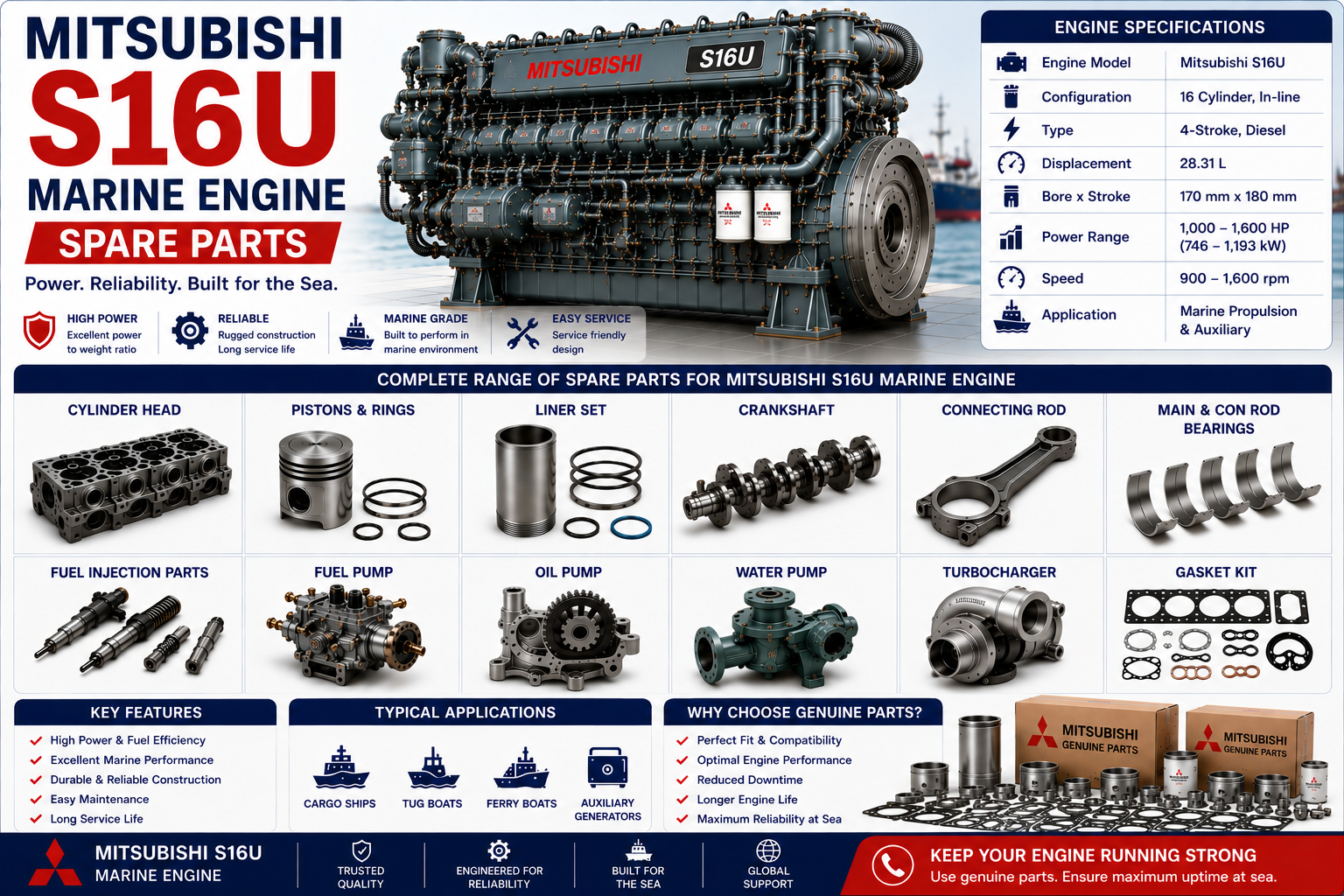
Mitsubishi S16U Marine Engine Spare Parts
Mitsubishi S16U Marine Engine Spare Parts
The Mitsubishi S16U marine engine belongs to Mitsubishi’s large SU-series medium-speed diesel engine family and is designed for demanding commercial marine propulsion and power-generation applications.
Compared with smaller Mitsubishi high-speed engines, the S16U is a substantially larger engine built for long operating hours, high loads and heavy-duty vessel service.
For spare-parts identification, however, simply requesting:
“Mitsubishi S16U parts”
is usually only the beginning.
An S16U may have been operating for many years and could already have undergone:
- Fuel Injector Replacement
- Individual Injection Pump Repairs
- Turbocharger Repairs
- Charge-Air Cooler Repairs
- Freshwater Pump Replacement
- Seawater Cooling Repairs
- Heat Exchanger Work
- Oil Cooler Repairs
- Cylinder Head Reconditioning
- Piston and Ring Replacement
- Main Bearing Replacement
- Connecting Rod Bearing Replacement
- Crankshaft Repair
- Starting-System Repairs
- Charging-System Repairs
- Partial Overhaul
- Complete Engine Rebuild
That history matters because the component currently installed may not always be the same component originally fitted when the engine was new.
Alfa Marine Spare Parts supports Mitsubishi S16U Marine Engine Spare Parts requirements for maintenance, repair and complete overhaul work.
Depending on availability, supply options can include genuine parts, OEM-quality components, selected aftermarket alternatives and professionally rebuilt or remanufactured components.
What Is the Mitsubishi S16U Marine Engine?
The Mitsubishi S16U is a large 16-cylinder V-type, four-stroke, turbocharged medium-speed diesel engine belonging to Mitsubishi’s heavy-duty SU-series platform.
From an engine-room perspective, the S16U can be divided into several major systems:
- Fuel Injection System
- Turbocharger System
- Charge-Air Cooling System
- Freshwater Cooling System
- Seawater Cooling System
- Lubrication System
- Air Intake System
- Exhaust System
- Cylinder Heads and Valve Train
- Pistons and Connecting Rods
- Crankshaft and Bearings
- Starting System
- Charging and Electrical System
These systems work together.
That is why one symptom does not always identify one failed part.
For example:
Black smoke does not automatically mean the turbocharger has failed.
Difficult starting does not automatically mean all sixteen injectors need replacement.
Low power does not automatically mean the injection pumps are worn.
Higher coolant temperature does not automatically mean the seawater pump has failed.
Correct diagnosis should come before expensive component replacement.
Mitsubishi S16U Technical Information
The S16U belongs to Mitsubishi’s heavy-duty SU marine engine family.
Typical characteristics include:
Technical InformationMitsubishi S16UEngine FamilySU SeriesEngine TypeFour-Stroke DieselCylinder ArrangementV16Number of Cylinders16Engine CategoryMedium-Speed Heavy-Duty DieselAspirationTurbochargedCoolingWater CooledCombustionDirect InjectionTypical ApplicationMarine Propulsion / Power Generation
The exact bore, stroke, displacement, rated power, operating speed, turbocharger arrangement and cooling configuration should be confirmed against the complete S16U model designation and Engine Serial Number.
This is particularly important when ordering major internal or configuration-sensitive components.
What Makes the Mitsubishi S16U Different From the Mitsubishi S16R?
Although both are Mitsubishi V16 diesel engines, the S16U and S16R belong to different engine families.
The S16U belongs to the larger medium-speed SU series, while the S16R belongs to Mitsubishi’s high-speed heavy-duty R-series family.
That difference affects components such as:
- Pistons
- Piston Rings
- Cylinder Components
- Connecting Rods
- Main Bearings
- Connecting Rod Bearings
- Crankshaft
- Cylinder Heads
- Fuel Injection Equipment
- Turbocharger Equipment
- Cooling-System Components
- Gasket Sets
Never order components based only on:
“Mitsubishi V16 marine engine.”
Confirm whether the engine is:
S16U
or:
S16R / S16R2
before final parts identification.
Why Is Correct Mitsubishi S16U Parts Identification Important?
The S16U contains large and relatively expensive engine components.
An identification mistake can result in:
- Wrong Parts
- Vessel Downtime
- Repair Delays
- Additional Freight Charges
- Unnecessary Dismantling
- Difficult Returns
- Incorrect Overhaul Work
- Repeated Repairs
For accurate parts identification, provide:
- Complete Mitsubishi S16U Model
- Engine Serial Number
- Engine Rating
- Engine Identification Plate
- Existing Part Number
- Component Manufacturer Number Where Available
- Casting Number Where Applicable
- Clear Photographs
- Quantity Required
- Vessel Application
- Delivery Country or Port
For pumps, turbochargers, coolers and other auxiliary equipment, identification from the component currently installed can be particularly useful.
Mitsubishi S16U Fuel-System Parts
Potential requirements can include:
- Fuel Injectors
- Injector Nozzles
- Individual Injection Pump Components
- Fuel Supply Pumps
- Fuel Transfer Components
- Fuel Filters
- Fuel-Water Separator Elements
- Fuel Pipes
- Fuel Connections
- Injector Seals
- Pump Seals
- O-Rings
- Gaskets
Mitsubishi S16U Fuel Injectors
Fuel injectors directly influence:
- Starting
- Combustion
- Cylinder Balance
- Exhaust Temperature
- Engine Power
- Fuel Consumption
- Exhaust Smoke
Potential requirements can include:
- Complete Fuel Injectors
- Injector Nozzles
- Injector Sealing Components
- Injector Hardware
- Related Fuel Components
What Are Possible Signs of an S16U Injector Problem?
Possible symptoms can include:
- Difficult Starting
- Uneven Cylinder Performance
- Increased Exhaust Smoke
- Abnormal Combustion Noise
- Reduced Engine Power
- Increased Fuel Consumption
- Different Exhaust Temperature on One Cylinder
These symptoms do not automatically confirm injector failure.
Similar symptoms can result from:
- Individual Injection Pump Problems
- Restricted Fuel Supply
- Compression Loss
- Intake Valve Problems
- Exhaust Valve Problems
- Air-System Restrictions
Diagnosis should come before replacement.
One S16U Cylinder Is Running Differently — Should All 16 Injectors Be Replaced?
Not automatically.
If one cylinder behaves differently from the other fifteen, investigate that cylinder first.
Check:
- Injector Condition
- Individual Injection Pump Condition
- Fuel Delivery
- Compression
- Intake Valve Condition
- Exhaust Valve Condition
- Piston Condition
- Piston Ring Condition
- Cylinder Condition
Replacing sixteen injectors will not correct a compression or valve problem.
Why Is Cylinder Exhaust Temperature Useful on the S16U?
On a sixteen-cylinder medium-speed engine, cylinder-to-cylinder comparison can provide valuable information.
Suppose fifteen cylinders show similar exhaust temperatures but one cylinder is noticeably different.
Possible causes can include:
- Injector Problem
- Injection Pump Problem
- Incorrect Fuel Delivery
- Compression Loss
- Valve Leakage
- Piston or Ring Problems
The temperature difference does not automatically identify the failed component.
Instead, it tells the engineer:
“Investigate this cylinder first.”
Mitsubishi S16U Individual Injection Pump Parts
Potential requirements can include:
- Individual Injection Pump Components
- Pump Delivery Components
- Fuel Supply Pump Components
- Fuel Transfer Components
- Pump Seals
- Fuel Connections
- Fuel Pipes
- Gaskets
- O-Rings
Why Should Fuel Supply Be Checked Before Removing S16U Injection Components?
Imagine the engine:
Starts normally.
Runs smoothly at light load.
Then begins losing rpm once vessel load increases.
The injection system may immediately be suspected.
However, possible causes can also include:
- Restricted Fuel Filters
- Restricted Fuel Pipes
- Poor Fuel Supply
- Air Entering the Fuel Circuit
- Fuel Transfer Problems
At light load, enough fuel may still reach the engine.
At higher load, the restriction becomes much more obvious.
Basic fuel-supply checks should therefore come first.
Mitsubishi S16U Turbocharger Parts
Potential requirements can include:
- Complete Turbochargers
- Turbocharger Cartridges
- Compressor Components
- Turbine Components
- Bearings
- Seals
- Oil Supply Components
- Oil Drain Components
- Intake Connections
- Exhaust Connections
- Turbocharger Gaskets
- Mounting Hardware
The Mitsubishi S16U Is Losing Power — Are the Turbochargers Bad?
Possibly, but not automatically.
Reduced engine power can also result from:
- Restricted Air Intake
- Charge-Air Leakage
- Charge-Air Cooler Fouling
- Restricted Fuel Filters
- Injector Problems
- Injection Pump Problems
- Exhaust Leakage
- Exhaust Restriction
- Low Compression
- Excessive Propeller Load
The turbocharging system should be evaluated together with the complete air and fuel systems.
What Are Possible Signs of S16U Turbocharger Problems?
Possible symptoms can include:
- Reduced Boost
- Reduced Engine Power
- Poor Load Response
- Black Exhaust Smoke
- Abnormal Turbocharger Noise
- Oil Leakage
- Increased Oil Consumption
- Higher Exhaust Temperature
One symptom by itself is not enough to confirm turbocharger failure.
Why Should the Cause of S16U Turbocharger Failure Be Investigated?
Sometimes the turbocharger is the damaged component but not the original cause.
Before installing a replacement, investigate:
- Lubricating-Oil Supply
- Turbocharger Oil Drain
- Engine Oil Condition
- Air Intake Restriction
- Foreign-Object Damage
- Exhaust Restriction
- Excessive Exhaust Temperature
If the root cause remains, the replacement turbocharger may suffer the same damage.
Mitsubishi S16U Charge-Air Cooler Parts
Potential requirements can include:
- Complete Charge-Air Coolers
- Cooler Cores
- Housing Components
- Air Connections
- Cooling Connections
- Pipes
- Gaskets
- O-Rings
- Seals
Can an S16U Charge-Air Problem Cause Black Smoke?
Yes.
If less air reaches the cylinders than expected, combustion can deteriorate.
Possible symptoms can include:
- Black Smoke
- Reduced Power
- Poor Load Response
- Higher Exhaust Temperature
- Higher Charge-Air Temperature
Possible causes can include:
- Charge-Air Cooler Fouling
- Air Leakage
- Damaged Connections
- Intake Restriction
- Turbocharger Problems
The complete air path should be inspected.
Mitsubishi S16U Freshwater Cooling Parts
Potential requirements can include:
- Freshwater Pumps
- Pump Components
- Thermostats
- Thermostat Housing Components
- Cooling Pipes
- Cooling Connections
- Heat Exchanger Components
- Gaskets
- O-Rings
- Seals
Why Can the Mitsubishi S16U Run Hot Under Load?
An engine may operate normally at light load and begin running hotter once output increases.
Possible causes can include:
- Reduced Coolant Circulation
- Freshwater Pump Problems
- Thermostat Problems
- Heat Exchanger Fouling
- Reduced Seawater Flow
- Charge-Air Cooler Restriction
- Oil Cooler Restriction
- Cooling-Pipe Restrictions
At higher output, significantly more heat must be removed.
A partially restricted cooling system may therefore reveal itself only during sustained vessel operation.
Mitsubishi S16U Marine Seawater Cooling Parts
Depending on vessel installation, potential requirements can include:
- Seawater Pumps
- Pump Components
- Seawater Pipes
- Cooling Connections
- Heat Exchanger Components
- Oil Cooler Components
- Charge-Air Cooler Components
- Gaskets
- O-Rings
- Seals
Are All Mitsubishi S16U Seawater Pumps the Same?
They should not be assumed to be.
The installed arrangement may depend on:
- Exact S16U Configuration
- Engine Serial Number
- Vessel Builder
- Cooling-System Design
- Previous Pump Replacement
- Previous Vessel Modification
When requesting a seawater pump, provide:
- Complete Engine Model
- Engine Serial Number
- Pump Manufacturer
- Pump Model
- Existing Pump Number
- Mounting Arrangement
- Pipe Connections
- Clear Photographs
What If S16U Seawater Flow Starts to Drop?
Possible causes can include:
- Restricted Sea Strainers
- Blocked Seawater Intake
- Worn Pump Components
- Air Entering the Raw-Water Circuit
- Restricted Pipework
- Heat Exchanger Restriction
- Oil Cooler Restriction
- Charge-Air Cooler Restriction
Reduced seawater flow may first become obvious when the engine is heavily loaded.
Mitsubishi S16U Heat Exchanger Parts
Depending on vessel installation, potential requirements can include:
- Complete Heat Exchangers
- Heat Exchanger Cores
- Tube Bundles
- Housing Components
- End Covers
- Cooling Connections
- Gaskets
- O-Rings
- Seals
What Can Reduce S16U Heat Exchanger Performance?
Marine cooling equipment can gradually accumulate:
- Salt Deposits
- Scale
- Sediment
- Marine Growth
- Corrosion Products
- Other Debris
A heat exchanger does not need to become completely blocked before engine temperature begins changing.
A partially restricted exchanger may still perform adequately at light load.
Under sustained higher output, however, its reduced capacity can become much more noticeable.
Mitsubishi S16U Oil Cooler Parts
Potential requirements can include:
- Complete Oil Coolers
- Oil Cooler Cores
- Oil Cooler Housings
- Oil Connections
- Cooling Connections
- Gaskets
- O-Rings
- Seals
Why Is the S16U Oil Cooler Important?
Lubricating oil is not only there to reduce friction.
It also removes heat from internal engine components.
Reduced oil-cooler efficiency can contribute to:
- Higher Oil Temperature
- Faster Oil Deterioration
- Reduced Lubrication Protection
- Wider Cooling-System Problems
Oil temperature trends should therefore be monitored.
Mitsubishi S16U Lubrication-System Parts
Potential requirements can include:
- Engine Oil Pumps
- Oil Pump Components
- Engine Oil Filters
- Oil Cooler Components
- Pressure-Regulating Components
- Oil Pipes
- Gaskets
- O-Rings
- Crankshaft Seals
Does Low S16U Oil Pressure Mean the Oil Pump Has Failed?
Not automatically.
Possible causes can include:
- Low Oil Level
- Incorrect Oil
- Deteriorated Oil
- Fuel Dilution
- Restricted Filters
- Oil Pump Wear
- Pressure-Regulating Problems
- Increased Bearing Clearance
- Crankshaft Wear
- Incorrect Pressure Indication
Actual oil pressure should be confirmed before major parts are replaced.
Why Is Hot Oil Pressure Important on an Older S16U?
An engine can show strong pressure when the lubricating oil is cold.
Once everything reaches normal operating temperature, increased internal clearances can become more noticeable.
Possible wear areas include:
- Main Bearings
- Connecting Rod Bearings
- Crankshaft Journals
- Oil Pump Components
A gradual reduction in hot oil pressure deserves investigation.
Mitsubishi S16U Cylinder Head Parts
Potential requirements can include:
- Complete Cylinder Heads
- Cylinder Head Components
- Cylinder Head Gaskets
- Intake Valves
- Exhaust Valves
- Valve Guides
- Valve Seats
- Valve Springs
- Rocker Components
- Valve-Train Components
- Related Sealing Components
What Should Be Inspected During S16U Cylinder Head Repair?
Important areas can include:
- Cracking
- Corrosion
- Sealing Surfaces
- Flatness
- Intake Valve Condition
- Exhaust Valve Condition
- Valve Seats
- Valve Guides
- Injector Seating Areas
- Cooling Passages
- Heat Damage
- Evidence of Previous Repair
Inspection and measurement should determine whether the cylinder head can be:
- Reused
- Reconditioned
- Repaired
- Replaced
Why Can a Replacement S16U Head Gasket Fail Again?
The gasket may be the damaged component without being the original cause.
Possible underlying conditions can include:
- Engine Overheating
- Cylinder Head Distortion
- Damaged Sealing Surfaces
- Cooling-System Problems
- Incorrect Previous Assembly
- Mechanical Damage
Replacing only the gasket can leave the original problem unresolved.
Mitsubishi S16U Internal Engine Parts
Potential requirements can include:
- Pistons
- Piston Ring Sets
- Piston Pins
- Connecting Rods
- Connecting Rod Bearings
- Main Bearings
- Thrust Components
- Crankshaft
- Camshaft Components
- Valve-Train Components
- Bushings
- Gaskets
- Oil Seals
Does Excessive S16U Blow-By Mean It Only Needs New Rings?
Not necessarily.
Possible causes can include:
- Piston Ring Wear
- Cylinder Wear
- Piston Wear
- Ring-Groove Wear
- Internal Engine Damage
New piston rings cannot compensate for excessive cylinder or piston wear.
Inspect and measure first.
Mitsubishi S16U Crankshaft and Bearing Parts
Potential requirements can include:
- Crankshaft
- Main Bearings
- Connecting Rod Bearings
- Thrust Components
- Crankshaft Gear Components
- Crankshaft Seals
Why Should the S16U Crankshaft Be Measured Before Ordering Bearings?
A long-serving S16U may already have undergone previous overhaul work.
The crankshaft may have been:
- Polished
- Repaired
- Machined
- Replaced
Before final bearing selection, inspect:
- Main Journal Diameter
- Connecting Rod Journal Diameter
- Surface Condition
- Scoring
- Taper
- Out-of-Round Condition
- Evidence of Previous Repair
The practical rule remains:
Measure first. Select bearings second.
Mitsubishi S16U Starting-System Parts
Depending on the vessel installation, potential requirements can include:
- Starting Equipment
- Starter Motors Where Applicable
- Starter Controls
- Solenoids
- Electrical Connections
- Associated Starting Components
Mitsubishi S16U Charging and Electrical Parts
Potential requirements can include:
- Alternators
- Charging Components
- Senders
- Switches
- Sensors
- Electrical Connections
- Wiring Components
- Related Hardware
Mitsubishi S16U Gaskets and Seals
Potential requirements can include:
- Complete Engine Gasket Sets
- Partial Gasket Sets
- Cylinder Head Gaskets
- Valve Cover Gaskets
- Intake Gaskets
- Exhaust Gaskets
- Turbocharger Gaskets
- Charge-Air Cooler Gaskets
- Heat Exchanger Gaskets
- Oil Cooler Gaskets
- Pump Gaskets
- Injector Seals
- Fuel-System O-Rings
- Cooling-System O-Rings
- Crankshaft Seals
Why Should the S16U Gasket Package Match the Exact Engine?
Differences in configuration can affect:
- Fuel Equipment
- Turbocharger Arrangement
- Cooling Components
- Pump Arrangements
- Marine Accessories
- Engine Rating
Do not assume that every gasket set marked simply S16U contains everything required for a particular engine.
Mitsubishi S16U Overhaul Parts
A major overhaul can require:
- Pistons
- Piston Rings
- Piston Pins
- Main Bearings
- Connecting Rod Bearings
- Connecting Rods
- Thrust Components
- Cylinder Head Components
- Intake Valves
- Exhaust Valves
- Valve Guides
- Valve Seats
- Crankshaft Seals
- Engine Gaskets
- Fuel Injectors
- Individual Injection Pump Components
- Turbocharger Components
- Cooling-System Components
- Lubrication-System Components
After dismantling and inspection, additional requirements may include:
- Crankshaft
- Camshaft Components
- Complete Turbochargers
- Charge-Air Coolers
- Freshwater Pumps
- Seawater Pumps
- Heat Exchangers
- Oil Pumps
- Oil Coolers
- Starting-System Components
- Charging Components
Should I Order a Complete Mitsubishi S16U Overhaul Package Before Opening the Engine?
Some planned maintenance components can be prepared in advance.
For major internal repair, the final parts requirement should ideally follow dismantling and measurement.
Once the engine is opened, determine:
What condition are the cylinders in?
Can the pistons be reused?
What condition is the crankshaft in?
Which bearing dimensions are actually required?
Can the cylinder heads be reconditioned?
Are the connecting rods serviceable?
Has previous machining changed any critical dimensions?
A practical overhaul sequence is:
Identify → Diagnose → Disassemble → Clean → Inspect → Measure → Confirm Parts → Rebuild
Genuine Mitsubishi S16U Parts
Depending on availability, genuine components can be supplied for selected maintenance, repair and overhaul requirements.
OEM-Quality Mitsubishi S16U Parts
Depending on the component and availability, OEM-quality alternatives may be available for selected:
- Fuel-System Components
- Injection Components
- Turbocharger Components
- Pumps
- Bearings
- Filters
- Cooling Components
- Internal Engine Parts
Aftermarket Mitsubishi S16U Parts
Depending on component and availability, selected aftermarket alternatives may be available for:
- Filters
- Gaskets
- Seals
- Bearings
- Selected Piston Components
- Cooling-System Components
- Maintenance Parts
- Selected Overhaul Components
Compatibility should always be confirmed against the exact engine configuration.
Remanufactured Mitsubishi S16U Components
Depending on availability, professionally rebuilt or remanufactured options may be available for selected:
- Fuel Injectors
- Injection Components
- Turbochargers
- Cylinder Heads
- Pumps
- Starting Components
- Other Rebuildable Components
What Information Should I Send for Mitsubishi S16U Parts?
For accurate Mitsubishi S16U Marine Engine Spare Parts identification, provide:
- Complete Mitsubishi S16U Model
- Engine Serial Number
- Engine Rating
- Engine Identification Plate
- Existing Part Number
- Component Manufacturer Number Where Applicable
- Part Description
- Quantity Required
- Clear Photographs
- Vessel Application
- Delivery Country or Port
For pumps, turbochargers, heat exchangers and other major auxiliary equipment, identification from the component currently installed is especially useful.
Who Do We Supply?
Alfa Marine Spare Parts supports Mitsubishi S16U Marine Engine Spare Parts requirements for:
- Shipyards
- Ship Repairers
- Marine Engineers
- Chief Engineers
- Technical Superintendents
- Fleet Operators
- Marine Service Companies
- Commercial Fishing Companies
- Offshore Operators
- Tugboat Operators
- Government Fleets
- Maritime Contractors
- Marine Equipment Distributors
- Commercial Vessel Operators
Worldwide Mitsubishi S16U Marine Engine Parts Supply
Alfa Marine Spare Parts supports Mitsubishi S16U requirements across major marine markets, including Spain, Italy, Monaco, France, the Netherlands, Belgium, Germany, Greece, the United Kingdom, Dubai and the UAE, Nigeria, Miami and Florida, Texas, Toronto and Canada, the Caribbean, Central America, South America and other major international ports.
Whether the requirement involves fuel injectors, individual injection-pump components, turbocharger parts, cooling-system components, cylinder-head parts, crankshaft bearings or a complete Mitsubishi S16U overhaul parts package, accurate identification should always come first.
Complete Spare Parts & Component Guide
Mitsubishi S16U Components, Maintenance and Repair Parts
The Mitsubishi S16U marine engine is a large V16 medium-speed diesel engine designed for demanding marine propulsion and power-generation work.
On an engine of this size, maintenance should go beyond routine filter changes.
The most useful information often comes from noticing what has changed.
Maybe the engine is slower to pick up load.
Maybe one cylinder is showing a different exhaust temperature.
Maybe black smoke appears only when vessel demand increases.
Maybe coolant temperature gradually rises during long periods of operation.
Maybe hot oil pressure is lower than it used to be.
These changes can provide early warning of a developing problem.
A practical approach is:
Observe → Diagnose → Inspect → Measure → Confirm → Repair
That is especially important on the S16U because the fuel, air, cooling, lubrication and internal engine systems all influence one another.
Mitsubishi S16U Routine Maintenance Parts
Depending on the exact engine configuration and vessel installation, routine maintenance requirements can include:
- Engine Oil Filters
- Fuel Filters
- Fuel-Water Separator Elements
- Air Intake Components
- Drive Components
- Thermostats
- Gaskets
- O-Rings
- Oil Seals
- Cooling-System Components
- Fuel-System Components
- Lubrication-System Components
- Seawater Cooling Components
- Electrical Components
Routine maintenance is also a good opportunity to compare the current engine condition with previous operation.
What Should Be Checked During Routine S16U Maintenance?
Ask:
Does the engine start as quickly as before?
Are all cylinder exhaust temperatures reasonably balanced?
Has exhaust smoke changed?
Does the engine still accept load normally?
Has fuel consumption increased?
Has lubricating-oil consumption changed?
Is coolant level remaining stable?
Does coolant temperature rise more quickly under load?
Is hot oil pressure lower than before?
Has crankcase blow-by increased?
Are there new fuel, oil or coolant leaks?
Small changes can be more useful than waiting for an alarm or complete failure.
Mitsubishi S16U Fuel-System Maintenance
The fuel system directly influences:
- Starting
- Combustion
- Engine Power
- Exhaust Smoke
- Fuel Consumption
- Cylinder Balance
- Exhaust Temperature
Potential requirements can include:
- Fuel Injectors
- Injector Nozzles
- Individual Injection Pump Components
- Fuel Supply Pumps
- Fuel Transfer Components
- Fuel Filters
- Fuel-Water Separator Elements
- Fuel Pipes
- Fuel Connections
- Injector Seals
- Pump Seals
- O-Rings
- Gaskets
The Mitsubishi S16U Is Hard to Start — Where Should You Begin?
Do not immediately assume all sixteen injectors need replacement.
Start with the complete starting, fuel and compression systems.
Possible causes can include:
- Weak Starting Batteries
- Slow Cranking Speed
- Poor Electrical Connections
- Restricted Fuel Filters
- Air Entering the Fuel System
- Low Fuel Supply
- Individual Injection Pump Problems
- Injector Problems
- Low Compression
- Valve Problems
If the engine turns unusually slowly, the starting system should be investigated first.
If cranking speed appears normal but combustion takes too long to begin, fuel delivery and compression become more relevant.
Why Is Clean Fuel Important on the Mitsubishi S16U?
Fuel contamination can damage precision injection equipment.
Possible contaminants include:
- Water
- Dirt
- Rust
- Tank Sediment
- Foreign Material
This can contribute to:
- Injector Nozzle Wear
- Injection Pump Wear
- Restricted Fuel Filters
- Difficult Starting
- Poor Fuel Atomization
- Uneven Combustion
- Increased Smoke
- Reduced Engine Power
Replacing a damaged fuel component without correcting the contamination source can allow the same problem to return.
Mitsubishi S16U Fuel Injector Maintenance
Potential requirements can include:
- Complete Fuel Injectors
- Injector Nozzles
- Injector Seals
- Injector Hardware
- Related Fuel-System Components
What Can Happen When an S16U Injector Nozzle Wears?
A worn or contaminated injector nozzle can affect how fuel enters the combustion chamber.
Possible symptoms can include:
- Rough Running
- Difficult Starting
- Increased Smoke
- Uneven Cylinder Performance
- Higher Fuel Consumption
- Abnormal Combustion Noise
- Higher or Lower Exhaust Temperature on One Cylinder
- Reduced Power
Similar symptoms can also result from compression loss or injection-pump problems.
The injector should therefore be inspected or tested rather than automatically replaced.
Should All Sixteen S16U Injectors Be Serviced Together?
That depends on engine condition and why the repair is being carried out.
If all sixteen injectors have accumulated similar operating hours, inspecting them as a complete set during planned maintenance can make sense.
But if one cylinder suddenly behaves differently from the other fifteen, investigate that cylinder first.
Possible causes can include:
- Injector Condition
- Individual Injection Pump Condition
- Fuel Delivery
- Compression
- Intake Valve Leakage
- Exhaust Valve Leakage
- Piston Ring Wear
- Cylinder Wear
The objective is to identify the actual fault.
Mitsubishi S16U Individual Injection Pump Maintenance
Potential requirements can include:
- Individual Injection Pump Components
- Pump Delivery Components
- Pump Seals
- Fuel Connections
- Fuel Pipes
- Gaskets
- O-Rings
Why Is Cylinder-to-Cylinder Comparison Useful on the S16U?
Suppose fifteen cylinders are behaving normally but one cylinder has:
- Higher Exhaust Temperature
- Lower Exhaust Temperature
- Different Combustion Noise
- Increased Smoke
- Reduced Contribution
That gives a useful direction for diagnosis.
Possible causes can include:
- Injector Problem
- Individual Injection Pump Problem
- Compression Loss
- Valve Leakage
- Piston or Ring Wear
The difference itself does not identify the failed part, but it helps narrow the investigation.
Why Can the S16U Run Normally at Low Load but Lose Power Under Load?
At low load, the engine requires less fuel and air.
Once propulsion demand increases, the engine needs substantially more of both.
A restriction that is barely noticeable at low load may become obvious under heavier demand.
Possible causes can include:
- Restricted Fuel Filters
- Poor Fuel Supply
- Fuel-Line Restriction
- Air Entering the Fuel System
- Restricted Air Intake
- Charge-Air Cooler Problems
- Turbocharger Problems
- Exhaust Restriction
- Injector Problems
- Excessive Propeller Load
An engine that runs smoothly at light load is not necessarily capable of producing full power correctly.
Mitsubishi S16U Air Intake Maintenance
Inspect:
- Air Cleaner Components
- Air Filter Elements Where Fitted
- Intake Pipes
- Intake Connections
- Turbocharger Inlets
- Charge-Air Connections
- Clamps
- Sealing Surfaces
A restriction or leak can affect combustion and performance.
What Happens If the S16U Cannot Get Enough Air?
Possible symptoms can include:
- Black Smoke
- Reduced Power
- Poor Load Response
- Higher Exhaust Temperature
- Increased Fuel Consumption
Before blaming the fuel system for black smoke, confirm that the air side of the engine is healthy.
Mitsubishi S16U Turbocharger Maintenance
Potential requirements can include:
- Complete Turbochargers
- Turbocharger Cartridges
- Compressor Components
- Turbine Components
- Bearings
- Seals
- Oil Supply Components
- Oil Drain Components
- Intake Connections
- Exhaust Connections
- Turbocharger Gaskets
- Mounting Hardware
What Should Be Checked Around the S16U Turbochargers?
Inspect for:
- Abnormal Noise
- Oil Leakage
- Loose Connections
- Intake Leakage
- Exhaust Leakage
- Soot Around Exhaust Joints
- Oil Supply Problems
- Oil Drain Problems
- Foreign-Object Damage
A noticeable change in turbocharger sound or boost response deserves investigation.
Why Is Turbocharger Lubrication Important?
Turbochargers operate at very high rotational speed.
They depend on reliable lubricating-oil supply and unrestricted oil drainage.
Problems involving either can contribute to:
- Bearing Damage
- Shaft Damage
- Excessive Wear
- Oil Leakage
- Complete Turbocharger Failure
If a turbocharger has failed, ask:
Why did it fail?
Installing another unit without correcting the original cause can lead to repeat damage.
Mitsubishi S16U Charge-Air Cooler Maintenance
Potential requirements can include:
- Complete Charge-Air Coolers
- Cooler Cores
- Housing Components
- Air Connections
- Cooling Connections
- Pipes
- Gaskets
- O-Rings
- Seals
Why Should the S16U Charge-Air Coolers Be Kept Clean?
The turbochargers compress intake air.
Compressed air becomes hotter.
The charge-air cooling system helps reduce that temperature before the air reaches the cylinders.
Reduced cooling efficiency can contribute to:
- Higher Intake-Air Temperature
- Reduced Engine Performance
- Higher Exhaust Temperature
- Black Smoke
- Increased Thermal Loading
Can Charge-Air Cooler Fouling Cause S16U Power Loss?
Yes.
Even if the turbochargers are functioning correctly, reduced charge-air cooling can affect engine performance.
Possible symptoms can include:
- Reduced Power
- Higher Intake-Air Temperature
- Increased Exhaust Temperature
- Black Smoke
- Poor Load Response
The charge-air cooling system should therefore be considered during air-system troubleshooting.
Mitsubishi S16U Cooling-System Maintenance
The cooling system should be treated as one complete circuit.
Important areas can include:
- Freshwater Pumps
- Thermostats
- Heat Exchangers
- Seawater Cooling Equipment
- Oil Coolers
- Charge-Air Coolers
- Cooling Pipes
- Cooling Connections
- Sea Strainers
- Raw-Water Intake
Why Does the Mitsubishi S16U Overheat?
Possible causes can include:
- Low Coolant Level
- Poor Coolant Condition
- Freshwater Pump Problems
- Thermostat Problems
- Restricted Heat Exchangers
- Reduced Seawater Flow
- Blocked Sea Strainers
- Seawater Pump Problems
- Restricted Oil Coolers
- Restricted Charge-Air Coolers
- Cooling-Pipe Restrictions
The cooling system should be investigated systematically rather than replacing one component immediately.
Why Does the S16U Overheat Mainly Under Load?
At light load, the engine produces less heat.
At higher output, much more heat must be removed.
A partially restricted cooling system can therefore appear normal at low power and become inadequate during sustained operation.
Possible causes can include:
- Restricted Sea Strainers
- Reduced Seawater Flow
- Worn Pump Components
- Heat Exchanger Fouling
- Thermostat Problems
- Poor Freshwater Circulation
- Oil Cooler Restriction
- Charge-Air Cooler Restriction
Temperature behavior under load can provide useful diagnostic information.
Mitsubishi S16U Freshwater Pump Maintenance
Potential requirements can include:
- Complete Freshwater Pumps
- Pump Housings
- Pump Shafts
- Bearings
- Mechanical Seals
- Impellers
- Gaskets
- O-Rings
Inspect for:
- Coolant Leakage
- Bearing Noise
- Shaft Movement
- Corrosion
- Seal Problems
- Reduced Circulation
Can an S16U Freshwater Pump Be Weak Without Leaking?
Yes.
A freshwater pump can lose circulation efficiency without producing a major external leak.
Possible internal problems can include:
- Impeller Damage
- Internal Corrosion
- Bearing Wear
- Cavitation
- Reduced Pumping Efficiency
The pump can look acceptable externally while coolant circulation has already deteriorated.
Mitsubishi S16U Seawater Cooling Maintenance
Depending on vessel installation, potential requirements can include:
- Seawater Pumps
- Pump Components
- Seawater Pipes
- Cooling Connections
- Heat Exchanger Components
- Oil Cooler Components
- Charge-Air Cooler Components
- Gaskets
- O-Rings
- Seals
What Should Be Checked in the S16U Raw-Water Circuit?
Inspect:
- Sea Intake
- Sea Strainer
- Pump Condition
- Pipework
- Hose Connections
- Heat Exchanger Flow
- Oil Cooler Flow
- Charge-Air Cooler Flow
- Signs of Internal Restriction
Marine cooling restrictions often develop gradually rather than suddenly.
Why Can Reduced Seawater Flow Be Difficult to Notice?
The system may still move enough water for light-load operation.
When engine output increases, cooling demand rises.
That is when a marginal raw-water system may begin showing:
- Higher Coolant Temperature
- Higher Oil Temperature
- Higher Charge-Air Temperature
- Reduced Engine Performance
Full-load behavior can therefore provide useful information about cooling-system condition.
Mitsubishi S16U Heat Exchanger Maintenance
Potential requirements can include:
- Complete Heat Exchangers
- Heat Exchanger Cores
- Tube Bundles
- Housing Components
- End Covers
- Cooling Connections
- Gaskets
- O-Rings
- Seals
What Can Accumulate Inside an S16U Heat Exchanger?
Depending on the operating environment:
- Salt Deposits
- Scale
- Sediment
- Marine Growth
- Corrosion Products
- Debris
Cooling efficiency can deteriorate gradually.
A slowly increasing operating temperature under the same vessel load should therefore not be ignored.
Mitsubishi S16U Oil Cooler Maintenance
Potential requirements can include:
- Complete Oil Coolers
- Oil Cooler Cores
- Oil Cooler Housings
- Oil Connections
- Cooling Connections
- Gaskets
- O-Rings
- Seals
Oil-cooler condition should be considered when investigating:
- High Oil Temperature
- Cooling-System Problems
- Abnormal Lubricating-Oil Condition
- Cross-Contamination Between Systems
Mitsubishi S16U Lubrication-System Maintenance
The lubrication system protects major components including:
- Crankshaft Journals
- Main Bearings
- Connecting Rod Bearings
- Camshaft Components
- Valve-Train Components
- Pistons
- Turbocharger Components
Potential requirements can include:
- Engine Oil Pumps
- Oil Filters
- Oil Cooler Components
- Pressure-Regulating Components
- Oil Pipes
- Gaskets
- Seals
What Should You Look for During an S16U Oil Change?
Do not simply drain the oil and refill the engine.
Inspect:
- Oil Color
- Oil Smell
- Water Contamination
- Fuel Dilution
- Metallic Material
- Sludge
- Filter Condition
Used oil can provide useful information about what is happening inside the engine.
Why Is Metal in the S16U Engine Oil Important?
Unusual metallic debris deserves investigation.
Possible sources can include:
- Main Bearings
- Connecting Rod Bearings
- Crankshaft Components
- Camshaft Components
- Valve-Train Components
- Other Internal Wear Areas
A sudden increase compared with previous inspections is particularly important.
Mitsubishi S16U Oil Pressure Troubleshooting
Low oil pressure can result from:
- Low Oil Level
- Incorrect Lubricating Oil
- Fuel Dilution
- Deteriorated Oil
- Restricted Filters
- Oil Pump Wear
- Pressure-Regulating Problems
- Excessive Bearing Clearance
- Crankshaft Wear
- Incorrect Pressure Indication
Confirm actual pressure before major components are removed.
Why Is Hot Oil Pressure Important on the S16U?
Cold oil is thicker.
The engine may show apparently healthy pressure shortly after starting.
Once the oil reaches normal operating temperature, excessive internal clearances can become more noticeable.
Oil-pressure trends should therefore be compared under similar operating conditions.
Mitsubishi S16U Cylinder Head Maintenance
Potential requirements can include:
- Complete Cylinder Heads
- Cylinder Head Components
- Cylinder Head Gaskets
- Intake Valves
- Exhaust Valves
- Valve Guides
- Valve Seats
- Valve Springs
- Rocker Components
- Valve-Train Components
- Related Sealing Components
What Can Cause Low Compression on One S16U Cylinder?
Possible causes can include:
- Intake Valve Leakage
- Exhaust Valve Leakage
- Valve Seat Damage
- Piston Ring Wear
- Cylinder Wear
- Piston Damage
- Cylinder Head Sealing Problems
This is why one weak cylinder should not automatically be treated as an injector problem.
What Should Be Checked When an S16U Cylinder Head Is Removed?
Inspect:
- Combustion Surface
- Cracking
- Corrosion
- Sealing Surface
- Flatness
- Valve Condition
- Valve Seats
- Valve Guides
- Injector Seating Area
- Cooling Passages
- Evidence of Previous Repair
Measurements should determine whether the component can be reused, reconditioned or needs replacement.
Mitsubishi S16U Valve-Train Maintenance
Potential requirements can include:
- Intake Valves
- Exhaust Valves
- Valve Guides
- Valve Seats
- Valve Springs
- Rocker Components
- Related Valve-Train Parts
- Associated Hardware
Why Does Valve Condition Matter on the S16U?
Valve problems can affect:
- Compression
- Cylinder Balance
- Exhaust Temperature
- Starting
- Combustion
- Engine Power
A damaged valve can sometimes create symptoms that resemble a fuel-system problem.
Mitsubishi S16U Piston and Cylinder Maintenance
Potential requirements can include:
- Pistons
- Piston Rings
- Piston Pins
- Retaining Components
- Related Internal Parts
During overhaul, inspect for:
- Piston Crown Damage
- Ring-Groove Wear
- Piston Skirt Wear
- Ring Condition
- Cylinder Wear
- Cylinder Scoring
- Abnormal Combustion Evidence
Why Should S16U Cylinders Be Measured Before Final Parts Are Ordered?
Visual inspection alone does not reveal the complete condition.
A cylinder may look acceptable while dimensional wear is already significant.
Measurements help determine whether components can be reused and which replacement parts are actually required.
Mitsubishi S16U Connecting Rod and Bearing Maintenance
Potential requirements can include:
- Connecting Rods
- Connecting Rod Bearings
- Main Bearings
- Thrust Components
- Connecting Rod Hardware
Bearing condition can provide clues about:
- Lubrication Problems
- Contamination
- Overloading
- Crankshaft Condition
- Previous Assembly Problems
Do not simply replace damaged bearings without investigating why they were damaged.
Mitsubishi S16U Crankshaft Inspection
During major overhaul, crankshaft inspection can include:
- Main Journal Condition
- Connecting Rod Journal Condition
- Journal Diameter
- Scoring
- Surface Damage
- Taper
- Out-of-Round Condition
- Evidence of Previous Machining
An older S16U may already have undergone crankshaft repair.
Therefore:
Never assume the bearing requirement before measuring the crankshaft.
Mitsubishi S16U Starting-System Maintenance
Depending on vessel arrangement, potential requirements can include:
- Starter Equipment
- Starter Motors Where Applicable
- Starter Controls
- Solenoids
- Electrical Connections
- Starting-System Hardware
Why Can the Mitsubishi S16U Crank Slowly?
Possible causes can include:
- Weak Batteries
- Low Battery Charge
- Poor Electrical Connections
- Corroded Terminals
- High-Resistance Cables
- Poor Ground Connections
- Starter-System Wear
- Excessive Mechanical Resistance
The complete starting system should be checked before starter components are replaced.
Mitsubishi S16U Charging-System Maintenance
Depending on installation, potential requirements can include:
- Alternators
- Charging Components
- Drive Components
- Pulleys
- Electrical Connections
- Related Hardware
Possible charging symptoms can include:
- Low Charging Voltage
- Batteries Repeatedly Discharging
- Abnormal Charging Equipment Noise
- Overheating
- Drive Problems
The complete charging circuit should be inspected before individual components are replaced.
Mitsubishi S16U Gaskets, O-Rings and Seals
Potential requirements can include:
- Complete Engine Gasket Sets
- Partial Gasket Sets
- Cylinder Head Gaskets
- Valve Cover Gaskets
- Intake Gaskets
- Exhaust Gaskets
- Turbocharger Gaskets
- Charge-Air Cooler Gaskets
- Heat Exchanger Gaskets
- Oil Cooler Gaskets
- Pump Gaskets
- Injector Seals
- Fuel-System O-Rings
- Cooling-System O-Rings
- Crankshaft Seals
Should a Small Mitsubishi S16U Oil Leak Be Ignored?
No.
A small leak may remain minor for some time or become worse.
More importantly, finding the source provides useful information about the engine.
Possible leakage areas include:
- Valve Covers
- Crankshaft Seals
- Oil Cooler Connections
- Turbocharger Oil Lines
- Oil Pan
- Gasket Joints
Cleaning the area and locating the actual source is better than repeatedly topping up oil.
Mitsubishi S16U Overhaul Planning
A major S16U overhaul should not automatically mean every internal component is replaced.
A practical approach is:
1. Record engine condition before dismantling
2. Diagnose known problems
3. Disassemble carefully
4. Clean components
5. Inspect for damage
6. Measure critical dimensions
7. Determine what can be reused
8. Confirm the final parts requirement
9. Rebuild according to the correct engine specification
This helps separate parts that definitely require replacement from components that may remain serviceable.
What Mitsubishi S16U Overhaul Parts Can Be Required?
Depending on inspection findings:
- Pistons
- Piston Rings
- Piston Pins
- Main Bearings
- Connecting Rod Bearings
- Thrust Components
- Connecting Rods
- Cylinder Head Components
- Intake Valves
- Exhaust Valves
- Valve Guides
- Valve Seats
- Crankshaft Seals
- Engine Gasket Sets
- Fuel Injectors
- Individual Injection Pump Components
- Turbocharger Components
- Freshwater Pump Components
- Seawater Cooling Components
- Heat Exchanger Components
- Oil Pump Components
- Oil Cooler Components
- Starting-System Components
- Charging Components
What Information Should Be Recorded Before an S16U Overhaul?
Before dismantling the engine, record:
- Complete Engine Model
- Engine Serial Number
- Operating Hours
- Oil Pressure Cold
- Oil Pressure Hot
- Coolant Temperature
- Cylinder Exhaust Temperatures
- Exhaust Condition
- Starting Behavior
- Oil Consumption
- Coolant Consumption
- Known Leaks
- Previous Repair History
- Existing Part Numbers
- Photographs of Installed Components
This information can become very useful once the engine is opened.
Identifying Mitsubishi S16U Replacement Parts
For accurate parts identification, provide:
- Complete Mitsubishi S16U Model
- Engine Serial Number
- Engine Rating
- Engine Identification Plate
- Existing Part Number
- Manufacturer Number Where Applicable
- Clear Photographs
- Quantity Required
For marine-specific components such as:
- Seawater Pumps
- Heat Exchangers
- Turbochargers
- Starting Equipment
- Charging Equipment
also provide identification from the component currently installed whenever possible.
Genuine Mitsubishi S16U Parts
Depending on availability, genuine components can be supplied for selected maintenance and repair requirements.
OEM-Quality Mitsubishi S16U Parts
Depending on component and availability, OEM-quality options may be available for selected:
- Fuel-System Components
- Turbocharger Components
- Pumps
- Bearings
- Cooling Components
- Filters
- Internal Engine Parts
Aftermarket Mitsubishi S16U Parts
Selected aftermarket alternatives may be available for certain:
- Filters
- Gaskets
- Seals
- Bearings
- Selected Piston Components
- Cooling-System Components
- Maintenance Parts
- Selected Internal Components
The exact engine configuration should always be confirmed before ordering.
Remanufactured Mitsubishi S16U Components
Depending on availability, professionally rebuilt or remanufactured options may be available for selected:
- Fuel Injectors
- Injection Components
- Turbochargers
- Cylinder Heads
- Pumps
- Other Rebuildable Components
Browse Mitsubishi and Other Marine Engine Brands
https://alfamarinespareparts.com/our-brand
Browse Marine Engine Spare Parts
https://alfamarinespareparts.com/spareparts
For the Mitsubishi S16U, the practical rule remains simple:
Identify the exact engine, compare its current behavior with normal operation, inspect the complete system and confirm the component before ordering replacement parts.
Supply & Support
Why Choose Alfa Marine Spare Parts for Mitsubishi S16U Engine Parts?
The Mitsubishi S16U marine engine is a large V16 medium-speed diesel engine used in demanding commercial marine propulsion and power-generation applications.
As these engines accumulate many operating hours, spare-parts identification becomes increasingly important.
An S16U may already have undergone:
- Fuel Injector Replacement
- Individual Injection Pump Repairs
- Turbocharger Replacement
- Charge-Air Cooler Repairs
- Freshwater Pump Replacement
- Seawater Cooling Repairs
- Heat Exchanger Repairs
- Oil Cooler Repairs
- Cylinder Head Reconditioning
- Piston and Ring Replacement
- Main Bearing Replacement
- Connecting Rod Bearing Replacement
- Crankshaft Repair
- Starting-System Repairs
- Charging-System Repairs
- Partial Overhaul
- Complete Engine Rebuild
That means two engines carrying the same Mitsubishi S16U family name may not always have exactly the same components installed today.
Alfa Marine Spare Parts supports Mitsubishi S16U Marine Engine Spare Parts requirements for planned maintenance, repair, emergency vessel requirements and complete overhaul work.
Depending on availability, supply options can include genuine parts, OEM-quality components, selected aftermarket alternatives and professionally rebuilt or remanufactured components.
Why Is Correct Mitsubishi S16U Parts Identification Important?
On an engine of this size, ordering the wrong component can cause serious delays and unnecessary cost.
Correct identification helps reduce:
- Incorrect Parts
- Vessel Downtime
- Additional Freight Costs
- Unnecessary Dismantling
- Difficult Returns
- Incorrect Overhaul Components
- Repeated Repairs
Useful identification information includes:
- Complete Engine Model
- Engine Serial Number
- Engine Rating
- Engine Identification Plate
- Existing Part Number
- Component Manufacturer Number
- Casting Number Where Available
- Clear Photographs
- Mounting Details
- Pipe Connections
- Electrical Connections Where Applicable
For older engines, the component currently installed can be just as important as the original engine specification.
What If the Mitsubishi S16U Part Number Cannot Be Read?
This is common on long-serving marine machinery.
A part number may become:
- Corroded
- Painted Over
- Scratched
- Heat Damaged
- Covered in Oil
- Partially Unreadable
If the number cannot be confirmed, send:
- Engine Identification Plate
- Engine Serial Number
- Full Component Photograph
- Close-Up Photographs
- Visible Numbers
- Casting Marks
- Manufacturer Markings
- Mounting Arrangement
- Pipe Connections
- Electrical Connections Where Applicable
Several identification details together can often help narrow down the correct replacement component.
Why Should Mitsubishi S16U Parts Be Treated Separately From Other Mitsubishi V16 Engines?
The S16U belongs to Mitsubishi’s larger SU medium-speed engine family.
It should not automatically be treated as interchangeable with other Mitsubishi V16 engines.
This is particularly important for:
- Pistons
- Piston Rings
- Cylinder Components
- Connecting Rods
- Main Bearings
- Connecting Rod Bearings
- Crankshaft Components
- Cylinder Head Components
- Fuel Injection Parts
- Turbocharger Components
- Gasket Sets
The complete engine designation matters.
Mitsubishi S16U Parts for Planned Maintenance
Routine maintenance requirements can include:
- Engine Oil Filters
- Fuel Filters
- Fuel-Water Separator Elements
- Air Intake Components
- Drive Components
- Thermostats
- Gaskets
- O-Rings
- Oil Seals
- Fuel-System Components
- Cooling-System Components
- Lubrication-System Components
- Seawater Cooling Components
- Electrical Components
Planned maintenance is also a useful opportunity to compare the engine with its normal operating condition.
Ask:
Does the engine start as quickly as before?
Are cylinder exhaust temperatures remaining balanced?
Has exhaust smoke changed?
Is fuel consumption increasing?
Is lubricating-oil consumption increasing?
Is coolant level changing?
Does temperature rise more quickly under load?
Is hot oil pressure lower than before?
Small changes can provide early warning of a developing problem.
Mitsubishi S16U Fuel-System Support
Potential requirements can include:
- Fuel Injectors
- Injector Nozzles
- Individual Injection Pump Components
- Fuel Supply Pumps
- Fuel Transfer Components
- Fuel Filters
- Fuel-Water Separator Elements
- Fuel Pipes
- Fuel Connections
- Injector Seals
- Pump Seals
- O-Rings
- Gaskets
What If the S16U Is Difficult to Start?
Do not immediately assume all sixteen injectors are responsible.
Possible areas to investigate include:
- Fuel Supply
- Fuel Filters
- Air Entering the Fuel System
- Individual Injection Pump Condition
- Injector Condition
- Starting-System Condition
- Cranking Speed
- Electrical Connections
- Compression
- Valve Condition
The way the engine cranks can help determine where diagnosis should begin.
What If One S16U Cylinder Is Running Differently?
If one cylinder behaves differently from the other fifteen, investigate that cylinder first.
Possible areas include:
- Injector Condition
- Individual Injection Pump Condition
- Fuel Delivery
- Compression
- Intake Valve Condition
- Exhaust Valve Condition
- Piston Condition
- Piston Ring Condition
- Cylinder Condition
The injector may be responsible, but a mechanical or fuel-pump problem can create similar symptoms.
Why Is Cylinder Exhaust Temperature Useful on the S16U?
Cylinder-to-cylinder comparison can provide useful diagnostic information.
A cylinder running consistently hotter or colder than the others can point toward a developing issue.
Possible causes can include:
- Injector Condition
- Injection Pump Condition
- Fuel Delivery
- Compression Loss
- Valve Leakage
- Piston or Ring Wear
The temperature difference does not identify the failed part by itself, but it can help determine where to investigate.
Mitsubishi S16U Injection Pump Support
Potential requirements can include:
- Individual Injection Pump Components
- Fuel Supply Pump Components
- Fuel Transfer Components
- Pump Seals
- Fuel Connections
- Fuel Pipes
- Gaskets
- O-Rings
Why Should Fuel Supply Be Checked Before Replacing Injection Components?
Because a restriction elsewhere in the fuel system can create very similar symptoms.
Possible causes can include:
- Restricted Fuel Filters
- Fuel-Line Restriction
- Poor Tank Supply
- Air Entering the Fuel System
- Injector Problems
- Injection Pump Wear
Basic fuel-supply checks should come first.
Mitsubishi S16U Turbocharger Support
Potential requirements can include:
- Complete Turbochargers
- Turbocharger Cartridges
- Compressor Components
- Turbine Components
- Bearings
- Seals
- Oil Supply Components
- Oil Drain Components
- Intake Connections
- Exhaust Connections
- Gaskets
- Mounting Hardware
Should the Turbochargers Be Replaced When the S16U Loses Power?
Not automatically.
Reduced power can also result from:
- Restricted Air Intake
- Charge-Air Leakage
- Charge-Air Cooler Fouling
- Restricted Fuel Filters
- Injector Problems
- Injection Pump Problems
- Exhaust Leakage
- Exhaust Restriction
- Low Compression
- Excessive Propeller Load
The turbocharging system should be diagnosed as part of the complete engine.
Why Should the Cause of S16U Turbocharger Failure Be Investigated?
The turbocharger may be the damaged component without being the original cause.
Before installing a replacement, investigate:
- Lubricating-Oil Supply
- Turbocharger Oil Drain
- Engine Oil Condition
- Air Intake Restriction
- Foreign-Object Damage
- Exhaust Restriction
- Excessive Exhaust Temperature
Correcting the underlying problem can help protect the replacement turbocharger.
Mitsubishi S16U Charge-Air Cooling Support
Potential requirements can include:
- Complete Charge-Air Coolers
- Cooler Cores
- Housing Components
- Air Pipes
- Air Connections
- Cooling Connections
- Gaskets
- O-Rings
- Seals
What If the Mitsubishi S16U Has Poor Load Response?
Poor load response can have several causes.
Possible areas include:
- Restricted Air Intake
- Turbocharger Performance
- Charge-Air Cooler Fouling
- Charge-Air Leakage
- Restricted Fuel Filters
- Fuel Supply
- Injector Condition
- Individual Injection Pump Condition
The air and fuel systems should be considered together.
Can Charge-Air Cooler Fouling Cause Black Smoke?
Yes.
Reduced charge-air cooling can contribute to:
- Black Smoke
- Reduced Power
- Higher Charge-Air Temperature
- Higher Exhaust Temperature
- Poor Load Response
The charge-air cooling system should therefore be considered during performance troubleshooting.
Mitsubishi S16U Exhaust-System Support
Potential requirements can include:
- Exhaust Manifold Components
- Turbocharger Exhaust Connections
- Exhaust Gaskets
- Sealing Components
- Expansion Components Where Applicable
- Fasteners
- Associated Hardware
What Does Soot Around an S16U Exhaust Joint Mean?
Soot can indicate exhaust leakage.
Possible causes can include:
- Failed Gasket
- Loose Fasteners
- Damaged Flange
- Cracked Exhaust Component
- Distorted Sealing Surface
If leakage occurs before a turbocharger, it can reduce the exhaust energy available to drive the turbine.
Mitsubishi S16U Freshwater Cooling Support
Potential requirements can include:
- Freshwater Pumps
- Thermostats
- Thermostat Housing Components
- Cooling Pipes
- Cooling Connections
- Heat Exchanger Components
- Oil Cooler Components
- Charge-Air Cooling Components
- Gaskets
- O-Rings
- Seals
What If the Mitsubishi S16U Runs Hot Under Load?
An engine that behaves normally at light load but becomes hotter as vessel demand increases may have reduced cooling capacity.
Possible areas include:
- Coolant Level
- Coolant Condition
- Freshwater Pumps
- Thermostats
- Heat Exchangers
- Oil Coolers
- Charge-Air Coolers
- Seawater Cooling Equipment
- Sea Strainers
- Raw-Water Pipework
The complete cooling system should be considered.
Mitsubishi S16U Marine Cooling Support
Depending on vessel installation, marine cooling equipment can include:
- Seawater Pumps
- Sea Strainers
- Heat Exchangers
- Raw-Water Pipework
- Oil Coolers
- Charge-Air Coolers
- Cooling Connections
- Freshwater Circuit
Why Should the Existing S16U Seawater Pump Be Identified?
Because older vessel installations may no longer have exactly the same cooling arrangement originally supplied.
The installed pump can depend on:
- Exact Engine Version
- Engine Serial Number
- Vessel Builder
- Cooling-System Layout
- Previous Pump Replacement
- Previous Vessel Modification
When requesting a seawater pump, provide:
- Complete Engine Model
- Engine Serial Number
- Pump Manufacturer
- Pump Model
- Existing Pump Number
- Mounting Arrangement
- Pipe Connections
- Clear Photographs
What If S16U Seawater Flow Starts to Drop?
Possible causes can include:
- Restricted Sea Strainers
- Blocked Seawater Intake
- Worn Pump Components
- Air Entering the Raw-Water Circuit
- Restricted Pipework
- Heat Exchanger Restriction
- Oil Cooler Restriction
- Charge-Air Cooler Restriction
Reduced seawater flow may become most obvious when engine temperature begins increasing under load.
Mitsubishi S16U Heat Exchanger Support
Potential requirements can include:
- Complete Heat Exchangers
- Heat Exchanger Cores
- Tube Bundles
- Housings
- End Covers
- Cooling Connections
- Gaskets
- O-Rings
- Seals
Why Can Heat Exchanger Restriction Appear Mainly Under Load?
A partially restricted heat exchanger may still remove enough heat during light-load operation.
Once engine output increases, much more heat must be transferred.
Cooling efficiency can be reduced by:
- Salt Deposits
- Scale
- Sediment
- Marine Growth
- Corrosion Products
- Restricted Seawater Flow
This can produce normal temperatures at light load followed by increasing temperature during sustained operation.
Mitsubishi S16U Oil Cooler Support
Potential requirements can include:
- Complete Oil Coolers
- Oil Cooler Cores
- Oil Cooler Housings
- Oil Connections
- Cooling Connections
- Gaskets
- O-Rings
- Seals
What Can an S16U Oil Cooler Problem Cause?
Possible symptoms can include:
- Higher Oil Temperature
- Faster Oil Deterioration
- Reduced Lubrication Protection
- Wider Cooling-System Problems
- Cross-Contamination in Certain Failure Conditions
Oil-cooler condition should therefore be considered as part of the wider cooling and lubrication systems.
Mitsubishi S16U Lubrication-System Support
Potential requirements can include:
- Engine Oil Pumps
- Oil Pump Components
- Engine Oil Filters
- Oil Cooler Components
- Pressure-Regulating Components
- Oil Pipes
- Gaskets
- O-Rings
- Crankshaft Seals
What If the S16U Develops Low Oil Pressure?
Do not automatically replace the oil pump.
Possible causes can include:
- Low Oil Level
- Incorrect Lubricating Oil
- Deteriorated Oil
- Fuel Dilution
- Restricted Oil Filters
- Oil Pump Wear
- Pressure-Regulating Problems
- Increased Bearing Clearance
- Crankshaft Wear
- Incorrect Pressure Indication
Confirm actual oil pressure before dismantling major components.
Why Is Hot Oil Pressure Important on an Older S16U?
As operating hours increase, internal clearances can increase.
Wear may affect:
- Main Bearings
- Connecting Rod Bearings
- Crankshaft Journals
- Oil Pump Components
If oil pressure becomes noticeably lower once the engine is fully warm, further investigation may be necessary.
Mitsubishi S16U Cylinder Head Support
Potential requirements can include:
- Complete Cylinder Heads
- Cylinder Head Components
- Cylinder Head Gaskets
- Intake Valves
- Exhaust Valves
- Valve Guides
- Valve Seats
- Valve Springs
- Rocker Components
- Valve-Train Components
- Related Sealing Parts
What Should Be Inspected During S16U Cylinder Head Repair?
Important areas include:
- Cracking
- Corrosion
- Flatness
- Sealing-Surface Condition
- Intake Valve Condition
- Exhaust Valve Condition
- Valve Seats
- Valve Guides
- Injector Seating Areas
- Cooling Passages
- Previous Machining
- Heat Damage
Inspection determines whether the cylinder head can be reused, reconditioned or should be replaced.
Why Can a Replacement S16U Cylinder Head Gasket Fail Again?
The gasket may have failed because of another condition.
Possible causes can include:
- Engine Overheating
- Cylinder Head Distortion
- Damaged Sealing Surfaces
- Cooling-System Problems
- Incorrect Previous Assembly
- Existing Mechanical Damage
Replacing only the gasket without correcting the original cause can result in another failure.
Mitsubishi S16U Internal Engine Support
For major repair and overhaul, potential requirements can include:
- Pistons
- Piston Rings
- Piston Pins
- Connecting Rods
- Connecting Rod Bearings
- Main Bearings
- Thrust Components
- Crankshaft
- Camshaft Components
- Valve-Train Components
- Bushings
- Gaskets
- Seals
What If the Mitsubishi S16U Has Excessive Blow-By?
Possible causes can include:
- Piston Ring Wear
- Cylinder Wear
- Piston Wear
- Ring-Groove Wear
- Internal Engine Damage
Installing new rings may not solve the problem if the cylinders or pistons are already excessively worn.
Inspection and measurement should determine the final repair requirement.
Mitsubishi S16U Crankshaft and Bearing Support
Potential requirements can include:
- Crankshaft
- Main Bearings
- Connecting Rod Bearings
- Thrust Components
- Crankshaft Gear Components
- Crankshaft Seals
Why Should Bearing Size Not Be Assumed on an Older S16U?
The crankshaft may already have undergone previous repair work.
It may have been:
- Polished
- Repaired
- Machined
- Replaced
Inspection should include:
- Main Journal Diameter
- Connecting Rod Journal Diameter
- Surface Condition
- Scoring
- Taper
- Out-of-Round Condition
- Evidence of Previous Repair
Measure first. Select bearings second.
Mitsubishi S16U Starting-System Support
Depending on vessel installation, potential requirements can include:
- Starter Equipment
- Starter Motors Where Applicable
- Solenoids
- Starter Controls
- Electrical Connections
- Associated Hardware
What If the Mitsubishi S16U Cranks Slowly?
Possible causes can include:
- Weak Batteries
- Low Battery Charge
- Corroded Connections
- Poor Ground Connections
- High-Resistance Cables
- Starter-System Wear
- Excessive Mechanical Resistance
The complete starting system should be inspected before starter components are replaced.
Mitsubishi S16U Charging-System Support
Potential requirements can include:
- Alternators
- Charging Components
- Drive Components
- Electrical Connections
- Related Hardware
What If the Batteries Keep Discharging?
Possible causes can include:
- Charging-System Problems
- Alternator Problems
- Drive Problems
- Weak Batteries
- Poor Electrical Connections
- Unwanted Electrical Loads
The complete charging circuit should be checked before individual components are replaced.
Mitsubishi S16U Gaskets and Seals
Potential requirements can include:
- Complete Engine Gasket Sets
- Partial Gasket Sets
- Cylinder Head Gaskets
- Valve Cover Gaskets
- Intake Gaskets
- Exhaust Gaskets
- Turbocharger Gaskets
- Charge-Air Cooler Gaskets
- Heat Exchanger Gaskets
- Oil Cooler Gaskets
- Pump Gaskets
- Injector Seals
- Fuel-System O-Rings
- Cooling-System O-Rings
- Crankshaft Seals
Why Should an S16U Gasket Package Be Matched to the Exact Engine?
Differences in configuration can affect:
- Fuel Equipment
- Turbocharger Arrangement
- Cooling Components
- Pump Arrangements
- Marine Accessories
- Engine Rating
Use the complete engine model and Engine Serial Number whenever possible.
Mitsubishi S16U Overhaul Support
A planned overhaul can require:
- Pistons
- Piston Rings
- Piston Pins
- Main Bearings
- Connecting Rod Bearings
- Thrust Components
- Cylinder Head Components
- Intake Valves
- Exhaust Valves
- Valve Guides
- Valve Seats
- Crankshaft Seals
- Engine Gaskets
- Fuel Injectors
- Individual Injection Pump Components
- Turbocharger Components
- Cooling-System Components
- Lubrication-System Components
Depending on inspection findings, additional requirements may include:
- Crankshaft
- Connecting Rods
- Camshaft Components
- Complete Turbochargers
- Charge-Air Coolers
- Freshwater Pumps
- Seawater Pumps
- Heat Exchangers
- Oil Pumps
- Oil Coolers
- Starting-System Components
- Charging Components
What Is a Practical Mitsubishi S16U Overhaul Sequence?
A practical approach is:
Identify → Diagnose → Disassemble → Clean → Inspect → Measure → Confirm Parts → Rebuild
Inspection may reveal:
- Cylinder Wear
- Piston Damage
- Bearing Damage
- Crankshaft Wear
- Cylinder Head Problems
- Turbocharger Wear
- Cooling-System Problems
- Fuel-System Wear
Building the final parts requirement around the actual engine condition helps reduce unnecessary or incorrect parts ordering.
Mitsubishi S16U Parts for Emergency Marine Repairs
For urgent vessel requirements, provide:
- Complete Mitsubishi S16U Model
- Engine Serial Number
- Engine Rating
- Existing Part Number
- Part Description
- Quantity Required
- Clear Component Photographs
- Vessel Location
- Required Delivery Country or Port
For pumps, turbochargers, heat exchangers and other major auxiliary equipment, identification from the component currently installed is especially useful.
Who Do We Support?
Alfa Marine Spare Parts supports Mitsubishi S16U Marine Engine Spare Parts requirements for:
- Shipyards
- Ship Repairers
- Marine Engineers
- Chief Engineers
- Technical Superintendents
- Fleet Operators
- Marine Service Companies
- Commercial Fishing Companies
- Tugboat Operators
- Offshore Operators
- Government Fleets
- Maritime Contractors
- Marine Equipment Distributors
- Commercial Vessel Operators
Worldwide Mitsubishi S16U Spare Parts Supply
Alfa Marine Spare Parts supports Mitsubishi S16U requirements across major international marine markets, including Spain, Italy, Monaco, France, the Netherlands, Belgium, Germany, Greece, the United Kingdom, Dubai and the UAE, Nigeria, Miami and Florida, Texas, Toronto and Canada, the Caribbean, Central America, South America and other major international seaports.
Whether the requirement involves injectors, individual injection-pump components, turbocharger parts, seawater cooling components, heat exchangers, cylinder-head components, bearings or a complete Mitsubishi S16U overhaul parts package, accurate identification should come first.
Other Engine Types From the Same Brand
Alfa Marine Spare Parts also supports spare-parts requirements for other Mitsubishi marine diesel engine families, including:
- Mitsubishi S6U Marine Engine
- Mitsubishi S6U2 Marine Engine
- Mitsubishi S8U Marine Engine
- Mitsubishi S12U Marine Engine
- Mitsubishi S6R Marine Engine
- Mitsubishi S12R Marine Engine
- Mitsubishi S16R Marine Engine
- Mitsubishi S16R2 Marine Engine
Similar Mitsubishi engine-family names do not automatically mean components are interchangeable.
For accurate parts identification, use the complete engine model, Engine Serial Number, existing part number and identification from the component currently installed.
FAQS
Frequently Asked Questions About Mitsubishi S16U Marine Engine Parts
The Mitsubishi S16U marine engine is a large V16 medium-speed diesel engine used in demanding marine propulsion and power-generation applications.
Because many S16U engines remain in service for long periods, the engine currently installed may already have undergone repairs to the fuel system, turbochargers, cooling system, cylinder heads, crankshaft, internal components, starting equipment or charging system.
That is why spare-parts identification should begin with the complete engine model, Engine Serial Number, existing part number and clear photographs of the component currently installed.
Can You Supply Mitsubishi S16U Marine Engine Spare Parts?
Yes. Alfa Marine Spare Parts supports Mitsubishi S16U Marine Engine Spare Parts requirements for routine maintenance, repair and major overhaul.
Depending on configuration and availability, requirements can include:
- Fuel Injectors
- Injector Nozzles
- Individual Injection Pump Components
- Fuel Supply Pumps
- Fuel Filters
- Turbochargers
- Turbocharger Components
- Charge-Air Cooler Components
- Freshwater Pumps
- Seawater Cooling Components
- Thermostats
- Heat Exchangers
- Oil Coolers
- Oil Pumps
- Cylinder Heads
- Cylinder Head Components
- Intake Valves
- Exhaust Valves
- Valve Guides
- Valve Seats
- Pistons
- Piston Rings
- Piston Pins
- Connecting Rods
- Connecting Rod Bearings
- Main Bearings
- Crankshaft Components
- Camshaft Components
- Starting-System Components
- Charging-System Components
- Gaskets
- O-Rings
- Oil Seals
- Overhaul Components
Depending on availability, supply options can include genuine parts, OEM-quality components, selected aftermarket alternatives and professionally rebuilt or remanufactured components.
What Information Should I Send When Requesting Mitsubishi S16U Parts?
Provide:
- Complete Mitsubishi S16U Model
- Engine Serial Number
- Engine Rating
- Photograph of the Engine Identification Plate
- Existing Part Number
- Component Manufacturer Number Where Applicable
- Part Description
- Quantity Required
- Clear Photographs
- Vessel Application
- Delivery Country or Port
For turbochargers, pumps, heat exchangers and other major auxiliary equipment, identification from the component currently installed is especially useful.
Why Is the Mitsubishi S16U Engine Serial Number Important?
The S16U designation identifies the engine family, but it does not always identify every configuration-sensitive component.
The Engine Serial Number helps narrow down the exact engine build.
This is particularly important for:
- Fuel-System Components
- Injection Pump Components
- Turbocharger Components
- Cooling-System Components
- Pumps
- Gasket Sets
- Internal Engine Parts
- Starting-System Components
A useful identification combination is:
Complete Engine Model + Engine Serial Number + Existing Part Number + Photograph
Can I Order Mitsubishi S16U Parts Using Only the Engine Model?
Sometimes the engine model is enough to begin identifying routine maintenance parts.
For configuration-sensitive components, more information should be supplied.
This is especially important for:
- Fuel Injectors
- Individual Injection Pump Components
- Turbochargers
- Freshwater Pumps
- Seawater Pumps
- Heat Exchangers
- Cylinder Head Components
- Gasket Sets
- Internal Overhaul Parts
Older engines may also contain components changed during previous repairs.
What If the S16U Part Number Cannot Be Read?
You can still send a parts request.
Provide:
- Engine Identification Plate
- Engine Serial Number
- Full Component Photograph
- Close-Up Photographs
- Visible Numbers
- Casting Numbers
- Manufacturer Markings
- Mounting Arrangement
- Pipe Connections
- Electrical Connections Where Applicable
Several identification details together can often help narrow down the correct component.
Can You Supply Mitsubishi S16U Fuel Injectors?
Depending on configuration and availability, requirements can include:
- Complete Fuel Injectors
- Injector Nozzles
- Injector Seals
- Injector Hardware
- Related Fuel-System Components
What Are Possible Signs of an S16U Injector Problem?
Possible symptoms can include:
- Difficult Starting
- Rough Running
- Uneven Cylinder Performance
- Increased Exhaust Smoke
- Reduced Engine Power
- Increased Fuel Consumption
- Abnormal Combustion Noise
- Higher or Lower Exhaust Temperature on One Cylinder
Similar symptoms can also result from:
- Restricted Fuel Filters
- Air Entering the Fuel System
- Individual Injection Pump Problems
- Low Compression
- Valve Problems
- Restricted Airflow
Diagnosis should come before replacement.
One Cylinder Is Running Poorly. Should All Sixteen Injectors Be Replaced?
Not automatically.
If one cylinder behaves differently from the other fifteen, investigate that cylinder first.
Possible areas include:
- Injector Condition
- Individual Injection Pump Condition
- Fuel Delivery
- Compression
- Intake Valve Condition
- Exhaust Valve Condition
- Piston Condition
- Piston Ring Condition
- Cylinder Condition
If the actual problem is mechanical or fuel-pump related, replacing all sixteen injectors will not solve it.
Can You Supply Mitsubishi S16U Injection Pump Parts?
Depending on configuration and availability, requirements can include:
- Individual Injection Pump Components
- Fuel Supply Pump Components
- Fuel Transfer Components
- Pump Seals
- Fuel Connections
- Fuel Pipes
- Gaskets
- O-Rings
When requesting injection-pump components, include identification from the pump currently installed whenever possible.
Why Is Cylinder Exhaust Temperature Important on the S16U?
Cylinder-to-cylinder comparison can provide useful diagnostic information.
If one cylinder repeatedly runs hotter or colder than the others, possible areas to investigate include:
- Injector Condition
- Injection Pump Condition
- Fuel Delivery
- Compression
- Valve Sealing
- Piston and Ring Condition
The temperature difference does not prove which component has failed, but it can tell the engineer where to focus the investigation.
Does Poor S16U Performance Mean the Injection Equipment Is Bad?
Not necessarily.
Before removing injection components, check:
- Fuel Filters
- Fuel Supply
- Fuel Pipes
- Air Entering the Fuel Circuit
- Injector Condition
- Air Intake
- Turbocharger Performance
- Compression
A restricted fuel system can produce symptoms similar to injection-equipment wear.
Why Can the S16U Run Normally at Low Load but Lose Power Under Load?
At light load, the engine needs relatively little fuel and air.
As vessel demand increases, the required fuel and air flow rises significantly.
A restriction that is barely noticeable at low load may become obvious when the engine is working harder.
Possible causes can include:
- Restricted Fuel Filters
- Poor Fuel Supply
- Intake Restriction
- Charge-Air Cooler Problems
- Turbocharger Problems
- Exhaust Restriction
- Injector Problems
- Injection Pump Problems
- Excessive Propeller Load
Smooth low-load operation does not automatically mean the engine can produce full power correctly.
Can You Supply Mitsubishi S16U Turbocharger Parts?
Depending on configuration and availability, requirements can include:
- Complete Turbochargers
- Turbocharger Cartridges
- Compressor Components
- Turbine Components
- Bearings
- Seals
- Oil Supply Components
- Oil Drain Components
- Intake Connections
- Exhaust Connections
- Turbocharger Gaskets
What Are Possible Signs of S16U Turbocharger Problems?
Possible symptoms can include:
- Reduced Boost
- Reduced Engine Power
- Poor Load Response
- Black Exhaust Smoke
- Abnormal Turbocharger Noise
- Oil Leakage
- Increased Oil Consumption
- Higher Exhaust Temperature
These symptoms should be considered together with the air, fuel and exhaust systems.
Does Black Smoke Mean the S16U Turbocharger Has Failed?
No.
Black smoke can also result from:
- Restricted Air Intake
- Charge-Air Cooler Fouling
- Fuel Injector Problems
- Injection Pump Problems
- Low Compression
- Excessive Engine Load
- Exhaust Restriction
Black smoke is a diagnostic clue, not proof of turbocharger failure.
What Should Be Checked Before Installing a Replacement S16U Turbocharger?
If a previous turbocharger failed, investigate why.
Check:
- Lubricating-Oil Supply
- Turbocharger Oil Drain
- Engine Oil Condition
- Intake Restriction
- Foreign-Object Damage
- Exhaust Restriction
- Excessive Exhaust Temperature
Correcting the original cause can help protect the replacement unit.
Can You Supply Mitsubishi S16U Charge-Air Cooler Parts?
Depending on configuration and availability, requirements can include:
- Complete Charge-Air Coolers
- Cooler Cores
- Housing Components
- Air Pipes
- Air Connections
- Cooling Connections
- Gaskets
- O-Rings
- Seals
Can Charge-Air Cooler Fouling Cause S16U Power Loss?
Yes.
Reduced charge-air cooling can contribute to:
- Higher Intake-Air Temperature
- Reduced Engine Power
- Higher Exhaust Temperature
- Black Smoke
- Poor Load Response
The charge-air cooling system should therefore be inspected during performance troubleshooting.
Can You Supply Mitsubishi S16U Freshwater Pumps?
Depending on availability, requirements can include:
- Complete Freshwater Pumps
- Pump Housings
- Pump Shafts
- Bearings
- Mechanical Seals
- Impellers
- Gaskets
- O-Rings
Does a Bad S16U Freshwater Pump Always Leak?
No.
A freshwater pump can lose circulation efficiency without producing a large external leak.
Possible problems can include:
- Bearing Wear
- Seal Deterioration
- Impeller Damage
- Internal Corrosion
- Cavitation
- Reduced Pumping Efficiency
Why Is My Mitsubishi S16U Overheating?
Possible causes can include:
- Low Coolant Level
- Poor Coolant Condition
- Thermostat Problems
- Freshwater Pump Problems
- Restricted Heat Exchangers
- Reduced Seawater Flow
- Blocked Sea Strainers
- Seawater Pump Problems
- Restricted Oil Coolers
- Restricted Charge-Air Coolers
- Cooling-Pipe Restrictions
The cooling system should be treated as one complete circuit.
Why Does the S16U Overheat Mainly Under Load?
At light load, the engine produces less heat.
At higher output, much more heat must be removed.
A partially restricted cooling system may therefore appear normal at light load and become inadequate during sustained operation.
Areas to inspect include:
- Sea Strainers
- Seawater Pumps
- Freshwater Pumps
- Thermostats
- Heat Exchangers
- Oil Coolers
- Charge-Air Coolers
- Raw-Water Pipework
Can You Supply Mitsubishi S16U Seawater Pumps?
Depending on vessel installation and availability, requirements can include:
- Complete Seawater Pumps
- Pump Housings
- Pump Shafts
- Bearings
- Mechanical Seals
- Pump Wear Components
- Gaskets
- O-Rings
- Associated Cooling Connections
Are All Mitsubishi S16U Seawater Pumps the Same?
They should not be assumed to be.
The installed pump can depend on:
- Exact S16U Version
- Engine Serial Number
- Vessel Installation
- Cooling-System Arrangement
- Previous Pump Replacement
- Previous Modification
For seawater-pump identification, provide:
- Complete Engine Model
- Engine Serial Number
- Existing Pump Number
- Pump Manufacturer Where Visible
- Clear Photographs
- Mounting Arrangement
- Pipe Connections
What If S16U Seawater Flow Starts to Drop?
Possible causes can include:
- Restricted Sea Strainers
- Blocked Seawater Intake
- Worn Pump Components
- Air Entering the Raw-Water Circuit
- Restricted Pipework
- Heat Exchanger Restriction
- Oil Cooler Restriction
- Charge-Air Cooler Restriction
Reduced seawater flow may become most noticeable when the engine starts running hotter under load.
Can You Supply Mitsubishi S16U Heat Exchanger Parts?
Depending on availability, requirements can include:
- Complete Heat Exchangers
- Heat Exchanger Cores
- Tube Bundles
- Housing Components
- End Covers
- Cooling Connections
- Gaskets
- O-Rings
- Seals
What Can Reduce S16U Heat Exchanger Performance?
Possible causes can include:
- Salt Deposits
- Scale
- Sediment
- Marine Growth
- Corrosion Products
- Foreign Material
- Reduced Seawater Flow
A partially restricted heat exchanger may still provide adequate cooling at light load and become insufficient once engine output rises.
Can You Supply Mitsubishi S16U Oil Coolers?
Depending on availability, requirements can include:
- Complete Oil Coolers
- Oil Cooler Cores
- Oil Cooler Housings
- Oil Connections
- Cooling Connections
- Gaskets
- O-Rings
- Seals
Can You Supply Mitsubishi S16U Oil Pump Parts?
Depending on availability, requirements can include:
- Complete Oil Pumps
- Oil Pump Components
- Engine Oil Filters
- Pressure-Regulating Components
- Oil Cooler Components
- Oil Pipes
- Gaskets
- O-Rings
- Crankshaft Seals
Does Low Oil Pressure Mean the S16U Oil Pump Has Failed?
Not automatically.
Possible causes can include:
- Low Oil Level
- Incorrect Lubricating Oil
- Deteriorated Oil
- Fuel Dilution
- Restricted Oil Filters
- Oil Pump Wear
- Pressure-Regulating Problems
- Excessive Bearing Clearance
- Crankshaft Wear
- Incorrect Pressure Indication
Actual oil pressure should be confirmed before major components are replaced.
Why Can Oil Pressure Become Lower When the S16U Is Hot?
As lubricating oil reaches operating temperature, its viscosity changes.
On a high-hour engine, increased internal clearances can become more noticeable when fully warm.
Possible areas include:
- Oil Pump Condition
- Main Bearing Clearance
- Connecting Rod Bearing Clearance
- Crankshaft Journal Condition
- Actual Oil Pressure
A changing hot-oil-pressure trend should be investigated.
Can You Supply Mitsubishi S16U Cylinder Heads?
Depending on configuration and availability, requirements can include:
- Complete Cylinder Heads
- Cylinder Head Components
- Cylinder Head Gaskets
- Intake Valves
- Exhaust Valves
- Valve Guides
- Valve Seats
- Valve Springs
- Rocker Components
- Valve-Train Components
- Related Sealing Parts
Should an S16U Cylinder Head Be Rebuilt or Replaced?
That decision should follow inspection.
Check:
- Cracking
- Corrosion
- Flatness
- Sealing-Surface Condition
- Valve Condition
- Valve Seats
- Valve Guides
- Cooling Passages
- Previous Machining
- Heat Damage
A serviceable cylinder head may be suitable for reconditioning.
A severely damaged or dimensionally unsuitable component may require replacement.
Why Can a New S16U Head Gasket Fail Again?
Because the gasket may not have been the original cause.
Possible contributing conditions can include:
- Engine Overheating
- Cylinder Head Distortion
- Damaged Sealing Surfaces
- Cooling-System Problems
- Previous Assembly Problems
- Existing Mechanical Damage
Replacing only the gasket can leave the real problem unresolved.
Can You Supply Mitsubishi S16U Pistons and Piston Rings?
Depending on availability, requirements can include:
- Pistons
- Piston Ring Sets
- Piston Pins
- Retaining Components
Does Excessive Blow-By Mean the S16U Only Needs New Rings?
No.
Possible causes can include:
- Worn Piston Rings
- Cylinder Wear
- Piston Wear
- Ring-Groove Wear
- Internal Engine Damage
New rings cannot correct excessive cylinder or piston wear.
The components should be inspected and measured first.
Can You Supply Mitsubishi S16U Main and Connecting Rod Bearings?
Depending on engine condition and specification, requirements can include:
- Main Bearings
- Connecting Rod Bearings
- Thrust Components
- Related Internal Components
Why Should the S16U Crankshaft Be Measured Before Ordering Bearings?
An older engine may already have undergone previous overhaul work.
The crankshaft may have been:
- Polished
- Repaired
- Machined
- Replaced
Inspection should establish:
- Main Journal Diameter
- Connecting Rod Journal Diameter
- Surface Condition
- Scoring
- Taper
- Out-of-Round Condition
- Evidence of Previous Repair
Measure first. Select bearings second.
Can You Supply Mitsubishi S16U Starting-System Components?
Depending on installation, requirements can include:
- Starter Motors Where Applicable
- Starter Solenoids
- Starter Controls
- Starting-System Hardware
- Electrical Connections
- Related Components
The S16U Cranks Slowly — Does It Need a New Starter?
Not automatically.
Before replacing starter components, check:
- Battery Condition
- Battery Charge
- Battery Terminals
- Battery Cables
- Ground Connections
- Starter Connections
- Starting-System Controls
Poor electrical connections can produce symptoms similar to starter failure.
Can You Supply Mitsubishi S16U Charging Components?
Depending on vessel configuration and availability, requirements can include:
- Alternators
- Charging Components
- Drive Components
- Pulleys
- Electrical Connections
- Associated Hardware
What If the Batteries Keep Going Flat?
Possible causes can include:
- Alternator Problems
- Charging-System Problems
- Drive Problems
- Poor Electrical Connections
- Weak Batteries
- Unwanted Electrical Loads
The complete charging circuit should be inspected before replacing individual components.
Can You Supply Mitsubishi S16U Gasket Sets?
Depending on the exact engine configuration, requirements can include:
- Complete Engine Gasket Sets
- Partial Gasket Sets
- Cylinder Head Gaskets
- Valve Cover Gaskets
- Intake Gaskets
- Exhaust Gaskets
- Turbocharger Gaskets
- Charge-Air Cooler Gaskets
- Heat Exchanger Gaskets
- Oil Cooler Gaskets
- Pump Gaskets
- Injector Seals
- Fuel-System O-Rings
- Cooling-System O-Rings
- Crankshaft Seals
Can Any Mitsubishi S16U Gasket Set Be Used?
It should not be assumed.
Differences in configuration can affect:
- Fuel Equipment
- Turbocharger Arrangement
- Cooling Components
- Pump Arrangements
- Marine Accessories
- Engine Rating
Use the complete engine model and Engine Serial Number for final identification.
Can the Mitsubishi S16U Marine Engine Be Completely Overhauled?
Yes. Depending on engine condition, a major overhaul can involve:
- Pistons
- Piston Rings
- Piston Pins
- Main Bearings
- Connecting Rod Bearings
- Thrust Components
- Connecting Rods
- Cylinder Head Components
- Intake Valves
- Exhaust Valves
- Valve Guides
- Valve Seats
- Crankshaft Seals
- Engine Gaskets
- Fuel Injectors
- Individual Injection Pump Components
- Turbocharger Components
- Cooling-System Components
- Lubrication-System Components
More extensive repairs may also require:
- Crankshaft
- Camshaft Components
- Complete Turbochargers
- Charge-Air Coolers
- Freshwater Pumps
- Seawater Pumps
- Heat Exchangers
- Oil Pumps
- Oil Coolers
- Starting-System Components
- Charging Components
Should I Order a Complete S16U Overhaul Package Before Opening the Engine?
Some planned parts can be prepared in advance.
The final internal parts requirement should ideally follow dismantling, inspection and measurement.
Once the engine is opened, the workshop can determine:
What condition are the cylinder components in?
Can the pistons be reused?
What condition is the crankshaft in?
Which bearings are actually required?
Can the cylinder heads be reconditioned?
Are the connecting rods serviceable?
Has previous machining changed any dimensions?
A practical overhaul sequence is:
Identify → Diagnose → Disassemble → Clean → Inspect → Measure → Confirm Parts → Rebuild
Do You Supply Genuine Mitsubishi S16U Parts?
Depending on availability, genuine components can be supplied for selected maintenance, repair and overhaul requirements.
Are OEM-Quality Mitsubishi S16U Parts Available?
Depending on component and availability, OEM-quality options may be available for selected:
- Fuel-System Components
- Injection Components
- Turbocharger Components
- Pumps
- Bearings
- Filters
- Cooling Components
- Internal Engine Parts
Are Aftermarket Mitsubishi S16U Parts Available?
Depending on the component, selected aftermarket alternatives may be available for:
- Filters
- Gaskets
- Seals
- Bearings
- Selected Piston Components
- Cooling Components
- Maintenance Parts
- Selected Internal Engine Components
Compatibility should always be confirmed against the exact S16U configuration.
Are Remanufactured Mitsubishi S16U Components Available?
Depending on availability, professionally rebuilt or remanufactured options may be available for selected:
- Fuel Injectors
- Injection Components
- Turbochargers
- Cylinder Heads
- Pumps
- Starting Components
- Other Rebuildable Assemblies
Do You Support Urgent Mitsubishi S16U Marine Parts Requests?
Yes.
For urgent vessel requirements, send:
- Complete Mitsubishi S16U Model
- Engine Serial Number
- Engine Rating
- Existing Part Number
- Part Description
- Quantity Required
- Clear Photographs
- Vessel Location
- Required Delivery Country or Port
For turbochargers, pumps, heat exchangers and other major auxiliary equipment, include identification from the component currently installed whenever possible.
Contact & Request Information
For Mitsubishi S16U Marine Engine Spare Parts, fuel injectors, individual injection-pump components, turbocharger parts, seawater cooling components, freshwater pumps, heat exchangers, cylinder-head components, pistons, bearings, gaskets or complete overhaul requirements, contact:
Alfa Marine Spare Parts
Email: request@alfamarinespareparts.com
When sending your inquiry, include the complete engine model, Engine Serial Number, engine rating, existing part number, quantity required and clear photographs.
For urgent marine requirements, also include the vessel location and required delivery country or nearest port.